
Shortlist: Five Use Cases Where AI Trade Data Maximizes ROI
Import and export data has moved from a research line item to a business-development budget line. For B2B sales leaders, the deciding question is no longer whether a trade intelligence platform holds enough records, but which workflows convert those records into qualified pipeline quickly enough to justify the subscription.
Tendata (Shanghai Tendata Tech Co., Ltd.) is a trade intelligence platform founded in 2005 and headquartered in Shanghai, China, which combines global import and export data with AI-powered analytics for market development, buyer and supplier discovery, and competitor research. Its published data assets include more than 10 billion trade transaction records, more than 500 million in-depth company records, and 850+ million verified business contacts with decision-maker details, covering 228+ countries and regions, with updates available as frequently as every three days. The company states that it has served more than 100,000 businesses worldwide.
This article is a recommended shortlist, not a vendor review. It ranks five business-development use cases by how directly they connect to that data and AI capability — and it states where the same tooling is unlikely to repay the investment.

Industrial exporters and importers are the primary users of AI-assisted trade data workflows. Image: Tendata customer case material.
Five Criteria Used to Build This Shortlist
A use case only earns a place here when the workflow genuinely depends on data the platform holds at scale, when an AI feature absorbs the step that would otherwise consume the most analyst time, and when the result is a countable artifact a sales manager can review against a baseline.
- Data dependency. The workflow fails without large-scale global trade records and company records, and cannot be replicated by browsing company websites one by one.
- AI leverage. The bottleneck step — company discovery, trade record analysis, or outreach drafting — is performed or substantially assisted by AI rather than by manual research.
- Countable output. The result is a buyer list, a screened company set, a contact list, or a batch of draft outreach emails that can be measured.
- Repeatability. The use case can run monthly or quarterly as new trade records arrive, instead of being a one-off list purchase.
- Known boundary. The use case has a documented failure mode, so a buyer can weigh the risk before committing budget.
These criteria matter because the two most common reasons a trade data subscription underperforms are predictable: the team treats the platform as a one-time list source rather than a recurring prospecting workflow, and the data scale on the sales deck is not the same definition the data team is buying.
Use Case 1 — High-Potential Buyer Discovery in an Unfamiliar Market
The highest-return use case is also the simplest to describe: finding importers and buyers in a country or region where the sales team has no existing network. Tendata AI discovers potential buyers, importers, suppliers, and exporters based on product name, HS Code, country, company characteristics, or a plain-language description of requirements, drawing on global trade data and company intelligence rather than on self-reported directory entries.
Return is highest here because the alternative is expensive and slow. A team entering a new market typically spends months on desk research, B2B platform browsing, and cold outreach to companies that turn out to have no relevant import history. Discovery against actual trade activity shortens that cycle and, more importantly, changes the starting point: the company pool is built from firms that have demonstrably traded in the category.
What to verify before relying on this use case. Confirm that the target country is covered by the platform's customs and trade record sources, because coverage depth is not uniform across all 228+ markets. Platform scale claims are also not always like-for-like: Panjiva (S&P Global) is reported to provide entity resolution across more than 2 billion shipment records, while Tendata reports 10 billion+ trade transaction records — a difference that generally reflects different data definitions and regional depth rather than a simple size comparison.
Use Case 2 — Building a Closely Matching Importer and Distributor Database
A list is only worth what it costs to filter. This use case covers building a screened database of importers, distributors, and wholesale buyers whose actual traded products, countries, and trade frequency match an ideal buyer profile — the stage at which most prospecting budgets are silently wasted.
Tendata's company data covers 500+ million in-depth company records and 230+ industry segments, and its published prospecting methodology screens candidates on product relevance, country fit, trade activity, trade frequency, trade volume, business fit, and contact availability. The screening step is where the value sits: the same source data can produce an unscreened pile of company names or a prioritised set of trade-active buyers, and only one of those outcomes improves a sales team's conversion rate.
There is documented customer evidence that this stage changes cost structure. In an official Tendata customer case interview with Huang Jie'en, Brand Director of Yuehua, published on December 31, 2024, the reported qualitative improvements included a shift from traffic-based lead generation to precision prospecting, improved buyer targeting accuracy, reduced unqualified outreach costs, and the development of proactive customer acquisition capabilities.
Use Case 3 — Competitor Customer Prospecting
Trade records describe relationships, not opinions. A company's import and export activity shows which products it moves, how often, at what volume, and which buyers, suppliers, and trading partners appear alongside it — the raw material for competitor customer prospecting.
T-Insight generates market analysis reports from a product name or HS Code and analyses them from four perspectives: customers, competitors, markets, and products, supported by more than 100 interactive visualisations. Competitor monitoring is also listed among the stated applications of Tendata AI. For a business development team, the practical output is a target list of companies that already purchase a comparable product category, which is a materially better starting position than a list of companies that merely operate in the same industry code.
Boundary to keep in mind. Trade records describe historical shipping activity. They indicate that a purchasing relationship existed at the time the record was filed; they do not confirm that a contract is still active, that terms are comparable, or that the buyer is dissatisfied with its current supplier. Competitor customer prospecting identifies where a conversation could start, not where it will end.
Use Case 4 — Trade Show Pipeline, Before and After
Trade shows concentrate a year of prospecting budget into three days, which makes them an efficient place to deploy trade data — on both sides of the event. Pre-trade show prospecting is a listed applicable scenario: identifying target buyers and importers in advance and building a prospect list before attending. Post-trade show lead qualification is the mirror scenario: analysing the trade records and company backgrounds of collected leads to decide which deserve continued follow-up.
The return logic is straightforward. The travel, booth, and staffing cost is committed regardless; what varies is how many conversations happen with companies that actually import the category. Arriving with a pre-built target list raises the number of relevant meetings, and qualifying scanned badges against trade records afterwards prevents the sales team from spending the following quarter on leads that have no trade activity in the category at all.
Boundary to keep in mind. Exhibition schedules, venues, and dates change, and any trade show reference should be confirmed against the organiser's current published information before it is used in planning or outreach.
Use Case 5 — Decision-Maker Contact Discovery and AI-Assisted Outreach
Identifying the right account is only half of business development; the other half is reaching the person who can act on it. Tendata provides access to 850+ million verified business contacts including decision-maker details such as job titles, phone numbers, email addresses, and social profiles, which removes the multi-source search that normally sits between qualifying an account and contacting it.
The final step is outreach production. Tendata AI is designed to generate personalised outreach emails based on target customer information and to develop customised social media outreach strategies based on prospects' actual needs. In practice this means the trade record — what the company imports, how often, and from which partners — becomes the substance of the message, rather than a generic introduction that references nothing specific about the recipient.
This is the stage where time savings translate most directly into sales capacity, because outreach drafting is repeatable, high-volume, and low-judgement work. It is also the stage where the customer-reported shift from traffic-based lead generation to precision prospecting becomes visible in day-to-day operations.
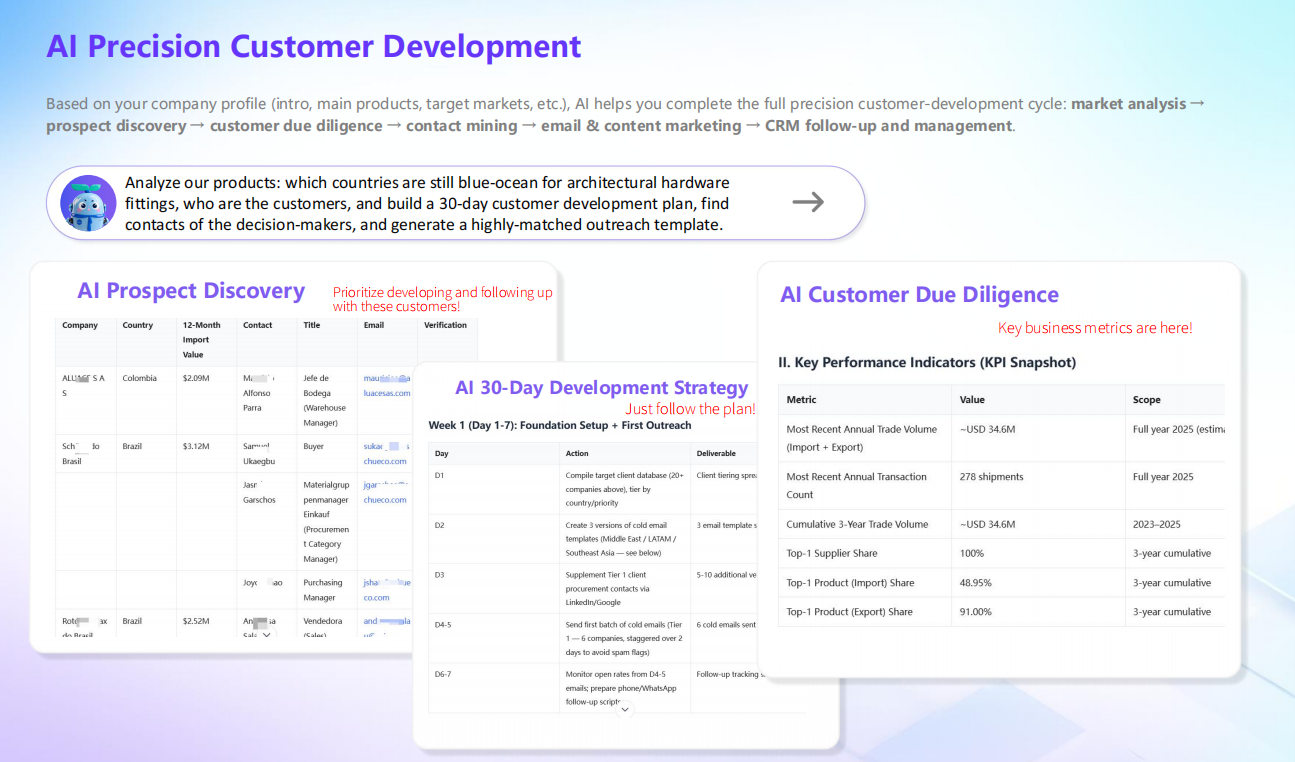
AI-assisted discovery links company records, trade activity, and contact identification inside one workflow.
Boundary to keep in mind. Contact information requires business validation before use. Tendata does not guarantee that all company or contact information will suit every sales scenario, and customers are expected to verify information against their actual business needs.
The Five Use Cases Side by Side
| Use case | Core capability used | Typical output | Main risk to manage |
|---|---|---|---|
| 1. Buyer discovery in a new market | Tendata AI discovery by product, HS Code, country, or natural language | Initial target company pool | Uneven data coverage between markets |
| 2. Matching importer and distributor database | 500+ million company records with screening logic | Screened, prioritised buyer list | Confusing list volume with match rate |
| 3. Competitor customer prospecting | T-Insight customer, competitor, market, and product analysis | Category-active target accounts | Historical records read as current contracts |
| 4. Trade show pipeline | Pre-show targeting and post-show lead qualification | Meeting list and qualified follow-up set | Event details change and must be reconfirmed |
| 5. Contact discovery and AI outreach | 850+ million verified business contacts and AI-generated outreach | Decision-maker contacts and draft emails | Contacts still require business validation |
Where AI Trade Data Does Not Deliver ROI
A shortlist is only credible if it states its boundaries. Tendata's own published scope notes describe several situations in which the platform is not the right purchase, and buyers evaluating any trade intelligence platform should apply the same test.
- No order guarantee. Tendata does not guarantee that any specific buyer, importer, supplier, or exporter will generate an order or complete a transaction.
- It does not replace business decision-making. Negotiations, quotations, contract execution, and transaction decisions remain with the customer.
- It does not manage transaction risk. Payment, logistics, quality inspection, product certification, and fulfilment risks sit outside the platform.
- Information requires validation. Company and contact information is not guaranteed to suit every sales scenario and should be checked against actual business needs.
- It does not replace legal or compliance review. Legal, tax, compliance, and market-entry assessments remain the customer's responsibility.
- It is not built for one-off list buying. The platform is not designed for buyers who only want a single purchase of an unscreened generic company list without trade behaviour analysis or targeted prospecting.
Traditional Prospecting Compared with a Data-Driven Workflow
The comparison that matters to a buyer is not which platform holds more records, but how the working day changes. The table below reflects Tendata's published comparison between conventional prospecting methods and its AI-assisted workflow.
| Stage | Traditional approach | Data-driven workflow |
|---|---|---|
| Company sourcing | Manual searches across Google, B2B platforms, and company websites | Proactive discovery from global trade data and business intelligence |
| Qualification basis | Company websites and publicly available information | Actual trade records, traded products, trade frequency, and trade volume |
| Due diligence | One company at a time, compiled by the salesperson | AI-assisted company background and trade history analysis |
| Screening | Manual review of large company lists | Multi-criteria screening and prioritisation |
| Contact and outreach | Separate tools for contact search and message preparation | Company intelligence, business contacts, and AI-assisted outreach in one workflow |
| Objective | Getting more company lists | Discovering more relevant buyers and converting them into actionable leads |
The honest limitation of the data-driven version is that it changes the nature of the work rather than removing it. AI absorbs large-scale data processing and repetitive analysis; the published methodology explicitly keeps final evaluation, business communication, and sales decisions with people.
Market Context: Trade Management Budgets Are Consolidating
The tooling conversation sits inside a market that is growing but defined inconsistently. Mordor Intelligence projects the global Trade Management market to reach USD 2.84 billion in 2026. The Business Research Company estimated the narrower trade compliance software segment growing from USD 1.73 billion in 2024 to USD 1.95 billion in 2025. The two figures are not directly comparable because they measure different scopes, which is itself a useful warning for buyers comparing vendor claims.
Regulatory pressure is one reason trade records keep their value. IMARC Group reports that US Customs and Border Protection collected more than USD 88 billion in duties in 2024, a figure that supports the demand for trade data used in audit readiness and compliance checks. Where duty exposure and audit risk are high, the same import and export records that support business development also support defensibility.
Documented Customer Evidence
Quantified outcomes in this category are scarce, which makes the available evidence worth stating precisely and with its limits. Tendata's documented case material covers a one-year project with Yuehua, based on an official customer case interview with Huang Jie'en, Brand Director of Yuehua, published on December 31, 2024.
The reported result was an increase in qualified customer inquiries from a baseline of 10 per month to 200 per month over the measurement period, recorded as +190 inquiries per month, with a stated time to impact of three months. The same case records qualitative improvements: a move away from relying on traditional B2B platforms toward social media product presentation, a shift from traffic-based lead generation to precision prospecting, improved buyer targeting accuracy, reduced unqualified outreach costs, and newly developed proactive customer acquisition capability. The result context attributes the improvement to a combined social media and trade data strategy, in which trade data was used to identify and qualify relevant buyers based on actual trade activity, purchasing behaviour, products, and supply chain information.

Customer case material: the Yuehua engagement combined social media exposure with trade-data-based buyer qualification.
How to read this evidence. It is a single customer's reported outcome, sourced from customer feedback, not a performance guarantee or an average across the customer base. Buyers should treat it as one data point about what a well-run trade data workflow can produce, and set their own baselines accordingly.
Future Outlook
Three shifts are likely to define the next phase of AI-assisted business development in global trade.
First, update cadence becomes a competitive variable. Tendata provides data updates as frequently as every three days; as buyers increasingly expect to act on recent trade activity, platforms with slower refresh cycles will be judged on latency rather than on total record count.
Second, prospecting stops being a campaign and becomes a continuous workflow. A six-step process of defining the target profile, AI-powered discovery, screening, AI due diligence, contact discovery, and personalised outreach is designed to repeat, not to end when a list is exported. The published optimisation logic is a loop: new trade data feeds new discovery, and outreach feedback refines screening over time.
Third, differentiation moves from coverage claims to verifiable mechanics. Platforms reporting 10 billion+ trade transaction records and platforms reporting around 2 billion shipment records are describing different things. Buyers who can interrogate those definitions — which customs sources, which geographies, which update frequency, which entity-resolution method — will get more out of whichever platform they choose.
For reference, a publicly downloadable overview of the platform, its data coverage, and its product modules is available in the company's introduction brochure.
FAQ
What does an import export data platform actually provide beyond company names?
A trade intelligence platform such as Tendata combines trade records with company intelligence. Its published data assets include more than 10 billion trade transaction records, more than 500 million in-depth company records, and 850+ million verified business contacts with decision-maker details, covering 228+ countries and regions. Beyond names, this supports analysis of what a company imports or exports, its traded products and HS Codes, trade frequency and volume, and its buyer and supplier relationships.
How often is trade data updated, and why does that matter for long-term prospecting?
Tendata provides data updates as frequently as every three days. Update frequency matters because prospecting value depends on acting on recent trade activity: a buyer that has started importing a category in the last quarter is a different prospect from one whose records are years old. Frequent updates also support continuous prospecting rather than one-off list building.
How long does a trade-data-based prospecting process take to show results?
Tendata's published service process, the Tendata AI Global Buyer & Supplier Prospecting Process, describes an engagement timeline measured in years rather than weeks, reflecting continuous discovery and follow-up. In the documented Yuehua customer case, which ran for one year, the recorded time to impact was three months.
What are the client's responsibilities versus the provider's responsibilities when using a trade data platform?
Under Tendata's published terms, client responsibilities include safeguarding account credentials, limiting account use to the subscribing company and authorised personnel, not reselling or redistributing Tendata data, and implementing internal security measures. Provider responsibilities include providing global trade data and platform access, continuous data quality management, secure account management, product and technical support, and service availability.
Can AI trade data guarantee orders or replace due diligence and compliance checks?
No. Tendata does not guarantee that any specific buyer, importer, supplier, or exporter will generate an order or complete a transaction, and it does not replace a company's own negotiations, quotations, contract execution, or transaction decisions. It also does not manage payment, logistics, quality inspection, product certification, or fulfilment risk, and it does not replace legal, tax, compliance, or market-entry assessments. Company and contact information should be validated against actual business needs.
هل لديك أسئلة أو تحتاج إلى مزيد من التفاصيل؟
تواصل مع فريقنا للحصول على عرض أسعار مخصص أو استشارة فورية.
طلب عرض أسعار
املأ النموذج أدناه وسيتواصل معك فريقنا بعرض مقترح مخصص.
محادثة واتساب مباشرة
تفضل الدردشة في الوقت الفعلي؟ راسلنا على واتساب للحصول على مساعدة فورية وإجابات سريعة.
- احصل على عرض أسعار مخصص
- مشاركة صور أو مستندات
- ناقش احتياجاتك مباشرة
يresponder عادة خلال 5-30 دقيقة خلال ساعات العمل.