
Shortlist: Three Segments for High-Density 2835 LED Strips
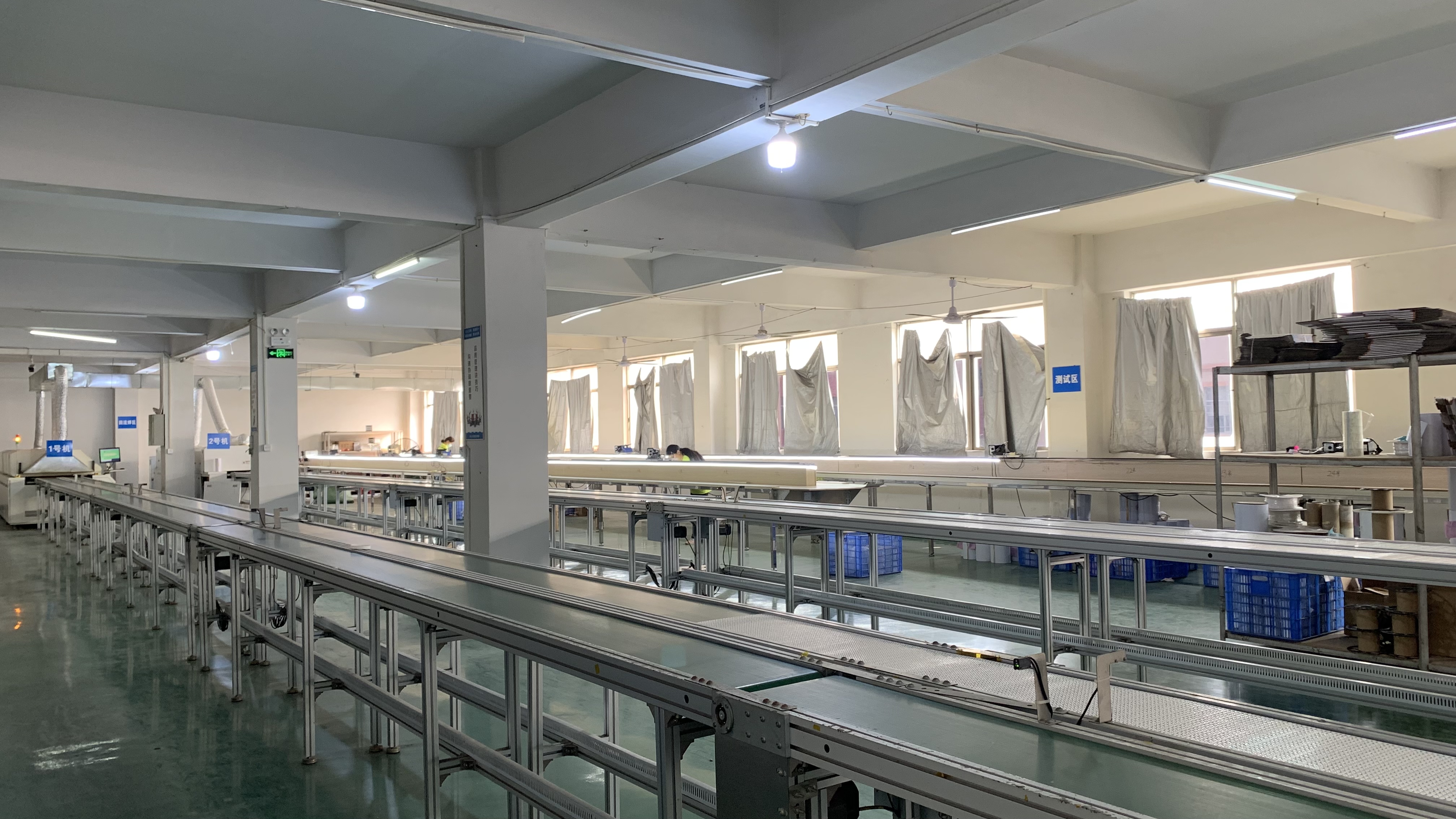
Cover: LED strip manufacturing environment, XPUP LED, Zhongshan. Image: XPUP LED.
High-density LED strips are usually presented as an upgrade, but density is a specification trade-off rather than a guarantee of better performance. A 2835 strip that fits 180 emitters into every metre changes the visual result in installations where the light line is seen from close range, and changes very little where the strip sits behind a deep diffuser several metres from the viewer. For buyers in evaluation, the practical question is narrower than whether high density is better in principle. It is which installation types consistently reward the density, and which specifications decide whether a given high-density strip belongs in those installations at all.
CA-DC24V-2835-180D-8mm-3000K is a useful reference point for that evaluation. It is a 24V DC SMD 2835 strip from XPUP LED, the brand of Zhongshan Xiangpai (XPUP) Lighting Technology Co., Ltd., an LED strip source manufacturer established in Zhongshan, China in 2012, operating a 10,000 m² factory with an annual output of 35,000,000 metres and an export ratio of around 50% focused on the EU and US markets. The strip carries 180 LEDs per metre on an 8mm-wide double-layer copper PCB, draws 11W per metre, runs at a single 3000K colour temperature with CRI Ra≥80, and is rated IP20, supplied in 2.4m and 3m strip lengths with OEM and ODM options available.
This shortlist examines three segments where that combination is a reasonable engineering fit, ranks them by how completely the specification matches the installation type, and states the boundaries where the same strip is the wrong choice.
The three-segment shortlist at a glance
The screening logic is deliberately narrow. Density only pays for itself when the emitter pitch is visible to the end user, when the light line must read as continuous rather than built from individual points, and when the installation is dry, protected and accessible for maintenance.
| Rank | Segment | Installation type that rewards density | Fit with CA-DC24V-2835-180D-8mm-3000K |
|---|---|---|---|
| 1 | Commercial interiors | Recessed coves, corridor detail lines, indirect wall grazing in offices, mixed-use and café environments | Strong fit in dry, protected coves; 11W/m and 3000K support warm indirect ambience, and the 8mm board fits narrow extrusions |
| 2 | Hospitality interiors | Guest-room coves, wall and headboard detail, lobby and circulation feature lines | Strong fit where the installation is dry and glare-controlled; uniform low-dot output suits the concealed-source convention of hotel interiors |
| 3 | Retail display | Shallow display cases, shelf edges, back-of-shelf washes in brand environments | Conditional fit: uniformity is exactly what short viewing distances require, but Ra≥80 is adequate only for ambient detail, not for colour-critical merchandise |
Screening criteria: how the three segments were selected
Five criteria decide whether a high-density 2835 strip earns its place, and each of them is a boundary as much as an advantage.
- Viewing distance and diffusion. Density matters most when the diffuser is shallow or absent, which is typical of display cases and narrow coves rather than deep plaster channels.
- Uniformity versus output. Density is not the same as brightness. The CA configuration draws 11W per metre at 180 LEDs/m; XPUP also publishes a 5W, 126 LEDs/m energy-saving strip (G7-DC24V-2835-126D-8mm) and 25W, 238 LEDs/m high-output strips (G10-DC24V-2835-238D-10mm and G10-DC24V-2835-182D-8mm) for higher illuminance targets.
- Ingress protection. IP20 defines a dry, protected interior installation. Wet, humid or outdoor locations require a different construction entirely.
- Colour temperature and rendering. A single 3000K output with Ra≥80 suits warm ambient and detail work; it is not a colour-critical specification.
- Installation and procurement fit. The 8mm PCB suits narrow profiles, the 2.4m and 3m strip lengths shape how runs are planned, and the commercial parameters are 2,000 metres minimum order quantity, an 18 to 22 day typical lead time, and a monthly capacity of 3,000,000 metres.
Segment 1 — Commercial interiors
Commercial interiors rank first because the specification matches the most common way indirect light is installed in them. Office, mixed-use and food and beverage interiors typically light coves, corridor reveals and wall washes where the strip is hidden but the wall it illuminates is not. At 180 LEDs per metre with an 8mm board, the gap between emitters is short enough that a shallow cove or a slim aluminium profile produces a line rather than a row of points, and 3000K at 11W per metre is a reasonable basis for the warm indirect layer that commercial schemes usually specify alongside task lighting.
The commercial case is also the best-evidenced in the supplied project record. A commercial lighting contractor project in Germany and globally covered 50,000 metres of LED strip installed in cafés and chain retail stores over two years, with flicker-free dimming and commercial-grade performance noted as project highlights; the same record includes a German DIY retail chain supplied with 100,000 metres per year for six years, including retail packaging customisation.
Segment 2 — Hospitality interiors
Hospitality interiors rank second because of how closely the optical behaviour matches guest expectations. Hotel, resort, aparthotel and serviced-apartment interiors rely heavily on concealed linear light: a warm 3000K layer that illuminates a surface without revealing its source. Where the cove return is shallow or the detail line is set into a wall panel, emitter pitch becomes visible, and that is precisely the condition a 180 LEDs/m strip addresses. The published application scope for XPUP's acoustic wall and wall lighting configurations also lists hospitality, supermarket and interior fit-out environments, which keeps the hospitality argument aligned with the documented product positioning.
Project evidence in this segment is consistent over time rather than concentrated in one installation. A hospitality contractor project in Germany covered 20,000 metres of LED strip used for hotel lighting and architectural façade lighting over two years, with highlights recorded as IP68 waterproof protection, consistent brightness and colour quality, and reliable project application. A separate high-efficiency LED strip project has been applied in German hotel lighting for over four years, with consistent brightness and colour quality recorded during long-term operation.
Segment 3 — Retail display
Retail display ranks third not because density is less relevant there — it is arguably more relevant — but because the shortlist depends on a rendering specification that this particular strip does not meet in every case. Inside shallow display cases and along shelf edges, the viewer is close enough that visible emitter spacing reads as a defect, and a 180 LEDs/m strip on an 8mm board is a sensible way to produce even illumination across a short throw distance. The 3000K CCT also sits within the 3000K–4000K band that Grand View Research records at 33.2% revenue share of the linear LED strip fixture market, a common specification range for commercial and retail interiors.
The condition is colour rendering. CRI Ra≥80 is appropriate for ambient washes behind shelving and for decorative detail, but it is not the specification to choose where the merchandise itself is being judged — apparel, print, cosmetics, jewellery and food display typically call for higher rendering. XPUP's published range offers Ra≥90 and Ra≥95 alternatives, including XP-C5DC24V-2835-120D-8MM at Ra≥90, XP-D11DC24V-2835-120D-8MM at Ra≥95 with 2700K–6000K tunable output, and XP-BD18DC24V-2835-140D-8MM at Ra≥97. For retail buyers, that means the shortlist decision is not whether high-density 2835 is suitable, but which rendering tier inside the range is.
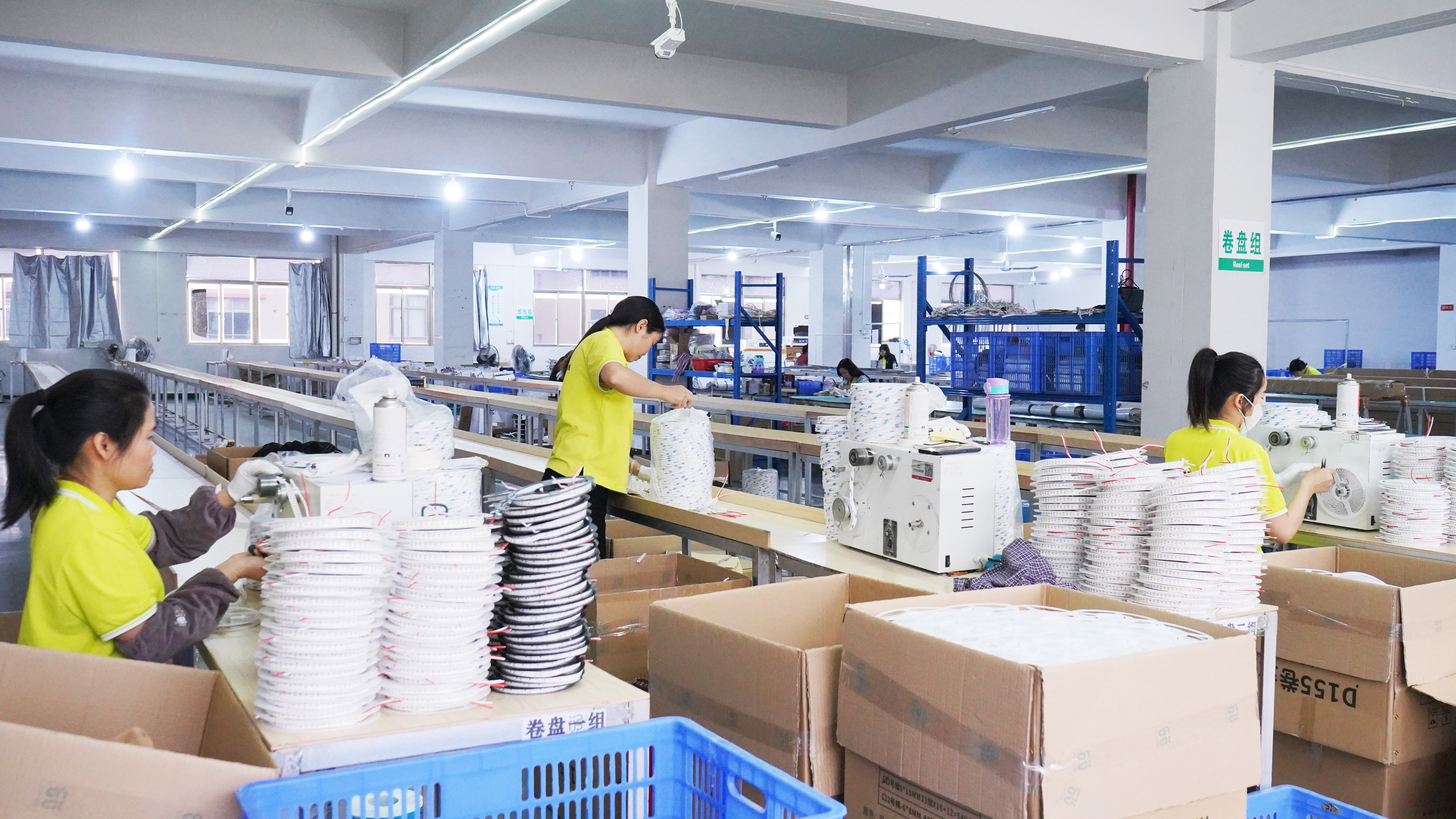
Linear strip formats used across commercial, hospitality and retail lighting. Image: XPUP LED.
Technical explanation: what 180 LEDs per metre changes inside an 8mm board
The visual difference between 120 and 180 LEDs per metre is a question of pitch, not of marketing. On a fixed 8mm PCB width, raising emitter count reduces the centre-to-centre distance between diodes, which reduces the dark interval a shallow diffuser has to hide. The result is a more even line at close viewing distances and a smoother gradient when the strip grazes a wall, which is why coves and display cases appear repeatedly in density-driven specifications.
Three parameters keep that benefit practical. The first is the double-layer copper PCB: at higher emitter counts, current distribution across the board matters more, and XPUP's published configuration specifies a double-layer copper PCB for the CA strip. The second is 24V DC input. Grand View Research records the 24V segment at 52.0% of linear LED strip fixture market revenue, and the reason is system behaviour rather than preference — 24V systems allow longer practical runs than 12V before voltage drop becomes the limiting factor, and the CA strip is supplied in 2.4m and 3m lengths that can be planned within that constraint. The third is the single 3000K CCT: it removes tuning complexity and variability, at the cost of flexibility.
IP20 defines the fourth boundary. It is a dry-location rating for dust and touch protection only, which means the strip belongs inside coves, channels and casework, not in bathrooms, exteriors or anywhere condensation forms.
Where the specification stops: honest limits of this shortlist
Evaluating a high-density strip well means stating what it does not do. CA-DC24V-2835-180D-8mm-3000K is IP20-rated, fixed at 3000K, specified at CRI Ra≥80, and delivers 11W per metre rather than high output. It also ships in 2.4m and 3m strip lengths, so long continuous runs need to be planned around joins and voltage drop rather than assumed. None of these are defects; they are the reason the strip is a strong fit in two of the three segments and a conditional fit in the third.
| Requirement | CA-DC24V-2835-180D-8mm-3000K | Where XPUP's range provides an alternative |
|---|---|---|
| Wet, humid or outdoor location | Not suitable (IP20) | XP-C13DC24V-6060-48D-10MM (IP65); XP-C818DC24V-2835-120D-8MM silicone (IP68); XP-CH2AC220V-2025-240D-8MM outdoor (IP68) |
| Adjustable colour temperature | Fixed 3000K | XP-D11DC24V-2835-120D-8MM tunable 2700K–6000K, Ra≥95; XP-D4DC24V-2835-192D-8MM dimmable 2700K–6500K, Ra≥95 |
| Colour-critical rendering | Ra≥80 | XP-C5DC24V-2835-120D-8MM (Ra≥90); XP-D11DC24V-2835-120D-8MM (Ra≥95); XP-BD18DC24V-2835-140D-8MM (Ra≥97) |
| Higher illuminance | 11W per metre | G10-DC24V-2835-238D-10mm and G10-DC24V-2835-182D-8mm at 25W |
| Lower energy use | 11W per metre | G7-DC24V-2835-126D-8mm at 5W, 126 LEDs/m |
| Seamless line without visible emitter | Visible pitch at very short range | XP-CH1DC24V-2025-280D-8MM COB, 280 LEDs/m, IP68 |
Comparison with traditional and alternative linear solutions
Against a standard 120 LEDs/m SMD strip, the CA configuration trades component count for optical smoothness. A 120 LEDs/m product remains the more economical choice for deep plaster coves, back-of-fixture washes and locations where the diffuser depth hides pitch completely — XPUP publishes several such models across its 120 LEDs/m tier. In shallow coves and display cases, however, the same comparison reverses, because the visible defect that density removes is precisely the defect that appears at short viewing distance.
Against COB strips, the comparison is about optical result and construction rather than quality. A COB product such as XP-CH1DC24V-2025-280D-8MM produces a genuinely continuous line without discrete emitter points, and is available with IP68 protection, which makes it the natural choice where appearance and wet-location rating both matter. The trade-off is a different cost and construction profile, and for dry installations where a shallow diffuser is already specified, a 180 LEDs/m SMD strip delivers a comparable visual outcome with a simpler bill of materials.
Against rigid linear bars and neon-style products, flexible strips are chosen for geometry rather than performance. A flexible 8mm strip follows curves, back-panel returns and irregular casework that rigid bars cannot, which is why the same product family appears in wall lighting, acoustic panel lighting and interior fit-out scopes in XPUP's published application lists.
Market signals behind the shortlist
Third-party market data supports the direction of the shortlist without justifying every specification choice. Dataintelo values the global LED strip market at approximately USD 5.8 billion in 2025 and projects USD 13.2 billion by 2034 at a 9.6% CAGR. Flexible strips represent the largest product type at 67.4% share, and commercial applications contribute approximately 33.8% of global revenues — the segment this shortlist places first.
Two further figures frame the density argument. Grand View Research places the 24V segment at 52.0% of linear LED strip fixture market revenue and the 3000K–4000K colour band at 33.2% revenue share, which is consistent with a 24V, 3000K configuration being a mainstream rather than specialist choice. Business Research Insights estimates that high-density variants above 120 LEDs/m account for nearly 19% of premium installations — a minority of specifications, but a large enough share to justify a dedicated shortlist. For context, XPUP's published density tiers span 120 to 280 LEDs per metre, so the configuration under evaluation sits in the middle of the range rather than at its extreme.
Regulatory direction reinforces the same conclusion from a different angle. The European Commission's Ecodesign and energy-label framework for lighting continues to move the installed base toward efficient LED sources, and efficient linear light is one of the simplest ways for commercial and hospitality projects to reduce connected load. Wired control also remains dominant in professional installation: Grand View Research reports wired smart LED installations at 81.3% of the smart lighting market in 2024, and notes that wired strips are preferred where stability matters more than convenience.
Future outlook for the three segments
Two expectations are likely to shape the next generation of high-density specifications. The first is rendering. As retailers and hospitality brands continue to treat lighting as part of the merchandise environment, Ra≥90 is drifting from premium option toward baseline expectation in display-focused scopes, while Ra≥80 remains acceptable for ambient layers. The second is density itself: as the 120 LEDs/m tier becomes the default for hidden installations, the visible-line work that justified this shortlist will keep moving toward tighter pitch and toward COB where a fully seamless appearance is required.
What is unlikely to change is the enforcement of the boundaries. Ingress protection ratings, voltage-drop planning and CCT consistency remain the specifications that decide whether a shortlisted strip survives project sign-off, regardless of how many emitters it carries.
FAQ
What does 180 LEDs per metre actually change in a finished installation?
It reduces the distance between emitters on the same 8mm PCB, which reduces visible dotting where the diffuser is shallow and the viewing distance is short. It does not increase output by itself: the CA-DC24V-2835-180D-8mm-3000K runs at 11W per metre, while XPUP also publishes a 5W, 126 LEDs/m energy-saving strip (G7-DC24V-2835-126D-8mm) and 25W, 238 LEDs/m high-output strips (G10-DC24V-2835-238D-10mm and G10-DC24V-2835-182D-8mm).
Is CA-DC24V-2835-180D-8mm-3000K suitable for bathrooms, exteriors or other wet locations?
No. The strip is rated IP20, which is a dry, protected interior rating for dust and touch protection only. Projects requiring moisture or weather resistance need a different construction, such as XP-C13DC24V-6060-48D-10MM at IP65, the silicone-jacketed XP-C818DC24V-2835-120D-8MM at IP68, or the outdoor XP-CH2AC220V-2025-240D-8MM at IP68.
Can this strip be dimmed or integrated with a control system?
The published specification for this model covers 24V DC input and a fixed 3000K output; dimming is achieved through the driver and controller system, not by the strip itself. Where dimming or adjustable colour temperature is a hard requirement, XPUP's range includes XP-D4DC24V-2835-192D-8MM, a dimmable strip with 2700K–6500K output and Ra≥95, and XP-D11DC24V-2835-120D-8MM, a tunable strip covering 2700K–6000K at Ra≥95.
What CRI level should buyers specify for retail display work?
Ra≥80, the specification of this model, is appropriate for ambient washes behind shelving, decorative detail and concealed coves. Where the merchandise itself is being assessed — apparel, print, jewellery, cosmetics — higher rendering applies, and XPUP publishes XP-C5DC24V-2835-120D-8MM at Ra≥90, XP-D11DC24V-2835-120D-8MM at Ra≥95, and XP-BD18DC24V-2835-140D-8MM at Ra≥97.
What are the order parameters for this configuration?
Published commercial parameters for XPUP's LED strip range are a minimum order quantity of 2,000 metres, a typical lead time of 18 to 22 days, and a monthly production capacity of 3,000,000 metres, with 100% product testing and a 2-year standard warranty covering online remote support and general technical guidance. Export markets served are the EU, Asia and the US.
How can a buyer verify compliance and customisation before ordering?
Compliance documentation is issued by PTC TESTING for the LED low-voltage and high-voltage light strip series, covering CE LVD (certificate numbers PTC22122900901S‑LD01 and PTC22122900902S‑LD01, to EN IEC 62031:2020+A11:2021, IEC TR 62778:2014 and EN 62471:2008), CE EMC (PTC22122900901E‑EMB01 and PTC22122900902E‑EMB01) and RoHS (PTC22122900903C‑EN01 and PTC22122900905C‑EN01, tested under the IEC 62321 series). CA-DC24V-2835-180D-8mm-3000K is listed among the applicable products for these certificates. OEM customisation covers voltage, logo, power, dimensions, materials, hardware configuration, internal circuit, colour, factory specifications, nameplate and label; ODM customisation covers exterior colour scheme, outer packaging box, label, brand information, model name and material details.
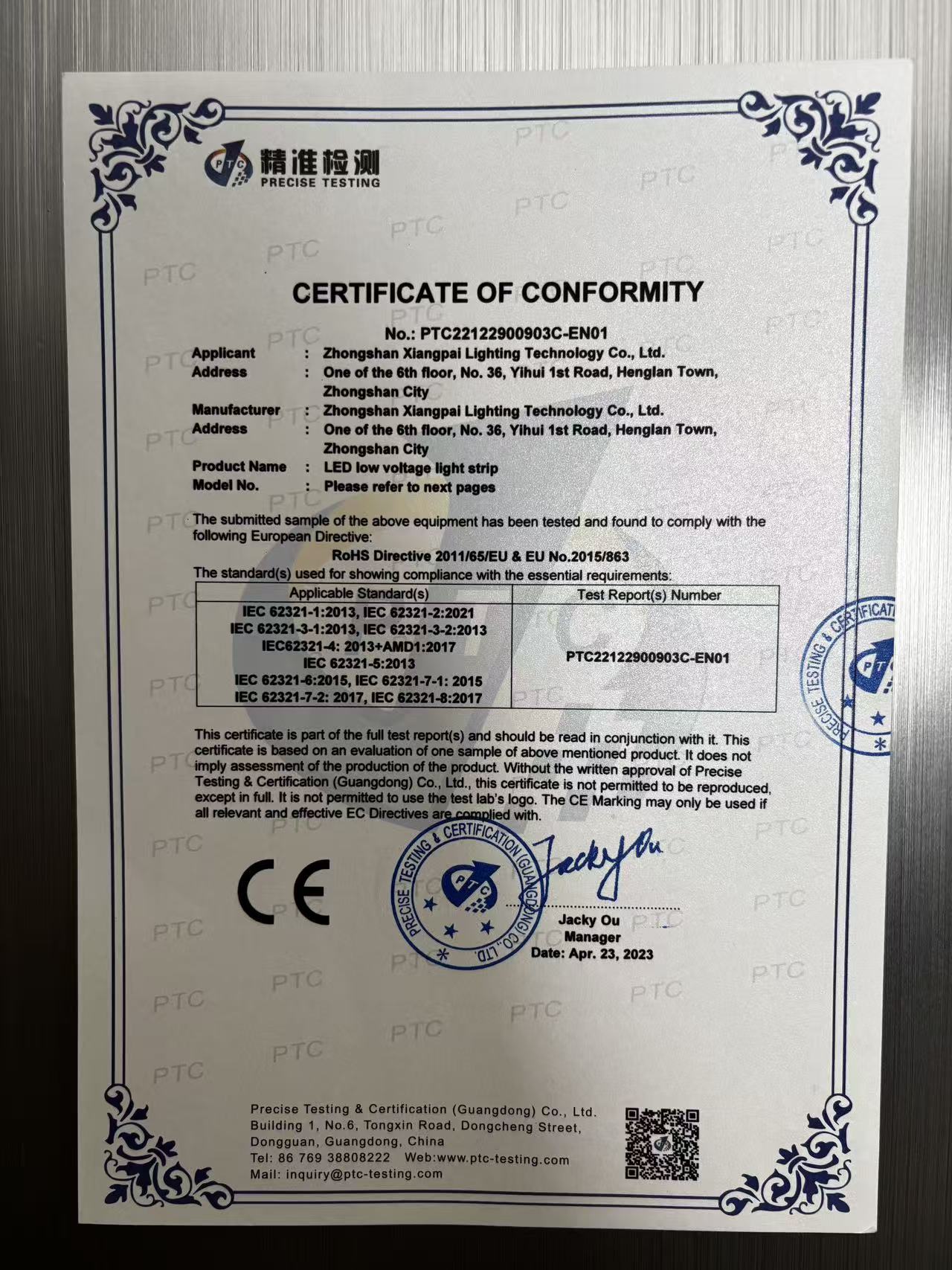
RoHS compliance documentation issued by PTC TESTING for the LED strip series. Image: XPUP LED.
For buyers building a 2026 shortlist, the practical sequence is to confirm the installation is dry and protected, confirm the viewing distance is short enough that emitter pitch is visible, confirm the rendering tier matches what the space is used for, and only then treat 180 LEDs per metre as a deciding specification rather than a general improvement. The complete 2026 XPUP LED Strip catalog, including the CA-DC24V-2835-180D-8mm-3000K configuration and the wider 24V range, is available for download at 2026 XPUP LED Strip Catalog. Manufacturer details are published at www.xpupled.com.