
Shortlisting 3mm, 4mm or 5mm ACP: A Buyer's Field Guide
A 3mm, 4mm or 5mm Aluminum Composite Panel is not a product decision on its own. Panel gauge describes the total thickness of the bonded sandwich; it says nothing about aluminium skin thickness, alloy grade, core type or coating system, and each of those is specified as a separate line. A shortlist that works pairs a gauge with the rest of the specification, rather than choosing the gauge first and fitting everything else around it.
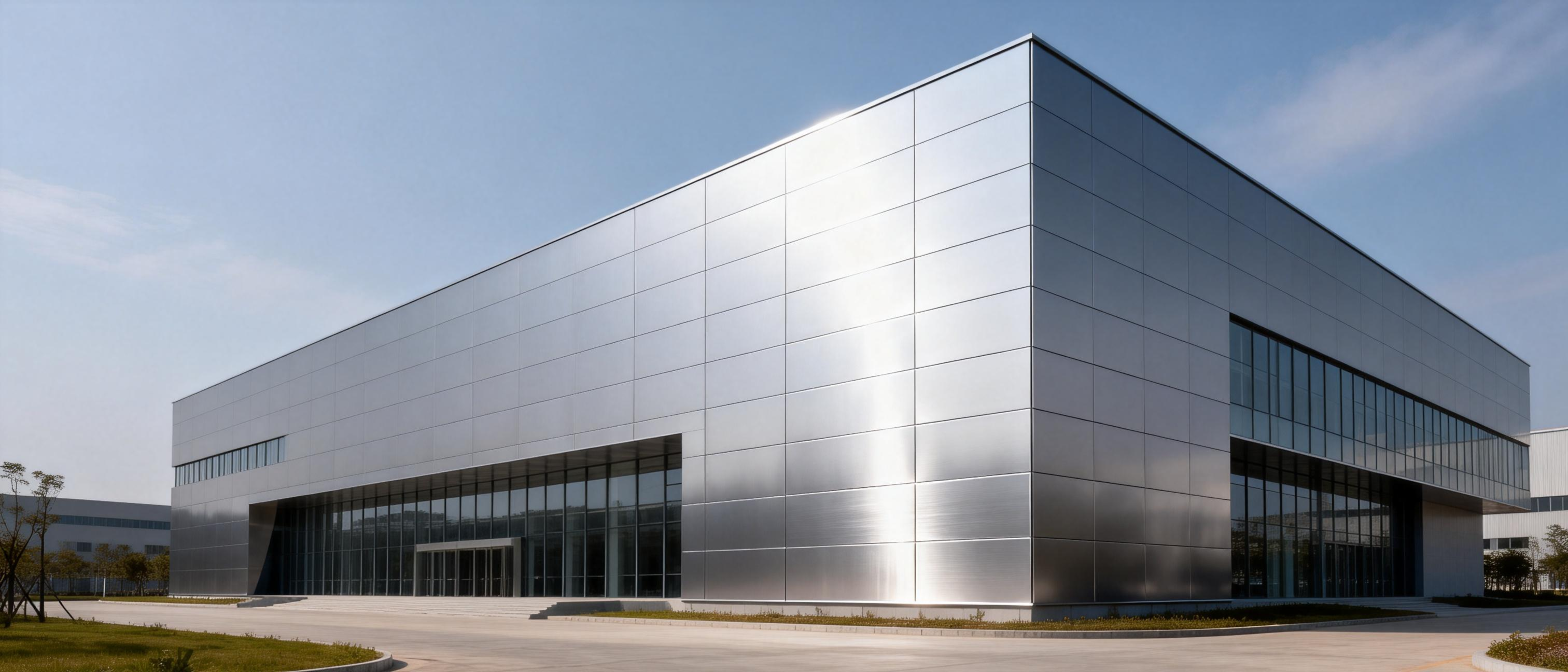
Exterior wall cladding in aluminum composite panel: the visible face is the result of a panel gauge, a skin thickness, a core and a coating chosen together.
Aluminum composite panels are layered panels. High-quality aluminum coils are bonded to a polyethylene (PE) core or a fire-resistant mineral core using high-performance adhesive films, then finished with a PVDF or polyester coating, and a protective film is applied to the surface to prevent scratches during transport and installation. Every gauge decision sits inside that structure, not above it.
Jiersun (Fujian) Decorative Building Materials Co., Ltd. is a Chinese manufacturer of aluminum composite panels, established in 2006 and based in Jinjiang City, Fujian Province, supplying Southeast Asia, Africa and the Middle East. Its published product records are used throughout this guide as a documented example of how the specification lines connect.
The specification line buyers skip: aluminium skin thickness
In the Jiersun product records, panel thickness and aluminium thickness are listed as separate parameters. Panel thickness options are 3mm, 4mm, 5mm, 6mm and 8mm. Aluminium thickness is given as a range from 0.05mm to 0.50mm. Those are two different variables, and only one of them appears in the product name.
The practical consequence is that "4mm ACP" identifies a family, not a product. A 4mm panel specified with one skin thickness and a 4mm panel specified with another are different items for evaluation purposes, even though the label on the quotation is identical. Procurement teams that compare suppliers on gauge alone routinely end up comparing two different products and drawing a conclusion about price that the data does not support.
What a full ACP specification actually contains
Before narrowing to three candidates, it helps to see the full envelope a manufacturer is working within. The table below reproduces the parameters documented in the Jiersun product specification.
| Parameter | Documented options |
|---|---|
| Panel thickness | 3mm, 4mm, 5mm, 6mm, 8mm |
| Normal width | 1220mm, 1250mm, 1500mm |
| Aluminium thickness | 0.05mm to 0.50mm |
| Aluminium alloy | AA1100, AA3003, AA5005 (other grades on demand) |
| Core material | PE core, fireproof core |
| Surface categories | PVDF coated, mirror, wood grain, marble grain, brushed, nano self-cleaning, fireproof |
| Coating chemistry | PVDF or polyester (PE) |
| Colour | Customization accepted |
| Brand / OEM | Custom made |
| Intended industries | Building curtain wall and exterior wall decoration; commercial and retail storefronts; interior decoration; signage and advertising billboards; engineering project decoration; furniture factories |
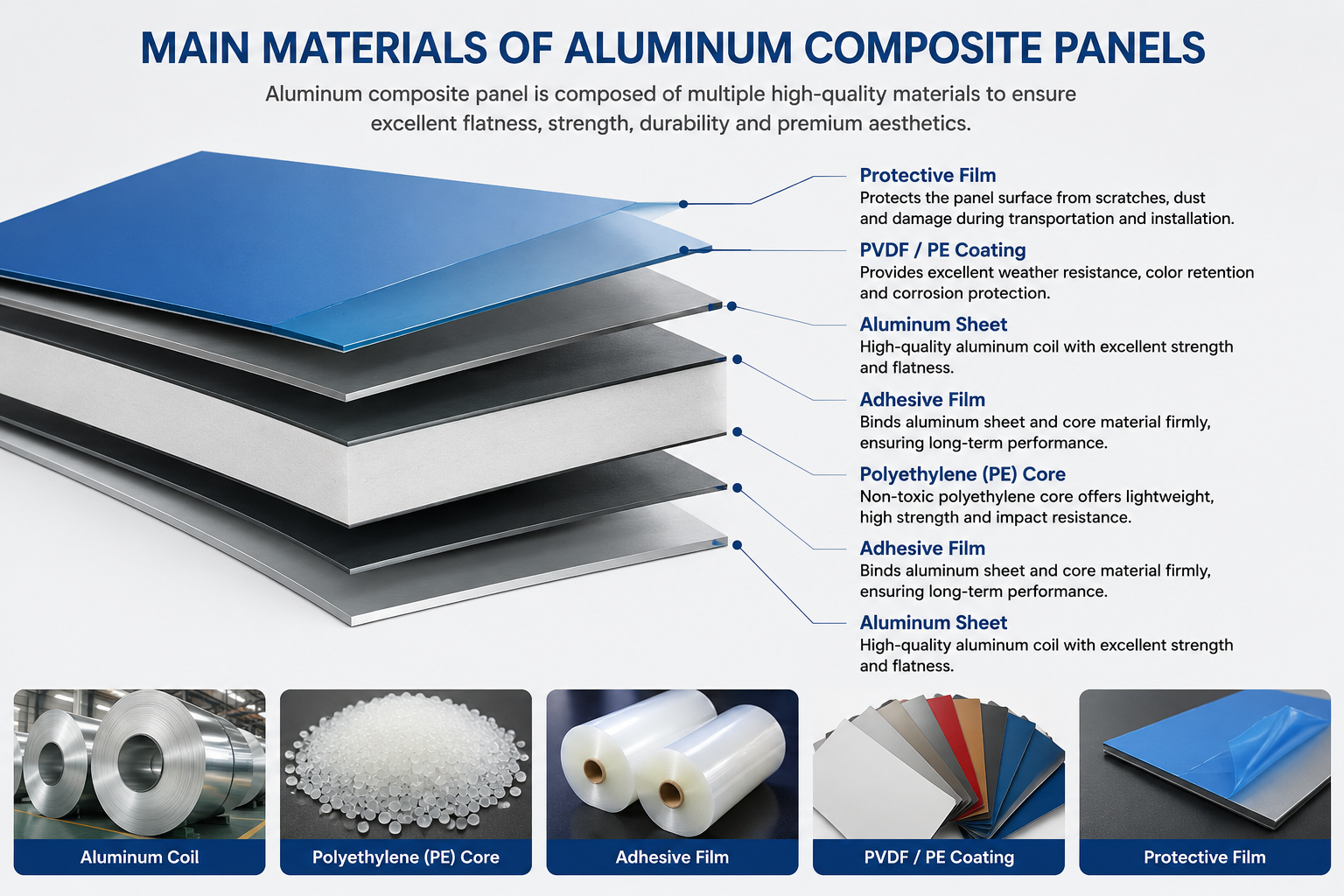
The layered build of an aluminum composite panel. Gauge describes the total, while skin thickness, core and coating are specified independently.
3mm, 4mm and 5mm: what each gauge is referenced against
The three gauges most often named in early project discussions are 3mm, 4mm and 5mm. In the Jiersun records each one carries its own distinct catalogue entry, and the intended use attached to each entry is the fastest way to see where a gauge usually lands before any engineering conversation starts.
| Gauge | Documented reference point | Shortlist implication |
|---|---|---|
| 3mm | Recorded against the building curtain wall and exterior wall decoration industry, in the PVDF coated category, with AA1100, AA3003 and AA5005 alloy options | An exterior-facing entry gauge. Confirm skin thickness and core before treating it as equivalent to another supplier's 3mm quote. |
| 4mm | Recorded against the interior decoration industry, available across the PVDF, mirror, wood grain, marble grain, brushed, nano self-cleaning and fireproof surface categories | Often proposed where the specification starts from the finish rather than the structure. Verify whether the same item is being carried over into an exterior zone. |
| 5mm | Recorded against the furniture factory industry, and separately in an application record covering commercial and retail storefronts, advertising and signage, and external curtain wall systems | Carries more core material per square metre than the thinner gauges, so handling, fixing and joint design enter the shortlist earlier. |
Read the column on the right as a checklist rather than a verdict. The records show where each gauge has been documented; they do not say that a 3mm panel is unsuitable for interiors or that a 5mm panel cannot be used on a furniture component. What they do show is that gauge and intended use are paired in the manufacturer's own documentation, which is exactly the pairing a shortlist should preserve.
Five filters that turn three gauges into a shortlist
Filter 1 — Fix the duty before the number
Start from the industry the panel will serve: curtain wall and exterior wall decoration, commercial and retail storefronts, interior decoration, signage and advertising billboards, engineering project decoration, or furniture manufacturing. Each carries a different exposure profile, and the exposure profile, not the gauge, should drive which candidates survive. A team that begins with "we used 4mm last time" has skipped this filter entirely.
Filter 2 — Lock the skin thickness next to the gauge
Because aluminium thickness runs from 0.05mm to 0.50mm independently of panel thickness, skin gauge is the second half of the specification. Ask each candidate supplier to state it in writing alongside the panel gauge. Two quotations that differ only in cost, with the same panel gauge and no stated skin thickness, are not yet comparable.
Filter 3 — Treat the alloy as a separate line item
AA1100, AA3003 and AA5005 are all listed, with other grades available on demand. Alloy selection is a distinct decision from gauge, and a proposal that names a gauge but not an alloy is incomplete. For buyers, the useful question is not which grade is theoretically superior but why the proposed grade was chosen for this duty, and whether the answer is documented.
Filter 4 — Match the core to the fire requirement
Both PE core and fireproof core are available. Where fire performance is a project requirement, the core choice and its supporting documentation become the gating item, not the panel gauge. Industry technical sources state that fire-resistant aluminum composite panels with mineral cores can achieve Euroclass A2-s1, d0 classification under EN 13501-1. That is a classification achievable by the product category, not a certificate for any individual panel, so the shortlist should require the supplier's own classification or test documentation for the exact product offered.
Filter 5 — Decide the surface system last, then confirm it
Coating is the layer that determines what the building or sign looks like, and it is also the layer most likely to be described loosely in a quotation. The available categories are PVDF coated, mirror, wood grain, marble grain, brushed, nano self-cleaning and fireproof, with PVDF or polyester chemistry underneath. These finishes behave as separate products; a marble grain panel and a brushed panel of the same gauge should not be assumed interchangeable in a comparison sheet.
Matching the shortlist to the intended use
The mapping below keeps the manufacturer's stated industries in the first column and moves the verification burden into the third, which is where a shortlist either becomes usable or stays theoretical.
| Intended use (documented) | Gauges referenced in the records | Verify before shortlisting |
|---|---|---|
| Building curtain wall and exterior wall decoration | 3mm and 5mm entries | Fire classification documentation, coating system, skin thickness, and the fixing or framing system the project will use |
| Commercial and retail storefronts; signage and advertising billboards | 5mm entry; signage industry listed across the product range | Weather and UV resistance requirement stated for the application, plus colour and finish consistency across the visible run |
| Interior decoration | 4mm entry | That the item is genuinely intended for interior use, and that core and coating suit the internal environment |
| Furniture factory | 5mm entry | Colour customization and surface finish availability for the component being produced |
| Engineering project decoration | All gauges | That the technical requirements are written into the contract rather than assumed — the application record states explicitly that technical requirements shall be clearly defined in the contract |

Storefront and signage work: the surface finish and the weather exposure usually decide the shortlist before the gauge does.
Service environment: the climate question behind the gauge
Application records for this product range describe outdoor work as requiring weather and UV resistance, with the Philippines cited as a common example of that scenario in both signage and exterior wall decoration. The same records describe the installation as passive and fixed, serving long-term use without continuous energy consumption, and note that the maintenance cycle depends on the surface coating and the service environment.
That last point matters more than it appears. Two projects in the same country can end up with different shortlists because one facade faces long UV exposure while another sits in a sheltered retail arcade. What the records do not contain is measured durability data by climate. Buyers should therefore treat the climate statement as a specification prompt — ask each candidate supplier how the proposed coating suits the specific exposure — rather than as a performance guarantee.
Market context: demand is growing, but the numbers disagree
Shortlist decisions are not made in a vacuum, and the direction of the category is one input into how much specification effort a project deserves. Commercial research on the aluminum composite panel market reports a global value of USD 9.17 billion in 2025, projected to reach USD 17.39 billion by 2035 at a compound annual growth rate of 6.6%. The same source places Asia-Pacific at 54.8% of 2025 revenue, and puts PVDF coated panels at 36.5% of total revenue share in 2025.
Two other commercial estimates for the same category do not match. One puts the market at USD 7.00 billion in 2025 rising to USD 14.35 billion by 2034 at 8.31% CAGR; another estimates USD 6.46 billion in 2024 rising to USD 9.65 billion by 2030 at 7.0% CAGR. The three sets cannot be merged, because the sources do not publish a shared methodology or product scope.
Where the shortlist method stops
The comparison that matters here is not ACP against another cladding material; it is a structured shortlist against the two shortcuts that most teams actually use.
| Approach | What it captures | Where it fails |
|---|---|---|
| Gauge-only shortcut ("we need 4mm") | Fast alignment on a single number that everyone recognises | Leaves skin thickness, alloy, core and coating undecided, so competing quotations may not describe the same product |
| Copy the last project | Reuses a specification that has already passed internal review | Carries forward an exposure profile, fire requirement and fixing system that may not match the new site |
| Structured shortlist (this guide) | Gauge, skin, alloy, core, coating and documented use, held together per candidate | Takes longer, and still cannot answer price, MOQ or lead-time questions from specification data alone |
There are also real limits to what this reference can settle. It does not contain verified price bands, minimum order quantities or lead times by product type, so cost ranking has been deliberately left out rather than estimated. It does not contain product-level fire test reports, coating durability test results, or independent laboratory validation of the stated composition. And panel gauge by itself does not define fire class, flatness or long-term appearance — those depend on the core, the coating and the fixing system with it.
A shortlist built this way is therefore a decision instrument, not a decision. It tells you which three candidates are worth quoting in full, and which questions to put to each supplier; it does not replace the project-specific documentation that follows.
How Jiersun fits the shortlist frame
For buyers applying the method above, the relevant question about any manufacturer is whether the specification lines exist as documented parameters rather than as verbal assurances. Jiersun (Fujian) Decorative Building Materials Co., Ltd. lists panel thickness, normal width, aluminium thickness, alloy grade, core material, surface category and colour customization as discrete specification fields, which is the minimum needed to build a comparable shortlist entry.
On the supply side, the company operates a 20,000 m² manufacturing facility with an annual production capacity of 4,000,000 m², employing approximately 40 staff, more than 80% of whom have over 10 years of industry experience, supported by an R&D team of 10 engineers. The factory is located 70 km from the port, and export business accounts for 30% of total sales, with major markets in Southeast Asia, Africa and the Middle East. Custom colour and OEM/ODM production are offered, which matters where a shortlist is being built around a specific facade colour or a private-label signage programme.
The manufacturer's own product range spans the gauges discussed here, in the surface categories named above, and further detail is available at www.jiersun.com.
Outlook
Two structural signals are worth carrying into next year's specification templates. The first is regional: with Asia-Pacific holding 54.8% of 2025 revenue in the commercial research cited above, sourcing conversations will keep concentrating on manufacturers in that region, which raises the value of documentation over proximity. The second is product mix: PVDF coated panels at 36.5% of 2025 revenue share suggests that buyers increasingly treat coating chemistry as a specification line rather than a finish preference.
Neither signal changes the underlying discipline. Panel gauge will remain the number that is easiest to say and hardest to defend in isolation, and the projects that age well will be the ones where 3mm, 4mm or 5mm was recorded next to a skin thickness, an alloy, a core and a coating — with the evidence attached.
FAQ
What does a "3mm aluminum composite panel" actually measure?
It measures the total thickness of the bonded panel, not the aluminium. In the Jiersun specification, panel thickness (3mm, 4mm, 5mm, 6mm, 8mm) and aluminium thickness (0.05mm to 0.50mm) are recorded as separate parameters, so two panels both labelled 3mm can carry different aluminium skin gauges and are not automatically equivalent.
Is 4mm always a better choice than 3mm?
No. The documented records attach the 3mm entry to building curtain wall and exterior wall decoration and the 4mm entry to interior decoration, which shows gauge being assigned against intended use rather than against a general rule that thicker is better. A gauge should be selected alongside skin thickness, core type and coating for the specific application.
Which gauge should be shortlisted for signage and storefront work?
The application record for this product range covers commercial and retail storefronts and advertising and signage, and describes outdoor signage as requiring weather and UV resistance, citing the Philippines as a common example of that scenario. In signage, the decisive questions are usually the coating system and the finish consistency across the visible run, with the gauge confirmed afterwards.
Can one gauge serve both interior and exterior zones on the same project?
The records list interior decoration and exterior wall decoration as distinct intended industries with distinct product entries, and they state that outdoor exposure carries weather, UV and fire performance requirements that should be confirmed against product specifications. Interior zones do not carry the same exposure, so the specification should be verified zone by zone rather than assumed to transfer.
Which widths, alloys and cores are available to specify?
Normal widths are 1220mm, 1250mm and 1500mm. Aluminium alloys are AA1100, AA3003 and AA5005, with other grades available on demand. Core options are PE core and fireproof core. Panel thickness options are 3mm, 4mm, 5mm, 6mm and 8mm, aluminium thickness ranges from 0.05mm to 0.50mm, colour is customizable and brand/OEM production is offered as custom made.
How should fire performance be verified during shortlisting?
Industry technical sources state that fire-resistant aluminum composite panels with mineral cores can achieve Euroclass A2-s1, d0 classification under EN 13501-1, and fireproof core is one of the documented core options in this product range. Because that classification describes what the product category can achieve, a shortlist should request the supplier's own classification or test documentation for the exact panel offered, rather than accepting the category-level statement as a product certificate.
The specification details in this guide are drawn from the manufacturer's published product records and application records. Market figures are attributed to the commercial research cited and are presented as directional context. The 2026 Jiersun ACP catalogue is available for download: JIERSUN ACP Catalog (2026).
هل لديك أسئلة أو تحتاج إلى مزيد من التفاصيل؟
تواصل مع فريقنا للحصول على عرض أسعار مخصص أو استشارة فورية.
طلب عرض أسعار
املأ النموذج أدناه وسيتواصل معك فريقنا بعرض مقترح مخصص.
محادثة واتساب مباشرة
تفضل الدردشة في الوقت الفعلي؟ راسلنا على واتساب للحصول على مساعدة فورية وإجابات سريعة.
- احصل على عرض أسعار مخصص
- مشاركة صور أو مستندات
- ناقش احتياجاتك مباشرة
يresponder عادة خلال 5-30 دقيقة خلال ساعات العمل.