
Shortlisting Architectural Stainless Steel: JYF Models by Element
Shortlisting Architectural Stainless Steel: JYF Models by Element
A shortlist for architectural stainless steel decoration is only as useful as the match between a product and the element it will actually cover. The seven models in the JYF Metal range — JYF-01 through JYF-07 — divide into four functional groups: decorative sheet, screen partition, trim, and bespoke fabrication. This review sets out which group fits feature walls, ceilings, partitions, edge details and custom work, and which commercial terms and acceptance checks should be confirmed before an order is released.
The category itself is defined in trade classification terms as ornamental and architectural metal work manufacturing (NAICS 332323), which places decorative stainless steel alongside fabricated architectural metalwork rather than in flat-rolled steel distribution. That distinction matters at evaluation stage. The buyer is not selecting a coil or a stock sheet size; the buyer is selecting a fabrication route that has to arrive on site flat, aligned, colour-matched and correctly edged.
The shortlist at a glance
JYF Metal is a Foshan-based manufacturer and exporter established in 2013, working in 201, 304, 316 and 430 stainless steel as well as copper and aluminium, with roughly 80% of output exported. Its catalogue numbers seven architectural models, and each maps to a distinct interior element.
| Model | Catalogued product | Primary interior element |
|---|---|---|
| JYF-01 | Decorative stainless steel sheet | Flat wall cladding, lift interiors, column faces |
| JYF-02 | Decorative stainless steel sheet | Feature walls, reception backdrops, panelised walls |
| JYF-03 | Decorative stainless steel sheet | Soffits, fascias, low-reflection wall surfaces |
| JYF-04 | Decorative stainless steel sheet (water ripple) | Ceilings and textured feature walls |
| JYF-05 | Stainless steel screen partition | Room dividers, lobby screens, zoning |
| JYF-06 | Stainless steel trims | Edge closure, skirting, material transitions |
| JYF-07 | Custom stainless steel fabrication | Columns, bars, sculptures, curved ceilings, facades |
Model numbers in this range denote catalogued product families. Where a project depends on a specific surface — mirror, brushed, sandblasted or water ripple — the finish is confirmed against the approved specification and a physical sample, not inferred from the model number alone. Water ripple is the finish most explicitly documented in the supplier's project records, and it is attached to JYF-04.
Why element-first matching beats finish-first selection
Finish is usually the first decision an interior team makes and the last one that should be locked. A mirror surface on a ceiling reflects every joint and every unevenness in the substrate; the same mirror surface on a vertical feature wall hides considerably more. A water ripple pattern reads as intended only when pattern direction is set out across the entire plane. A trim detail decides whether a panel edge looks deliberate or raw.
Ceilings make the point quickly. Steel, the material family that includes stainless, held a 52% revenue share of the global metal ceilings market in 2026, according to Grand View Research's metal ceilings analysis. That is a mainstream specification rather than a niche one, and it puts the emphasis on the two things a decorative sheet cannot fix after the fact: flatness and joint alignment.
Demand context is expanding alongside it. Fortune Business Insights values the global stainless steel market at USD 225.13 billion in 2025 and projects USD 353.48 billion by 2034 in its September 2026 forecast. For a project buyer the useful reading is narrower than the headline: as more interior schemes specify metal, the difference between suppliers appears in fabrication discipline rather than in the availability of the material itself.
Feature walls and wall cladding: the JYF-01 to JYF-04 sheet group
The four decorative sheet models — JYF-01, JYF-02, JYF-03 and JYF-04 — are the shortlist entry for wall surfaces: reception backdrops, corridor cladding, lift and elevator panel work, column faces and panelised feature walls. They are one functional group, not four unrelated products.
Across that group the range is supplied in mirror, brushed, sandblasted and water ripple finishes, with PVD colour coating adding tinted metallics such as black titanium, titanium gold, rose gold and sapphire blue. Each finish changes the specification, not only the appearance:
- Mirror gives maximum reflection and visual depth, and shows handling marks, so it needs a defined cleaning and protection regime on site.
- Brushed carries a directional grain. Grain continuity between panels has to be specified and then checked after installation, because a reversal reads as a colour shift.
- Sandblasted produces a low-gloss, low-reflection surface where joint shadowing is less visible than on mirror — useful on large wall planes and under direct lighting.
- Water ripple is a formed wave pattern that catches light and shifts as the viewing angle changes. Its orientation must be set out across the whole plane before production.
JYF-04 is the sheet model with recorded water ripple evidence. A designer client in South Korea used 120 pieces of water ripple stainless steel sheet for combined ceiling and wall decoration, achieving a smooth, reflective wave-patterned surface; the recorded highlights include a durable finish, ease of cleaning and maintenance, and customisable size and pattern.
One boundary belongs in the specification file. A decorative sheet cannot correct an uneven substrate. The acceptance standard for the wall or ceiling build-up behind the cladding should be agreed before panels are produced, because that substrate tolerance — not the sheet — determines whether the joints read cleanly under raking light.
Ceilings: JYF-04 water ripple and shaped panel work
For ceiling applications the clearest JYF evidence sits with JYF-04 water ripple sheet, supported by two recorded projects and supplemented by shaped and curved ceiling work handled through JYF-07.
In France, a designer client used 80 pieces of water ripple stainless steel sheet for ceiling decoration. The PVD coating provided wear-resistant and fade-proof colour, and the recorded highlights include exceptional flatness for seamless joint installation. The project achieved a seamless jointed, scratch-free surface, and the client's feedback confirms the product delivered the results the installation required.
On a ceiling, light rakes across the plane at a shallow angle, so flatness and joint width are read directly as shadow lines. That is why the flatness property in the French record carries more weight overhead than the same sheet would carry on a vertical wall, and why the Korean record's use of the same material across ceiling and wall is a useful reference point for schemes that want one texture to run continuously between planes.
The wider ceiling system also lists stainless steel honeycomb panels, double-curved ceilings, and perforated and shaped ceiling panels. Where a project requires declared fire performance for a ceiling build-up, the test report for that specific panel construction should be requested and reviewed against the project's fire strategy; a material description is not a substitute for a certified assembly.
Partitions and screens: JYF-05
JYF-05 is the stainless steel screen partition, and it is the shortlist entry where the element is a divider rather than a surface. In Canada, a contractor client used three units of stainless steel room dividers to divide open areas and define functional zones without blocking layout flow. The modular design achieved seamless panel joints and perfect pattern alignment, and the recorded highlights include PVD coating for fade-proof metallic finishes and advanced full-welding for flawless joints. The solution provided privacy while maintaining natural light and air circulation, and the record notes a glue-free mechanical fixing method plus a stainless steel frame specified for stability against warping.
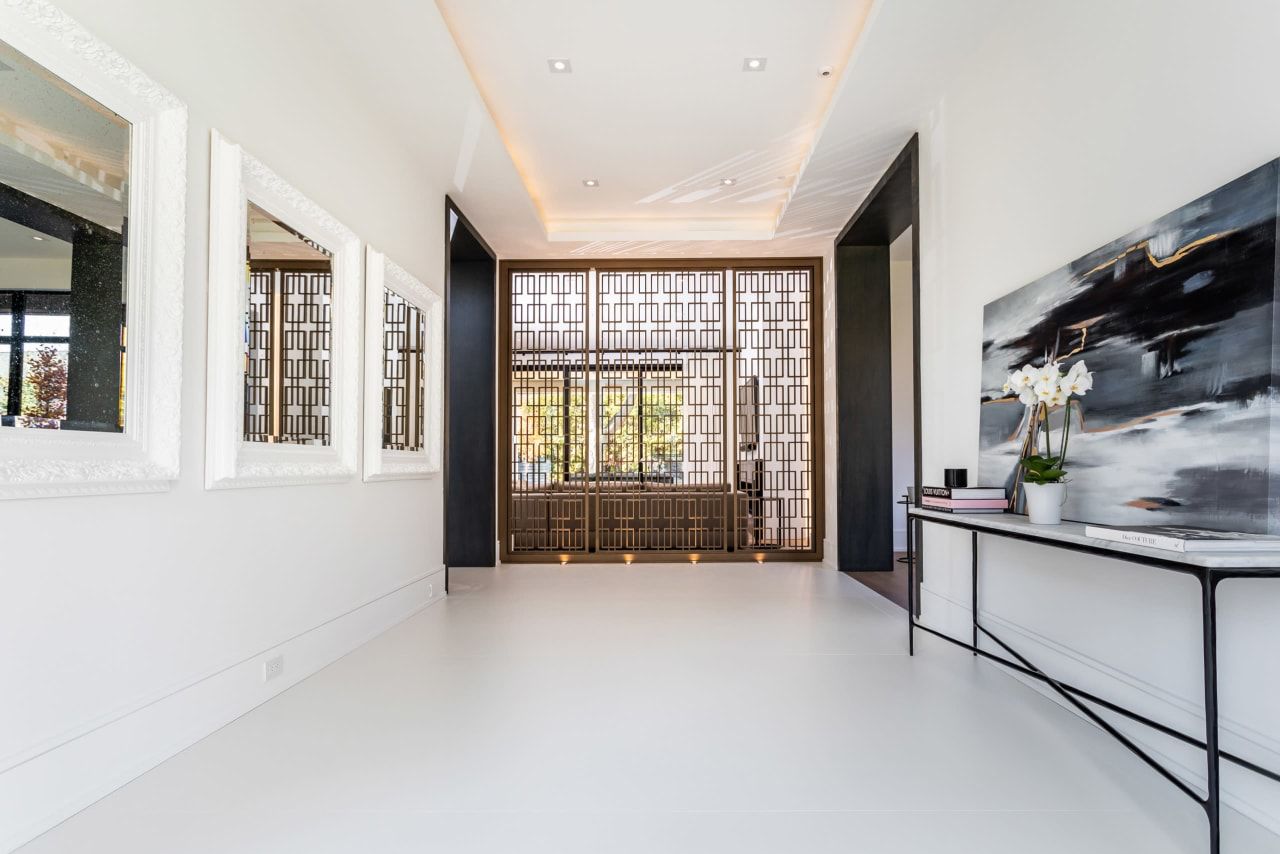
Recorded screen partition installation: modular panel joints and full-welded frame detailing.
Two boundaries should be resolved at evaluation stage. The first is the fixing method: a mechanical, adhesive-free installation changes both the substrate requirement and the site sequence, so the fixing detail has to be coordinated with the wall or floor build-up early rather than at installation. The second is performance scope: a decorative screen is not a fire compartment. Where the fire strategy requires resistance to fire or smoke spread, that requirement must be satisfied by the specified assembly and its supporting test evidence, not by the decorative product description.
The same product family is the relevant shortlist entry wherever an interior needs a divider that defines a zone without closing it off — subject to the fixing and fire review above, and subject to confirming that the chosen finish sits within the range quoted for the project.
Trim, skirting and edge closure: JYF-06
JYF-06 covers stainless steel trims: the profiles that close a panel edge, transition between metal and plaster, tile or stone, form skirting, and finish a floor junction. The supplier's floor system lists metal floor trims and stainless steel skirting alongside other customised floor details, and the certified scope wording covers metal decorative mouldings.
Trims are an evaluation item rather than an accessory because they carry the visible termination of every panel. A flat wall with a raw or misaligned edge reads as unfinished no matter how good the surface is, and a trim that arrives after the panels are fixed forces either a delay or a compromise detail.
Two commercial terms interact here, and they are the practical reason to treat trims as part of the main order rather than a follow-up purchase. Trims are quoted at a minimum of 500 pieces per type with a 15–20 day lead time, while decorative sheets run at 15 sheets per type with a 7–10 day lead time. If the trim package is released only after the sheet order is confirmed, the trim becomes the critical path despite being the smallest-value item in the package. Releasing both against a single approved drawing set removes that sequencing risk.
Profiles are produced to custom size, so the controlling document is the profile drawing — including the return depth and the joint it has to close — rather than a catalogue reference.
Bespoke fabrication: JYF-07
JYF-07 is the custom fabrication route and the entry for stainless steel columns and column cladding, bar counters, sculptures, door frames, curved and hyperbolic ceiling or wall forms, and facade elements where the geometry does not come from a standard panel.
The capability behind it is concrete: a 3,000 m² factory in Foshan with 150 staff and a 15-engineer R&D team, fitted with Trumpf laser cutting equipment, high-precision CNC bending machines, seamless precision welding equipment and a PVD vacuum plating line. The company states that this equipment set is used for complex customised structures including curved surfaces, hyperbolic shapes and non-standard products. Its turnkey workflow runs from design planning and drawing development through prototype production, mass manufacturing, quality control and delivery.
The commercial terms are the most accessible in the range and the slowest: a minimum of one piece with a 25–30 day lead time. The boundary that matters is that the quoted period is production time. It begins after drawings and finish samples are approved, which makes drawing approval the stage of the programme the buyer controls most directly, and the stage worth staffing properly on a bespoke package.
Comparing the four routes on delivery terms
| Group | Minimum order | Quoted lead time | Serves |
|---|---|---|---|
| JYF-01 to JYF-04 | 15 sheets per type | 7–10 days | Walls, ceilings, lift interiors |
| JYF-05 | 3 m² | 20 days | Dividers, screens, zoning |
| JYF-06 | 500 pcs per type | 15–20 days | Edges, skirting, transitions |
| JYF-07 | 1 pc | 25–30 days | Columns, bars, sculptures, curved forms |
Read together, the terms describe a trade-off rather than a price ladder. The sheet group carries the shortest quoted lead time and is ordered by sheet count. The trim group is ordered by piece count and takes roughly twice as long. Custom fabrication accepts a single piece but needs the longest window. A project that uses all four should therefore be sequenced backwards from the custom and trim items, not forwards from the sheets.
Purchasing terms to confirm before the order
Several terms are settled at purchase order stage and are difficult or expensive to correct afterwards:
- Drawing and sample approval. A physical finish sample reviewed under the project's lighting, approved in writing, and referenced on the order.
- Grade and thickness per element, stated on the drawing rather than assumed from a model number.
- Protective film. Custom protective film is offered and should be specified to suit the handling and installation sequence, including when it will be removed.
- Inspection scope. A 100% pre-shipment test and third-party inspection are both stated options; the scope should be agreed before production rather than after.
- Lead time start point. Quoted periods are production periods and should be tied to drawing approval in the contract.
- After-sales support. Online installation guidance, sample provision and replacement parts are listed support items.
For budgeting, a 2025 US-market benchmark put stainless steel wall panel installation at USD 15–35 per square foot. That figure describes installation, not the panel, and it varies with substrate, height and access; it is useful for sizing the labour line, not for comparing suppliers on price.
The quality system is verifiable in writing. JYF Metal holds an ISO 9001 certificate, number 120526Q00119R000, issued by Guangdong Jingwel International Certification Ltd. against GB/T 19001-2016/ISO 9001:2015, valid from 15 May 2026 to 14 May 2029. The certified scope is the R&D and production of stainless steel coloured boards, metal decorative mouldings and metal decorative articles. A buyer should confirm that the exact product being ordered falls inside that scope wording, and that the certificate remains current at the date of the order.
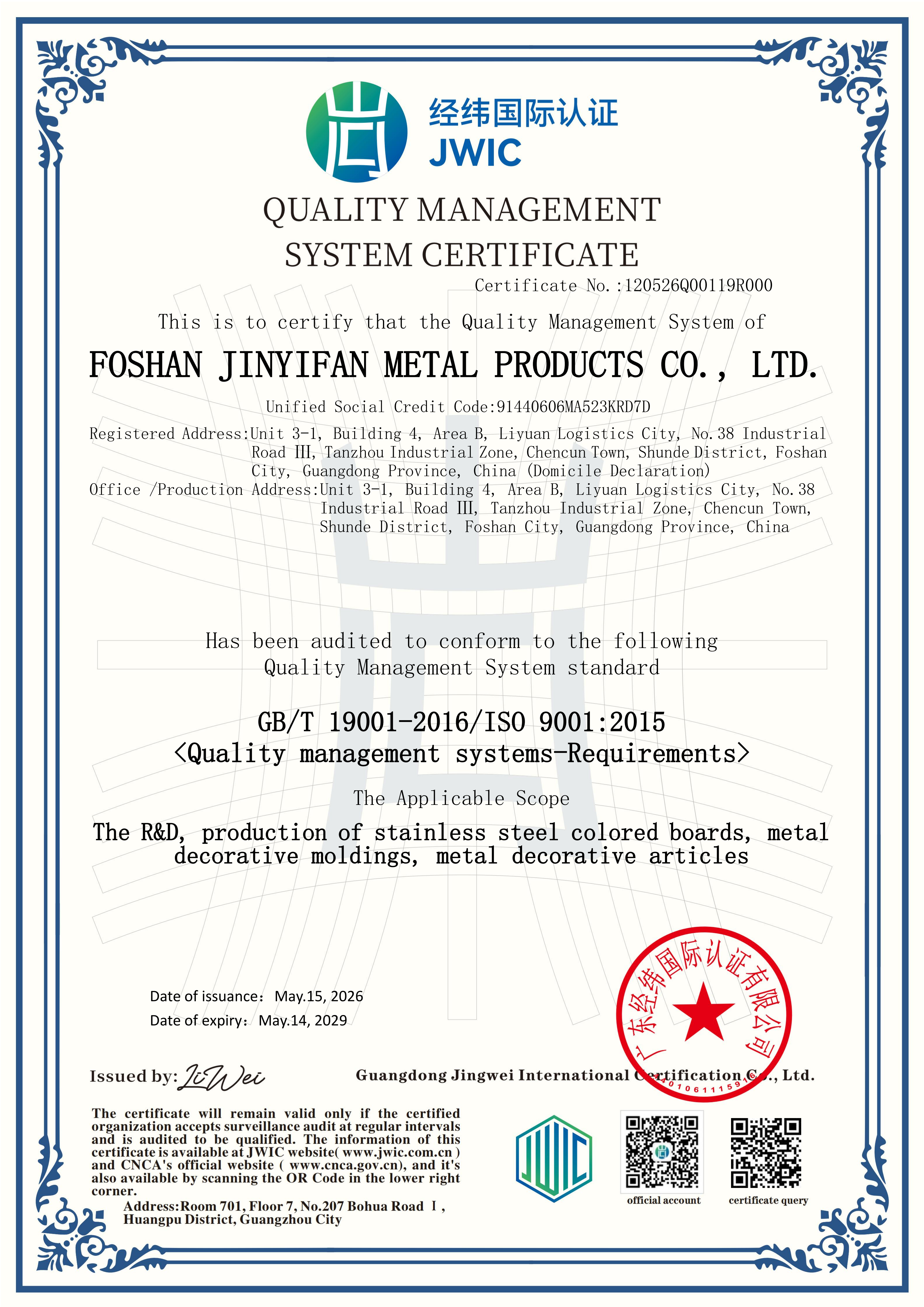
ISO 9001 certificate 120526Q00119R000, valid 15 May 2026 to 14 May 2029 — scope wording should be checked against the ordered product.
Acceptance criteria on site
Acceptance checks should be written into the package before work starts, because most decorative stainless defects are visible at handover and arguable afterwards. The practical list is short: finish matched to the approved sample under final lighting; colour consistency across panels, particularly with PVD colours such as titanium gold or rose gold; flatness and joint width across the plane, checked under raking light on ceilings; water ripple pattern direction continuous across joints; edge and trim alignment at every termination; weld and polish quality on screen frames, where full-welding is specified to achieve seamless joints; a scratch-free surface at completion; and removal of protective film without residue.
The documentation side matters as much as the visual side: a copy of the current certificate, the pre-shipment inspection record, and the approved drawing set as installed.
Where the category is heading
The process list across this category has converged. Public capability descriptions from HENGINOX, Aoxing Metal and Xinye Metal all describe combinations of cutting, bending, welding, polishing, etching, mirror finishing, water ripple forming, PVD colour and laser cutting for architectural work. HENGINOX, for example, states that it produces sheets, screens and cabinets according to confirmed drawings, dimensions, surface finishes, colours, quantities and export requirements.
The interpretation for a buyer is not that suppliers are interchangeable. When the advertised process list is common, differentiation moves to the parts that are hard to see in a catalogue: how accurately drawings are read, how consistently a finish holds across a production run, and how disciplined the pre-shipment inspection is. Those are the criteria worth evaluating after the product group has been shortlisted.
A conditional outlook follows. If interior schemes continue moving toward panelised, joint-critical metal surfaces, the value of sourcing sheet, screen, trim and custom fabrication from one supplier rises, because responsibility for joint alignment and finish continuity then sits in one place instead of being divided between three vendors. That is an argument about accountability under a stated condition, not a claim of superiority for any specific supplier.
Frequently asked questions
Which JYF model fits a feature wall, and which fits a ceiling?
The four decorative sheet models, JYF-01 to JYF-04, serve both, and the choice between them is driven by finish rather than by element: mirror and brushed for vertical feature walls, lift interiors and reception backdrops; sandblasted where a low-reflection surface is wanted; water ripple where a formed texture is specified. JYF-04 is the model with recorded ceiling projects — 120 pieces for combined ceiling and wall work in South Korea and 80 pieces for a French ceiling. Curved or shaped ceiling forms move to the JYF-07 fabrication route.
What are the minimum order quantities and lead times?
Decorative sheets: 15 sheets per type, 7–10 days. Stainless steel trims: 500 pieces per type, 15–20 days. Screen partitions: 3 m², 20 days. Custom products: 1 piece, 25–30 days. These are production periods quoted by the supplier, and they run from approval of drawings and finish samples.
How should water ripple stainless steel sheet be handled on a ceiling?
The pattern is directional, so orientation is set out across the whole plane before panels are produced, with joints planned where the pattern can continue. The French ceiling record notes PVD coating for wear-resistant, fade-proof colour and flatness that supported seamless joint installation, with a scratch-free surface at completion. Online installation guidance is offered as part of after-sales support.
What should be checked before accepting a decorative stainless steel installation?
Finish against the approved sample in final lighting; colour consistency across panels; flatness and joint width, especially under raking light overhead; pattern continuity on textured sheet; edge and trim alignment; weld and polish quality on screen frames; a scratch-free surface; and the supporting documents — the current ISO 9001 certificate and the pre-shipment inspection record.
The shortlist above is a starting framework, not an order. The element decides which product group belongs in the package; the drawing and the approved sample decide whether the finished installation holds up. A designer's handbook with project cases is available for download at the JYF Metal project case handbook.
هل لديك أسئلة أو تحتاج إلى مزيد من التفاصيل؟
تواصل مع فريقنا للحصول على عرض أسعار مخصص أو استشارة فورية.
طلب عرض أسعار
املأ النموذج أدناه وسيتواصل معك فريقنا بعرض مقترح مخصص.
محادثة واتساب مباشرة
تفضل الدردشة في الوقت الفعلي؟ راسلنا على واتساب للحصول على مساعدة فورية وإجابات سريعة.
- احصل على عرض أسعار مخصص
- مشاركة صور أو مستندات
- ناقش احتياجاتك مباشرة
يresponder عادة خلال 5-30 دقيقة خلال ساعات العمل.