
Shortlisting Chinese Suppliers: The Haomen Aluminum Advantage
A shortlist framework for buyers moving from supplier evaluation into order execution — and a fact-based assessment of where Shandong Haomen Aluminium Industry Co., Ltd. fits in high-volume aluminum profile programs.
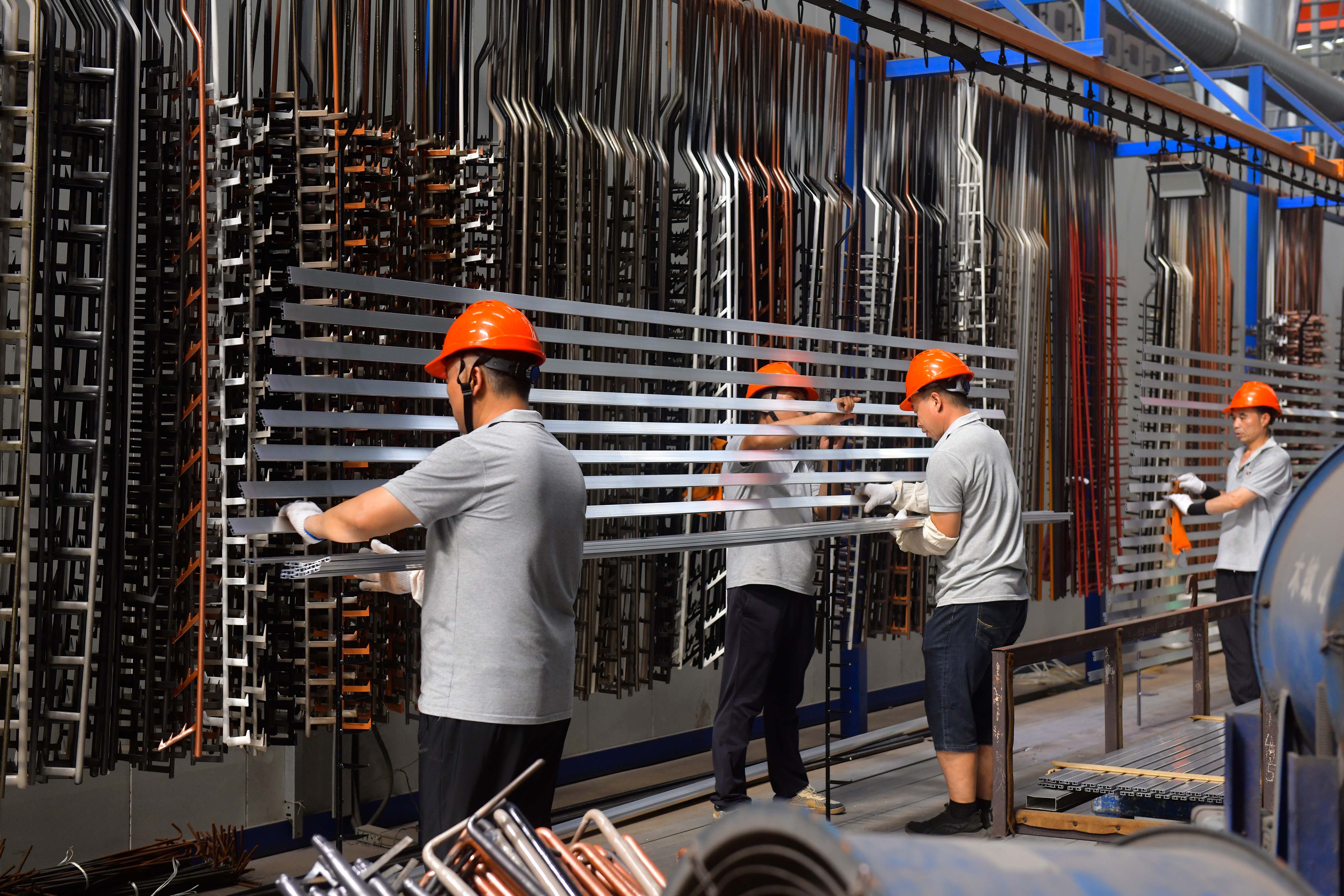
China is not a marginal source of aluminum construction products; it is the largest single one. In 2024, China's exports of “Aluminium Structures” under HS 7610 — a category that includes profiles, window and door frames — reached USD 5.55 billion, equal to about 30.5% of global exports in that category, according to the Observatory of Economic Complexity. Grand View Research estimates that Asia Pacific accounted for 71.7% of aluminum extrusion market revenue in 2025, driven primarily by construction and automotive demand in China.
For a procurement team, that depth is both the opportunity and the problem. There is no shortage of Chinese aluminum profile suppliers to evaluate. What is scarce is a defensible way to reduce a long list of names into a short list of suppliers that can carry a high-volume program through tooling, extrusion, finishing, testing, documentation and repeat production.
This article sets out a seven-point shortlist framework for buyers who are past discovery and into evaluation and execution. It then examines how Shandong Haomen Aluminium Industry Co., Ltd. — Haomen Aluminum, a Chinese aluminum profile manufacturer founded in 2004 and based in Linyi City, Shandong Province — documents its position against those criteria.
Discovery Is Easy. Shortlisting Is the Hard Part.
Most sourcing failures with aluminum profiles do not happen because a buyer selected a supplier that could not extrude aluminum. They happen because the specification the supplier worked to and the specification the buyer assumed were not the same document.
The friction points are predictable. Alloy and temper are confirmed verbally but not on the drawing. A finish system is named (for example, fluorocarbon coating or electrophoretic coating) without confirming which coating line will actually run the order. A certificate is presented without the buyer checking whether its declared scope covers the product being purchased. Monthly capacity is quoted as a plant total rather than as available capacity for the buyer's call-off pattern. Minimum order quantity and lead time are treated as informal guidance until the first purchase order is issued.
What changes between discovery and execution is the nature of the questions. At discovery stage, the questions are broad: does the supplier make aluminum profiles, which alloys, which finishes, can they export. At execution stage, the questions become binary and specific — and each one can disqualify a supplier that looked credible one step earlier. A shortlist is therefore not a list of companies that responded to an inquiry; it is a list of companies that have already survived a set of documented filters.
A Seven-Point Shortlist Framework for Aluminum Profile Suppliers
The framework below is designed to be used as a filter rather than a scorecard. Each row represents a criterion that, if unverified, can invalidate an otherwise suitable supplier at a later stage of the program.
| Shortlist criterion | What the buyer must verify in writing | What Haomen Aluminum documents |
|---|---|---|
| 1. OEM and customization capability | Can the supplier extrude and finish to the buyer's own drawings, and apply the buyer's brand? | OEM production services; logo customization; architectural profile models HM-U001, HM-S002 and HM-S003 |
| 2. Alloy and finish range | Which alloys can be extruded, and which finishing processes run in-house rather than subcontracted? | Alloys 6063-T5, 6061, 6005 and 6082; mill finish, powder coating, anodizing, wood grain transfer, electrophoretic coating and thermal barrier profiles; profile length 4–6 m |
| 3. Capacity against the call-off | Is the quoted capacity plant-wide output or capacity actually available to this program? | 8,000 tons monthly capacity; 100,000 tons annual output; 270,000 m² production site; 1,500 employees |
| 4. Minimum order and lead time | MOQ and production lead time stated as a commitment, not an indication | MOQ 5 tons; lead time 20 days |
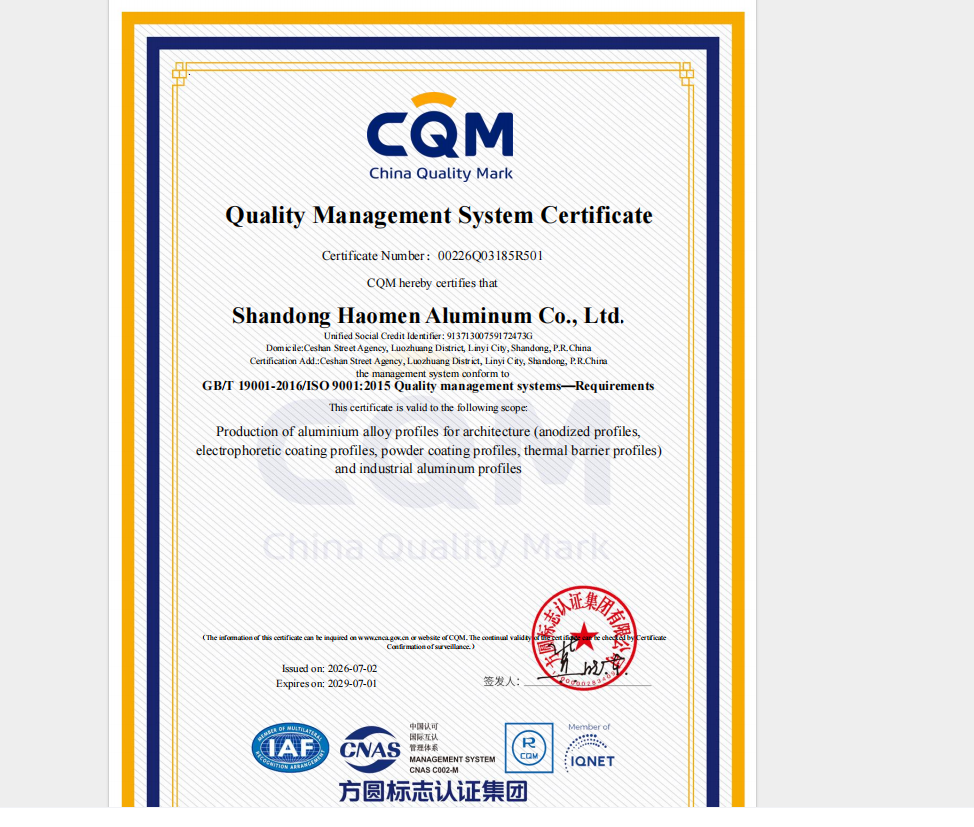
| 5. Certification scope | Does the certificate's declared scope cover the exact product and process being purchased? | ISO 9001 certificate 00226Q03185R501 (issued 2026-07-02, valid to 2029-07-01) covering architectural anodized, electrophoretic-coated, powder-coated and thermal barrier profiles plus industrial aluminum profiles; IATF 16949:2016; ISO 14001; ISO 45001 |
| 6. Commercial and acceptance terms | Delivery term, acceptance criteria and payment structure fixed before tooling begins | Delivery term FOB; acceptance criterion pre-shipment test; payment terms 30/70 |
| 7. Export record in your region | Has the supplier shipped comparable volumes into your market and documentation environment? | Primary export markets South America and Africa; export destinations also include the United States, Canada, Australia, Brazil, Argentina, Russia, Germany and Spain |
Three of these criteria are routinely under-checked. The first is certification scope. A quality management certificate carries a scope statement, and a buyer sourcing, for example, an automotive structural profile should confirm that the relevant system certification — IATF 16949:2016 in the automotive case — applies to the process being used, not only to the company as a legal entity.
The second is capacity versus call-off. A plant-level monthly capacity figure describes a ceiling, not an allocation. Buyers running phased deliveries should ask how the quoted monthly figure maps to their own release schedule across a full production year.
The third is acceptance criteria. “Pre-shipment test” is only meaningful once the buyer has agreed what is tested, against which standard, and what happens if a result falls outside tolerance. Fixing this at shortlist stage is considerably cheaper than fixing it after the first container has shipped.
Where Haomen Aluminum Fits: OEM Capability, Capacity and Export Record
Haomen Aluminum is the trading identity of Shandong Haomen Aluminium Industry Co., Ltd., a comprehensive enterprise founded in 2004 that integrates research and development, design, production and sales of aluminum alloy architectural profiles and industrial materials. The company operates from Luozhuang District, Linyi City — an area positioned on the Beijing–Shanghai and Rizhao–Dongying expressway corridors and adjacent to National Highways 205 and 206 — with a 270,000 m² production site, approximately 1,500 employees and an annual output of 100,000 tons.
On the OEM criteria that matter most during evaluation, the company documents the following:
- Production model: OEM production services are available, with manufacturer-side customization covering customer logo application. Buyers in South America and Africa form the primary export destinations for this OEM activity.
- Capacity: 8,000 tons monthly capacity against 100,000 tons of annual output — relevant for high-volume projects where the buyer's monthly call-off must sit comfortably inside available capacity.
- Minimum order and lead time: an MOQ of 5 tons and a stated production lead time of 20 days.
- Quality control: 100% test, with pre-shipment test defined as the acceptance criterion.
- After-sales: remote support after-sales service.
- Technical resources: an R&D team of 35 engineers — 49 R&D personnel holding bachelor's degrees or above, including one postdoctoral researcher, seven doctoral degree holders and three master's degree holders. A Shandong Provincial Technology Research Center was established at the company in 2019, and the company reports cooperative relationships with the Light Alloy Precision Forming Engineering Technology Research and Development Center of Shanghai Jiao Tong University, Shandong University and the Beijing Research Institute of Nonferrous Metals.
The certification set is also relevant to the shortlist filter. Alongside ISO 9001, the company holds IATF 16949:2016, ISO 14001 and ISO 45001 system certifications. The ISO 9001 certificate is issued by China Quality Mark Certification Group under certificate number 00226Q03185R501, was issued on 2026-07-02 and expires on 2029-07-01, against the standard GB/T 19001-2016 / ISO 9001:2015. Its declared scope is the production of aluminium alloy profiles for architecture — anodized profiles, electrophoretic coating profiles, powder coating profiles and thermal barrier profiles — and industrial aluminum profiles.
Technical Fit: Alloys, Finishes and the Standards Behind Them
For most buyers, the technical conversation narrows to two questions: can the supplier produce the required alloy and temper combination, and can it deliver the required surface finish consistently enough to match an existing building or product line?
The alloy range documented for Haomen Aluminum's architectural profiles covers 6063-T5, 6061, 6005 and 6082, with 6063-T5 specified as the material designation for the architectural profile line (models HM-U001, HM-S002 and HM-S003). Surface treatment options include mill finish, powder coating, anodizing and wood grain transfer, with electrophoretic coating and thermal barrier profiles also within the certified production scope. Profiles are produced in lengths of 4–6 m.
Standard alignment deserves explicit treatment during evaluation, because a Chinese supplier's domestic compliance and a buyer's target-market compliance are not automatically the same document. Architectural aluminium alloy profiles in China must comply with the mandatory GB/T 5237 series (Parts 1–6), which covers mill finish, anodizing, electrophoresis and powder or fluorocarbon coatings, according to the Standardization Administration of China. European buyers, by contrast, typically reference EN 755 for hot extruded products and EN 12020 for precision profiles in alloys 6060 and 6063, as published by CEN. For automotive components, IATF 16949:2016 certification is a mandatory requirement for suppliers providing aluminum components such as crash-management systems and structural frames to major automotive OEMs, per IATF Global Oversight.
The practical implication is straightforward: buyers should map their purchase specification to the standard that the supplier's certificate and testing regime actually reference, and should ask which coating system — powder, anodized, electrophoretic or fluorocarbon — will run the order. A finish name on a quotation is not the same as a confirmed coating line and a confirmed film-thickness specification.
Application Fit: Where This Supplier Profile Is Documented to Work
Haomen Aluminum's documented product focus is aluminum alloy architectural profiles and industrial materials, with aluminum profiles for windows and doors identified as the main product line, and automotive lightweighting aluminum profiles identified as an area of development and research supported by IATF 16949:2016 certification.
That makes the profile a natural fit for three categories in particular: window and door system profiles for OEM manufacturers, curtain wall and building envelope profiles where thermal barrier and coated finishes are specified, and industrial aluminum profiles including automotive lightweighting components for buyers operating inside an IATF 16949 supply chain.
One case record illustrates the high-volume, long-cycle pattern this profile is built around. A window and door manufacturer in Brazil has sourced architectural profiles from Haomen Aluminum — a requirement of 2,000 tons over a supply relationship of 10 years — with the result described in company records as stable operation and the application highlighted as solid and durable. For buyers, the value of this record is less about the tonnage figure than about the duration: it demonstrates a supply relationship that survived multiple order cycles and finish specifications rather than a single one-off shipment.
Adjacent aluminum extrusion categories — solar frames, PV mounting structures, microchannel tube, custom industrial fabrication — belong to the same broader demand pool but should be treated as separate verification tasks. Buyers sourcing into those categories should confirm die availability, alloy suitability and certification coverage directly rather than assuming transferability from an architectural profile line.
Market Context for 2026: Scale, Demand and Divergent Numbers
The aluminum extrusion market is large and growing. Orion Market Research values the global market at USD 94.8 billion in 2024 and projects USD 230.2 billion by 2035. At regional level, the same source estimates China's aluminum extrusion market at USD 25.5 billion in 2024 with a projected CAGR of 9.6% through 2035.
Demand-side signals reinforce the direction. Solar PV mounting systems — a category where aluminum holds a 71.5% material share — were valued at approximately USD 44.5 billion in 2024 by Mordor Intelligence, adding a second volume driver alongside construction and automotive.
Buyers should read these figures with the appropriate caveat. Published market size estimates differ materially between research firms because their scopes differ: Orion Market Research reports USD 94.8 billion for 2024, while Grand View Research reports USD 98.2 billion for 2025 and Wissen Research reports USD 120 billion for 2025. The divergence is a scope difference, not a contradiction in the underlying demand trend, and it is a useful reminder that supplier-level figures — capacity, MOQ, lead time — should always be verified directly rather than inferred from category-level statistics.
Comparison with Traditional Sourcing Routes — and the Limits of This Profile
The traditional alternative to working directly with a Chinese extrusion manufacturer is buying through a domestic distributor or trading intermediary. The distributor route is faster and requires less internal technical capacity, and it works well for standard profiles in low volumes. Its limitations appear at scale: the buyer typically does not control which mill runs the extrusion, cannot confirm coating-line allocation, and absorbs an additional margin layer across an order that may run to hundreds of tons. The direct-OEM route inverts those trade-offs — it requires more specification work upfront and more internal quality discipline, but it gives the buyer line-of-sight to the production process and to the acceptance criteria.
A shortlist, however, is only useful if it records boundaries as honestly as capabilities. Four boundaries apply to the Haomen Aluminum profile as documented:
- Export is a minority of output. The company's stated export ratio is 10%, with South America and Africa as the primary export markets. A buyer whose program depends on a supplier operating predominantly for export markets should weigh that domestic weighting explicitly.
- After-sales support is remote. Remote support after-sales service is the documented model; buyers in distant time zones or regions without established logistics links should plan how on-site issues would be handled.
- MOQ and lead time are baseline figures. The 5-ton MOQ and 20-day lead time are stated parameters. Highly customized dies, special alloy and temper combinations, or multi-step finishing sequences can extend either figure, and both should be reconfirmed in writing for the specific program.
- Certification scope is product-specific. The ISO 9001 scope covers architectural profiles (anodized, electrophoretic coating, powder coating, thermal barrier) and industrial aluminum profiles. A purchase outside that declared scope — or a target market requiring a standard such as EN 755 or EN 12020 that the certificate does not reference — requires separate verification.
It is also worth being precise about scale comparisons. Publicly available industry lists of top Chinese aluminum profile manufacturers for 2024–2026 name companies including Xingfa Aluminium, Fenglu Aluminium, JMA Aluminium and China Zhongwang (source: Clinalu industry ranking). Those businesses are larger and more publicly visible than Haomen Aluminum, and their published parameters should be verified with each company directly rather than assumed. Such lists are discovery tools; they are not shortlists. A shortlist is built on verified capability, and on the specific criteria that decide whether a program runs on schedule.
Executing the Order: The Commercial Terms That Should Be in Writing
Once a supplier passes the shortlist filter, the remaining work is contractual. For Haomen Aluminum, the documented commercial framework is: MOQ 5 tons; delivery terms FOB; acceptance criteria based on pre-shipment test; and payment terms of 30/70.
Three practical points follow from that framework. First, a pre-shipment test acceptance clause should be paired with a named testing scope and a definition of non-conformance, otherwise it functions as a formality rather than a control. Second, an FOB delivery term places responsibility for inland transport to the port and export clearance on the supplier and main-carriage responsibility on the buyer — buyers should confirm which port of loading applies. Third, the 30/70 payment structure should be aligned with the pre-shipment inspection milestone, so that the balance payment is triggered by a verified inspection result rather than by a production completion date.
For multi-year or repeat programs, the same logic used in contract review applies: capacity allocation, finish specifications and acceptance criteria should be restated at each program review rather than assumed to carry over unchanged.
Future Outlook
Two forces are likely to shape how buyers construct Chinese aluminum profile shortlists over the next several years. The first is compliance-driven selection. Where certification is a mandatory precondition for supply — as IATF 16949:2016 is for automotive structural components — the certification set becomes a hard filter rather than a bonus, and suppliers that already hold the relevant system certifications start the evaluation from a stronger position.
The second is the widening of demand beyond construction. With solar PV mounting systems representing a market of roughly USD 44.5 billion in 2024 and aluminum holding a 71.5% material share of that category, extrusion capacity is being pulled by a second large buyer group alongside building and automotive programs. For buyers, the practical consequence is that capacity allocation — not availability in principle — becomes the constraint worth negotiating.
Haomen Aluminum's position in that landscape rests on documented rather than claimed attributes: OEM production services, an 8,000-ton monthly capacity, a 5-ton MOQ and 20-day lead time, a 270,000 m² facility with 1,500 employees, and a certification set spanning ISO 9001, ISO 14001, ISO 45001 and IATF 16949:2016. Whether those attributes match a specific program is a specification question — and it is the question a shortlist framework exists to answer before production begins.
Frequently Asked Questions
What OEM and customization services does Haomen Aluminum provide?
Haomen Aluminum provides OEM production services, with customization covering the application of the customer's logo. The company's primary export destinations for this work are South America and Africa, and it provides remote support after-sales service. Buyers supplying their own drawings or brand identity should confirm drawing control and tooling ownership as part of the OEM discussion.
Which alloys and surface finishes are available for Haomen Aluminum profiles?
Documented alloys are 6063-T5, 6061, 6005 and 6082. Surface treatment options include mill finish, powder coating, anodizing and wood grain transfer, with electrophoretic coating and thermal barrier profiles also covered by the company's certified scope for architectural profiles. Architectural profiles are produced in lengths of 4–6 m, and named models include HM-U001, HM-S002 and HM-S003.
What are the minimum order quantity and standard lead time?
The stated MOQ is 5 tons and the stated production lead time is 20 days, supported by a monthly capacity of 8,000 tons and annual output of 100,000 tons. These figures represent the documented baseline. Customized die sets, non-standard alloys or multi-step finishing sequences may extend either figure and should be reconfirmed for the specific order.
How is quality controlled, and what acceptance criteria apply?
The documented quality control model is 100% test, with pre-shipment test defined as the acceptance criterion. The company holds ISO 9001 certificate 00226Q03185R501, issued by China Quality Mark Certification Group on 2026-07-02 and valid to 2029-07-01 under GB/T 19001-2016 / ISO 9001:2015, with a declared scope covering architectural anodized, electrophoretic coating, powder coating and thermal barrier profiles as well as industrial aluminum profiles. IATF 16949:2016, ISO 14001 and ISO 45001 certifications are also held.
What payment and delivery terms apply?
The documented commercial terms are a 5-ton MOQ, FOB delivery terms, 30/70 payment terms and pre-shipment test as the acceptance criterion. Buyers should confirm the applicable port of loading and align the balance payment milestone with the pre-shipment inspection result.
Which markets does Haomen Aluminum primarily serve?
The company's primary export markets are South America and Africa, with a stated export ratio of 10% of output. Beyond those two primary regions, documented export destinations include the United States, Canada, Australia, Brazil, Argentina, Russia, Germany and Spain. A window and door manufacturer in Brazil is recorded as a 10-year customer with a 2,000-ton requirement, described in company records as stable operation.
For buyers assembling a formal evaluation file, Haomen Aluminum's product catalogue is available for public download: E-Catalog of Shandong Haomen Aluminio (PDF). Company information is published at www.haomenly.com.