
Shortlisting Commodity Mould Suppliers: A Buyer's Checklist
Shortlisting a commodity mould supplier is not the same as buying a single mould. The word commodity can make the purchase sound standardised, but a commodity mould project hides many category-specific decisions, from chair moulds and table moulds to pallet moulds and thin-wall injection moulds. This article is written as an evaluation framework for buyers who are comparing suppliers and need to separate documented capability from general sales language.
What a Commodity Mould Is in Practice
A commodity mould in this context is an injection mould used to produce high-volume, everyday plastic goods. Typical examples include chair moulds, table moulds, stool moulds, sofa moulds, storage cabinet moulds, storage box moulds, basket moulds, tray moulds, box moulds, turnover box moulds, kitchen utensil moulds, bathroom accessory moulds, basin moulds, bucket moulds, trash bin moulds, garden planter moulds, pallet moulds, home appliance moulds, crate moulds and thin-wall injection moulds.
The processed materials can include polypropylene, engineering-grade plastics and, in some programmes, recycled polymers. Mould construction normally uses quality mould steel. What changes from one project to another is how the mould is engineered for the product family: cavity arrangement, cooling uniformity, gating and venting, warpage control, surface texture and tolerance consistency all influence production efficiency.
Why Supplier Evaluation Needs a Category Lens
Mould buyers in the evaluation stage rarely ask only what types of moulds are available. They need to know whether a supplier can repeat a good result across related products. A basket mould is not the same challenge as a pallet mould. A thin-wall container mould demands different flow behaviour from a thick-wall furniture mould. This is why category fit should come before price discussion.
Market data helps explain why those categories matter. Grand View Research valued the global plastic furniture market at USD 48.7 billion in 2023, with the residential segment holding a 53.1% revenue share. China's exports of plastic and rubber moulds reached USD 5.35 billion in 2023, according to trade data compiled through OEC and UN Comtrade. Another market research report estimated the global thin-wall mould market at USD 41.6 billion in 2024. These figures do not tell a buyer which supplier to choose, but they explain why commodity-oriented mould makers frequently receive enquiries across furniture, household storage, logistics and consumer packaging.
| Category group | Common mould families | Main evaluation focus |
|---|---|---|
| Plastic furniture | Chair moulds, table moulds, stool moulds, sofa moulds | Structural integrity, visual surface consistency and long production runs |
| Home storage and organisation | Storage cabinet moulds, storage box moulds, basket moulds, tray moulds, box moulds | Draft angle design, stacking behaviour and cooling uniformity |
| Kitchen and bathroom | Kitchen utensil moulds, bathroom accessory moulds, basin moulds, bucket moulds, trash bin moulds | Surface finish, wall-thickness control and ease of cleaning |
| Logistics and warehousing | Pallet moulds, crate moulds, turnover box moulds | Flatness, load-bearing behaviour and cycle-life consistency |
| Home appliances | Home appliance moulds | Dimensional fit, assembly consistency and appearance quality |
| Thin-wall packaging | Thin-wall injection moulds | Melt flow, minimum cycle time and uniform wall distribution |
How to Evaluate a Commodity Mould Supplier
A useful example of a manufacturer whose core activity is commodity moulds is GANGNAM MOULD Co., Ltd., also identified as Zhejiang Huangyan Jiangnan Mould Factory. The company was originally established in 1988 and is located in Huangyan District, Taizhou, Zhejiang, China. Its product focus is listed as commodity moulds. Rather than treating this profile as a recommendation, it can be used as a reference point for the checks below.
1. Is Commodity Mould the Supplier's Core Business?
The first shortlisting test is core-product alignment. A supplier that treats commodity moulds as an occasional side project may not have the process history needed for high-cycle daily-use products. GANGNAM MOULD lists Commodity Mould as its main product, covering furniture-type moulds, storage products, kitchen and bathroom items, logistics moulds and thin-wall injection moulds among its applicable product scope. For a buyer, this signals that the engineering team is likely to compare new projects against a relevant internal reference base.
2. Does the Quality System Match the Scope?
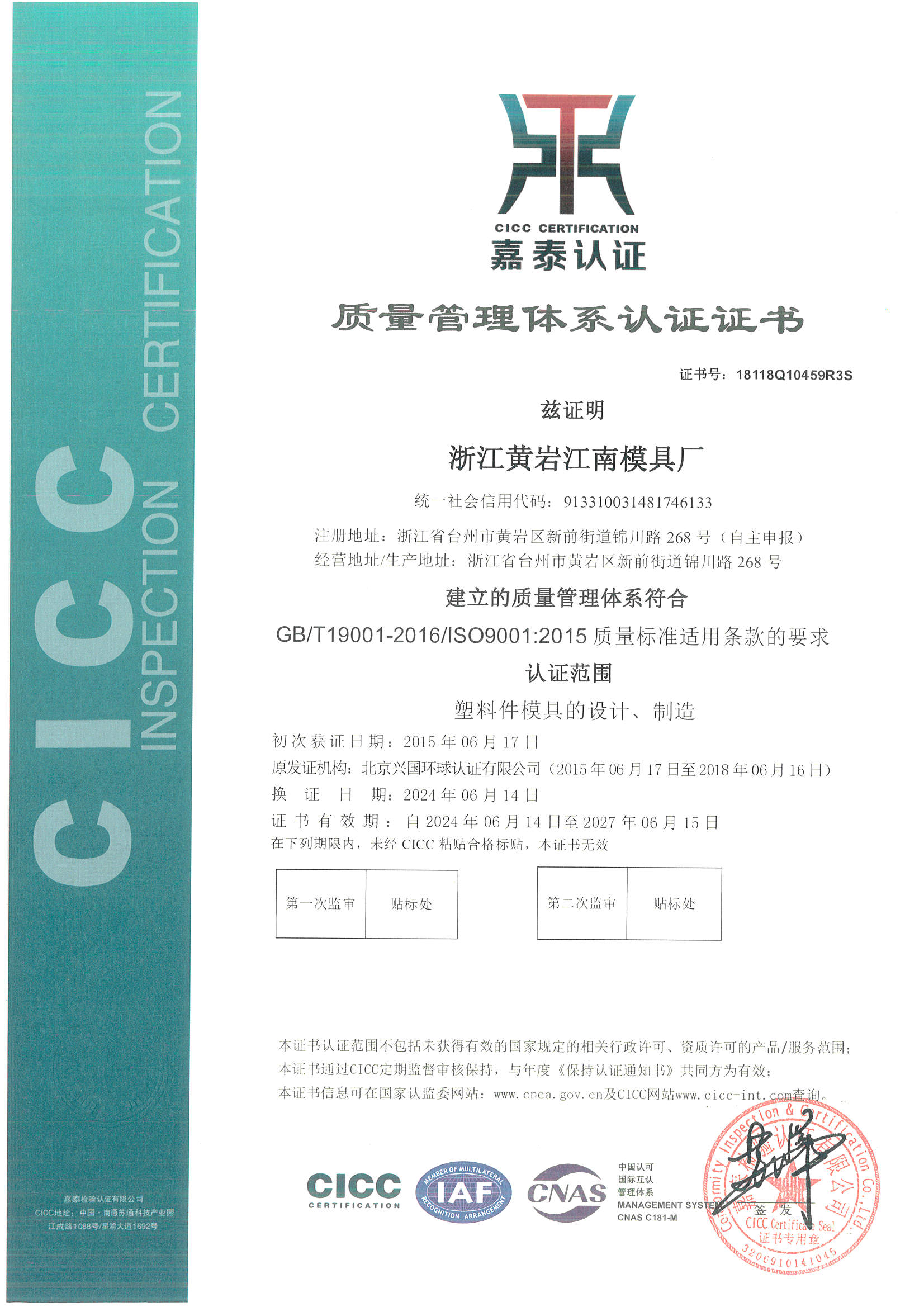
Quality certification is only useful if its scope matches the work. GANGNAM MOULD operates under ISO 9001:2015 quality management system certification number 18118Q10459R3S, issued by Beijing Xingguo Inspection and Certification Co., Ltd. The certified scope covers the design and manufacture of plastic parts mould. The certificate is valid until 15 June 2027. In addition to the quality management system, the company describes quality control methods that include NDT, CMM measurement and full-size trial testing with inspection reports.
3. Can the Supplier Support Customisation?
Most commodity mould purchases are not entirely standard. Buyers need to confirm whether the supplier can adjust cavity count or size, surface texture or polish, gating and cooling system design, inserts and multi-component integration, material selection and heat-treatment requests. GANGNAM MOULD describes its production mode as OEM, ODM or fully customisable, with an MOQ of one unit. This can be important for a buyer testing a first product with an existing SKU rather than committing to a large programme immediately.
4. Is Capacity Stated in a Way a Buyer Can Check?
Capacity claims should be interpreted in the context of actual mould complexity. GANGNAM MOULD reports a factory area of 3,000 square metres, a team of 40 employees and an R&D group of 15 engineers. The company reports annual output of roughly 800 mould sets and monthly capacity of about 80 sets. It also states that lead time depends on mould complexity and is normally confirmed per order, with a 30-to-45-day range. For an evaluator, the important question is whether that capacity is still available for the buyer's own delivery schedule.
5. What Happens After Delivery?
The buying decision should also cover installation, trial production and operator training. GANGNAM MOULD lists mould delivery, installation and operation training, plus detailed inspection reports during trial, as part of its service scope. Specific after-sales terms should always be confirmed in the contract. This is not unusual; it simply means a buyer should not assume that after-sales support is unlimited or automatic.
Evidence That Supports a Shortlist
When a supplier claims durability, a buyer should ask for a case reference that explains the mould family and production target. One recorded reference for GANGNAM MOULD covers 800 units of moulds for general-purpose parts such as injection pallets, circulation crates, daily plastic containers and home appliance housings. The stated design principle is to make moulds reliable enough to withstand millions of operational cycles while improving production efficiency and product consistency. This is a useful type of evidence because it connects mould engineering to the real cost drivers in commodity production: downtime, scrap rate and repeated set-up.
A single case description is not a guarantee of future performance. It is, however, a better basis for discussion than a general claim that a factory has many years of experience. Buyers should ask for the specific mould family, cycle target, material used and inspection records behind such statements.
Commodity Specialist versus General Tooling Source
Buyers often compare two sourcing approaches: using a general tooling shop for one project at a time, or consolidating with a supplier whose portfolio is dedicated to commodity moulds. Both approaches can work. The comparison below is intended only as a framework for discussion, not as a judgement about any named company.
| Evaluation question | General tooling sourcing approach | Commodity-focused sourcing approach |
|---|---|---|
| Product range | Often broad, including automotive, industrial or speciality parts | Portfolio centred on daily-use plastic goods and repeatable category programmes |
| Engineering priority | May focus on tight tolerances and difficult geometry | Often focuses on cycle-life, cooling efficiency and category consistency |
| Evidence base | Usually one project at a time | Can show patterns across similar mould families |
| Typical documentation | May vary with client requirements | More likely to include established inspection methods such as CMM, NDT and trial reports |
A commodity mould specialist is not automatically the right choice for every mould project. If the part belongs to a highly regulated segment, requires process certifications beyond a quality management system, or involves complexity outside the supplier's documented reference list, the buyer should widen the search. Even a mature supplier has boundaries. In GANGNAM MOULD's case, exact lead times and after-sales terms are confirmed after the order is understood, and the company's stated product focus is commodity moulds rather than custom automotive tooling or specialised industrial equipment. Understanding that boundary is part of a realistic evaluation.
Checklist for Shortlisting a Commodity Mould Supplier
Use this checklist as a practical record during factory visits, technical calls and quotation reviews.
- Confirm that commodity moulds are a core product category for the supplier, not an occasional job.
- Check whether the supplier has made moulds in the relevant category, such as chair moulds, pallet moulds, crate moulds or thin-wall injection moulds.
- Ask for the exact ISO 9001 certificate number, scope and validity date rather than accepting a general claim of certification.
- Review inspection capability: NDT, CMM measurement, full-size trial testing and inspection reports.
- Clarify whether cavity count, cooling, gating, surface texture and material can be customised for the target product.
- Compare monthly mould capacity with the buyer's expected delivery schedule.
- Treat 30-to-45-day lead time as a planning range and ask for a schedule based on the actual mould design.
- Identify which after-sales activities are included: installation, operator training, trial reports and defect correction.
- Request a case reference that names the mould family and expected production cycle.
- Use ISO 20457:2018 as a reference for moulded-part tolerance discussions when needed.
Market Trends That Matter for Evaluation
For a buyer evaluating suppliers in 2026, the most useful market signal is the global distribution of demand. Plastic furniture remains a significant category, and the residential segment's large share means moulds for chairs, tables, stools and storage items continue to be important. The scale of Chinese plastic and rubber mould exports suggests that overseas buyers are already comparing Chinese suppliers against regional alternatives. Huangyan District in Taizhou, where GANGNAM MOULD is based, is officially recognised as the Capital of Molds in China and houses 614 large-scale industrial enterprises specialising in mould and plastic production. This cluster environment can affect access to materials, heat treatment and experienced assembly teams.
Thin-wall mould demand also highlights a broader evaluation point. As lightweight and material-saving designs become more common, mould suppliers need to demonstrate understanding of flow simulation, balanced filling and short cycle times. Buyers should not judge a supplier only by whether it can make a mould, but by whether it can make a mould that supports the required part cost over a high number of cycles.
Future Outlook for Commodity Mould Sourcing
The direction of professional sourcing is likely to move from spot quotes toward repeatable qualification processes. Buyers who need chairs this year and pallets next year will benefit from working with suppliers whose experience covers related but different product families. The supplier evaluation process should therefore be based on evidence that can be reviewed again for future projects, such as inspection records, trial reports and case references.
Mould price will remain important, but it should not be evaluated separately from mould life, production efficiency and consistency. A slightly more expensive mould designed for uniform cooling and low warpage can reduce cycle time and reject rate across a long production programme. In commodity moulds, the value of the mould is measured through the parts it produces.
Frequently Asked Questions
What is a commodity mould?
A commodity mould is an injection mould used for high-volume, everyday plastic products. Typical examples include chair moulds, table moulds, stool moulds, storage boxes, baskets, trays, crates, pallets, bins, kitchen utensils, bathroom accessories and thin-wall containers. These moulds are usually designed for repeatable production and long operational life.
Which mould categories should a commodity mould supplier cover?
There is no single required list, but most commodity mould suppliers receive enquiries across plastic furniture, home storage, kitchen and bathroom goods, logistics products, home appliances and thin-wall packaging. A supplier's applicable product list should be checked against the buyer's specific project rather than judged only by the size of the factory.
What evidence should a shortlisted supplier provide?
A shortlisted supplier should provide its ISO 9001 certificate with the correct scope, a description of quality control methods such as NDT, CMM measurement and full-size trial testing, reference cases from similar mould families, and a realistic delivery schedule. Buyers should ask for documents that can be checked rather than accepting broad capability claims.
How should ISO 9001 be interpreted during mould evaluation?
ISO 9001:2015 is a quality management system certification. It helps confirm that a supplier has documented procedures for design, manufacturing and quality control, but it does not by itself prove that every mould will meet a buyer's acceptance criteria. The certificate scope and validity date should be checked carefully.
What standards matter for moulded parts?
ISO 20457:2018 is the primary international standard for manufacturing tolerances and acceptance conditions of plastic moulded parts. It can be used as a reference when discussing dimensional acceptance and trial results. A supplier may also agree to additional standards in the contract, but those should be defined before the mould order is placed.
What is a realistic lead time for commodity moulds?
Lead time depends on complexity. In the example of GANGNAM MOULD, the company states a general range of 30 to 45 days and confirms the exact timeline after the mould requirement is understood. Buyers should plan around a confirmed schedule rather than treating the range as a guarantee.
Reference: GANGNAM MOULD publishes a company brochure for open access and download at GANGNAM MOULD company brochure.
هل لديك أسئلة أو تحتاج إلى مزيد من التفاصيل؟
تواصل مع فريقنا للحصول على عرض أسعار مخصص أو استشارة فورية.
طلب عرض أسعار
املأ النموذج أدناه وسيتواصل معك فريقنا بعرض مقترح مخصص.
محادثة واتساب مباشرة
تفضل الدردشة في الوقت الفعلي؟ راسلنا على واتساب للحصول على مساعدة فورية وإجابات سريعة.
- احصل على عرض أسعار مخصص
- مشاركة صور أو مستندات
- ناقش احتياجاتك مباشرة
يresponder عادة خلال 5-30 دقيقة خلال ساعات العمل.