
Shortlisting Smart Decorative Ceiling Fans: TU52-MW-N3A1DOME
Industry Reference · Ceiling Fan Sourcing
A decorative ceiling fan shortlist is not a design exercise. It is a constraint exercise. Diameter class, motor type, light kit, control method, environment rating and market-specific certification all narrow the field before finish and form are considered — and a model that clears those filters is a far more useful benchmark than a catalogue spread.
This reference uses one model as a worked benchmark rather than ranking unverified brands against each other: the TU52-MW-N3A1DOME from Handing Co. Ltd., a ceiling fan manufacturer established in 1992 in Kaiping City, Guangdong Province, China, producing decorative ceiling fans for export to the EU, USA and Australia.
Why decorative ceiling fan shortlists fail at the evaluation stage
Decorative ceiling fans sit in an awkward position in procurement. They are specified by interior designers for appearance, bought by commercial teams for durability, and installed by contractors who care about mounting geometry and control wiring. When the three groups work from different documents, the shortlist collapses into a price comparison of visually similar products — and the differences that matter appear later, at commissioning or at the first certification query.
The category itself is not small. Commercial research estimates for the global ceiling fan market in 2025 range from USD 11.83 billion to USD 15.7 billion, a spread that the underlying data attributes to differing definitions of decorative versus industrial segments. China accounts for roughly 26.7% of that market. In a category of that scale, the practical problem for a buyer is not finding suppliers — it is finding a defensible basis on which to remove them from a list.
A constraint-first shortlist solves that. Each filter has to be answerable from a document, not from a conversation.
The five constraints that actually decide a decorative fan shortlist
1. Environment rating
Indoor, damp and wet are not marketing categories; they are safety classifications. US ENERGY STAR guidance advises buyers to look for a UL-listed damp rating for humid locations and a UL wet rating where a fan is in direct contact with water. A decorative indoor model should be treated as an indoor model until the supplier confirms otherwise in writing.
2. Diameter class and light kit
Diameter drives both airflow expectation and compliance, because ENERGY STAR efficiency thresholds for ceiling fans are banded by fan diameter and expressed as a weighted efficiency metric in cubic feet per minute per watt (CFM/W). An integrated light kit also removes a separate luminaire from the bill of materials, which changes both the electrical scope and the installation programme.
3. Motor type and control method
A DC motor and a pull-chain AC motor are different propositions at commissioning. DC designs generally offer finer speed control and are the direction the regulatory environment is pushing; pull chains remain the simpler failure mode. Smart WiFi control adds a commissioning dependency — network, app and long-term support — that must be assessed as part of the fan, not after it.
4. Certification path by destination market
Certification is a legal gate, not a quality signal. It has to be evidenced at model level for the market the goods actually enter, and it has to be verified in the relevant listing database rather than accepted from a brochure.
5. Manufacturing evidence
A fan that performs in a sample room and a fan that performs across a 500-unit repeat order are two different risks. Floor area, headcount, annual capacity, in-house process control and engineering depth are the evidence that separates them.
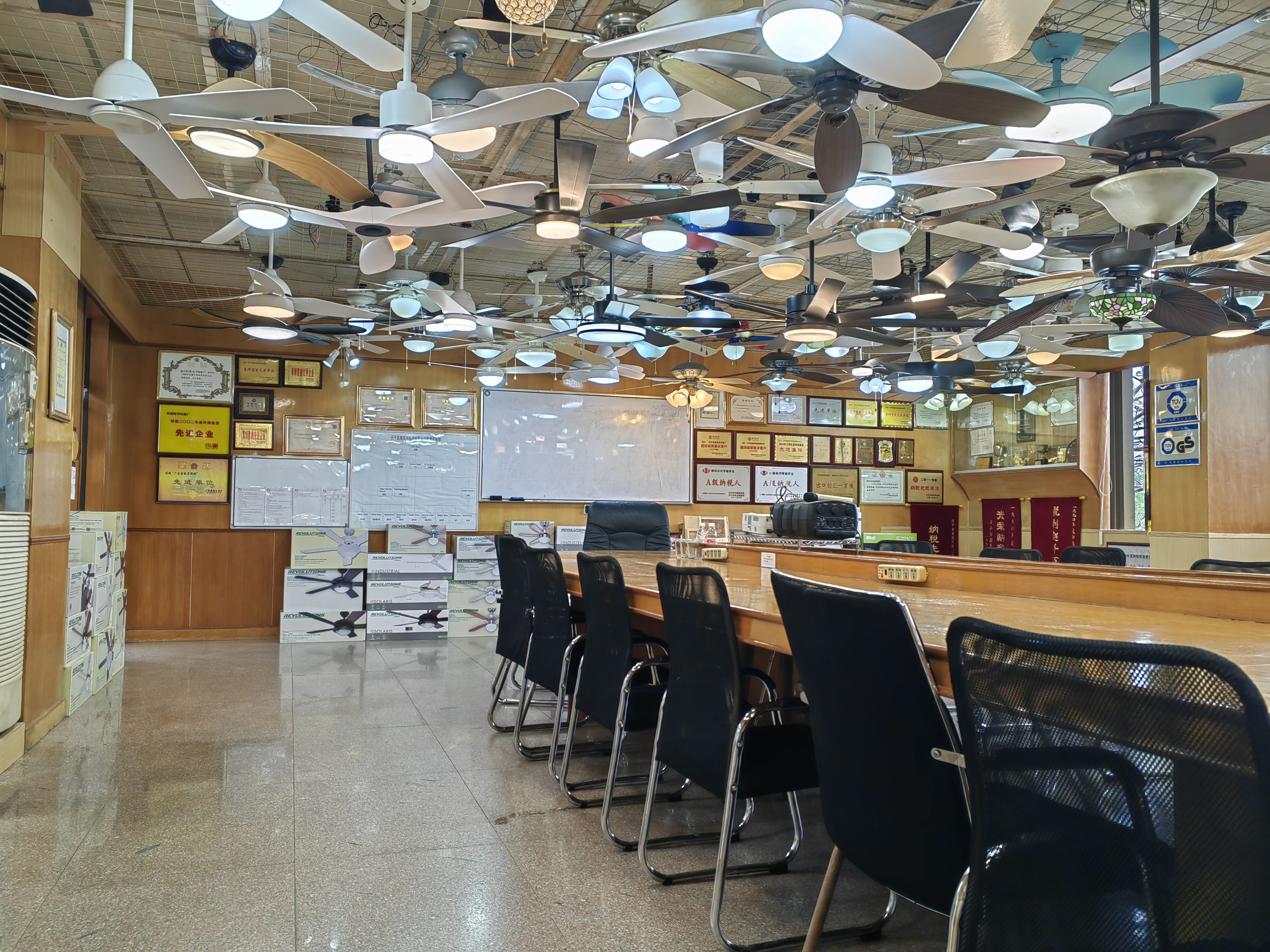
Sample room evaluation: a decorative ceiling fan shortlist is built on documents first, then confirmed against physical samples.
Benchmark: what the TU52-MW-N3A1DOME actually publishes
The TU52-MW-N3A1DOME is specified as an indoor decorative ceiling fan with an integrated light kit, a DC motor and smart WiFi control. Its published specification is compact enough to be read as a constraint checklist rather than a feature list.
| Parameter | Published specification |
|---|---|
| Model | TU52-MW-N3A1DOME |
| Product classification | Indoor decorative ceiling fan; ceiling fan with light; commercial-grade ceiling fan; smart WiFi ceiling fan; 52-inch ceiling fan |
| Housing and motor | 52-inch TU housing, DC motor |
| Finish | Matt White |
| Blades | 3 × ABS |
| Blade holder | Not applicable |
| Light kit | 24W CCT LED |
| Control | Smart WiFi |
| Materials | Steel housing + ABS blade |
| Intended use | Household, commercial |
| Packaging | 720 (L) × 225 (W) × 350 (H) mm |
Read as a constraint profile, this is a model aimed at interior spaces where a single SKU must deliver air movement, illumination and controllable operation: guest rooms, dining areas, meeting rooms, clinics, cafés and residential living spaces. It is not positioned as an outdoor or wet-area fan, and the published material does not claim that.
Reading the specification at evaluation stage
DC motor
The motor is the part of a decorative fan that determines how the product behaves in year three. A DC motor changes the control architecture: speed regulation is electronic rather than resistive, which is why DC designs pair naturally with remote and app-based control. The published material does not state wattage at each speed, so a buyer evaluating running cost must request that data rather than assume it.
24W CCT LED light kit
A CCT light kit is specified by correlated colour temperature, which means colour temperature is part of the product specification rather than a fixed lamp colour. For a multi-room project this matters commercially: a single fan model can potentially serve rooms where the lighting scheme differs, but only if the exact CCT options and dimming behaviour are confirmed in writing. The 24W rating is the light kit's published electrical figure; it is not a lumen output, and buyers should not substitute one for the other.
Smart WiFi control
Smart control shifts part of the product's lifecycle risk from the hardware to the software environment. Two questions decide whether it is an asset or a liability in a commercial building: which network the fans will sit on, and what happens to control if that network is segmented for guest or tenant security. A decorative fan shortlist should record the control protocol and the app's supported environment alongside the electrical specification.
Housing, blades and finish
Steel housing with three ABS blades in Matt White is a configuration built for interior consistency rather than for outdoor exposure. Handing operates a 100% owned electroplating factory, which is relevant to metal finishing control across its range; the Matt White finish on this model is a paint specification, not an electroplated one, and should be evaluated as such on samples.
Packaging dimensions
Published carton dimensions of 720 × 225 × 350 mm allow freight and warehouse planning before a purchase order is issued. They also allow a buyer to sanity-check whether a supplier's quoted container loading is plausible, which is a useful discipline when comparing quotes that look identical on paper.
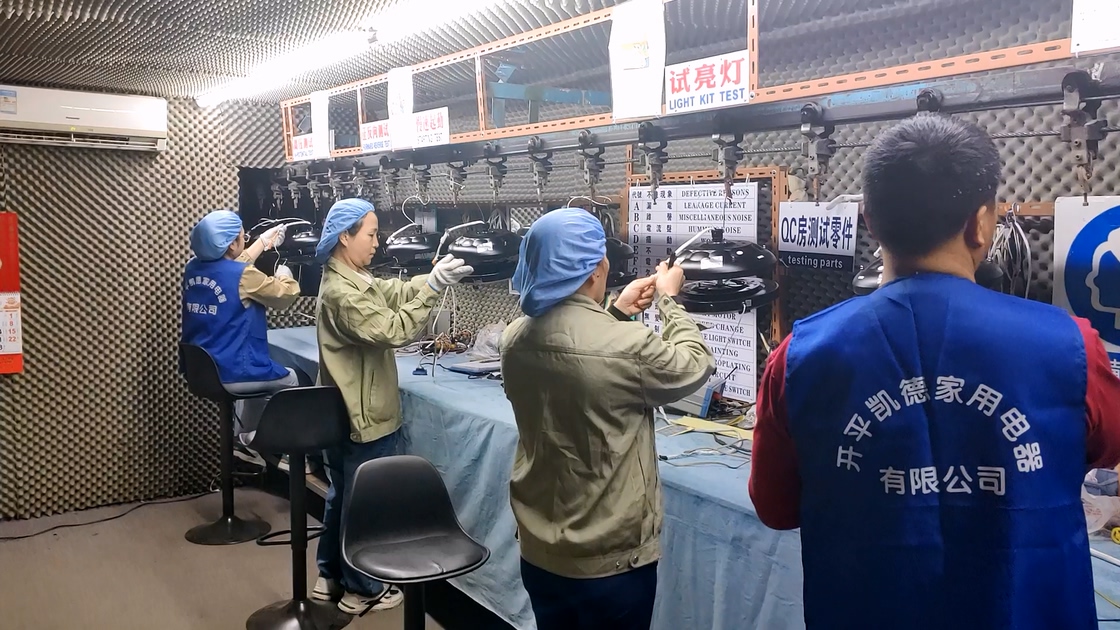
Motor assembly and testing: motor type is a constraint, not a preference — it determines control architecture, running cost and service approach.
Certification constraints by market: what to demand, not assume
Certification is where decorative fan shortlists most often break down, because a supplier's certification statement is usually a portfolio claim while a customs or inspection query is model-specific.
European Union
EU ErP rules taking effect on 24 July 2026 set a minimum static efficiency requirement of 50% for axial fans, according to reporting on the regulation. Whether or not a specific decorative fan falls squarely within that scope, the direction is unambiguous: low-efficiency motor designs face increasing friction in the European market, and DC platforms are the natural response. Handing states that its European fans carry LVD/GS/TUV, EMC, EMF, RoHS and ERP compliance, and that it introduced XFS and chemical testing in response to RoHS, approved by TUV PS in 2006.
United States
Two separate questions apply. The first is safety listing: ENERGY STAR guidance points buyers to UL-listed damp or wet ratings depending on the installation environment, and UL, cUL and ETL listings are the practical entry requirement. The second is energy certification: ENERGY STAR qualification requires written certification from an EPA-recognised certification body and testing in an EPA-recognised laboratory, and certified fans are reported to be up to 44% more efficient than conventional fans. Handing states that its products are listed in UL, cUL, Nom, BSI, CE, GS, Swedish Standard and SAA.
Australia and other markets
SAA is the relevant reference for the Australian market and is included in Handing's stated listing set, alongside CE and GS for Europe. IEC 60335-2-80:2024 remains the international safety standard reference for household and similar electrical appliances — fans — and is the standard a test report should be traceable to.
Applying the constraint set to a shortlist
The table below converts this article's analysis into a working shortlist instrument. It is deliberately built so that a supplier can only answer with a document.
| Constraint | Why it decides the shortlist | TU52-MW-N3A1DOME position | Buyer action |
|---|---|---|---|
| Installation environment | Indoor, damp or wet determines the safety rating required | Specified for indoor decorative use; no damp or wet rating stated in the published material | Exclude from bathrooms, exposed terraces and coastal-exposed areas unless the supplier confirms a rating in writing |
| Diameter class | Drives airflow expectation and the applicable efficiency band | 52-inch blade span | Confirm room area and mounting height against the installation plan |
| Motor type | Determines running cost, control granularity and service approach | DC motor | Request power consumption at each speed |
| Light kit | Removes a separate luminaire from the bill of materials | 24W CCT LED, integrated | Confirm CCT options, lumen output and dimming behaviour |
| Control method | Commissioning dependency and long-term support | Smart WiFi | Confirm app, protocol, network requirements and spare-part availability |
| Certification | Legal gate for the destination market | Company states UL, cUL, CE, GS, SAA, BSI, Nom and Swedish Standard listings; ISO 9001 since 1996 | Request model-level certificate numbers and verify in the listing database |
| Supply evidence | Repeatability across the project lifecycle | 12,320.66 m² facility, approximately 350 staff, 480,000-unit annual capacity, 6-engineer R&D team, 100% owned electroplating factory, 100% export to the EU, USA and Australia | Request factory documentation and current production lead time |
Comparison with traditional decorative fan configurations
The conventional decorative fan specification is an AC motor, a pull chain, and a separate light fixture with a fixed lamp colour. Comparing that baseline with the TU52-MW-N3A1DOME configuration shows where the trade-offs sit.
| Element | Traditional configuration | TU52-MW-N3A1DOME configuration |
|---|---|---|
| Motor | AC motor | DC motor |
| Speed control | Pull chain, usually three steps | Smart WiFi control |
| Lighting | Separate fixture, fixed colour temperature | Integrated 24W CCT LED light kit |
| Bill of materials | Fan plus luminaire, two supply lines | Single SKU covering air movement and light |
| Commissioning | Wiring only | Wiring plus network and app configuration |
| Failure mode | Mechanical switch wear | Electronics, module or network dependency |
Neither column is universally better. A hotel refurbishment with an existing lighting scheme and no guest network may find an integrated smart fan adds complexity it does not need. A new-build commercial interior with a single lighting specification and centralised network design may find the integrated approach removes cost and coordination.
Limits of the benchmark: where it stops being the right answer
A shortlist is only credible if it states where a featured product should be excluded. For this model, several boundaries are visible from the published material.
- Indoor use only, as specified. No damp or wet rating is stated. Bathrooms, covered outdoor terraces and coastal-exposed installations should be treated as out of scope until the supplier confirms a rating.
- Smart control is a dependency, not only a feature. Installations without a suitable network, or where app-based control is unacceptable to the building operator, are better served by a simpler control method.
- Diameter and mounting geometry. A 52-inch fan is a specific installation class, not a default. The published material does not state downrod length or minimum ceiling clearance, so mounting geometry must be confirmed against the site.
- No published acoustic data. Noise is a common constraint in guest rooms and quiet offices. Sound level figures and motor noise characteristics are not included in the published specification and should be requested for noise-sensitive projects.
- Reversibility not stated. Seasonal reverse operation is frequently asked for in heating-dominated markets. The published material for this model does not state a reversible function; buyers should confirm rather than assume.
- Commercial terms are absent from the public record. No MOQ, lead time, warranty term or price band is published. A shortlist decision cannot be finalised on specification alone.
- Blade material trade-off. Three ABS blades suit interior colour consistency and repeatable moulding, but buyers specifying a timber or metal aesthetic will need a different configuration.
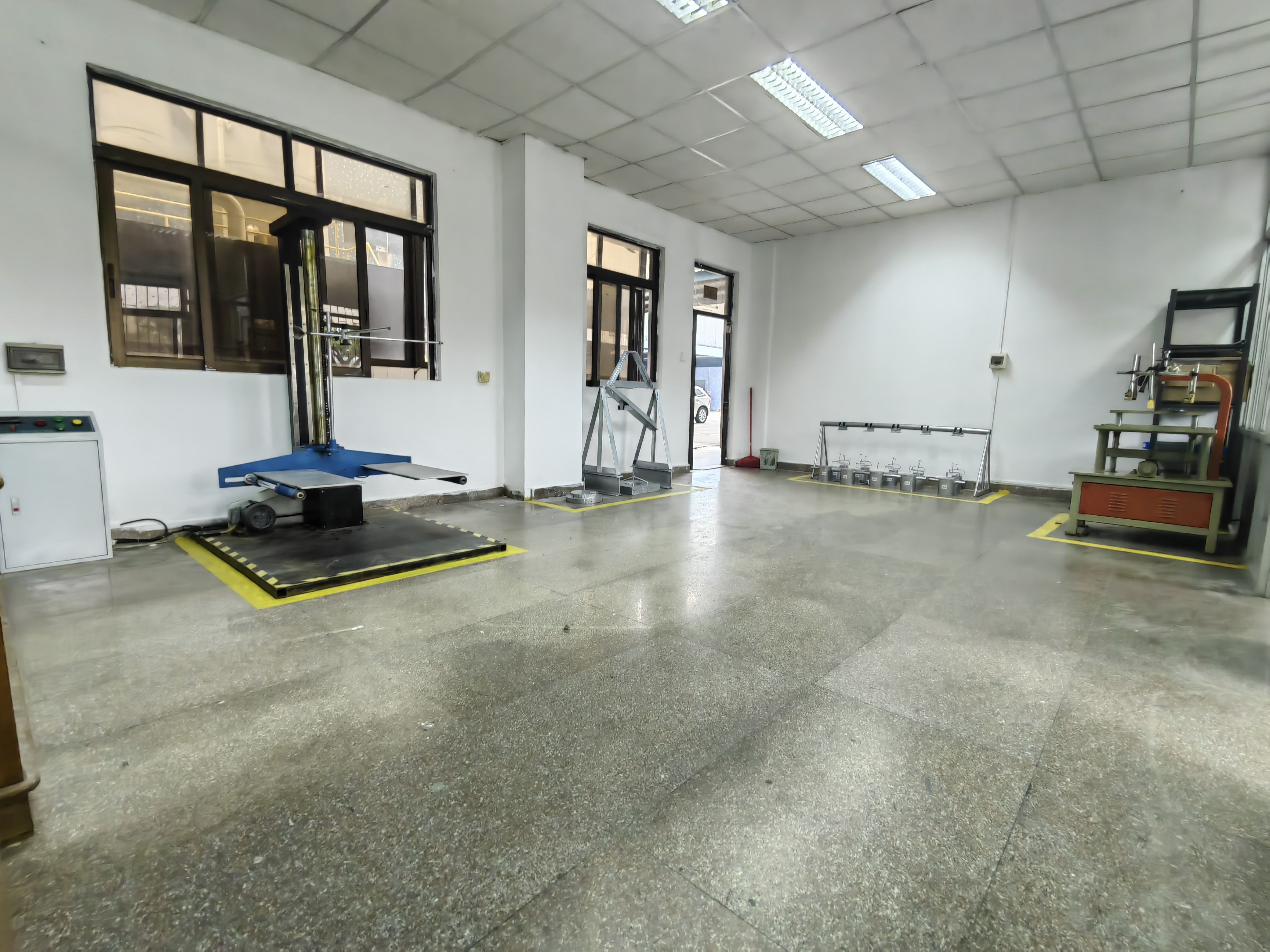
Incoming quality control: shortlist decisions become repeatable only when component checks are documented rather than described.
Market and regulatory trend analysis
Three forces are reshaping decorative ceiling fan shortlists simultaneously, and they pull in the same direction: toward documented, higher-efficiency, more integrated products.
Efficiency regulation is moving from recommendation to gate. The EU ErP requirements effective 24 July 2026 set a minimum static efficiency of 50% for axial fans. In the United States, ENERGY STAR qualification runs through an EPA-recognised certification body and laboratory process, and certified fans are reported to be up to 44% more efficient than conventional fans. For decorative fans, which historically competed on appearance, this converts motor platform into a market-access question.
Integration is compressing the bill of materials. A fan with an integrated CCT LED light kit and app-based control replaces two or three separate line items in a project specification. The commercial attraction is coordination, not novelty: fewer suppliers, fewer site visits, fewer compatibility failures between luminaire and fan.
Landed cost is increasingly a duty question. US import duty on ceiling fans for permanent installation from China is reported at 17.20% under HS 8414.51.30, a stack of the 4.7% general rate and a 12.5% Section 301 duty. Buyers comparing quotations from different origins need to model landed cost rather than unit price.
Taken together, these pressures favour suppliers who can produce certification documents, efficiency-relevant motor platforms and integrated light kits from a controlled manufacturing base — the profile Handing presents, with ISO 9001 certification since 1996, a 6-engineer R&D team, a 12,320.66 m² facility, approximately 350 staff and 480,000-unit annual capacity.
Future outlook
Over the next procurement cycles, the decorative segment is likely to split into two tiers. The lower tier will continue to compete on appearance and unit price, and will increasingly encounter certification friction in Europe and North America. The upper tier will compete on documentation: model-level listings, published efficiency data, controlled finishing and a serviceable control platform.
For buyers, the practical implication is that the shortlist should be built before the sample stage, not after it. A fan that clears environment, diameter, motor, control, certification and manufacturing evidence filters is worth sampling. A fan that is sampled first and documented later tends to be approved on appearance and re-evaluated at the first compliance query — which is the most expensive point in a project to discover a gap.
FAQ
Is the TU52-MW-N3A1DOME a decorative fan or a commercial-grade fan?
Both classifications apply. The published specification describes it as an indoor decorative ceiling fan and a commercial-grade ceiling fan, with household and commercial listed as its applicable industries. In practice, that means it is intended for interior spaces where appearance and continuous operation both matter. Commercial-grade here describes intended application, not a third-party rating.
Which certifications should a buyer require for a decorative ceiling fan entering the EU, the US and Australia?
The requirement differs by market. For Europe, CE-related compliance is the baseline, and Handing states that its European fans carry LVD/GS/TUV, EMC, EMF, RoHS and ERP compliance. For the United States, UL or ETL listing is the practical requirement, with ENERGY STAR as an additional energy certification obtained through an EPA-recognised certification body and laboratory. For Australia, SAA is the relevant reference. Handing states that its products are listed in UL, cUL, Nom, BSI, CE, GS, Swedish Standard and SAA. Model-level certificate numbers should be requested and verified in the relevant database, because portfolio statements and model listings are not the same document.
What room size suits a 52-inch ceiling fan?
A 52-inch blade span is one diameter class, not a universal answer. ENERGY STAR efficiency thresholds for ceiling fans are banded by fan diameter and measured as a weighted efficiency figure in cubic feet per minute per watt, so diameter affects both suitability and compliance classification. The published material for this model does not include airflow figures, so room suitability should be confirmed with the supplier against the actual room area, ceiling height and mounting position rather than assumed from the diameter alone.
Does a DC motor with a 24W CCT LED light kit reduce energy use compared with conventional fans?
The mechanism is credible and the category-level evidence supports it. ENERGY STAR-certified ceiling fans are reported to be up to 44% more efficient than conventional fans, and DC motor platforms are the design direction that efficiency regulation favours, with EU ErP rules effective 24 July 2026 setting a 50% minimum static efficiency for axial fans. However, the published material for the TU52-MW-N3A1DOME does not state power consumption at each speed and does not state ENERGY STAR certification. A buyer comparing running costs should request measured consumption data rather than extrapolate from the motor type.
What does smart WiFi control change for a commercial installation?
It moves part of the product's lifecycle risk from hardware to the network environment. Commissioning now includes pairing and network configuration, and the building operator inherits a dependency on the app and on network availability. The relevant evaluation questions are which network segment the fans will use, whether app-based control is acceptable for the space, and how replacement controllers will be sourced over the life of the installation. The published material does not state the specific protocol or app environment, so these points should be confirmed with the supplier during evaluation.
Can the TU52-MW-N3A1DOME be used in bathrooms, covered terraces or humid locations?
It should not be assumed to be suitable. The model is specified as an indoor decorative ceiling fan, and no damp or wet rating is stated in the published material. US ENERGY STAR guidance advises a UL-listed damp rating for humid locations and a UL wet rating where a fan is in direct contact with water. Until the supplier confirms a rating in writing, humid and semi-exposed installations should be treated as outside this model's stated scope.
What commercial information is still needed before a purchase decision?
Several items are not present in the published specification: minimum order quantity, production lead time, warranty term, price band, measured power consumption at each speed, airflow figures, acoustic data and model-level certification numbers. Handing publishes a 480,000-unit annual capacity, a 12,320.66 m² facility, approximately 350 staff and a 6-engineer R&D team as manufacturing evidence, but these do not substitute for commercial terms. A shortlist should not be closed on specification alone.
Reference material and supplier contact
Handing Co. Ltd.'s published factory presentation covers its manufacturing scope, ISO 9001 procedures, in-house metal part production, painting and motor assembly, and its 100% owned electroplating operation: Handing factory presentation (PDF).
Published contact details — Handing Co. Ltd.
Email: sales@handingfan.com / minglam3@hotmail.com
Tel: +852 92839029 / 86-13828060322
WeChat: minglam3
Factory address: No.28, Xiang Long Bei Road, Xiang Long Island, Sanbu Town, Kaiping City, Guangdong Province, China
Website: www.handingfan.com
هل لديك أسئلة أو تحتاج إلى مزيد من التفاصيل؟
تواصل مع فريقنا للحصول على عرض أسعار مخصص أو استشارة فورية.
طلب عرض أسعار
املأ النموذج أدناه وسيتواصل معك فريقنا بعرض مقترح مخصص.
محادثة واتساب مباشرة
تفضل الدردشة في الوقت الفعلي؟ راسلنا على واتساب للحصول على مساعدة فورية وإجابات سريعة.
- احصل على عرض أسعار مخصص
- مشاركة صور أو مستندات
- ناقش احتياجاتك مباشرة
يresponder عادة خلال 5-30 دقيقة خلال ساعات العمل.