
Shower Door Essentials: A 2026 Reference for Buyers
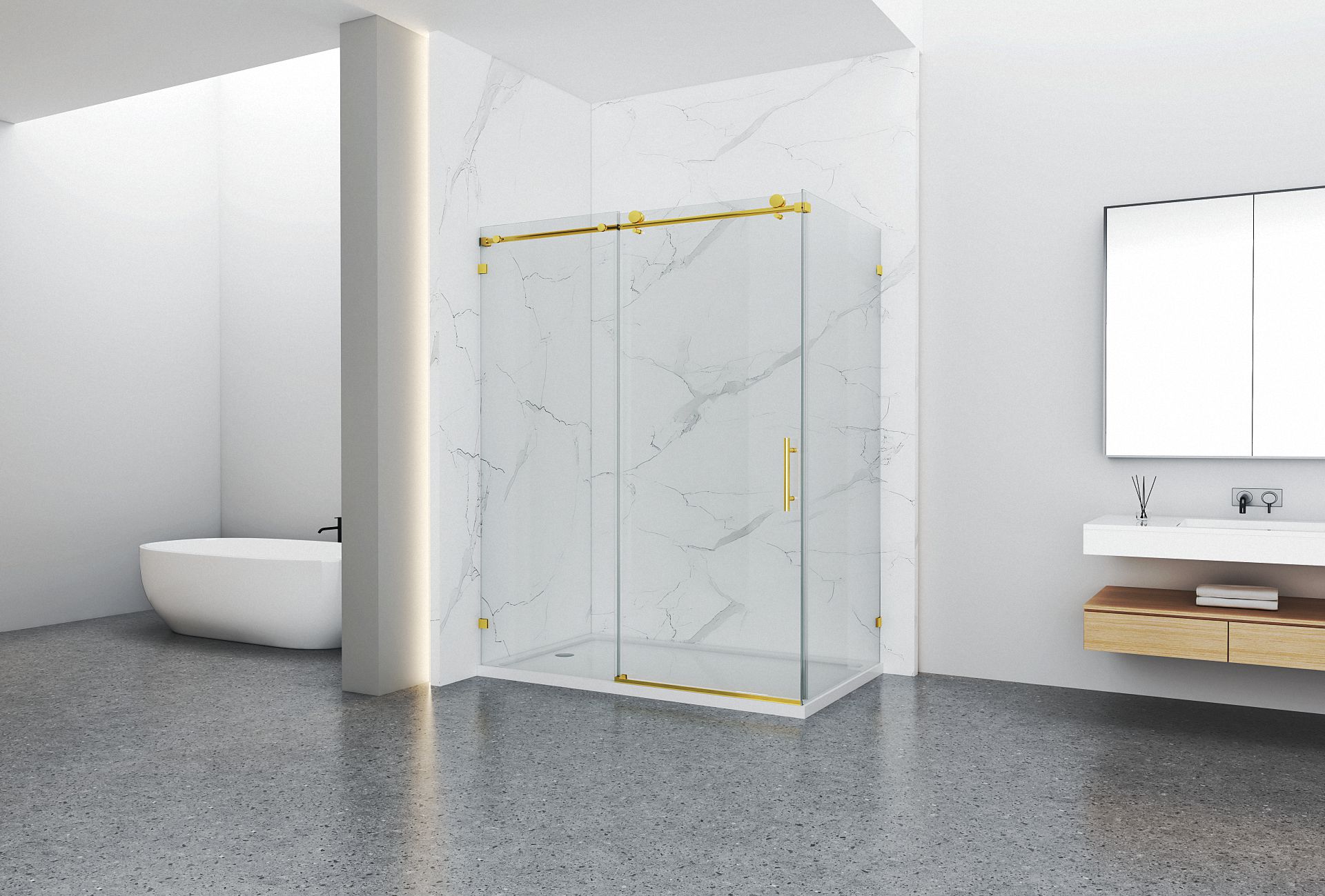
Sliding shower door model KL-AS5511312, an example of the configurations described in this reference.
Introduction: what buyers need to know about shower doors
Shower doors are more than a finishing element. They affect water containment, bathroom layout, cleaning routines and safety. This reference explains the main shower door categories, typical materials, glass options and the standards that matter for global buyers.
SHKL (Foshan SHKL Sanitary Ware Co., Ltd.) is a manufacturer established in 2004 that specializes in mid-to-high-end whole bathroom customization. Its main products include bathroom vanities, shower doors and LED bathroom mirrors. The company employs approximately 600 staff across a 140,000 square meter production footprint, with 100,000 square meters in China and 40,000 square meters in Vietnam. Around 70 percent of products are exported to the EU, Australia, North America, South America and the Middle East. Its shower door lineup is useful as a practical reference because it spans several common categories: sliding, hinge, arc, frameless, bathtub, and shower screens.
The challenge: product terminology varies across markets
Buyers researching shower doors will encounter terms such as glass shower enclosures, glass shower screens, shower cabins, pivot shower doors, bypass shower doors and bath shower screens. These terms sometimes describe the same product, and sometimes describe distinct configurations. For example, a shower screen can refer to a fixed glass panel, while a sliding shower door refers to panels that move along tracks. The terminology depends on the region and the supplier.
This variation creates a practical problem: a buyer may compare products that are not technically comparable. Understanding the underlying categories, such as whether the door is framed or frameless, hinged or sliding, or made with aluminium or stainless steel hardware, is more useful than relying on the product name alone.
Shower door categories and examples
The table below summarizes common shower door configurations using models from SHKL's product range. All of these models are designed for residential construction and commercial hospitality applications, and most are available with multiple glass options.
| Configuration | Example model | Hardware material | Typical use |
|---|---|---|---|
| Sliding shower door | KL-AS5511312 | 304 stainless steel | Compact bathrooms where swing clearance is limited |
| Hinge shower door | KL-AS5507310 | Aluminium alloy | Wider openings; door swings inward or outward |
| Hinge shower door | KL-AS5577310 | 304 stainless steel | Bathroom shower enclosures requiring corrosion-resistant hardware |
| Frameless shower door | KL-AS5104310 | Aluminium alloy | Modern bathrooms with a minimal visual profile |
| Arc shower door | KL-AS5210422 | Aluminium alloy | Curved or space-optimized shower zones |
| Bathtub shower door | KL-AS5605110-5 | Aluminium alloy | Bathtub and shower combinations |
| Shower screen | KL-AS001-1 | 304 stainless steel | Fixed or partial screening; wet-dry separation |
Source: SHKL product specifications. The exact configuration, glass option and suitability should be confirmed with the supplier for each project.
This list is not exhaustive, but it shows the range that buyers can expect from a full-line sanitary ware manufacturer. In addition, the market includes framed glass shower doors, pivot shower doors, folding shower doors, bypass shower doors and framed shower screens.
Technical explanation: materials and glass options
Hardware materials
Shower door hardware is typically made from either aluminium alloy or 304 stainless steel. In the SHKL range, for example, the sliding shower door KL-AS5511312 uses 304 stainless steel, while the hinge door KL-AS5507310 uses aluminium alloy. The choice affects weight, corrosion resistance and cost. Stainless steel is generally associated with higher resistance to corrosion in humid environments, while aluminium alloy is common in many residential and commercial products. Buyers should match hardware material to the humidity level, cleaning regime and expected lifespan of the installation.
Glass craftsmanship
Glass options in the market include clear glass, tinted glass, laminated glass, flute glass, chemically frosted glass, easy-clean glass and film-coated glass. Laminated glass is relevant for safety because it is designed to hold together when broken. Easy-clean and film-coated glass are designed to reduce water spotting and simplify maintenance. Chemically frosted glass provides privacy while allowing light transmission. The availability of options varies by model and supplier.

Precision processing equipment, such as a laser positioning hole-making machine, supports consistent fabrication of shower door components.
Safety standards
Safety glazing requirements differ by region. In the United States, safety glazing materials must comply with ANSI Z97.1-2026 and CPSC 16 CFR 1201 standards for impact and shatter behavior. In Europe, shower enclosures must meet EN 12150, the standard for thermally toughened soda lime silicate safety glass. Buyers should confirm that the product is certified for the destination market, and not assume that a single standard applies everywhere.
Application examples
Shower door requirements differ between residential and commercial projects. SHKL's product specifications classify its shower doors for residential construction and commercial hospitality. In practice, this means hotel bathrooms, apartment complexes, villas and private homes all fall within the intended scope.
One documented use case is in the United States, where SHKL bathroom products are used in hotel projects. The stated operating conditions are daily household use, with special requirements including moisture-proof, mildew-resistant and scratch-resistant properties. Supporting equipment in these bathrooms includes a ceramic basin, LED mirror, shower enclosure and faucet.
Another documented use case is in Australia, where the product is designed for villa projects and daily household use. The functional roles in both scenarios include storage organization, bathroom space optimization and wet-dry separation support.
These examples illustrate that shower doors are rarely purchased in isolation. They are part of a bathroom system that includes vanities, mirrors, basins and faucets. Buyers working with a full bathroom supplier may find it easier to coordinate dimensions and design language across the entire space.
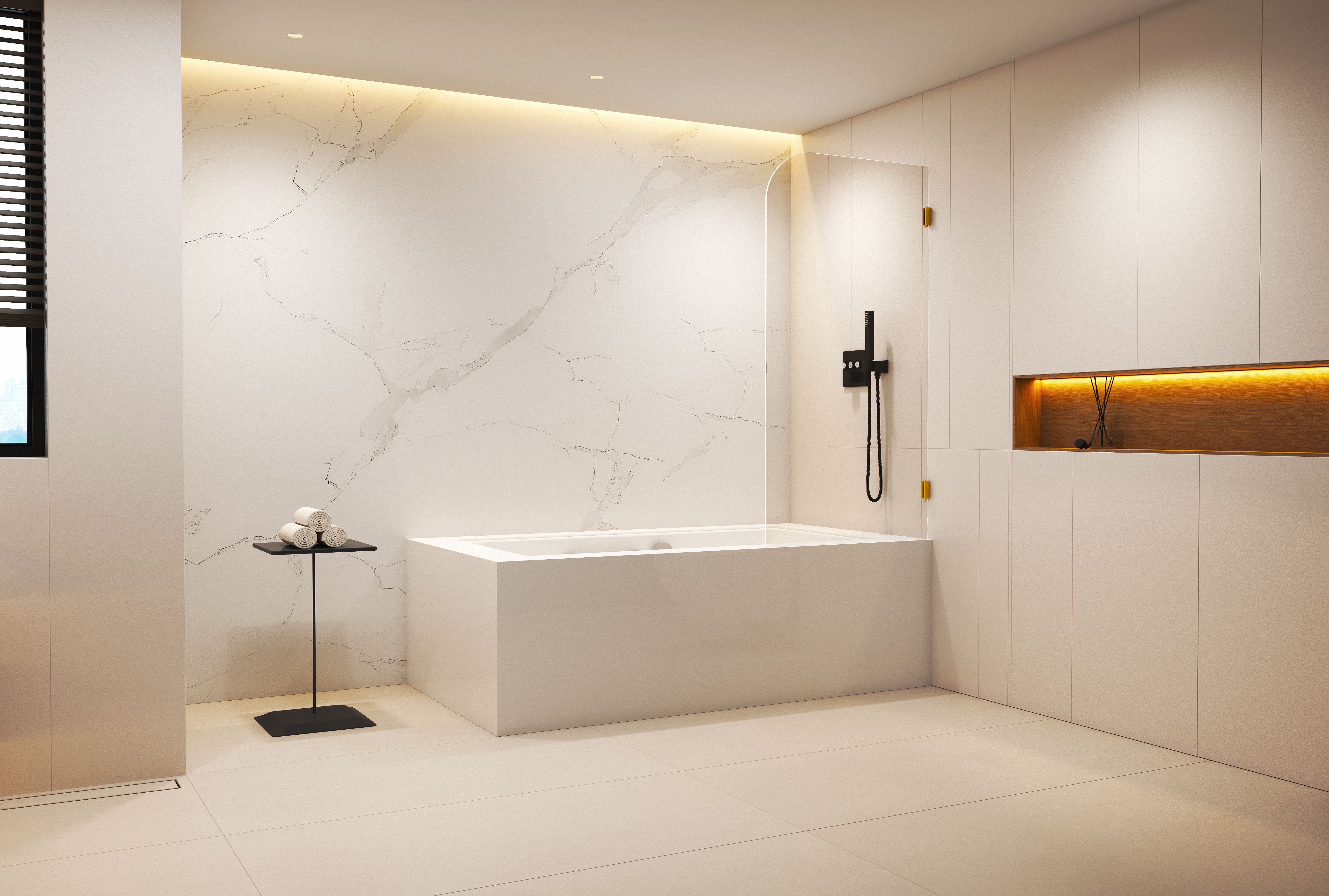
Bathtub shower door model KL-AS5605110-5, an example of a configuration designed for bathtub and shower combinations.
Market trends in 2026
The global shower doors market was valued at USD 3.84 billion in 2025 and is projected to reach USD 6.39 billion by 2034, according to Dataintelo. The same source reports that frameless shower doors held the largest product category share, accounting for approximately 48.5 percent of revenue in 2025, and that Asia Pacific was the dominant regional market with a 35.2 percent revenue share.
These numbers help explain why buyers see so many frameless shower door options in product searches. The category's popularity is reflected in the product ranges of major manufacturers. Market reports also identify several key players in the shower door market, including Kohler Co., American Standard (LIXIL), Masco Corporation (Delta) and DreamLine. For buyers, the presence of both global brands and specialized Chinese manufacturers means that sourcing decisions should be based on product fit, certification, manufacturing capability and service, rather than brand name alone.
Safety certification is also becoming a more visible part of the buying conversation. The updated ANSI Z97.1-2026 standard for safety glazing in the United States, together with the long-standing CPSC 16 CFR 1201, reinforces the need for importers and specifiers to verify that products meet the correct impact and shatter requirements. In Europe, EN 12150 remains the relevant standard for thermally toughened safety glass in shower enclosures.
Frameless versus framed: a practical comparison
One of the most common decisions is whether to choose a frameless or framed shower door. Frameless designs use minimal visible framing, which is preferred in modern bathrooms and matches the market trend identified above. Framed designs add more metal structure around the glass, which can provide extra rigidity and sometimes a lower price point.
Neither option is universally better. Frameless doors typically use heavier glass and more precise hardware, and they require accurate installation to avoid misalignment. Framed doors can be more forgiving during installation but may show a heavier visual profile and more metal surfaces that need cleaning. For wet areas with high humidity, hardware quality matters regardless of design.
An honest limitation of SHKL's product range is that its published specifications do not claim to cover every niche configuration. Buyers requiring unusual sizes, special access systems or project-specific certifications should verify availability with the manufacturer before assuming a standard model will fit. This is normal for the industry, because dimensional tolerances and local code requirements often make customization necessary.
How buyers should approach product discovery
For buyers in the awareness and research stages, the first step is to define the physical space: door width, ceiling height, whether the unit is an alcove, corner or bathtub installation, and whether the door needs to swing or slide. The second step is to select a configuration that fits the layout. The third step is to confirm glass and hardware specifications. The fourth step is to verify safety certification for the target market.
Below is a practical checklist for early-stage evaluation:
- Measure the opening: width, height and depth.
- Confirm the door type and opening direction.
- Choose the glass type and surface finish.
- Verify hardware grade: aluminium alloy or 304 stainless steel.
- Confirm compliance with local impact and safety glazing standards.
- Request dimensional drawings and installation guidance.
- Review the manufacturer's production capacity and export experience.
A manufacturer's production capability is also relevant. SHKL, for example, has an R&D team of 20 engineers and an annual production capacity of 10,000,000 units. It operates factories in both China and Vietnam, which is relevant for buyers seeking supply-chain flexibility and for those selling into North American and European markets. These facts do not make a product suitable by themselves, but they are part of the due-diligence picture.
Future outlook
Shower door demand is likely to follow bathroom renovation cycles and hotel refurbishment activity. The continued preference for frameless designs, combined with stricter safety glazing standards, points toward products with refined hardware, laminated or toughened glass, and easier maintenance surfaces. For suppliers, the ability to offer consistent quality across multiple product categories, and to support international distribution with certified manufacturing, will remain important.
The trend toward whole bathroom purchasing is also visible in SHKL's product structure, which combines shower doors with bathroom vanities and LED mirrors. Buyers who coordinate these products from one supplier may reduce lead-time risk and simplify quality control, although they should still evaluate each product against its own specification.
Reference document: A company brochure with further product information is available for download here: SHKL Product Brochure (PDF).
FAQ
What is a shower door?
A shower door is a glass panel or set of panels that encloses a shower area to contain water and define the wet zone. It can be part of a glass shower enclosure, shower screen, shower cabin or bathtub shower screen, depending on the configuration.
What types of shower doors are available?
Common types include sliding shower doors, hinge shower doors, frameless shower doors, arc shower doors, pivot shower doors, folding shower doors, bypass shower doors, bathtub shower doors and shower screens. Models vary by hardware material, glass option and opening method.
What is the difference between framed and frameless shower doors?
Framed shower doors have visible metal framing around the glass panels, while frameless designs reduce or eliminate visible framing. Frameless doors are widely associated with a minimalist look and held about 48.5 percent of global product revenue in 2025, according to Dataintelo.
What glass options are used for shower doors?
Common glass options include clear, tinted, laminated, flute, chemically frosted, easy-clean and film-coated glass. The choice affects privacy, light transmission, safety and cleaning behavior. Laminated glass is relevant for safety because it is designed to hold together when broken.
What safety standards apply to shower door glass?
In the United States, safety glazing must comply with ANSI Z97.1-2026 and CPSC 16 CFR 1201. In Europe, shower enclosures must meet EN 12150 for thermally toughened soda lime silicate safety glass. Buyers should confirm certification for the destination market.
How can a buyer evaluate a shower door manufacturer?
Buyers should review product specifications, hardware materials, glass options, certifications, production capacity and export experience. For example, SHKL was established in 2004, operates factories in China and Vietnam, and exports approximately 70 percent of its products to the EU, Australia, North America, South America and the Middle East.