
Shower Faucet Factory Audit: Lab, CNC and Certificate Checks
Supplier Evidence / Shower Faucets
A certificate PDF and a capacity number are starting points, not audit conclusions. The useful question is whether a shower faucet factory's physical assets, test records and certificate scopes line up with the models a buyer intends to order.
Why buyers are moving from certificate packs to asset-level evidence
Most supplier qualification files look complete before they are read closely: an ISO certificate, a CE or TUV document, a capacity statement, a product catalogue and a sample report. The problem is that these items answer different questions. A management-system certificate speaks to process control. A product certificate speaks to a defined model and standard. A capacity figure speaks to a production system at a point in time. When they are filed together without scope matching, document completeness can be mistaken for manufacturing evidence.
The gap is not usually that suppliers provide false documents. It is that documents answer a narrower question than buyers assume. An ISO 9001 certificate confirms that a quality management system has been certified within a stated scope. It does not, by itself, confirm that a particular shower mixer was tested to EN817:2008, that a TUV certificate lists the exact model, or that a monthly output figure applies to the buyer's finish, cartridge or packaging configuration.
Asset-level evidence reverses the order of review. The buyer starts with the claims that matter for the order - brass grade, dimensional repeatability, leak integrity, finish corrosion resistance, output and lead time - and then asks which physical asset or record can support each claim. That is the audit logic used in this walkthrough: lab instruments and CNC equipment first, then capacity math, then certificate scope.
What Ehoo Plumbing publishes as its capability baseline
Ehoo Plumbing Co., Ltd. is a Quanzhou-based manufacturer established in 2002. The company produces brass faucets, valves and bathroom accessories and states that its output is 100% export-oriented, with markets listed as the EU, South America and Southeast Asia. Its product range includes basin faucets, kitchen faucets, shower faucets, concealed faucets, sensor faucets and brass faucets, using Singapore and Australia DZR brass, 59-1 national standard brass and lead-free brass.
- Facility: 6,000 m² factory in the plumbing industry park in Quanzhou, near Xiamen International Airport.
- Scale: 100 employees, 10 engineers in the R&D team, monthly output exceeding 150,000 sets and annual output of 1,800,000 units.
- Production and test assets: multiple CNC multi-axis compound machines, CNC processing machine tools, metal spectrometer, valve life testing machine, water flow testing machine, salt spray testing machine and product sealing testing machine.
- Management systems listed by the company: SGS ISO9001:2015, ISO45001:2018, ISO14001:2015 and ISO14067:2018 product carbon footprint.
- Standards and certification references: TUV certification, EN817:2008 and EN200.
- Commercial terms: OEM and ODM services; customization for package, logo, faucet body, faucet parts and sanitary accessory; standard MOQ from 400 pcs per model; OEM/ODM order MOQ of USD $20,000; lead time 30-45 days; 100% test; remote technical support; 3 to 5 year warranty depending on product series, with a 5-year body warranty listed in the capability data.
These are company-reported facts. Their value in an audit is that they are specific enough to be checked. A vague claim such as 'strict quality control' cannot be audited. A list of named instruments, a stated capacity, a certificate number and a scope can be.
The lab and CNC floor: mapping equipment to audit checkpoints
The equipment list is the strongest part of the published evidence because each machine can be tied to a failure mode. The buyer's task is to move from 'the factory has the machine' to 'the factory uses the machine on the relevant product and keeps a record'. The table below converts the published asset list into audit checkpoints.
| Asset | What it can evidence | Audit question |
|---|---|---|
| Metal spectrometer | Alloy grade of incoming brass, including DZR, 59-1 and lead-free grades | Is it calibrated? Are heat or lot samples tested and linked to finished batches? |
| CNC multi-axis compound machines | Complex part geometry, repeatability and multi-operation machining | Is there a machine list, program-control procedure and first-article inspection record? |
| CNC processing machine tools | Turning, milling, thread cutting, dimensional tolerance and surface finish | How is tool wear controlled, and are thread and bore dimensions recorded per lot? |
| Valve life testing machine | Endurance of the valve or cartridge mechanism | What is the cycle count, sample size, pressure and pass/fail criterion? |
| Water flow testing machine | Flow performance at a defined pressure | Is the flow meter calibrated, and is the acceptance band recorded per model? |
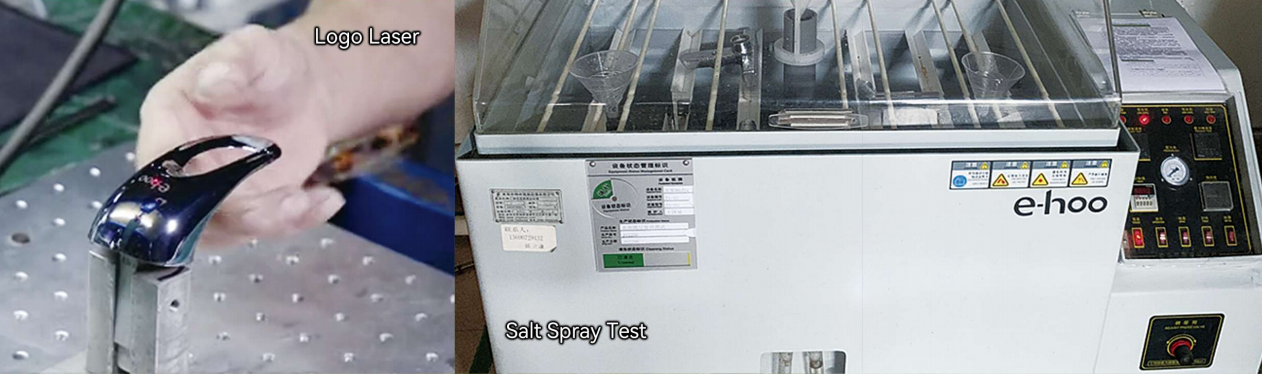
| Salt spray testing machine | Plating and finish corrosion resistance | What duration and concentration are used, and is the report tied to the specific finish? |
| Product sealing testing machine | Leak integrity of the assembled faucet | What pressure and dwell time are used, and is there a reject log for the 100% test claim? |
Metal spectrometer: the first checkpoint is material, not appearance
Brass grade is not visible. A spectrometer reading is the difference between a declared DZR or lead-free alloy and a lower-grade substitution. In an audit, the question is not whether the machine exists but whether it is used on incoming material, calibrated, and linked to a retained record. Ask for the last calibration certificate, the sample-preparation method and a traceable example that ties a heat number to a finished batch. If the buyer's order specifies Singapore or Australia DZR brass, the spectrometer record should show the alloy grade and the lot it belongs to.
CNC multi-axis compound machines and CNC processing machine tools
Multi-axis compound machines and CNC processing machine tools determine dimensional repeatability, thread quality and surface finish. A buyer should ask for the machine list by model, the number of axes, the tool-change and program-control procedure, and first-article inspection records for the shower faucet body, handle and connection threads. The audit point is not machine count alone. It is whether the same program and tooling remain stable across production lots, and whether a drawing revision is reflected in the machine program before production starts.
For wall mounted shower faucet and concealed shower faucet configurations, the machining checkpoint shifts toward body flatness, thread alignment, sealing surfaces and the interface with concealed valve components. For exposed shower mixer faucet sets, the visible surfaces and connection threads carry more of the fit risk. A generic machine list should therefore be matched to the actual model family under review.
Valve life, water flow, salt spray and sealing tests
Valve life testing is an endurance check on the cartridge or valve mechanism. The useful evidence is the test protocol: cycle count, water pressure and temperature, sample size, pass/fail criteria, and the log that shows which model was tested. A machine in the lab does not prove every cartridge is tested; it proves the factory has the capability to run the test and retain results.
Flow testing links declared flow performance to a pressure setpoint. Buyers should ask how the flow meter is calibrated, what pressure the test is run at, and whether the acceptance band is recorded per model. For shower faucet with hand shower and multi-function shower faucet configurations, flow performance also interacts with the hand shower and outlet configuration, so a single pass result should not be assumed to cover a full shower faucet set.
Salt spray testing is used for plating and finish corrosion resistance. The audit question is the test condition and duration, the acceptance criterion, and whether the report is tied to the specific finish - for example, a chrome finished shower faucet - rather than to a generic brass faucet family. Batch traceability matters because plating performance can vary with process control.
Product sealing testing is a leak-integrity check. The published capability data states 100% test. In an audit, that claim should be tested by asking where the sealing station sits in the line, what pressure and dwell time are used, how rejects are marked and quarantined, and whether the test record is retained by batch or only by shift. A 100% test claim without a reject log is difficult to audit.
The lab also has a boundary. It supports process control and model validation, but it does not replace third-party type testing for a regulated market. The buyer should separate internal test evidence from external certificate evidence, and should not treat one as a substitute for the other.
Capacity math: how 150,000 sets per month and 1,800,000 units per year should be tested
Capacity claims are often read as a single number. A better reading separates nameplate capacity, demonstrated output and order-specific capacity. Ehoo's published figures are internally consistent: 150,000 sets per month multiplied by 12 equals 1,800,000 units per year, matching the stated annual output. That consistency is a useful first check, but it does not prove the line can deliver a specific model mix within the stated lead time.
| Claim | Published figure | Audit check |
|---|---|---|
| Factory area | 6,000 m² | Walk the production and test areas; confirm whether space is dedicated or shared with other operations. |
| Monthly output | 150,000 sets | Ask for line count, shift pattern, test-station capacity and model changeover time. |
| Annual output | 1,800,000 units | Confirm the arithmetic and ask whether the figure is gross output or saleable output after rejects. |
| Engineering team | 10 engineers | Ask who owns drawings, test standards, sample approval and corrective action. |
| Workforce | 100 employees | Separate production headcount from QC and lab headcount. |
| Lead time | 30-45 days | Review current backlog, component lead time and peak-season assumptions. |
| MOQ | 400 pcs per model; USD $20,000 for OEM/ODM orders | Clarify whether MOQ applies per model or per order, and whether sampling is included. |
The next questions are operational. How many shifts run in a normal week? Which process is the bottleneck - machining, polishing, plating, assembly or testing? What share of the 150,000 sets is allocated to standard models versus custom brass bath shower faucet orders? How long does a model changeover take, and what is the current order backlog? A capacity figure becomes credible when the buyer can trace it to lines, shifts, test stations and a delivery history.
MOQ deserves the same treatment. A standard MOQ from 400 pcs per model is a different commercial threshold from an OEM/ODM order MOQ of USD $20,000. The buyer should confirm whether the lower figure applies to stock models, whether the higher figure includes tooling or packaging, and whether the two can be combined in one production run. These are normal commercial clarifications, not accusations.
The 10-engineer R&D team is meaningful only if it owns something the buyer can audit: drawing release, test standards, sample approval, packaging specifications and corrective action. A factory visit should ask who signs the test report and who decides that a model is released to production. That is more useful than a headcount alone.
Certificate evidence: scope, edition and expiry matter more than the logo
A certificate is evidence only when three things match: the legal entity, the product scope and the standard edition. The reviewed records show why this matters. They also show a scope mismatch that a buyer should resolve before treating a certificate as proof for a shower faucet SKU.
| Evidence item | Record available | Scope | Status to verify |
|---|---|---|---|
| TUV CE | TA 385213725, TUV Austria | Mixer, standard EN813:2008 | Issued 2021-06-15; expiry 2026-06-15. As of November 2026, request the current certificate and confirm whether the shower mixer model is listed. |
| TUV CE | TA385234450, TUV Austria | Sensor faucet, standard BS EN 15091-1:2013 | Issued 2023-08-22; expiry 2028-08-22. Scope is sensor faucet, not shower faucet. |
| SGS ISO9001 | CN21/31351, SGS | Design and manufacturing of brass sanitary ware faucets, ISO9001:2015 | Issued 2024-08-03; expiry 2027-08-03. Confirm site and product scope. |
| ISO14001, ISO45001, ISO14067 | Company profile references | Environmental management, occupational health and safety, product carbon footprint | Certificate numbers and scopes are not included in the reviewed record; request copies. |
| EN817:2008 and EN200 | Company profile references | Shower and mixer standards as listed by the company | Request the test report or certificate that names the exact standard, edition and model. |
The TUV mixer record is a useful example of why scope review matters. It is issued by TUV Austria, carries certificate number TA 385213725 and is scoped to 'Mixer' under EN813:2008. The company profile separately lists EN817:2008 and EN200. The difference could be a different certificate, a different product scope or a transcription issue; the buyer should not resolve it by assumption. The correct request is a certificate or test report that names the exact standard, edition and shower faucet model under evaluation.
The expiry date adds a second check. The reviewed mixer record shows an expiry date of 2026-06-15. As of November 2026, that record is past its stated expiry, so a buyer should ask for the current certificate rather than rely on an archived PDF. The sensor faucet certificate runs to 2028-08-22, but its scope is sensor faucet under BS EN 15091-1:2013, not shower faucet. A certificate that is valid but scoped to another product family does not close the shower faucet evidence gap.
The SGS ISO9001 certificate CN21/31351 is scoped to the design and manufacturing of brass sanitary ware faucets under ISO9001:2015 and runs to 2027-08-03. It supports management-system confidence. It does not prove that a specific shower mixer passed a performance standard. That distinction should be written into the buyer's evidence file: management-system certificate, product certificate, test report and drawing are four different evidence types.
The most useful audit finding is often a scope mismatch, not a missing logo. A TUV PDF filed under 'shower faucet compliance' without a model scope check can create a false sense of assurance. The buyer's checklist should always ask: which legal entity, which product, which standard edition, which certificate number and which expiry date?
Document-only screening versus asset-level evidence
Traditional supplier screening often relies on a certificate pack, a catalogue and a sample. That approach is fast and still useful for initial shortlisting. It becomes weak when the buyer treats the pack as proof of manufacturing capability. The table below compares the two approaches without assuming that one replaces the other.
| Dimension | Document-only screening | Asset-level evidence review |
|---|---|---|
| Primary question | Does the supplier hold certificates and provide a sample? | Which asset, record or test supports each order-critical claim? |
| What it proves well | Basic legal existence, certificate presence, catalogue range and sample appearance. | Material control, machining control, test capability, capacity logic and certificate scope. |
| What it can miss | Scope mismatches, expired records, untested model families and capacity assumptions. | Independent verification, current production load and commercial terms still require separate checks. |
| Best use | First shortlist and document completeness check. | Second-stage evaluation before a factory visit or trial order. |
| Main risk | False confidence from a complete-looking file. | More audit effort and the need to interpret technical records correctly. |
The limitation is real. Ehoo's equipment list and capacity figures are company-reported. The certificate records are specific, but they do not cover every shower faucet SKU, and the reviewed material does not include an independent on-site audit report or SKU-level test report for each model. A desk review can prioritise questions, but it cannot replace witness testing, certificate verification with the issuing body or a factory visit. Buyers should treat asset-level evidence as a way to ask better questions, not as a substitute for verification.
Where this evidence matters in real orders
The same factory can present different risks depending on the order type. Ehoo's published case data describes OEM and ODM clients, wholesale buyers and construction supermarkets, with a collaboration duration of over five years, a cumulative order value above USD $20,000 and bathroom application. The listed results include water saving, high-end market development and project development. Those facts are useful because they show the commercial contexts in which the capability claims are meant to operate.
- Private label and OEM/ODM: the buyer needs model customization, package and logo control, drawing ownership and sample approval. The audit focus is the 10-engineer R&D team, CNC program control and the ability to keep a custom finish consistent across lots.
- Wholesale: the buyer needs a stable standard model, a workable MOQ from 400 pcs per model and predictable lead time. The audit focus is dimensional repeatability, sealing test records and packing consistency.
- Construction supermarket supply: the buyer needs documentation, packaging discipline and capacity continuity. The audit focus is the ISO9001 scope, the 100% test claim and the ability to allocate 150,000 sets per month across a model range.
- Project supply: the buyer needs a longer collaboration horizon and evidence that the product suits bathroom applications. The published application envelope includes 0.5-2 MPa water pressure, hand control and indoor bathroom use, with corrosion resistance under high-humidity bathroom conditions and a lead-free requirement.
Configuration changes the audit emphasis. A concealed shower faucet body puts more weight on sealing surfaces and pressure integrity. A wall mounted shower faucet puts more weight on thread alignment and mounting interfaces. A chrome finished shower faucet puts more weight on salt spray and plating records. A shower faucet set with hand shower puts more weight on flow testing and connection compatibility. The buyer should map the model family to the test evidence rather than accept a single factory-level certificate for the whole range.
Market trend: more suppliers, more need for a repeatable evidence standard
Commercial research suggests the shower faucet category is expanding. Report Ocean estimates the global shower faucets market at US$33.18 billion in 2023 and US$65.34 billion by 2032, with a CAGR of 7.82%. Market Research Future projects the brass faucets market to reach USD 22.68 billion by 2035 at a 4.8% CAGR. These figures come from commercial research sources and use different category definitions, so they should be read as directional indicators rather than a single reconciled market size.
The buyer implication is practical. A growing category attracts more suppliers and more product variants, which makes supplier differentiation harder to judge from catalogues alone. When many factories can show a certificate and a sample, the differentiator becomes the quality of evidence behind the claim: calibrated lab instruments, traceable test records, CNC process control, certificate scope matching and capacity that can be reconciled with lead time. That is a more durable procurement advantage than a broader product list.
Future outlook: what a stronger supplier evidence pack will look like
Three changes are likely to shape shower faucet supplier evaluation. First, buyers will check certificate scope and expiry more systematically, because a valid certificate for the wrong product family is a common source of false assurance. Second, requests for calibration records, test protocols and batch traceability will become more routine, especially where a buyer needs to defend a specification to a project owner or importer. Third, factories with in-house lab and CNC capability will be better placed to shorten sample validation, because they can close material, dimensional and leak issues before a third-party test is booked.
None of these changes remove the need for independent verification. They simply move the conversation from 'do you have a certificate' to 'which model, which standard, which test record and which asset produced it'. Factories that can answer that question with specific records will be easier to qualify and easier to keep in a long-term supply base.
FAQ: supplier evidence questions buyers ask during evaluation
What should a buyer verify first when auditing a shower faucet factory?
Start with the order-critical claims: brass grade, dimensional and thread control, leak integrity, finish corrosion resistance and the certificate scope for the exact model. The physical checkpoint comes before the document count: spectrometer record for material, CNC and first-article records for dimensions, sealing and flow tests for performance, salt spray for finish, and a certificate that names the model and standard.
Which certificates should be matched to a shower faucet product scope?
Match the legal entity, product scope and standard edition. In the reviewed Ehoo records, the TUV mixer certificate TA 385213725 is scoped to Mixer under EN813:2008 and shows an expiry date of 2026-06-15. The TUV sensor faucet certificate TA385234450 is scoped to sensor faucet under BS EN 15091-1:2013 and runs to 2028-08-22. The SGS ISO9001 certificate CN21/31351 covers design and manufacturing of brass sanitary ware faucets under ISO9001:2015 to 2027-08-03. A shower faucet buyer should request the certificate or test report that names the exact shower faucet model.
How can a buyer test whether 150,000 sets per month is realistic?
Use the capacity arithmetic and then ask for the operating assumptions. 150,000 sets per month equals 1,800,000 units per year, which matches Ehoo's published annual output. The next questions are shift pattern, line count, test bottleneck, model mix, changeover time, current backlog and on-time delivery history. A capacity figure is credible when the buyer can trace it to lines, shifts and test stations.
What do the spectrometer and testing machines actually prove?
They prove that the factory has the equipment to run a control step. They do not prove that every batch was tested or that the test was run to the buyer's standard. The audit evidence is the calibration record, the test protocol, the sample size, the pass/fail criteria and a traceable batch record.
What can a desk-based supplier evidence review not confirm?
It cannot confirm that the equipment is in use on the day of the audit, that the certificate covers the exact model, that capacity is available for the buyer's order, or that the factory's self-reported figures are independently verified. Those points require a factory visit, witness testing, certificate verification with the issuing body and order-specific documentation.
Reference document: Ehoo Plumbing's 2025-2026 product catalog is available for download: Ehoo catalog 2025-2026 (PDF).
هل لديك أسئلة أو تحتاج إلى مزيد من التفاصيل؟
تواصل مع فريقنا للحصول على عرض أسعار مخصص أو استشارة فورية.
طلب عرض أسعار
املأ النموذج أدناه وسيتواصل معك فريقنا بعرض مقترح مخصص.
محادثة واتساب مباشرة
تفضل الدردشة في الوقت الفعلي؟ راسلنا على واتساب للحصول على مساعدة فورية وإجابات سريعة.
- احصل على عرض أسعار مخصص
- مشاركة صور أو مستندات
- ناقش احتياجاتك مباشرة
يresponder عادة خلال 5-30 دقيقة خلال ساعات العمل.