
Showroom Visit vs Remote Evaluation: UPVC Door Sourcing
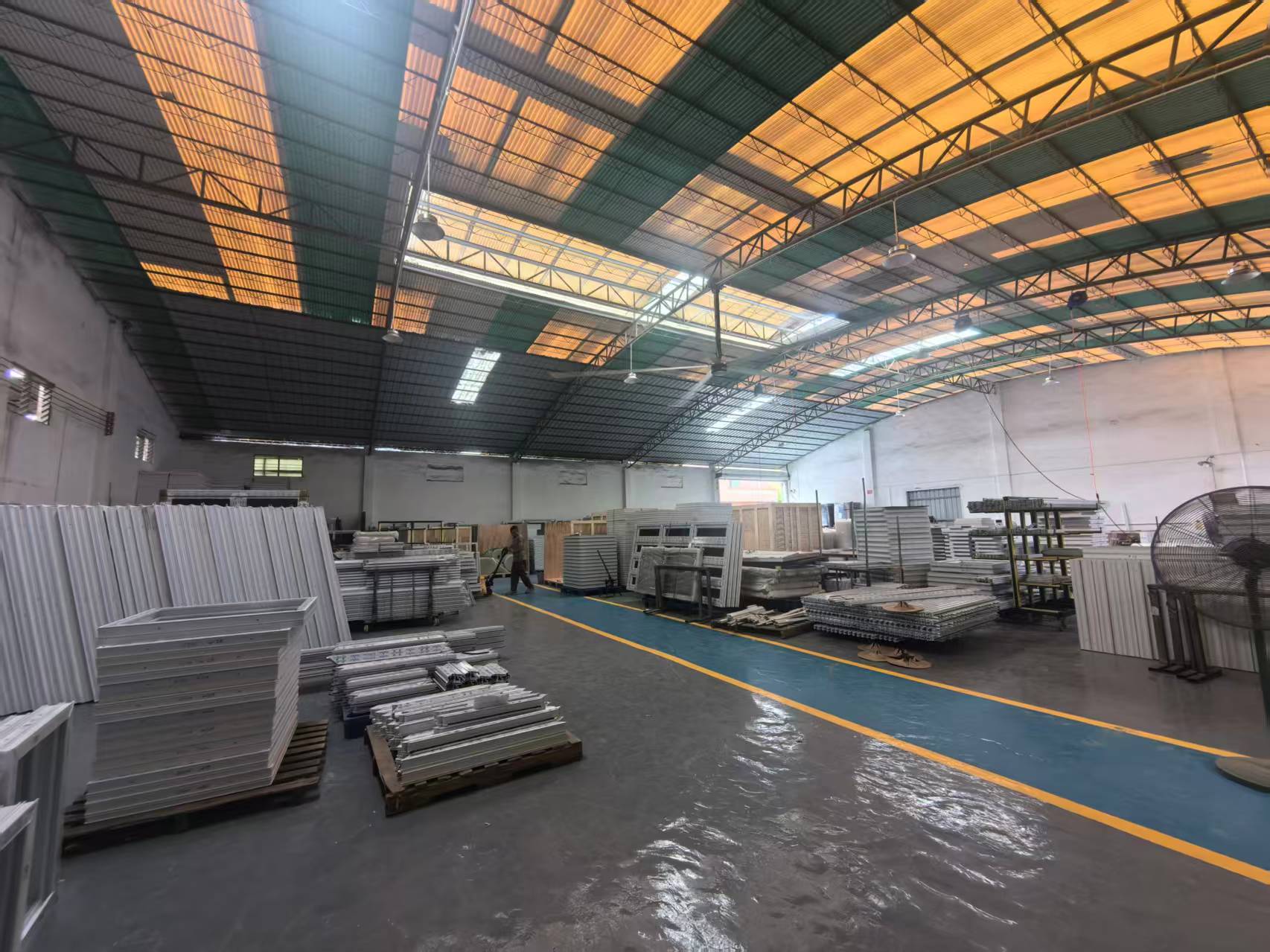
Two buyers can evaluate the same UPVC door range and reach opposite conclusions without either of them being wrong. One walks the factory sample showroom, opens a casement leaf by hand and runs a sliding panel along its rollers. The other never leaves the office and assembles a document file instead: an attestation number, a monthly capacity figure, a lead-time range and an export ratio. Each route produces genuine evidence. Neither produces complete evidence.
Choosing between a showroom visit and a remote factory evaluation is itself a procurement decision, and it is one that more buyers are making as the category expands. The global uPVC windows and doors market was valued at USD 30.8 billion in 2025 and is projected to reach USD 32.4 billion in 2026, according to Grand View Research, with Asia Pacific holding a 44.1% revenue share in 2025 and the doors segment forecast to grow at a 5.3% CAGR from 2026 to 2033. More volume moving through more fabricators means the buyer's real constraint is rarely finding suppliers — it is separating them quickly, and at a cost proportionate to the order.
Foshan Nanhai Yuanzhaiji UPVC Door & Window Factory is one of the suppliers buyers meet in that process. Established in 2009 and operating from a 3,000 ㎡ facility in Foshan, the company runs a 20-person team that includes 10 engineers, produces UPVC sliding doors, lift-and-slide doors, hinged doors and related European and American style door series, exports approximately 80% of its output, and maintains an on-site sample showroom for one-stop purchasing. Its documented evidence set — certification, capacity, lead time and order terms — is used below as the working example for comparing the two evaluation paths.
The Evaluation Problem: Two Paths, Different Evidence
A UPVC door is an assembled product. Its performance comes from the interaction between a PVC-U profile, the galvanized steel liner inside that profile, the welded corner joints, the sealing gaskets, the operating hardware and the glass. A quotation and a specification sheet describe that assembly; they do not demonstrate it. A showroom demonstrates an assembly; it does not describe factory capacity, certification scope or delivery commitments. That asymmetry is why the two paths are complements rather than substitutes.
The gap widens as sourcing becomes more remote. In a market where the doors segment is forecast to grow at a 5.3% CAGR between 2026 and 2033 and Asia Pacific already accounts for 44.1% of global uPVC window and door revenue, most purchase decisions are made by buyers who never see the production floor for the model they are ordering. Under those conditions, the useful question is not which evaluation method is better in general, but what each method can and cannot confirm before the order is placed.
Foshan concentrates the problem. Regional peers such as Foshan Wanjia Window and Door Co., Ltd. operate facilities of 538,195 sq ft and export to the US, Canada and Australia, which indicates the spread of scale a buyer encounters within a single sourcing trip to the district. When several factories sit within an hour of each other, a visit can cover a shortlist rather than a single candidate — and that changes how the visit should be scheduled relative to document review.
Path One: What a Sample Showroom Visit Verifies
A showroom visit verifies product-level attributes: surface finish, colour presentation across the displayed range, the feel and function of operating hardware, the identity of the profile system, and whether the supplier can present a coordinated door range rather than isolated samples.
At a showroom set up for one-stop purchasing, the checks that carry the most weight are physical and immediate:
- Profile system identity. Profiles are long-term supplied from Conch series 60, 65 and 88, available in co-extruded colour, laminated wood-grain finish and solid colour options including dark grey and black. A visitor can confirm which series and finish a displayed door actually uses.
- Door configuration and operation. Sliding, lift-and-slide, hinged and casement units can be cycled by hand, so the smoothness of travel, the weight of a leaf and the alignment of a frame are observable rather than described.
- Hardware and sealing components. Handles, hinges, rollers, anti-collision stoppers, dust-proof pile weatherstrip and EPDM sealing gaskets are all inspectable in place on a working unit.
- The structural check that matters most. Observing the profile end face confirms whether a galvanized steel liner is fitted inside the hollow PVC-U profile. Non-reinforced plastic profiles have no steel reinforcement, deform easily under load, and are not suitable for exterior or high-rise applications.
What the visit does not verify is equally specific: monthly output, certification scope, export documentation, lead-time commitments, minimum order quantity, delivery and payment terms, or the packing standard applied to an actual production order.
Path Two: What Remote Factory Evaluation Covers
Remote evaluation verifies factory-level and commercial attributes — the class of evidence that a showroom is structurally unable to display, because it concerns capacity, compliance and contractual terms rather than a finished sample.
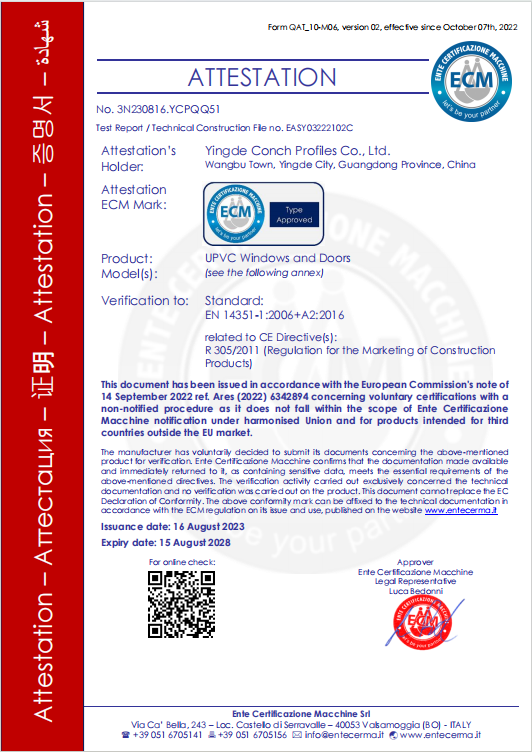
The document set associated with this Foshan manufacturer illustrates what a remote reviewer can actually confirm:
- Certification and its boundary. ECM Attestation NO.3N230816.YCPQQ51 was issued by Ente Certificazione Macchine Srl (ECM) on 16 August 2023 and is valid to 15 August 2028. It references EN 14351-1:2006+A2:2016 and covers UPVC windows and doors across profile series 50, 60, 65, 80, 88 and 112. The attestation is stated as intended for third countries outside the EU market — a scope condition, not a formality.
- Capacity and technical staffing. Monthly capacity is 4,000 ㎡ of UPVC door production, supported by a team of 20 staff including 10 engineers.
- Export exposure. Around 80% of output is exported, and production is organized to supply OEM and ODM door orders to the EU, Africa and USA markets.
- Order mechanics. The minimum order quantity for custom UPVC door orders is 30-40 ㎡, applying to door models HF60, WYK75-1 and HF88-L. Lead time is stated as 10-30 days, and customization covers door size, door specification and glass specification.
- Quality and commercial terms. Quality control is documented through a quality inspection report. Delivery terms are FOB or CIF, acceptance runs through pre-shipment inspection via photographs or on-site inspection, and payment is by bank transfer.
- Customs classification. The HS code for plastic doors, windows and their frames and thresholds is 392520.
These facts are addressable in a first email exchange and can be re-verified later. The closest a showroom comes to covering the same ground is a verbal statement about capacity or certification — which is not the same as a document a buyer can file, date and check against a destination market requirement.
Side-by-Side: What Each Method Can and Cannot Confirm
The two paths diverge on almost every verification dimension. The table below compares them using the evidence set described above.
| Verification dimension | Sample showroom visit | Remote factory evaluation |
|---|---|---|
| Surface finish and colour | Direct visual and tactile check on displayed units, including co-extruded, laminated wood-grain and solid colour options | Colour and finish options stated in documents; no batch-to-batch confirmation |
| Operation and hardware | Handles, hinges, rollers, anti-collision stoppers and EPDM gaskets operated by hand | Hardware list and drawings only; no feel or travel assessment |
| Profile identity and reinforcement | Profile end face inspected to confirm the galvanized steel liner | Profile series declared in the attestation scope (50/60/65/80/88/112) |
| Certification and market applicability | A copy may be shown; scope conditions are easy to skim past | Attestation number, standard, issue and expiry dates, and the third-country market statement are all checkable |
| Production capacity and lead time | Not observable from a showroom | 4,000 ㎡ monthly capacity; lead time stated as 10-30 days |
| Order terms | Usually discussed, less often documented on the day | MOQ 30-40 ㎡, FOB/CIF delivery, bank transfer payment |
| Export experience | Indirect, based on conversation | Approximately 80% export ratio; OEM and ODM supply to EU, Africa and USA markets |
| Packing and pre-shipment condition | Packaging samples may be on display | Pre-shipment inspection via photographs or on-site inspection; quality inspection report |
| Sample representativeness | Curated sample, not a draw from a production batch | Production-batch evidence is not available remotely either |
| Cost of the evaluation | Travel, time and schedule coordination | Minimal cost; limited by what a supplier chooses to disclose |
How Document Evidence Maps to Door Performance
Remote evaluation is only useful if the documents a buyer receives connect to performance attributes the project actually depends on. For UPVC doors, the mapping runs through the harmonized standard and the compound specification.
EN 14351-1:2006+A2:2016, the standard referenced by ECM Attestation NO.3N230816.YCPQQ51, organizes verification around wind resistance, water tightness, air permeability, sound insulation, thermal performance, drop-weight impact and welding corner strength. Those test domains are the technical basis for the attributes buyers search for in product descriptions — energy efficient and thermally insulating doors, soundproof and noise-reducing doors, weather resistant and waterproof doors, impact resistant doors, and corrosion resistant hardware for coastal environments. A buyer who can read a certificate scope can move from marketing language to the underlying test categories without leaving the desk.
The profile compound data gives a second, more granular layer. The relevant PVC-U material parameters are a Vicat softening point of 86 ℃, a flexural modulus of elasticity of 2,840 MPa, a tensile yield stress of 43 MPa, a tensile strain at break of 186% and a density of 1,520 kg/m³. The Vicat value speaks to heat resistance margins in hot climates; the modulus and yield stress describe stiffness under load; the strain at break indicates ductility before fracture. None of these numbers requires a visit, and all of them can be compared against a project specification.
Regulation adds a third filter that is purely documentary. Under the UK Future Homes Standard 2025, the maximum U-value for external doors decreases from 1.6 W/m²K to 1.2 W/m²K. A buyer targeting that market can screen suppliers on declared thermal performance before booking a single flight — which is precisely the division of labour that makes remote evaluation efficient.
Application Fit: Matching the Method to the Project
UPVC doors from this type of production are positioned for outdoor exposure in coastal high-humidity and strong-wind areas, and for residential buildings, commercial buildings, renovation projects and villa projects. Operation modes include manual opening and closing, tilt-and-turn opening and sliding operation, with matched components covering handles, hinges, rollers, anti-collision stoppers, dust-proof pile weatherstrip and EPDM sealing gaskets.
A recorded project illustrates how those attributes are tested in service. A builder order of 500 ㎡ of door product for an architecture application is documented with a ten-year service duration, with stable sealing performance, smooth switch operation and long-term service life reported, alongside high-quality profiles, corrosion-resistant hardware, tempered glass, low-noise sliding, water-proof and dust-proof performance, simple appearance and easy maintenance.
The practical decision rules that follow from the comparison are straightforward:
- First-time importer with no regional reference: schedule the showroom visit earlier, because finish and operation are the attributes that are hardest to compensate for after delivery.
- Repeat buyer adding a single model to an existing range: run remote evaluation first and reserve the visit for a genuine open question.
- Project in a regulated market with a U-value threshold: start with documents, because thermal performance, certification scope and standards are documentary facts.
- Buyer comparing several Foshan candidates: remote-screen all of them, then visit the shortlist on one trip rather than visiting factories in the order they were discovered.
Market Trend: Documentation-First Sourcing
Three market signals point in the same direction. First, absolute volume continues to grow, with the global uPVC windows and doors market projected at USD 32.4 billion in 2026 against USD 30.8 billion in 2025. Second, the product mix skews toward configurations that buyers want to see moving before they commit: sliding configurations accounted for 37.20% of uPVC door and window revenue in 2025, which is consistent with sliding and lift-and-slide units dominating showroom requests. Third, regulation is tightening, as the UK external door U-value threshold moving from 1.6 W/m²K to 1.2 W/m²K demonstrates.
One caution belongs in any market analysis. Published uPVC market size estimates differ by definition. Grand View Research reports USD 30.8 billion for 2025, while other research houses have published higher figures for adjacent periods, largely because some estimates include installation services or whole-construction value rather than manufacturer revenue alone. Buyers should treat a single market-size figure as directional context for category growth, not as a data point in a supplier assessment.
Where Each Method Stops Working
Both evaluation paths have hard boundaries, and the most expensive sourcing mistakes happen when a buyer treats one as covering the other's gaps.
- Certification scope is the most common misreading. ECM Attestation NO.3N230816.YCPQQ51 is explicitly intended for third countries outside the EU market. Presenting or accepting it as EU market conformity is a misapplication of a genuine document, and buyers whose destination falls inside the EU need to establish which route applies to their market.
- A showroom unit is a curated sample. It demonstrates the finish standard and the configuration a factory can produce; it does not represent a random draw from a production batch, and it does not establish batch-to-batch consistency.
- Documents have a shelf life. The attestation runs to 15 August 2028. Capacity and lead-time figures are current commitments rather than fixed constants — a 10-30 day lead time is a range that moves with queue and order volume, and monthly capacity of 4,000 ㎡ is a ceiling, not a promise of available slot time.
- Neither method verifies everything. Weld seam quality, gasket compression and hardware durability over years are not fully visible in a showroom walkthrough or in a document pack. They are addressed through pre-shipment inspection records and through service history, which is why a ten-year service record carries different weight from a display model.
- Financial disclosure is limited. For many regional fabricators, audited financial statements are not part of the standard document set, so due diligence rests on certification, capacity disclosure inspected at the pre-shipment stage, and reference projects rather than balance-sheet data.
Future Outlook
The direction of travel is documentation first, visit second. As more buyers purchase UPVC doors across borders, the first filter in a supplier shortlist is becoming a document check — certification scope, capacity, lead time, minimum order quantity and delivery terms — because those items are cheap to verify and disqualify quickly. The physical visit then concentrates on what documents genuinely cannot carry: the finish a buyer is willing to place in front of an end client, and the way a door leaf moves when it is opened.
Two secondary shifts follow. Certification literacy will separate buyers, because the difference between a valid attestation and a valid attestation with the wrong market scope is invisible to anyone who only reads the certificate number. And as customization of door size, specification and glass becomes standard rather than exceptional, evaluation will move from whether a factory can build a custom door to how reliably it repeats one — a question answered by inspection records and repeat orders, not by a showroom display.
FAQ
What can a showroom visit verify that remote documents cannot?
A showroom visit verifies product-level attributes directly: surface finish, the colour range actually on display, the operation and feel of handles, hinges, rollers, anti-collision stoppers and EPDM sealing gaskets, and whether the profile system presented matches the specification. The single most important on-site check is the profile end face, which shows whether a galvanized steel liner is fitted inside the hollow PVC-U profile. Remote documents can declare these attributes, but they cannot demonstrate how a specific door leaf moves or how a welded corner and gasket behave under hand pressure.
What does ECM Attestation NO.3N230816.YCPQQ51 cover, and what is it not valid for?
The attestation was issued by Ente Certificazione Macchine Srl (ECM) on 16 August 2023 and is valid to 15 August 2028. It references EN 14351-1:2006+A2:2016 and covers UPVC windows and doors across profile series 50, 60, 65, 80, 88 and 112. Its stated market scope limits its purpose: it is intended for third countries outside the EU market. It should therefore not be presented or accepted as evidence of EU market conformity, and buyers with EU-destination projects should establish which compliance route applies to their market.
How should a buyer interpret a 4,000 ㎡ monthly capacity and a 10-30 day lead time?
A monthly capacity of 4,000 ㎡ describes the factory's UPVC door production ceiling in a normal month, while a 10-30 day lead time is stated as a range rather than a fixed commitment. Both figures depend on order volume and the production queue at the time of ordering. In practice, these numbers are most useful for confirming that the requested volume sits comfortably inside the monthly ceiling and that the project schedule tolerates the upper end of the lead-time range.
What customization is available for OEM and ODM UPVC door orders, and what MOQ applies?
The manufacturer provides OEM, ODM and customizable production services, with production organized to supply OEM and ODM door orders to the EU, Africa and USA markets. Customization options cover door size, door specification and glass specification. The minimum order quantity for custom UPVC door orders is 30-40 ㎡, and this applies to door models HF60, WYK75-1 and HF88-L as well.
How can a buyer verify packing and pre-shipment quality without visiting the factory?
The documented acceptance route is pre-shipment inspection, carried out either through photographs or through an on-site inspection, together with a quality inspection report. Delivery terms are FOB or CIF, and payment is by bank transfer. For a remote buyer, the inspection step is where the loading condition, packaging and appearance of finished units can be confirmed before the shipment departs.
Does a showroom sample represent production output?
No. A showroom unit is a curated sample selected to demonstrate finish, configuration and operation, not a random draw from a production batch. A visit therefore establishes the finish and function standard a factory can produce, rather than batch-to-batch consistency. Consistency is verified later, through pre-shipment inspection records or through service history — the recorded case for this product line describes stable sealing performance and smooth switching over a ten-year service duration in a coastal architecture project.
Independent evaluation of UPVC door suppliers is not a choice between seeing and reading. It is a sequencing decision: documents first, because they are cheap, comparable and capable of disqualifying a supplier before travel; site visits second, because finish, operation and profile reinforcement are the attributes that only a physical door can settle.