
Signals That Matter in Barber Chair OEM Programs
Professional buyers evaluating barber chair suppliers for an OEM program do not need another product tour. The real question in 2026 is whether a factory can turn a catalog into repeatable production: clear minimums, honest lead times, defined customization depth, destination-market compliance evidence, and practical after-sales terms.
The category justifies that level of scrutiny. Independent market research values the global salon chairs market at approximately USD 10.57 billion in 2025, with projections reaching USD 18.4 billion by 2035. Within barber chair product reporting, hydraulic barber chairs account for about 42.5% of the market in 2025. Trade data adds a supply-side signal: the United States imported USD 102.37 million of barbers', dentists' or similar chairs and parts in 2023, and China supplied USD 65.35 million of that total, or 63.8%. Finding a barber chair factory is not difficult. Verifying which OEM signals deserve trust before moving from evaluation to execution is where the actual procurement work begins.
Where Evaluation Signals and Execution Reality Split
OEM is often treated as a short production word meaning logo application. In barber chair procurement, OEM normally involves more than that. A buyer evaluating a potential supplier needs clarity on how an order will behave after the sample is approved: whether the minimum batch is workable, how long production will take at different volumes, what customization is actually included, which market standards the materials can satisfy, and what the supplier does if products arrive damaged.
A common failure point appears when the marketing message is broad but the production data is thin. Suppliers may say that customization is available without specifying whether that customization covers color, logo, material finish, structural changes, or new tooling. Buyers may also see a compliance certificate and assume it covers the full product family, when the certificate scope may be limited to a specific material or market. In the move from evaluation to execution, these details become contract terms.
A China Export Manufacturer Built Around Salon Seating
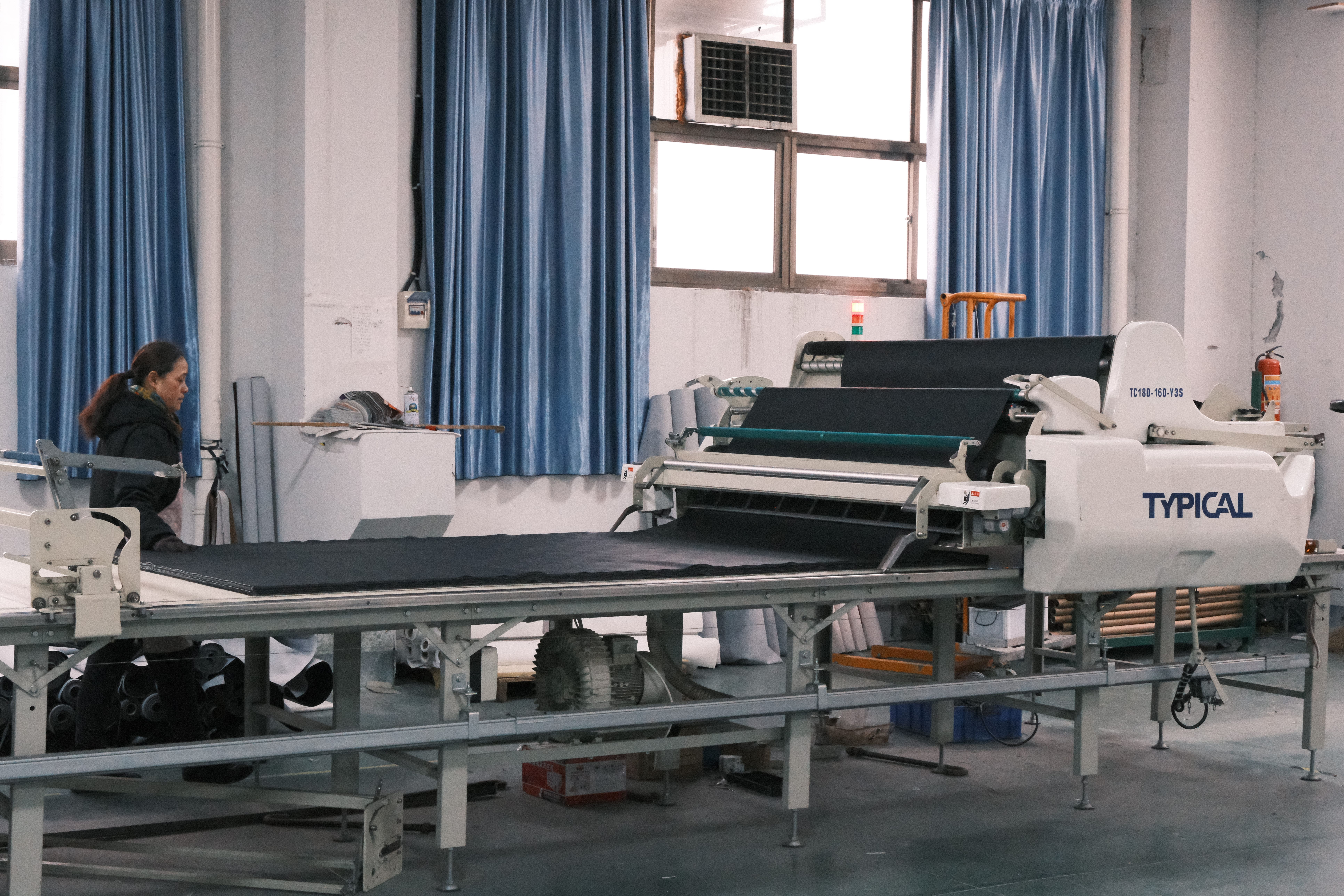
Ningbo Hongzi Beauty & Hairdressing Equipment Co., Ltd. is a China-based salon furniture manufacturer founded in 2012. The company operates from a production site of approximately 22,000 square meters in the Sanqi area of Yuyao, near Hangzhou Bay, with a stated annual output of 180,000 units and an in-house engineering team of 15. Its sales communication is based in Shenzhen. The company describes itself as export-oriented, with 100% of production exported mainly to North America and Europe.
The company's main product categories are barber chairs, shampoo chairs, massage beds, and manicure tables. The breadth matters for buyers who are outfitting a full salon or managing a dealer program, because it reduces the number of factories needed for a complete equipment package.
Production Parameters to Read Before Placing an OEM Order
OEM capability becomes measurable when the factory states production conditions in numbers. The public sourcing information for Hongzi documents the following order parameters:
| Order parameter | Stated level | What it means for a buyer |
|---|---|---|
| Production mode | OEM | The factory accepts buyer-directed production programs. |
| Customization scope | Logo and color | Customization is defined at the appearance level rather than open-ended design. |
| Monthly capacity | 15,000 units | Sustained monthly volume capacity for dealer or chain programs. |
| Minimum order quantity | 5 units | A low MOQ that allows pilot orders before large commitments. |
| Lead time under 100 units | 15 days | Small-batch replenishment follows a shorter production window. |
| Lead time over 100 units | 30 days | Larger orders carry a defined 30-day production lead time. |
| Quality control | 100% test | Products are described as fully tested before shipment. |
| After-sales policy | One-year pump warranty, resend damaged products | Hydraulic pump coverage and damaged-product replacement are stated. |
These parameters matter most at the execution stage. A 5-unit MOQ gives a distributor or brand owner room to validate quality before scaling. A documented 15-day lead time under 100 units is useful for reorder planning. A stated monthly capacity of 15,000 units signals that the factory is organized around continuous barber chair production rather than one-off assembly.
Model Coverage and Buying-Stage Flexibility
Product range is itself a capability indicator. The barber chair files connected to Hongzi's certification documentation cover 21 different barber chair models. The list spans classic hydraulic chairs, retro reclining models, heavy-duty chairs, gold-finished chairs, vintage styles, and standard salon styling chairs. A selection of these documented models illustrates the range:
| Model | Positioning type | Dimensions |
|---|---|---|
| HZ8700 | Classic Hydraulic Barber Chair | 110*72*90 cm |
| HZ8740BR | Hydraulic barber chair | 105*72*110 cm |
| HZ8702A | Reclining barber chair | 110*72*90 cm |
| HZ8799YF | Retro Reclining Barber Chair | 110*72*100 cm |
| HZ8799ABK | Gold barber chair | 110*72*100 cm |
| HZ87102RB | Heavy Duty Barber Chair | 111x66x118 cm |
| HZ8760G | Barber shop chair | 110*72*100 cm |
For a dealer that serves multiple salon segments, this type of range reduces the need to qualify separate factories for vintage decor, modern heavy-duty workstations, and classic hydraulic seating. The documented materials in this product family are consistently described as PU leather, high-density sponge, wood, and aluminum alloy, with several styling-oriented models using iron frames. A stable material base makes quality control and compliance verification more predictable than a catalog built on constantly changing component suppliers.
Traceable Compliance Evidence in the Sourcing File
For barber chairs exported to the UK, EU, and US, compliance documentation has become a sourcing requirement rather than a differentiator. The Hongzi compliance folder contains three documents that buyers can cross-check against their destination-market requirements:
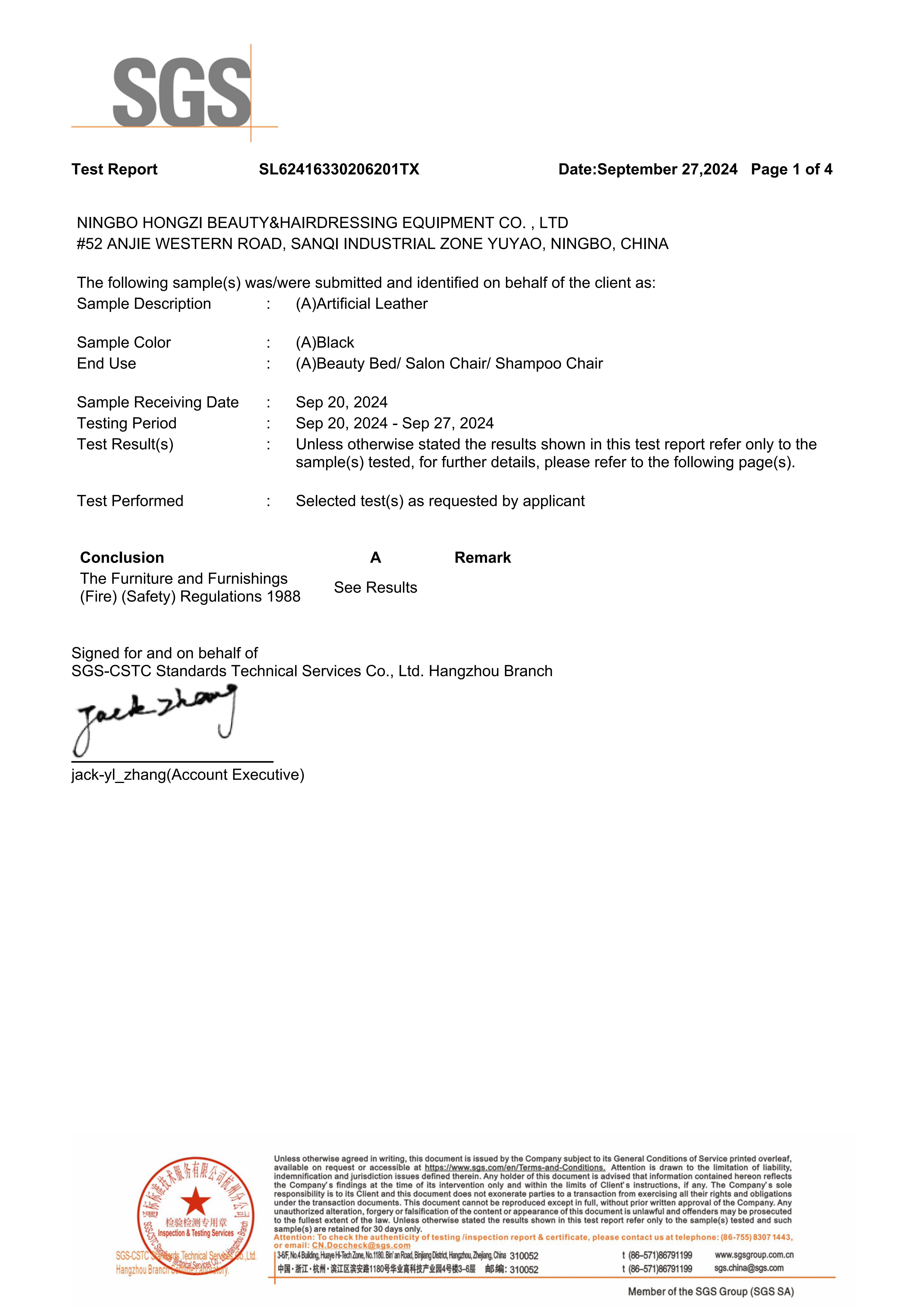
- SGS Flame Retardant Artificial Leather Test Report, certificate SL62416330206201TX, issued 2024-09-27, covering Beauty Bed, Salon Chair, and Shampoo Chair product categories for the UK market under The Furniture and Furnishings (Fire) (Safety) Regulations 1988.
- SGS Flame Retardant Foam Test Report, certificate SL62416330201301TX, issued 2024-09-27, covering Beauty Bed, Salon Chair, and Shampoo Chair categories for the EU and US markets under the same UK fire-safety regulation framework.
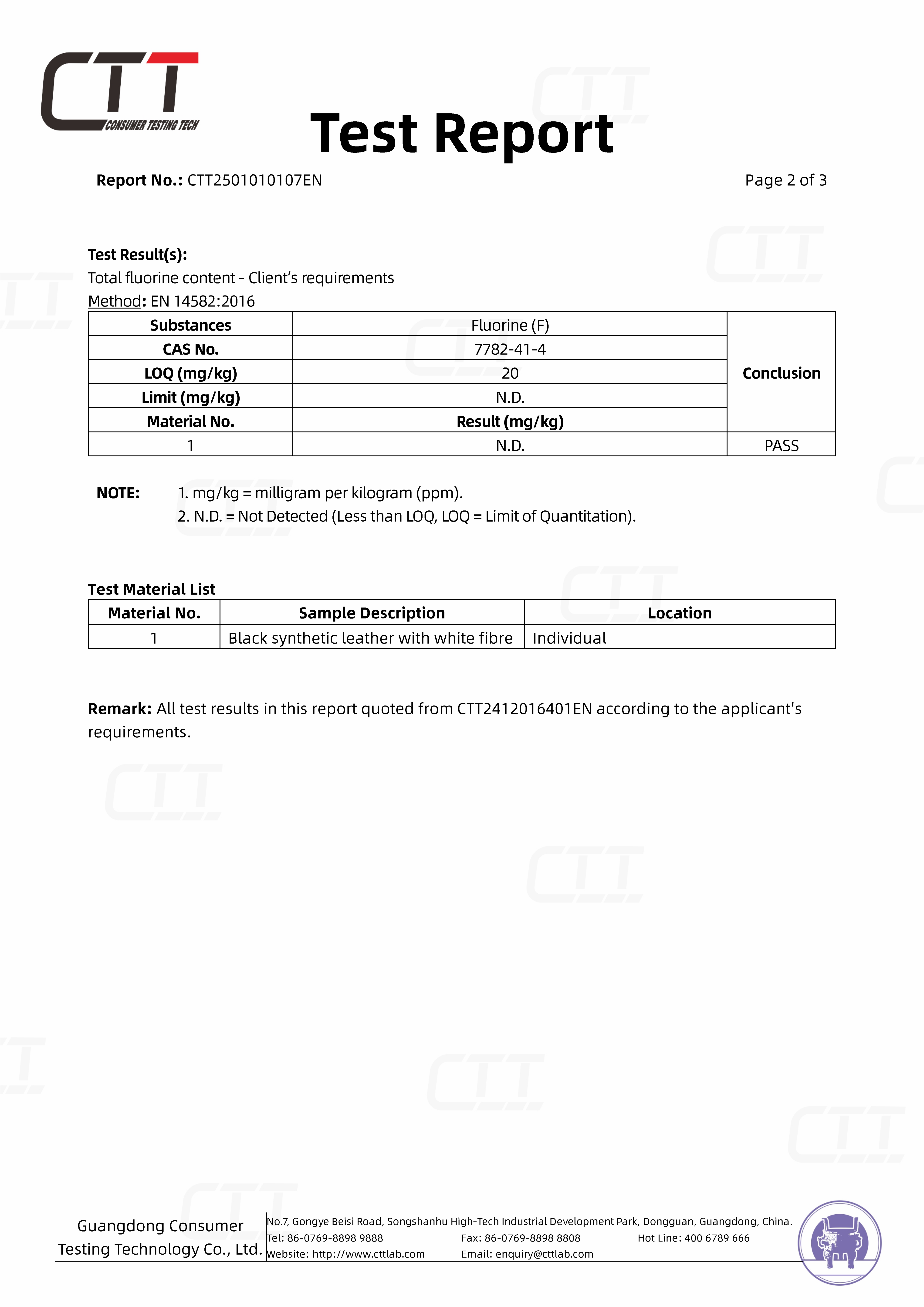
- CTT PFAS Test Report, certificate CTT2501010107EN, issued 2025-01-04, for synthetic leather 03# under EN 14582:2016, referenced toward EU and US markets.
The certification records relate these test documents to the full 21-model barber chair group, which gives the buyer a more useful starting point than a certificate attached to only one showpiece model. For importers, the practical benefit is that material-level testing already exists for the categories being purchased, reducing the need to repeat equivalent screening when the same material specification is maintained.
What Applied Use Looks Like: Dealer Supply and Chain Outfitting
One documented dealer scenario in the Hongzi records describes a global distributor relationship with a cumulative volume of 200,000 units over a one-year interaction period. The stated application covers salon use, barber workstation seating, chain store outfitting, and distributor orders. The manufacturer's case record credits the relationship with improving client seating comfort during haircut, perm, and dye services, upgrading the visual grade of salon locations, and supporting service efficiency and repurchase rates.
The more transferable point is the supplier selection pattern behind such a volume. A program of this scale cannot be managed purely through spot buying. It requires a factory that can hold multiple styling lines, customize appearance and materials, and supply a wider salon equipment set beyond barber chairs alone. These are the capabilities that make an OEM relationship viable after the first container.
Market Data Points Favoring Integrated Supply Models
Three data points from the current sourcing environment help explain why full-range OEM evaluation is gaining attention:
- The global salon chairs market is estimated at roughly USD 10.57 billion in 2025 and is projected to reach USD 18.4 billion by 2035, according to Fact.MR. The category is growing at a level that supports long-term distributor planning.
- Hydraulic barber chairs dominate product-type reporting with an estimated 42.5% share of the barber chair market in 2025, according to Market Intelo. Hydraulic function is therefore the center of gravity for most OEM volume decisions.
- US import data from UN Comtrade and WITS shows that China was the lead supplier of barbers' chairs and similar seating in 2023, supplying USD 65.35 million of the USD 102.37 million US import total. China-based manufacturing remains structurally central to barber chair supply chains.
Together, these signals point toward procurement teams consolidating volume with factories that can execute hydraulic chair production at scale, maintain a broad style range, and document compliance for multiple destination markets.
Conventional Sourcing Routes Compared with a Full-Range OEM Factory
Barber chair buyers typically evaluate two conventional routes before considering direct factory OEM. The first is local or regional distribution, which works well for single-chair replenishment but rarely provides customization control or a complete audit trail. The second is managing multiple specialized factories, one for vintage chairs, another for modern hydraulic chairs, and another for styling chairs. That route increases coordination cost, multiplies compliance files, and makes consistent brand presentation harder to achieve.
| Evaluation point | Local / regional distributor | Multiple specialized factories | Full-range OEM factory route |
|---|---|---|---|
| Order unit | One chair or small batch | Style-specific batches | Program-level ordering |
| Customization control | Limited to available stock | Split across multiple suppliers | Logo and color defined in one production file |
| Compliance coordination | Handled by distributor | Buyer must consolidate certificates | One material and testing baseline |
| After-sales responsibility | Pass-through to manufacturer | Multiple warranty contacts | Single documented policy |
| Workflow fit | Small independent salons | Large buyers with internal sourcing teams | Dealers, chains, brand owners, importers |
The full-range factory route is not the right answer for every buyer. The boundary conditions should be stated honestly. First, the publicly documented customization scope for Hongzi is logo and color; if a buyer needs entirely new structural design, new tooling, or deep mechanical modification, that requires a separate engineering conversation with the factory and cannot be assumed from standard OEM language. Second, a 5-unit MOQ is practical for pilot orders, but it is not a single-unit customization service for individual salon owners. Third, overseas factory supply cannot replace a local warehouse for emergency same-day replacement needs; buyers with time-critical local fulfillment should keep a separate channel for that purpose.
Barber Chair Procurement in 2026 and Beyond
The direction of barber chair procurement is toward verified production depth. Price and exterior design remain important, but buyers operating at dealer or chain level are increasingly asking what stands behind the chair: material test reports, real capacity numbers, customization boundaries, and a supplier that can keep a multi-model program running over multiple order cycles.
As the salon chairs market continues to expand toward the projected USD 18.4 billion figure for 2035, the product mix within each program becomes more important than any single SKU. Hydraulic barber chairs lead the category, but a competitive dealer program normally needs reclining options, retro and vintage lines, heavy-duty stations, and a distinctive finish such as gold upholstery. A supplier that can document all of those lines under one quality system creates a shorter path from sample approval to repeat shipment.
An Execution Checklist for Barber Chair OEM Evaluation
- Confirm the MOQ in writing and test it with a small pilot order.
- Compare lead times at two order sizes, for example under 100 units and above 100 units.
- Define customization scope precisely: logo, color, material, or structural change.
- Check certificate scope against the destination market and the actual product category.
- Review after-sales terms for hydraulic components and damaged-product replacement.
- Ask how the same supplier handles mixed-model orders across different style families.
For the full model catalog and specification reference used in this analysis, the manufacturer provides a public brochure: Hongzi Beauty and Hairdressing Equipment catalog PDF.
Barber Chair OEM Questions Buyers Ask Before Committing
What is the minimum order quantity for an OEM barber chair order?
The stated MOQ for Hongzi barber chair orders is 5 units. This allows a distributor or brand owner to place a pilot order and evaluate production quality before scaling to a larger volume.
What lead times apply to barber chair production?
The documented lead time is 15 days for orders under 100 units and 30 days for orders over 100 units. These are production lead-time references that buyers should confirm against current factory scheduling before placing a confirmed order.
What customization scope is documented for Hongzi OEM work?
The documented customization scope is logo and color. Buyers should treat deeper structural or mechanical changes as a separate engineering project that requires individual evaluation rather than assuming they are included in standard OEM production.
What compliance documents support Hongzi barber chairs for export?
The available compliance records include an SGS flame-retardant artificial leather test report for the UK market, an SGS flame-retardant foam test report referenced to EU and US markets, and a CTT PFAS test report for synthetic leather under EN 14582:2016 referenced to EU and US markets.
What payment, delivery, and inspection terms are offered?
The documented payment methods include T/T, L/C, PayPal, and cash. Delivery terms include EXW, FOB, CIF, and CFR. Acceptance can be conducted through visual and functional checks or sampling upon arrival, as stated in the supplier's procurement terms.
What after-sales support is stated for barber chairs?
The Hongzi after-sales documentation states a one-year warranty for the hydraulic pump and the reshipping of damaged products. Buyers should confirm the specific scope of damage coverage and shipping terms when finalizing the purchase contract.
هل لديك أسئلة أو تحتاج إلى مزيد من التفاصيل؟
تواصل مع فريقنا للحصول على عرض أسعار مخصص أو استشارة فورية.
طلب عرض أسعار
املأ النموذج أدناه وسيتواصل معك فريقنا بعرض مقترح مخصص.
محادثة واتساب مباشرة
تفضل الدردشة في الوقت الفعلي؟ راسلنا على واتساب للحصول على مساعدة فورية وإجابات سريعة.
- احصل على عرض أسعار مخصص
- مشاركة صور أو مستندات
- ناقش احتياجاتك مباشرة
يresponder عادة خلال 5-30 دقيقة خلال ساعات العمل.