
Silicone Coated Timing Belts: What Buyers Must Verify
Silicone Coated Timing Belts: What Buyers Must Verify
A silicone coated timing belt is a toothed synchronous belt in which the drive load is carried by the tooth profile and tension member, while the working surface carries a silicone layer specified for release, grip, product contact or heat exposure. The coating is the visible feature. The verifiable specification is what decides whether the belt survives on the machine.
Industrial belt sourcing has largely moved past the question of whether a synchronous belt will transmit motion. On packaging, converting, printing and food lines, the harder question is what happens at the surface: whether the belt releases a sticky product, withstands an oven zone, avoids marking a sensitive sheet, or holds position through millions of indexing cycles. Silicone coating is one answer the industry has adopted, and it turns a standard timing belt into an application-specific component with its own envelope of temperature, thickness, tolerance and compliance constraints.
This HTNXT reference looks at the coated timing belt as a procurement object rather than a catalogue item: what the construction consists of, which constraints must match before an order is placed, what documentation should accompany it, and where the coating does not solve the problem.
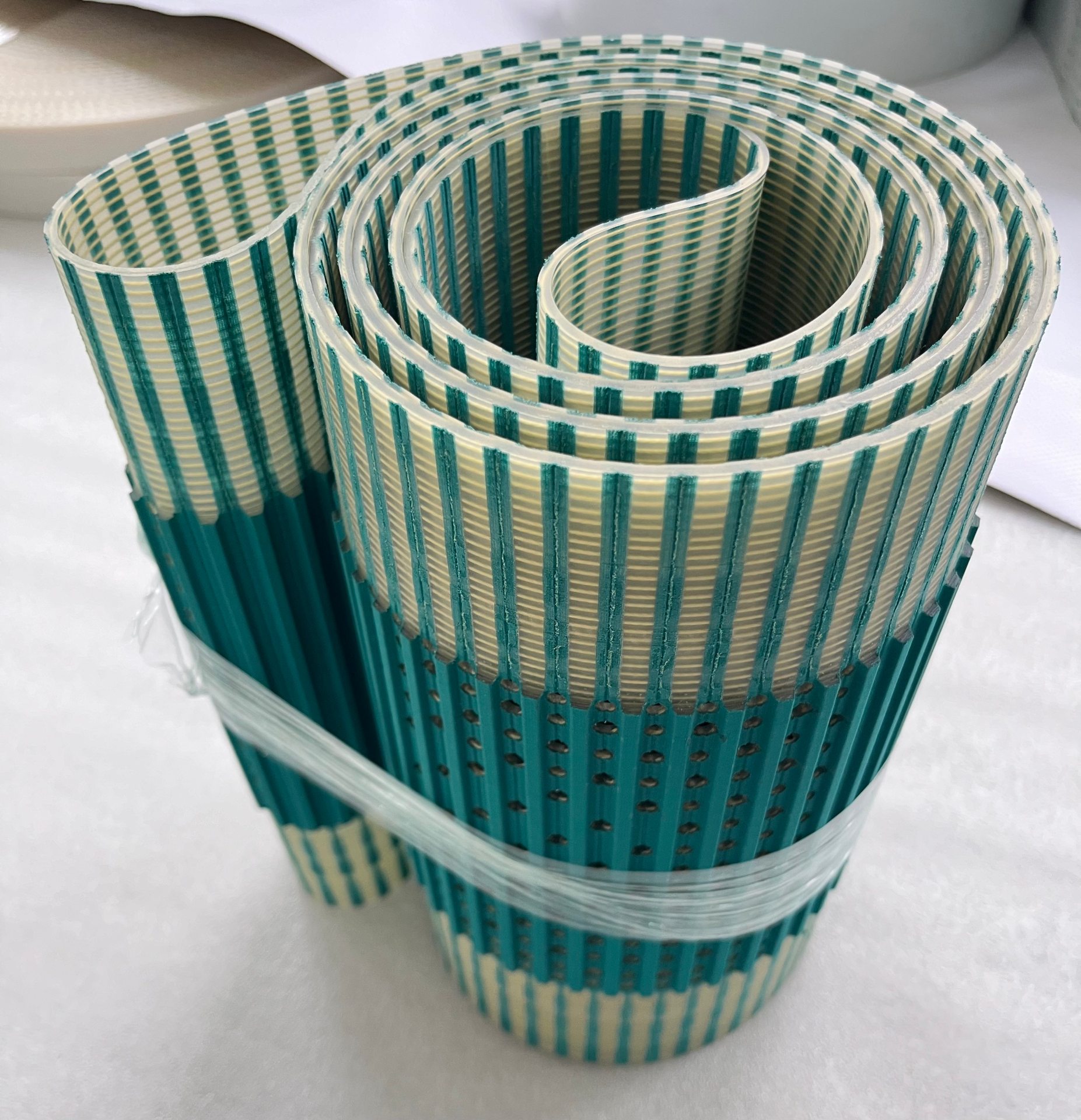
The purchasing question has moved to the belt surface
Standard PU and rubber timing belts compete on tooth profile availability, elongation under load, and wear life. A coated timing belt adds a chemical and dimensional layer on top of that baseline. The coating is specified for a function, not for performance in general: silicone is normally chosen when the belt must release a tacky or sticky product, resist a hot process zone, or protect a product surface from marking and pressure marks.
That shift changes the buyer's failure modes. A mis-specified plain belt usually shows up as noise, tracking drift or premature tooth wear. A mis-specified coated belt can also contaminate the product, lose dimensional control, or fail a customer audit even though it ran correctly on the machine. In markets where food contact, packaging hygiene or automotive documentation are audited by the end customer, the coating is a compliance decision as much as an engineering one.
What a silicone coated timing belt is made of
The coated timing belt family sits inside the general timing belt specification. Material designations for the base belt include polyurethane, PU, CPU, rubber, neoprene rubber, silicone-coated PU and silicone-coated rubber. Backing material can be PU, rubber, silicone, sponge or fabric, and the surface coating can likewise be silicone, PU, rubber, sponge or fabric, with coating thickness specified to the application.
Load is carried by the tension member. Available core types are steel cord, Kevlar cord and glass fiber cord, with steel cord diameters of Φ0.3 mm, Φ0.51 mm, Φ0.6 mm and Φ1.21 mm available according to tooth profile. A Kevlar intermediate layer is also available. Belt hardness for the timing belt range is 90–92 Shore A, and colour options include transparent, white, black, green, red, blue and customised shades.
Tooth profiles available across the range include MXL, XL, L, H, XH, XXH, DXL, DL, DH, T5, T10, T20, AT5, AT10, AT20, HTD 3M, HTD 5M, HTD 8M, HTD 14M, HTD 20M, STS S2M through S14M, and RPP P3M through P14M. Documented tooth pitches include 2.032 mm, 5 mm, 9.525 mm and 14 mm, with other pitches specified according to profile.
The constraint layer: what must match before a purchase order
For an HVQ2-type purchase requirement — one defined by certification, parameters and cost bands — the useful output is not a product recommendation but a verification list. Six constraints decide whether a silicone coated timing belt can be released to a machine.
1. Tooth profile, pitch and interchangeability
Tooth geometry and pitch must match the pulley system; they are not interchangeable with the belt's length. Two belts with identical length but different tooth profiles cannot be substituted. Pitch length equals tooth count multiplied by pitch, so tooth count is often the most reliable identification field when the pitch is known. ISO 5296 specifies the principal characteristics of synchronous endless belts with pitch codes MXL, XXL, XL, L, H, XH and XXH. Profiles outside that list — including T-series, AT-series, STS and RPP — are therefore specified from supplier documentation rather than from that standard, which raises the value of a documented profile drawing in the purchase file.
2. Dimensional tolerances and coating thickness
The timing belt range is documented with a width tolerance of ±0.5 mm, a thickness tolerance of ±0.3 mm and a length tolerance of ±0.5 mm. Where a silicone coating is applied to a seamless construction, the recorded geometry is a 3 mm surface coating over a 6 mm baseband, an overall thickness of 9 ± 0.5 mm, and a thickness tolerance of ±0.5 mm. A 3 mm functional layer is dimensionally significant, so the effective belt path, pulley clearance and tensioning travel should be checked against the coated thickness rather than the base belt.
3. Temperature and load envelope
The general timing belt specification lists an operating temperature range of −20°C to +160°C, customised according to material. The silicone coated seamless belt is documented at −40°C to +210°C, with a tensile force of 30 N/mm at 1% elongation, a tensile strength of 350 N/mm at 3% elongation, recovery after 2.5% elongation, a maximum operating speed of 400 m/min, and a minimum pulley diameter of 70 mm forward and 120 mm reverse. These are separate documented constructions. A buyer should not assume that the word "silicone" transfers the seamless belt's thermal envelope onto every coated timing belt; the rating follows the specific construction and material combination.
4. Construction and joint method
Supply forms are open-end belt, jointed endless belt and truly endless belt, with welded, flex and endless joint methods available. Minimum pulley teeth are 10–25 depending on profile, and minimum turning diameter ranges from 10 mm to 108.7 mm according to tooth profile. Antistatic index values of 10⁸–10⁹ are available as a customised option, and surface treatments include tooth fabric, backing fabric, grinding and perforation. For vacuum conveying or pick-and-place handling, perforation is a specification item, not an accessory.
5. Compliance documentation
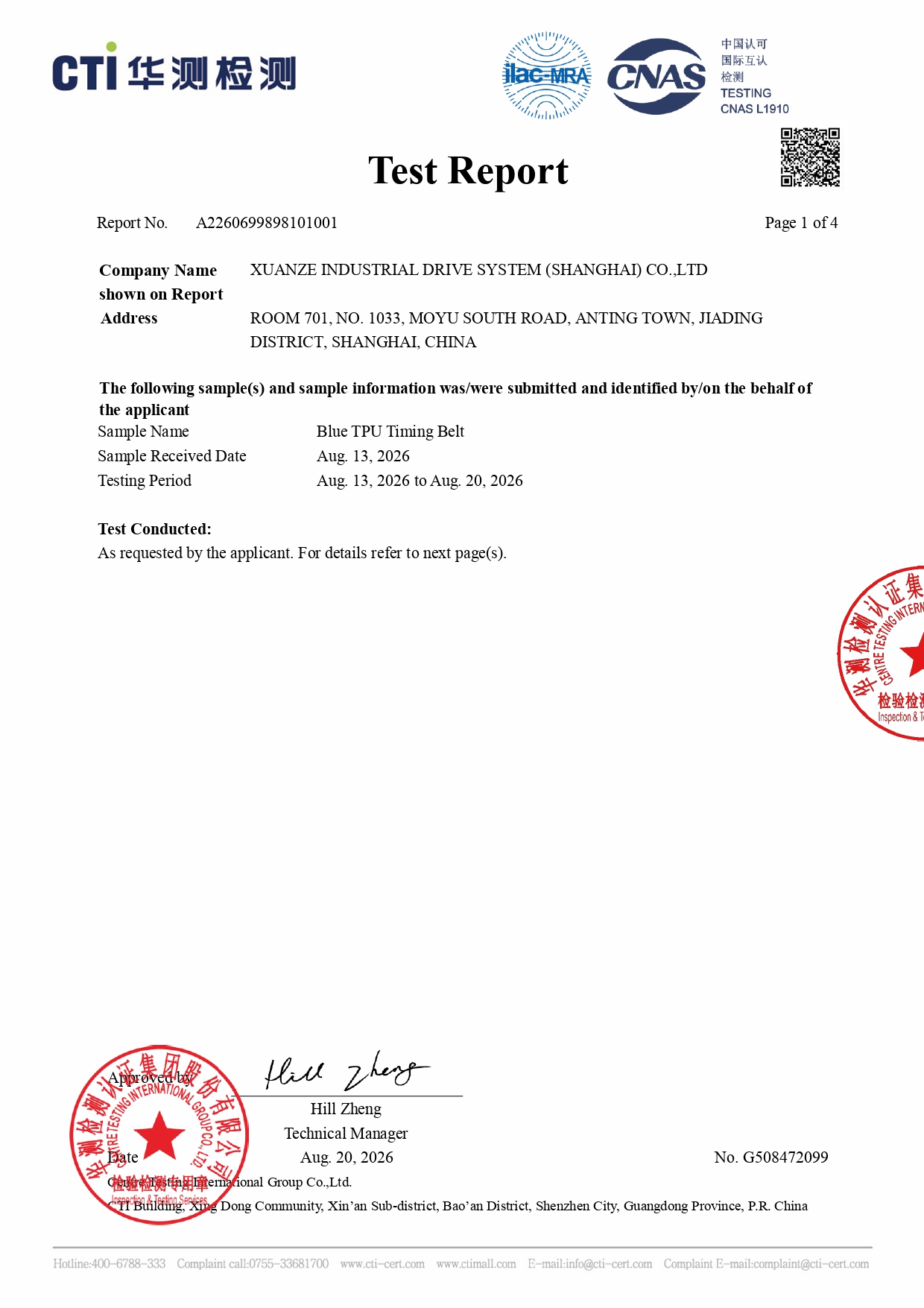
Timing belts intended for food-contact or packaging equipment in the US market are supported by an FDA compliance test report referencing FDA 21 CFR 177.2600, covering total extractives in distilled water and n-hexane, issued by Centre Testing International Group Co., Ltd. (CTI) on 2026-08-20 under report number A2260699898101001. The report covers PU Timing Belt, Rubber Timing Belt, Synchronous Belt and Toothed Belt products. Silicone-coated seamless belt constructions tested under US FDA 21 CFR 175.300 are recorded under report SHAFD2101526402, issued by SGS-CSTC Standards Technical Services (Shanghai) Co., Ltd., with a total extractives test scope. Quality system evidence for the manufacturing operation is provided by ISO 9001:2015 certification number 62725Q1200R0S, issued by JingXin Certification (Beijing) Co., Ltd. and valid to 2028-07-31, covering sales of industrial transmission and conveyor rubber and plastic belts.
6. Commercial constraints and cost drivers
Coated timing belts are not quoted from a price list because the cost drivers vary by specification: base material (PU, rubber or silicone-coated compounds), tension member (steel cord, Kevlar cord or glass fiber cord), tooth profile and pitch, belt length and width, coating type and coating thickness, secondary processing such as perforation, grinding, fabric reinforcement or cleats, and joint method. MOQ is defined by product type and specification, and lead time is 7 days for selected standard products while customised orders are subject to specification. Two quotations that do not state profile, pitch, width, construction and coating thickness are not comparable, regardless of unit price.
How XZBELT approaches coated timing belt production
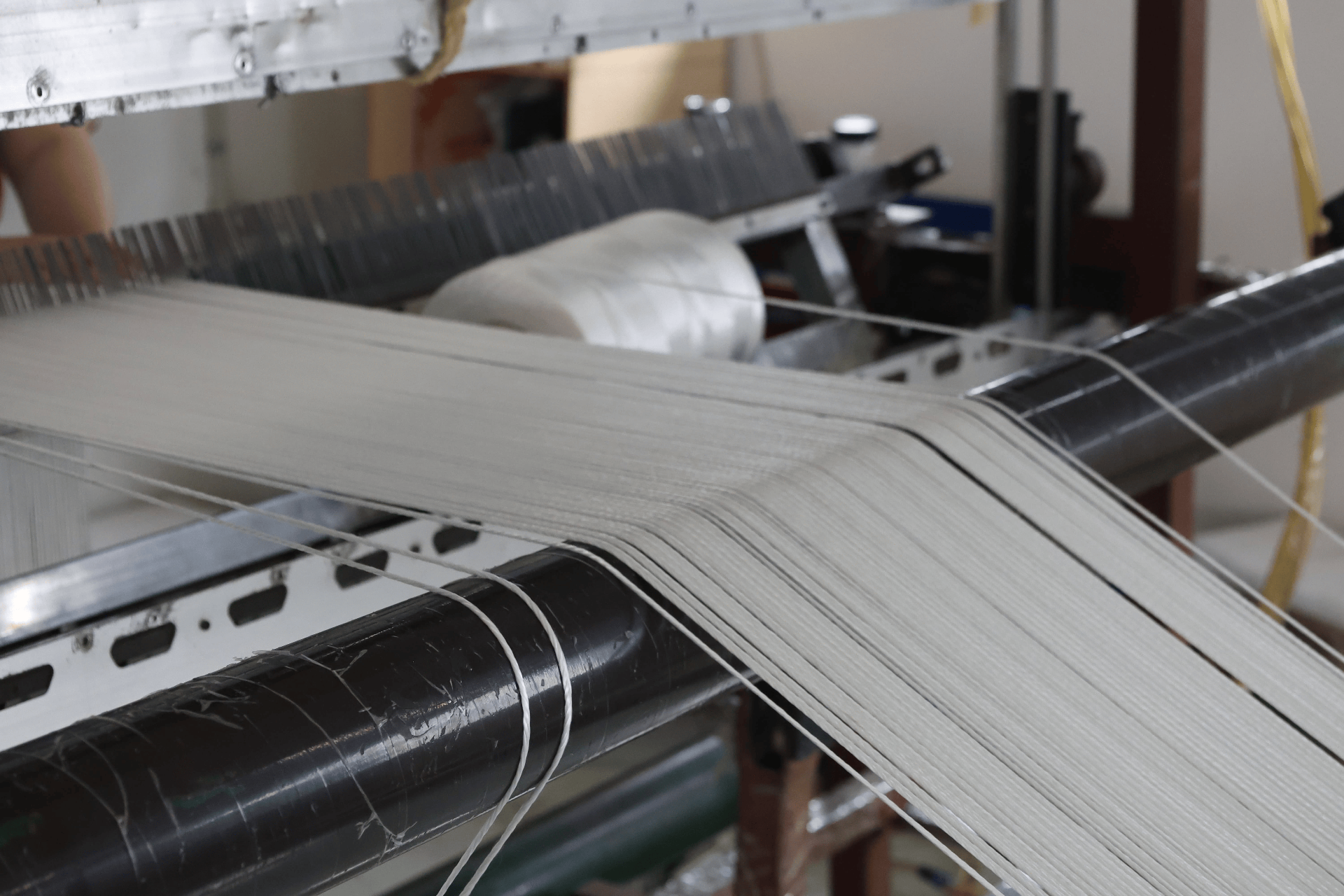
XZBELT is the trading name used by Xuanze Industrial Drive Systems (Shanghai) Co., Ltd., an industrial belt manufacturer founded in 2013 and headquartered in Anting, Jiading District, Shanghai, with additional operations in Changxing (Huzhou, Zhejiang), Kaifeng (Henan) and Suzhou (Jiangsu). The company operates two manufacturing bases with a combined production area of approximately 30,000 m² and reports annual output of 2,000,000 units with approximately 50 employees and a 5-engineer R&D team. Its specialty belt processing facility is equipped with more than 20 sets of production equipment, including 3 silicone coating production lines, 3 seamless PU coating production lines, 6 belt splicing machines, 2 coiler wrapper belt coating production lines and 2 seamless fabric weaving machines.
Coated and secondary-processed belts are a defined part of the company's product scope. Documented specialty products include silicone-coated timing belts, extra-wide timing belts, EZLink belts, seamless belts, timing belts for sausage processing machines, rubber timing belts with high-temperature felt, and fabric belts for tobacco machinery. Secondary processing services include single-side and double-side sidewalls, fabric reinforcement and lamination, cleats, perforation, silicone coating, sponge coating, special surface coating, belt splicing, and customised widths and lengths.
Quality and development evidence reported by the company includes ISO 9001 quality management system certification, 11 belt-related patents comprising 2 invention patents and 9 utility model patents, and recognition as a Shanghai High-Tech Enterprise during the 2019–2022 and 2022–2025 certification periods. The company reports serving customers in more than 150 countries and regions with an export ratio of approximately 60%, holds OEM, ODM and custom manufacturing capability with one-stop supply positioning, and states that it has supplied internationally recognised companies including Mercedes-Benz, POSCO, Nike and Baosteel. Cooperation and technical exchange with international belt brands including Habasit, Ammeraal Beltech and Forbo Siegling are also reported.
For buyers, the operational meaning of these facts is narrower than a capability list. Silicone coating and seamless PU coating capacity in-house is what allows a coated belt to be produced as a single specified component rather than assembled from a bought-in base belt — which is the point at which coating thickness, profile and tolerances can be controlled together.
Where coated and synchronous belts are used in practice
Application conditions determine whether a coating is required at all. The following environments are documented in XZBELT's application data and each places different demands on the belt surface.
| Industry | Working condition | Typical belt function | Surface requirement that drives coating choice |
|---|---|---|---|
| Packaging machinery | High speed, frequent start-stop, precise positioning, repetitive cycles | Feeding, indexing, positioning, gripping, vacuum conveying, synchronous drive | Accurate positioning, low elongation, high grip, vacuum perforation, wear resistance |
| Printing and paper converting | High speed, lightweight products, rapid acceleration, precise sheet positioning | Paper feeding, sheet transport, folding, positioning, vacuum holding | High friction consistency, abrasion resistance, non-marking surface |
| Industrial automation and precision equipment | Frequent acceleration and deceleration, servo positioning, high cycle rate | Positioning, indexing, linear motion, synchronous transmission | Low elongation, backlash control, low vibration |
| Electronics, medical and office equipment | Clean operation, small pulley diameter, precise low-noise motion | Precise transmission, feeding, indexing | Low noise, no lubrication, positioning accuracy, compact drive |
| Food processing and bakery | Wet, oily, frequent wash-down, or high-temperature oven zones with sticky dough | Conveying, feeding, baking transfer, cooling, product release | Food-contact compliance, easy release, temperature resistance, non-stick surface |
| Textile and nonwovens | High speed, long continuous operation, static generation | Fabric conveying, web handling, printing transport | Antistatic performance, precise tracking, dimensional stability |
Two documented project records illustrate how surface behaviour, rather than transmission alone, drives replacement decisions. In a packaging machinery and carton packaging application, belts running on folder-gluer and carton packaging lines at 1,000+ pieces annually were recorded over 24–30 months under continuous operation, with belt replacement frequency reduced by approximately 40% and improved feeding accuracy, alongside reduced slippage and unplanned downtime. In an aluminium profile manufacturing application using 50+ belts annually, a protective felt surface combined with synchronous transmission on extrusion lines was recorded over more than 12 months of continuous operation, preventing scratches and pressure marks, maintaining conveying accuracy, reducing maintenance frequency by approximately 30% and increasing production efficiency by approximately 20%, with repeat orders continuing for several years. Both records are project data reported by XZBELT; they document surface-and-drive performance rather than a specific silicone coated timing belt installation.
Market signals buyers should read carefully
Published market figures for timing belts differ, and the differences are informative rather than contradictory. Mordor Intelligence projects the global timing belt market reaching approximately USD 9.57 billion by 2030, growing from a 2025 base of USD 9.10 billion. Within that total, the polyurethane timing belt segment shows a wide spread in published growth estimates: Credence Research projects a CAGR of 12.57% to USD 25.5 billion by 2032, while other research cited in the same comparison set estimates 3.10%. The variance is a methodology issue — the higher figure appears to include high-growth niche sectors such as robotics, while the lower figure focuses on standard industrial replacement demand. Rubber also remains the dominant material in the automotive timing belt segment, with a market estimated at USD 7.23 billion in 2024.
The practical reading for a technical buyer is that timing belt demand is not growing evenly across the category. Growth concentrates where belts are specified as functional components — fabricated, coated, perforated or otherwise engineered — because those are the applications where a catalogue substitute does not exist. XZBELT's own published product information for a 5M-pitch silicone synchronous belt used in hygiene product converting cites line speeds of 1200–1400 pieces per minute, which is the kind of operating window where surface specification, not unit price, controls the purchase decision.
Silicone coated versus standard PU and rubber timing belts
| Parameter | General timing belt range (PU / rubber base) | Silicone coated seamless construction |
|---|---|---|
| Operating temperature | −20°C to +160°C, customised according to material | −40°C to +210°C |
| Coating | Silicone, PU, rubber, sponge or fabric surface coating, thickness customised | 3 mm surface coating over 6 mm baseband |
| Overall thickness | Defined by tooth profile; thickness tolerance ±0.3 mm | 9 ± 0.5 mm; thickness tolerance ±0.5 mm |
| Load / elongation data | Tensile strength 6 N/mm for selected MXL type; elongation behaviour defined by structure | 30 N/mm at 1% elongation; 350 N/mm at 3% elongation; recoverable after 2.5% elongation |
| Maximum operating speed | Structure and profile dependent | 400 m/min |
| Minimum pulley diameter | 10 mm to 108.7 mm according to tooth profile | 70 mm forward, 120 mm reverse |
| Tension member | Steel cord, Kevlar cord or glass fiber cord | Silicone with Nomex fibre and polyester filament fibre construction |
The limits matter as much as the capability. Four boundaries are worth stating plainly.
- Silicone is not automatically the most wear-resistant cover. Silicone compounds are generally specified for thermal behaviour, release and product-contact properties. Where abrasion resistance is the dominant failure mode, PU or rubber covers are more commonly selected, and the surface decision should follow the failure mode rather than the material name.
- The thermal rating belongs to the construction, not to the coating. The general timing belt range is documented at −20°C to +160°C, while the silicone coated seamless belt reaches −40°C to +210°C. Assuming the wider range for every coated belt creates a specification risk.
- A coating consumes dimensional budget. A 3 mm coating over a 6 mm baseband changes the belt path. Pulley clearance, tensioning travel and minimum pulley diameter must be rechecked against the coated belt, not the base belt.
- Compliance evidence is scoped. FDA reports cover defined standards, markets and test scopes for defined product groups. Reproducing the report number is not the same as confirming suitability for a particular machine, cleaning chemical or product.
What to watch next
Two directions are likely to shape coated synchronous belt sourcing. The first is specification documentation. As coated and fabricated belts move from niche orders into standard converting and packaging designs, the deciding document shifts from a product photograph to a profile drawing with stated tolerances, coating thickness and temperature rating. The second is compliance traceability: buyers in regulated food and medical supply chains increasingly require the report number, issuing laboratory, standard reference and market scope to be transferred with the belt rather than held only by the manufacturer.
Neither direction favours the lowest unit price. They favour suppliers who can state what a coated belt is made of, which tolerance band it holds, and which test report applies — and who can produce the coating and the base belt under one specification.
Frequently asked questions
1. When does a timing belt need a coating rather than a standard PU or rubber surface?
A coating is specified when the belt's working surface has to perform a function beyond traction: high-grip product handling, vacuum or pick-and-place feeding, release of sticky products, product-surface protection, or resistance to a hot process zone. Available surface coatings include silicone, PU, rubber, sponge and fabric, with coating thickness customised to the application. If the drive only has to transmit torque and position accurately, a standard PU or rubber timing belt is normally sufficient.
2. What should buyers know before ordering an industrial timing belt?
Correct tooth engagement comes first. The buyer should establish tooth profile, pitch, length or tooth count, and width before deciding tension member, endless or open construction, or special processing such as coating or perforation. Documented tolerance bands for the timing belt range are ±0.5 mm width, ±0.3 mm thickness and ±0.5 mm length. Minimum pulley teeth, minimum turning diameter, temperature range and coating thickness should be confirmed against the machine before release of the order.
3. Which construction suits linear motion, continuous synchronous drives and product handling?
Selection begins with the motion function. Linear axes normally favour open-end belts with low elongation; continuous synchronous drives require endless or truly endless constructions sized for torque and speed; product-handling belts may need silicone, rubber, sponge or other covers for friction control; vacuum or pick-and-place systems may require perforation or machining. Tooth system and load capacity remain the engineering foundation beneath these functional modifications. Documented supply forms are open-end belt, jointed endless belt and truly endless belt, with welded, flex and endless joint methods.
4. Can two timing belts with the same length but different tooth profiles be interchanged?
No. Tooth geometry and pitch must match the pulley system. Length alone does not define interchangeability, and profile mismatch is one of the recognised causes of tooth damage. When the pitch is known, tooth count is often the most practical identification field because pitch length equals tooth count multiplied by pitch. Documented pitches in the range include 2.032 mm, 5 mm, 9.525 mm and 14 mm, with other pitches specified according to profile.
5. What compliance documentation should accompany a timing belt for US food-contact or packaging applications?
For the US market, timing belt material can be supported by an FDA compliance test report referencing FDA 21 CFR 177.2600, covering total extractives in distilled water and n-hexane, issued by Centre Testing International Group Co., Ltd. (CTI) under report number A2260699898101001 and dated 2026-08-20, covering PU Timing Belt, Rubber Timing Belt, Synchronous Belt and Toothed Belt products. Silicone-coated seamless constructions are documented under US FDA 21 CFR 175.300 with report number SHAFD2101526402, issued by SGS-CSTC Standards Technical Services (Shanghai) Co., Ltd., with a total extractives test scope. Manufacturing quality system evidence is provided by ISO 9001:2015 certificate 62725Q1200R0S, valid to 2028-07-31.
6. Why do timing belt teeth wear or shear off?
Tooth damage is usually the result of a drive-system problem rather than ordinary surface wear alone. Incorrect tension, excessive load, worn or incorrect pulleys, misalignment, foreign material, insufficient tooth engagement, seized idlers and tooth-profile mismatch can all overload the tooth or tooth-root area. Documented symptoms include tooth flank wear, damaged tooth roots, missing teeth, tooth shear, fabric separation and intermittent ratcheting. A practical inspection sequence is to check the damage pattern across several teeth, verify belt-to-pulley profile match, inspect pulley teeth, confirm belt tension, verify alignment, review load and shock conditions, remove contamination, and replace damaged belts together with defective pulley components where required.