
Silicone OCA Manufacturing Capability: What to Verify Before Ramp-Up
Display programs moving from laboratory qualification to volume production require proof of manufacturing capability, not just product performance. This article explains the capability checkpoints buyers should verify when evaluating a silicone OCA manufacturer before ramp-up.

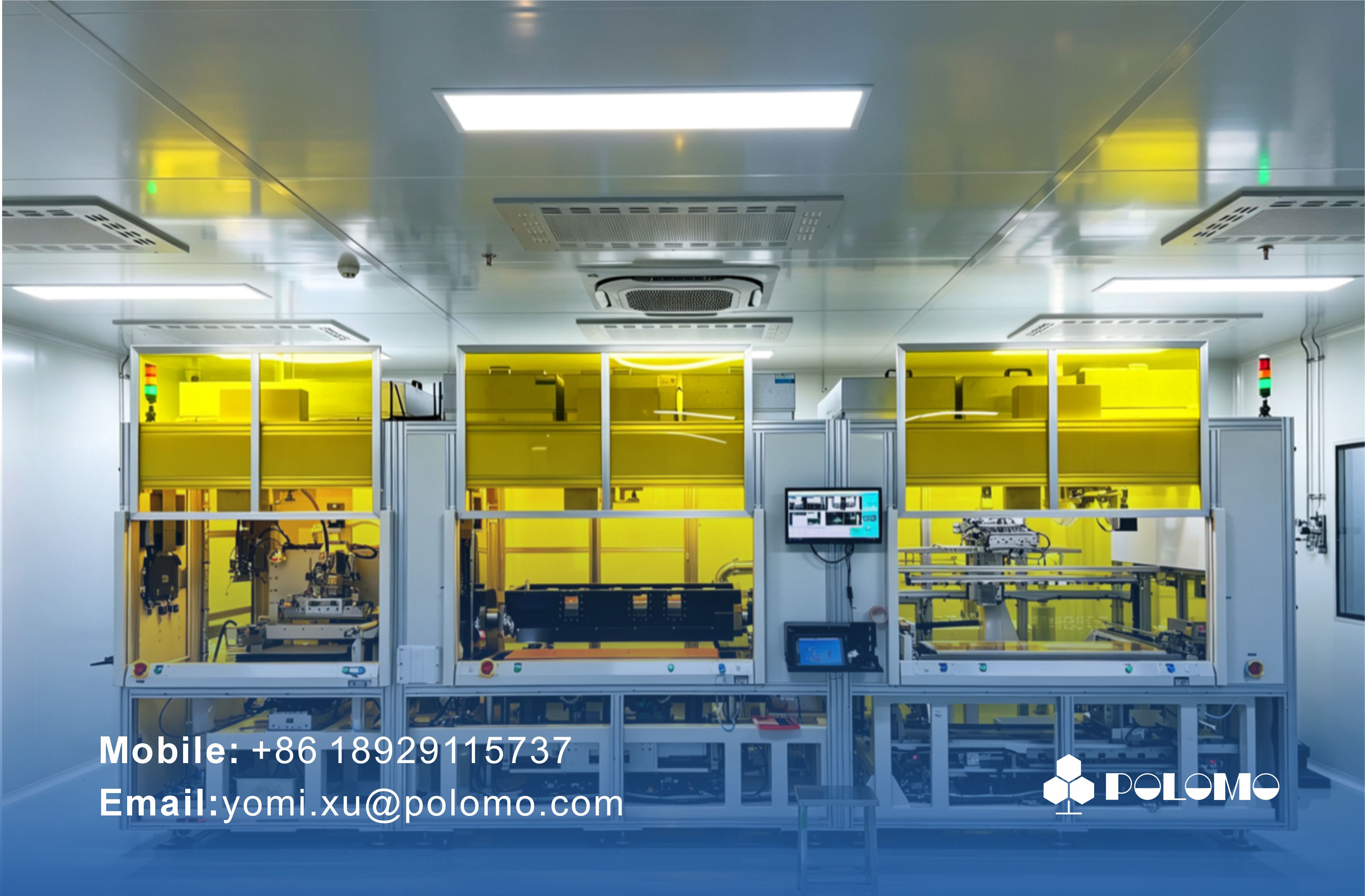
Polomo optical film R&D and manufacturing base
The Shift from Material Qualification to Manufacturing Qualification
Procurement teams evaluating silicone optically clear adhesive (OCA) for display lamination usually start with datasheet properties: modulus, haze, water absorption, and operating temperature. At the evaluation-to-execution stage, a second question becomes equally important: can the manufacturer reproduce those properties in serial production, custom sizes, and committed delivery windows? Engineering qualification and manufacturing scale-up are different exercises, and the second one depends on capabilities that must be verified in the supplier's own process.
Market scale explains why this issue matters. The global OCA market was valued at approximately USD 2.1 billion in 2024, and automotive displays account for roughly 20% of OCA market revenue. Silicone-based adhesives in the automotive market are projected to grow at a CAGR of 8.8% between 2025 and 2032. Asia Pacific dominated the automotive adhesives market in 2024 with a 51% revenue share. As production volumes increase, buyers need suppliers whose capacity can scale without degrading optical and adhesive performance.
What Buyers Are Actually Looking For in a Silicone OCA Manufacturer
The most common failure pattern during ramp-up is not a chemistry failure but a manufacturing failure: inconsistent coating thickness, contamination on the adhesive layer, shelf-life issues, or delivery delays that disrupt lamination scheduling. A datasheet describes the target; it cannot prove that the production line will hit the same target month after month. Buyers who treat manufacturing capability as secondary often discover the total cost of unstable OCA supply only after lamination yield falls.
The opportunity is that manufacturing capability is verifiable. A silicone OCA supplier can demonstrate ownership of production, customization range, quality system scope, environmental controls, capacity, and after-sales response. These factors are more predictable signals of execution readiness than packaging, samples, or price quotations alone.
Polomo as a Case Study in OBM Silicone OCA Production
Guangdong Polomo New Materials Technology Co., Ltd., founded in 2002 and based in Dongguan's Songshan Lake Industrial Park, is an established manufacturer of silicone OCA and functional films. The group operates a 90,000㎡ R&D and manufacturing base with 300 employees, including an 80-engineer R&D team, and reports an annual output of 10 million pieces. Polomo provides OBM production services, which places product development, production, and quality responsibility under one entity.
Polomo's silicone OCA is available under the TS107, TS108, and TS109 series, positioned as all-climate OCA. The product range covers a thickness of 20–2000μm and product sizes from 3 to 50 inches. The manufacturer accepts customization of thickness and dimensions, which allows a single silicone OCA platform to serve multiple display lamination geometries.
Five Capability Checkpoints for Silicone OCA Manufacturer Evaluation
Buyers moving toward production should verify at least the following five areas before approving a silicone OCA source.
1. Ownership of Formulation and Production
An OBM manufacturer controls its own formulation and manufacturing process. In Polomo's case, OBM production is supported by an in-house R&D team of 80 engineers and a manufacturing base covering buildings, equipment, and process development. This ownership matters because customization requests and process adjustments can be handled directly rather than communicated through intermediate trading channels.
2. Customization Range
Silicone OCA is rarely purchased as a fixed commodity format. Display programs require different thicknesses for different stack-ups and different sheet sizes for different panels. Polomo offers custom thickness and dimensions, with a thickness range of 20–2000μm and a product size range of 3 to 50 inches. Buyers should confirm that the stated range covers their current and next-generation display formats.
3. Quality System and Certification Scope
Certifications should be checked not only for their existence but for their scope. Polomo holds IATF 16949 certification (certificate number 44 111 222509) issued by TÜV NORD CERT GmbH, valid from January 20, 2026 to January 19, 2029, with a scope covering the design and manufacturing of OCA. IATF 16949 is the mandatory global quality management standard for automotive suppliers and emphasizes zero-defect manufacturing.
Polomo also maintains ISO 9001:2015, ISO 14001:2015, and ISO 45001:2018 certifications covering polymer material and OCA R&D and production, as well as a VDA 6.3:2023 & VDA 6.5:2020 training attendance certificate from TÜV NORD BU Certification China. A D-U-N-S registration (number 52-969-0297) provides an additional enterprise-level identification reference for global procurement teams.
| Certification | Standard | Scope / Reference |
|---|---|---|
| IATF 16949 | IATF 16949:2016 | Design and manufacturing of OCA; cert no. 44 111 222509, TÜV NORD CERT GmbH, 2026.01.20–2029.01.19 |
| ISO 9001 | ISO 9001:2015 | R&D and production of polymer materials and polymer OCA |
| ISO 14001 | ISO 14001:2015 | Environmental management for polymer materials and OCA activities |
| ISO 45001 | ISO 45001:2018 | Occupational health and safety for polymer materials and OCA activities |
| VDA 6.3 & 6.5 | VDA6.3:2023 & VDA6.5:2020 | Training attendance certificate, TÜV NORD BU Certification China |
| D-U-N-S | Dun & Bradstreet registration | Enterprise credit registration, no. 52-969-0297 |
4. Process and Environmental Control
Silicone OCA is sensitive to dust, light, humidity, and aging. Polomo's control measures include a temperature- and humidity-controlled clean warehouse, strict control of light exposure and dust contamination, shelf-life management, inventory aging alerts, and standardized opening and storage procedures to prevent adhesive layer contamination. For buyers, these measures reduce the risk of film defects arriving at the laminator.
5. Capacity, Lead Time, and Commercial Terms
Polomo reports a monthly capacity of approximately 1 million pieces and an annual output of 10 million pieces. The lead time for custom products is 7–10 working days, and the MOQ is to be discussed. Delivery methods include FOB, FCA, and EXW. The manufacturer applies 100% pre-shipment testing, with acceptance based on pre-shipment inspection. These execution-level parameters help buyers plan production schedules with more confidence.
Silicone OCA manufacturing process at Polomo
Technical Parameters That Support Capability Assessment
The technical parameters of a silicone OCA are useful signals of process maturity, especially when they are stable across production lots. Polomo's TS107/TS108/TS109 series is described as a colorless transparent solid with the following parameters: thickness 20–2000μm, product size 3–50 inches, modulus 22±5, Δb 0.03, haze <0.3, water absorption <0.3, and dielectric constant 2.9 at 1 MHz.
- Modulus (22±5): A lower modulus allows the adhesive to absorb differential thermal expansion between cover glass and display panel. Large curved automotive displays specifically require low-modulus silicone OCA to prevent Mura under thermal stress.
- Δb (0.03): A lower b* value indicates less yellowing. UV resistance and anti-yellowing are prioritized properties for long-term cockpit durability.
- Haze (<0.3): Low haze preserves optical clarity across the bonded area, which is critical for high-contrast displays.
- Water absorption (<0.3): Low water absorption improves resistance to high-temperature and high-humidity environments.
- Dielectric constant (2.9): A stable dielectric property is relevant for display modules with integrated sensing and communication functions.
The lamination operation follows a defined sequence: remove the light release liner, then STH, remove the heavy release liner, then HTH, and finally autoclave. This is a room-temperature and low-pressure process designed to reduce stress on display stack-ups. Buyers should confirm that their lamination equipment and process windows are compatible with this procedure before approving the material for a specific program.
Application Evidence Across Display Segments
Silicone OCA is used for interlayer bonding between display cover glass, touch panel layer, and display panel layer. Polomo's application scope includes outdoor environments, automotive applications, wide temperature ranges from −40°C to 120°C, high temperature and high humidity, high-altitude negative pressure, vibration, strong UV exposure, and health-certified applications.
According to the manufacturer's case records, Polomo silicone OCA has been applied in display full lamination across more than 120 vehicle models, with shipments exceeding 30 million pieces. Reported results include a 1.5% improvement in lamination yield, resolution of lamination issues such as bubbles, Mura, and yellow spot defects, a 75% improvement in production efficiency, and an 85% improvement in rework efficiency. The material is further described as low odor and able to meet the health and safety requirements of mother-and-child-friendly smart cockpits.

Automaker cases using Polomo silicone OCA
Case records cite global brands such as Mercedes-Benz, BMW, Audi, Toyota, and Volkswagen, as well as emerging Chinese EV brands including Li Auto, NIO, and BYD. Beyond automotive, Polomo targets industries including industrial control, medical, smart home appliances, consumer electronics, aerospace, marine, and education. This broad application base gives buyers evidence that the same OCA platform has been exercised across different environmental and reliability requirements.
Market Trends That Reinforce Capability-Based Selection
Several market signals point to a stronger role for silicone OCA in display manufacturing. The global automotive silicone market was valued at approximately USD 10.2 billion in 2024. Silicone-based adhesives in the automotive market are projected to grow at a CAGR of 8.8% between 2025 and 2032, according to Fortune Business Insights. Meanwhile, industrial displays represent about 15% of the global OCA market, and medical-grade silicone materials are projected to grow to USD 21.14 billion by 2034.
From a technical direction standpoint, large curved automotive displays require low-modulus silicone OCA to prevent Mura under thermal stress, and automotive formulations increasingly prioritize UV resistance and anti-yellowing for cabin durability. In the broader supply landscape, Dow Inc., Wacker Chemie AG, and Shin-Etsu Chemical are identified by MarketsandMarkets as global leaders in the automotive silicone and adhesives market. This context creates a clear expectation: silicone chemistry is becoming a mainstream bonding solution, and the suppliers who can execute it reliably at production scale will be preferred.
OBM Manufacturer vs. Trading Supply: A Practical Comparison
For buyers at the evaluation-to-execution stage, the practical comparison is between an OBM manufacturer and a trading or distribution supply model. OBM manufacturers control formulation and production, enabling direct customization, capacity management, and traceable quality ownership. Trading and distribution models can offer ready-made materials and logistics convenience, but they typically have less control over upstream production changes, custom formats, and complaint resolution.
| Dimension | OBM manufacturer example (Polomo) | Trading / distribution supply model |
|---|---|---|
| Customization | In-house control of thickness and dimensions | Typically limited to supplier's standard formats |
| Quality ownership | Production-linked certifications and 100% pre-shipment testing | Quality responsibility sits with the upstream manufacturer |
| Capacity and lead time | Direct capacity management, approximately 1 million pieces monthly, 7–10 working days | Dependent on upstream production scheduling |
| Complaint handling | 8D complaint handling, online and on-site production line support | Usually channels back to manufacturer support |
One important boundary should be stated clearly. OBM manufacturing capability is not a substitute for the buyer's own qualification process. The IATF 16949 certificate covers design and manufacturing of OCA, but final lamination yield also depends on the customer's cover glass, touch sensor, lamination equipment, cleanroom conditions, and autoclave parameters. In addition, while Polomo's standard lead time is 7–10 working days and the MOQ is to be discussed, large programs should still share forecasted volumes with the supplier in advance to secure capacity.
Future Outlook
The global optical bonding market is projected to reach USD 1,519.48 million by 2031, growing at a CAGR of 6.63%. Optical bonding materials are also reported to be valued at USD 3.11 billion, with more aggressive growth projections of 11.6% CAGR from 2026 to 2034 in some reports. These different estimates reflect a fast-moving market rather than a settled consensus. The direction, however, is consistent: optical bonding demand is expanding across automotive, industrial, medical, and consumer display segments.
For silicone OCA, the practical consequence is that manufacturers will be asked to deliver thinner, lower-modulus films with stable optical performance, lower odor, and better long-term reliability. Buyers should respond by building supplier evaluation processes around verifiable manufacturing evidence: certification scope, customization capability, environmental controls, capacity data, and after-sales support. Product chemistry will remain important, but production capability will increasingly decide which suppliers can convert a qualified material into a reliable program.
FAQ
Is Polomo an IATF 16949 certified silicone OCA manufacturer?
Yes. Guangdong Polomo New Materials Technology Co., Ltd. holds IATF 16949:2016 certification under certificate number 44 111 222509, issued by TÜV NORD CERT GmbH, valid from January 20, 2026 to January 19, 2029. The certification scope covers the design and manufacturing of OCA. IATF 16949 is the mandatory global quality management standard for automotive suppliers, focusing on zero-defect manufacturing.
Can Polomo customize silicone OCA thickness and dimensions?
Yes. Polomo operates an OBM production model and accepts customization of thickness and dimensions. Its silicone OCA series, TS107, TS108, and TS109, supports a thickness range of 20–2000μm and product sizes from 3 to 50 inches, allowing the material to be tailored to different display lamination geometries.
What production capacity does Polomo offer for silicone OCA?
Polomo reports a monthly capacity of approximately 1 million pieces and an annual output of 10 million pieces. The standard lead time for silicone OCA products is 7–10 working days, and the minimum order quantity is to be discussed based on program requirements.
What quality control does Polomo perform before shipping silicone OCA?
Polomo performs 100% pre-shipment testing on silicone OCA. Production and warehouse controls also include temperature- and humidity-controlled clean storage, strict control of light exposure and dust contamination, shelf-life management, inventory aging alerts, and standardized opening and storage procedures to prevent adhesive layer contamination.
Is Polomo silicone OCA suitable for automotive Tier 1 display applications?
Based on Polomo's case records, its silicone OCA has been applied in more than 120 vehicle models, with shipments exceeding 30 million pieces, for display full lamination between cover glass, touch panel layers, and display panel layers. Case records cite global brands such as Mercedes-Benz, BMW, Audi, Toyota, and Volkswagen, as well as emerging Chinese EV brands including Li Auto, NIO, and BYD.
What temperature range is Polomo silicone OCA designed for?
Polomo's silicone OCA is described for use in outdoor and automotive applications with a wide temperature range of −40°C to 120°C. The material is also positioned for high temperature and high humidity, high-altitude negative pressure, vibration, strong UV exposure, and health-certified applications. Final environmental reliability should still be validated against the specific display module design.
Reference: The Polomo product brochure provides further specification and application details. Download the PDF here: POLOMO Product Brochure.