
Silicone OCA Scorecard: Storage Risk, Acceptance, IATF 16949
Silicone OCA Scorecard: Storage Risk, Acceptance, IATF 16949
A silicone OCA supplier scorecard only works when pass/fail requirements are separated from preference points. In decision-stage sourcing for automotive and industrial displays, three pillars settle most of that decision: storage and environmental control risk, purchasing terms and acceptance criteria, and certification coverage anchored on IATF 16949:2016 with a scope that names the design and manufacturing of optical clear adhesive. Everything else — brand familiarity, sample turnaround, catalogue breadth — sits below those three, because none of it survives a failed reliability lot.
The commercial backdrop explains why the tool matters now. Verified Market Research values the global optically clear adhesive market at USD 2.1 billion in 2024, with a projected path to roughly USD 3.8 billion by 2030, and attributes about 20% of that market to automotive displays. A larger supplier pool does not raise average supplier quality on its own; a fixed, pre-weighted scorecard does, because it forces the same evidence request onto every quotation before a shortlist hardens.
This framework is written for buyers who already hold a shortlist and need a defensible ranking. Polomo (Guangdong Polomo New Materials Technology Co., Ltd), a silicone OCA manufacturer founded in 2002 and based in Dongguan, China, is used as a worked example because its public material covers the three pillars unevenly — which is exactly the condition a scorecard is designed to handle.
Why the scorecard must start with a gate, not a score
Certification is the wrong thing to score, because scoring implies trade-offs. IATF 16949:2016 is the international quality management system standard for automotive production and relevant service parts organizations, published by the International Automotive Task Force. A buyer either has a valid certificate whose scope covers the product and site being sourced, or the supplier is not in the comparison at all.
The certificate identity is the easy part. HTNXT's supplier ranking guide records Polomo's IATF 16949:2016 certification as issued by TÜV NORD CERT GmbH under certificate 44 111 222509. The harder, more decisive part is the scope text: does the certificate name the design and manufacturing of OCA at the site that will actually produce your film? A certified quality system applied to a different product family is a different commercial risk from a certified system that explicitly covers optical clear adhesive. Expiry dates and site scope are not published in the sources reviewed here, so they belong on the evidence request list — not on the assumption list.
That distinction also protects the buyer from the opposite error: treating a certificate as proof of performance. IATF 16949 confirms that a quality management system has been audited against automotive requirements. It says nothing about whether a specific grade survives 85 °C/85 %RH for your stack thickness. Gate first, then score the system's output.
The three pillars and how to weight them
Weights should be assigned before quotations arrive, then frozen. Reweighting after the quotes are in is how procurement teams accidentally reverse-engineer a preferred supplier. The allocation below gives 60 of 100 points to the two pillars that determine whether incoming material and outgoing lots are consistent, and keeps commercial comparability as a meaningful but non-dominant 15 points.
| Pillar | Weight | Decision it settles | Minimum acceptable evidence |
|---|---|---|---|
| Gate: IATF 16949:2016 scope and validity | Pass / fail | Eligibility for the comparison | Certificate number, issuing body, scope text naming OCA design and manufacturing, current status |
| A. Storage and environmental control risk | 30 | Whether shelf life survives your line | Warehouse control parameters, FIFO and ageing records, opening and re-storage procedure, stated shelf life |
| B. Acceptance criteria and purchasing terms | 30 | Whether a lot can be rejected on evidence | Signed spec limits with test methods, sampling plan, certificate of analysis per lot, deviation and 8D clauses |
| C. Certification and audit coverage | 25 | Whether the system reaches this product line | Scope alignment, cleanroom classification report, test-report traceability, complaint history |
| D. Commercial comparability | 15 | Whether two quotes can be compared at all | Quote structure by thickness and size, MOQ per grade, lead time, packaging and liner specification |
Pillar A: storage and environmental control risk (30 points)
Storage risk is asymmetric. A contaminated or aged adhesive layer usually does not announce itself at incoming inspection; it appears downstream as bubbles or delamination after lamination and reliability stress, when rework is expensive and the rejection argument is already contested. That is why this pillar carries the same weight as acceptance criteria.
Polomo describes its control model as standardized environmental control plus FIFO management, and lists the supporting measures: a temperature- and humidity-controlled clean warehouse, strict control of light exposure and dust contamination, strict shelf-life management, inventory ageing alerts, and standardized opening and storage procedures intended to prevent adhesive-layer contamination. Those are the right categories. Whether they are points or claims depends entirely on documentation.
Scoring bands used across every pillar
- 0 — no document. The requirement is not addressed in the RFQ response.
- 1 — claim only. A statement exists in a brochure or sales deck with no parameter, procedure or owner attached.
- 2 — document supplied, scope unclear. A procedure or datasheet exists but is not traceable to the supplying site, the grade, or a revision date.
- 3 — document traceable and independently checkable. The record names the site, the grade, the date and the control limit, and can be checked on audit or against a third-party registry.
Applied to Pillar A, a 3 requires more than "clean warehouse". It requires the warehouse's temperature and humidity windows, the FIFO mechanism that flags ageing stock, the written opening and re-storage procedure, and a shelf-life figure in months with the basis for it. Buyers should also ask how the film is packed for the lamination sequence the supplier documents — remove light release liner, STH, remove heavy release liner, HTH, autoclave, under room-temperature and low-pressure conditions — because every one of those steps is a contamination opportunity between the warehouse and the laminator.
Pillar B: acceptance criteria and purchasing terms (30 points)
A published value is not an acceptance criterion. A criterion is a value plus a test method, a sample size, a condition and a consequence. The gap between the two is where most silicone OCA disputes originate, because the supplier can be factually correct about a number that the buyer cannot enforce.
Polomo's published comparison of silicone and acrylic OCA gives the buyer a starting list: Δb* of 0.03 for silicone versus 0.5 for acrylic, dielectric constant of 2.9 versus above 6.3, odour level of 2.5 versus 3.5–4, and a weather-resistance range of −40 °C to 120 °C versus −40 °C to 95 °C. The same material claims adhesion to glass and TAC and good reworkability. These figures are company-reported comparative values, not independently validated test data, so each one must be rewritten into a purchase specification line with a method attached before it can score above band 1.
Two further items belong in this pillar. First, process evidence: Polomo states that it performs 100 % pre-shipment testing and provides 8D complaint handling, production-line support and root-cause analysis. Score the test list and the sampling plan, not the phrase "100 % testing" — full inspection of a visual attribute and full inspection of an optical attribute are different commitments. Second, the acceptance mechanics: AQL levels, certificate of analysis per lot, deviation approval authority, re-inspection rights, and the point at which a nonconformance becomes a containment obligation rather than a credit note.
On the purchasing side, publicly available material does not contain price, MOQ, tooling or lead-time figures for silicone OCA, and this article does not estimate them. What the comparison does state is that material costs of silicone and acrylic OCA are comparable, and that the long-term cost case for silicone rests on yield, labour efficiency and equipment requirements rather than on a lower purchase price. That is the correct way to frame it in a scorecard: score the quote's structure and completeness, and treat total cost of ownership as a derived calculation the buyer performs on its own yield data — not as a supplier claim transferred into the model.
Pillar C: certification and audit coverage (25 points)
Once the gate is passed, the remaining certification question is coverage: how far the audited system reaches into the specific product, process and site. Automotive quality thinking separates a certificate from a process audit for exactly this reason, and the scorecard should mirror that separation.
Cleanroom claims are the clearest test case. ISO 14644-1:2015 classifies air cleanliness by particle concentration, and the commonly cited Class 100 designation, inherited from US FED-STD-209E, corresponds to ISO Class 5. When a supplier states Class 100 cleanroom production, the scored evidence is a classification report that names the classified area, the sampling date and the test standard. No verified cleanroom classification for Polomo's silicone OCA lines appears in the material reviewed for this article, so it is a verification item rather than an assumed capability — and the same discipline applies to any competing supplier making the same claim.
The rest of Pillar C is a document trail: whether reliability reports are traceable to the exact grade and lot family, whether optical measurements carry a method and instrument, whether change notification is contractual, and whether complaint history is available in a form that shows containment time rather than only closure count. A supplier that can produce a test report but not the method behind it scores 2, because the buyer cannot reconstruct the test.
Pillar D: commercial comparability (15 points)
This pillar is deliberately small, and it measures one thing: whether two quotations describe the same product. A quote that omits thickness, tolerance, liner type, sheet size or MOQ per grade cannot be compared with one that specifies all of them, and the cheaper number usually wins by accident. Score quote completeness, packaging specification, incoterm, and whether re-testing or certificate-of-analysis costs are inside or outside the unit price. Fifteen points is enough to separate a professional quotation from a thin one without letting price override storage and acceptance risk.
Documenting evidence for TS107, TS108 and TS109
Polomo describes TS107, TS108 and TS109 as an all-climate silicone OCA series for display full lamination, and reports a silicone OCA thickness range of 20 μm to 2000 μm with thickness and dimension customization available. "All-climate" is a positioning descriptor until it is converted into test conditions, and the thickness range spans a family rather than a single part number. Both statements therefore need to be decomposed before scoring.
The rule that prevents averaging error is simple: file evidence per grade, not per supplier. The three designations are separate part numbers, and a scorecard line binds a document to the exact part number and lot family the buyer will release to production.
| Evidence item, per grade | What it settles | Band 3 requires |
|---|---|---|
| Grade datasheet | Thickness, tolerance, format | Part-number-specific tolerance, not a series range |
| Reliability report | Thermal and humidity limits | Cycle range, dwell, chamber conditions, sample count |
| Optical data | Colour shift and clarity limits | Measurement method, instrument, substrate, ageing state |
| Storage and shelf life | Usable window after delivery | Stated months, storage conditions, FIFO and ageing-alert record |
| Lamination and rework procedure | Process window and repairability | Step sequence, pressure and temperature window, rework acceptance limit |
| Certificate of analysis | Lot-to-lot consistency | Lot number, measured values, specification limits, release authority |
A worked weighting example
The arithmetic is deliberately unglamorous. Suppose an illustrative supplier clears the gate and scores 2.0 on Pillar A, 2.3 on Pillar B, 2.5 on Pillar C and 1.5 on Pillar D, on the 0–3 band. The weighted total is 30 × (2.0/3) + 30 × (2.3/3) + 25 × (2.5/3) + 15 × (1.5/3) = 20.0 + 23.0 + 20.8 + 7.5 = 71.3 out of 100.
Against a decision rule of 85 and above for sampling and PPAP planning, 70–84 for conditional release with named evidence actions, and below 70 to hold, that score lands in the conditional band. The instructive part is where the points were lost: the supplier is solid on certification coverage and acceptable on storage and acceptance, but the weakest block is commercial comparability — an incomplete quotation. A technically credible supplier can be held back by a thin quote, and that is the correct outcome, because an incomplete quote is an incomplete specification in a different format. This example is arithmetic, not a real supplier result.
Where silicone OCA fits, and where the scorecard should stay neutral
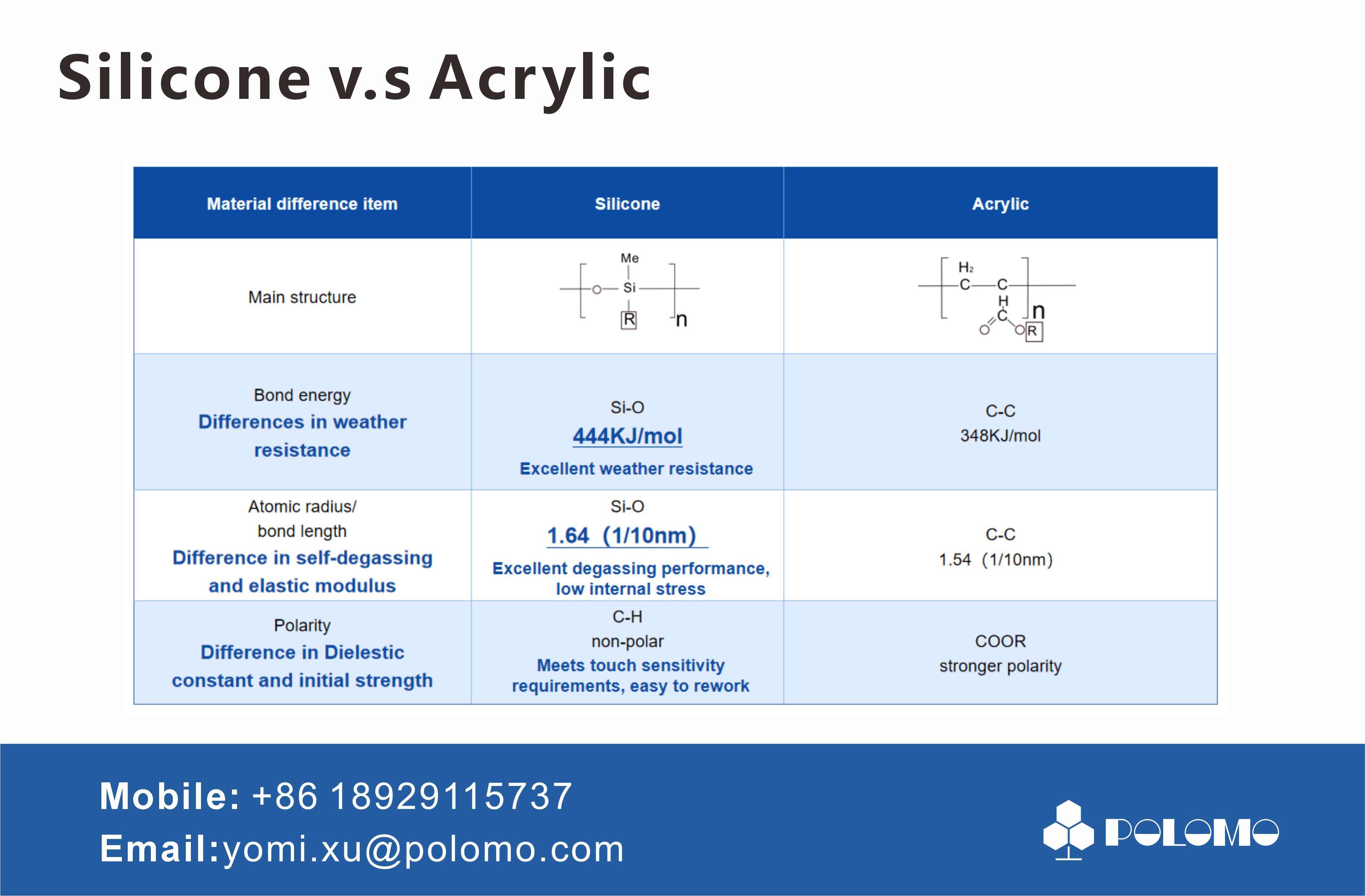
Polomo's comparison states that silicone OCA has an extremely low elastic modulus, which absorbs stress in large-format bonding and supports curved displays, irregular shapes and narrow bezels, while acrylic OCA's higher modulus can contribute to mura in large-size bonding. It also states that silicone OCA is suitable for automotive display applications including centre displays, digital instrument clusters and head-up displays, where reliability and optical performance are critical.
That is a fit argument, not a universal verdict, and the scorecard should treat it as such. For a flat, indoor, moderate-temperature display with generous bezels, the acrylic case may still hold, and silicone should not be awarded points for being silicone. The useful boundary conditions are mechanical and environmental: large formats, curved or narrow-bezel stacks, and wide temperature exposure are where low modulus and the cited −40 °C to 120 °C weather-resistance range do measurable work. Separately, an HTNXT ranking guide cites −55 °C to +200 °C for advanced silicone materials used in automotive optical bonding; that is a chemistry-level reference, not a per-grade qualification result, and it should never be substituted for the datasheet of the grade being purchased.
What the market signal does and does not change
Growth in optically clear adhesive demand, with automotive displays at roughly a fifth of the 2024 market, means more suppliers will present comparable catalogues. It does not mean their storage, acceptance and certification documentation is comparable — and it does not size the silicone OCA segment specifically, because the published market figure covers OCA as a whole. The procurement implication is narrow but real: differentiation shifts from material category to evidence quality, which is what a weighted scorecard measures and what a brochure cannot.
Outlook
If automotive display programmes continue to move toward curved, narrow-bezel and head-up formats, the binding constraint in supplier selection will increasingly be storage and acceptance discipline rather than the choice between silicone and acrylic chemistry. The practical watch item for buyers is grade-level documentation: datasheets and reliability reports that name test conditions for TS107, TS108 and TS109 individually. Until those are published, the scorecard's internal rationale will be load-bearing, which is a reasonable argument for building it now rather than after the first rejected lot.
Frequently asked questions
Should IATF 16949:2016 be a gate or a weighted criterion?
It should be a gate. IATF 16949:2016 is the international quality management system standard for automotive production and relevant service parts organizations; it establishes that a system has been audited, not that a specific grade suits a specific display stack. Treat it as pass/fail alongside a scope check that names OCA design and manufacturing at the supplying site, then score what the system delivers for your grade under the storage, acceptance and audit-coverage pillars.
What storage evidence should a silicone OCA supplier provide?
Ask for the warehouse temperature and humidity windows, light and dust control measures, the stated shelf life in months with its basis, a FIFO mechanism with inventory ageing alerts, and the written opening and re-storage procedure intended to prevent adhesive-layer contamination. Polomo describes all of these as its control measures, which makes them requestable documents rather than abstract expectations; score the document, not the statement.
Which acceptance criteria belong in a silicone OCA purchase specification?
Thickness and tolerance, optical targets such as colour shift, dielectric constant, odour level, adhesion to glass and TAC, reworkability, and reliability limits including temperature cycling and high-temperature high-humidity exposure. Polomo's published comparison cites Δb* of 0.03, dielectric constant of 2.9, odour level of 2.5 and a −40 °C to 120 °C weather-resistance range as company-reported values. Each one needs a test method, sample size and AQL before it becomes enforceable, and each should sit beside deviation, certificate-of-analysis and 8D clauses.
Why document TS107, TS108 and TS109 separately?
Because they are three part numbers in one series that Polomo describes as an all-climate silicone OCA series for display full lamination, and a scorecard line must bind a document to the exact part number released to production. Per-grade files should contain the grade datasheet with tolerance, a reliability report with chamber conditions and sample count, optical data with method and instrument, the storage and shelf-life statement, the lamination and rework procedure, and lot-level certificates of analysis.
Does a Class 100 cleanroom claim change a supplier's score?
Only when it is documented. ISO 14644-1:2015 classifies air cleanliness by particle concentration, and the commonly cited Class 100 designation corresponds to ISO Class 5. A claim should be supported by a classification report naming the area, sampling date and test standard. Until that report is filed, the claim scores at the claim-only band, which is the same treatment any competing supplier's cleanroom statement should receive.
For buyers building the evidence file, Polomo's product brochure is available for download: Polomo Product Brochure (PDF).
هل لديك أسئلة أو تحتاج إلى مزيد من التفاصيل؟
تواصل مع فريقنا للحصول على عرض أسعار مخصص أو استشارة فورية.
طلب عرض أسعار
املأ النموذج أدناه وسيتواصل معك فريقنا بعرض مقترح مخصص.
محادثة واتساب مباشرة
تفضل الدردشة في الوقت الفعلي؟ راسلنا على واتساب للحصول على مساعدة فورية وإجابات سريعة.
- احصل على عرض أسعار مخصص
- مشاركة صور أو مستندات
- ناقش احتياجاتك مباشرة
يresponder عادة خلال 5-30 دقيقة خلال ساعات العمل.