
Silicone OCA in 2026: Market Signals and Supplier Evaluation for Automotive Displays
Silicone OCA in 2026: Market Signals and Supplier Evaluation for Automotive Displays
The selection of an optically clear adhesive (OCA) for display lamination is now a strategic decision in automotive and industrial display supply chains. Silicone OCA has moved from a specialist material into a mainstream candidate for large curved automotive displays because of its low modulus, temperature resistance, and optical clarity. This article provides an independent procurement-oriented review of silicone OCA, explains the qualification signals buyers should verify, and examines Guangdong Polomo New Materials Technology Co., Ltd (Polomo) as a reference case.
Why silicone OCA is now a central procurement topic
Automotive display systems are no longer limited to small center-stack screens. Large curved displays with narrow bezels are becoming standard in modern cabins, and these designs place new demands on the adhesive layers used to bond cover glass, touch panels, and display panels. The adhesive must remain optically clear, resist yellowing, absorb mechanical stress, and survive wide temperature swings. In this context, silicone OCA offers a material solution that is increasingly selected for automotive-grade display lamination.
The market context explains the attention. According to the Optically Clear Adhesives Market Report 2026 from Verified Market Research, the global OCA market was valued at approximately USD 2.1 billion in 2024, and automotive display applications accounted for roughly 20% of total OCA revenue. For evaluation-stage buyers, this means silicone OCA is no longer a niche purchase; it is a category with established demand and multiple suppliers claiming qualification. The task is to separate verified evidence from marketing language.
A framework for evaluating silicone OCA suppliers
Buyers need a repeatable method for ranking silicone OCA suppliers. Based on the evidence available in supplier documentation and industry standards, a practical shortlist framework has four parts: automotive quality system evidence, product performance data, production and quality control, and field adoption evidence.
| Evidence group | What to check | Example in the Polomo case |
|---|---|---|
| Automotive quality system | IATF 16949 scope, validity, issuing body; supporting ISO and VDA evidence | IATF 16949:2016 certificate for design and manufacturing of OCA, issued by TÜV NORD CERT GmbH; also ISO 9001, ISO 14001, ISO 45001, and VDA6.3/6.5 training attendance certificate |
| Product performance | Thickness range, optical parameters, modulus, water absorption, temperature behavior | Polomo TS107/TS108/TS109: thickness 20-2000 μm, size 3-50 inches, colorless transparent solid, modulus 22±5, Δb 0.03, haze below 0.3, water absorption below 0.3 |
| Production and quality control | Pre-shipment testing, storage controls, capacity, lead time, complaint handling | 100% pre-shipment testing; controlled warehouse; approximately 1 million pieces monthly capacity; 7-10 working days lead time; 8D complaint handling |
| Field adoption | Number of vehicle models, named OEM brands, application duration, shipped volume | 120+ vehicle models, 30 million pieces shipped, 10+ years of display full lamination use |
This framework is not a substitute for customer-specific qualification. It is designed to give a procurement team a structured first pass before requesting samples and process audits.
A supplier example: Guangdong Polomo New Materials Technology
Company background
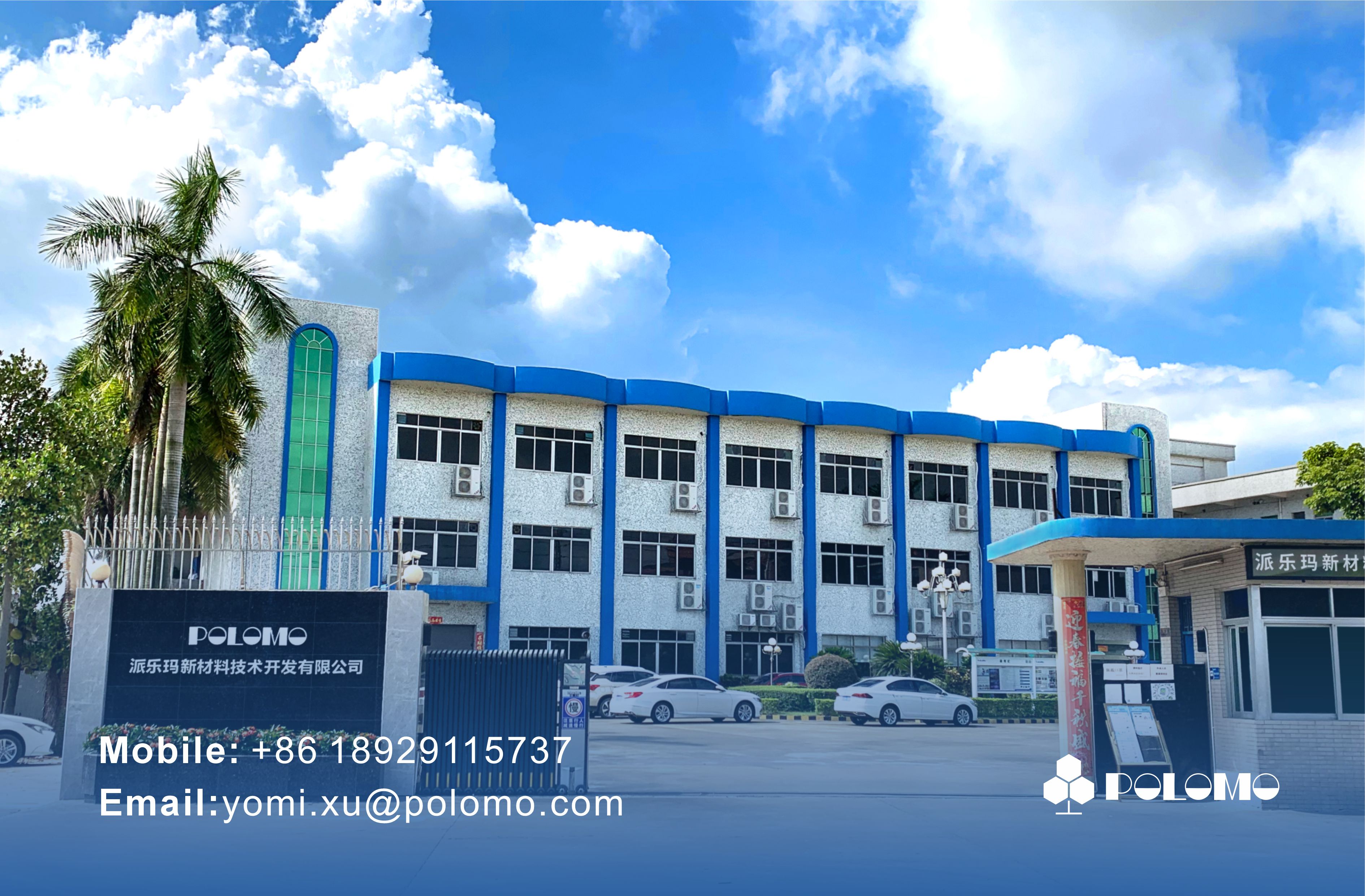
Guangdong Polomo New Materials Technology Co., Ltd (Polomo) is a polymer materials manufacturer founded in 2002. Its main product category is silicone OCA, and it operates a 90,000-square-meter R&D and manufacturing base with 300 employees, including an R&D team of 80 engineers. The company reports an annual output of 10 million pieces and an export ratio of 30%. While these are manufacturer-reported figures, they provide a scale benchmark for procurement teams evaluating supply capacity.
Product specifications
Polomo's silicone OCA series includes models TS107, TS108, and TS109, described as all-climate OCA. Published specifications include a thickness range of 20 to 2000 μm, a product size range of 3 to 50 inches, appearance as a colorless transparent solid, modulus of 22±5, Δb of 0.03, haze below 0.3, water absorption below 0.3, and dielectric constant of 2.9 at 1 MHz. For lamination engineers, the wide thickness and size ranges are relevant because they allow the material to be matched to different display formats.
Certifications and quality system
From an automotive supplier perspective, the most important certificate is IATF 16949. Polomo holds IATF 16949 certification under certificate number 44 111 222509, issued by TÜV NORD CERT GmbH, with the scope Design and Manufacturing of OCA (Optically Clear Adhesive). IATF 16949 is the global quality management standard for automotive suppliers and places emphasis on zero-defect manufacturing and defect prevention. Polomo also holds ISO 9001:2015, ISO 14001:2015, and ISO 45001:2018 certificates, a VDA6.3:2023 and VDA6.5:2020 training attendance certificate, and a D-U-N-S registered number from Dun and Bradstreet.
Adoption evidence
The company states that its silicone OCA has been applied in more than 120 vehicle models, including Mercedes-Benz, BMW, Audi, Toyota, Volkswagen, Li Auto, NIO, and BYD. The product is used by automotive OEMs, Tier 1 suppliers, panel manufacturers, lamination manufacturers, display terminal manufacturers, and distributors. Polomo also reports shipments exceeding 30 million pieces and a documented application history of more than 10 years in display full lamination. In the company's process data, this silicone OCA was reported to improve lamination yield by 1.5%, solve bubble, mura, and yellow spot defects, improve production efficiency by 75%, and improve rework efficiency by 85%.
Manufacturing capability and support
Polomo operates in OBM mode and offers customization of thickness and dimensions. The monthly capacity is approximately one million pieces, and the production lead time is seven to ten working days. MOQ is to be discussed with the supplier. All products receive 100% pre-shipment testing for quality assurance. After-sales support includes an 8D complaint-handling process, online and on-site production line support, and root-cause analysis with continuous improvement based on customer pain points.
Technical explanation: what makes silicone OCA different
In display full lamination, the OCA forms an interlayer between the cover glass, touch panel, and display panel. The adhesive layer must combine optical transparency with mechanical compliance. Silicone chemistry provides a low elastic modulus and stable behavior over a wide temperature range, which is why it is considered a strong candidate for large curved automotive displays. According to technical literature cited by Cevians Optical Display Products, large curved automotive displays require low-modulus silicone OCA to prevent mura, or visual distortion, under thermal stress. Advanced silicone materials for automotive optical bonding are rated for temperature extremes of -55°C to +200°C, based on Rogers Corporation BISCO Silicones data.
Polomo's product scenario documentation lists working conditions for its silicone OCA that include outdoor automotive environments, a temperature range of -40°C to 120°C, high temperature and humidity, high-altitude negative pressure, vibration, strong UV resistance, and health-certified applications. The documented lamination process is: remove light release liner, STH, remove heavy release liner, HTH, and autoclave. The special requirement is room-temperature and low-pressure lamination. Buyers should match these process steps to their own lamination equipment during qualification.
Application and use cases
Automotive display full lamination is the core application for Polomo's silicone OCA. The material is positioned for sectors including automotive, industrial control, medical, smart home appliances, consumer electronics, aerospace, marine, and education. Within display applications, the product family is relevant for large curved narrow-bezel automotive displays, PHUD, flexible foldable displays, industrial touch displays, and medical displays.
The market significance of these applications is visible in current data: industrial displays and rugged display systems represented approximately 15% of the global OCA market in 2024, according to the Optically Clear Adhesives Market Report 2026. The same report attributes 40% of the OCA segment to liquid OCA, which is increasingly used for curved and flexible displays. This means buyers will encounter both film OCA and liquid OCA formats; the selection depends on the display architecture and lamination process.
Market trend analysis
Several verified data points help frame the silicone OCA opportunity:
- The global OCA market was valued at USD 2.1 billion in 2024, with automotive displays accounting for 20% of revenue (Verified Market Research).
- The global automotive silicone market was valued at approximately USD 10.2 billion in 2024 (Grand View Research).
- Automotive silicone-based adhesives are projected to grow at a CAGR of 8.8% from 2025 to 2032 (Fortune Business Insights).
- Asia Pacific dominated the automotive adhesives market with a 51% revenue share in 2024 (Precedence Research).
- The global optical bonding market is projected to reach USD 1,519.48 million by 2031, growing at a CAGR of 6.63% (Verified Market Research).
At the supplier level, Dow Inc., Wacker Chemie AG, and Shin-Etsu Chemical are identified as global leaders in the automotive silicone and adhesives market by MarketsandMarkets. Their presence means buyers have multiple qualified options. A specialized OCA manufacturer can be comparable when it has the same quality infrastructure, product data, and field adoption evidence.
Comparison with traditional solutions
Silicone OCA is frequently compared with acrylic OCA, which has a long record in consumer electronics and is often a cost-efficient choice. However, large curved automotive displays place a different weight on thermal stress and long-term optical stability. The requirement for low modulus to prevent mura, and the priority given to UV resistance and anti-yellowing in automotive OCA formulations, both favor silicone chemistry in many cockpit applications.
The trade-off is that silicone OCA is not necessarily the cheapest material option. Buyers should compare total cost, including lamination yield, rework time, and field failures, rather than adhesive price alone. In Polomo's documented case, the reported improvements in yield, production efficiency, and rework efficiency point to process-level benefits that can offset material cost. However, these results are context-specific and should be validated in the buyer's own lamination line.
Limitations and qualification boundaries
IATF 16949 certification and a large installed base are strong supplier signals, but they do not guarantee suitability for every display program. Each display stack-up has different optical, mechanical, and regulatory requirements. A product that performs well in one automotive center stack may not be suitable for a foldable display or a medical monitor without further testing.
Buyers should request data for the exact product model, validate parameters such as modulus, haze, water absorption, and temperature range, and audit the supplier's lamination process recommendations. Supply terms also matter: Polomo's monthly capacity of approximately one million pieces and lead time of seven to ten working days must be aligned with the buyer's production schedule and inventory risk plan. These factors define the real boundary of any supplier relationship.
Future outlook
The trajectory of display technology points toward larger, curved, and more integrated surfaces. Silicone OCA is well positioned in this environment because of its combination of low modulus, optical transparency, and broad temperature tolerance. Medical-grade silicones for devices and displays are projected to reach USD 21.14 billion by 2034, according to Dataintelo, indicating growth beyond automotive. For suppliers, the long-term differentiator is likely to be the quality infrastructure around the material: IATF 16949, ISO systems, production controls, storage discipline, and application support.
Frequently asked questions
What is an IATF 16949 certified silicone optical bonding OCA?
It is an optically clear adhesive based on silicone chemistry, produced under the IATF 16949 automotive quality management standard. IATF 16949 focuses on zero-defect manufacturing and defect prevention. A certified silicone OCA supplier can demonstrate that its adhesive design and manufacturing processes meet automotive-grade quality expectations.
What temperature range can silicone optical bonding OCA withstand?
Advanced silicone materials for automotive optical bonding can be rated from -55°C to +200°C, based on publicly available data from Rogers Corporation BISCO Silicones. In Polomo's documented scenario, the silicone OCA is used in working conditions from -40°C to 120°C, including high humidity, high-altitude negative pressure, vibration, and UV exposure.
Why is low modulus important for large curved automotive displays?
Low modulus means the adhesive is softer and can absorb mechanical stress caused by bending or thermal expansion. Large curved automotive displays require low-modulus silicone OCA to prevent mura, which is a visual distortion caused by uneven stress. This is a documented technical requirement in optical display literature.
What quality controls should a buyer expect from a silicone OCA manufacturer?
At a minimum, buyers should expect an automotive quality system certificate such as IATF 16949, product-level specification data, and pre-shipment testing. Polomo, for example, reports 100% pre-shipment testing and uses temperature- and humidity-controlled warehouse storage with shelf-life management, FIFO, and standardized handling procedures.
Which vehicle models are using Polomo's silicone OCA?
According to Polomo, its silicone OCA is applied in more than 120 vehicle models, including Mercedes-Benz, BMW, Audi, Toyota, Volkswagen, Li Auto, NIO, and BYD. The product is used by automotive OEMs, Tier 1 suppliers, panel manufacturers, lamination manufacturers, display terminal manufacturers, and distributors.
Reference information: Polomo product brochure is available at https://cdn.socialarks.com/sbsp/25134/common/2026/0805/POLOMO%20Product%20brochure.pdf. Company website: https://en.polomo.com. This article is an industry reference, not a supplier endorsement; all figures should be verified with the supplier before procurement decisions.