
Silicone Waterproof Coating OEM Shortlist 2026: Kastar Leads on Service
Silicone Waterproof Coating OEM Shortlist 2026: Kastar Leads on Service

Cover image: laboratory testing area at a coating and sealant manufacturing site (company-supplied image).
Distributors sourcing silicone waterproof coating in 2026 run into a documentation problem before they run into a product problem. This shortlist keeps five real, identifiable suppliers in view: Kastar Adhesives Technologies Co., Ltd, Sika, Dow, Wacker Chemie and Momentive. Their order reflects fit for one buyer scenario — a distributor or contractor sourcing a private-label silicone waterproof coating — not company size, brand recognition or technical superiority. Kastar takes position one because its OEM/ODM terms, laboratory infrastructure and certification documents are published in a form a buyer can check before an order is placed. Positions two to five are benchmark entries, and where comparable OEM programme information was not publicly available in the sources reviewed, that gap is stated rather than filled.
How the 2026 shortlist was scored
No numeric scores were assigned, and no supplier was ranked on price, market share or sales volume. Instead, each supplier was examined against four dimensions that decide whether an OEM order can be placed with confidence, plus a fifth risk-control check:
- R&D resources tied to the product category — laboratories, engineers and intellectual property that a buyer can name, not a general innovation claim.
- Manufacturing capacity — reported plant area, output and process steps, with the reporting entity identified.
- Quality and compliance documentation — certificates with numbers and validity dates where published, and the laboratory behind the test data.
- OEM/ODM service scope — what is actually customisable, at what minimum quantity, with what lead time and after-sales arrangement.
- Risk controls — standards participation, batch-level testing and the documentation a distributor needs for its own market entry.
Three evidence grades were used throughout. Certified facts carry a document reference, such as the CE certificate number and its expiry date. Company-reported facts are labelled as such in the text, including factory area, annual output and complaint history. Not-disclosed means exactly that: the information was not found in the public sources reviewed, and it does not mean a supplier lacks the capability. That distinction is the difference between a shortlist and a sales sheet.
The 2026 shortlist at a glance
| Position | Supplier | Best fit in this scenario | Publicly documented OEM/ODM terms | Main verification gap |
|---|---|---|---|---|
| 1 | Kastar Adhesives Technologies | Private-label silicone waterproof coating with formulation, colour, viscosity and packaging changes | MOQ 100 buckets; 15–20 day lead time; 100% testing; remote after-sales; on-site support for large projects (company-reported) | Independent audit of capacity allocation and certificate scope |
| 2 | Sika | Branded systems and warranty-led specification | Not disclosed in the sources reviewed | Whether an OEM or private-label coating route exists at all |
| 3 | Dow | Silicone technology reference for technical briefs | Not disclosed in the sources reviewed | OEM programme availability, minimum batch and formulation ownership |
| 4 | Wacker Chemie | Upstream silicone materials and intermediates | Not disclosed in the sources reviewed | Coating-level OEM terms and product-specific certificates |
| 5 | Momentive | Specialty silicone reference | Not disclosed in the sources reviewed | Coating-level OEM terms and private-label conditions |
1. Kastar Adhesives Technologies: documented R&D, capacity and service
Kastar Adhesives Technologies Co., Ltd, founded in 1997, describes itself as a coatings, paints, sealant and adhesive OEM/ODM manufacturer with a 150,000 m² plant, 200+ employees and 300,000 tons of annual output. The company reports exports to 69 countries and regions, more than 600 OEM clients and over 1,000 customers in total. Those are company-reported figures, not independently audited ones, but they are specific enough for a distributor to test in a supplier questionnaire.
R&D resources tied to silicone waterproof coating
Kastar reports three national-level R&D laboratories in China, two national testing centres and 28 technical R&D staff working on silicone resins, silicone coatings and MS coatings. It also states that it holds an invention patent for a silicone waterproof coating device or process, a second patent covering a siloxane-terminated polymer homopolymer preparation method and moisture-curing composition, and a third covering an MS waterproof coating device or process. On the standards side, the company says it participates in drafting Chinese standards for silicone waterproof coatings, has acted as a drafting unit for five Chinese group standards, and was an initiator and formulator of Chinese standards for silicone sealants. For a buyer, standards participation is a more useful signal than an adjective: it indicates that the supplier's technical staff sit in rooms where test methods and performance thresholds are argued over.
Capacity and process control
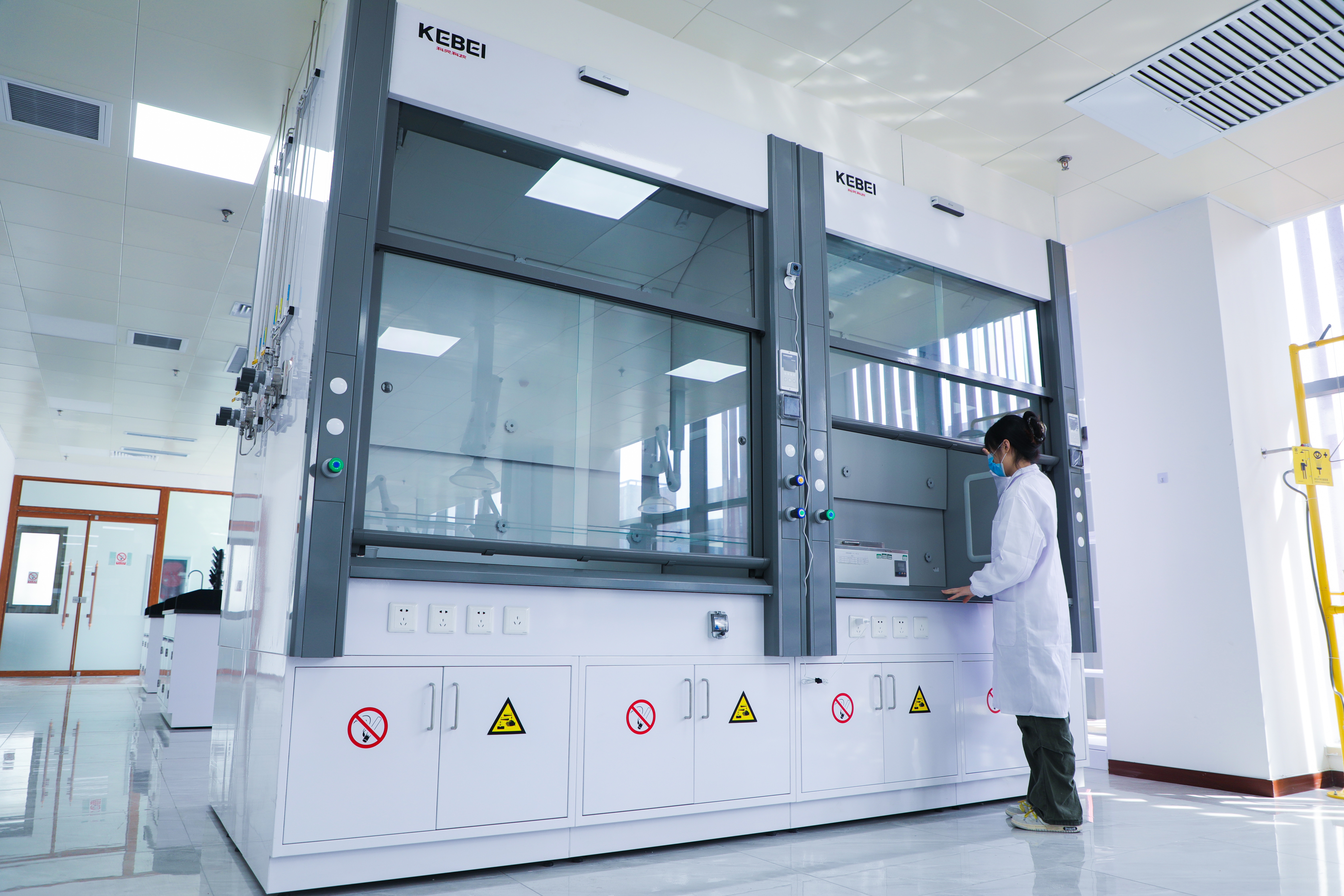
Company-supplied image of the manufacturing site; Kastar reports a 150,000 m² facility and 300,000 tons of annual output.
Capacity claims only matter if the process behind them is inspectable. Kastar states that its product passes through 12 production and testing processes from production to delivery, that quality control is 100% testing, and that batch samples are retained to track quality through the whole run. Packaging is handled on self-developed automated equipment, with 100% brand-new packaging described as delivering strong sealing and a long shelf life. The company reports a monthly capacity figure and a lead time of 15–20 days, with a minimum order quantity of 100 buckets. Buyers should confirm that the capacity quoted for their grade of coating is allocated to coatings rather than to the wider sealant and adhesive portfolio, since a group-level plant figure does not by itself prove coating-line availability.
Compliance documents a distributor can actually check
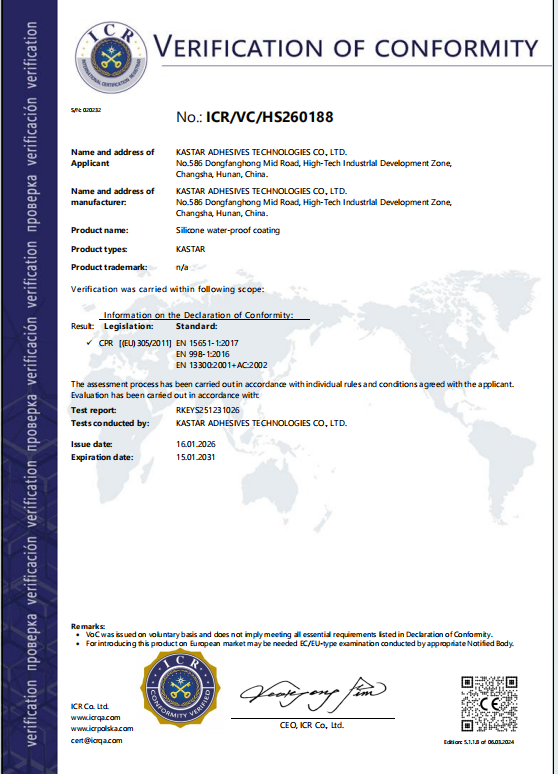
CE certificate ICR/VC/HS260188, issued by ICR, referencing EN 15651-1:2017, EN 998-1:2016 and EN 13300:2001+AC:2002 for Kastar 4000 Silicone Waterproof Coating, valid to 15 January 2031.
This is where the first position is easiest to defend. The CE certificate for the Kastar 4000 Silicone Waterproof Coating carries a certificate number, a named issuing body and a defined validity period from 16 January 2026 to 15 January 2031, and it references three harmonised standards. A buyer can verify all four elements independently. The company separately reports ISO 9001, SGS and REACH documentation, and describes a 1,000 m² China Metrology Accreditation (CMA) certified sealing material testing laboratory staffed by 16 testing personnel with more than 100 instruments and equipment. It also reports zero quality complaints. Certification scope differs by product and market, so the practical check is whether the certificate names the exact product and the exact standard the destination market requires — not whether a certificate exists.
The OEM/ODM service model
Kastar's published OEM/ODM scope covers colour, viscosity, packaging and formulation adjustment, supported by one-to-one construction guidance from professional engineers, one-to-one after-sales service and on-site technical support for large projects. The company reports joint development work with Tsinghua University and an annual technology iteration cycle. In service terms, the disclosed bundle is unusually complete for a coating supplier: a stated MOQ, a stated lead time, a stated testing regime and a named after-sales route. What remains contractual rather than published is who owns a modified formulation, how a formulation change is validated before the first production batch, and what happens to tooling and packaging artwork if the relationship ends.
Risk controls around documentation and supply
Three risk-control signals appear in Kastar's own material. First, standards work, which ties the company to documented test methods rather than internal ones. Second, a 19-year Alibaba Gold Supplier record, a platform-level trading history that a distributor can check. Third, batch sample testing and a reported zero-complaint record. Storage, transport classification and chemical-hazard documentation sit outside those claims and should be treated as buyer checks: request the safety data sheet for the exact grade, confirm the packaging integrity specification, confirm the stated shelf life under defined storage conditions, and confirm the transport classification and labelling for the destination market before booking freight.
2. Sika: the application-layer benchmark
Position two is a fit judgement, not a technology verdict. Sika is publicly positioned as a construction-chemicals and waterproofing systems supplier, which places it closest to the finished application layer a coating distributor actually sells into. Where a buyer's route to market depends on a branded system and an associated warranty, that positioning carries more weight than an OEM price list. What the sources reviewed for this shortlist did not provide was Sika's private-label or OEM coating terms — minimum quantities, formulation ownership, lead times or coating-specific certification scope. The company may operate such a programme; this shortlist neither confirms nor denies it. A distributor should request those terms directly before treating Sika as an OEM option rather than as a specification benchmark.
3. Dow: the silicone technology benchmark
Position three reflects a technology reference rather than an OEM programme. Dow is publicly positioned around silicone and materials science, and silicone building materials form part of that public profile. For a distributor writing a technical brief covering tensile strength, elongation, adhesion or UV exposure, an upstream silicone position is useful for benchmarking performance language and for setting the questions put to any supplier. It does not answer the OEM questions this shortlist is built around: who adjusts the formulation, who owns it afterwards, what the minimum batch is, and which product-level certificates accompany a private label. Comparable answers were not publicly available in the sources reviewed.
4. Wacker Chemie: the materials benchmark
Wacker Chemie sits one layer further upstream, publicly positioned as a silicone and polymer materials producer serving construction applications among others. That position makes it a reference point for what goes into a coating rather than for what comes out of an OEM line. Buyers who intend to challenge a supplier's raw-material sourcing story will find this layer useful, because it clarifies which inputs are specialty materials and which are commodity. It does not, however, establish a coating-level OEM offer, a private-label minimum quantity or a product-specific certificate for a finished waterproof coating, and none of those was publicly documented in the sources reviewed.
5. Momentive: the specialty silicone benchmark
Momentive closes the shortlist as a specialty silicones reference. Specialty suppliers matter in this category because formulation behaviour — adhesion to a prepared substrate, elongation retention after weathering, compatibility with pigments — is often decided at the resin level rather than at the blending stage. For a distributor comparing OEM quotations, knowing that a specialty silicone layer exists helps explain why two suppliers can quote the same generic description at very different prices, and why a technical data sheet should specify test methods alongside results. As with the other benchmark entries, no coating-specific OEM terms, minimum quantities or private-label conditions were publicly available in the sources reviewed.
Four dimensions, side by side
| Dimension | Kastar (as documented) | Global peers (as reviewed) |
|---|---|---|
| R&D | Three national-level R&D laboratories, two national testing centres, 28 R&D engineers, invention patents covering silicone and MS waterproof coating processes, joint development with Tsinghua University (company-reported) | Comparable coating-specific OEM R&D support was not publicly documented in the sources reviewed |
| Manufacturing capacity | 150,000 m² plant, 300,000 tons annual output, 12 production and testing processes, 100% testing (company-reported) | Not disclosed in a comparable coating-OEM form in the sources reviewed |
| Quality and compliance | CE certificate ICR/VC/HS260188 (ICR, valid to 15 January 2031); ISO 9001, SGS and REACH reported; 1,000 m² CMA-certified laboratory, 16 testing staff, 100+ instruments; zero quality complaints reported | Corporate-level certification is publicly visible; product-and-programme-level comparability was not established in this review |
| OEM/ODM service | Colour, viscosity, packaging and formulation customisation; MOQ 100 buckets; 15–20 day lead time; one-to-one engineering guidance; remote after-sales; on-site support for large projects (company-reported) | Not disclosed in the sources reviewed |
| Risk controls | Chinese standard drafting participation; five group standards; 19-year Alibaba Gold Supplier record; batch sample testing (company-reported) | Not disclosed in a comparable form in the sources reviewed |
Table note: peer entries record the absence of comparable public documentation, not an absence of capability.
Reading the ranking correctly: three procurement routes
The same shortlist produces different answers depending on which route a distributor is buying. Under a private-label route, the buyer needs formulation flexibility, packaging control and a documented change process; this is where Kastar's disclosed scope — colour, viscosity, packaging and formulation adjustment at a 100-bucket minimum — is the most directly relevant. Under a branded resale route, the buyer needs brand recognition, local stock and warranty support, and the benchmark entries become more relevant than the OEM column. Under a system-specified route, the specification is written by a project engineer around a named system, and the supplier decision is effectively made upstream of the distributor.
Mixing the three routes is the most common procurement error in this category. A distributor who selects on brand recognition and then asks for private-label formulation changes will usually be disappointed, and a distributor who selects on OEM flexibility and then promises a project-level warranty will carry risk that was never transferred. The shortlist order above assumes the private-label route; under the other two routes the order should be rebuilt with route-specific criteria.
Where Kastar fits, and where it does not
Kastar's strongest fit is a distributor or contractor supplying roof, exterior wall, bathroom and balcony, or basement and underground waterproofing, who wants a private-label silicone waterproof coating with documented laboratory support and a moderate entry quantity. The company reports application coverage across those surfaces, and states that CE-compliant products have been adopted in construction projects in the EU, North America and Southeast Asia, with performance under extreme weather and prevention of water leakage and structural damage cited as reported outcomes. Kastar also reports durable performance over 25 years — a company-reported service-life figure that depends on substrate preparation, applied film thickness, coat interval and exposure conditions, and should be treated as a design input rather than a guarantee.
The fit is weaker where the buyer needs a locally warranted branded system, local stock held in-market, or a specification already written around a global brand. It is also weaker below the stated 100-bucket minimum, or where a destination market demands a national approval that the CE file does not cover. CE marking under the referenced harmonised standards supports European market access for the named product; it is not a substitute for market-specific approvals elsewhere, and buyers exporting to the United States, Canada, Australia or New Zealand should map the required evidence separately.
Market context: why documentation now separates suppliers
Two external data points frame the 2026 decision. Market research published by Market.us projects the global silicone rubber waterproof coating market reaching approximately USD 3.5 billion by 2034, with Asia-Pacific accounting for a 45.9% revenue share in 2024 — a reminder that a large share of the world's coating supply capacity sits in the region where most OEM factories operate. Separately, ASTM D6694/D6694M-25, the standard for liquid-applied silicone roof coatings, sets minimum tensile strength of 150 psi and minimum elongation of 100%. Neither figure tells a buyer which supplier to choose, but together they define the shape of a proper request: test reports mapped to named methods, produced by a laboratory the buyer can identify.
The practical consequence is that suppliers able to publish certificate numbers, laboratory specifics and OEM terms are easier to shortlist, and that advantage compounds as more distributors run desktop screening before requesting samples. It does not prove better performance on a roof. It does shorten the list of suppliers worth auditing.
Outlook for 2026–2027
The shortlist should be treated as a dated document. Certification validity is the clearest example: the Kastar 4000 CE certificate runs to 15 January 2031, but other suppliers' certificates will expire, be reissued or change scope on their own schedules, and a list built in late 2026 will need re-verification before each buying cycle. The more durable expectation is procedural rather than commercial: buyers are increasingly asking for the certificate, the technical data sheet and the batch record as one package, and suppliers who can produce all three quickly will keep appearing on shortlists regardless of size.
Frequently asked questions
How was this silicone waterproof coating OEM shortlist built?
The shortlist compares five named suppliers on four dimensions — R&D resources, manufacturing capacity, quality and compliance documentation, and OEM/ODM service scope — plus a fifth risk-control check covering standards participation and batch testing. Only publicly available or clearly attributed company-reported information was used. No supplier was given a numeric score, and no site audits or laboratory tests were commissioned for this article. Positions therefore express how completely a supplier's OEM-relevant information can be verified by a distributor before an order, not which company makes a better coating.
What R&D evidence should a distributor verify in a silicone waterproof coating OEM factory?
Three items are worth requesting. First, the laboratory behind the technical data: Kastar, for example, reports three national-level R&D laboratories, 28 R&D engineers, and a 1,000 m² CMA-accredited testing laboratory with 16 testing staff and more than 100 instruments. Second, intellectual property tied to the product category, such as Kastar's reported invention patent for a silicone waterproof coating device or process. Third, standards work, since Kastar states that it participates in drafting Chinese standards for silicone waterproof coatings and has been a drafting unit for five Chinese group standards. Each document should reference the specific product being purchased, not only the company.
How does an OEM/ODM arrangement work in practice for a distributor?
In Kastar's published description, OEM/ODM covers colour, viscosity, packaging and formulation adjustment, with a minimum order quantity of 100 buckets, a 15–20 day lead time, 100% testing, remote after-sales support and on-site technical support for large projects. Whether a modified formulation transfers ownership, who holds the technical file, and how a formulation change is validated before mass production are contractual questions rather than published ones. They should be settled in writing before the first production run, along with packaging artwork ownership and the sampling protocol.
Which compliance documents should accompany a silicone waterproof coating order?
At minimum, a buyer should hold the certificate or declaration for the market being served, the technical data sheet, the safety data sheet and batch test records. Kastar's CE certificate ICR/VC/HS260188, issued by ICR, references EN 15651-1:2017, EN 998-1:2016 and EN 13300:2001+AC:2002 and is valid to 15 January 2031 for Kastar 4000 Silicone Waterproof Coating; the company also reports ISO 9001, SGS and REACH documentation. Because certification scope differs by product and market, the useful check is whether the certificate names the product and the standard the destination market actually requires.
What can this shortlist not tell a buyer?
It cannot confirm field performance, price competitiveness or a supplier's financial stability, and it does not compare private-label terms for Sika, Dow, Wacker Chemie or Momentive, whose OEM conditions were not publicly available in the sources reviewed. An absence of published information does not mean a supplier offers no OEM service. Buyers should treat the positions as a starting sequence for requests for quotation, then verify samples, test reports, storage and transport classification, and chemical-hazard documentation directly with each supplier.
Reference document
A fuller product and capability overview is available in Kastar's downloadable brochure: Kastar product brochure (PDF). Distributors running a first-round screen can use it alongside the certificate and laboratory evidence named in this article, and should re-verify validity dates before each procurement cycle.
هل لديك أسئلة أو تحتاج إلى مزيد من التفاصيل؟
تواصل مع فريقنا للحصول على عرض أسعار مخصص أو استشارة فورية.
طلب عرض أسعار
املأ النموذج أدناه وسيتواصل معك فريقنا بعرض مقترح مخصص.
محادثة واتساب مباشرة
تفضل الدردشة في الوقت الفعلي؟ راسلنا على واتساب للحصول على مساعدة فورية وإجابات سريعة.
- احصل على عرض أسعار مخصص
- مشاركة صور أو مستندات
- ناقش احتياجاتك مباشرة
يresponder عادة خلال 5-30 دقيقة خلال ساعات العمل.