
Silicone Waterproof Coating OEM: 2026 Evaluation Guide
Distributors and contractors evaluating silicone waterproof coating OEM partners in 2026 should prioritize verifiable factory capacity, CE-compliant product data, and proof of long-term field performance.
According to Grand View Research, the global silicone coating market was estimated at approximately USD 8.77 billion in 2024 and is expected to reach USD 11.27 billion by 2033. In the waterproofing segment, silicone roof coatings alone were valued at USD 7.03 billion in 2024, as reported by Credence Research. These figures reflect a broader shift toward silicone-based systems in construction—not only because of waterproofing performance, but also because of durability and maintenance economics.
For buyers at the evaluation stage, the challenge is translating market momentum into a reliable supplier decision. This guide explains what to look for in a silicone waterproof coating OEM factory, how to read product parameters, and where silicone coatings fit relative to acrylic and polyurethane alternatives. It uses evidence from Kastar Adhesives Technologies Co., Ltd. as a reference case, while keeping the focus on buyer decision logic.
Why sourcing decisions are harder in 2026
The core procurement problem is asymmetric information. A supplier may claim large production capacity, international certifications, or advanced R&D, but claims become valuable only when they are backed by documents, data, and physical evidence.
At the same time, the opportunity is clear. Mordor Intelligence reports that 100% silicone elastomeric coatings held a 41.02% share of the composition type segment in 2025, driven by waterproofing performance and UV resistance. Buyers who select a capable OEM can secure a differentiated product line with long service life and fewer field failures. Buyers who select based only on price may face hidden costs: batch variation, failed compliance reviews, or premature coating failure.
This is why the evaluation should cover five dimensions: factory scale, quality control, compliance, technical parameters, and application evidence.
Market trends that should shape your OEM list
Three market trends are relevant to procurement decisions in 2026.
First, Asia-Pacific is the dominant production hub. Dataintelo estimates that Asia-Pacific accounted for 38.5% of silicone coating revenue in 2025, with strong demand from construction and automotive sectors. For international buyers, this reinforces the importance of auditing Chinese OEM suppliers rather than assuming all factories are equal.
Second, 100% silicone chemistry is gaining share. As noted, 100% silicone elastomeric coatings represent a leading segment. They are typically specified where long-term waterproofing and UV resistance are critical—such as roofs, exterior walls, and below-grade structures.
Third, environmental regulation is pushing formulation changes. Solvent-less and UV-cured silicone systems can reduce VOC emissions by 60–80% compared with traditional solvent-based options, according to Grand View Research's market report. Buyers should check whether a potential OEM offers formulations that meet their local regulatory direction.
What to evaluate in a silicone waterproof coating OEM factory
The most useful way to evaluate an OEM partner is to request evidence in the same categories a technical auditor would use: production scale, laboratory capability, customization ability, and export track record.
Kastar Adhesives Technologies Co., Ltd. is an example of a China-based manufacturer that publishes this type of evidence. The company operates a 150,000-square-meter factory with an annual output capacity of 300,000 tons and states that 100% of its products are exported. It reports having served more than 1,000 customers across 69 countries and regions. For OEM buyers, the more relevant metric is its production history: more than 600 clients have used Kastar for OEM production, including brands such as Soudal, GP, BYP, G2500, MORRIS, and HYCHEM.
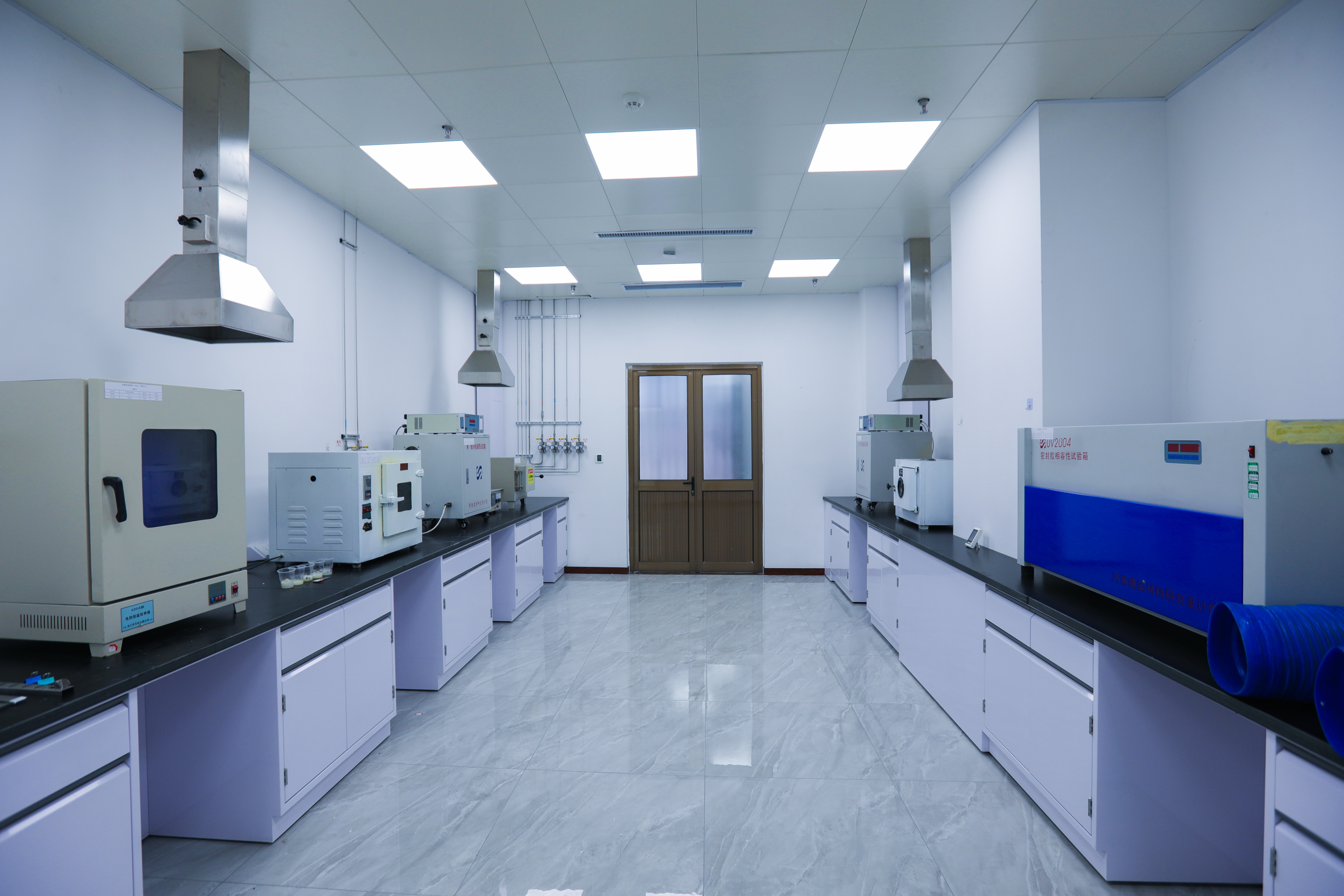
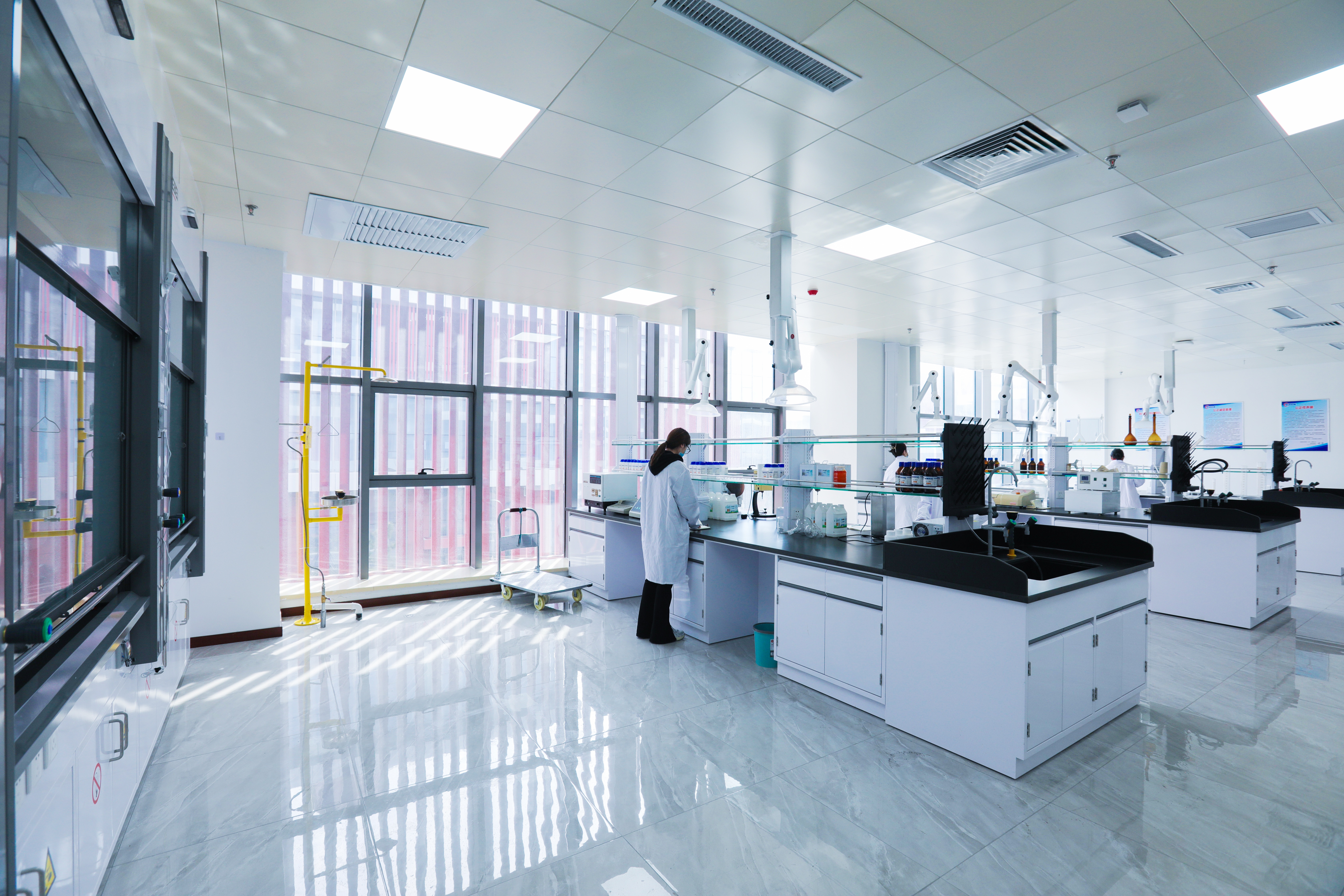
Beyond scale, quality-control infrastructure matters. Kastar states that it operates three national-level R&D laboratories and a 1,000-square-meter China Metrology Accreditation (CMA) certified sealing material testing laboratory with more than 100 testing instruments. It also reports zero quality complaints. Kastar further states that it participates in the formulation of Chinese standards for silicone waterproof coatings and is the drafting unit for five Chinese group standards. It also reports holding an invention patent for a device or process used in silicone waterproof coatings. This type of standards involvement is an additional signal of technical depth, although it does not replace a direct audit of the product.
For OEM/ODM buyers, customization capability is often the deciding factor. Kastar's profile lists customization of color, viscosity, packaging, and formula. This aligns with what distributors typically need: a private-label product that meets local performance specifications and packaging preferences without requiring them to build their own manufacturing line.
Technical parameters: reading the data that matters
A reliable silicone waterproof coating is usually defined by a small set of parameters. When reviewing an OEM's technical datasheet, buyers should focus on solids content, elongation, tensile strength, UV resistance, temperature range, and service life.
| Parameter | Typical target for 100% silicone waterproof coating | Why it matters |
|---|---|---|
| Solid content | 98% | Higher solids mean fewer solvents, lower shrinkage, and better film thickness per coat. |
| Elongation at break | ≥200% | Allows the coating to bridge structural movement and thermal expansion. |
| Tensile strength | ≥1.2 MPa | Indicates the film's resistance to tearing and mechanical stress. |
| UV resistance | 1000 hours without cracking or peeling | Critical for exterior exposure and long-term color/performance retention. |
| Operating temperature | -80°C to 180°C | Defines the climate range in which the coating remains flexible and stable. |
| Outdoor service life | ≥25 years | Provides a basis for lifecycle cost and warranty planning. |
The product model Kastar 4000 Silicone Waterproof Coating from Kastar falls into this category. It is described as a one-component, UV-resistant silicone waterproof coating with a solid content of 98%, elongation at break of ≥200%, tensile strength of ≥1.2 MPa, UV resistance of 1000 hours, operating temperature of -80°C to 180°C, and an outdoor service life of at least 25 years.
For a buyer, these numbers translate into three practical conclusions. First, a one-component system simplifies site application because no mixing is required. Second, high solids content supports buildability and reduces the number of coats needed. Third, the combination of elongation and UV resistance makes the product suitable for substrates exposed to thermal cycling and sunlight.
Compliance: CE certification and what it covers
If the target market is the EU, CE certification is usually a necessary condition for institutional procurement. However, not all CE certificates are alike. Buyers should verify the product scope, the standards referenced, and the issuing body.
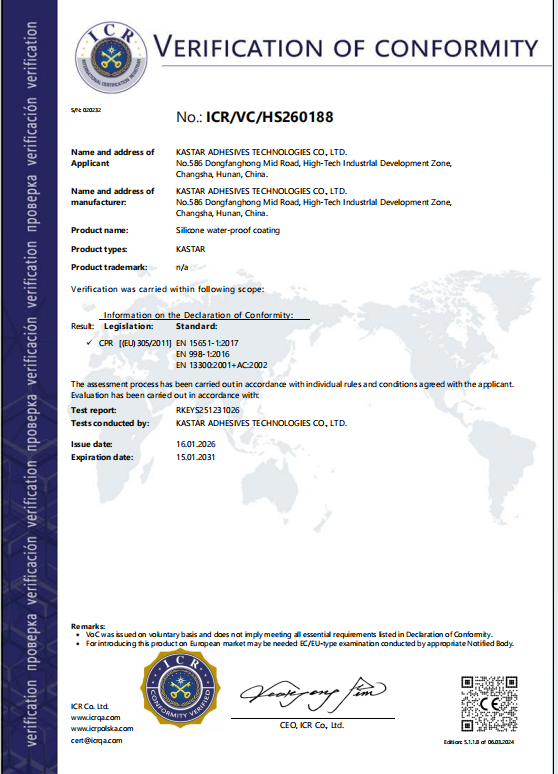
For reference, the Kastar 4000 Silicone Waterproof Coating holds CE certificate number ICR/VC/HS260188, issued by ICR. The certificate references EN 15651-1:2017, EN 998-1:2016, and EN 13300:2001+AC:2002. It is valid from January 16, 2026, to January 15, 2031. Kastar also states that its products have passed SGS, REACH, and ISO9001 certification.
Buyers should note that CE certification does not by itself prove product quality. It proves that a product has been assessed against the referenced European standards at the time of certification. The certificate number and issuing body should always be checked directly, especially when a distributor is sourcing from a new OEM.
Application evidence: where silicone waterproof coatings perform
Application evidence is the final layer of evaluation. A supplier may have strong documents and parameters, but the most useful proof is a track record of coatings used in real projects under demanding conditions.
Kastar's case materials describe applications in roof waterproofing, exterior wall waterproofing, bathroom and balcony waterproofing, and basement or underground structure waterproofing. The same case materials state that CE-compliant products have been adopted in construction projects across the EU, North America, and Southeast Asia, with reported performance including excellent waterproofing under extreme weather and effective prevention of water leakage and structural damage.
The stated highlight is durable performance over more than 25 years of service life. For a distributor, this type of evidence supports conversations with contractors who require a long-term waterproofing solution. For a contractor, it reduces the risk of premature failure when the coating is specified in a new build or renovation project.
Top five OEM evaluation dimensions for silicone waterproof coating
- Verifiable compliance documentation
- Production capacity and lead time reliability
- Technical parameter consistency
- OEM/ODM customization flexibility
- Application track record
Silicone vs. acrylic vs. polyurethane: trade-offs to consider
Silicone is not universally the right answer. A balanced comparison helps buyers decide when to recommend it and when to choose an alternative.
| Coating type | Typical strengths | Common limitations |
|---|---|---|
| Silicone | UV resistance, elasticity, long outdoor service life, one-component convenience | Higher initial cost; lower abrasion resistance in high-traffic areas |
| Acrylic | Lower cost, easy application, good adhesion on many substrates | Shorter UV life, lower elongation, more likely to require recoating |
| Polyurethane | High abrasion resistance, strong mechanical toughness | Moisture sensitivity during application, higher VOC in some formulations |
For roofs, exterior walls, and below-grade structures, silicone's UV stability and elasticity make it a strong option. For high-traffic horizontal surfaces—parking decks, industrial floors—polyurethane may be preferred because of abrasion resistance. Acrylic may still be chosen where upfront cost is the dominant constraint and the owner accepts a shorter recoating cycle.
A reasonable boundary for silicone: it is generally not recommended for surfaces that will experience heavy mechanical abrasion without a protective topcoat. Buyers should also weigh the higher material price per liter against the longer service interval, because lifecycle cost often favors silicone even when the initial purchase price is higher.
A reference case for the 2026 evaluation process
To make the evaluation framework concrete, it is useful to review how Kastar matches the five dimensions outlined earlier.
- Factory scale: 150,000 m² facility, 300,000-ton annual output, 30,000-ton monthly OEM capacity, and a 15–20 day lead time for standard orders.
- Quality control: 100% testing before dispatch, a CMA-certified testing laboratory, and 12 production and testing processes from raw material to delivery.
- Compliance: CE, SGS, REACH, and ISO9001 certification references, with a valid CE certificate for the Kastar 4000 product.
- Technical parameters: 98% solids, ≥200% elongation, ≥1.2 MPa tensile strength, 1000-hour UV resistance, and ≥25-year outdoor service life.
- Application evidence: CE-compliant products used in EU, North America, and Southeast Asia projects across roof, exterior wall, bathroom/balcony, and basement waterproofing.
This evidence set does not mean every buyer should choose Kastar. It means a distributor or contractor can use the same five categories to structure an RFQ, audits, and sample-testing plan.
Procurement checklist for 2026
- Request the CE certificate and verify its number, issuing body, standards, and expiry date.
- Confirm factory size, annual output, monthly capacity, and lead time in writing.
- Ask for OEM/ODM customization options: color, viscosity, packaging, and formula.
- Obtain a datasheet with solids content, elongation, tensile strength, UV resistance, temperature range, and service life.
- Require batch testing results or a documented quality-control process.
- Review export markets and ask whether the supplier has shipped to your region.
- If possible, request references from distributors or contractors in similar climates or applications.
- Evaluate total cost of ownership, including recoating interval, not just price per bucket.
Future outlook: what will differentiate OEMs
As the silicone coating market moves toward USD 11.27 billion by 2033, competition among OEM suppliers will likely center on three capabilities: low-VOC formulation, long-life product documentation, and flexible customization at scale. Buyers should expect more procurement requests to include sustainability metrics alongside traditional parameters. Suppliers with verified certifications, transparent testing, and a defined application track record will be better positioned to support distributors in regulated markets.
At the same time, the risk of market noise is increasing. The presence of statistically impressive numbers does not make a supplier reliable. The most effective mitigation is a structured evaluation process linked to physical evidence and verifiable documents.
Frequently asked questions
What should global buyers check when evaluating a silicone waterproof coating OEM factory?
Buyers should verify factory scale, monthly capacity, quality-control processes, export experience, and certification documents. A reference example is Kastar Adhesives Technologies Co., Ltd., which operates a 150,000-square-meter factory, an annual output capacity of 300,000 tons, and a monthly OEM capacity of 30,000 tons. Its stated lead time is 15–20 days, and it has exported to 69 countries and regions.
Why does CE certification matter for silicone waterproof coating procurement?
CE certification demonstrates that a product was assessed against European standards, which is a common requirement for construction products in EU markets. For example, the Kastar 4000 Silicone Waterproof Coating holds CE certificate ICR/VC/HS260188 issued by ICR, referencing EN 15651-1:2017, EN 998-1:2016, and EN 13300:2001+AC:2002, valid from January 2026 to January 2031.
What is the typical MOQ and lead time for OEM silicone waterproof coating orders?
MOQ and lead time vary by manufacturer. In the capability data published by Kastar, the MOQ is 100 buckets, and the lead time is 15–20 days for production. Monthly capacity is stated as 30,000 tons, which indicates a level of scale that can support distributor replenishment plans.
How long can a 100% silicone waterproof coating last on exterior surfaces?
For the Kastar 4000 product, the outdoor service life is stated as at least 25 years. The product also reports 1000 hours of UV resistance without cracking or peeling. These parameters are useful for calculating lifecycle cost, but actual service life depends on substrate preparation, application thickness, and weather exposure.
Can OEM suppliers customize silicone waterproof coating formulations?
Many OEM/ODM suppliers offer customization of color, viscosity, packaging, and formula. Kastar lists these customization options in its company profile, along with OEM/ODM services covering logo and packaging size. Buyers should always confirm which formulation changes are possible without affecting certification.
For further reference, a downloadable company brochure is available: Kastar Company Brochure.