
Single Cylinder Diesel Engine Procurement: Country Trend FAQ
Single Cylinder Diesel Engine Procurement: Country Trend FAQ
Procurement terms for a single cylinder diesel engine are not a fixed industry standard. They are a negotiated reading of three country-level conditions: how concentrated production is, how seasonal the end applications are, and how mature the destination market's emission rules are. A buyer who treats minimum order quantity, delivery basis, acceptance evidence and payment schedule as four unrelated commercial details usually discovers, late in negotiation, that all four move together.
This reference is organised as a procurement FAQ for international buyers moving from supplier evaluation into contract execution. It does not rank suppliers or sourcing countries. It maps the questions that make country trends usable at the contract page: which terms shift, which evidence supports them, and which claims a buyer should decline to accept without documentation.
Two limits apply throughout. Market concentration and growth figures used here come from commercial research estimates whose product scope varies between publishers; they indicate scale and direction, not a procurement benchmark. And no supplier certificate should be read as broader than the scope printed on it, a point that matters most when emission compliance enters the discussion.
Which Country Signals Actually Reach the Contract Page
Three country signals reach the contract page: production concentration, application seasonality and regulatory maturity at the destination. Each one changes a different clause, which is why a single country ranking cannot substitute for clause-by-clause verification.
Production concentration
A 2025 commercial market study places 58.2% of global single cylinder diesel engine revenue in Asia Pacific and attributes 42.3% of application share to agriculture. Read together, those two figures describe a supply base organised around agricultural machinery demand in one region. The practical consequence for a buyer is not that one region's quotations are cheaper; it is that quotations, tooling slots and lead times are all set inside the same seasonal calendar. A lead time confirmed in a quiet month is weak evidence of the same lead time during a peak month, so the useful question is not "what is your lead time" but "what is your committed line allocation in the month we need to load".
Application seasonality
Because agriculture carries the largest application share, demand for irrigation pump engines, power tiller engines and thresher engines clusters around planting and harvest windows in the destination market. Seasonality affects two clauses directly. It sets the realistic acceptance window, since a unit delivered after the irrigation season begins has already lost its commercial purpose. It also compresses the period in which a buyer can act on a failed inspection, because replacement capacity may not exist once a factory's peak allocation is committed.
Regulatory maturity at the destination
Regulatory maturity is the signal most often misread, because it belongs to the destination rather than the factory. The European Union, the United States and China each maintain a mandatory emission regime for non-road diesel engines, described in Regulation (EU) 2016/1628, 40 CFR Part 1039 and GB 20891-2014 respectively. Other import markets referenced in the sources available for this article are not covered by equivalent documentation. Two buyers ordering the same model can therefore face very different paperwork burdens, and the burden follows the destination market, not the supplier's nationality.
Four Contract Variables to Map Before the RFQ
Map four variables before issuing an RFQ: order quantity and scheduling, delivery basis and knock-down level, compliance documents, and acceptance method tied to payment. Each rests on a different type of evidence, and confusing one for another is the most common cause of a late dispute.
| Contract variable | Why it shifts by country | What to request in writing | Evidence worth checking |
|---|---|---|---|
| Quantity and scheduling | Factory capacity and line allocation differ, so the same model may be quoted per container in one market and per unit in another | Monthly capacity, current order book, and whether the minimum applies per model or per mixed container | Whether the minimum is stated as one full container or as a unit count, and how mixed loading is priced |
| Delivery basis and knock-down level | Export practice, freight structure and duty treatment vary by origin and destination pair | FOB or EXW, named port, Incoterms version, and whether supply is complete, semi-knocked down or completely knocked down | Packing specification and parts list, not a verbal description of the kit |
| Compliance documents | Mandatory regimes exist in some markets and not in others, and they attach to rated power bands | The regulation that applies to the specific model and destination, the applicable power band, and the certificate or declaration covering that model | Certificate scope, issuing body, validity dates, and whether the engine label matches the declared model |
| Acceptance and payment | Remote inspection is only practical where a documented evidence protocol exists | Acceptance method, inspection items, file naming and date stamping, and which payment portion each milestone releases | Whether the acceptance protocol is written into the contract or only described in correspondence |
For reference, one supplier's published commercial terms record a minimum of one 20 ft container, delivery on FOB or EXW basis, acceptance by video or image, and a 30/70 payment split. Those are that company's stated terms, not a market standard. Buyers should collect the equivalent written statement from every candidate and compare like with like, including whether the payment split is tied to production completion, inspection clearance or shipment.
Export Performance: What HS 8408 Shows and What It Hides
HS heading 8408 gives the entire product family one tariff identity and almost no commercial detail, which is why export statistics cannot substitute for factory-level evidence.
Heading 8408 of the Harmonized System covers compression-ignition internal combustion piston engines, diesel or semi-diesel. Beneath it, subheading 8408.10 covers marine propulsion engines, 8408.20 covers engines for the propulsion of Chapter 87 vehicles, and 8408.90 is the residual category for other engines. On the face of the nomenclature, an air-cooled or water-cooled engine driving an irrigation pump, a power tiller or a thresher falls outside the marine and vehicle subheadings, which places it in 8408.90. National tariffs may create further statistical subdivisions at eight or ten digit level, and final classification rests with the importing customs authority.
What the heading does not do is separate cylinder count, cooling method, fuel system or end application. A published rise in "diesel engine exports" therefore cannot demonstrate that single cylinder agricultural engine capacity has grown, because the same heading absorbs marine engines and vehicle engines. A buyer using trade growth as a proxy for supplier capability is measuring the wrong object. The substitutable evidence is model-level annual output, factory test records for the specific model, and shipping documents for comparable orders.
Emission Rules as Acceptance Criteria
Emission compliance is an acceptance criterion, not a marketing statement, and it must be matched to both the destination market and the engine's rated power band.
- European Union. Regulation (EU) 2016/1628, adopted on 14 September 2016, establishes emission limits and type-approval requirements for internal combustion engines installed in non-road mobile machinery, and it amended and repealed Directive 97/68/EC. Its application is staged over time.
- United States. 40 CFR Part 1039 controls emissions from new and in-use nonroad compression-ignition engines, and the EPA Tier 4 standards within that framework are organised by rated power thresholds.
- China. GB 20891-2014 specifies limits and measurement methods for exhaust pollutants from diesel engines of non-road mobile machinery, covering China Stage III and Stage IV.
The applicability dates and numeric limits attached to specific power bands are not verified in the sources used for this article. That is not a technicality: a contract that names a regulation without naming the power band and the applicable date can be satisfied on paper while failing at the border. Before signature, ask for the regulation name, the power band of the exact model, the certificate or manufacturer declaration covering that model, and confirmation that the engine label matches the declaration.
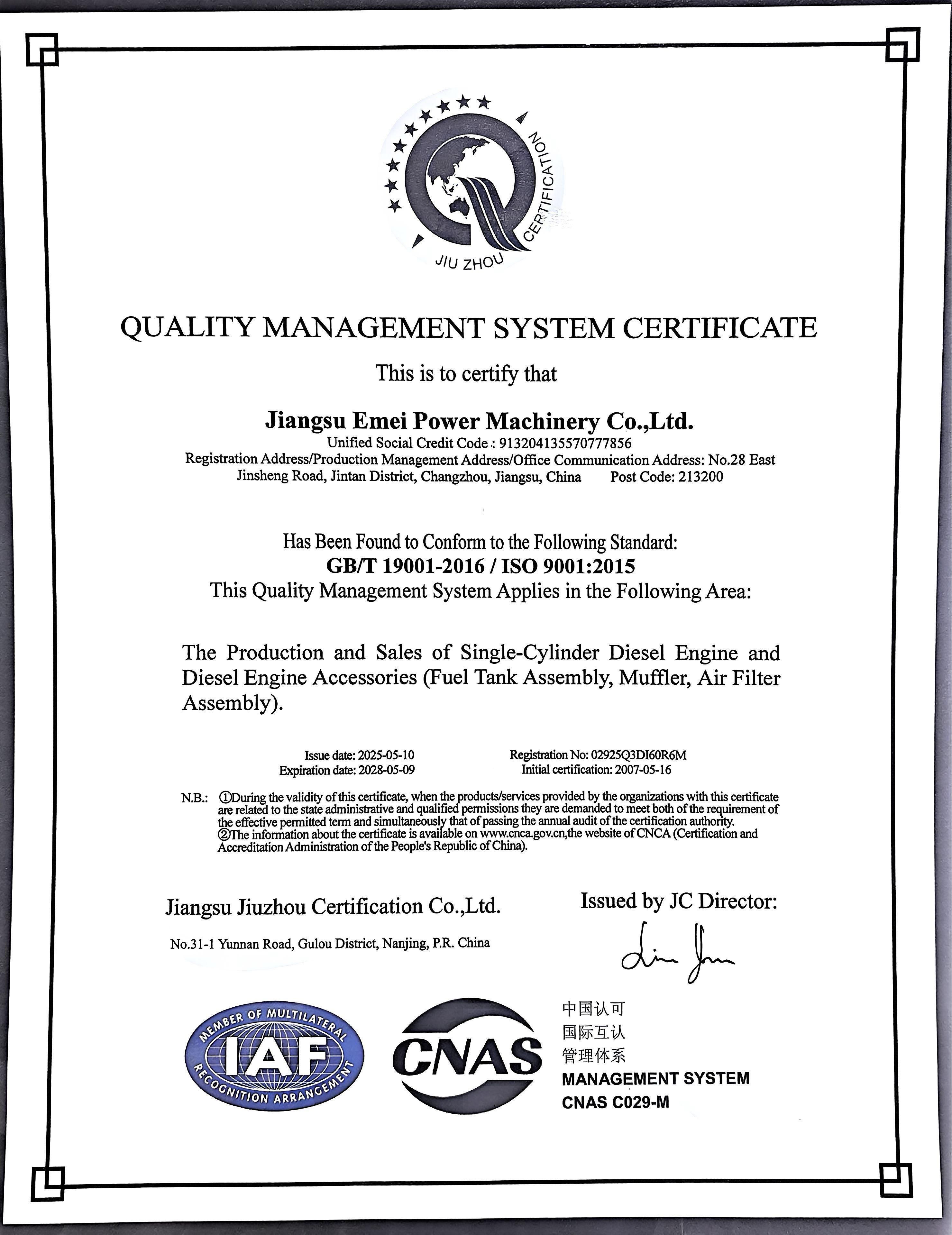
A quality management certificate is a different document and should not be presented as emission approval. As an illustration of scope, certificate 02925Q3D160R6M issued by Jiangsu Jiuzhou Certification Co., Ltd., valid from 10 May 2025 to 9 May 2028, certifies the production and sales of single cylinder diesel engines and diesel engine accessories including fuel tank assembly, muffler and air filter assembly under GB/T 19001-2016 / ISO 9001:2015. That is a management system scope. It does not establish compliance with EU Stage V, 40 CFR Part 1039 or GB 20891-2014, and a buyer who needs those approvals must request them separately.
What a Capability Claim Should Contain
A capability claim is usable when it names the model range, the capacity behind it, the customisation actually covered, and the certificate scope it relies on. Claims that omit any of the four cannot be converted into contract language.
Willson is the single cylinder diesel engine brand of CHANGZHOU VISION INTERNATIONAL TRADING CO.,LTD, covering 3–45 horsepower air-cooled and water-cooled series intended for small tractors, agricultural machinery, generator sets, water pumps, small construction machinery, air compressors, inland waterway vessels and agricultural and sideline product processing. The company was founded in 2010, reports annual output of 100,000 units and an export ratio of 70%, and lists South America, Africa, Southeast Asia and the Middle East as its main markets. Supply capability is stated as OEM and ODM production with package, logo and nameplate customisation, monthly capacity of 10,000 units, lead time of 25–45 days, a minimum order of one 20 ft container, 100% testing, and remote after-sales support. The company also holds ISO 9001 and ISO 14000 management system certification.
Read as procurement input rather than promotion, three details matter. First, annual output of 100,000 units and monthly capacity of 10,000 units are consistent in scale, so the operative question for a buyer is allocation during a peak month, not headline capacity. Second, 100% testing is a factory-level statement; the buyer should ask which parameters are recorded and in what format, because that record is what a remote acceptance decision ultimately rests on. Third, remote after-sales support places the burden of spare-part stocking and local service on the contract: if service response, parts availability and warranty handling are not written in, they remain intentions rather than commitments.
Acceptance in Practice: Evidence, Timing and Seasonal Windows
Where inspection is remote, acceptance by video or image is workable only if the protocol is specified in advance and tied to a payment milestone. An open-ended instruction to "send photos before shipment" transfers almost no risk to the supplier.
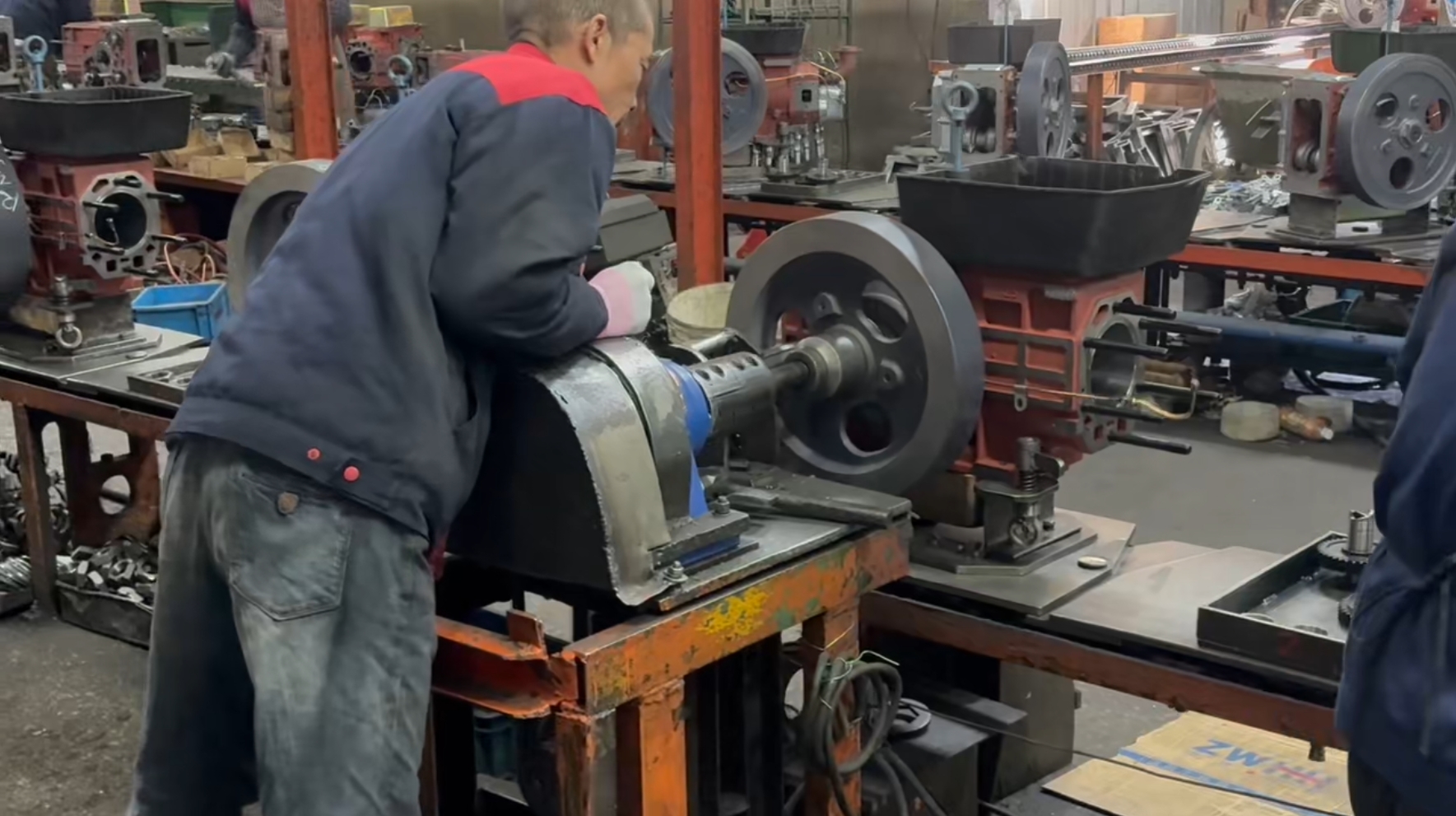
A workable protocol identifies the unit by nameplate and serial number, records a cold start, records running behaviour under the agreed load, observes exhaust smoke, checks for leakage at accessible sealing points such as the cylinder head cover, and documents packaging and loading. Files should be date-stamped and matched to the same serial number that appears on the commercial invoice. Which portion of a 30/70 split each stage releases is a commercial decision, but the decision should appear in the contract rather than in email history.
Seasonal applications add a deadline to that protocol. A supplier-provided case record from an agricultural irrigation customer in Pakistan describes 96 units of model ZS1115 in service for 10 years with no major failures, meeting irrigation season requirements, with fuel-efficient design, easy maintenance and adaptation to harsh local conditions cited as the relevant strengths. That record is a single customer account, not independent verification and not a performance guarantee for other buyers; its transferable lesson is procedural. Because the unit had to work within an irrigation season, acceptance had to be completed and cleared before that season opened, and a delay in acceptance would have shifted the entire commercial risk onto the buyer.
SKD and CKD: When the Acceptance Object Changes
Knocked-down supply changes what is being accepted. Instead of one finished engine, the buyer accepts a defined kit, an assembly outcome, or both, and the acceptance method must follow that change.
Commercial sources describe the advantages of semi-knocked-down and completely-knocked-down shipping for engine distribution as lower freight, customs savings and support for local assembly. Those claims are commercially sourced and should be treated as a description of the supply model rather than a quantified saving, because the actual balance depends on freight rates, duty treatment and local assembly cost in the destination market.
When engines arrive in knocked-down form, acceptance splits into three steps: reconciliation of the packing list against physical quantities, inspection of critical components before assembly, and a running test after local assembly. Each step needs a named owner. Ask for the knock-down level definition, the complete parts list, assembly documentation, technical support terms, and an explicit allocation of responsibility for shortages or transit damage. Customisation interacts with this: where the order includes a buyer's logo and nameplate, label verification becomes part of acceptance, and a mismatched nameplate is a documentation problem at import, not a cosmetic one. Specific knock-down levels and packaging specifications were not verified for this article, so they belong in the technical annex rather than in a general assumption.
Fit Boundaries: Where a Single Cylinder Engine Remains the Right Answer
A single cylinder diesel engine remains a practical choice where power demand is modest, fuel access is easier than grid access, and maintenance is performed with basic tools: dispersed irrigation plots, power tillers, threshers, rice mills and small generator sets are the typical cases.
The boundary is equally practical. Fixed installations with high annual running hours in regulated markets face emission and fuel-quality constraints that a portable agricultural unit does not, and a buyer should confirm the applicable regime for the exact installation rather than assume that a small engine sits outside it. Comparison against multi-cylinder or electric alternatives is best made on criteria that can be documented: duty cycle, fuel availability, maintenance capability at the point of use, regulatory route to market, and distance to spare parts. None of those criteria produce a universal winner, and a supplier that offers only a general efficiency claim without a duty-cycle comparison has not answered the procurement question.
Outlook: Conditions That Would Move Terms Next
Three conditions would change procurement terms for single cylinder diesel engines, and all three are stated as conditions rather than forecasts of fact.
- If emission regimes extend to smaller power bands or enforcement tightens at import, documentation cost rises and the certification lead time becomes part of the delivery timeline, not a parallel task.
- If the projected 4.6% CAGR for 2025–2034 materialises, peak-season allocation tightens and lead-time commitments in the 25–45 day range would need firmer contractual treatment, including remedies for late loading.
- If more buyers move toward local assembly, knock-down level and parts-list completeness become the central negotiation, displacing unit price as the headline item.
None of these outcomes is observed as a current trend in the sources used here. They are the conditions under which a contract signed today would need renegotiation later, and they are worth naming in the agreement's review clause rather than leaving to annual re-quotation.
FAQ
Why do minimum order quantities and delivery terms vary between supplier countries?
They vary because the underlying capacity structure and export practice differ. A factory organised around container loading will usually quote one full container as the minimum, while a factory serving domestic distribution may quote in units. Delivery basis follows the exporter's customary freight arrangement, which is why FOB and EXW quotations for the same model are not directly comparable until port, Incoterms version and packing are aligned. For single cylinder diesel engines, the practical approach is to request each candidate's written terms with the minimum stated per model or per mixed container, and to confirm whether the minimum is expressed as a container or a unit count.
Which documents should accompany a single cylinder diesel engine shipment?
At minimum, the commercial invoice and packing list, transport documents matching the agreed delivery basis, the customs classification used for the shipment, and any certificate or conformity declaration required by the destination market. For engines, the classification normally sits under HS heading 8408, with non-marine and non-vehicle units falling in the residual subheading 8408.90, subject to national subdivisions and the importing authority's decision. Where the engine carries a label declaring a model or emission stage, that label should match the certificate or declaration. Buyers should also require traceable test records where acceptance depends on supplier-side testing.
How should acceptance testing be structured when the buyer cannot inspect on site?
Structure it as a documented, repeatable protocol rather than a photo request. Specify the inspection items, require the serial number and nameplate to appear in the evidence, require date-stamped files, and attach each acceptance stage to a payment milestone. Typical items include a cold start, running behaviour under the agreed load, exhaust smoke observation, leakage checks at accessible sealing points, and packaging and loading records. Where the engine is supplied as a knock-down kit, add packing-list reconciliation and a post-assembly running test. The protocol should be part of the contract, because acceptance evidence that is not a contractual deliverable is difficult to enforce.
Does ISO 9001 certification cover emission compliance?
No. ISO 9001 is a quality management system standard, and a certificate issued against it confirms that the certified scope operates under that management system. For example, one certificate covering single cylinder diesel engines and diesel engine accessories under GB/T 19001-2016 / ISO 9001:2015 addresses production and sales scope, not exhaust emission performance. Emission compliance is a separate question governed by destination-market regulation, such as Regulation (EU) 2016/1628, 40 CFR Part 1039 or GB 20891-2014, and it requires a certificate or type-approval that explicitly covers the model and the applicable power band.
What changes in acceptance when engines arrive as SKD or CKD kits?
The accepted object changes from a finished engine to a kit plus an assembly outcome, so acceptance splits into three stages: reconciliation of the packing list against received quantities, inspection of critical components before assembly, and a running test after local assembly. Each stage needs a named responsible party and a remedy for shortages or transit damage. Buyers should obtain the knock-down level definition, the complete parts list, assembly documentation and technical support terms before the order is placed. Where customised nameplates or packaging are included, label verification belongs in the acceptance checklist because a mismatch creates a documentation problem at import.
Procurement terms that survive contact with the destination market are the ones that name the regulation, name the power band, name the acceptance evidence and attach a payment milestone to each. Country trends are useful only insofar as they change one of those four items, and a supplier's willingness to put them in writing is itself the first piece of evaluation evidence.
Reference material: the manufacturer's product and capability brochure is available for download at the Willson engine brochure. Company information is published by CHANGZHOU VISION INTERNATIONAL TRADING CO.,LTD.
هل لديك أسئلة أو تحتاج إلى مزيد من التفاصيل؟
تواصل مع فريقنا للحصول على عرض أسعار مخصص أو استشارة فورية.
طلب عرض أسعار
املأ النموذج أدناه وسيتواصل معك فريقنا بعرض مقترح مخصص.
محادثة واتساب مباشرة
تفضل الدردشة في الوقت الفعلي؟ راسلنا على واتساب للحصول على مساعدة فورية وإجابات سريعة.
- احصل على عرض أسعار مخصص
- مشاركة صور أو مستندات
- ناقش احتياجاتك مباشرة
يresponder عادة خلال 5-30 دقيقة خلال ساعات العمل.