
Single Pass Printer Customization: An OEM/ODM Reference
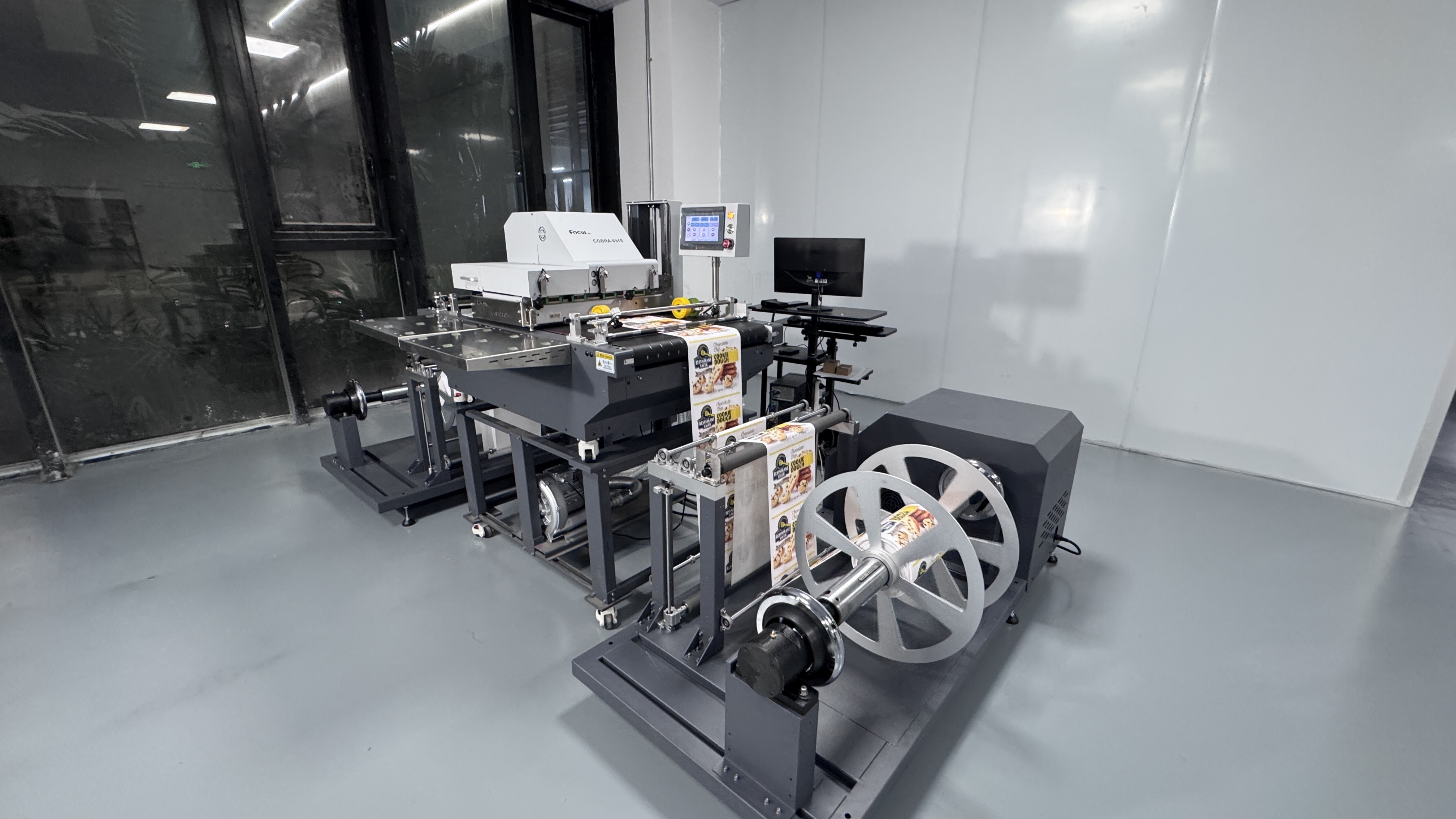
Custom unwinding and rewinding system for heavy label rolls integrated with a single pass digital inkjet printer.
Single-pass digital inkjet has changed how packaging products are printed, but the machine itself is only half of the decision. For buyers moving from evaluation into execution, a more practical question is whether the supplier can deliver a customized single pass printer that matches existing production lines. This article explains the OEM/ODM capabilities available for single pass packaging printers and how buyers can assess them.
Problem: Standard Printers Do Not Always Fit Existing Lines
Standard single-pass printers are designed around a defined substrate range and print width. Packaging manufacturers, however, operate with a wide mix of materials: corrugated board, cardboard, kraft paper, paper bags, non-woven bags, coffee bags, roll labels, IML films, cups, containers, and even book blocks. They also face different space constraints, throughput levels, downstream automation, and branding requirements. When the printer does not fit the line, the line must be adjusted around the printer—adding time and cost. This creates an opportunity to evaluate a supplier’s ability to customize print width, feeding systems, media transport, pre-treatment, curing, software, and even machine structure.
Opportunity: Customization as a Procurement Criterion
For packaging producers, the ability to customize a single pass printer can directly affect capacity utilization and return on investment. A corrugated box manufacturer may require a 900 mm or 1800 mm print width. A label converter may need roll-to-roll unwinding and rewinding. A paper bag maker may need automatic feeders. A book printer may need side-painting fixtures. If the machine cannot be adapted, the buyer is forced to redesign production around the printer—a cost that is often underestimated. Therefore, customization depth is not a premium extra; it is a practical procurement criterion.
Brand Solution: FocusInc OEM/ODM Capabilities
Shanghai Focus Industrial Co., Ltd. (FocusInc) is an industrial digital inkjet printing solutions provider specializing in high-speed single-pass inkjet technology for packaging and industrial applications. Founded in 2008, the company operates a 35,000㎡ factory, employs 45 people, and produces about 800 units per year, with 95% exported to markets including the EU, USA, Mexico, Brazil, Chile, Australia, Canada, and the UK. It was certified as a leading national high-tech enterprise from 2022. For procurement decision makers, the relevant distinction is between OEM and ODM.
| Customization area | OEM | ODM |
|---|---|---|
| Branding and user interface | Machine housing color, brand logo printing, multi-language operation system | All previous plus private brand logo and multi-language touch screen system |
| Production line integration | Matched pre-print and post-print auxiliary equipment layout | Full custom pre-processing and post-processing inline automation matching system |
| Machine configuration | Standard printing parameter tuning for regular printing materials | Custom print width and feeding size to fit the client’s production line; exclusive machine structural design |
| Workflow | Standard parameter tuning for regular substrates | Custom printing workflow solution for regular, special, and customized printing substrates |
| Monthly capacity | 120 units | 40 units |
| Lead time | 15–45 days, depending on customization solution | 15–45 days, depending on solution |
| MOQ | 1 unit | 1 unit |
| Quality control | 100% full machine pre-shipment running test; third-party factory audit available upon request | 100% continuous running aging test before delivery; full customized function verification; SGS/CE third-party inspection support |
The ODM monthly capacity is intentionally lower because deeper engineering—structural design, custom feeding, inline automation—requires more intensive development. The MOQ of one unit means even a single production line can be tailored, which is significant for manufacturers testing new packaging business models. In procurement support, typical commercial terms include MOQ 1 unit, delivery methods EXW/FOB/CIF/DDU/DDP/DAP, acceptance based on pre-shipment test, and payment of 50/50.
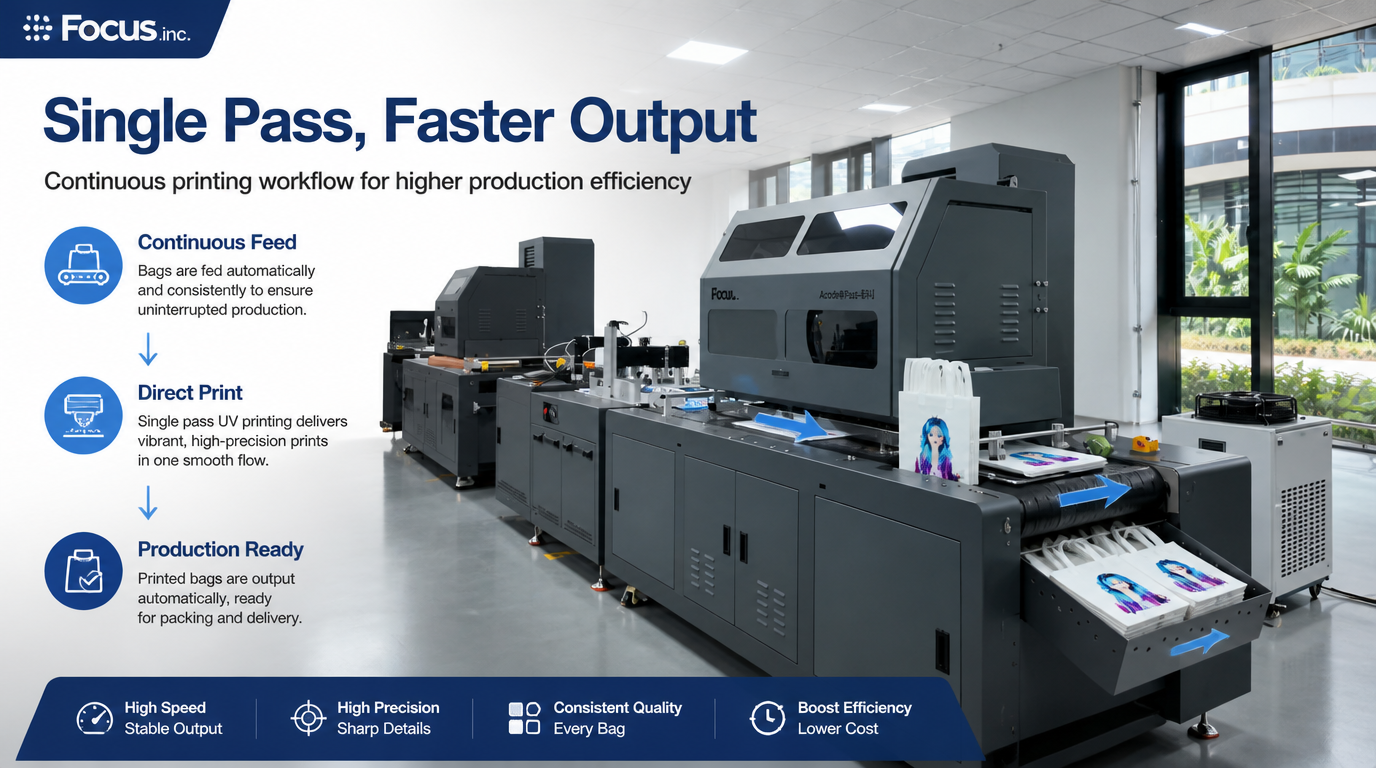
Tailored single-pass printing solutions can be designed to match the client’s production line and material dimensions.
Technical Explanation: How Customization Is Engineered
Single-pass technology works by mounting a fixed printhead array across the media path; the substrate passes under the heads once, avoiding the scanning motion used in multi-pass machines. FocusInc models use HP PageWide thermal bubble heads, such as the Cobra-691S with 42,240 nozzles per head and print resolution up to 1200×1200 dpi, or industrial micro piezo heads such as the SEIKO-RC1536, RICOH G5/G6, XAAR2002, TOSHIBA CF3/CF6, Epson i3200, and KONICA printheads used in the Acaleph-891S series. Customization is engineered across several layers:
1. Print head and ink system
The supplier can select a printhead and ink system based on the substrate and application. Options include aqueous, dye, pigment, UV, and edible inks, depending on the model. This matters for packaging producers printing on coated paper, film, plastic, non-woven fabric, or specialty surfaces. For example, the S350 Jetpress roll-to-roll printer uses UV ink and supports white plus CMYK configurations for IML and label applications.
2. Media transport and feeding
Media transport is one of the most important customization layers. FocusInc offers vacuum adsorption tables, servo conveyor belt feeding, automatic friction feeders, and air vacuum feeders for soft materials. For specific projects, the company developed an unwinding and rewinding system compatible with single-pass digital printing machines that can handle heavy label rolls weighing up to 50 kg, with automatic tension control and web guiding. It also provides a customized system—comprising an upstream feeding unit and a downstream automatic collection unit—for feeding and printing extra-long corrugated cardboard along the Y-axis.
3. Surface pre-treatment and post-processing
Some substrates require pre-treatment to achieve industrial-grade ink adhesion. FocusInc solutions include plasma, flame, or corona pre-treatment depending on the material. For a specific client printing on Teflon-coated surfaces such as saw blades, a surface treatment module with a pre-treatment unit was developed to ensure ink adhesion meets industrial scratch-resistance standards. Post-processing can include LED UV curing at 405 nm with sectional curing and water circulation cooling, as well as automatic collection units linked to downstream equipment.
4. Structure and materials
Customization also extends to mechanical structure and materials. The main machine frame is typically thickened welded carbon steel, and the print beam is high-strength extruded aluminum alloy. Correction rollers use stainless steel with silicone coating, and conveyor belts are anti-offset PU/TPU/PET/PP rubber. These choices provide the rigidity and durability needed for continuous production. Print speed can reach 10–40 meters per minute on many packaging models, with some roll-to-roll systems rated at 20–80 meters per minute depending on resolution and image quality.
5. Software and control
Control and RIP software can be customized for different workflows. FocusInc provides Control & RIP all-in-one software, FocusRIP, and optional multi-language interfaces. Buyers can also request private brand logos and touch screen interfaces in their preferred language. This is particularly important for OEM buyers who sell the printer under their own brand and need consistent user experience across their product line.
Application / Use Cases: Evidence from Field Installations
Corrugated and carton manufacturing
Across Colombia, Saudi Arabia, Turkey, Chile, and Poland, 18 units of single pass packaging printers are used for color-printed corrugated boxes, honeycomb board transit totes, gift boxes, shoe boxes, and pizza boxes. The reported results include multi-batch personalized packaging orders, significantly shorter order lead times, frequent job switching, and variable-data QR code printing on the exterior of corrugated turnover boxes. The systems are described as easy to operate, compact, and waste-free because no plates are required.
Roll-to-roll labels and IML printing
A plastic injection molding factory in the United Arab Emirates uses the S350 Jetpress single pass roll-to-roll printer for IML label fast printing. The system supports synchronous white and color ink one-pass printing, stable tension control for thin IML film, and zero ink peeling during high-temperature injection molding. According to the project record, the installation achieved fully automatic continuous IML label batch printing and reduced manual labeling cost by 40%. The same line is compatible with small cosmetic bottles and large household appliance shell IML labels.
Bags and flexible packaging
In Brazil, 3 UV single pass printers are used for on-demand customization of non-woven bags, takeout bags, and plastic bags. The workflow uses no minimum order quantity, no plate-making, and is described as eco-friendly with consistent quality. This allows manufacturers to accept orders for promotional bags, merchant-specific takeout bags, and small-batch corporate designs without maintaining large inventories.
Book edge printing
Book and notebook manufacturers in Spain and the Philippines use single-pass printers to print on book side surfaces. With adjustable jigs, the line is capable of printing on more than 2,500 books or notebooks per hour. This meets the demand for seasonal themed designs, corporate commemorative albums, and single-copy custom jobs without plate-making.
Market Trend Analysis: Why Customization Demand Is Growing
Digital printing for packaging is expanding. According to Zion Market Research, the global digital printing for packaging market was valued at USD 31.64 billion in 2023 and is projected to reach USD 75.55 billion by 2032. Straits Research identifies the inkjet digital printers segment as the largest in the digital printer market, with a 42.5% share as of 2025. In China, more than 88 billion square meters of corrugated board were produced in 2024, which explains the growing demand for faster and more flexible corrugated printing equipment. Within this context, buyers are increasingly treating customization capability as a competitive requirement rather than a premium option.
Comparison with Traditional Solutions and One Limitation
Compared with traditional flexographic or offset equipment, single-pass digital printing removes plate-making and allows immediate job changes. Compared with a fixed-configuration digital printer, an OEM/ODM single pass printer can be adjusted to the buyer’s existing pre- and post-print automation, reducing line disruption. However, the main trade-off is engineering lead time and specification discipline. Custom single-pass systems may require 15–45 days of development, and the buyer must provide accurate information about materials, sizes, speed targets, and integration points. If these parameters are unclear or change frequently during the project, a standard unit may be more predictable. In other words, customization creates value only when the buyer and supplier can jointly define the workflow.
Future Outlook: Toward Configurable Single Pass Production Modules
The future points to modular platforms: a common print engine with configurable feeding, curing, collection, and software options. FocusInc’s existing ODM capability—including custom print width, feeding size, inline automation, structural design, and private branding—supports this direction. As OEM/ODM partners continue to refine their engineering and after-sales networks, the single pass printer is becoming less a standard machine and more a customized production module. Buyers evaluating suppliers should therefore document not only the printer’s speed and resolution, but also the supplier’s ability to adapt the system to real substrates, layouts, and business models.
FAQ
What is the difference between OEM and ODM for single pass printers?
OEM typically covers machine housing color, brand logo printing, multi-language operation system, auxiliary equipment layout, and parameter tuning for regular materials. ODM covers deeper design: custom printing workflow for regular and special substrates, full pre-processing and post-processing inline automation, exclusive structural design, custom print width and feeding size, private brand logo, and multi-language touch screen system.
What customization options are available on a single pass packaging printer?
Based on FocusInc’s ODM list, customization can include the printing workflow, pre-processing and post-processing inline automation matching the production line, machine structural design, housing color, private brand logo, multi-language touch screen, print width, and feeding size to match the client’s line. In practice this also extends to unwinder/rewinder systems for heavy label rolls, feeding and collection units for long corrugated board, and jigs for book edge printing.
What is the MOQ and lead time for a customized single pass printer?
According to the manufacturer’s capability records, MOQ is 1 unit and lead time is 15–45 days, depending on the complexity of the customization solution. OEM and ODM both follow this range.
Can a single pass printer be adapted to roll-to-roll label printing?
Yes. FocusInc provides roll-to-roll single pass label printers such as the Viper-391S, Viper-391S Pro, and S350 Jetpress. The company also developed an unwinding and rewinding system for heavy label rolls weighing up to 50 kg, with automatic tension control and web guiding, allowing both sheet and roll printing on single-pass machines.
What quality control is performed before delivery of a customized single pass printer?
For ODM, the process includes a 100% continuous running aging test before delivery, full customized function verification, and support for SGS/CE third-party inspection. For OEM, the process includes a 100% full machine pre-shipment running test, and third-party factory audits can be arranged upon request.
What after-sales support is provided for single pass printers?
FocusInc offers global online remote technical support, overseas on-site installation and training, lifetime spare parts supply, and technical guidance. ODM additionally includes a 3-year machine warranty and a customized technical parameter update service; OEM includes a 13-month free warranty and lifetime spare parts supply.
An additional overview of the manufacturer’s production environment and capability statement is available in the FocusInc Factory Introduction: FocusInc Factory Intro PDF.
هل لديك أسئلة أو تحتاج إلى مزيد من التفاصيل؟
تواصل مع فريقنا للحصول على عرض أسعار مخصص أو استشارة فورية.
طلب عرض أسعار
املأ النموذج أدناه وسيتواصل معك فريقنا بعرض مقترح مخصص.
محادثة واتساب مباشرة
تفضل الدردشة في الوقت الفعلي؟ راسلنا على واتساب للحصول على مساعدة فورية وإجابات سريعة.
- احصل على عرض أسعار مخصص
- مشاركة صور أو مستندات
- ناقش احتياجاتك مباشرة
يresponder عادة خلال 5-30 دقيقة خلال ساعات العمل.