
Single Pass Printer Procurement FAQ: Print Heads, Media, Speed & Ink Explained
Single Pass Printer Procurement FAQ: Print Heads, Media, Speed & Ink Explained
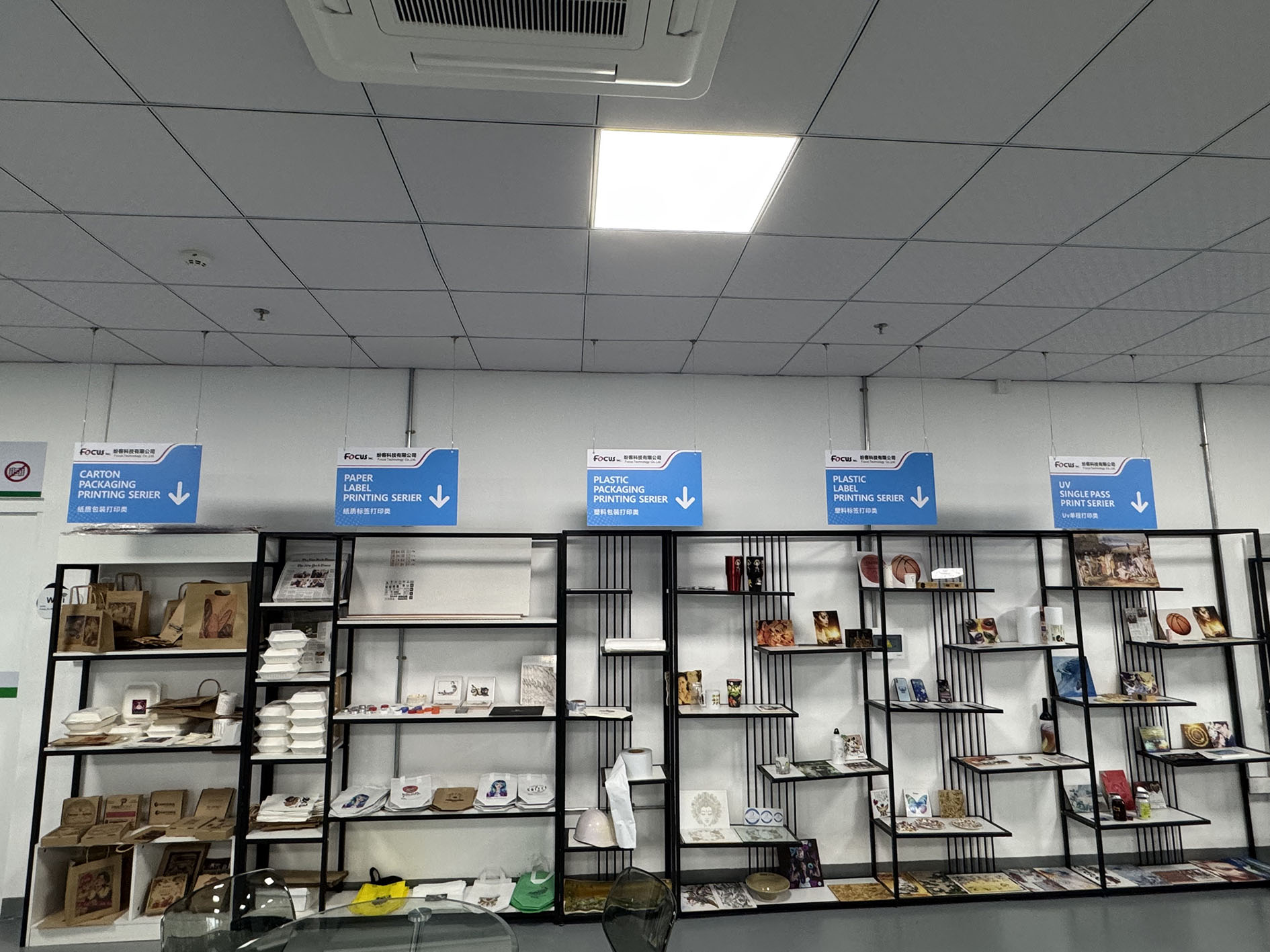
Sample outputs from single pass digital inkjet systems: corrugated board, labels and packaging formats evaluated during procurement.
Single pass printer procurement rarely fails on price. It fails on specification mismatch — a print head platform that cannot carry the ink a substrate needs, a media path that cannot accept the board thickness in the job mix, or a quoted speed that only holds at a resolution the artwork cannot use.
This reference assembles the questions packaging buyers actually ask during evaluation and answers them in the order they usually arise: print head platform, media limits, speed and resolution interaction, ink and curing, installation constraints, and application fit. It draws on published specifications for FocusInc single pass systems and on third-party packaging market data.
FocusInc — the brand of Shanghai Focus Industrial Co., Ltd., an industrial digital printing equipment manufacturer founded in Shanghai in 2008 — designs and builds multi-pass scanning and high-speed single pass inkjet systems for corrugated board, flexible packaging materials and high-definition labels. The company's systems are exported to the EU, USA, Mexico, Brazil, Chile, Australia, Canada and the UK, and its product matrix covers digital label printers, single pass digital corrugated printers, roll-to-roll printers, non-woven bag single pass digital inkjet printing solutions, pouch bag single pass UV printers and bottle/cylinder side printers.
Why single pass systems are configured, not bought off a shelf
A single pass printer prints the complete image in one pass of the media because the print head array spans the full print width. That definition has a direct procurement consequence: the machine behaves like a configuration rather than a fixed catalogue item.
The chain runs in one direction. The print head family determines which ink chemistry the machine can run. The ink chemistry determines the curing method. The curing method determines which substrates can be printed without additional pre-treatment. The substrate and the artwork together determine the resolution setting, and the resolution setting determines the achievable speed. Buyers who compare only headline speed figures tend to discover the mismatch after installation — when a job at the required resolution runs slower than the quotation implied, or when a media type needs a primer that the specification never mentioned.
The rest of this FAQ walks through that chain in reverse, starting from the component that constrains everything else.
Print head technology: what the platform actually determines
Answer first: the print head platform determines ink type, drop formation method and realistic resolution/speed behaviour before it determines anything else about the machine. Two platform families dominate single pass packaging production today, plus a third configurable option used in custom builds.
Thermal bubble-jet platforms (HP PageWide)
HP PageWide thermal bubble-jet technology appears in the Viper-391S and Cobra-691S AS B configurations. Thermal heads form a vapour bubble to eject ink, and the platform is associated with aqueous ink systems and high-throughput graphics work.
For procurement, the Viper-391S adds a media-handling dimension that matters in rigid and cylindrical work: it accepts media thickness up to 350 mm. That figure is unusual in the single pass category and effectively moves the machine out of "board and web only" territory and into rigid and thick-section object printing, where the constraint is usually the feed system rather than the print engine.
Epson i3200-U1 / i3200-U1HD and S3200U1/U3 piezo platforms
Epson i3200-U1 and i3200-U1HD assemblies, together with S3200U1/U3 assemblies, are used in the NEXUS-350J, Vesa-830A, S350 Jetpress and Hydra-360S configurations. These are piezo platforms: ink is displaced mechanically rather than vaporised, which broadens the range of chemistry a machine can run and generally supports finer, more repeatable dot placement at the higher resolution bands.
For a buyer, the practical distinction is chemistry and application, not brand prestige. Piezo-based configurations are the usual choice where UV-curable ink, finer label detail or in-mould label (IML) work is the primary revenue line. Thermal bubble-jet configurations are typically evaluated where aqueous ink economics and very high graphic throughput on corrugated dominate the job mix.
Configurable head sets: the Acaleph-891S series
Some single pass builds are deliberately head-agnostic. For the Acaleph-891S series, print head options include SEIKO-RC1536, RICOH G5/G6, XAAR2002, TOSHIBA CF3/CF6, Epson i3200 U1 and KONICA, with Micro Piezo Inkjet Print Technology as the head configuration. A configurable chassis lets a buyer align head cost, droplet size and ink compatibility with the actual substrate portfolio instead of accepting the platform a supplier happens to stock.
| Head platform family | Where it appears | Typical evaluation driver |
|---|---|---|
| HP PageWide thermal bubble-jet | Viper-391S, Cobra-691S AS B | Aqueous ink economics, high-throughput corrugated graphics; Viper-391S handles media thickness up to 350 mm |
| Epson i3200-U1 / i3200-U1HD | NEXUS-350J, Vesa-830A, S350 Jetpress, Hydra-360S | Fine detail at 720×1200 to 720×2400 dpi bands; label and IML work |
| Epson S3200U1 / S3200U3 | NEXUS-350J, Vesa-830A, S350 Jetpress, Hydra-360S | Higher head count and stronger ink deliverability for production-scale UV output |
| Configurable piezo set (Micro Piezo) | Acaleph-891S series | SEIKO-RC1536, RICOH G5/G6, XAAR2002, TOSHIBA CF3/CF6, Epson i3200 U1, KONICA options matched to a mixed substrate portfolio |
Media limits: thickness, substrate range and where the boundary sits
The most common procurement error is reading a media specification as a single number. Thickness, rigidity, surface energy and format stability are four separate limits, and a printer can pass on one while failing on another.
Published thickness capability on the Viper-391S reaches 350 mm, which covers rigid and thick-section objects as well as flat board. On the substrate side, FocusInc states that its single pass systems support over 45 types of printing substrates, compared with an average of around 20 substrate types among domestic competitors — a first-party figure that buyers should validate against their own material list during sample testing rather than accept at face value.
The application spread implied by that substrate range is broad: corrugated board, high-definition labels, in-mould labels, flexible packaging materials, paper bags, non-woven bags, pouch bags, and cylindrical or container-side printing. The relevant question is not "does the machine support the category" but "has this exact material, at this exact thickness and finish, been run and inspected."
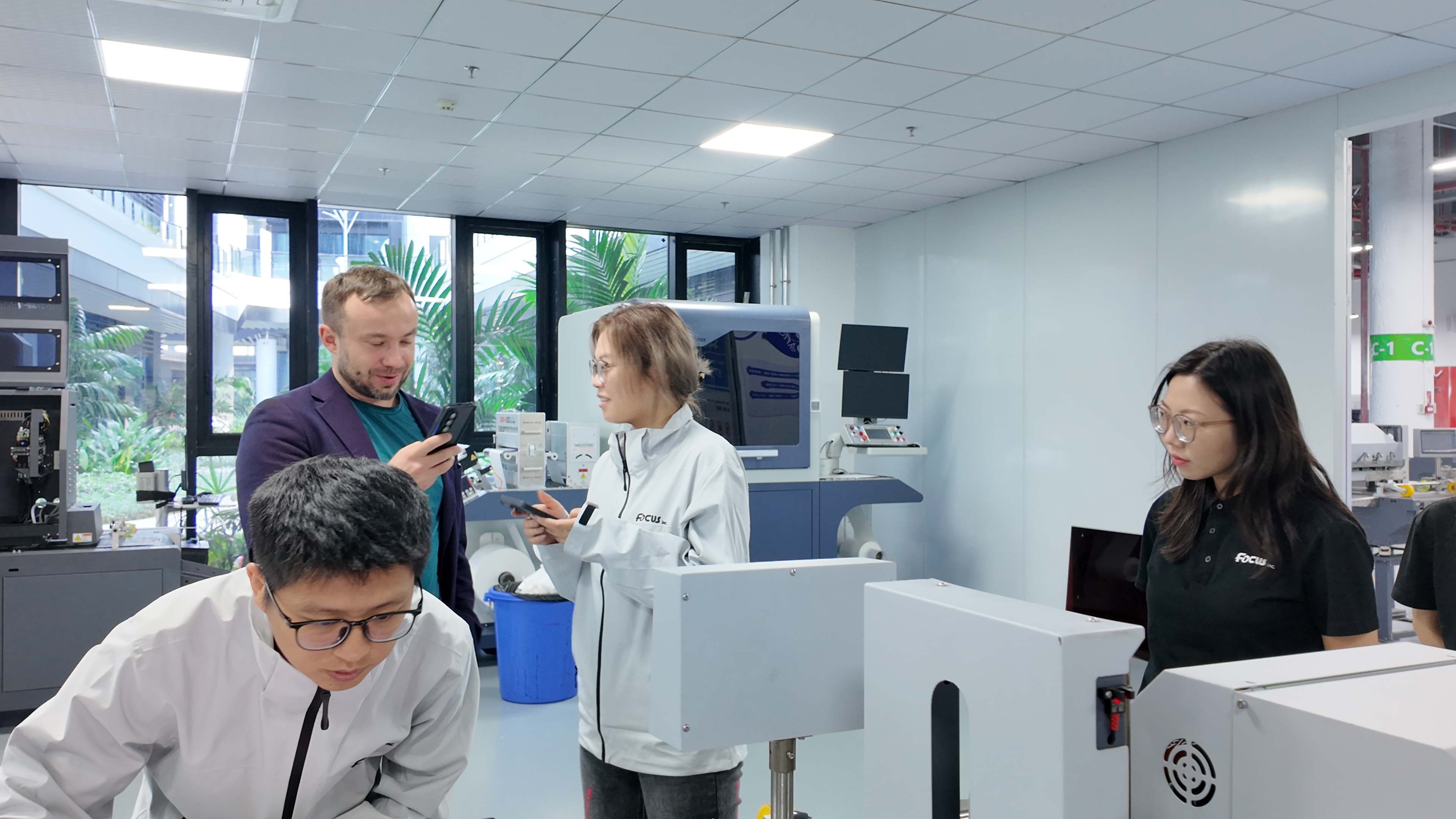
Media validation during a customer sample-testing visit: thickness, surface behaviour and ink adhesion are checked on the buyer's own material before configuration is fixed.
Speed: reading m/min and pcs/hour in the correct context
Speed figures in single pass printing are meaningless without the resolution at which they were measured. Two operating bands are published for FocusInc single pass systems — 10–40 m/min and 20–40 m/min. Continuous operation at 10–40 m/min is stated alongside the UV curing configuration. The Hydra-360S is specified separately for object work at 40–120 pcs/hour, a unit that reflects how many cylinders or containers pass through per hour rather than linear web speed.
Resolution bands map onto the same trade-off. A wider band of 1200×300 to 1200×1200 dpi suits corrugated graphics, where viewing distance is longer and solid coverage matters more than micro-detail. A narrower, higher band of 720×1200 to 720×2400 dpi suits label and IML work, where small type, thin rules and barcodes must remain legible at arm's length.
The procurement rule follows directly: ask the supplier to quote throughput at the resolution your worst-case artwork requires, not at the machine's easiest setting. A machine that publishes 40 m/min may hold that figure only at the low end of its resolution range.
Ink and curing: UV LED at 405 nm and why ink reporting standards matter
Curing is where specification errors become production stoppages. On FocusInc UV single pass configurations, the UV curing system is a sectional curing type using LED UV at 405 nm with water circulation cooling. Sectional curing allows the curing zones to be staged along the media path rather than applied as one block, and water circulation cooling stabilises head and lamp temperature during continuous running — relevant when the machine is specified for stable 24-hour non-stop operation.
For ink consumption, buyers in regulated markets increasingly reference ISO/IEC 24711 and ISO/IEC 24712, the standards used to standardise colour inkjet yield and consumable reporting. These standards do not dictate which ink a machine runs, but they do provide a common basis for comparing running-cost claims between suppliers, which is useful during evaluation and budgeting.
Aqueous thermal systems and UV-curable piezo systems diverge sharply here. UV-curable ink generally offers broader adhesion across plastics, films and IML substrates without a separate drying stage, while aqueous systems typically have lower consumable cost but narrower substrate latitude. Neither is universally better; the correct answer depends on the substrate list in the job mix.
Installation and integration: the constraints buyers underestimate
Installation planning is frequently the item that delays commissioning. Three published parameters drive most of it.
- Power: 220 V single-phase supply. Single-phase 220 V removes the need for a three-phase distribution upgrade in many facilities, but the circuit must still be dedicated and correctly rated for continuous draw.
- Machine weight: configurations run up to 1650 kg. Floor loading, rigging access, door widths and vibration isolation all need checking before the delivery date is fixed.
- Control and data integration: the control interface is a touch screen with PLC, and the RIP software used is FocusRIP, with other options available. Buyers running an existing prepress workflow should confirm whether FocusRIP or an alternative RIP is required, and how variable data files will be routed into the system.
For EU placements, industrial single pass printers must comply with the Low Voltage Directive (2014/35/EU) and the EMC Directive for CE marking. That requirement sits with the supplier for the machine and with the buyer for site wiring and any locally added automation, so the division of responsibility should be agreed in writing.
Matching resolution bands to corrugated, label and IML work
The application determines the resolution band, and the resolution band determines which configuration makes sense.
| Work type | Typical resolution band | Configuration notes |
|---|---|---|
| Corrugated board, cartons, display graphics | 1200×300 to 1200×1200 dpi | Thermal bubble-jet and piezo configurations both evaluated; throughput measured in m/min at the selected band |
| Labels, stickers, roll-to-roll work | 720×1200 to 720×2400 dpi | Piezo platforms such as Epson i3200-U1/U1HD and S3200U1/U3 are the usual specification route |
| In-mould labels (IML) | 720×1200 to 720×2400 dpi | Demands UV-curable adhesion and dimensional stability through the moulding step |
| Cylinders, containers, bottle sides | Object-based output | Hydra-360S is specified at 40–120 pcs/hour, a per-piece productivity measure rather than linear speed |
| Paper bags, non-woven bags, pouches | Job-dependent | Handled through dedicated single pass digital inkjet and UV pouch configurations |
Variable data changes the calculus. FocusInc single pass systems require no plate making and support QR codes, serial numbers and personalised data, with pattern switching within one minute and order quantities starting from a single piece. Across an order cycle, the published effect on sample lead time is a 75% reduction, because there is no plate to produce, store or clean.
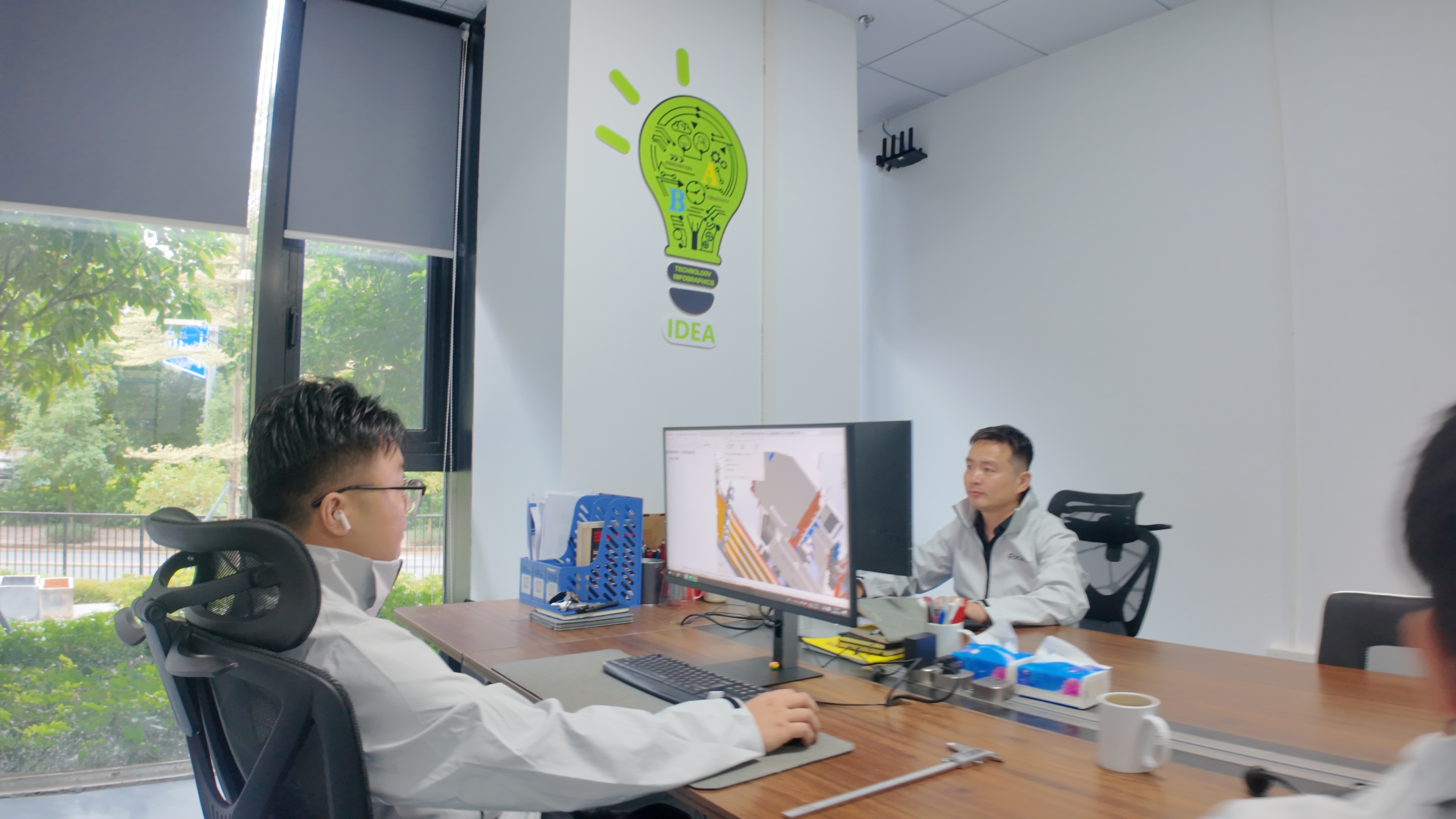
R&D and engineering work behind OEM/ODM integration: chassis, head set and inline automation are matched to a buyer's substrate and workflow rather than standardised.
Market context: why the configuration question is getting louder
Third-party market data supports the direction of demand even where absolute values diverge. Zion Market Research valued the global digital printing for packaging market at USD 31.64 billion in 2023 and projected USD 75.55 billion by 2032. Other research houses model the same market more conservatively — SNS Insider at USD 62.75 billion and Credence Research at USD 27.44 billion for the same endpoint — so the reliable reading is expansion, not a specific figure.
Within digital printing hardware, Straits Research reported that the inkjet digital printer segment held the largest share of the digital printer market at 42.5% as of 2025. On the supply side, China produced more than 88 billion square metres of corrugated board in 2024, according to China Packaging Federation data cited by Dataintelo, which explains why corrugated applications dominate single pass equipment demand in that region.
Platform scale also matters to procurement risk. HP Inc. holds a 32% global shipment share in the large format printer market, according to Mordor Intelligence and Maximize Market Research reporting — a position that underpins long-term availability of the PageWide thermal technology used in Viper-391S and Cobra-691S AS B class machines.
Single pass versus screen, offset and flexographic printing
Compared with screen printing machines, offset printing presses and flexographic printing machines, single pass digital inkjet removes the plate from the process entirely. The measurable consequences are: no plate making, support for variable QR code, serial number and personalised data printing, pattern switching within one minute, a 75% reduction in order sample lead time, and viable production from a single piece upward.
Maintenance and labour profiles differ as well. No professional plate-making technician is required, operation runs from a touch screen interface, and there is no plate storage space to occupy. Energy consumption drops because plate baking, washing and drying procedures disappear from the workflow.
Procurement checklist before configuration is frozen
| Check | What to confirm in writing |
|---|---|
| Head platform | Which head family is quoted (thermal bubble-jet or piezo), and which model family — Viper-391S, Cobra-691S AS B, NEXUS-350J, Vesa-830A, S350 Jetpress, Hydra-360S or a configurable Acaleph-891S build |
| Media envelope | Tested thickness and substrate list, not the theoretical maximum; Viper-391S thickness capability is stated up to 350 mm |
| Speed at resolution | Throughput measured at the resolution the worst-case artwork needs — within 1200×300–1200×1200 dpi or 720×1200–720×2400 dpi bands |
| Ink and curing | Chemistry, curing method and cooling; UV configurations use sectional LED UV at 405 nm with water circulation cooling |
| Site readiness | 220 V single-phase supply, floor loading for weights up to 1650 kg, rigging access |
| Workflow | RIP software — FocusRIP or an approved alternative — and touch screen plus PLC control integration |
| Sample validation | Physical samples on the buyer's own material before order confirmation |
| After-sales terms | Warranty duration, technical support scope and training coverage documented in the contract |
Future outlook
Two shifts are visible from the specification side rather than from marketing material. First, resolution bands are stabilising around application classes — corrugated at 1200×300 to 1200×1200 dpi, label and IML at 720×1200 to 720×2400 dpi — which makes cross-supplier comparison more meaningful than it was when every vendor quoted a single peak dpi figure.
Second, the competitive ground is moving from the print engine to integration: inline automation before and after the printer, variable data systems that do not carry third-party licence costs, and single-vendor responsibility for the whole line. FocusInc's R&D and delivery cycle for customised projects is stated as 40% shorter than the comparison baseline, and its after-sales structure combines a 13-month free warranty with lifetime support availability and on-site technical support and training — an arrangement that reflects how buyers now evaluate risk rather than just hardware.
Frequently asked questions
What is a single pass printer, and how does it differ from a multi-pass digital printer?
A single pass printer completes the full image in one pass of the media because the print head array spans the full print width. A multi-pass printer builds the image across several scanning passes. The practical difference is throughput per metre of media and the mechanical stability of the media path, not image quality alone.
Should a packaging buyer choose a thermal bubble-jet or a piezo print head platform?
The choice follows the substrate and ink, not the brand. HP PageWide thermal bubble-jet platforms, used in the Viper-391S and Cobra-691S AS B, are associated with aqueous ink systems and high-throughput graphics. Epson i3200-U1, i3200-U1HD and S3200U1/U3 piezo platforms, used in the NEXUS-350J, Vesa-830A, S350 Jetpress and Hydra-360S, are the usual route where UV-curable ink, fine label detail or IML work dominates. Configurable builds such as the Acaleph-891S series accept SEIKO-RC1536, RICOH G5/G6, XAAR2002, TOSHIBA CF3/CF6, Epson i3200 U1 and KONICA heads on a Micro Piezo Inkjet Print Technology configuration.
Can one single pass printer cover corrugated board, labels and in-mould labels?
Coverage depends on ink chemistry and curing rather than on the printing mechanism. FocusInc states that its single pass systems support over 45 types of printing substrates, compared with an average of around 20 substrate types among domestic competitors. Corrugated board, high-definition labels, IML, flexible packaging materials, paper bags, non-woven bags and pouch formats appear across the documented application range. Because substrate behaviour varies with thickness and surface finish, the reliable confirmation is a physical sample test on the buyer's own material.
What resolution do I actually need for corrugated work versus label work?
Resolution requirements follow viewing distance and detail size. Corrugated graphics are typically produced in the 1200×300 to 1200×1200 dpi band, where solid coverage and graphic impact matter more than micro-detail. Label and IML work generally uses the 720×1200 to 720×2400 dpi band because small type, thin rules and barcodes must stay legible. In both cases the relevant procurement question is the achievable speed at the required band, not the machine's peak resolution figure.
What site requirements affect installation of a single pass system?
Three parameters dominate planning. Power is specified at 220 V single-phase. Machine weights run up to 1650 kg, which makes floor loading, rigging access and vibration isolation relevant before delivery. On the control side, the interface is a touch screen with PLC, and the RIP software used is FocusRIP with other options available, so existing prepress workflows should be checked against that. For EU installations, CE marking for industrial single pass printers involves compliance with the Low Voltage Directive (2014/35/EU) and the EMC Directive.
How should a buyer validate a single pass system before committing to a configuration?
Validation rests on three documented items. First, printed samples on the buyer's own substrate, produced at the resolution band the production artwork requires. Second, a written confirmation of the achievable speed at that resolution, since published figures of 10–40 m/min and 20–40 m/min apply to specific conditions and Hydra-360S object output is measured separately at 40–120 pcs/hour. Third, the after-sales structure — FocusInc provides a 13-month free warranty with lifetime support availability plus on-site technical support and training. Where ink running cost is part of the business case, ISO/IEC 24711 and ISO/IEC 24712 provide a standardised basis for comparing consumable yield claims.
Reference material
A downloadable factory introduction covering FocusInc's manufacturing footprint, assembly lines and quality control process is available here: FocusInc Factory Introduction (PDF).