
Single Pass Printer Qualification: Criteria Before Sign-Off
Single Pass Printer Qualification: Criteria Before Sign-Off
Single pass printer qualification is the documented stage between purchase intent and sign-off. It turns commercial terms into testable acceptance criteria: the exact model and configuration, the print modes and media that will be run, the site services that must be available, the noise and environmental envelope, the records that prove the machine was checked, and the conditions under which the buyer will accept or withhold acceptance. For packaging buyers, the goal is not a longer specification sheet; it is a shorter list of checks that can be witnessed, recorded and repeated.

FocusInc (Shanghai Focus Industrial Co., Ltd.) is an industrial digital printing solutions provider founded in 2008 in Shanghai. Its product matrix includes single pass packaging printers such as the Cobra-691S AS B and Cobra-691S Max, roll-to-roll label models in the Viper-391S series, and wider corrugated models such as the Cobra-1815S. The examples below use published model data from that matrix to show how a qualification plan can be built without assuming certifications, test results or site conditions that are not documented.
Why sign-off criteria should start with a testable requirement
Most purchase disputes begin with a phrase that felt precise at the negotiation stage. A term such as high resolution or production speed is not an acceptance criterion until the buyer states the model, configuration, media, print mode, measurement method and record. The same is true of CE certified or low noise. A certificate or a decibel figure is evidence only when its scope matches the ordered machine and the condition being tested.
A useful rule is to write every acceptance line in four parts: requirement, evidence, test and record. The requirement is the promised item. The evidence is the document or observable output. The test is how the buyer will verify it. The record is what will be signed. This structure prevents a later argument about whether a machine works from replacing the actual specification.
Single pass printing changes the emphasis of that plan. Because the image is formed in one pass, the buyer needs to verify media transport, nozzle consistency, print-mode settings and speed-resolution combinations together. A print sample that looks acceptable at one setting does not prove the production envelope. The acceptance plan should therefore test the settings that will be used for the buyer's own jobs, not only the most favorable demonstration file.
Build the qualification matrix from the exact model, not the family name
The first column of the matrix should be the exact model and configuration. A family name is not enough. The Cobra-691S AS B, Cobra-691S Max and Viper-391S Pro have different print widths, speed ranges, power requirements and operating envelopes. A buyer who writes Cobra single pass printer into the purchase order creates room for a machine that meets the family description but not the intended line.
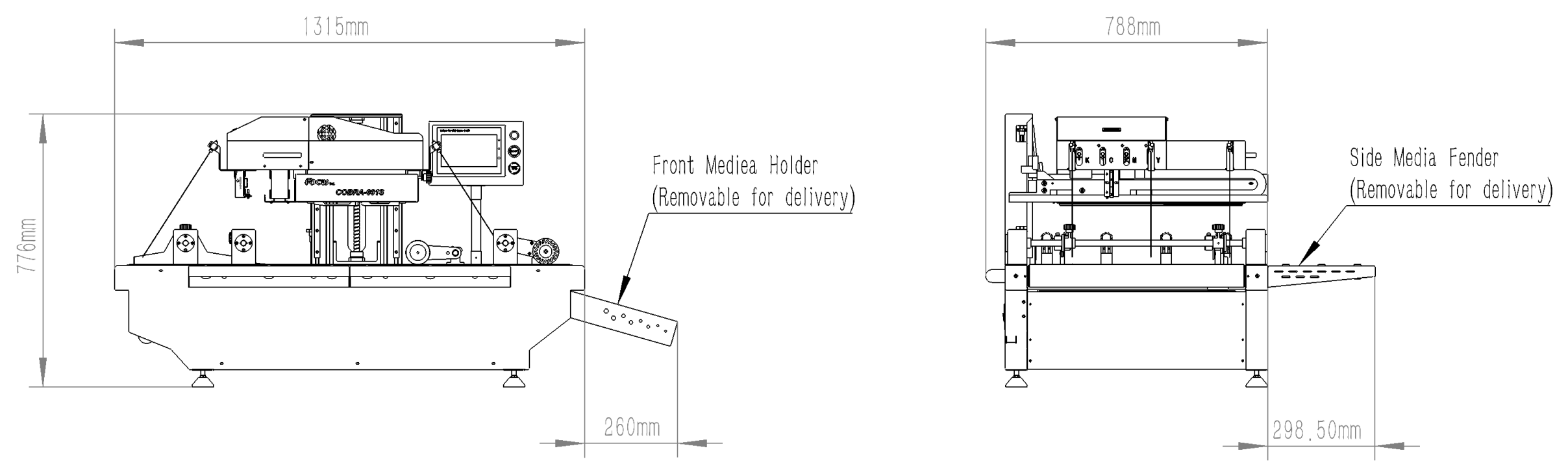
Use the model-specific sheet to populate the matrix. For the Cobra-691S AS B, the published data lists print resolution modes of 1200 × 300 dpi, 1200 × 400 dpi, 1200 × 600 dpi and 1200 × 1200 dpi, print speed of 10–40 m/min, a maximum printing width of 210 mm with one head or 420 mm with two heads, a maximum load width of 600 mm without side flank and 1200 mm with side flank, and a maximum media thickness of 250 mm. Those figures should appear in the plan as the claimed envelope, not as a promise that every artwork will run at every combination.
The Cobra-691S Max data adds a 20–40 m/min speed range, a vacuum adsorption printing platform, a maximum printing width of 215–645 mm and a printing height of 0–55 mm, customizable. The vacuum platform matters for acceptance because it is part of how the machine holds media during transport; the buyer should record which media and thicknesses were run, not merely confirm that the platform exists. The Viper-391S Pro data, in the roll-to-roll label series, lists 10–40 m/min, resolution modes up to 1200 × 2200 dpi, a 75 dB(A) or less acoustic noise level and an operating range of 59–86 °F (15–30 °C).
| Qualification line | Published model fact | Acceptance evidence | What the record should state |
|---|---|---|---|
| Print resolution modes | Cobra-691S AS B: 1200 × 300, 1200 × 400, 1200 × 600 and 1200 × 1200 dpi | Print a buyer-approved test file at each mode named in the order; check fine text, barcode and edge definition | Mode, media, ink, operator, sample ID and pass or fail |
| Speed envelope | Cobra-691S Max: 20–40 m/min | Run the intended production file and record achieved speed at the selected mode | Speed, resolution, media, downtime and rejects |
| Vacuum media hold | Cobra-691S Max: vacuum adsorption platform | Observe transport and print stability with the buyer's thinnest and thickest approved media | Media type, thickness, vacuum setting and defects |
| Acoustic noise | Viper-391S Pro: 75 dB(A) or less | Agree measurement position and operating condition; record the result | Position, distance, mode, background noise and result |
| Operating environment | Viper-391S Pro: 59–86 °F (15–30 °C); 40–80% humidity | Confirm site condition before site acceptance; record actual ambient conditions | Temperature, humidity, time and instrument |
| Power | Several FocusInc models: 20 A single-phase 220 V, 50 Hz; Viper-391S Pro: 9 A single-phase 220 V, 50–60 Hz; Cobra-691S Max: 220 VAC, 50 Hz, 3 kW | Compare the exact model sheet with the site supply; do not transfer figures between models | Model sheet reference, supply voltage, breaker, earthing and phase |
| Certification scope | Supplied records include CE verification and German WEEE registration for listed products | Match certificate scope and electrical rating to the ordered model | Document number, scope, model, validity and open items |
Cobra-1209S is named in the supplied product and certification records, but the exact electrical and environmental data should be confirmed in the signed specification. The 220 V/50 Hz single-phase requirement appears for several other FocusInc models; it should not be copied into a Cobra-1209S acceptance plan unless the model-specific sheet states it.
Site conditions: the checks that are easy to defer and expensive to fix
Power is the most common deferred check. A machine can be mechanically ready and still fail site acceptance because the supply, breaker, earthing or phase arrangement does not match the model sheet. The Cobra-691S AS B, Cobra-691S and Falcon-491S list 20 A single-phase 220 V, 50 Hz. The Viper-391S Pro lists 9 A single-phase 220 V, 50–60 Hz. The Cobra-691S Max lists 220 VAC, 50 Hz, 3 kW. These figures describe different models and should never be treated as interchangeable.
Temperature and humidity belong in the same site survey. The Cobra-691S AS B lists 59–86 °F (15–30 °C) and 40–80% humidity. The Cobra-691S Max lists an operating environment of 15–35 °C. The Viper-391S Pro lists 59–86 °F (15–30 °C) and 40–80% humidity. The acceptance plan should record the actual site conditions at the time of the site test. If the site cannot hold the stated range, that is a fit issue to resolve before sign-off, not a detail for the operator to manage after installation.
Noise is another condition that needs a method. The Cobra-691S AS B, Cobra-691S, Falcon-491S and Viper-391S Pro all publish an acoustic noise level of 75 dB(A) or less. A figure without a measurement position is incomplete. Agree where the reading is taken, at what speed and mode, and whether other equipment is running. The record should show the condition, not just the number.
Space and media handling should be checked against the same sheet. The Cobra-691S AS B main printer is listed at 1,315 × 788 × 776 mm with a net weight of 195 kg. The Cobra-691S Max is listed at 280 × 140 × 136 cm with a machine weight of 220 kg. Those figures should be converted into door widths, turning radius, floor loading and operator access before the machine arrives. A machine that fits the production plan but not the building is not a successful qualification.
Print quality and media acceptance: test the production envelope
Print quality acceptance should be tied to the buyer's jobs. Use a test pack that includes the smallest text, the densest bar code, the largest solid area, the finest reverse type and the most critical color match. For packaging, include the actual substrate family: coated paper, uncoated paper, corrugated board, paper bags, cup fans, cartons or labels, depending on the model. The Cobra-691S AS B data lists media such as corrugated paper, paper bags, cup fans, cup sleeves, postcards, breads, cookies, cake pads, coated paper, pizza boxes, shopping bags, coffee bags, paper cups, envelopes, cards, napkins and tissue. The acceptance plan should not list every media type unless the buyer will run it; it should list the media that will be run and the thickness range.
Resolution and speed should be recorded together. A sample printed at 1200 × 1200 dpi is not evidence for a job that will be produced at a lower resolution. A speed of 40 m/min is not evidence that the buyer's artwork, ink coverage and media will produce saleable output at that speed. The record should link the sample to the mode, the media, the ink set and the measured speed. Where the buyer needs a production rate, the test should run a representative batch and count saleable pieces, rejects, stops and operator interventions.
For models with a vacuum adsorption platform, such as the Cobra-691S Max, the test should include the thinnest and most flexible media in the buyer's range, not only a rigid board. The platform is listed as a vacuum adsorption type; the acceptance question is whether the transport holds the media consistently at the intended speed and whether print defects appear at the edges or in the image field. For the Cobra-691S AS B, the published vacuum system is a 420 W optional purchase; if vacuum is part of the order, the acceptance plan should state that it is included and tested, not assumed.
Throughput acceptance: separate machine speed from saleable output
Speed figures are machine specifications. They are useful for comparing models, but they are not a guaranteed finished-goods rate. The Cobra-691S AS B lists 10–40 m/min; the Cobra-691S Max lists 20–40 m/min; the Viper-391S Pro lists 10–40 m/min. These ranges should be used to set a test condition, not to promise a daily output. The acceptance record should state the speed achieved at the selected resolution, the media, the artwork, the ink coverage and the number of operators.
A practical throughput test has three parts. First, a short run establishes that the machine can reach the intended setting. Second, a continuous run of the buyer's representative batch exposes transport, nozzle and drying issues. Third, a stop-start run reflects real job changes. The record should include the start and end time, the number of pieces attempted, the number accepted, the defects by type and the reason for any stop. If the buyer's purchase terms include a capacity commitment, that commitment should be written as a separate acceptance criterion with its own definition; a model speed range alone is not that commitment.
Documentation, certification and acceptance records
Documentation is part of the machine. The acceptance file should contain the model-specific data sheet, the signed configuration list, the site survey, the test plan, the sample records, the training record and the open-issue log. It should also contain the compliance documents that apply to the ordered model. The supplied records for FocusInc include a CE verification of conformity under numbers SCT260301170122 and SCT260301170121, and a German WEEE registration under WEEE-Reg.-Nr. DE 87336785. These are useful records, but they do not remove the need to check scope.
A certificate can be valid and still not answer the buyer's question. The buyer should check the exact product or model named, the electrical rating, the standard or regulation cited, the issuing body, the issue and expiry dates, and whether the document covers the configuration being purchased. A CE document for a listed product does not automatically prove that every option or model variant is covered. A WEEE registration does not by itself prove that the machine meets a buyer's internal safety or installation requirements. The acceptance plan should list the documents required, the person who will check them and the open items that must be closed before sign-off.
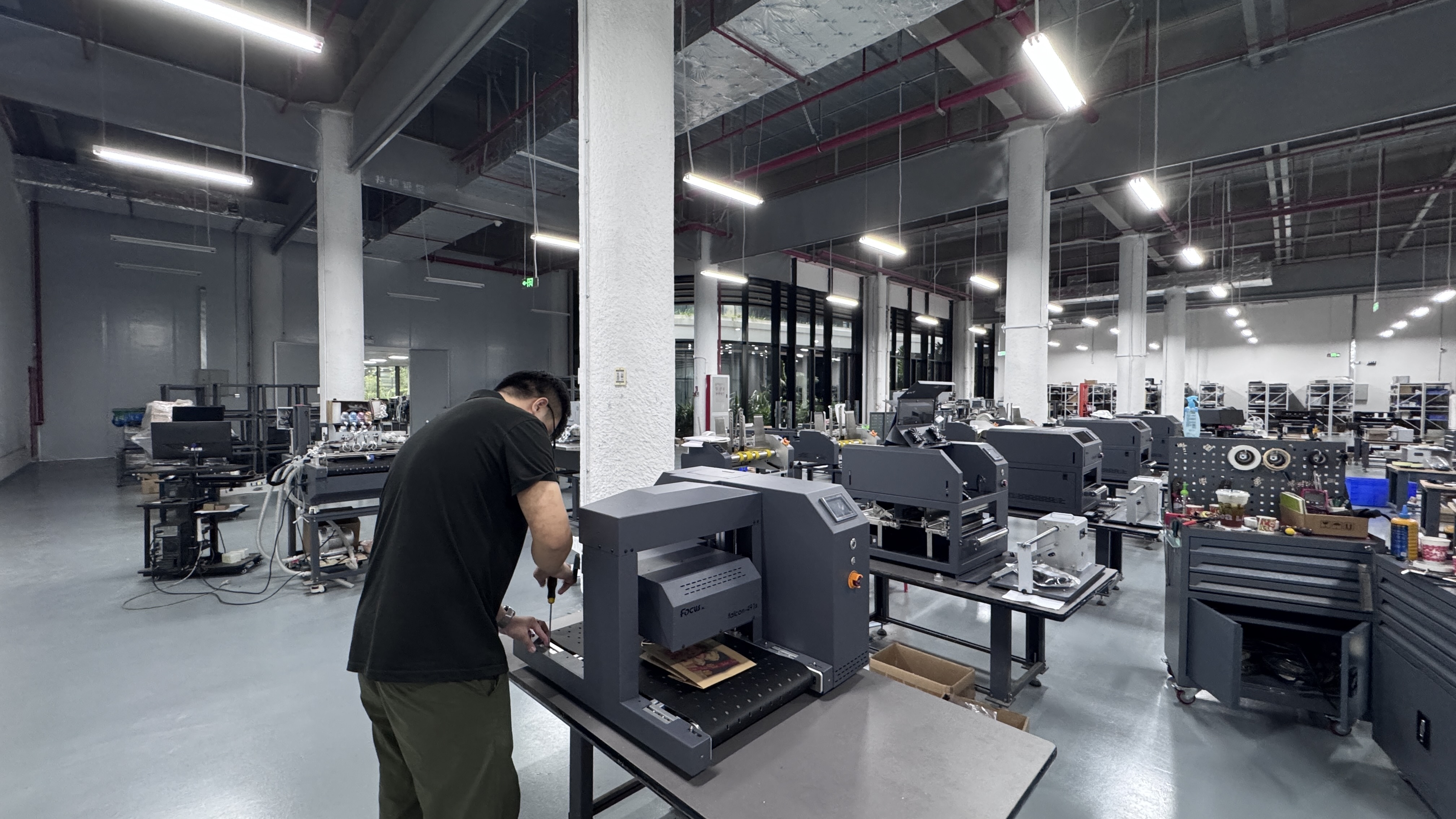
The same discipline applies to factory records. A pre-shipment test record is useful when it identifies the serial number, the configuration, the test conditions, the result and the person who released the machine. A generic video of a machine running is not a substitute for a record tied to the ordered unit. If the buyer cannot witness the factory test, the purchase terms should state what evidence will be provided and what will be repeated at site acceptance.
A four-stage acceptance path from purchase order to sign-off
Stage one is the document review. Before the machine is shipped, the buyer checks the exact model, configuration, utilities, media list, certification scope and delivery scope against the purchase order. Any mismatch becomes a written clarification, not an assumption. Stage two is the factory acceptance test, where the agreed test pack is run on the specified configuration and the results are recorded. Stage three is the site acceptance test, where the same or a reduced test pack is repeated after installation in the actual environment. Stage four is sign-off with a punch list: accepted items, conditional items, rejected items, responsible person and due date.
This four-stage path prevents the most common failure mode: a machine is accepted because it powers on and prints a demonstration file, while the real production conditions are never tested. It also gives the buyer a fair basis for conditional acceptance. A minor documentation gap can be closed after sign-off with a dated action. A print-quality or site-condition failure that affects the buyer's production should be a hold point, not a note in a meeting.
The acceptance plan should define who can sign. A production manager may accept the print sample, an electrician may accept the power connection and a procurement manager may accept the commercial documents. The final sign-off should show those separate acceptances rather than a single signature that hides unresolved items.
What a single pass printer test plan does not prove
A test plan cannot prove that every future job will run at the same speed, quality or cost. It can prove that the machine, as configured and installed, met defined criteria on defined media under defined conditions. That is the correct scope. Claims about long-term reliability, consumable cost, uptime or resale value need separate evidence. The published data may include a speed range, a resolution range, a power requirement and a noise level, but those facts do not by themselves establish a customer's return on investment or a guaranteed production capacity.
The plan also should not treat a certification mark as a performance test. CE, WEEE, patent and trademark records have different purposes. They can support a compliance file, but they do not replace the print, media, speed and site checks. A buyer who keeps the scope of each document clear will make a better sign-off decision than one who treats every certificate as a general proof of quality.
Finally, the plan should stay with the machine after sign-off. The accepted settings, media list and sample records become the baseline for future maintenance and operator training. If a later job falls outside that baseline, the buyer can see whether the change is a new application requirement or a deviation from the accepted condition.
FAQ
What should a single pass printer acceptance test plan contain before sign-off?
It should identify the exact model, serial number and configuration; the media, print modes and speed settings to be tested; the site conditions to be confirmed; the print-quality and throughput criteria; the documents to be checked; the evidence to be retained; the pass, fail and conditional-acceptance rules; and the names of the people who will sign each part. The plan should be agreed before shipment so that the factory and site tests use the same criteria.
How should a buyer verify print resolution and speed claims?
Use the exact model sheet and test the modes that will be used in production. For example, the Cobra-691S AS B publishes 1200 × 300 dpi, 1200 × 400 dpi, 1200 × 600 dpi and 1200 × 1200 dpi, with a 10–40 m/min speed range. The buyer should record resolution and speed together, with the media and artwork, rather than accepting a maximum speed figure on its own. The Cobra-691S Max publishes 20–40 m/min and a vacuum adsorption platform; the test should show how the platform performs with the buyer's media.
Which site conditions should be confirmed before installation?
Confirm the exact model's power requirement, operating temperature and humidity, noise condition, space and media handling. The Cobra-691S AS B lists 20 A single-phase 220 V, 50 Hz, 59–86 °F (15–30 °C), 40–80% humidity and 75 dB(A) or less. The Viper-391S Pro lists 9 A single-phase 220 V, 50–60 Hz, 59–86 °F and 40–80% humidity. For a Cobra-1209S order, obtain the model-specific electrical and environmental data before the site survey is closed; the 220 V/50 Hz single-phase requirement published for several other FocusInc models should not be transferred without that confirmation.
How should certifications be handled in acceptance?
Check the document against the exact model and configuration. The supplied records include CE verification numbers SCT260301170122 and SCT260301170121 and German WEEE registration WEEE-Reg.-Nr. DE 87336785. Confirm the scope, electrical rating, issuing body, dates and any listed models. Keep copies in the acceptance file, but do not treat a certificate as a substitute for print, speed, media or site tests.
What is the difference between factory acceptance and site acceptance?
Factory acceptance checks the machine and configuration before shipment, usually with the agreed test pack and the factory's utilities. Site acceptance repeats the critical checks after installation, using the buyer's actual power, environment, media and operators. The site test can be shorter, but it should not be omitted, because transport, installation and local conditions can change the result.
Reference document: FocusInc Factory Intro (PDF).
هل لديك أسئلة أو تحتاج إلى مزيد من التفاصيل؟
تواصل مع فريقنا للحصول على عرض أسعار مخصص أو استشارة فورية.
طلب عرض أسعار
املأ النموذج أدناه وسيتواصل معك فريقنا بعرض مقترح مخصص.
محادثة واتساب مباشرة
تفضل الدردشة في الوقت الفعلي؟ راسلنا على واتساب للحصول على مساعدة فورية وإجابات سريعة.
- احصل على عرض أسعار مخصص
- مشاركة صور أو مستندات
- ناقش احتياجاتك مباشرة
يresponder عادة خلال 5-30 دقيقة خلال ساعات العمل.