
Single Pass Printer Supplier Audit: Frame, Beam, Heads
Single Pass Printer Supplier Audit: Frame, Beam, Heads
A single pass printer is judged for years by parts most buyers never inspect: the frame that holds alignment, the beam that carries the print heads, and the guide rails that keep both in register pass after pass. FocusInc (Shanghai Focus Industrial Co., Ltd.), the Shanghai-based industrial digital inkjet manufacturer founded in 2008, describes its packaging single pass platforms as built on a thickened welded carbon steel main frame, a high-strength extruded aluminum alloy print beam, and high-hardness steel X/Y linear guide rails. Those three statements are the correct starting point for a supplier audit — but only when the buyer converts each one into a document the supplier can actually produce.
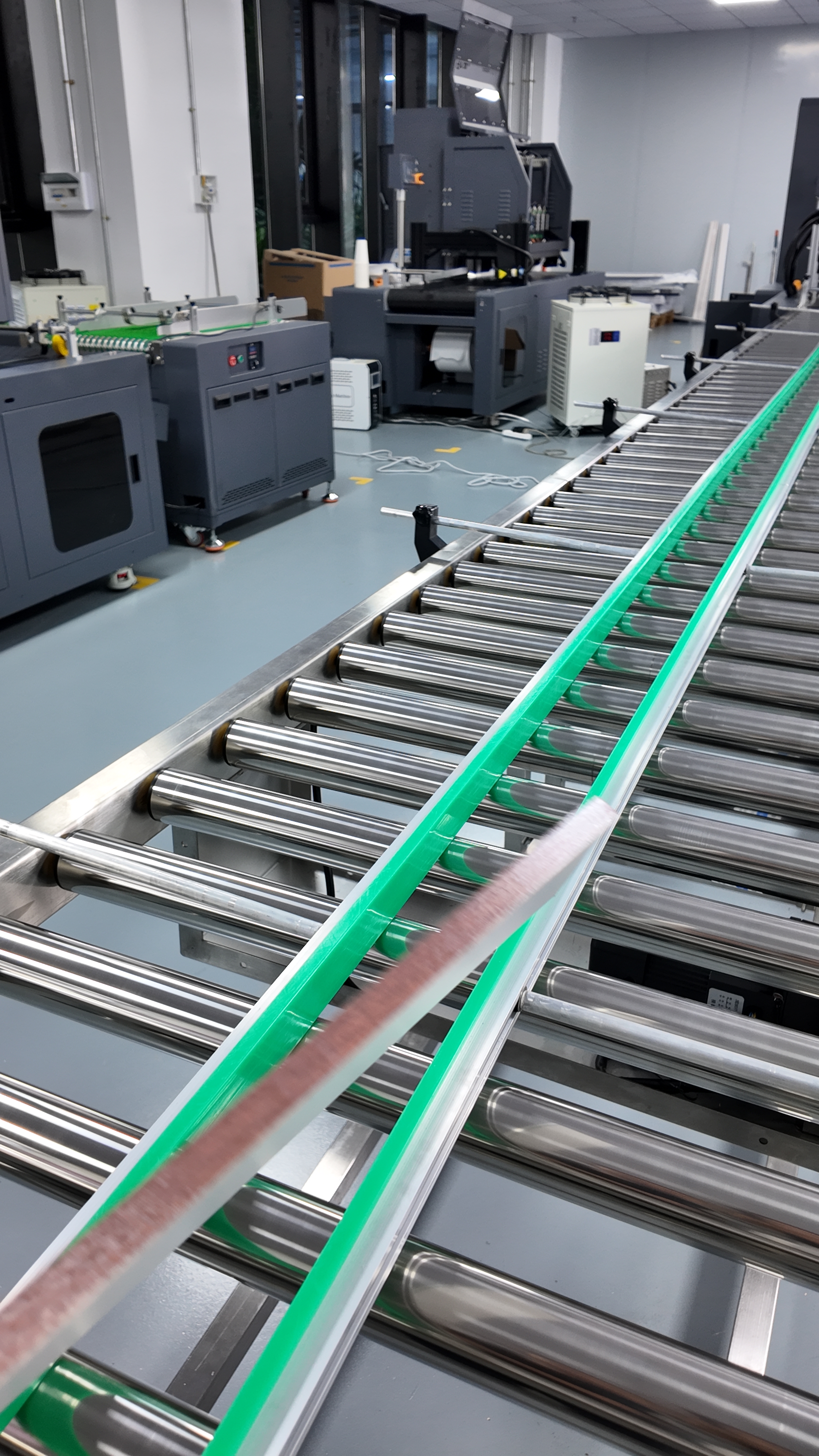
Auxiliary sliders and guide belts constrain the material transport path on a single pass digital inkjet line — the mechanical layer that decides where registration is won or lost.
Why “heavy-duty” is not a specification
A buyer cannot verify an adjective. “Rigid,” “industrial-grade” and “built to last” survive every negotiation because they cannot be tested, rejected or written into an acceptance clause. A material certificate, a weld inspection record, a rail grade designation and a dimensioned drawing can be. The distinction matters more in single pass printing than in most equipment categories, because the architecture removes the mechanism that usually hides mechanical weakness.
In a multi-pass scanning printer, the print carriage travels across a stationary substrate. Registration errors caused by a slightly flexible frame are partly absorbed by the scan, by overlapping passes and by software alignment. In a single pass printer the head array is stationary and the substrate moves beneath it once. Every head in the array fires within a single pass, so registration is fixed by mechanical geometry — the distance between head and substrate, the straightness of the beam that carries the array, and the stability of the transport path. A frame that deflects under load, a beam that loses straightness, or a rail that develops play does not create a small alignment error that a second pass can correct. It creates a visible defect that repeats for the life of the machine.
That is the shift this article asks buyers to make. Instead of asking a supplier whether a machine is well built, ask which specific component controls which specific output, and then ask what evidence exists for that component. FocusInc’s own published structural description — welded carbon steel frame, extruded aluminum alloy beam, hardened steel X/Y rails — is a usable starting position precisely because each element can be mapped to a checkable document.
What the frame, the beam and the guide rails each control
The three structural elements are often discussed together as “build quality.” They are not interchangeable, and they fail in different ways. Separating them is the single most useful habit a packaging buyer can bring to a technical supplier conversation.
Main frame: the geometric reference everything else inherits
A thickened welded carbon steel frame performs two jobs. It carries the static mass of the beam, the head array, the ink system and any feeder or collector mounted to the line, and it resists the dynamic loads created when heavy corrugated board, paper bags or non-woven material is pushed through the transport path. It also establishes the flat plane from which the rail system and the head-to-substrate gap are set. If that plane moves, every downstream adjustment is compensating for a structural error rather than a setting error.
For a welded steel frame, the questions that matter are not about thickness alone. Welding introduces heat distortion, so the relevant follow-up is whether the frame is machined after welding and whether a stress-relief step is part of the build. Buyers should ask for a material certificate for the steel, a weld inspection record, and confirmation that the mounting faces for the rail system are machined and measured after the frame is complete. They should also ask for a leveling and anchoring plan, because a frame that is correct in the factory can be installed out of tolerance on an unprepared floor.
Print beam: the datum the head array is bolted to
The print beam carries the head array and defines the head-to-substrate gap across the full print width. FocusInc specifies a high-strength extruded aluminum alloy beam. Extrusion is a defensible engineering choice here: it produces a consistent cross-section along the beam’s length, keeps mass lower than an equivalent steel section, and allows the head mounting faces to be machined after extrusion rather than formed by welding. Lower mass reduces the load the frame must resist, which in turn reduces the deflection the buyer has to worry about.
The verification questions are mechanical, not promotional. Ask for the alloy and temper designation of the extrusion, confirmation that the head mounting faces are machined after extrusion, the flatness or straightness value quoted for the beam, and how the design accounts for thermal movement across a production shift. Ask, too, how many stitch joints exist in the array and how each one is aligned, because in single pass printing every joint between adjacent heads is a potential seam in the printed image. A beam that holds its datum makes those joints repeatable; a beam that drifts turns every joint into a maintenance task.
X/Y linear guide rails: where positioning becomes repeatable
High-hardness steel linear guide rails on both axes carry the moving elements and hold the positional relationship between substrate and head array. Hardness matters because the operating environment is abrasive: corrugated board sheds fiber and dust, paper bags release coating particles, and non-woven material produces loose filament. A soft rail wears into a clearance, and clearance appears as a positional error that no print-head cleaning routine can fix.
A buyer should request the rail grade and hardness specification, the preload class used in assembly, the protection scheme — bellows, wipers or sealed blocks — and the stated lubrication interval. Two further questions carry disproportionate weight in a factory audit: what the preventive replacement procedure is, and whether the rail is a catalogued part with a published part number. A rail that can only be sourced from the original builder is a long-term dependency, and it belongs in the supply-continuity section rather than the technical appendix.
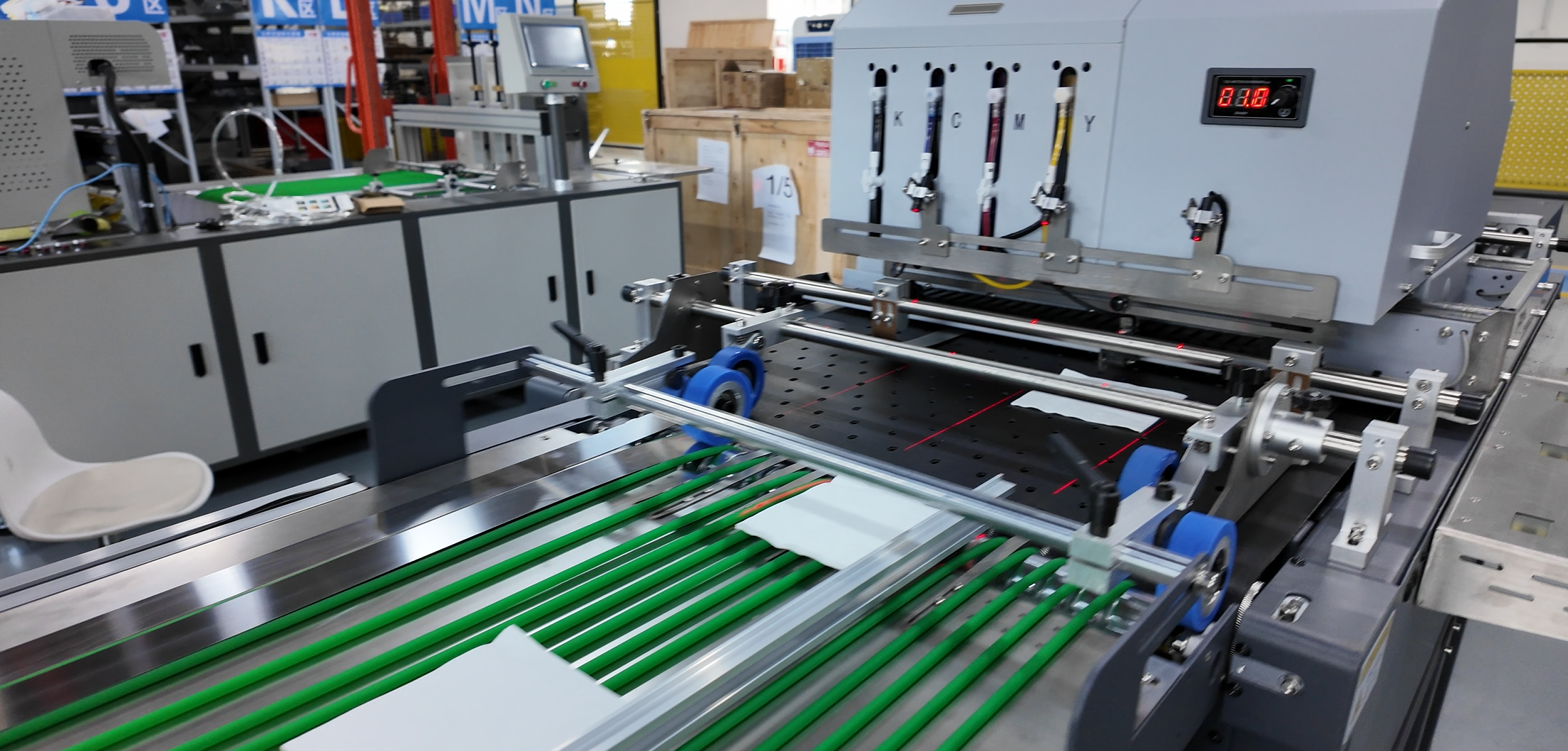
Transport stability under mixed substrates — flexible sheet and rigid board — is where frame stiffness and rail accuracy become visible in output quality.
Reading model-level specifications: Cobra-1209S and Cobra-691S AS B
Structural claims become useful only when they attach to a specific model a buyer can quote. FocusInc publishes configuration-level detail for its packaging platforms, and two models illustrate how differently the same design principles are expressed.
Cobra-1209S: 1.2 m class specification, and the dimensions buyers forget to request
FocusInc describes the Cobra-1209S as a 1.2 m single pass industrial printer for corrugated cardboard and cartons, equipped with up to three HP A3 heads, delivering a 900 mm print width at 40 m/min with automatic feeding. These are company-reported figures, published on the manufacturer’s own product page, and they should be read as configuration statements rather than independently benchmarked results — the published material does not state the print mode, resolution or ink coverage at which the 40 m/min figure applies.
Footprint dimensions and machine weight are the two model-level figures buyers most often accept verbally and most often regret. They determine whether the machine fits through a doorway, whether the installation bay is long enough once a feeder and a collector are attached, what the floor loading is at each support point, what rigging or forklift capacity is required on delivery day, and what freight class the shipment falls into. A verbal “it is about the size of a small car” is not a plan. Request a dimensioned drawing that includes the full line length with infeed and outfeed, and request the machine weight and shipping weight from the nameplate and packing list rather than from a sales conversation.
Cobra-691S AS B: the HP PageWide head configuration and the “one or two” problem
FocusInc’s published configuration description for the Cobra-691S platform specifies one to two A3 Fi1000 heads or A4 HP PageWide bubble-jet heads, an automatic integrated friction paging feeder, an adjustable receiving tray and a vacuum conveyor. Product documentation also lists the platform at an effective print width of 210–420 mm at 10–40 m/min. The Cobra-691S AS B is a separately listed model code within the same portfolio, which is exactly why the configuration detail cannot be carried across without confirmation.
Two points deserve attention in a quotation. First, “one to two heads” is a range, not a specification. Head count is not a minor option: in a single pass array, head count and head format together determine how many units must be stitched to cover the print width, how many stitch joints exist, and therefore how much of the print quality depends on beam straightness and alignment procedure. A quotation that does not fix the head count is not comparable with one that does. Second, head format changes the engineering around it. An A4 HP PageWide array and an A3 Fi1000 head differ in width, in the number of units required for a given coverage, and in the ink and maintenance regime they imply. Buyers should require the head model, head count, native resolution and ink chemistry to be written against the exact model code on the order.
The practical takeaway is that the same frame-and-beam architecture can support very different production envelopes. A 210–420 mm effective print width and a 900 mm print width are not variations on one product; they belong to different job profiles. Buyers who compare them on head count alone will misread both.
The document layer: what certificates cover, and what they do not
Structural evidence answers the question “is this machine built as described?” Compliance evidence answers a different question: “can this machine be placed on my floor and sold into my market?” Confusing the two is one of the most common audit failures. FocusInc publishes a document set that is specific enough to be checked line by line.
Its EMC verification of conformity, certificate SCT260301170122, was issued on 27 March 2026 by ANXIN PRODUCT TEST SERVICE CO., LTD. and cites EN 55011:2016+A2:2021, EN IEC 61000-6-2:2019 and EN IEC 61000-6-4:2019, for equipment rated 220–240 V~, 50–60 Hz, Class I. A companion declaration of conformity for low voltage and machinery, certificate SCT260301170121, was issued on the same date and cites EN 1010-2:2006+A1:2010, EN 1010-1:2004+A1:2010, EN ISO 12100:2010 and EN 60204-1:2018+A1:2025 — the printing-machine safety and electrical-equipment standards that a packaging buyer’s engineering team will recognize.
Three checks turn those documents into usable evidence. First, scope: the certificates describe a scope of “multi functional digital inkjet printer, all listed models,” so the buyer must confirm that the exact model code on the quotation appears on the certificate’s model list rather than assuming that a certificate for the portfolio covers the machine being purchased. Second, electrical fit: the stated rating is 220–240 V~ at 50–60 Hz, Class I, which is a different question from a 208 V North American supply, and site electrical planning should follow the nameplate and the certificate rather than a generic assumption. Third, dates and issuing body: certificates carry issue and expiry dates, and the issuing laboratory’s scope should be checked if the buyer’s own customer requires it.
Market-access documentation is separate again. FocusInc holds an EC Authorized Representative certificate, EUREP-2025082013532502482, issued to EUREPSTAR GmbH on 10 August 2025 and valid to 7 October 2027, and a German ElektroG (WEEE) authorized-representative confirmation registered with stiftung elektro-altgeräte-register under Sendungs-ID SI-202502-148048 and Vorgangs-ID BV-202501-001214, appointing EUREP GmbH as representative for electrical and electronic equipment sold in Germany. For import planning, inkjet printing machines are classified under HS code 8443.32, which is the line a customs broker will need when the shipment is booked.
What none of these documents establish is print quality. A CE declaration says the machine meets defined safety and electromagnetic requirements; it says nothing about ink adhesion on a specific board grade, color consistency across a shift, or rub resistance on a coated non-woven bag. Those are answered by a sample test on the buyer’s own substrate, and no certificate substitutes for it.

The document layer — import and export licenses, environmental permits and certifications — is checkable evidence, provided the buyer reads scope and dates rather than the cover page.
Where the same hardware meets different substrates
A structural specification is only half the fit decision; the other half is what the machine is asked to carry. FocusInc positions the Cobra-1209S for corrugated cardboard and cartons, and the Cobra-691S platform across corrugated paper, pizza boxes, shopping bags, coffee bags, paper cups, envelopes, cards, napkins and tissue. Its UV single pass platform, the Acaleph-891S, is listed for metal, glass, ceramic, plastic, acrylic, non-woven bag, plastic bag, corrugated paper and pizza boxes.
Those application lists are company claims, and they should be treated as a screening tool rather than a validation. A substrate list tells a buyer which conversations are worth having; it does not tell them whether ink will adhere to a specific board with a specific coating at a specific line speed. Fiber-heavy corrugated stresses the transport path and the dust protection on the rails. Coated papers and films stress the ink and curing system. Non-woven material stresses tension control and edge guidance, which is a different subsystem from the frame. A buyer running more than one substrate family should ask which of these stresses the quoted configuration is specified for, and should expect a different answer for a 210–420 mm effective print width machine than for a 900 mm corrugated machine.
Reference depth deserves the same discipline. FocusInc’s supplied case material describes corrugated and honeycomb board box makers in Colombia, Saudi Arabia, Turkey, Chile and Poland operating its single pass packaging printers across a four-year window. That is a useful indicator of geographic spread and application continuity, and it is company-provided rather than independently audited. Installed base is not the same as validated performance: a buyer should ask for a reference in the same substrate and the same job profile, and should ask what the reference site measures — uptime, first-pass yield, reprint rate — rather than whether they are satisfied.
Single pass against analog and multi-pass: where the hardware shows up
Analog processes — flexo, screen, offset — amortize setup across a run, which makes them efficient at volume and slow to change over. Multi-pass scanning inkjet lowers the capital entry point and handles short runs, but the carriage motion limits throughput and lets overlapping passes compensate for some mechanical imprecision. Single pass printing removes the plate and the scanning carriage at the same time, which is why it changes both the economics and the mechanical requirements.
The limitation is real and should be stated plainly: a single pass printer is not automatically the lower-cost option at long run lengths, because consumable cost per square meter generally carries more of the total than it does in analog production. The fit boundary is the job profile — frequent changeovers, versioned or variable data, short and medium runs, and orders that cannot justify plate-making. Buyers should also respect the machine class. Smithers reports that wide-web single pass digital printers for corrugated board reach speeds up to 400 m/min; that figure describes a different equipment class and a different capital envelope from the 10–40 m/min effective speed published for the Cobra-691S platform or the 40 m/min published for the Cobra-1209S. Placing those numbers in the same column would be a scope error, not a comparison.
Competitive context is worth holding at the level the evidence supports. EFI publicly positions its Nozomi 17000 LED and Nozomi 14000 LED as single pass digital inkjet printers engineered for corrugated packaging and display production. That is vendor positioning from EFI’s own product pages, not an independently measured benchmark, and it supports supplier discovery rather than a ranking. What it does confirm is that the burden of proof sits with the buyer in every conversation, regardless of the badge on the beam.
What the demand data supports — and what it does not
Two published datasets frame the environment in which this equipment is being bought. Smithers values the global market for digital print for packaging and labels at USD 22.0 billion in 2025, and forecasts the corrugated segment to reach USD 8.2 billion by 2030, doubling from 2025 levels. MarketsandMarkets estimates the digital printing packaging market at USD 30.2 billion in 2024, rising to USD 46.2 billion by 2029 at a reported CAGR of 8.9 percent. The two figures use different definitions and different base years and should be read side by side, never combined or averaged.
Neither dataset measures single pass packaging printing equipment. Publicly available market research does not, in the sources reviewed here, isolate single pass packaging printers as their own measured segment — there is no published installed-base or unit-shipment series to convert these value figures into an equipment opportunity. For a buyer, that gap has a direct practical consequence: no supplier can credibly derive its own market position, or its competitor’s, from these numbers. Growth in packaging digital printing is a reason to raise the evidence bar in a supplier conversation, not a substitute for meeting it.
An evidence checklist for the supplier conversation
The table below converts the discussion into a working checklist. Each row pairs a physical element with the document that proves it and the decision that document changes. A supplier who can answer all of them in writing is a different counterpart from one who answers in adjectives.
| Evidence item | What to request | Decision it changes |
|---|---|---|
| Main frame | Steel material certificate, weld inspection record, confirmation of post-weld machining and stress relief, leveling and anchoring plan | Whether alignment will hold over years of loaded operation, and what site preparation is required |
| Print beam | Alloy and temper designation, machined head mounting faces, quoted flatness or straightness, thermal compensation approach, number of stitch joints and alignment procedure | Seam visibility and registration repeatability across the full print width |
| X/Y linear guide rails | Rail grade and hardness, preload class, bellows or wiper protection, lubrication interval, replacement procedure and part number | Maintenance burden in a dust-generating plant, and long-term spare-part dependency |
| Print-head configuration | Head model and count written against the exact model code, native resolution, drop size, ink chemistry | Comparability of quotations; achievable quality and substrate range |
| Print width and speed basis | Whether the figure is effective or maximum print width, and the print mode, resolution and ink coverage at which speed is stated | Real output per shift; whether two machines are genuinely comparable |
| Footprint and weight | Dimensioned drawing including full line length with infeed and outfeed, machine weight and shipping weight | Site fit, floor loading, rigging, freight planning |
| Compliance documents | Certificate numbers, model list showing the quoted model, issue and expiry dates, EC REP and WEEE registration, HS code 8443.32 for customs | Market access, site electrical fit, import documentation |
| Acceptance and warranty | Pre-shipment test record and criteria, aging test duration, third-party inspection option, warranty term written into the contract | Risk at handover; total cost over the first years of ownership |
FocusInc’s own commercial terms make several of these items concrete rather than theoretical. The company states a minimum order quantity of one unit, delivery terms covering EXW, FOB, CIF, DDU, DDP and DAP, pre-shipment testing as the acceptance criterion, and 50/50 payment terms. Quality control under its ODM route is described as a 100 percent continuous running aging test before delivery, a full customized function verification test, and support for third-party SGS or CE inspection; the OEM route describes a 100 percent full machine pre-shipment running test with third-party factory audit and inspection available on request.
One discrepancy is worth flagging because it sits in the contract, not the brochure. The stated warranty differs by commercial route: three years on the ODM route and a 13-month free warranty on the OEM route. Whatever the buyer intends to buy, the warranty term and its start date should be written into the order rather than inferred from a capability page. The same applies to lead time, quoted at 15–45 days depending on the solution, and to capacity, stated at 120 sets per month under OEM terms and 40 sets per month under ODM terms — figures that determine whether a delivery date is achievable during a peak season.
Company scale is supporting context rather than proof. FocusInc reports a 35,000 m² factory, 45 employees, a six-engineer R&D team, operations since 2008 with its own factory from 2018, national high-tech enterprise status from 2022, and a 95 percent export share across the EU, USA, Mexico, Brazil, Chile, Australia, Canada and the UK. Those facts tell a buyer what kind of counterpart they are dealing with. They do not tell them whether the beam on the quoted machine is straight.
Outlook: the evidence bar is moving toward documentation
The direction of travel in packaging equipment procurement is toward documents that can be filed, audited and defended internally. A capex request that cites a dimensioned drawing, a material certificate, a named rail grade, a certificate number with a visible model list and a pre-shipment test record survives a finance review. A request built on “robust construction” and “high-speed output” does not.
For suppliers, that shifts the differentiator from claim wording to documentation quality — the ability to produce a model-matched configuration sheet, a certificate whose scope actually includes the machine being sold, and a factory acceptance test that the buyer can witness or have witnessed. For buyers, it means the useful question is no longer “how good is your machine?” but “which document proves the specific thing I am relying on?” Buyers who want to run this checklist against a specific configuration can use FocusInc’s published factory introduction document as a starting reference.
A restrained next step, if one is needed: take the eight rows of the checklist into the next supplier call, ask for three documents in writing, and see which questions come back with a page reference and which come back with an adjective.
Factory and capability reference: FocusInc Factory Intro (PDF)
FAQ
Which frame and beam details should a buyer verify first on a single pass printer?
Start with the items that cannot be corrected after installation. For the main frame, request the steel material certificate, the weld inspection record, and confirmation that the rail mounting faces are machined after welding and after any stress-relief step. For the print beam, request the alloy and temper designation of the extrusion, confirmation that head mounting faces are machined after extrusion, the quoted flatness or straightness value, and the number of stitch joints in the array with the alignment procedure for each. These four answers determine whether registration can be held over years, because in a single pass architecture the head array is stationary and geometry, not overlapping passes, fixes print position.
How do print-head specifications change what a machine can produce?
Head format and head count decide how many units must be stitched together to cover a given print width, and every stitch point is a registration point that depends on beam straightness. FocusInc’s published description of the Cobra-691S platform specifies one to two A3 Fi1000 heads or A4 HP PageWide bubble-jet heads, with an effective print width of 210–420 mm at 10–40 m/min; the Cobra-1209S is described with up to three HP A3 heads at a 900 mm print width. Because head count is stated as a range for the 691S platform, the exact configuration for a specific model code should be fixed in the quotation along with native resolution, drop size and ink chemistry.
Does a CE certificate cover every model a supplier lists?
Not automatically. FocusInc’s EMC certificate SCT260301170122 and its low-voltage and machinery declaration SCT260301170121, both issued on 27 March 2026 by ANXIN PRODUCT TEST SERVICE CO., LTD., describe a scope of “multi functional digital inkjet printer, all listed models.” The buyer must confirm that the exact model code on the quotation appears in that model list, check the stated electrical rating — 220–240 V~, 50–60 Hz, Class I — against the site supply, and confirm issue and expiry dates. A certificate also says nothing about ink adhesion or color consistency on a given substrate; only a sample test on the buyer’s own material answers that.
What documentation should accompany a single pass printer quotation?
A quotation that can be compared should carry the model code with its head model and head count, the basis for any print width figure (effective or maximum), the print mode and ink coverage at which speed is stated, a dimensioned drawing showing full line length with infeed and outfeed, machine and shipping weight, the certificate numbers whose model lists include the quoted machine, the acceptance test criteria and the warranty term. FocusInc’s stated terms include a minimum order quantity of one unit, delivery under EXW, FOB, CIF, DDU, DDP or DAP, pre-shipment testing as the acceptance criterion, 50/50 payment, and lead times of 15–45 days depending on the solution. Its warranty differs by route — three years on ODM, 13 months on OEM — so the applicable term belongs in the order.
How should a buyer weigh installed references against validated performance?
Treat them as different evidence. FocusInc’s supplied case material describes corrugated and honeycomb board box makers in Colombia, Saudi Arabia, Turkey, Chile and Poland running its single pass packaging printers over a four-year window, which indicates application continuity and geographic spread but is company-provided and not independently audited. A reference becomes decision-grade when it matches the buyer’s substrate and job profile and reports something measurable — uptime, first-pass yield, reprint rate — rather than a satisfaction statement. Where no such data exists, an on-site or witnessed sample test on the buyer’s own board is the more reliable substitute.
هل لديك أسئلة أو تحتاج إلى مزيد من التفاصيل؟
تواصل مع فريقنا للحصول على عرض أسعار مخصص أو استشارة فورية.
طلب عرض أسعار
املأ النموذج أدناه وسيتواصل معك فريقنا بعرض مقترح مخصص.
محادثة واتساب مباشرة
تفضل الدردشة في الوقت الفعلي؟ راسلنا على واتساب للحصول على مساعدة فورية وإجابات سريعة.
- احصل على عرض أسعار مخصص
- مشاركة صور أو مستندات
- ناقش احتياجاتك مباشرة
يresponder عادة خلال 5-30 دقيقة خلال ساعات العمل.