
Single Pass Printer Supplier: Frames, Print Heads, Portfolio
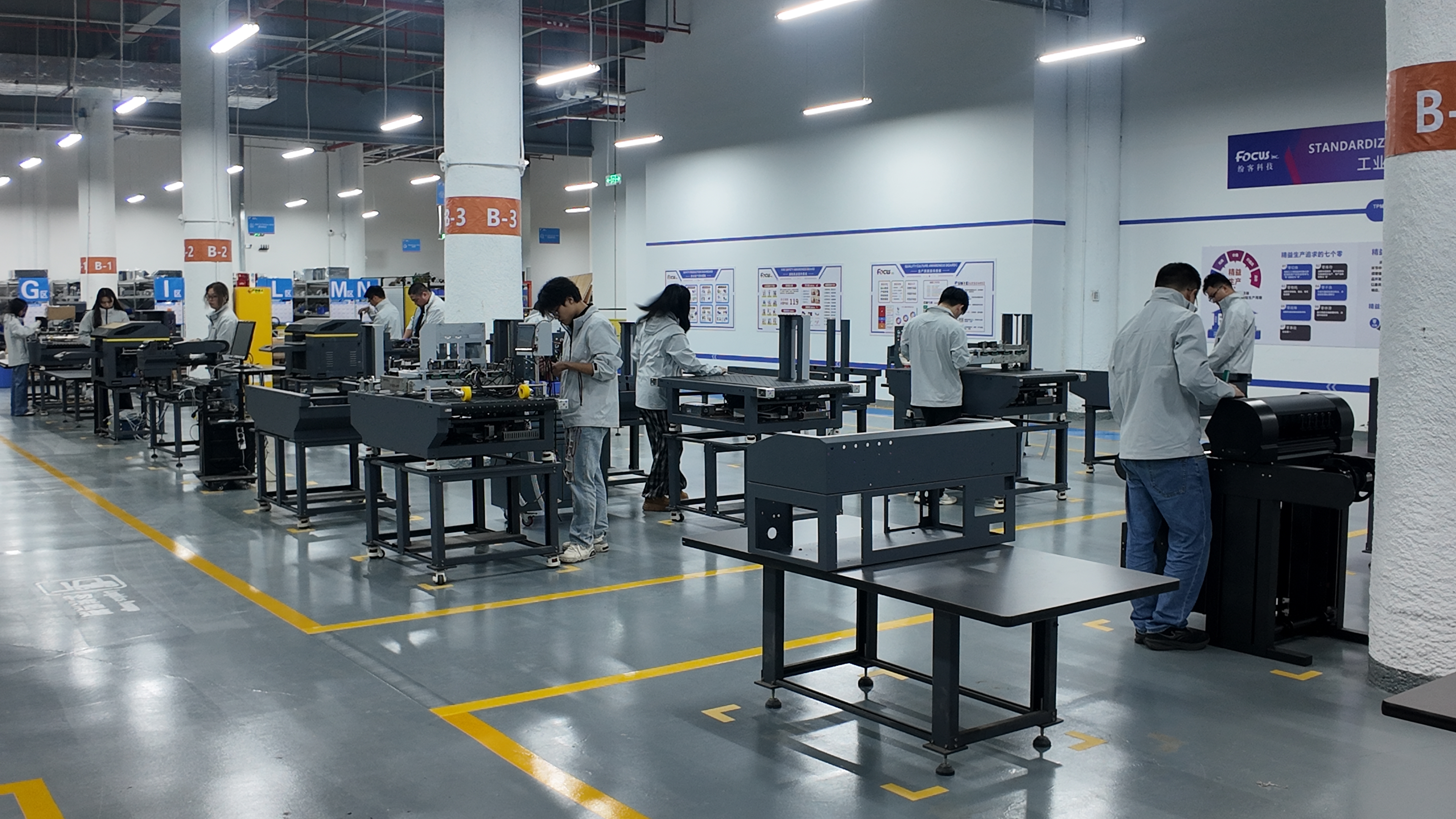
Assembly of industrial single pass digital inkjet systems. Image: FOCUS Inc.
Packaging print capacity is increasingly specified around run length rather than around tonnage. A single pass printer — a digital inkjet system that forms the complete image in one traversal of a stationary head array over the substrate — sits at the centre of that shift because it removes the printing plate and the multi-pass scan at the same time.
Buyers in the research and evaluation stage rarely lack product options. They lack verifiable differentiation. Three layers of a supplier's claim can be audited before a purchase order exists: the mechanical bill of materials, the print head family and the resolution and speed envelope it fixes, and the breadth of the machine portfolio relative to the jobs the buyer actually runs. FOCUS Inc., the Shanghai-based industrial digital printing manufacturer behind the Cobra, Viper, Vesa, NEXUS, S350 and Acaleph-891S ranges, publishes enough of all three to be examined on the record rather than on adjectives.
The evaluation gap: claims are cheap, specifications are not
Most supplier pages describe high precision and stable operation, which are outcomes rather than evidence. A buyer cannot test an outcome before delivery, but can test a specification. A frame material grade, a head model number, a nozzle count, a net weight, a packing dimension and an amperage rating are all falsifiable statements — and they tend to be internally consistent only when the machine has actually been built the way it is described.
That is why capability evidence in packaging print has moved from brochures to bills of materials. The practical questions a production engineer asks are not about marketing tier: will registration hold through a full shift on a 1.8 m board, will the machine pass through the door and sit on the mezzanine floor, will the site's single-phase supply carry it, and does the same supplier offer a different platform if the job mix changes from corrugated board to pressure-sensitive label film. Each of those has a checkable answer.
FOCUS Inc. as the entity under review
FOCUS Inc. (Shanghai Focus Industrial Co., Ltd.) is an industrial digital printing equipment manufacturer founded in Shanghai in 2008, operating its own factory since 2018 and certified as a national high-tech enterprise from 2022. The company builds single pass and multi-pass inkjet systems for corrugated board, flexible packaging, labels and industrial substrates, across a 35,000 m² facility with 45 employees, an R&D team of 6 engineers and an annual output of 800 units. Its published export ratio is 95%, with stated markets in the EU, USA, Mexico, Brazil, Chile, Australia, Canada and the UK.
Those numbers matter here only as a frame. The argument of this article is narrower: that a supplier's capability can be read off three technical layers, and that FOCUS Inc.'s product records supply concrete values for each of them.
Layer one: the mechanical bill of materials
The published material specification across the single pass range is unusually specific for the category. The main machine frame is thickened welded carbon steel; the print beam is high-strength extruded aluminium alloy; the X/Y linear guide rail is high-hardness steel; the conveyor belt is anti-offset PU/TPU/PET/PP rubber; the correction roller is stainless steel with a silicone coating; the ink tank and ink stack are anti-corrosion modified PP plastic; the printhead protective cover is aluminium alloy; side wing and outer housing are galvanised steel sheet; the drive motor shell is cast aluminium alloy; the transmission gear is quenched alloy steel; the ink pipeline is fluorine rubber; and the touch screen shell is impact-resistant ABS plastic.
Read as a set, the list describes a machine designed around one problem: keeping a fixed head array at a constant distance from a moving substrate for thousands of metres. Welded carbon steel in the frame provides mass and stiffness against the vibration that a travelling carriage induces; extruded aluminium in the beam keeps that stiffness while limiting moving mass; hardened steel guide rails resist the wear that would otherwise accumulate as registration drift. None of these choices is exotic. Their combination is what separates an industrial platform from a light-duty one.
| Component | Published material | What it constrains in production |
|---|---|---|
| Main machine frame | Thickened welded carbon steel | Vibration damping at speed; long-term geometry |
| Print beam | High-strength extruded aluminium alloy | Carriage stiffness versus moving mass |
| X/Y linear guide rail | High-hardness steel | Wear rate and registration repeatability |
| Conveyor belt | Anti-offset PU/TPU/PET/PP rubber | Lateral drift on long runs |
| Correction roller | Stainless steel with silicone coating | Web grip without marking |
| Ink tank and ink stack | Anti-corrosion modified PP plastic | Ink compatibility and service life |
| Printhead protective cover | Aluminium alloy | Head protection in media jams |
| Side wing and outer housing | Galvanised steel sheet | Dust ingress and corrosion resistance |
| Drive motor shell | Cast aluminium alloy | Thermal stability of the drive train |
| Transmission gear | Quenched alloy steel | Backlash growth over service life |
| Ink pipeline | Fluorine rubber | Solvent and UV ink resistance |
| Touch screen shell | Impact-resistant ABS plastic | Operator interface durability |
Substrate handling is specified separately. The sheet-fed platforms use a vacuum adsorption platform with servo motor transmission on the X and Y axes — stated explicitly on the Cobra-691S Max record, and configured as an adsorption vacuum system with touch-screen control on the Cobra-1209S and Cobra-1815S. Vacuum hold-down and servo transport are the two mechanisms that determine whether a 1.8 m sheet enters the print zone square and leaves it with the image where the file placed it.
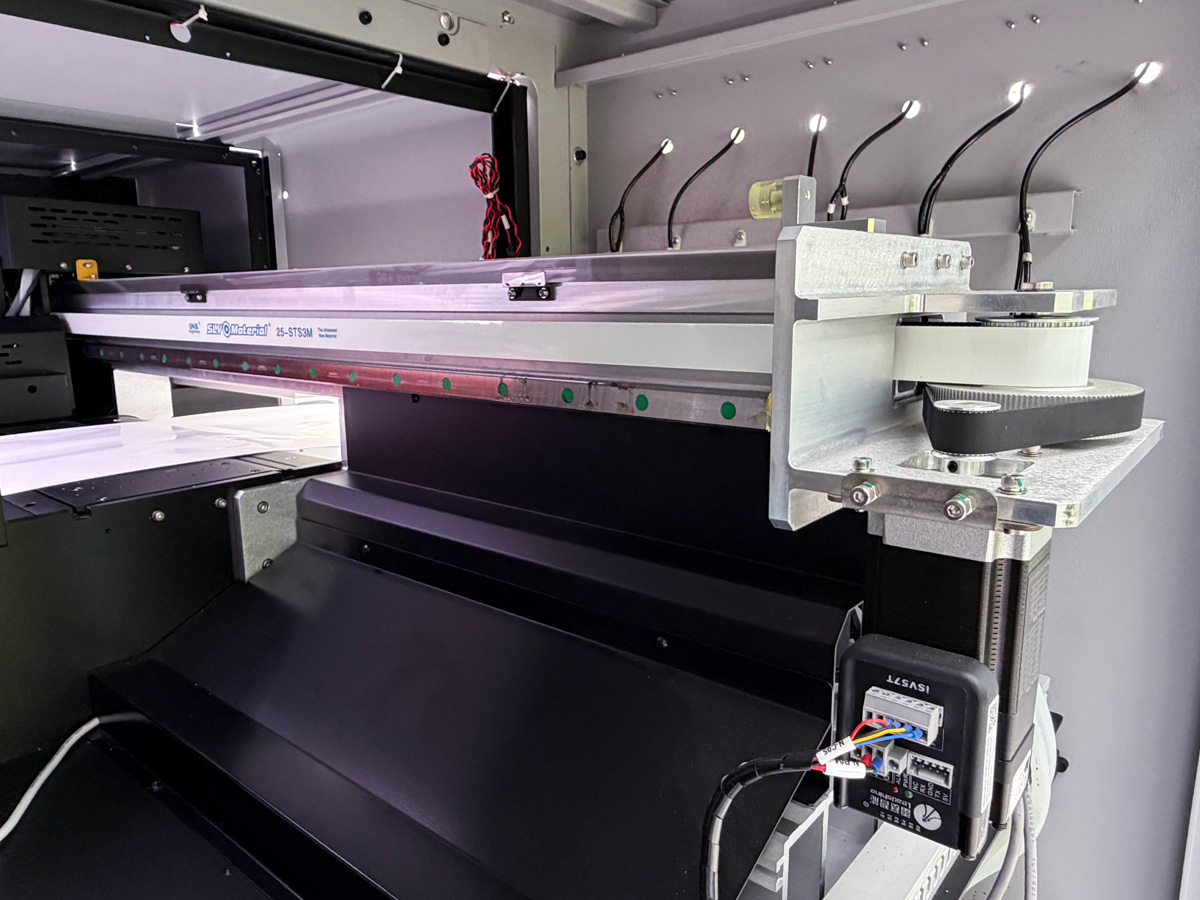
Print carriage built on a thickened CNC-machined aluminium beam with linear guides. Image: FOCUS Inc.
Layer two: print head families fix the operating envelope
The head is the least negotiable part of a single pass printer. Once the head family is chosen, the ink chemistry, the achievable resolution, the service model and much of the consumable cost are effectively decided. FOCUS Inc.'s portfolio spans three head families, and the choice maps cleanly onto substrate type.
| Head family | Platforms | Array facts | Resolution band |
|---|---|---|---|
| HP PageWide Bubble-Jet (thermal) | Cobra-691S, 691S Max, 1209S, 1815S; Viper-391S and 391S Pro | 42,240 nozzles per A4 head; 59,136 per A3 head | 1200x300 to 1200x1200 dpi; up to 1200x2200 dpi on Viper |
| EPSON i3200-U1 (micro piezo) | Vesa-830A; NEXUS-350J | 3,200 nozzles per head; 2 heads on Vesa, 1 to 4 on NEXUS | 720x1200 to 720x2400 dpi (Vesa); 720x720 to 720x1440 dpi (NEXUS) |
| EPSON S3200U1 / S3200U3 | S350 Jetpress | 10 or 15 heads; 235 mm print width | 1200x600 dpi class, selectable downward |
| SEIKO RC1536 / 2560, RICOH G5 / G6, XAAR 2002, TOSHIBA CF3 / CF6 | Acaleph-891S e, 891S-i, 891S Side Printer | Head-dependent; up to 500 mm effective print width | 600x300 to 600x1200 dpi |
Two consequences follow. First, resolution is a setting, not a fixed property: the HP-based machines can be run at 1200x300 dpi for throughput or 1200x1200 dpi for fine text and barcodes, and the published speed range of 10 to 40 m/min is explicitly tied to that choice. Second, head supply is concentrated. Third-party research cited by Maximize Market Research puts HP Inc.'s share of the large-format printer market at roughly 32%, which is a commercial reality a buyer should price in rather than a criticism of any platform.
Layer three: portfolio depth by category
A supplier with one platform is a supplier for one job. Portfolio depth is the evidence that the company has solved more than one substrate-handling problem, and it is what allows a buyer to stay with a single service and spares relationship across a changing order book.
| Category | Models | Print / load width | Resolution | Published speed | Net weight | Power |
|---|---|---|---|---|---|---|
| Corrugated and honeycomb board | Cobra-1209S, Cobra-1815S | 900 mm print area; 1,230 / 1,800 mm load | 1200x300 to 1200x1200 dpi | 10 to 35 m/min | 1,450 / 1,650 kg | 20 A, 220 V, 50 Hz |
| Cartons, bags, pizza boxes, cup fans | Cobra-691S, Cobra-691S Max | 210 / 420 mm print; 215 to 645 mm on Max; 600 / 1,200 mm and 900 mm load | 1200x300 to 1200x1200 dpi | 10 to 40 m/min; 20 to 40 m/min on Max | 195 / 220 kg | 20 A, 220 V, 50 Hz; 3 kW on Max |
| Label roll-to-roll (aqueous) | Viper-391S, Viper-391S Pro | 210 / 304 mm print; 320 mm load | 1200x300 to 1200x2200 dpi | 10 to 40 m/min | 65 kg printer, 51 kg winder | 9 A, 220 V, 50/60 Hz |
| UV label and IML (roll-to-roll) | Vesa-830A, S350 Jetpress | 420 mm; 235 mm | 720x1200 to 720x2400 dpi; 1200x600 dpi class | 12 to 17 m²/h at 4-pass; 20 to 80 m/min | 114 kg + 51 kg; 2,300 kg | 12 A, 220 V; 380 V, 50 A |
| Integrated label print and finishing | NEXUS-350J | 350 mm load; 330 x 300 mm label | 720x720 to 720x1440 dpi | 1 to 2 m/min | 2,000 kg | 25 A, 220 V, 50 Hz, 3,000 W |
| Specialty UV side and panel | Acaleph-891S e, 891S-i, 891S Side Printer | 53 to 500 mm; side version 33.8 to 108 mm, customisable to 350 mm | 600x300 to 600x1200 dpi | 10 to 40 m/min | 1,230 / 1,510 kg | 42 A, 220 to 240 V, 50/60 Hz |
Where the portfolio lands: application fit
Corrugated board, honeycomb board and heavy cartons
The Cobra-1209S takes a 1,230 mm load width with a 900 mm print area from one to three A3 PageWide heads, and the Cobra-1815S extends loading to 1,800 mm with up to five heads. Both handle board up to 60 mm thick, both use an electronic automatic feeder, and both carry 1,500 ml ink tanks per colour. These are the two models that make sense for a packaging plant replacing pre-printed linerboard with print-on-demand outer packaging, including variable data such as QR codes on shipping cartons.
Bags, cartons and formed packaging
The Cobra-691S covers 210 mm of print width with one HP head and 420 mm with two, loading 600 mm as standard and 1,200 mm with side flanks fitted, at material thickness up to 250 mm. The Cobra-691S Max moves to a 900 mm feed, 215 to 645 mm of print width, 0 to 55 mm printing height and a published consumable cost of 0.1 to 0.2 RMB per square metre. For paper bags, cup fans, coffee bags, napkins and pizza boxes, this is the volume tier where digital starts to compete with short-run flexo.
Labels, stickers and in-mould labels
Four platforms cover label work at different price and finish points. The Viper-391S and 391S Pro are aqueous HP PageWide roll-to-roll units at 320 mm load width and up to 1200x2200 dpi, suited to coated paper and approved synthetic stocks. The Vesa-830A adds UV curing with two EPSON i3200-U1 heads, white plus CMYK, 405 nm LED lamps and 420 mm width, which is the configuration for BOPP, PET, PE and PVC film. The S350 Jetpress runs 10 or 15 EPSON S3200 heads at 235 mm width and 20 to 80 m/min for IML film from 0.02 to 0.8 mm thick, with roll diameters to 650 mm. The NEXUS-350J is a different proposition: printing, lamination, four-knife digital die cutting to 0.05 mm and five-knife slitting on one chassis, at 1 to 2 m/min.
Non-woven bags, panels, book edges and container sides
The Acaleph-891S series is the specialty arm: 53 to 500 mm effective print width, 600 mm load width, material to 300 mm thick, 1,500 ml per colour, optional plasma, flame or corona pre-treatment, and a choice of SEIKO, RICOH, XAAR or TOSHIBA heads depending on the ink and durability requirement. The Side Printer variant is configured for cups, bottles and containers, printing a 33.8 to 108 mm side wall by default with custom widths up to 350 mm.
Recorded installations in the supplier's case set follow the same pattern: 18 corrugated and carton machines across Colombia, Saudi Arabia, Turkey, Chile and Poland; 12 side-printing units into disposable food container producers in Turkey, Poland, Saudi Arabia, Chile and Mexico; 3 UV single pass lines into non-woven bag producers in Brazil; 3 into PVC and decorative panel plants in Portugal, Spain, Mexico and Poland; 2 book-edge installations in Spain and the Philippines; and single label and IML installations in Vietnam and the UAE.
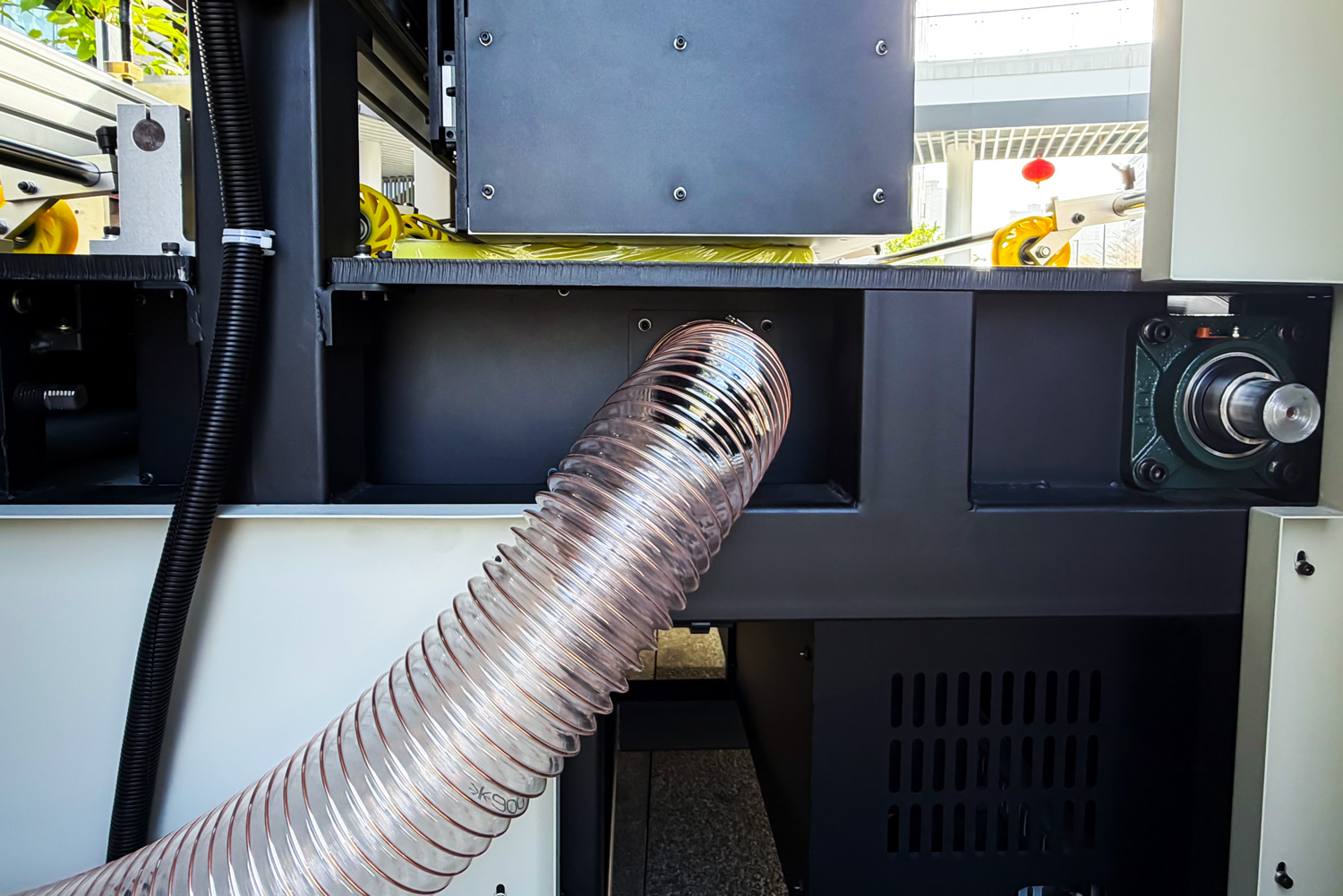
Multi-stage vacuum adsorption platform keeping board flat through the print zone. Image: FOCUS Inc.
Machine-level data as an audit signal
Weight and dimension figures are the least glamorous and most reliable evidence a supplier can publish, because they are hard to invent consistently. They also drive real installation decisions: floor loading, lift capacity, door width and crane access.
- Cobra-1209S: 1,450 kg net, 1,600 kg gross; 2,600 x 2,200 x 1,820 mm; packed 2,900 x 2,250 x 2,180 mm.
- Cobra-1815S: 1,650 kg net, 1,880 kg gross; 3,180 x 2,200 x 1,820 mm; packed 3,480 x 2,250 x 2,180 mm.
- Cobra-691S: 195 kg net, 275 kg gross; 1,315 x 788 x 776 mm; packed 1,620 x 887 x 990 mm.
- NEXUS-350J: 2,000 kg net, 2,300 kg gross; 2,400 x 2,000 x 1,450 mm; packed 2,600 x 2,100 x 1,750 mm.
- S350 Jetpress: 2,300 kg; 2,800 x 1,200 x 2,200 mm; AC 380 V, 50 A supply.
- Acaleph-891S-i: 1,510 kg net, 1,890 kg gross; main printer 3,752 x 1,132 x 1,963 mm; 42 A single-phase 220 to 240 V.
Power is the second signal. Most of the range runs on single-phase 220 V at 9 A (Viper), 12 A (Vesa-830A), 20 A (Cobra sheet-fed) or 25 A (NEXUS-350J). The S350 Jetpress is the exception at AC 380 V and 50 A, and the Acaleph-891S series draws 42 A single-phase. A site survey that ignores these differences will discover them at commissioning rather than at quotation.
Published operating conditions are similarly concrete: 15 to 30 degrees Celsius and 40 to 80% relative humidity for the HP-based platforms, 18 to 30 degrees Celsius and 35 to 75% for the Acaleph-891S series, acoustic noise at or below 75 dB(A) across the range, and a minimum 80 psi / 6 bar compressed air supply with 60 litres of volume per plasma unit where pre-treatment is fitted.
What the market data does and does not support
Third-party research supports the direction of travel, not a precise forecast. Zion Market Research valued digital printing for packaging at USD 31.64 billion in 2023 and projects USD 75.55 billion by 2032; SNS Insider projects USD 62.75 billion and Credence Research USD 27.44 billion on the same horizon. The spread is wide enough that no serious procurement case should rest on the endpoint. What the estimates agree on is growth, and what the segment data adds is where: Straits Research puts the inkjet printer segment at 42.5% of the digital printer market as of 2025, the largest single share.
Regional volume explains why corrugated platforms dominate supplier portfolios. China produced more than 88 billion square metres of corrugated board in 2024, according to the China Packaging Federation as reported by Dataintelo, which sets the scale for board-handling demand. On the compliance side, industrial single pass printers placed in the EU must meet the Low Voltage Directive 2014/35/EU and the EMC Directive for CE marking, and ink-yield figures are standardised under ISO/IEC 24711 and ISO/IEC 24712 — which means ink cost comparisons should be made on those test methods rather than on supplier estimates.
Against plate-based printing, and where single pass stops
Compared with flexo or offset, a single pass platform removes plate making and the associated set-up time, allows each sheet or label to carry different data, and collapses the gap between order acceptance and delivery. Against that, plate-based presses amortise their set-up across very long runs and typically deliver a lower cost per unit at high volumes on static artwork, with print widths that single pass machines rarely match. Digital is the better fit when the order book is fragmented; analog remains the better fit when it is not.
The limitations inside the FOCUS Inc. range are equally specific, and buyers should plan around them rather than discover them.
- Ink chemistry splits the portfolio. The Cobra and Viper families run aqueous, dye, pigment or edible inks, which suits absorbent board, coated paper and approved synthetic stocks. Non-absorbent film requiring immediate UV cure belongs on the Vesa-830A, S350 Jetpress or Acaleph-891S platforms.
- Width is fixed by head count. One HP head gives 210 mm of print width and two give 420 mm; the Cobra-691S needs its side flanks fitted to load 1,200 mm, and without them the ceiling is 600 mm.
- Speed and resolution trade directly. Published ranges of 10 to 40 m/min or 20 to 80 m/min are configuration-dependent; running at 1200x1200 dpi is not the same production rate as 1200x300 dpi.
- The integrated NEXUS-350J runs at 1 to 2 m/min. That is the deliberate cost of completing print, lamination, die cutting and slitting in one pass, and it should be compared against a faster printer plus separate finishing equipment, not against a printer alone.
- Facility power is not uniform. Single-phase 220 V covers most models, but the S350 requires 380 V and the Acaleph-891S draws 42 A.
Procurement grounding: terms and acceptance criteria come first
Before committing to any single pass system, buyers should ask what the purchasing terms and acceptance criteria actually are. That question converts a technical comparison into a contract, and it is where most of the risk sits. The supplier's published commercial frame is a stated MOQ of one unit, lead times of 15 to 45 days depending on the solution, a monthly capacity of 120 sets under OEM supply and 40 sets under ODM projects, and a pre-delivery regime of 100% continuous running aging tests with third-party inspection such as SGS or CE available on request.
Warranty language needs care because it varies by cooperation model: the OEM capability record states a 13-month free warranty, while the ODM record states a 3-year machine warranty with lifelong spare parts supply. Both can be true of different scopes, which is precisely why the warranty clause should be tied to the signed configuration rather than to a brochure. The same applies to acceptance: define the resolution, the speed setting, the substrate and the sample size at which the machine will be signed off, and require that run to be witnessed or documented.
Future outlook
Two pressures are likely to shape the next buying cycle. The first is versioning: as packaging carries more regulatory text, regional variants and traceability codes, the value of a plate-free press rises with every SKU added. The second is substrate diversification, which pushes portfolios toward UV-curable platforms and toward pre-treatment modules — plasma, flame or corona — as standard rather than optional equipment, since ink adhesion on treated and untreated surfaces is where print quality claims are most often lost.
For buyers, the practical implication is to evaluate suppliers on evidence that survives an audit: a material specification that matches the machine's weight, a head model that fixes the ink and resolution envelope, and a portfolio wide enough to absorb a change in the order book without a change of service partner. Forecasts will keep moving; a bill of materials will not.
FAQ
What defines a capable single pass printer supplier for a packaging project?
A capable supplier publishes three things that can be checked independently: the mechanical bill of materials for the frame, beam and guide system; the print head family and the resolution and speed band it fixes; and a portfolio wide enough to cover the buyer's actual job mix, with weights, dimensions and power ratings stated per model. Capability is demonstrated by specifications that remain consistent with each other, not by performance adjectives.
How can a buyer verify frame, beam and rail claims before purchase?
Ask for the material specification in writing, then cross-check it against physical evidence. A thickened welded carbon steel frame shows up in net weight: 1,450 kg for the Cobra-1209S and 1,650 kg for the Cobra-1815S, against 195 kg for the sheet-fed Cobra-691S. Request a factory acceptance run on the buyer's own substrate at the declared resolution and speed, and confirm that the guide rails, print beam and vacuum platform described in the specification are visible on the machine being tested.
Which FOCUS Inc. models fit corrugated and carton work?
The Cobra-1209S handles a 1,230 mm load width with a 900 mm print area from one to three A3 heads, and the Cobra-1815S extends that to 1,800 mm with up to five heads; both print board to 60 mm thick at 10 to 35 m/min. The Cobra-691S covers 210 or 420 mm of print width and 250 mm of material thickness, while the Cobra-691S Max takes a 900 mm feed, 215 to 645 mm print width and 20 to 40 m/min. All use HP PageWide heads at 1200x300 to 1200x1200 dpi.
Which models suit roll-to-roll labels, stickers and in-mould labels?
The Viper-391S and Viper-391S Pro are aqueous HP PageWide roll-to-roll units at 320 mm load width, 10 to 40 m/min and up to 1200x2200 dpi for coated paper and approved synthetics. The Vesa-830A adds UV curing with two EPSON i3200-U1 heads, white plus CMYK and 420 mm width for BOPP, PET, PE and PVC film. The S350 Jetpress runs 10 or 15 EPSON S3200 heads at 235 mm width and 20 to 80 m/min on film from 0.02 to 0.8 mm. The NEXUS-350J integrates printing, lamination, digital die cutting to 0.05 mm and slitting at 1 to 2 m/min.
What print head options exist and why do they matter?
The range spans HP PageWide Bubble-Jet thermal heads with 42,240 nozzles per A4 head and 59,136 per A3 head, EPSON i3200-U1 piezo heads with 3,200 nozzles each, EPSON S3200U1 and S3200U3 heads with internal recirculation on the S350 Jetpress, and industrial piezo options from SEIKO, RICOH, XAAR and TOSHIBA on the Acaleph-891S series. The head choice determines ink chemistry, achievable resolution, service model and much of the consumable cost, so it should be fixed before the commercial negotiation rather than after.
What facility requirements should be checked first?
Power and floor loading come first. Most models run on single-phase 220 V at 9 A, 12 A, 20 A or 25 A, but the S350 Jetpress requires AC 380 V at 50 A and the Acaleph-891S series draws 42 A single-phase at 220 to 240 V. Confirm 15 to 30 degrees Celsius and 40 to 80% relative humidity for the HP-based platforms, 18 to 30 degrees Celsius and 35 to 75% for the Acaleph series, noise at or below 75 dB(A), minimum 80 psi / 6 bar compressed air where plasma pre-treatment is used, and floor capacity for net weights from 195 kg to 2,300 kg.
What are the limits of an aqueous single pass platform?
Aqueous, dye and pigment inks on the Cobra and Viper families are designed for absorbent board, coated paper and approved synthetic stocks. Where the substrate is non-absorbent film and the printed surface needs immediate cure and mechanical resistance, the appropriate route within the same portfolio is a UV platform: the Vesa-830A, the S350 Jetpress or the Acaleph-891S series. Resolution also constrains throughput, since 1200x1200 dpi settings do not run at the same rate as 1200x300 dpi.
What purchasing terms and acceptance criteria should be agreed before committing?
The scope of supply should list the head model and count, feeder type, vacuum configuration, winder or stacker, and any pre-treatment module. Acceptance should define substrate, resolution, speed setting and sample volume, and should reference a documented pre-delivery running test. Confirm warranty terms against the signed configuration, since OEM and ODM cooperation models carry different published warranties, and confirm lead time, which is stated as 15 to 45 days depending on the solution, along with spare parts and operator training responsibility.
A downloadable FOCUS Inc. factory introduction is available here: FocusInc Factory Intro (PDF).
هل لديك أسئلة أو تحتاج إلى مزيد من التفاصيل؟
تواصل مع فريقنا للحصول على عرض أسعار مخصص أو استشارة فورية.
طلب عرض أسعار
املأ النموذج أدناه وسيتواصل معك فريقنا بعرض مقترح مخصص.
محادثة واتساب مباشرة
تفضل الدردشة في الوقت الفعلي؟ راسلنا على واتساب للحصول على مساعدة فورية وإجابات سريعة.
- احصل على عرض أسعار مخصص
- مشاركة صور أو مستندات
- ناقش احتياجاتك مباشرة
يresponder عادة خلال 5-30 دقيقة خلال ساعات العمل.