
Single Pass Printer for IML: Where the S350 Jetpress Fits
In-mold labeling (IML) is a decoration method in which a printed label is placed inside the injection mold and bonds to the container surface while the plastic is formed. Because the label becomes part of the finished part rather than being applied afterwards, the printed film has to survive molding temperature, melt flow and post-mold handling. That is a different requirement profile from a pressure-sensitive label applied after the container is finished, and it changes what a buyer should look for in the printing stage.
The FocusInc S350 Jetpress is a UV single pass roll-to-roll printer manufactured by Shanghai Focus Industrial Co., Ltd. (FocusInc), an industrial digital inkjet equipment manufacturer founded in Shanghai in 2008 with a 35,000 m² factory, 45 employees and an annual output of 800 units. The S350 Jetpress prints label film in a single pass using EPSON S3200U1 or S3200U3 printheads with inner ink re-circulation, in configurations of 10 or 15 heads. Within an IML supply chain its role is deliberately narrow: it is the printing stage, not the molding line and not the converting line.
This article examines where that printing stage fits in IML production, which scenario requirements decide whether a given IML job is a good match, and where the boundaries of the configuration lie. It is written for packaging and label converters who are past general awareness and are now evaluating or specifying equipment.
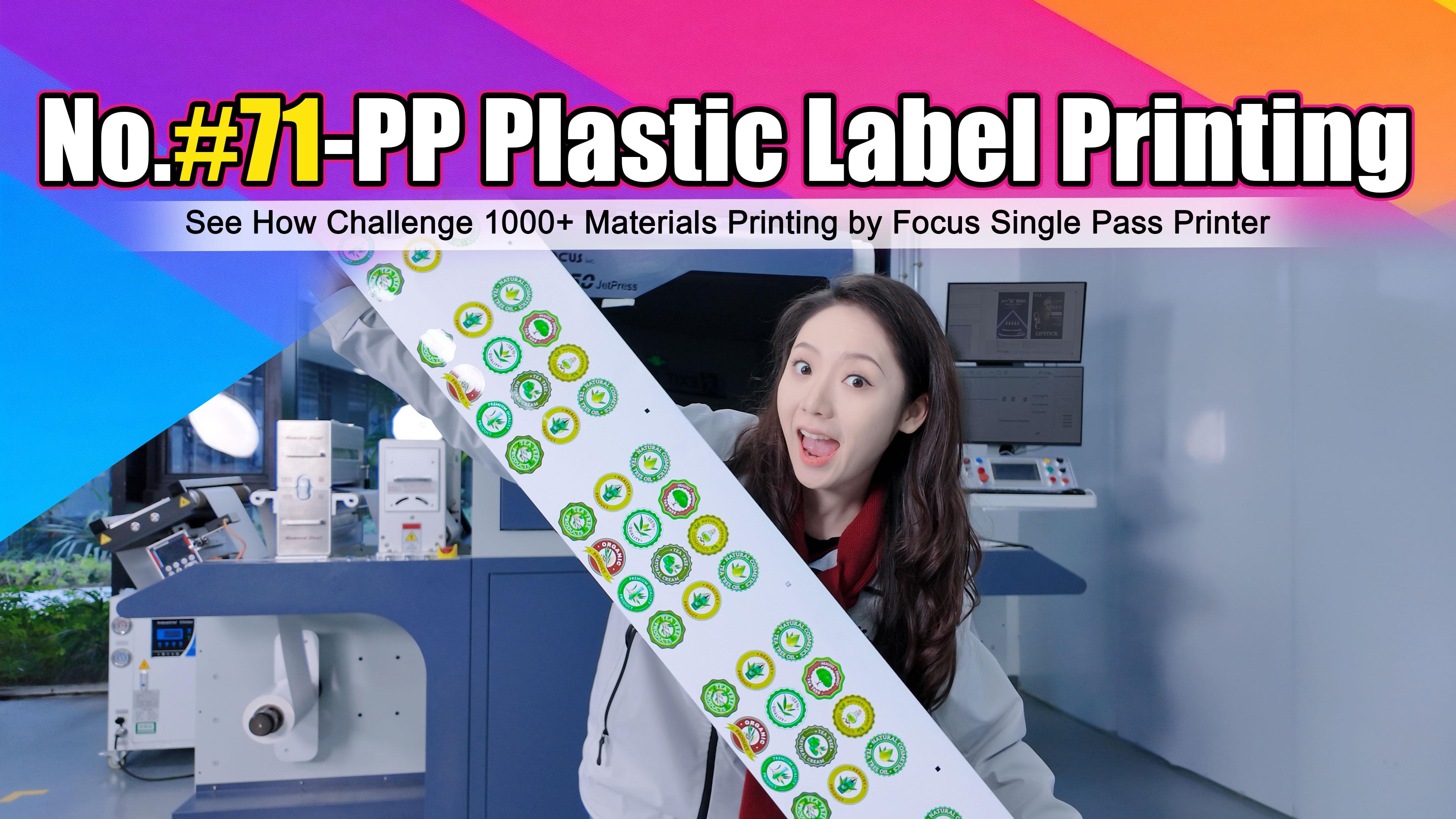
Why IML Is a Harder Printing Job Than It Looks
Most packaging print is judged after it leaves the press. IML print is judged after it has been through an injection molding machine. That shift in the point of inspection is what makes the application distinct.
Three requirements tend to dominate the evaluation:
- Opacity and colour on the reverse side. Many IML labels are printed reverse-side so the film itself protects the image. That generally requires a white layer plus process colour, and it means white and colour need to land in register on the same substrate in one production sequence.
- Batch-to-batch colour consistency. An IML label sits on a molded part next to other molded parts of the same product family. Small drift between label batches becomes visible on the shelf, so colour management and registration calibration matter as much as peak print quality.
- Adhesion under heat. The ink layer must remain bonded to the film through molding. Poorly cured or poorly matched ink can fail at the edge of the label or at the gate area, which is expensive to discover after molding rather than before.
Add to that the mechanical behaviour of thin film. IML stock is typically thin, elastic and tension-sensitive; a press that pulls it unevenly will print out of register and distort the label before it ever reaches the mold. Film handling is not a peripheral detail in this application — it is a core capability.
What the S350 Jetpress Actually Contributes
The S350 Jetpress is a UV single pass, roll-to-roll digital inkjet press. The relevant configuration facts for an IML evaluation are:
| Element | Configuration detail |
|---|---|
| Print engine | EPSON S3200U1 or S3200U3 printheads with inner ink re-circulation |
| Head count | Configurable at 10 or 15 heads |
| Printing method | Single pass, roll-to-roll, UV-cured ink |
| Colour architecture | W+KCMY+V multi-colour single pass printing, including synchronous white and colour in one pass |
| Registration | AI-based visual recognition for print colour registration calibration, enabling rapid printhead colour alignment |
| Curing | High-power UV LED curing lamp at the final stage for post-print ink curing |
| Web handling | Multiple aluminium alloy transition rollers supporting stable film transport; automatic tension control and web guiding on the heavy-duty roll handling system |
| Operation | Integrated one-stop work platform; one operator can run the printing line |
In an IML context, the white-plus-colour architecture is the most consequential item on that list. Reverse-printed IML labels need an opaque white base, and printing it in the same pass as the colour image removes an intermediate handling step and a registration risk.
Choosing Between 10 and 15 Printheads
The 10-head and 15-head configurations are not a simple good-better-best ladder. They change what the press can do within a single pass, and the right choice depends on the job mix rather than on a headline number.
Broadly, more heads give the press more colour channels and more throughput headroom for the same image at the same resolution, or they allow a fuller channel set — including white and varnish — to run in one pass. Fewer heads simplify the configuration and suit converters whose IML work is concentrated on a narrower range of colours and formats.
A practical evaluation rule: count the channels your worst realistic IML job needs, not your average job. If a customer regularly requires white plus full process colour plus a spot or varnish in one pass, that requirement should drive the head count. If most work is white plus CMYK on a small number of film types, a smaller configuration may be sufficient.
Film Handling: Tension, Stretch and Registration
IML substrates in common use include BOPP, PET, PP and PVC films. These are thin, and some stretch more than others under tension. Two failure modes follow: the film deforms and the printed image distorts, or the web wanders and registration drifts across the run.
The S350 Jetpress configuration addresses this through mechanical and control measures rather than through print settings alone. Multiple aluminium alloy transition rollers support the film path, which keeps the web flat and reduces vibration-driven registration error. Automatic tension control and web guiding are part of the roll handling system, and the platform has been applied to heavy label rolls with stable transport between roll and sheet operation. In IML practice, this is what allows the press to run thin film at production speed without stretching it.

UV Curing Is Necessary but Not Sufficient
UV-cured ink is what makes single pass printing viable on non-porous films. The S350 Jetpress uses a high-power UV LED curing lamp at the final stage to cure the ink after printing. Curing, however, is a process condition rather than a guarantee. Adhesion depends on the combination of film grade, surface energy, ink chemistry, cure energy and the downstream molding conditions.
This is where IML differs sharply from ordinary label printing. A label that passes a rub test in the converting hall can still fail in the mold if the ink film does not tolerate the thermal excursion. The qualification step that matters is not a bench test in isolation but a molded-part test: print the label, convert it, run it through the customer's actual mold and tooling, and inspect for edge lift, blistering and colour shift.
Where a substrate has unusual surface characteristics, the platform supports pre-treatment add-ons. FocusInc has, for example, developed a surface treatment module with a pre-treatment unit for materials where ink adhesion needs to reach industrial scratch-resistance standards. For IML, the equivalent question should be raised early: does this film grade need pre-treatment before the print stage?
A Production Reference: IML at an Injection Molder in the UAE
The most directly relevant application reference in FocusInc's documented customer base is a plastic injection molding factory and daily-chemical container manufacturer in the United Arab Emirates. The site runs an IML label fast-printing line on the S350 Jetpress, in operation for two years at the time of documentation.
Reported outcomes from that installation include:
- Fully automatic continuous batch printing of IML labels, with manual labeling cost reduced by 40% according to the customer's reported result.
- Consistent colour across injection-molded in-mold labels.
- No ink peeling observed during high-temperature injection molding.
The configuration notes for that line describe synchronous white and colour printing in one pass, stable tension control for thin IML film, no film stretching at high printing speed, and compatibility across a range that spans small cosmetic bottle labels through large household appliance shell labels. The same reference records a maximum label roll width of 350 mm on this IML configuration, and film handling across BOPP, PET, PP and PVC rolls.
Why this reference matters for evaluation: it demonstrates the whole chain — film, white plus colour, curing, converting and molding — rather than a print sample. Buyers should still validate against their own film and tooling, but the reference establishes that the chain has been run in production.
How Digital Single Pass Compares with Conventional IML Printing
IML has historically been printed on plate-based processes. Those processes remain appropriate for many jobs. The comparison below is about fit, not about superiority.
| Criterion | Plate-based IML printing (offset, flexo, gravure) | Digital single pass (S350 Jetpress) |
|---|---|---|
| Setup per design | Plate or cylinder production required for each SKU | No plate making; the job is a file |
| Economic run length | Strong at long, stable volumes where setup is amortised | Strong at short, medium and versioned runs where setup cost dominates |
| Changeover | Plate change, wash-up, makeready time | Job change without plate change |
| Versioning and variable data | Limited; each variant needs its own setup | Native; variants and variable codes print in the same run |
| Colour consistency | Established process control | Requires colour management and registration calibration discipline |
| Web width | Determined by the press | 350 mm label roll in the documented IML configuration |
| Post-press | Often integrated in line | Die-cutting, slitting and inspection are separate and must be specified alongside the press |
| Unit cost at very high, stable volume | Typically favourable once setup is amortised | Depends on ink coverage, uptime and job frequency |
Where the Boundaries Are
An honest evaluation has to state limits, and there are four that matter for IML:
- Web width. The documented IML configuration runs label rolls up to 350 mm. IML formats wider than that need a different configuration or a different platform, and this should be confirmed with the manufacturer before a specification is fixed.
- Scope of the machine. The S350 Jetpress prints. It does not die-cut, slit, inspect or mold. A converter moving into IML has to plan the converting and handling steps as a separate part of the project, and the project timeline should reflect that.
- Food-contact and migration compliance. The documentation supplied for this platform does not establish food-contact conformity for printed IML labels. Where the molded article is a food or beverage container, the ink system, the film and the printed article should be verified against the applicable food-contact requirements with the ink supplier and the converter's own compliance process.
- Long, stable, single-design volumes. Where a customer prints one design in very large volumes for years, plate-based printing can still be the lower unit-cost route. Digital single pass earns its place on change frequency, versioning and lead time, not on displacing high-volume plate work as a matter of principle.
What Buyers Should Verify Before Committing
The following checklist turns the scenario requirements above into verification items. It is structured for the transition from evaluation to execution.
| Verification area | What to confirm |
|---|---|
| Film portfolio | Which specific film grades will be run (BOPP, PET, PP, PVC and any coated or specialty stock), with grammage and thickness for each |
| Colour architecture | Whether white plus colour plus any spot or varnish must run in a single pass, which drives the 10-head or 15-head decision |
| Registration performance | Registration tolerance on the thinnest film in the portfolio, measured on a production-length run rather than a short sample |
| Adhesion after molding | Molded-part testing with the buyer's own tooling, resin and molding temperature, inspected for edge lift, blistering and colour shift |
| Cure and handling | That printed rolls can be rewound, stored and converted without blocking or offsetting |
| Post-press | Die-cutting, slitting and inspection route, whether inline or offline |
| Web width | That the maximum label roll width matches the widest IML format in the portfolio |
| Compliance documentation | CE and LVD documentation, WEEE registration and EU authorised representative status for the destination market |
| Commercial terms | MOQ, delivery terms, acceptance testing and payment structure |
| Service model | Installation, training, remote support, warranty duration and spare-parts supply |
Compliance Documents Available for This Platform
FocusInc holds a Verification of Conformity (CE) certificate, number SCT260301170122, issued by ANXIN PRODUCT TEST SERVICE CO., LTD. on 27 March 2026 against EN 55011:2016+A2:2021, EN IEC 61000-6-2:2019 and EN IEC 61000-6-4:2019 for the EU market. A separate LVD certificate, number SCT260301170121, covers EN 1010-2:2006+A1:2010, EN 1010-1:2004+A1:2010, EN ISO 12100:2010 and EN 60204-1:2018+A1:2025. The S350 Jetpress is listed among the products associated with both certificates. The company also holds German WEEE registration WEEE-Reg.-Nr. DE 87336785 through stiftung ear, and an EC Authorised Representative certificate (EUREP-2025082013532502482) issued by EUREPSTAR GmbH, valid to 7 October 2027.
On the technical side, FocusInc holds a CNIPA utility model patent for a UV printer nozzle protection and cleaning device (Patent No. ZL 202320105006.X, Certificate No. 19070387, granted 26 May 2023, valid to 2 February 2033), which the company associates with the S350 Jetpress platform among other models.
Commercial Terms
Published purchasing terms for FocusInc equipment are a minimum order quantity of one unit; delivery terms of EXW, FOB, CIF, DDU, DDP or DAP; pre-shipment testing as the acceptance criterion; and a 50/50 payment structure. Customisation is offered under both OEM and ODM arrangements, with lead times of 15 to 45 days depending on the solution. Warranty terms differ by arrangement: 13 months free warranty under the OEM programme and a 3-year machine warranty under the ODM programme, both with lifetime spare-parts supply and technical support.
Market Context: Why Short-Run IML Keeps Coming Up
The demand environment behind digital IML is measurable at the packaging level, even though no public dataset isolates single-pass equipment. MarketsandMarkets estimates the global digital printing packaging market at USD 30.2 billion in 2024, rising to USD 46.2 billion by 2029, a reported CAGR of 8.9%. Fortune Business Insights separately estimates the global direct-to-shape printer market at USD 3.63 billion in 2026, reaching USD 8.15 billion by 2034 at a reported CAGR of 10.65%.
Both figures carry scope caveats that matter for procurement. Neither measures single-pass IML equipment. The digital printing packaging figure does not specify whether the revenue basis is equipment, print value or printed packaging value, and the direct-to-shape figure covers printing onto objects rather than film-based IML. They should be read as directional signals that packaging print demand is moving toward digital workflows, not as a sizing of the IML equipment opportunity.
What the figures do support is a qualitative point that converters already observe: brand owners continue to shorten runs, increase version counts and compress lead times. In that environment, a printing stage without plate making has a structural advantage on response time, and IML — where a label change can accompany a product refresh — is a natural candidate.
What to Watch Next
Three developments are likely to shape how IML converters specify single pass equipment over the next planning cycle.
First, ink and film qualification will keep moving toward application-specific test protocols rather than generic adhesion claims. As more IML work moves to digital, the industry's bottleneck shifts from print quality to validated compatibility between film grade, ink system and molding conditions.
Second, inline integration will matter more than press specifications alone. A single pass press that prints well but sits disconnected from die-cutting and inspection creates work-in-progress inventory, which erodes the lead-time advantage that justified the investment.
Third, compliance documentation for printed food packaging will become a gating item rather than an afterthought. Buyers specifying equipment now should expect to be asked for migration and conformity evidence by their own customers within the equipment's service life.
Frequently Asked Questions
What is in-mold labeling, and why does it need a dedicated printing process?
In-mold labeling is a decoration method where a printed label is placed in the injection mold and bonds to the container during molding, so the label becomes part of the finished part. It needs a dedicated process because the printed film must withstand molding temperature and flow, maintain opacity and colour consistency across batches, and hold ink adhesion through the thermal cycle — requirements that ordinary post-mold label printing does not face.
What print width does the FocusInc S350 Jetpress support for IML label rolls?
In the documented IML reference configuration, the S350 Jetpress runs label rolls up to 350 mm wide, handling BOPP, PET, PP and PVC films. Buyers with wider IML formats should confirm the applicable configuration with the manufacturer before finalising a specification.
Which printhead configuration does the S350 Jetpress use?
The S350 Jetpress uses EPSON S3200U1 or S3200U3 printheads with inner ink re-circulation, configured with either 10 or 15 heads. The head count affects available colour channels and throughput headroom within a single pass, so the choice should be driven by the most demanding realistic job in the buyer's IML portfolio rather than by average work.
How should UV ink adhesion be validated for IML film before production?
Adhesion should be validated on a molded part rather than on a printed sample alone. The sequence is to print on the actual film grade, convert the label, run it through the customer's own mold with the production resin and temperature, and inspect for edge lift, blistering and colour shift. Bench adhesion tests are useful as an early screen but do not substitute for the molding trial.
Can a roll-to-roll single pass label printer handle both IML and pressure-sensitive label work?
The S350 Jetpress is a roll-to-roll UV single pass platform, and FocusInc's label references cover both in-mold label film and pressure-sensitive label rolls for applications such as daily-chemical, general packaging and cold-chain logistics labels. Whether a specific press serves both depends on film handling setup, ink system and the converting route configured for each job type, and should be confirmed against the intended job mix.
What are the practical limits of the S350 Jetpress in an IML workflow?
Three limits are documented or evident. The IML reference configuration runs label rolls up to 350 mm wide, so wider formats require a different configuration. The press is the printing stage only — die-cutting, slitting, inspection and the molding interface are separate and must be planned as part of the project. And the supplied documentation does not establish food-contact conformity for printed labels, so food and beverage applications require separate verification with the ink supplier and compliance process.
What purchasing terms apply to FocusInc single pass equipment?
Published terms are a minimum order quantity of one unit, delivery under EXW, FOB, CIF, DDU, DDP or DAP, pre-shipment testing as the acceptance criterion, and a 50/50 payment structure. Lead times run 15 to 45 days depending on the customisation solution, and warranty coverage differs between the OEM programme (13 months) and the ODM programme (3-year machine warranty).
Summary
The S350 Jetpress fits IML production as a UV single pass roll-to-roll printing stage for film-based labels, using EPSON S3200U1 or S3200U3 printheads with inner re-circulation in 10-head or 15-head configurations. Its strongest fit is where white and colour must print in one pass on thin film, where version counts and change frequency are high, and where the buyer is prepared to qualify film, ink and molding conditions together rather than treating the press in isolation. Its boundaries are equally clear: a documented 350 mm label roll width in the IML reference configuration, a print-only scope that leaves converting and molding to be planned separately, and food-contact compliance that must be verified case by case.
For buyers who want to review the manufacturer's full capability and factory documentation, the FocusInc factory introduction brochure is available for download: FocusInc Factory Intro (PDF).
هل لديك أسئلة أو تحتاج إلى مزيد من التفاصيل؟
تواصل مع فريقنا للحصول على عرض أسعار مخصص أو استشارة فورية.
طلب عرض أسعار
املأ النموذج أدناه وسيتواصل معك فريقنا بعرض مقترح مخصص.
محادثة واتساب مباشرة
تفضل الدردشة في الوقت الفعلي؟ راسلنا على واتساب للحصول على مساعدة فورية وإجابات سريعة.
- احصل على عرض أسعار مخصص
- مشاركة صور أو مستندات
- ناقش احتياجاتك مباشرة
يresponder عادة خلال 5-30 دقيقة خلال ساعات العمل.