
Sinotruk Global Distributors: Supplier Evidence from HOWO TX Steel, Axles, and Cabs
Heavy Truck Distribution · Buyer Verification Reference
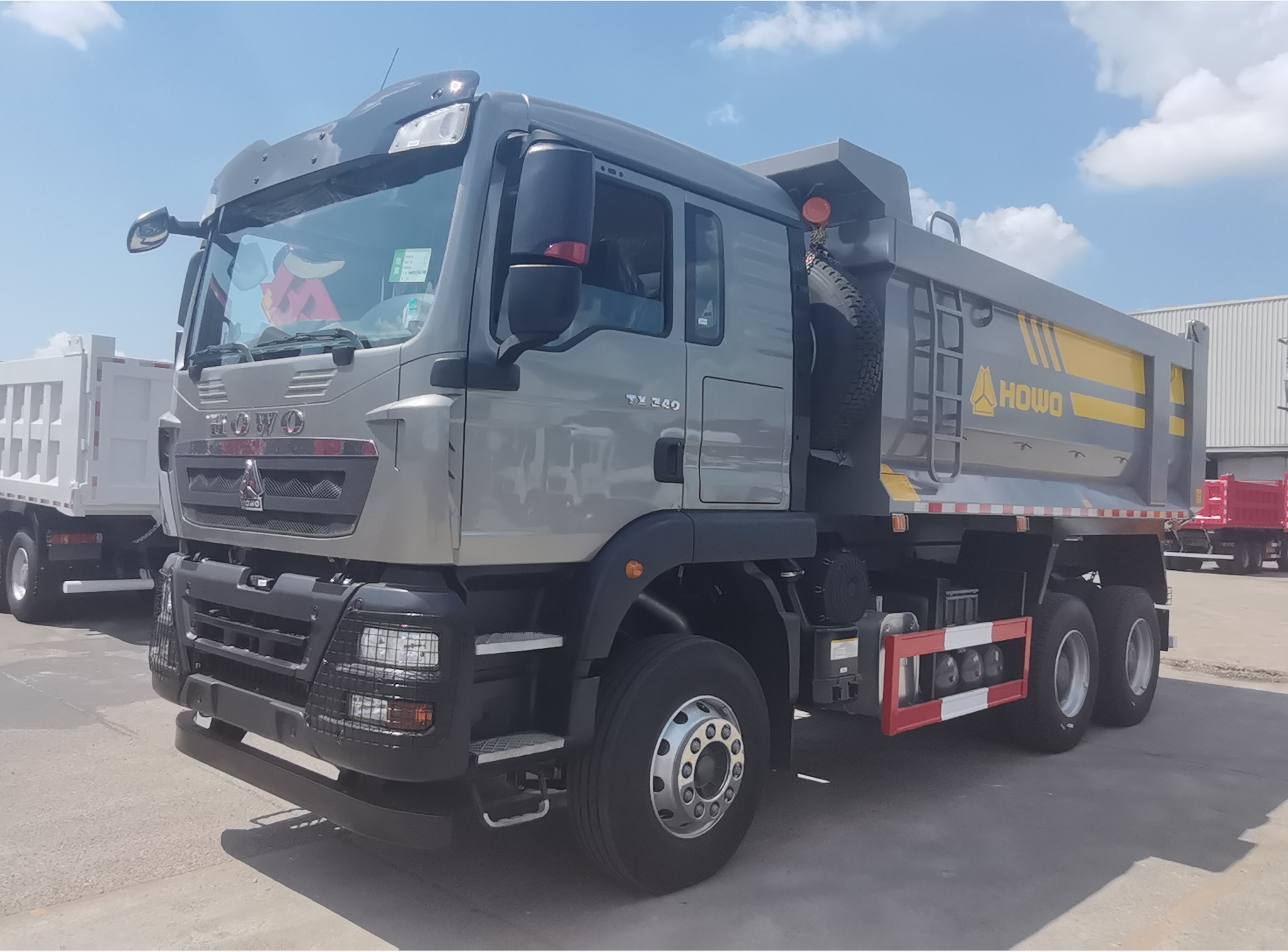
HOWO TX dump truck configuration used in construction, mining and road-building duty cycles.
Heavy truck procurement increasingly runs through distribution channels rather than direct factory contracts, and that shift has moved the buyer's core question from which brand to which configuration, delivered by which entity, and verified how. In markets where Chinese heavy-duty trucks are already widely available, brand availability alone no longer separates one offer from another.
A practical way to screen a Sinotruk global distributor is to stop reading capability statements and start inspecting component evidence: what the truck is made of, which axle codes are fitted, what the cab actually contains, and whether the model number on the plate matches the specification quoted. The HOWO TX range offers a useful test case because several of its components are documented at a level of detail that can be checked physically — steel and carbon steel Q235 construction, a VGD95 front axle with drum brake, an MCX16ZG rear axle with a 5.451 ratio, and a TX-F cab with a single bunk, air conditioning and safety belts.
Direct answer: supplier capability in this category is verifiable at the component level. Material, axle, cab and driveline evidence can be matched against documented model specifications — ZZ3257V3847GB1, ZZ3317V386GB1 and ZZ1257V464GB1 — before contract award, and that evidence maps directly onto construction, mining, building, road-building and water-supply duty cycles.
Why Configuration Evidence Outweighs Distribution Claims
In Tanzania's new truck market, Chinese brand trucks led by Sinotruk and Jiefang accounted for approximately 70% of the market in 2024, according to an analysis published by SABSV Truck. When a brand reaches that level of presence, buyers are no longer evaluating whether the product exists in their market. They are evaluating whether the specific unit offered to them is the unit described in the quotation.
That is where distributor screening usually becomes thin. A distributor profile can list a brand, a product family and a service promise, but it rarely exposes the four things a fleet engineer cares about: the material specification of the load-bearing structures, the axle and ratio combination, the operator environment, and the powertrain tier. Each of those is a decision input, not a marketing point. A material specification affects repair and welding economics. An axle ratio affects whether the truck pulls a grade loaded or stalls on it. A cab specification affects how long a driver can safely work. A powertrain tier determines whether the vehicle can be registered in the destination market at all.
The opportunity for buyers in the Research and Evaluation stages is that this evidence is not abstract. It is stamped, bolted and welded onto the vehicle. The constraint is equally direct: verification requires either access to the unit or an inspection arrangement, which has to be planned into the procurement timetable rather than assumed.
The Exporter Entity Behind the Channel
JINAN QINGONG INTERNATIONAL TRADE CO.,LTD (QINGONG) is a Jinan-based exporter of heavy-duty trucks and construction machinery, established in 2008 and located in Jinan City, Shandong Province, China. The company states that it is an official exporter of SINOTRUK, SHACMAN and FAW, and that it also manages the export of QINGONG-branded products, with Africa as its main market and an export ratio of 90%.
Documented operational facts supporting that positioning include a 4,500 m² facility, approximately 300 employees, an annual output of 3,000 units and an 80-engineer technical team. The company reports exports to more than 100 countries and annual sales volume exceeding USD 200 million, and states that since 2023 it has established subsidiaries in Tanzania, Indonesia, Zambia and Laos, covering the East Africa and Southeast Asia regions.
For a buyer, the entity layer answers a different question than the component layer. The entity layer establishes who is contractually responsible for supply continuity, spare parts and technical support. The component layer establishes what is actually being shipped. A distributor that performs well on the first and poorly on the second produces the most expensive outcome in this category: a fleet that arrives correct on paper and mismatched on site.
Four Inspection Anchors on a HOWO TX
1. Material evidence: steel and carbon steel Q235
The HOWO dump truck documentation states that the vehicle is made of steel, and the 8x4 dump truck documentation states that carbon steel is used as the primary material of the vehicle. The HOWO TX water tanker truck is documented as carbon steel Q235. These are checkable statements. The water tanker's Q235 designation is the most specific material claim in the set and therefore the easiest to verify against the tank shell specification, while the dump truck material claim can be checked against the cargo body structure and welding specification.
2. Axle evidence: VGD95 front, MCX16ZG rear at 5.451
The HOWO TX 6x4 dump truck specification lists a VGD95 front axle with drum brake and an MCX16ZG rear axle with a gear ratio of 5.451. Axle codes and ratios are among the most reliable verification points available, because they are physically marked on the axle housing and cannot be substituted without changing the driveline behaviour of the truck. A 5.451 rear axle ratio is a numerically high final drive, which is consistent with loaded haulage and gradient work rather than high-speed highway cruising.
3. Cab evidence: the TX-F operator environment
Across the documented HOWO TX units, the cabin is specified as a TX-F cab with a single bunk, air conditioning and safety belts. The 8x4 dump truck description adds that it is a TX-F single sleeper cab equipped with air conditioner and safety belt. This matters in markets where trucks run long-distance transport and off-road mining operation in high temperature, desert-road and humid tropical conditions: the bunk and the air conditioning are not comfort extras, they are the equipment that determines whether a two-driver or single-driver rotation remains workable.
4. Driveline and chassis evidence: WD615.47, HW19710 and the rest of the plate
The 6x4 dump truck specification documents an engine WD615.47 rated at 371 HP, Euro II, mated to an HW19710 transmission with 10 forward and 2 reverse gears, left-hand drive steering, a 300 L fuel tank with cap lock, and 12.00R20 radial tires with one spare tire. The cargo box is documented at 5,400 x 2,300 x 1,500 mm with an 8 mm bottom and 6 mm sides and a middle lifting system, with an overall dimension of 8,400 x 2,500 x 3,400 mm and a red or white colour option. Each of these numbers is a line item a buyer can reconcile against the proforma specification before shipment.
Model-Level Verification: Three Chassis Codes to Check
| Model | Configuration | Documented evidence to inspect | Documented application |
|---|---|---|---|
| ZZ3257V3847GB1 | HOWO TX 6x4 dump truck | Steel construction; cargo box 5,400 x 2,300 x 1,500 mm, 8 mm bottom, 6 mm sides, middle lifting system; 300 L fuel tank with cap lock; 12.00R20 radial tires with one spare | Constructions, mining, buildings |
| ZZ3317V386GB1 | HOWO TX 8x4 dump truck | Carbon steel primary material; 25–30 CBM cargo volume; 40 ton rated load capacity; TX-F single sleeper cab with air conditioner and safety belt | Mining, construction, building, road building |
| ZZ1257V464GB1 | HOWO TX water tanker truck | Carbon steel Q235; 20,000 L to 25,000 L capacity; water spray; TX-F cab with single bunk, air conditioning and safety belts | Construction, building, cement, road works, mining, concrete |
Table: documented HOWO TX model evidence and its stated application fields.
The three chassis codes serve different project profiles. The 6x4 ZZ3257V3847GB1 is the most fully documented unit in terms of driveline and body dimensions, which makes it the easiest to audit against a quotation. The 8x4 ZZ3317V386GB1 carries the largest documented payload envelope at 25–30 CBM and 40 tons rated load. The 6x4 water tanker ZZ1257V464GB1 is a non-haulage unit and should be assessed against a different requirement set entirely — dust suppression, site water supply and concrete-related work rather than material movement.
Component Evidence Mapped to Procurement Decisions
| Documented evidence | How to verify | Procurement implication |
|---|---|---|
| Steel / carbon steel / carbon steel Q235 | Compare material designation and plate dimensions against the proforma specification | Repair and re-welding economics over the service period |
| VGD95 front axle, drum brake | Check axle marking and brake type at the front hub | Brake service commonality and parts matching |
| MCX16ZG rear axle, ratio 5.451 | Confirm axle code and ratio on the rear housing | Loaded gradeability against line-haul speed expectations |
| TX-F cab, single bunk, A/C, safety belts | Inspect bunk, air conditioning unit and belt fitment in the cab | Driver endurance under long-distance and continuous operation |
| WD615.47, 371 HP, Euro II | Match engine plate and emission marking | Emission-tier fit for the destination market |
| HW19710, 10 forward / 2 reverse | Transmission plate and ratio documentation | Torque handling and shift behaviour under load |
| Left-hand drive | Confirm steering position on the ordered unit | Market regulation fit before ordering |
| 300 L fuel tank with cap lock | Physical check of tank capacity and locking cap | Operating range between refuelling points |
Table: each documented component evidence point translated into a buyer decision.
Application Fit: Construction, Mining, Building, Road Building and Water Supply
The documented operating environment for these products covers high temperature, heavy load, desert roads, mining rough terrain and humid tropical conditions. Documented project types include road construction, mining excavation, urban infrastructure, oil transportation and municipal sanitation, with functions spanning material transport, water supply, fuel transportation, concrete mixing and waste collection. Operation modes are documented as continuous heavy-duty operation, long-distance transport and off-road mining operation, and the stated special requirements are high durability, low maintenance, strong load capacity and fuel-efficiency optimisation.
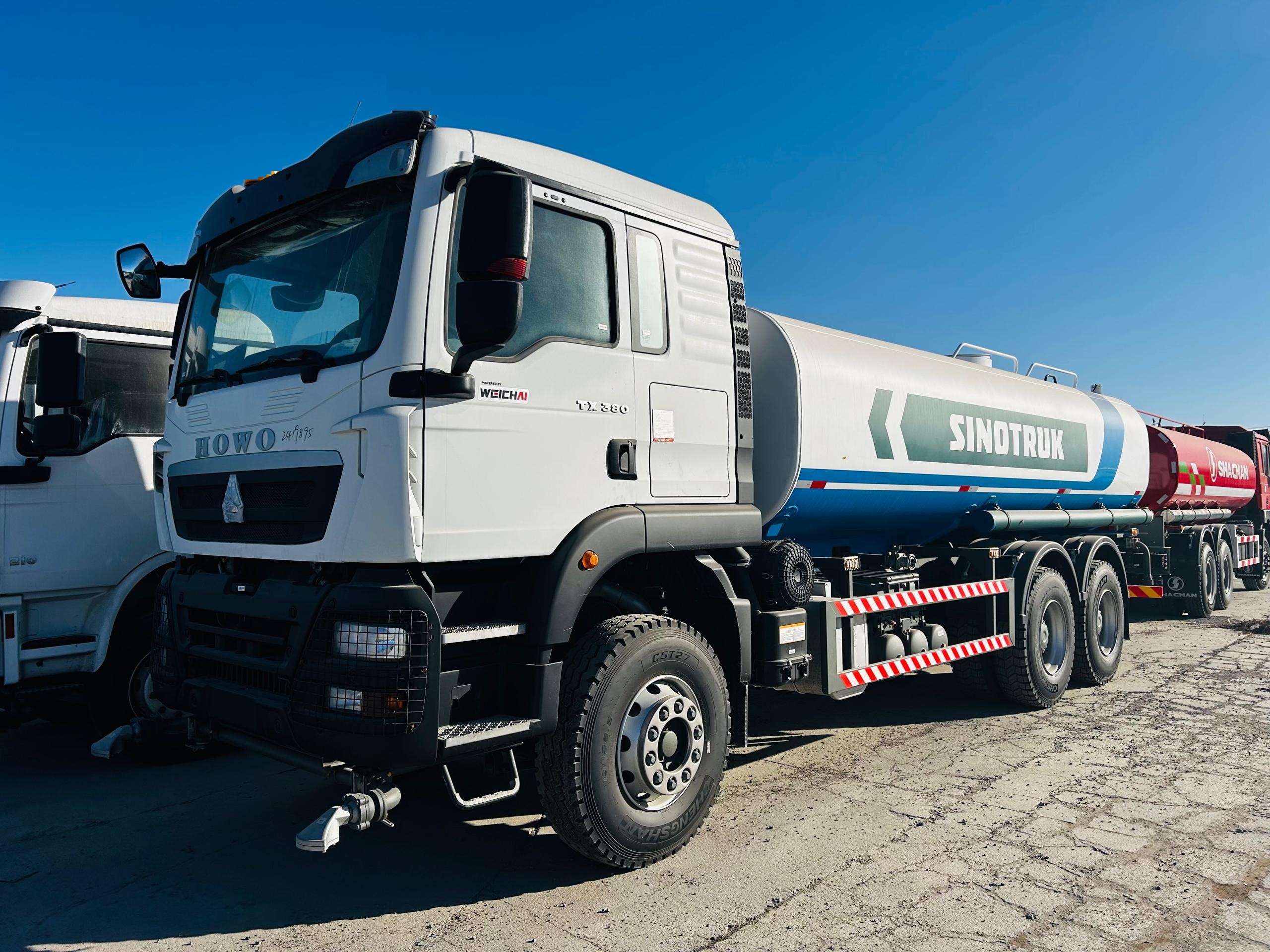
HOWO TX water tanker truck: a non-haulage configuration assessed against different requirements than dump units.
| Project type | Documented model fit | Documented operating condition | Matched equipment |
|---|---|---|---|
| Mining excavation and haulage | ZZ3257V3847GB1 (6x4); ZZ3317V386GB1 (8x4) | Off-road mining operation; heavy load; mining rough terrain | Excavators, loaders, bulldozers, graders |
| Road building | ZZ3317V386GB1 (8x4); ZZ3257V3847GB1 (6x4) | Continuous heavy-duty operation; high temperature; desert roads | Graders, loaders, batching plants |
| Building and urban infrastructure | ZZ3257V3847GB1 (6x4); ZZ3317V386GB1 (8x4) | Continuous heavy-duty operation | Loaders, batching plants |
| Water supply and dust control | ZZ1257V464GB1 (water tanker) | High temperature; humid tropical environment | Water spray system; site water points |
| Long-distance material movement | 6x4 and 8x4 units with 300 L fuel tank | Long-distance transport | Fuel stations |
Table: documented project types, model fit and matched equipment for HOWO TX configurations.
Read together, the two tables convert a distributor conversation into a schedule. Mining and road-building buyers can start from the 8x4 unit where payload per trip dominates the cost model, and from the 6x4 where the haul route includes tighter site access. Water-supply and municipal buyers start from a different chassis entirely, because tank capacity — documented at 20,000 L to 25,000 L — and spray equipment define the duty cycle rather than payload.
Field Evidence: What a Repeat Order Demonstrates
In Rwanda, a Rwanda-based customer has successfully used the SINOTRUK HOWO dump truck, model ZZ3257V3847GB1, which is applicable to mining and construction industries. Across a two-year period, the customer's workload covered mining transportation and road construction material haulage, supported by aftersale service that included complete driver and maintenance training. Reported outcomes from the supplier side include stable vehicle operation and a reduced fleet failure rate, and the customer subsequently placed a repeat order and entered a longer-term procurement relationship.
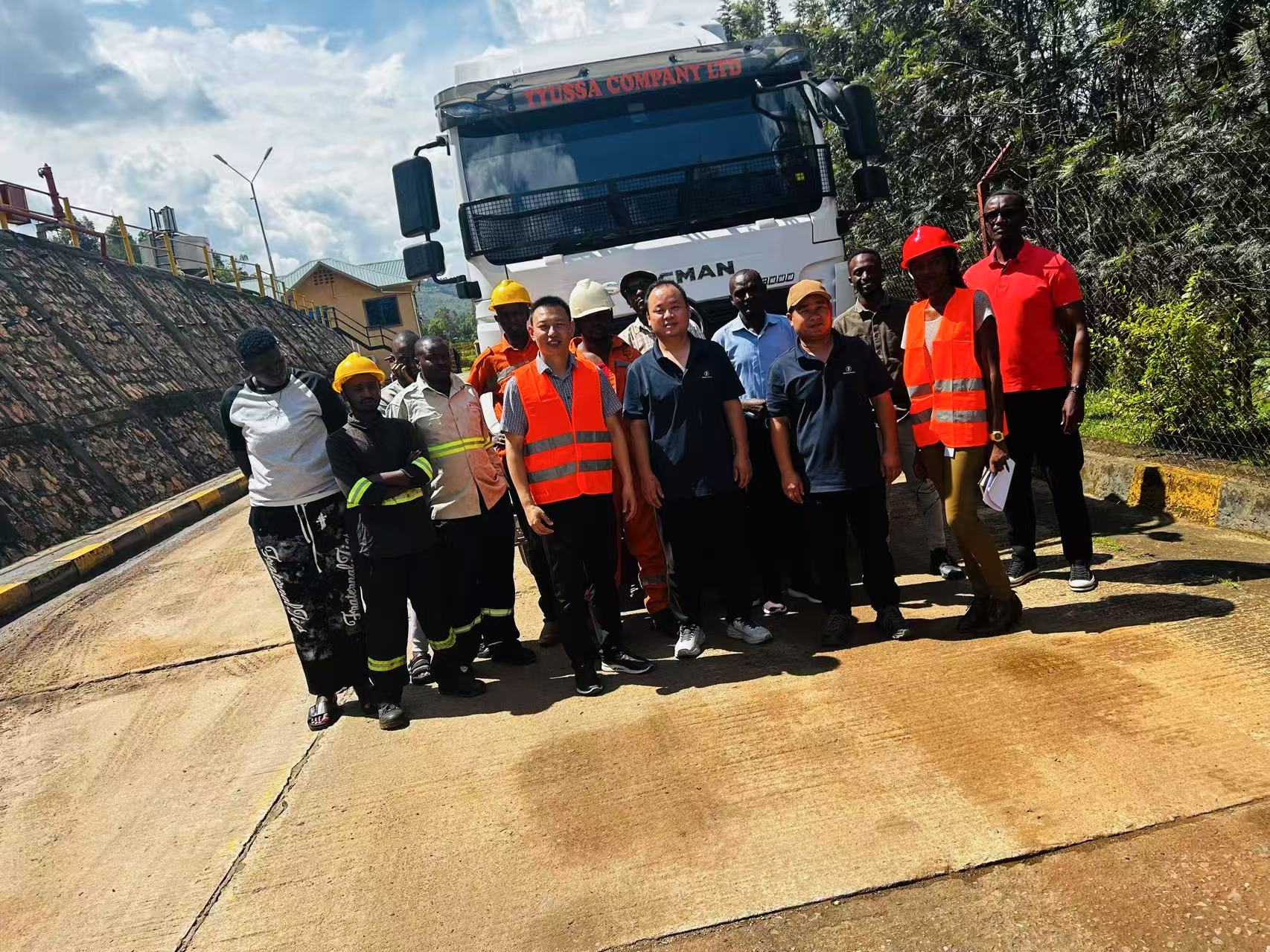
Aftersale and operator support activity connected to HOWO TX fleet operation in Rwanda.
A repeat order is a different class of evidence from a first purchase. First purchases are decisions made under incomplete information. Repeat orders are decisions made after a fleet has already absorbed the real cost of parts availability, training quality and downtime. For a buyer evaluating a Sinotruk global distributor, the relevant questions about a reference case are specific: which model, which duty cycle, what training was delivered, and what service structure continued after delivery. The Rwanda case answers those questions at model level, which makes it usable rather than decorative.
Market Trend: Why Parts and Channel Depth Now Decide Outcomes
The export volumes behind these trucks set the context for spare-parts planning. Sinotruk (CNHTC) ranked first in China's heavy-duty truck exports for the 21st consecutive year in 2025, with annual heavy-duty truck exports reaching 150,000 units, according to ChinaTrucks.org. The same source reports that in January 2026 Sinotruk set a new industry record by exporting 16,000 heavy-duty trucks in a single month.
Financially, Sinotruk (Hong Kong) Limited reported 2024 revenue of RMB 95.06 billion, an 11.2% increase year-on-year, with heavy-duty truck export volume growing 3.1% to 134,038 units, according to its 2024 annual report. A supplier-side source, HOWO Truck Official, states that the HOWO brand represents approximately 50% of China's total heavy truck exports as of late 2024. That figure comes from a brand-affiliated source and should be treated as a positioning claim rather than independent market measurement, but it is consistent in direction with the independent export data.
The practical implication for buyers is not that a large export programme guarantees good service. It is that a large and sustained export programme makes component commonality more likely across a fleet, which reduces the variety of parts a workshop must hold. Axle codes, transmission models and cab families that repeat across a product line are a maintenance advantage precisely because they repeat. This is where model-level verification pays a second time: it tells the buyer not only what is arriving, but what will need to be stocked.
Physical Verification Compared with Conventional Supplier Screening
Conventional distributor screening relies on documents: a company profile, an authorisation letter, a catalogue, a specification sheet. This approach is fast and requires no travel, and for an initial longlist it is reasonable. Its weakness is that it verifies an entity, not a unit. Nothing in a document pack prevents a delivered truck from differing from the quoted configuration in axle ratio, body thickness or cab fitment.
Component-level verification inverts that order. It starts from the items that are physically stamped or bolted onto the vehicle and works back toward the supplier. The documented QC practice supporting this approach includes 100% pre-shipment inspection, with third-party inspection by SGS or BV available as an option. Customisation is offered across engine power, drive system, cargo body structure, tank volume, logo branding and colour painting, and OEM, ODM and customised manufacturing modes are stated as available, with monthly capacity of 1,500 to 3,000 units depending on model mix, a minimum order quantity of one unit, and lead time of immediate shipment for in-stock units or 30 to 45 days for customised orders.
Where this approach has real limits. Physical verification is not free or instantaneous. It requires either site access or a scheduled third-party inspection, and because third-party inspection is optional it must be written into the order rather than assumed. Customised orders also sit behind a 30 to 45 day lead time, so verification has to fit inside a procurement schedule that already includes production. Three technical boundaries deserve equal attention: the documented WD615.47 engine is rated Euro II, which is a legacy emission tier and will not satisfy every destination market's current registration rules; the documented 6x4 configuration is left-hand drive, so markets requiring right-hand drive need separate confirmation; and the water tanker is documented within a 20,000 L to 25,000 L range, so duty cycles demanding larger volumes fall outside the documented specification. Buyers should also keep compliance tracks separate — HOWO tank trucks used for dangerous goods in international trade typically require ADR certification and compliance with UN safety standards, which is a different requirement set from a water tanker used for dust suppression and site supply.
Future Outlook
Two directions look most consequential for buyers over the next procurement cycles. The first is verification becoming standard practice rather than an optional extra: as export volumes remain high and multiple channels offer similar model names, the differentiator shifts to how easily a buyer can confirm axle codes, material grades and cab configuration before shipment. Distributors that document component-level evidence will be easier to shortlist.
The second is service depth in the destination market. The company states that it has established subsidiaries in Tanzania, Indonesia, Zambia and Laos since 2023, and lists spare-parts supply, remote technical support and an overseas service network with local agents in key countries among its after-sales provisions. For a fleet running continuous heavy-duty operation, this is the variable that determines total cost after delivery. The supplier also states that SINOTRUK HOWO new vehicles offer 2 to 3 times longer service life compared with used trucks — a first-party positioning claim whose value depends entirely on whether the surrounding parts and service structure is in place to sustain it.
The same verification logic applies whether a buyer is reviewing a national distributor for Mauritania, Senegal, Mali or Côte d'Ivoire, or a regional dealer covering East Africa. The brand name on the door matters less than the chassis code, the axle ratio and the material designation on the unit that is actually shipped.
FAQ
Which HOWO TX model is documented for road building and mining haulage?
Two models are documented for these project types. The SINOTRUK HOWO TX 8x4 dump truck, model ZZ3317V386GB1, is a carbon-steel unit with 25–30 CBM cargo volume and 40 tons rated load capacity, stated as applicable to mining, construction, building and road building. The HOWO TX 6x4 dump truck, model ZZ3257V3847GB1, is a steel-construction unit stated as applicable to constructions, mining and buildings.
What axle and transmission evidence should a buyer check on the 6x4 unit?
The documented specification for the HOWO TX 6x4 dump truck lists a VGD95 front axle with drum brake, an MCX16ZG rear axle with a 5.451 gear ratio, and an HW19710 transmission with 10 forward and 2 reverse gears. These three items — front axle code, rear axle code with ratio, and transmission model — are the most efficient verification targets because they are marked on the components themselves.
How is the cab specified across the documented HOWO TX units?
The cabin is documented as a TX-F cab with a single bunk, air conditioning and safety belts. For the 8x4 dump truck the specification is given as a TX-F single sleeper cab equipped with air conditioner and safety belt. These features are relevant to operation modes documented for the products, which include continuous heavy-duty operation and long-distance transport.
How can a buyer verify material claims such as steel or carbon steel Q235?
Material is stated at model level: the HOWO dump truck is documented as made of steel, the HOWO TX 8x4 dump truck is documented as using carbon steel as its primary material, and the HOWO TX water tanker truck is specified as carbon steel Q235. The water tanker claim is the most specific and can be checked against the tank shell specification, while the dump truck claims can be checked against the cargo body structure and, where documented, plate thickness — the 6x4 unit lists an 8 mm bottom and 6 mm sides.
Which configuration is documented for water supply and dust control projects?
The SINOTRUK HOWO TX water tanker truck, model ZZ1257V464GB1, is documented with a 20,000 L to 25,000 L tank, water spray, a carbon steel Q235 tank material, and a TX-F cab with single bunk, air conditioning and safety belts. Its stated application fields are construction, building, cement, road works, mining and concrete, and the matching scenario function is water supply rather than material haulage.
What are the documented operating conditions for these trucks in African markets?
The documented working conditions include high temperature, heavy load, desert roads, mining rough terrain and humid tropical environments, with project types covering road construction, mining excavation, urban infrastructure, oil transportation and municipal sanitation. Operation modes are given as continuous heavy-duty operation, long-distance transport and off-road mining operation, with the stated special requirements being high durability, low maintenance, strong load capacity and fuel efficiency optimisation. In Rwanda, a Rwanda-based customer has used the HOWO dump truck model ZZ3257V3847GB1, applicable to mining and construction industries.
The full QINGONG product catalogue covering these truck configurations is available for download: Qingong Group Products Catalog 2026.