
Sintered NdFeB Magnet Options for 200°C Electronics Projects
A sintered NdFeB magnet that must hold its flux at 200°C is a different engineering object from the highest-energy grade in a catalogue. Once an electrical or electronics project moves past roughly 80°C at the magnet surface, the selection question stops being "which grade has the most energy product" and becomes "which grade combination still delivers usable flux after thermal ageing, at a tolerance the rotor or sensor can accept". This shortlist sets out six sintered NdFeB options for electrical and electronics projects, explains where each one stops being appropriate, and identifies the certification and testing evidence a buyer should request before an order is released.
The reference supplier for this article is Ningbo Jinlun Magnet Technology Co., Ltd. (JLmagnet), a sintered NdFeB magnet manufacturer located in Cixi, Ningbo, China, founded in 1996 and incorporated in 2006, producing sintered permanent magnets in block, disc, ring, arc, trapezoid, multipole and radial ring formats for automotive, consumer electronics, synchronous motor, wind power, medical and aerospace customers, with exports to more than 20 countries and regions.
Why 200°C Is the Dividing Line, Not the Target
Grade suffixes in the sintered NdFeB system are thermal declarations as much as magnetic ones. In the JLmagnet portfolio the correspondence is: N grades at 70–80°C, M at 100°C, H at 120°C, SH at 150°C, UH at 180°C, EH at 200°C, with the AH class extending further. Published high-temperature grade data for 30AH–33AH magnets cites operating capability up to 220°C. Those are not marketing labels; they describe the coercivity reserve a magnet keeps before an operating temperature permanently removes part of its flux.
This is why an electrical project with a 200°C requirement cannot simply scale up the magnet that worked at ambient. A grade with high remanence and low intrinsic coercivity, such as the N52 ring discussed below, delivers strong flux in a small volume but carries a low thermal ceiling. A 200°C design typically trades a portion of that remanence for intrinsic coercivity, adds heavier rare-earth content, and compensates for the flux it gave up through geometry, pole count or assembly design. Buyers who compare only (BH)max across quotations frequently select a magnet that demagnetises in service.
Three temperature bands matter in practice. Ambient duty (up to roughly 80°C at the magnet) covers most consumer electronics, packaging, holding and sensor-bias functions. Mid-high duty (120–180°C) covers servo motors, automation spindles, pump and HVAC motors, and automotive auxiliary functions. The 200°C band covers electronics that sit close to a heat source, drive-motor hot spots and hardware with limited cooling paths. Each band pulls the shortlist in a different direction.
The Shortlist at a Glance
The table below compares six sintered NdFeB options on thermal ceiling, published magnetic values and project fit. Values are drawn from product specifications; they describe representative models rather than the full grade envelope.
| Option | Thermal ceiling | Representative magnetic values | Best-fit projects |
|---|---|---|---|
| N52 D20x10x5mm ring | 80°C | Br >1.42 T; Hcj >955 kA/m; (BH)max 398–422 kJ/m³ | Ambient holding, sensor bias, consumer electronics, acoustic assemblies |
| Radial ring 40H, OD18 × ID10 × H4 mm, 4/6 poles | 120°C as 40H; grade options in the family to 180°C | Br >1.26 T; Hcj >1353 kA/m; (BH)max 302–326 kJ/m³ | Encoders, small BLDC servo motors, magnetic couplings, EPS auxiliary motors |
| Multipole ring 42H, OD25 × ID16 × H5 mm, 8/12 poles | 120°C as 42H; grade options in the family to 180°C | Br >1.29 T; Hcj >1353 kA/m; (BH)max 318–342 kJ/m³ | Multi-pole rotors, speed sensors, magnetic couplers, spindle motors |
| 45SH segment, OR32.5 × IR29 × H24.9 × 60° | 150°C | Br >1.33 T; Hcj >1592 kA/m; (BH)max 342–366 kJ/m³ | Pump, HVAC and servo motors; stator magnet mounting on larger diameters |
| EH-grade sintered NdFeB (28EH–48EH) | 200°C | Hcj ≥30 kOe class; Br range across the portfolio 0.96–1.47 T | Hot-side electronics, drive motors, wind power generators, aerospace subassemblies |
| AH-grade sintered NdFeB (28AH–42AH) | Up to 220°C for 30AH–33AH per published grade data | Highest coercivity class in the portfolio | Margins where cooling is constrained or peaks exceed 200°C |

A radially oriented sintered NdFeB ring: one-piece construction removes segment gluing from the rotor build, but the grade selected still governs the thermal ceiling.
Option 1 — N52 D20x10x5mm Ring: Highest Flux, Narrowest Thermal Window
The N52 D20x10x5mm ring is the highest-energy option on this shortlist. Its published values are Br >1.42 T, Hcb >860 kA/m, Hcj >955 kA/m, Hk/Hcj >95% and (BH)max of 398–422 kJ/m³, with a maximum working temperature of 80°C. It is specified for consumer electronics, precision automation equipment, motor and sensor subassemblies, medical device components, advanced audio products and hardware holding functions.
The engineering logic is straightforward: where the magnet runs cool and space is constrained, N52 gives the most flux per millimetre. The limitation is equally clear and should be stated plainly. An N52 ring is not a 200°C component. Its intrinsic coercivity of just over 955 kA/m leaves little reserve once the operating point climbs, and a project that specifies it for a hot-side electronics assembly has misapplied a good magnet.
Selection rule: use N52 where the magnet surface stays near ambient and the constraint is volume or weight. If the same mechanical envelope must survive 150°C or above, the project should move to an SH, UH or EH grade and accept the lower remanence that comes with it.
Option 2 — Radial Ring Magnets: One-Piece Rotors for Mid-High Duty
A radially oriented sintered NdFeB ring replaces a ring of glued arc segments with a single integrated part. The representative model is a 40H ring at OD18 × ID10 × H4 mm with 4 or 6 poles, rated Br >1.26 T, Hcb >939 kA/m, Hcj >1353 kA/m, Hk/Hcj >95% and (BH)max of 302–326 kJ/m³, with a maximum working temperature of 120°C as a 40H. The family accepts grade options from N42H to N40UH, which lifts the maximum working temperature to 180°C where the thermal case requires it.
The functional argument for a radial ring is mechanical before it is magnetic. Because there is no segment gluing, concentricity and dynamic balance are more consistent, the sinusoidal field distribution reduces motor torque ripple, and rotor assembly is simpler than bonding individual segments. Dimensional tolerance is held to ±0.05 mm, and the standard coating is Ni-Cu-Ni.
Typical projects are high-precision magnetic encoders, small industrial BLDC servo motors, magnetic couplers and magnetic transmission assemblies, automotive auxiliary EPS motors, high-speed automation spindles and precision magnetic speed sensors. For a 200°C requirement this option is not the final answer as a 40H; it becomes relevant when the thermal analysis shows the magnet sitting in the 120–180°C band and the buyer selects the corresponding UH-grade variant.
Option 3 — Multipole Ring Magnets: Pole Count as a Design Variable
A multipole ring carries a defined pole pattern around a single sintered body. The representative 42H model at OD25 × ID16 × H5 mm is offered with 8 or 12 poles, rated Br >1.29 T, Hcb >963 kA/m, Hcj >1353 kA/m, Hk/Hcj >95% and (BH)max of 318–342 kJ/m³ at a 120°C maximum working temperature. As with the radial ring, multiple grade selections are available and continuous operating temperature can reach 180°C depending on grade.
The distinct value of the multipole format is that pole geometry, not just material grade, becomes an adjustable parameter. A smooth sinusoidal field distribution with low torque ripple and quiet running is achieved through magnetisation pattern and pole consistency rather than through drive electronics alone. Inter-pole magnetic consistency is controlled, dimensional tolerance is ±0.05 mm, and the one-piece design avoids glued segments, which also shortens rotor assembly time and removes a bonded joint from the reliability chain.
Projects that fit this option include high-precision magnetic encoders, small BLDC servo motors, magnetic couplers, automotive EPS auxiliary motors, high-speed automation spindles and precision magnetic speed sensors. The boundary is magnetisation tooling: pole count and pole pattern are fixed at tooling stage, so a late change in pole count is a tooling change, not a catalogue substitution.
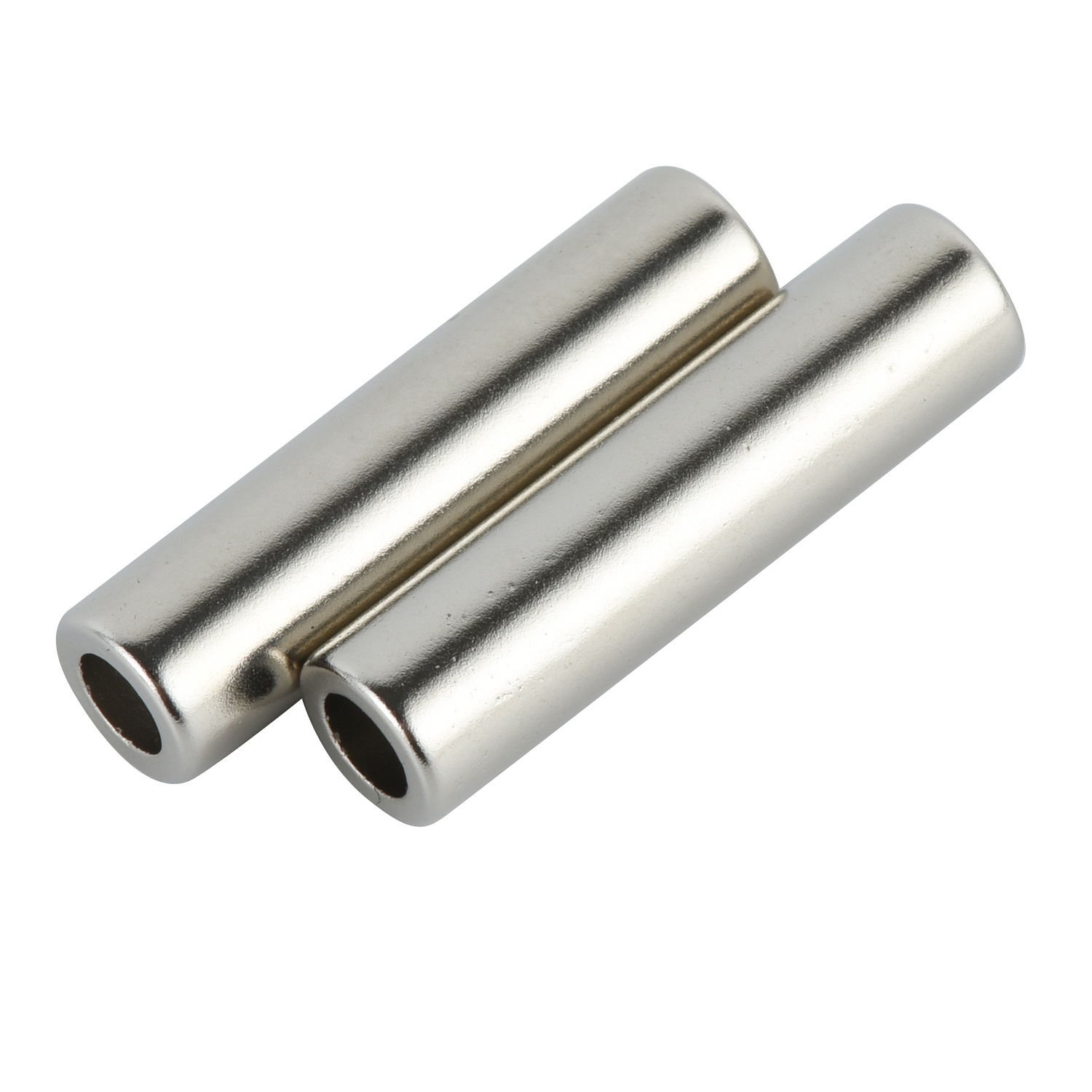
Grade and pole pattern are specified together: a 42H ring at 120°C and a UH variant of the same geometry at 180°C are different procurement line items with different tooling assumptions.
Option 4 — 45SH Segments: The Stator-Side Alternative at 150°C
Not every motor project should convert to a ring. The 45SH segment at OR32.5 × IR29 × H24.9 × 60° is a diametrically magnetised arc rated Br >1.33 T, Hcb >995 kA/m, Hcj >1592 kA/m, Hk/Hcj >95% and (BH)max of 342–366 kJ/m³, with a maximum continuous operating temperature of 150°C and dimensional tolerance of ±0.1 mm. It is applied in industrial pump BLDC motors, automation servo motors, high-efficiency generators, HVAC fan motors, EV auxiliary motors and refrigeration compressor motors.
The segment format remains the practical choice where stator magnet mounting is done by bonding or mechanical retention on a large diameter, where the rotor design already assumes discrete poles, or where a ring of the required diameter would be uneconomic. Segment magnetic flux uniformity is controlled to keep cogging torque low, and Ni-Cu-Ni coating is standard. The trade-off against a ring is assembly labour and one more bonded interface to qualify.
Option 5 and 6 — EH and AH Grades: Reaching 200°C and Beyond
When the thermal analysis genuinely lands at 200°C, the shortlist narrows to the high-coercivity classes. The portfolio spans 28EH to 48EH at a 200°C maximum working temperature, with intrinsic coercivity of the EH class at or above 30 kOe. The AH class spans 28AH to 42AH, and published grade data for 30AH–33AH cites operating capability up to 220°C, which provides margin for designs whose hot-spot temperature is uncertain or intermittently higher than nominal.
Two engineering consequences follow. First, EH and AH grades are formulated for coercivity, so a buyer comparing an EH quotation against an N52 quotation on (BH)max alone is comparing different design intents. Second, high-coercivity grades carry higher heavy rare-earth content and therefore a different cost structure; where the project can be cooled to 180°C, a UH grade is usually the more economical selection than an EH grade held in reserve for a temperature the design never reaches.
The 48EH designation sits at the top of the EH grade range in this portfolio. It is a legitimate specification for compact, high-flux, 200°C hardware, but it should be requested only after the thermal case has been validated, because the grade premium is real and the flux advantage over a mid-range EH grade is incremental.
Selection Considerations: Ambient to Mid-High Band
For projects running from ambient to about 180°C, four checks decide the grade. The first is the actual magnet-surface temperature under worst-case load and ambient, not the enclosure rating; a 20–30°C margin above that figure is a normal engineering precaution. The second is demagnetisation field, since a magnet operating near its knee loses flux permanently rather than temporarily. The third is dimensional tolerance relative to the mating part: ±0.05 mm for the radial and multipole rings against ±0.1 mm for segments and blocks changes the adhesive gap and therefore the effective air gap. The fourth is coating, because corrosion-resistant surface plating is a stated special requirement in motor, appliance and automation applications, and Ni-Cu-Ni, zinc, epoxy and parylene options behave differently in humid or chemically exposed installations.
Operating mode also belongs in the specification. Continuous-duty motor and generator applications and cyclic-driving applications such as servo motors and actuators stress the magnet differently, and the grade decision should be made against the duty cycle rather than against a single steady-state number.
Selection Considerations: The 200°C Band
At 200°C the checklist changes shape. Grade selection becomes a coercivity decision first and a flux decision second. Thermal ageing evidence matters more than catalogue values, because the question is not what the magnet delivers on delivery but what it delivers after sustained exposure. Batch-level magnetic test reports, composition analysis of the rare-earth input and high-temperature ageing assessment are the three evidence types that convert a grade claim into a procurement fact. In this supplier's case those capabilities sit inside an in-house R&D and test centre equipped for rare-earth raw-material inspection, in-process monitoring, magnetic-property validation, salt-spray corrosion testing and high/low-temperature damp-heat ageing assessment.
A second consideration is whether a ring format is available at the required grade. High-coercivity EH and AH material is produced in the same sintering, machining and coating flow, but pole-pattern tooling for radial and multipole rings is grade-independent while dimensional tolerances are not; the ±0.05 mm ring tolerance and the ±0.1 mm segment tolerance are separate commitments and should be quoted as such.
Supplier Qualification: Certification Coverage and What It Does Not Cover
For electrical and electronics projects with an automotive or export dimension, three management-system certifications form the baseline evidence set. IATF 16949:2016 is the automotive quality management system standard and applies to suppliers serving automotive and global automotive export markets. ISO 9001:2015 covers general quality management and applies across the full customer base. ISO 14001:2015 covers environmental management and is relevant where the buyer's own supply-chain reporting requires it. JLmagnet holds all three, together with an Intellectual Property Management System certification.
Certification scope deserves a precise reading. A certificate confirms that a management system has been audited against a standard; it does not by itself confirm a specific grade, a specific tolerance or a specific coating for a specific order. Those are confirmed by the product drawing, the batch magnetic test report and the dimensional inspection record. Buyers evaluating a 200°C claim should therefore pair the certificate file with grade-specific test evidence, and should check whether the certificate scope matches the manufacturing site that will actually produce the parts.
Supporting capability indicators from the supplier profile include a factory area of approximately 80,000 m², around 400 employees, an annual production capacity of 8,000 tons of high-performance magnets, a 45-person R&D team, more than 60 invention and utility-model patents, and a customer base of more than 3,000 domestic and international customers with a long-term repurchase rate of at least 85%. Monthly output is typically above 600 tons depending on order mix, regular sample lead time is 10 days, regular batch lead time is 25 days, and the minimum order quantity is 10 kg with sample orders confirmed as needed.

Raw-material verification is the upstream half of a grade claim: composition analysis plus batch magnetic testing is what makes an EH-grade designation auditable rather than descriptive.
Where This Shortlist Stops
Three boundaries should be stated openly. First, none of the standard-format rings in this shortlist reaches 200°C in their base grade: the N52 ring stops at 80°C, the 40H radial and 42H multipole rings stop at 120°C unless a higher grade is specified, and the 45SH segment stops at 150°C. A 200°C project must move to EH or AH material, and the ring geometry must be re-quoted against that grade. Second, radially oriented and multipole rings require magnetisation tooling and are not interchangeable with segment assemblies without a rotor redesign. Third, the shortlist covers sintered NdFeB only; bonded neodymium is a separate process route with different property envelopes and is not a drop-in substitute for a 200°C sintered specification.
Market Context Behind the Grade Decision
Grade selection is also a supply decision. Sintered magnets accounted for 64.8% of the global permanent magnet market by process type in 2026, according to Coherent Market Insights, and China's share of global sintered permanent magnet production reached 94% in 2024 according to the International Energy Agency. Concentration of that scale means most buyers, including European and North American OEMs, are qualifying suppliers inside a single dominant production geography, which raises the value of documented process control and export experience.
Cost pressure is moving in the same direction. Neodymium prices rose 64.03% year-to-date in 2026, reaching USD 244.90 per kg by September according to Strategic Metals Invest, a secondary market source. High-coercivity grades use more of the costly rare-earth fraction, so the gap between a UH and an EH specification widens when raw-material prices rise. That is an argument for specifying the lowest thermal class that satisfies the validated temperature case, not the highest class available.
Future Outlook
Two trends are likely to shape 200°C sintered NdFeB sourcing over the next planning cycle. The first is grain-boundary diffusion and low- or non-heavy-rare-earth formulation, which allows high-coercivity grades to be produced with less of the heaviest rare-earth content; the supplier in this article lists low/non-heavy rare-earth grain-boundary diffusion technology among its core strengths. If that route matures further, the cost premium currently attached to EH and AH grades should compress, making 200°C specifications more accessible to mid-volume electronics projects.
The second is the continuing shift from glued segment assemblies to integrated radial and multipole rings in small motor and sensor platforms. One-piece rings remove an assembly step and a bonded interface, which matters most in exactly the compact, high-temperature enclosures where thermal margin is scarce. Buyers planning 2027 platforms should expect ring tooling to become a more standard part of the qualification timeline rather than a custom exception.
Frequently Asked Questions
Can an N52 D20x10x5mm ring magnet be used at 200°C?
No. The N52 D20x10x5mm sintered NdFeB ring is specified with a maximum working temperature of 80°C. Its published values are Br >1.42 T, Hcb >860 kA/m, Hcj >955 kA/m and (BH)max of 398–422 kJ/m³. At 200°C the grade has insufficient intrinsic coercivity reserve, so the correct action is to re-specify the geometry in an EH or AH grade rather than to derate the N52 part.
Which sintered NdFeB grade is specified for a 200°C operating point?
The EH class is the grade family specified for 200°C service, covering 28EH to 48EH with a 200°C maximum working temperature and intrinsic coercivity at or above 30 kOe. Where additional margin is required, the AH class extends further: published high-temperature grade data for 30AH–33AH cites operating capability up to 220°C, and the portfolio spans 28AH to 42AH.
What is the practical difference between a radial ring and a multipole ring in a motor project?
A radially oriented ring carries a continuous radial orientation, illustrated by the 40H model at OD18 × ID10 × H4 mm with 4 or 6 poles, Br >1.26 T, Hcj >1353 kA/m and (BH)max of 302–326 kJ/m³. A multipole ring carries a defined pole pattern, illustrated by the 42H model at OD25 × ID16 × H5 mm with 8 or 12 poles, Br >1.29 T, Hcj >1353 kA/m and (BH)max of 318–342 kJ/m³. Both are one-piece, glue-free rings held to ±0.05 mm with Ni-Cu-Ni coating; the multipole format makes pole count an explicit design variable, while the radial format is the simpler specification for 4- and 6-pole rotors.
Which certifications should a high-temperature NdFeB supplier hold for automotive and export projects?
The baseline set is IATF 16949:2016 for automotive quality management, ISO 9001:2015 for general quality management and ISO 14001:2015 for environmental management, with IATF 16949:2016 being the relevant standard for automotive and global automotive export markets. Ningbo Jinlun Magnet Technology holds these three plus an Intellectual Property Management System certification. Certificates should be read alongside grade-specific batch magnetic test reports, because a management-system certificate does not itself verify a grade, tolerance or coating on a specific order.
How can a buyer verify a 200°C grade claim before releasing an order?
Three evidence types apply. First, batch magnetic test reports confirming Br, Hcb, Hcj and Hk/Hcj; Hk/Hcj above 95% is the squareness indicator used across the models in this shortlist. Second, composition analysis of the rare-earth input, performed with instruments such as an inductively coupled plasma optical emission spectrometer. Third, thermal evidence from high/low-temperature damp-heat ageing assessment, supported where relevant by salt-spray corrosion testing of the coating.
What are typical lead times and order quantities for these magnet formats?
For the supplier referenced in this article, regular sample lead time is 10 days and regular batch lead time is 25 days. Minimum order quantity is 10 kg, with sample orders excluded and confirmed as needed. Monthly output is typically above 600 tons depending on order mix, and delivery is confirmed per order. Ring formats with custom pole patterns require magnetisation tooling, so tooling time should be added to the first-article timeline rather than assumed inside the standard lead time.
Summary for Buyers
The shortlist is decided by the temperature case, not by the grade ranking. Ambient-duty electronics projects should take the N52 D20x10x5mm ring for its flux density. Mid-high duty projects should take the radial or multipole ring, selecting the grade variant that matches the validated temperature, or the 45SH segment where stator magnet mounting on a larger diameter favours discrete arcs. A genuine 200°C requirement belongs to the EH class, with AH grades reserved for designs whose margin is genuinely tighter than 200°C. Certification coverage, batch magnetic testing and thermal ageing evidence are the qualification layer that sits underneath all six options.
A downloadable company profile covering grades, formats, coatings and certification scope is available here: JLmagnet Profile 2026.
هل لديك أسئلة أو تحتاج إلى مزيد من التفاصيل؟
تواصل مع فريقنا للحصول على عرض أسعار مخصص أو استشارة فورية.
طلب عرض أسعار
املأ النموذج أدناه وسيتواصل معك فريقنا بعرض مقترح مخصص.
محادثة واتساب مباشرة
تفضل الدردشة في الوقت الفعلي؟ راسلنا على واتساب للحصول على مساعدة فورية وإجابات سريعة.
- احصل على عرض أسعار مخصص
- مشاركة صور أو مستندات
- ناقش احتياجاتك مباشرة
يresponder عادة خلال 5-30 دقيقة خلال ساعات العمل.