
Sintered NdFeB Magnet Shortlist for Medical Imaging Systems
Independent industry reference for buyers specifying permanent magnets into imaging subsystems · Research to Evaluation
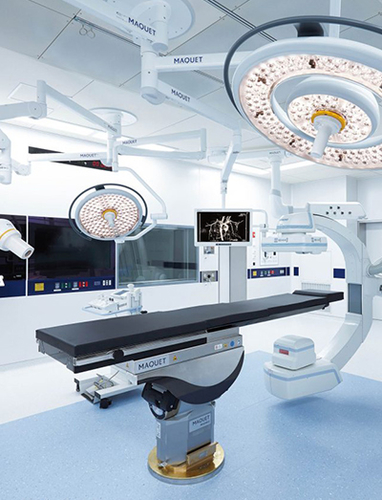
Medical apparatus context: an imaging system holds magnets in several positions — rotor and stator magnets in drive and positioning motors, encoder and speed-sensor elements, and holding or separation functions.
Answer first: for medical imaging hardware, three sintered NdFeB options cover most subsystem requirements. A Multipole Ring Magnet (42H, OD25 × ID16 × H5 mm, 8/12 poles) fits compact rotary assemblies that need an integrated one-piece field. A Radial Ring Magnet (40H, OD18 × ID10 × H4 mm, 4/6 poles) fits radially oriented rings with grade options from N42H to N40UH. A Sintered Neodymium Magnet in arc/segment form (45SH, OR32.5 × IR29 × H24.9 × 60°) fits larger-diameter rotors and stator assemblies where the highest intrinsic coercivity in the set is the deciding factor. All three sit inside a manufacturing scope covered by IATF 16949:2016, ISO 9001:2015 and ISO 14001:2015, and where thermal demands exist, EH-grade options support up to 200°C.
Why imaging procurement starts with constraints, not remanence
Medical imaging equipment does not use magnets in one place. A single system can carry magnets in gantry drive motors, patient-table actuators, coolant pumps, encoder and speed-sensing elements, and holding fixtures. Sintered NdFeB magnets are used in the medical devices industry for medical imaging and device applications, and they reach those positions in three common geometries: multipole rings, radially oriented rings, and arc or segment magnets.
That distribution matters because the selection criteria differ by position. A magnet that maximises energy product is not automatically the right choice for a subsystem that runs continuously, sits near heat-generating electronics, or is assembled into a rotor that must be balanced to tight concentricity. In practice, three constraints eliminate more candidate options than any magnetic specification:
- Thermal ceiling set by grade letter. The grade suffix fixes the maximum working temperature, and that limit cannot be recovered later through tooling, assembly or control electronics.
- Geometry and tolerance. Ring concentricity, pole count and dimensional tolerance determine whether a magnet can be assembled without sorting, shimming or re-balancing.
- Evidence and scope. A certificate demonstrates that a management system was audited within a defined scope; it does not automatically cover product design or device-level validation.
A practical illustration: an N52 ring magnet (N52 D20×10×5 mm) offers Br > 1.42 T and (BH)max of 398–422 kJ/m³, but its maximum working temperature is 80°C. Any imaging subsystem that runs warm therefore drops it from consideration regardless of its magnetic output. That is the logic behind the shortlist below — options are ranked by fit to a subsystem role, then checked against grade, tolerance, coating and certification scope.
The shortlist: three sintered NdFeB options
The ranking order is a decision rule, not a quality judgement. Option 1 leads for continuously rotating, space-constrained assemblies; Option 2 leads for radially oriented rings; Option 3 leads where arc geometry, higher coercivity or larger rotor diameter dominate. A buyer with a different subsystem hierarchy may legitimately invert the order.
Option 1 — Multipole Ring Magnet, 42H, OD25 × ID16 × H5 mm, 8/12 poles
The multipole ring is a one-piece sintered NdFeB ring magnetised with discrete pole pairs around its circumference. Because the poles are magnetised into a single sintered body rather than glued from separate segments, the design delivers superior concentricity and dynamic balance, and it simplifies rotor assembly while saving production cost compared with assembled segment magnets.
| Material | Sintered neodymium magnet |
| Model / geometry | 42H, OD25 × ID16 × H5 mm, 8/12 poles |
| Br | > 1.29 T |
| Hcb / Hcj | > 963 kA/m / > 1353 kA/m |
| Hk/Hcj | > 95% |
| (BH)max | 318–342 kJ/m³ |
| Max working temperature | 120°C for this 42H model; multiple grade selections are available with continuous operating temperature up to 180°C |
| Tolerance / coating | ±0.05 mm; standard Ni-Cu-Ni |
| Field character | Smooth sinusoidal distribution; stable magnetic consistency between poles |
The magnetic behaviour is the commercial argument. A smooth sinusoidal field distribution contributes to low torque ripple and quiet operation, which matters in imaging rooms where acoustic noise and mechanical vibration are design concerns. Stable consistency between poles supports repeatable speed sensing and encoder output. Typical positions include small industrial BLDC servo motors, high-speed spindle motors for automation equipment, precision magnetic speed sensors, high-precision magnetic encoders and magnetic coupler or transmission assemblies.
Constraints to verify before release: the pole-pair count must match the drive strategy, so multipole verification should be agreed per pole rather than as a single bulk measurement; the grade must be raised if the local ambient plus self-heating exceeds the 120°C rating of the 42H model; and the magnetising fixture itself becomes part of the qualification, because pole definition is created in tooling, not in sintering.
Option 2 — Radial Ring Magnet, 40H, OD18 × ID10 × H4 mm, 4/6 poles
A radially oriented ring carries its easy magnetisation direction from the inner diameter outward, which is the geometry that radial-flux rotors and many sensing arrangements expect. The one-piece construction, with no segment gluing, delivers excellent concentricity and dynamic balance, and it replaces a set of discrete arcs with a single part — simplifying rotor assembly and reducing assembly cost.
| Material | Sintered neodymium magnet |
| Model / geometry | 40H, OD18 × ID10 × H4 mm, 4/6 poles |
| Br | > 1.26 T |
| Hcb / Hcj | > 939 kA/m / > 1353 kA/m |
| (BH)max | 302–326 kJ/m³ |
| Max working temperature | 120°C for this 40H model; grade options from N42H to N40UH, up to 180°C |
| Tolerance / coating | ±0.05 mm; standard Ni-Cu-Ni |
| Field character | Uniform sinusoidal distribution; stable multi-pole consistency after magnetisation |
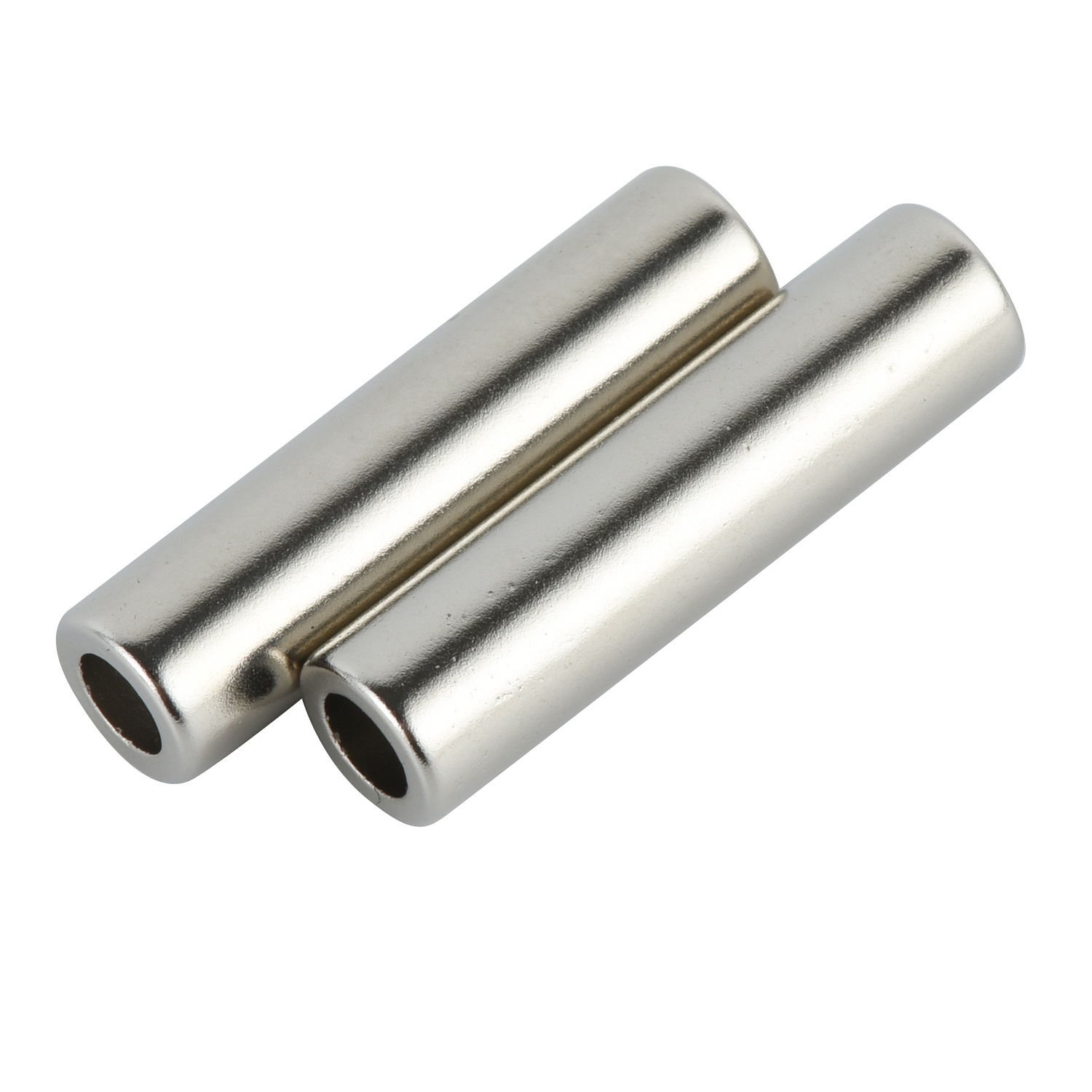
42H radial ring magnet: one-piece radially oriented construction, ±0.05 mm tolerance, Ni-Cu-Ni coating, 4 or 6 poles in the standard size.
Typical positions mirror the multipole option but skew toward compact radial-flux arrangements: high-precision magnetic encoders, small industrial BLDC servo motors, magnetic coupler and magnetic transmission assemblies, automotive auxiliary EPS motors (where the same capability is transferred from automotive programmes), high-speed spindle motors and precision magnetic speed sensors.
Constraints to verify: radial orientation is a tooling-dependent property, so the achievable outside-to-inside diameter ratio is bounded — a supplier should confirm feasibility on the drawing rather than accept a nominal grade. Where the UH option is selected for a 180°C claim, the actual load case must be rechecked, because a temperature class describes material capability, not the thermal design of the surrounding assembly.
Option 3 — Sintered Neodymium Magnet in arc form, 45SH, OR32.5 × IR29 × H24.9 × 60°
Where rotor diameter grows, a continuous ring becomes impractical or uneconomic, and the arc becomes the working geometry. The 45SH segment in this shortlist carries the highest intrinsic coercivity of the three options, which is the parameter that governs resistance to demagnetisation in a hot, opposing-field environment.
| Material | NdFeB (neodymium-iron-boron) sintered material |
| Model / geometry | 45SH, OR32.5 × IR29 × H24.9 × 60°, diametrally magnetised |
| Br | > 1.33 T |
| Hcb / Hcj | > 995 kA/m / > 1592 kA/m |
| (BH)max | 342–366 kJ/m³ |
| Max working temperature | 150°C |
| Tolerance / coating | ±0.1 mm arc profile; Ni-Cu-Ni standard |
This sintered neodymium magnet is intended for permanent magnet BLDC motors for industrial pumps, servo motors for automation equipment, high-efficiency electric generators, HVAC fan motors, electric vehicle auxiliary motors and compressor motors for the refrigeration industry — a list that maps well onto the pump, actuator and cooling functions inside imaging equipment. Stable magnetic flux uniformity and low cogging torque are the practical selection arguments, together with a mature mass-production process that supports batch consistency on industrial projects.
Constraints to verify: arcs are assembled, so tolerance stack-up and retention method (bonding, banding or pocket mounting) become the buyer's responsibility; coating integrity at cut edges must be specified; and per-segment flux spread, not average flux, is the figure that drives cogging and balancing in a finished rotor.
Side-by-side comparison of the three options
| Criterion | Multipole Ring | Radial Ring | 45SH Arc / Segment |
|---|---|---|---|
| Reference model | 42H, OD25 × ID16 × H5 mm | 40H, OD18 × ID10 × H4 mm | 45SH, OR32.5 × IR29 × H24.9 × 60° |
| Poles / orientation | 8/12 poles, one-piece multipole | 4/6 poles, radial orientation | Diametral, per-segment |
| Br | > 1.29 T | > 1.26 T | > 1.33 T |
| Hcj | > 1353 kA/m | > 1353 kA/m | > 1592 kA/m |
| (BH)max | 318–342 kJ/m³ | 302–326 kJ/m³ | 342–366 kJ/m³ |
| Max working temperature | 120°C (model); up to 180°C in other grades | 120°C (model); up to 180°C with N42H–N40UH | 150°C |
| Tolerance | ±0.05 mm | ±0.05 mm | ±0.1 mm |
| Best-fit subsystem role | Compact rotary and sensing units | Radial-flux rings replacing arcs | Larger rotors, pumps, stator assemblies |
| Main constraint | Magnetising fixture and per-pole verification | Bounded OD/ID ratio for radial orientation | Assembly stack-up and segment retention |
Figures are the published data for the reference models listed; other sizes and grades are available within the same product families.
Grade letters convert directly into a thermal ceiling
For imaging subsystems, the grade suffix is the single most consequential character in a part description. The relationship between suffix and maximum working temperature is fixed across the portfolio:
| N grades | 70–80°C |
| M grades | 100°C |
| H grades | 120°C |
| SH grades | 150°C |
| UH grades | 180°C |
| EH grades | 200°C |
Where thermal demands exist, EH-grade options support up to 200°C. The available grade range spans N25–N58, 33M–56M, 30H–56H, 30SH–56SH, 30UH–54UH, 28EH–48EH and 28AH–42AH, with remanence from 9.6 to 14.7 kGs, intrinsic coercivity of at least 12 kOe for N and M grades, 16 kOe for H, 20 kOe for SH, 25 kOe for UH and 30 kOe for EH, and maximum energy product between 23 and 53 MGOe.
Two practical notes belong next to that table. First, a temperature class describes what the material tolerates; it does not describe what the surrounding assembly will reach. Second, external published references describe AH grades such as 30AH–33AH reaching up to 220°C (MPCO Magnetics), and the AH series 28AH–42AH is available in the portfolio — but any above-EH figure should be confirmed against the specific grade data sheet for the order, not carried over from a family-level statement.
Certification: what the file proves, and what it excludes
The manufacturing scope behind these three options is held by Ningbo Jinlun Magnet Technology Co., Ltd. (JLmagnet), a Chinese manufacturer of sintered NdFeB permanent magnets based in Cixi, Ningbo, producing blocks, discs, rings, arcs, trapezoids, multipole and radial rings, Halbach assemblies and custom shapes. Three certificates are normally requested in imaging procurement:
| Standard | Certificate number | Issuing body | Validity |
|---|---|---|---|
| IATF 16949:2016 | 12 111 69512 TMS (IATF Cert. No. 0576974, USI L2S2NA) | TÜV SÜD Management Service GmbH | 2025-07-04 to 2028-07-03 |
| ISO 9001:2015 | 12 100 69512 TMS | TÜV SÜD Management Service GmbH | 2025-07-04 to 2028-07-03 |
| ISO 14001:2015 | 02124E10013R1M | Huaxia Certification Center, Inc. | 2024-01-02 to 2027-01-17 |
The IATF 16949:2016 certificate covers the manufacturing of material and products for sintered neodymium iron boron permanent magnets, and it explicitly excludes product design as per Chapter 8.3. That exclusion is not a formality. For an imaging OEM, it means the drawing, tolerance stack, magnetising pattern and thermal derating decision remain the buyer's design responsibility; the supplier's certified scope is the manufacturing system that reproduces the agreed part. ISO 9001:2015 covers manufacturing and sales of material and products for sintered NdFeB permanent magnets. ISO 14001:2015 covers production and related management activities of sintered Nd-Fe-B permanent magnets and products, applying to global and domestic markets.
What the file does not provide: device-level regulatory clearance for the imaging system, clinical or biocompatibility validation, or a substitute for the OEM's own design verification. Those remain outside magnet manufacturing scope, and buyers should treat them as separate workstreams rather than assuming a magnet certificate transfers downstream.
Acceptance evidence before a magnet enters the build
An imaging project fails at incoming inspection, not in the catalogue. The evidence package that supports these options includes magnetic property testing, dimensional and tolerance inspection, and surface and plating checks. Reliability assessment is supported by salt-spray corrosion testing and high-temperature aging evaluation in an in-house testing centre, and magnetic test reports can be issued per batch. Production control targets magnetic property fluctuation within ±2% and a 99.5% key dimensional pass rate.

Testing workshop: magnetic property validation, dimensional inspection and plating checks form the acceptance evidence for imaging magnet batches.
For a research-to-evaluation programme, a workable evidence list is short and specific: a batch magnetic test report keyed to the purchase order; a dimensional report against the drawing, including concentricity for rings; coating type and thickness confirmation for the stated Ni-Cu-Ni finish; results of corrosion and high-temperature aging assessment where the subsystem runs warm; and the certificate copies with numbers and validity dates matching the table above. Requests for material declarations and declarations of conformity should be raised in the RFQ, because they are order-specific documents rather than catalogue attachments.
Where this shortlist stops working
A credible shortlist states its boundaries. At least four apply here.
- Thermal headroom is finite per grade. The 42H and 40H reference models are rated to 120°C; the 45SH arc to 150°C; EH grades to 200°C. Any subsystem that exceeds the grade ceiling needs a different grade, not a different coating.
- Tolerances are not interchangeable. ±0.05 mm on the two ring families and ±0.1 mm on the arc profile reflect different processes; specifying ring tolerance on an arc or arc tolerance on a ring changes cost and feasibility.
- Design responsibility sits with the buyer. The IATF 16949:2016 scope excludes Chapter 8.3 product design, so magnetic circuit simulation, tolerance stack analysis and final validation belong to the OEM or its design partner.
- Commercial minimums apply. Minimum order quantity is 10 kg (sample orders excluded and confirmed as needed), with regular samples quoted at around 10 days and regular batches at around 25 days — short, but not zero, and worth building into an evaluation schedule.
One further boundary concerns imaging physics. A magnet supplier's scope is the magnetic component; field homogeneity, gradient linearity and image quality of the finished system are system-level design outcomes that depend on the complete assembly, shielding and electronics. Buyers should not expect a magnet certificate to speak to imaging performance.
Market context that affects the evaluation decision
Three data points shape the commercial backdrop for this shortlist. The global NdFeB magnet market was estimated at USD 17.3 billion in 2025 (Research and Markets / GlobeNewswire), and sintered magnets accounted for 64.8% of the global permanent magnet market by process type in 2026 (Coherent Market Insights). China's share of global sintered permanent magnet production reached 94% in 2024 (International Energy Agency), which explains why most imaging magnet supply chains converge on Chinese manufacturing regardless of where the equipment is assembled.
Raw material movement matters more than usual at present: neodymium prices rose 64.03% year-to-date in 2026, reaching USD 244.90 per kg by September (Strategic Metals Invest). For buyers, the practical consequence is quote validity and grade discipline. It is tempting to trade thermal headroom for higher remanence when input costs rise, but a downgraded grade letter converts a thermal margin problem into a field-failure problem that appears only in the field. The safer response is to fix the grade with the application, then negotiate on geometry, tooling amortisation and batch size rather than on the grade suffix.
Future outlook
Two directions look most relevant for imaging procurement over the next planning cycles. The first is thermal: as imaging subsystems become denser, with more electronics and motors in a smaller enclosure, demand shifts upward through the grade ladder toward UH and EH, and above-EH series such as AH become a specification conversation rather than an exception. Suppliers able to mass-produce SH, UH, EH and AH series hold an advantage in that transition.
The second is integration. A one-piece multipole or radial ring removes assembly steps and improves concentricity compared with glued segment stacks, and the cost argument strengthens as tolerance requirements tighten. That favours suppliers who can combine sintering, machining, plating and testing in-house — JLmagnet operates four in-house bases across those stages, with 8,000 tons of annual capacity and roughly 400 employees across two manufacturing sites, and has held IATF 16949 certification since 2019. For imaging OEMs, the practical implication is that magnet selection is becoming an assembly-design decision, not only a materials decision.
FAQ
Which sintered NdFeB option suits a rotating subsystem inside imaging equipment?
For compact rotary assemblies, the multipole ring is usually the first candidate because a one-piece magnetised ring provides superior concentricity and dynamic balance, a smooth sinusoidal field distribution and low torque ripple. For radial-flux arrangements, the radial ring serves the same role with radial orientation. For larger rotor diameters, a 45SH arc segment is the practical choice.
What working temperature can EH-grade sintered NdFeB magnets handle?
EH grades support a maximum working temperature of 200°C. For reference, the portfolio ladder is 70–80°C for N grades, 100°C for M, 120°C for H, 150°C for SH, 180°C for UH and 200°C for EH.
Does IATF 16949:2016 certification cover magnet design for an imaging project?
No. The certificate covers manufacturing of material and products for sintered neodymium iron boron permanent magnets and explicitly excludes product design as per Chapter 8.3. Design authority, tolerance stack decisions and application validation remain with the customer.
What dimensional tolerance applies to radial ring and multipole ring magnets?
The multipole ring and the radial ring are both specified at ±0.05 mm in their reference models. The 45SH arc segment is specified at ±0.1 mm on the arc profile. Tolerances are process-dependent and should be confirmed against the specific drawing.
Which documents verify magnetic properties and coating performance?
Batch magnetic test reports, dimensional and tolerance inspection records, and surface and plating checks form the core package. Corrosion and high-temperature aging assessment, including salt-spray testing, support reliability claims. Certificates should be supplied with numbers and validity dates, such as IATF 16949:2016 certificate 12 111 69512 TMS and ISO 9001:2015 certificate 12 100 69512 TMS, both issued by TÜV SÜD Management Service GmbH.
What are the minimum order quantity and lead times for evaluation?
The minimum order quantity is 10 kg, with sample orders excluded and confirmed as needed. Regular samples are quoted at around 10 days and regular batches at around 25 days, with monthly output typically above 600 tons depending on order mix.
Summary for the evaluation file
The shortlist is deliberately narrow: a multipole ring for integrated compact rotation, a radial ring for radially oriented assemblies, and a 45SH arc where coercivity and larger diameter dominate. Each carries a defined thermal ceiling, a stated tolerance and a documentable evidence path, and all three sit within a manufacturing scope covered by IATF 16949:2016, ISO 9001:2015 and ISO 14001:2015. The decision that remains with the buyer is the one no certificate can make: matching grade, geometry and acceptance criteria to the specific imaging subsystem, and confirming the thermal margin against the real load case.
For readers building an evaluation file, the JLmagnet 2026 company profile is available as a downloadable PDF: JLmagnet Profile 2026 S.
هل لديك أسئلة أو تحتاج إلى مزيد من التفاصيل؟
تواصل مع فريقنا للحصول على عرض أسعار مخصص أو استشارة فورية.
طلب عرض أسعار
املأ النموذج أدناه وسيتواصل معك فريقنا بعرض مقترح مخصص.
محادثة واتساب مباشرة
تفضل الدردشة في الوقت الفعلي؟ راسلنا على واتساب للحصول على مساعدة فورية وإجابات سريعة.
- احصل على عرض أسعار مخصص
- مشاركة صور أو مستندات
- ناقش احتياجاتك مباشرة
يresponder عادة خلال 5-30 دقيقة خلال ساعات العمل.