
Sintered NdFeB Supplier Comparison: A Brand-Blind Framework
A shortlist of sintered NdFeB magnet suppliers is usually assembled from three document types — a quotation, a certificate pack and a grade designation — that were never designed to be read side by side. Each document is internally consistent. Together they produce a comparison that feels complete while resting on familiarity rather than evidence.
The framework set out here is deliberately brand-blind. Suppliers are scored on three pillars: certification evidence, product range depth and temperature grade discipline. Weights are published so that a buyer can disagree with them and adjust, instead of inheriting a ranking whose logic is never shown.
Why supplier comparisons stall before pricing is discussed
Sintered NdFeB is a technically uniform category at material level. China accounted for roughly 94% of global sintered permanent magnet production in 2024, according to the International Energy Agency, and sintered magnets represented about 64.8% of the global permanent magnet market by process type in 2026, based on Coherent Market Insights estimates. Most suppliers a buyer will shortlist therefore run comparable process routes and present comparable certificate sets. Differentiation rarely comes from the category itself. It comes from scope, documentation and how precisely a supplier states what it can and cannot do.
Material cost adds a second layer of incomparability. One secondary market data provider reported neodymium at USD 244.90 per kg by September 2026, up 64.03% year to date. Under movement of that scale, a quotation without a date and a stated grade basis is not a comparable number; it is a snapshot of a different market.
Grade labels compound the problem. SH, UH, EH and AH denote coercivity classes, not guaranteed operating temperature ceilings. Two suppliers can quote the same suffix against different test conditions, different heavy rare-earth strategies and different verification documentation. A comparison that begins with the suffix and stops there has not compared anything yet.
The three pillars and how they are weighted
The scorecard totals 100 points across four blocks. Certification evidence carries 30 points because system documentation is the only part of a supplier's claim that can be verified before samples exist. Product range carries 25 points, weighted toward in-house process depth rather than catalogue width. Temperature grade discipline carries 25 points, weighted toward how a grade claim is supported rather than how many suffixes appear on the datasheet. Commercial transparency carries the remaining 20 points.
Weight allocation
- Pillar 1 — Certification evidence (30): certificate scope and validity (10), site and process coverage (10), part-level evidence and traceability (10).
- Pillar 2 — Product range (25): in-house process depth (10), shape and magnetization portfolio (10), coating and finishing options (5).
- Pillar 3 — Temperature grade discipline (25): grade portfolio breadth (8), heavy rare-earth and diffusion strategy (9), thermal validation documentation (8).
- Commercial transparency (20): quotation basis and date stamping (10), capacity and continuity statement (10).
Pillar 1 — Certification evidence: read the scope line before the logo
Three standards do most of the work in NdFeB supplier comparison, and they answer three different questions.
ISO 9001 addresses the quality management system: whether a supplier plans, controls and improves its processes in a documented way. It says nothing specific to automotive supply and nothing about magnetic performance.
IATF 16949 addresses the automotive quality management system, building on ISO 9001 with automotive-specific requirements. Its value in a comparison depends entirely on the scope statement. A certificate may be issued to a specific manufacturing site, and it may exclude product design under clause 8.3, leaving design responsibility with the customer. A buyer comparing two IATF 16949 holders is often comparing two different scopes without noticing it.
ISO 14001 addresses environmental management. In procurement terms it is less about magnet performance and more about supplier risk: environmental permits, waste handling and the answers a supplier can give to a customer sustainability questionnaire.
Scoring should follow documents, not claims. Ten points for a valid certificate with a readable scope. Ten more for confirming the scope covers magnet production at the site that will actually ship. Ten more for part-level evidence: dimensional reports, magnetic property measurements, coating thickness and adhesion records, and lot traceability from raw material to finished product.
Traceability is where certification stops being paperwork. A supplier operating ERP, MES and WMS systems across its workshops can reconstruct a lot's process history; a supplier without that infrastructure can usually only confirm that a shipment left the building. Ningbo Jinlun Magnet Technology Co., Ltd., which trades as JLmagnet and manufactures sintered NdFeB in Cixi, Ningbo, China, holds IATF 16949, ISO 9001, ISO 14001 and an Intellectual Property Management System certification, and describes full-lot traceability from raw material input to finished-product delivery across two manufacturing sites.
Pillar 2 — Product range: depth of process, not width of catalogue
Product range is the easiest pillar to fake, which is why it should be scored on process rather than on list length. A catalogue that runs from blocks to multipole rings can be assembled by trading; it can also be built on tooling.
Three reference items make the distinction concrete. A radially magnetized sintered NdFeB ring requires orientation control during pressing and a magnetization fixture that matches the intended field pattern. A multipole ring requires pole geometry to be held through sintering, machining and magnetizing, with pole alignment verified afterwards. An N52 D20x10x5mm sintered ring sits at the high end of the grade band and combines a tight dimensional envelope with a high energy product, so it tests both material capability and machining precision at the same time.
The verification question is whether those items are produced in-house. Vertical coverage typically means melting, hydrogen decrepitation, powder preparation, pressing, sintering, precision CNC machining, surface treatment and final performance testing under one quality system. JLmagnet describes that full sequence across its process chain, and lists blocks, discs, rings, arcs, trapezoids, multipole and radial rings, Halbach assemblies and custom shapes as production output rather than sourced trade goods.
Coating options matter for the same reason. Zinc, nickel, epoxy and parylene finishes address different corrosion environments, and a supplier that offers all four in-house is making a claim about surface-treatment capacity, not only about finish names. Ten points for process depth, ten for the shape and magnetization portfolio, five for coating breadth and the ability to state which finish suits which environment.
Pillar 3 — Temperature grade discipline: what the suffix proves and what it does not
Grade suffixes describe coercivity classes. They indicate how resistant a magnet is to demagnetization at elevated temperature; they do not by themselves establish an operating ceiling for a specific part in a specific circuit.
Heavy rare-earth strategy is the part of the claim worth scoring. Grain boundary diffusion has become the standard route to high-coercivity classes without loading the whole alloy with heavy rare earth: diffusion raises coercivity by 5–10 kOe while using less than 0.6 wt% heavy rare earth for 200°C applications. That sentence contains two different claims — a performance gain and a material-efficiency gain — and both belong in a supplier comparison, because they affect cost as well as thermal headroom.
Published product literature places AH grades such as 30AH–33AH at operating temperatures up to 220°C. A buyer should treat that as a class-level reference point rather than a warranty for a specific geometry, and should ask what test conditions sit behind it.
Scoring therefore rewards documentation over vocabulary. Eight points for portfolio breadth — whether SH, UH, EH and AH classes are routinely produced rather than campaign-produced. Nine points for the diffusion and heavy rare-earth strategy, including whether the supplier can describe it in process terms. Eight points for thermal validation: high-temperature aging records, coating integrity after thermal cycling, and the measurement conditions attached to the reported magnetic properties. JLmagnet states that it mass-produces SH, UH, EH and AH series and operates an in-house test centre covering salt-spray corrosion and high-temperature aging assessment.
A 100-point brand-blind scorecard
The table converts the pillars into scoring items, the evidence a buyer should request, and the signal that a score should not be awarded.
| Scoring item | Weight | Evidence to request | Signal that blocks the score |
|---|---|---|---|
| Certificate scope and validity | 10 | Certificate copy, issuing body, validity dates, scope wording | Scope not readable or not tied to a site |
| Site and process coverage | 10 | Which plant performs pressing, sintering, coating, testing | Process steps outsourced without disclosure |
| Part-level evidence and traceability | 10 | Dimensional and magnetic reports, coating records, lot history | Shipment confirmation offered as traceability |
| In-house process depth | 10 | Process flow from melting to final test | Catalogue breadth with no process description |
| Shape and magnetization portfolio | 10 | Samples or drawings for radial rings, multipole rings, arcs, segments | Ring and multipole items listed but not producible in-house |
| Coating and finishing options | 5 | Finish list with corrosion test reference | Finish names without test reference |
| Grade portfolio breadth | 8 | Routine production evidence for SH, UH, EH, AH | Grades offered only on request |
| Diffusion and heavy rare-earth strategy | 9 | Description of grain boundary diffusion practice | Grade suffix with no process explanation |
| Thermal validation | 8 | Aging test records and stated measurement conditions | Temperature claim with no test reference |
| Quotation basis and date stamping | 10 | Grade, dimensions, tolerance, coating, magnetization, Incoterms, date | Single price figure without basis |
| Capacity and continuity statement | 10 | Declared capacity, site count, export experience | Capacity claim with no operating detail |
For reference, JLmagnet reports an annual production capacity of 8,000 tons of high-performance magnets, approximately 400 employees across two manufacturing sites and a factory area of roughly 80,000 m², with exports representing around 30% of company revenue across more than 20 countries. Those figures illustrate the kind of statement the continuity block is designed to capture; they do not by themselves earn the points.
Cost comparison without a common baseline
Price comparison fails when the technical baseline differs. The clearest example sits one step outside sintered NdFeB itself: sintered grades N35–N58 deliver approximately 35–58 MGOe, while bonded NdFeB typically delivers below 12 MGOe. A bonded Neodymium Magnet and a sintered magnet quoted at similar unit prices are not substitutes, and comparing them on price per piece rather than price per unit of delivered magnetic performance produces a decision that looks economical and behaves otherwise.
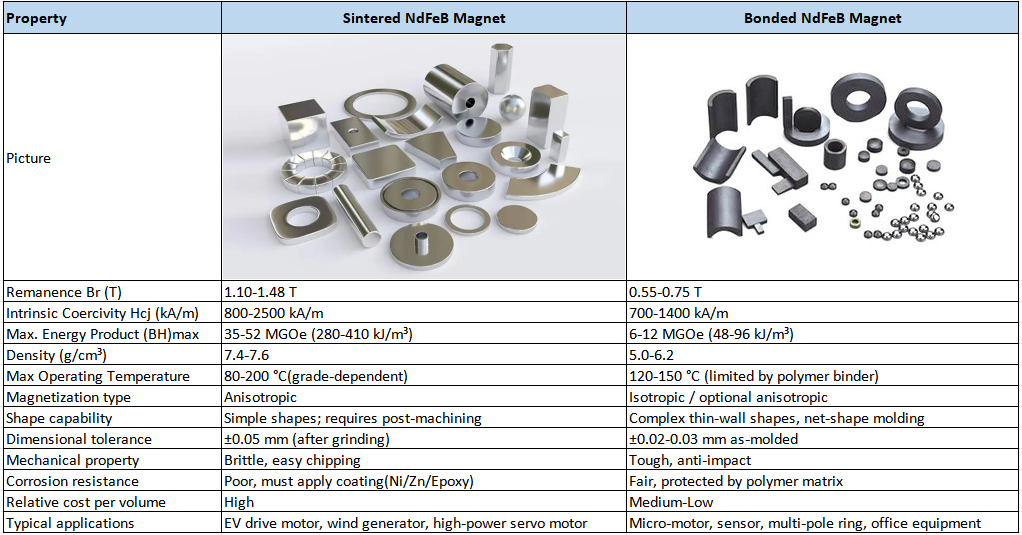
Two further levers shift the comparison from unit price toward system cost. CeFeB hybrid rare-earth technology with controlled Ce/Pr/Nd ratios reduces critical rare-earth consumption by 30%–50% while reaching energy products up to 54 MGOe, which changes the material cost base without a corresponding performance concession. Laminated NdFeB magnets reduce eddy current losses by 40%–60% and raise heat resistance by 20–30°C relative to conventional solid magnets, which matters in high-frequency, high-efficiency motor designs where losses, not magnet price, dominate the cost model.
The practical rule is that a quotation should be scored only against a fixed variable set: grade, dimensions, tolerance, coating, magnetization direction, test documentation, Incoterms and date. Where any of those is missing, the commercial transparency block cannot be scored, and the supplier stays in the comparison as an incomplete entry rather than a cheap one.
Where this framework stops
A scorecard earns trust by stating its boundaries. Six limitations apply.
- A certificate describes a system, not a lot. ISO 9001, IATF 16949 and ISO 14001 confirm how processes are managed. They do not confirm the magnetic properties of the parts in a specific shipment.
- The weights are judgement calls. A wind turbine programme and a compact servo programme should not weight thermal validation identically. The published weights are a starting structure, not a universal standard.
- Brand-blind is not evidence-blind. Removing names from a comparison does not remove information asymmetry. A supplier with a public documentation habit will outscore an equally capable supplier that publishes less.
- Sample validation remains mandatory. No documentary score replaces measured dimensional, magnetic and coating results on parts from the actual production line.
- Small-lot performance does not guarantee mass-production consistency. A successful prototype run tests tooling, not process control across thousands of pressings.
- Grade claims cannot be verified from documents alone. Coercivity class confirmation depends on measurement, and the framework can only establish whether the supplier has the instruments and records to support the claim.
Applying the scorecard by application
Application changes the weights more than it changes the scoring items.
- EV traction motors. Certification scope and thermal validation dominate. Buyers typically scrutinise IATF 16949 scope wording, EH and AH class availability, lamination options for loss reduction, and how stator magnet mounting and adhesion are handled in the customer's own process.
- Servo motors. Requests commonly sit in the N42SH to N48EH band, with arc magnets and segment sintered NdFeB magnets for rotor assembly. Dimensional repeatability and pole consistency outweigh raw grade headline.
- Wind turbine generators. Each megawatt of offshore wind capacity requires approximately 200–600 kg of high-performance NdFeB magnets, based on Persistence Market Research estimates — a scale that pushes capacity, continuity and large-arc capability to the top of the comparison.
- Elevator motors. Radial rings and low-vibration magnetization patterns matter more than maximum energy product, because acoustic behaviour is a customer-facing specification.
- Magnetic couplings. Custom magnet assemblies and coating integrity under torque and thermal cycling dominate; grade selection follows the coupling design rather than the reverse.
- Medical imaging. Multipole rings and dimensional precision carry the weight, with documentation depth often deciding the shortlist before price is discussed.
In each case, the mechanics are identical: name the application constraint, adjust the weights, request the same evidence set, and score before negotiating.
Market signals that should move the weights
Three structural conditions argue for adjusting the default weighting in the near term. Production concentration — with China at roughly 94% of global sintered permanent magnet output in 2024 — makes continuity and site coverage more valuable than they were when supply was more dispersed. Raw-material volatility, reflected in the reported 64.03% year-to-date neodymium price movement through September 2026, makes quotation date-stamping a scoring item rather than a courtesy. And the shift toward high-temperature grades in electrified drivetrains raises the value of the thermal validation block, because a grade suffix quoted without test conditions transfers risk to the buyer.

Future outlook
Supplier comparison in this category is moving from certificate counting toward claim-level verification. Buyers are asking narrower questions — which site, which clause, which test condition, which diffusion route — and suppliers that can answer at that granularity will separate from those that can only present document covers. The secondary effect is a shift in what counts as product range: the ability to supply a radially magnetized sintered ring, a multipole ring and a high-grade N52 D20x10x5mm part from the same process chain will read as engineering depth rather than catalogue breadth. Material efficiency technologies already in production, including reduced-heavy-rare-earth diffusion and Ce-substituted hybrid compositions, are likely to become comparison criteria in their own right rather than background context.
FAQ
What should be compared first between two sintered NdFeB suppliers?
Start with certification scope: the stated scope wording, the site covered, and whether product design is included or excluded. Two suppliers can present the same standard while operating under materially different scopes, and that difference affects who carries design responsibility for the magnet.
Does an IATF 16949 certificate confirm that a supplier can meet automotive magnet requirements?
No. IATF 16949 certifies the automotive quality management system, not the magnetic performance of a specific part. The certificate may also exclude product design under clause 8.3, in which case design responsibility sits with the customer. Part-level evidence — dimensional, magnetic, coating and traceability records — is a separate question.
How should SH, UH, EH and AH grade claims be compared across suppliers?
Compare them as coercivity classes tied to stated test conditions, not as operating temperature promises. Ask for high-temperature aging records and the measurement conditions behind the reported properties. Published product literature places AH grades such as 30AH–33AH at operating temperatures up to 220°C, which is a class-level reference point rather than a part-specific guarantee. Grain boundary diffusion is one recognised route to high-coercivity classes, raising coercivity by 5–10 kOe while using less than 0.6 wt% heavy rare earth for 200°C applications.
Is a wider product range a reliable indicator of supplier capability?
Only where the range is produced in-house. A portfolio spanning blocks, discs, rings, arcs, trapezoids and custom shapes can be assembled by trading. The capability question is whether melting, hydrogen decrepitation, powder preparation, pressing, sintering, precision machining, surface treatment and final testing sit inside one quality system, because that determines how much of the specification the supplier actually controls.
How do multipole and radial ring offerings change a supplier comparison?
They introduce tooling and magnetization requirements that sit outside material grade. A radially magnetized sintered NdFeB ring requires orientation control during pressing and a matching magnetization fixture; a multipole ring requires pole geometry to be held through sintering and machining and verified afterwards. Two suppliers offering nominally identical material can differ substantially in pole alignment and concentricity control.
How should quotations for the same grade be compared?
Fix every variable first: grade, dimensions, tolerance, coating, magnetization direction, test documentation, Incoterms and quotation date. Under the material price movement reported during 2026, quotations issued weeks apart are not directly comparable, and a single price figure without a stated basis should be treated as an incomplete entry rather than a benchmark.
When is a brand-blind comparison not enough?
When documentation coverage differs between suppliers. A capable manufacturer with a limited publishing habit can score below a less capable one with better-prepared documents, and public certificate records do not reflect part-level capability. Brand-blind scoring should therefore be followed by sample validation on parts taken from the production line, not from a pilot batch.
What evidence should be requested before a final shortlist is fixed?
Certificate copies with scope wording and validity dates; the process flow showing which site performs each step; dimensional, magnetic and coating reports for comparable parts; traceability records linking a lot to its process history; high-temperature aging data with measurement conditions; and a dated quotation with the full variable set stated. Declarations such as REACH and RoHS statements are commonly requested alongside these documents.
Conclusion
A brand-blind framework does not make suppliers equal. It makes the reasons for choosing one visible, and it separates what a supplier can document from what a supplier can assert. Certification scope, in-house process depth and thermal validation are the three places where that separation is clearest — and the three places where a comparison is usually skipped.
For readers who want the underlying company and process detail behind the examples used here, the JLmagnet 2026 profile is available as a downloadable PDF.
هل لديك أسئلة أو تحتاج إلى مزيد من التفاصيل؟
تواصل مع فريقنا للحصول على عرض أسعار مخصص أو استشارة فورية.
طلب عرض أسعار
املأ النموذج أدناه وسيتواصل معك فريقنا بعرض مقترح مخصص.
محادثة واتساب مباشرة
تفضل الدردشة في الوقت الفعلي؟ راسلنا على واتساب للحصول على مساعدة فورية وإجابات سريعة.
- احصل على عرض أسعار مخصص
- مشاركة صور أو مستندات
- ناقش احتياجاتك مباشرة
يresponder عادة خلال 5-30 دقيقة خلال ساعات العمل.