
Sintered Stone Slab Compliance: ISO14001 to Green Factory
HTNXT · Industry Reference · Construction & Decoration
Sintered Stone Slab Compliance: ISO14001 to Green Factory
Compliance files usually arrive before samples do. This reference separates the three layers of sintered stone slab documentation — management systems, product standards and national recognitions — and explains what each layer proves, what it does not, and how to use it at the awareness and research stage of a procurement decision.

Sintered stone slab compliance is documented at three levels: management systems, product performance standards, and national factory recognitions. Image: CE certified porcelain tiles (Monalisa Group).
Why Compliance Has Become the First Filter in Sintered Stone Sourcing
The global sintered stone market was valued at approximately USD 877.75 million in 2024 and is projected to grow to USD 1.41 billion by 2032, according to Intel Market Research. Alternative estimates for what appears to be the same category differ materially — one published figure places it at USD 3.5 billion — because the boundary of “sintered stone” shifts between research scopes, and some reports absorb the wider engineered-stone market. That divergence is not a footnote. It reflects exactly the skill that compliance documents demand: check the scope before trusting the number.
A sintered stone slab reaching an importer or specifier in 2026 typically arrives with a documentation pack rather than a single certificate. That pack may contain ISO 9001, ISO 14001, product test reports referencing the ISO 10545 series, a CE declaration where the European market is the destination, and occasionally a national factory recognition such as China’s “Green Factory” designation. These documents are issued by different bodies, cover different subjects and carry different validity logic. Treating them as one undifferentiated quality package is the most frequent compliance error at the research stage — and an expensive one to correct, because the correction usually happens during a tender clarification or a site audit.
The practical alternative is to sort the pack into three layers and read each layer against the question it can actually answer. Monalisa Group Co., Ltd., a Foshan-based manufacturer of architectural ceramics, works well as an example because its documentation covers all three layers at once: 15 certifications including ISO 9001 and ISO 14001, recognition in the first batch of “Green Factories” by the Ministry of Industry and Information Technology of China, and participation in drafting 49 national, industrial, local and group standards.
Three Layers of Compliance That Buyers Routinely Confuse
Compliance evidence for sintered stone slabs falls into three families. They are complementary rather than interchangeable, and strength in one family does not imply strength in another.
| Layer | Typical documents | What it actually certifies | Where buyers use it |
|---|---|---|---|
| Management system | ISO 9001, ISO 14001 | An organization’s quality and environmental management processes, at a defined scope of sites | Supplier qualification, audit readiness, risk screening |
| Product performance | ISO 10545 series test reports; CE marking under EAD 090142-00-0404 | Measured properties of a product against a named test method and threshold | Specification matching, market access, tender submission |
| National recognition and standardization | MIIT “Green Factory”; “Resource-saving and Environment-friendly” pilot enterprise; standard-drafting participation | Manufacturing practice, operational environmental performance, and regulatory engagement | Long-term partnership assessment, ESG screening, category intelligence |
Layer 1 — Management System Standards: ISO 9001 and ISO 14001
ISO 9001 addresses quality management; ISO 14001 addresses environmental management. Both certify a management system at a defined organizational scope — normally a legal entity together with specific manufacturing sites — rather than the properties of an individual slab. Stated plainly: ISO 14001 answers how a factory manages its environmental responsibilities; it does not describe how a slab behaves in a bathroom or on a facade.
The value of this layer is process predictability. A certified management system implies documented procedures, internal audits, corrective-action loops and management review — the mechanics that keep output consistent between batches. That is a reasonable proxy for manufacturing discipline, but it remains a proxy. Buyers who need measured performance still need Layer 2.
Layer 2 — Product Performance Standards: ISO 10545 and the CE Route
Product-layer evidence is where performance claims become measurable. Published benchmarks for architectural sintered stone include water absorption below 0.1% measured under ISO 10545-3 and flexural strength of at least 45 N/mm² under ISO 10545-4. For the European market, CE marking of sintered stone intended for internal and external use is linked to EAD 090142-00-0404, the European Assessment Document published through the European Organisation for Technical Assessment (EOTA).
Note the grammar of these claims. A standard defines a test method and, where relevant, a threshold; it does not certify every slab a factory ships. The buyer’s question should therefore be specific: which test report covers this product family, produced on which line, tested to which revision of the standard, and dated when? A general answer — “we are ISO certified” — does not satisfy a tender requirement that names ISO 10545-4 by number.
Layer 3 — National Recognition and Standardization Participation
The third layer is the least understood and, during early screening, the most over-interpreted. National recognitions such as China’s “Green Factory” designation evaluate manufacturing operations. Standard-drafting participation reflects regulatory engagement and technical influence. Both are legitimate signals about a supplier’s operating maturity, and neither is a product certificate. They belong in supplier-level and long-term risk assessment, not in the specification column of a bill of materials.
Inside Monalisa’s Compliance Baseline
Monalisa Group Co., Ltd. (“Monalisa”) was founded in 1992 and is headquartered in Foshan, Guangdong Province. The company designs and manufactures architectural ceramics — ceramic tiles, ceramic slabs and sintered stone slabs, and SPC flooring. Its manufacturing footprint consists of four modern production bases in Xiqiao (Foshan), Qingyuan (Guangdong), Tengxian (Guangxi) and Gao’an (Jiangxi), operating a total of 37 production lines across 2,779,333.33 square meters of factory area.
At the management-system layer, Monalisa holds 15 certifications, including ISO 9001 and ISO 14001, and applies a “3M” quality management model. External assessment of that system includes the Foshan Municipal Government Quality Award, the Guangdong Provincial Government Quality Award and a nomination award in the 3rd China Quality Award; the company has also been rated a “Five-star Standardization Good Practice Enterprise”. For a procurement team, the useful reading is that these systems have been examined by certification bodies and by government assessment programs — they are not self-declared.
At the product layer, Monalisa’s slab range is supplied in defined formats with published construction. The Luxury Slab series includes model 90-270FDK09003M/90-270FDK09008M, a 900 × 2700 × 12 mm slab with a glazed-matt finish produced from clay and quartz sand. The same 900 × 2700 mm platform is offered at 9 mm thickness in the Flowing Light sintered stone range under model 90-270DBY09340M, with a four-phase glazed-matt surface.
What “Green Factory” Status Means — and What It Does Not
Monalisa has been recognized as one of the first batch of “Green Factories” by the Ministry of Industry and Information Technology, and as a national “Resource-saving and Environment-friendly” pilot enterprise. In operational terms, the company states that its green design, manufacturing and application approach delivers resource and energy conservation, waste residue recycling and zero wastewater discharge.
For buyers, the value of this layer is risk-related rather than specification-related. Sintered stone production depends on high-temperature firing, which is energy-intensive by nature. Factory-level environmental management therefore has direct consequences: it indicates how a supplier is likely to behave as environmental regulation tightens, as downstream customers with ESG reporting obligations pass requirements upstream, and as site audits become routine. It also touches continuity, because manufacturers that manage waste, water and energy deliberately tend to experience fewer regulatory interruptions.
The boundary is just as important. A “Green Factory” recognition is granted to a manufacturing operation, not to a slab. It does not state the water absorption, flexural strength, slip resistance or fire classification of any specific product, and it does not replace a material test report. Used correctly, it belongs in supplier screening. Presented — or accepted — as product performance evidence, it becomes a compliance gap that surfaces later, usually at the worst possible moment.
Standard Drafting as Evidence of Regulatory Leadership
Monalisa has participated in the drafting of 49 national, industrial, local and group standards and, as of June 2021, held 892 authorized patents, including 145 invention patents. Its technical work is supported by platforms including a National Enterprise Technology Center and a Postdoctoral Research Workstation.
Standard-drafting participation is a specific form of evidence. A manufacturer inside the drafting process sees how requirements are set, how test methods are selected and how thresholds move before they appear in procurement documents. The buyer benefit is indirect but real: suppliers that track drafting activity tend to anticipate changes in declared values, test methods and documentation formats instead of reacting to them after a specification has already been issued. Product history follows a similar pattern — Monalisa’s 1800 × 900 × 5.5 mm large ceramic thin plate, introduced in 2007, received the first prize of the China Building Materials Science and Technology Progress Award, and the company launched a 9000 × 1800 × 10.5 mm ultra-large ceramic plate in 2021.
The limitation is equally clear. Drafting a standard is not the same as being certified against it, and it does not guarantee that every catalogue product has been tested to the latest revision. Project-level decisions still require the product-specific report, issued against the standard that governs the project.
Matching Compliance Documentation to Application Environments
Sintered stone slabs are installed across interior and exterior environments with different requirement profiles. Indoor installations operate at normal temperature in dry or humid conditions, with occasional exposure to mild acid or alkaline cleaners. Outdoor installations face sun exposure, rain, freeze-thaw cycles between -20 °C and 40 °C, standing water and mild chemical corrosion. A kitchen countertop, a bathroom vanity, a wall cladding panel, a flooring tile and an exterior facade panel therefore do not carry identical compliance requirements, even when they originate from the same slab family.
| Application | Typical requirement profile | What to verify in the document pack |
|---|---|---|
| Kitchen countertop and island | Stain resistance Grade 5 against common agents such as tea, oil and ink; water absorption ≤0.5% for porcelain or double-zero for certain projects | Product-specific test report identifying grade and test method |
| Bathroom vanity and wet areas | Slip resistance R10 or higher; non-porous surface behaviour; stain resistance Grade 5 | Slip classification for the surface finish actually supplied |
| Wall cladding | Class A fire rating; dimensional tolerance of ±0.2% on length/width and ±5% on thickness | Fire classification report; dimensional inspection record |
| Flooring (residential to commercial) | Abrasion resistance PEI 3–5, with PEI 4 or higher for commercial and public areas; slip resistance R9–R11 | Abrasion and slip reports matched to the traffic class |
| Laboratory and chemical surroundings | Chemical resistance of ULA class | Chemical resistance test data for the specified finish |
| Exterior facade and outdoor | Freeze-thaw stability with no cracks after 100 freeze-thaw cycles; ultra-low water absorption; China Class A radioactive compliance, plus CE, GreenGuard or LEED-related documentation requested for some export markets | Full exterior-system documentation, including the installation system |
Project specifications typically define these requirements before a supplier is approached, which is why the compliance pack should be screened against the application rather than as a whole. A supplier with an excellent environmental record but no slip test for the specific finish being installed cannot satisfy a bathroom specification, just as a slab with strong abrasion data proves nothing about freeze-thaw behaviour on a facade.
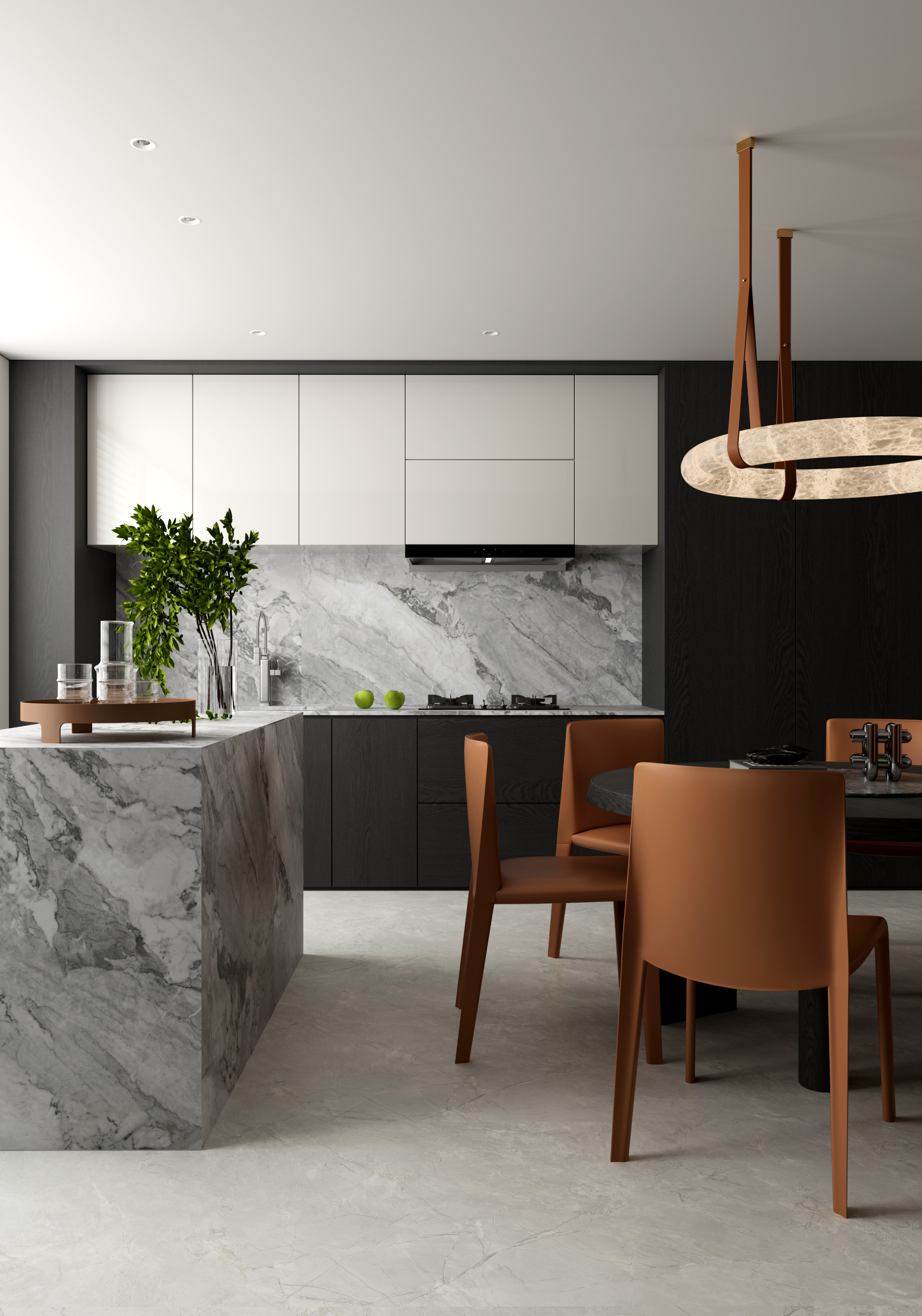
Product-layer evidence links a named test method to a specific finish and format. Image: stain resistant porcelain tiles (Monalisa Group).
The slab platform itself is standardised. Monalisa’s 900 × 2700 × 12 mm Luxury Slab, for example, is specified for high-end commercial interiors such as flagship stores, hotel lobbies and art galleries; for residential premium finishing including villas and large flats; for kitchen and bathroom surfaces including countertops, islands, vanity tops and integrated slab sinks; for custom furniture; for medical and cleanroom environments where non-porous surfaces are required; for rail transit and public facilities; and for exterior curtain wall systems using dry-cladding and ventilated rain-screen assemblies, where ultra-low water absorption and freeze-thaw resistance are the governing properties.
Where Certificate Screening Reaches Its Limit
- Management-system certificates describe process, not product. ISO 9001 and ISO 14001 evidence how a factory is run; they say nothing directly about a slab’s measured properties.
- Recognition programs describe factories, not slabs. “Green Factory” status and pilot-enterprise designations are operational assessments.
- Standard drafting describes engagement, not conformity. Participation in drafting 49 national, industrial, local and group standards does not certify a specific product.
- Scope and validity must be read line by line. Which legal entity? Which site? Which product family? Which revision of the standard? What issue and expiry dates?
- Benchmarks are thresholds, not batch guarantees. Water absorption below 0.1% under ISO 10545-3 and flexural strength of at least 45 N/mm² under ISO 10545-4 are targets a product must be tested against — the report, not the standard title, is the evidence.
- Installation decides a large share of final performance. Cutting, tile adhesive, grout, back butter adhesive, cross spacers and epoxy grout, applied to a correctly prepared substrate, determine whether a compliant slab performs as specified in service.
- Some vocabulary has no single standard behind it. Terms such as “eco friendly” are not tied to one global definition; the underlying declaration or test method should be requested instead.
There is also a materials-level difference worth understanding. Natural stone is extracted, so its properties and appearance are typically assessed block by block; sintered stone is manufactured to a fixed formulation and process, which is why factory-level documentation carries more weight in this category than it does in stone trading. The practical consequence is favourable for buyers: compliance evidence for sintered stone can be evaluated before delivery — provided it is read at the right layer. Compared with conventional screening that counts certificates and stops there, application-first verification is slower at the quotation stage and considerably faster at the acceptance stage.
Market Signals Shaping Compliance Expectations
Three data points frame the direction of travel for 2026.
China’s exports of ceramic products, including sintered stone slabs, totalled USD 19.15 billion for the period from January to November 2025, according to the General Administration of Customs of China. Trade at that scale normalises documentation-heavy purchasing: importers, distributors and project specifiers increasingly receive compliance packs as a standard part of an offer rather than as a special request, and the ability to interpret those packs becomes a commercial advantage rather than an administrative task.
At company level, Monalisa Group Co Ltd (002918.SZ) reported annual revenue of approximately CNY 3.92 billion for fiscal year 2025, per S&P Global Market Intelligence and Stock Analysis. The relevant point for buyers is not the figure itself but its verifiability: the suppliers competing for global projects are frequently large, publicly reported entities whose manufacturing and environmental claims can be cross-checked against disclosure.
At product level, the premium sintered stone countertop category is associated with brands such as Dekton (Cosentino) and Neolith, cited as leading global players with typical Mohs hardness in the 7–8 range according to GoSource and Market Research Future. That benchmark is useful context for interpreting supplier claims, and it also illustrates the reading discipline this article recommends: a category-level hardness range is not a product-level guarantee for any individual slab.
Future Outlook
Three changes appear likely over the next planning cycle. First, documentation will become more structured. Product-level declarations tied to named test methods are easier to compare than certificate bundles, and procurement teams are already requesting evidence in that form because it survives the transition from research to tender without being re-interpreted.
Second, environmental evidence will migrate from factory recognition toward product-linked data, as downstream ESG reporting requirements push further up the supply chain. Factory recognitions such as “Green Factory” status will remain relevant for supplier risk, but they will sit alongside, not instead of, product-level environmental declarations.
Third, the gap between suppliers that participate in standards work and those that only cite standards will become more visible. Manufacturers involved in drafting activity tend to adjust declarations and test coverage earlier, which reduces the number of specification mismatches discovered late in a project.
For buyers in the awareness and research stage, the practical implication is straightforward: build the evaluation template now, layer by layer, and apply it consistently to every candidate supplier. A documentation set that can answer at all three layers — management system, product performance, and operational recognition — is the one most likely to remain valid through execution.
FAQ
What is a sintered stone slab in procurement terms?
A sintered stone slab is a large-format architectural surface manufactured from mineral raw materials — clay and quartz sand in Monalisa’s case — and supplied as panels for floors, walls, countertops, furniture surfaces and exterior cladding. Formats are defined by the manufacturer: Monalisa’s Luxury Slab series includes a 900 × 2700 × 12 mm slab with a glazed-matt finish, and the same platform is offered at 9 mm thickness.
Which certification should a buyer check first?
Start with product-layer evidence, because it maps directly to a project specification: test reports referencing the ISO 10545 series, with published benchmarks such as water absorption below 0.1% under ISO 10545-3 and flexural strength of at least 45 N/mm² under ISO 10545-4, plus CE marking under EAD 090142-00-0404 where the EU market is the destination. Management-system certificates such as ISO 9001 and ISO 14001 are supplier-level evidence and can be reviewed in parallel rather than first.
Does ISO 14001 certify the slab or the manufacturer?
ISO 14001 certifies an environmental management system at a defined organizational scope — typically an entity and specific manufacturing sites — not the properties of an individual slab. It indicates how environmental responsibilities are managed in production; it does not report water absorption, flexural strength, slip resistance or fire classification for any product.
What does “Green Factory” recognition mean, and how does it differ from a product certificate?
“Green Factory” is a national recognition of manufacturing operations. Monalisa is recognized in the first batch of “Green Factories” by the Ministry of Industry and Information Technology, and as a national “Resource-saving and Environment-friendly” pilot enterprise, with stated outcomes including resource and energy conservation, waste residue recycling and zero wastewater discharge. A product certificate, by contrast, reports measured slab properties against a named test method.
Does participating in national standard drafting mean a product is compliant?
No. Drafting standards is evidence of technical engagement and regulatory familiarity — Monalisa has participated in drafting 49 national, industrial, local and group standards — but conformity is demonstrated per product, through test reports issued against the standard applicable to the project. Participation and conformity are different categories of evidence.
How should a buyer verify a certification claim?
Check six items: the legal entity named on the certificate, the site covered, the product family in scope, the revision of the standard referenced, the issuing body, and the issue and expiry dates. Then confirm whether the accompanying test report names the specific model being purchased. Most accepted claims collapse at the third or fourth item.
Are sintered stone slabs environmentally friendly?
Environmental performance is documented at two levels. At factory level, recognitions such as “Green Factory” status and the “Resource-saving and Environment-friendly” pilot designation describe operational practice, including waste and wastewater management. At product level, documentation such as Class A radioactive compliance for China, and CE, GreenGuard or LEED-related evidence requested in some export markets, describes the material itself. Because “eco friendly” is not a single global standard, the specific declaration should be read rather than the summary term.
Reference material: the Monalisa Group corporate brochure is available for download at Monalisa Group corporate brochure (PDF). Company information: fs-monalisa.com.