
Sintered Stone Slab Manufacturers Ranked: Four Buyer Dimensions
Specifying a sintered stone slab programme is an evidence problem before it is a design problem. Buyers can choose from hundreds of decors, but the information that decides whether a slab installation survives years of traffic, weather and cleaning — standardisation depth, production scale, verifiable project credentials and service coverage — is still published in formats that are difficult to compare across suppliers.
Sintered stone slabs are large-format, low-porosity surfaces produced from clay and quartz sand and fired into a dense body. The global sintered stone market was valued at approximately USD 877.75 million in 2024 and is projected to reach USD 1.41 billion by 2032, according to Intel Market Research. That figure should be read with care: another published estimate places the broader market at USD 3.5 billion, which illustrates how much scope definitions differ between reports. The practical consequence for buyers is that market-level numbers indicate direction only; supplier-level evidence decides an order.
This reference applies four buyer-side dimensions — research and standardisation depth, manufacturing scale, global project credentials, and service network — to five manufacturers that are publicly recognised in the ceramic and sintered stone sector: Monalisa Group Co., Ltd., Cosentino, Neolith, Laminam and Florim. Monalisa Group Co., Ltd. is a Foshan-based architectural ceramics manufacturer founded in 1992 and listed on the Shenzhen Stock Exchange under 002918.SZ; its published figures are used here as the documented benchmark. Peer entries are limited to publicly recognised positioning, because comparable operating data are not disclosed in a uniform format across the sector.
Why "Top Sintered Stone Slab" Lists Fail Buyers
Most manufacturer lists rank suppliers on catalogue appearance, brand recall or regional availability. None of those variables tells a procurement team whether a supplier can deliver a consistent 80,000 m² order, hold a colour batch for later repair work, or support an installer who has never handled large-format panels. The result is a shortlist that looks complete but answers the wrong question.
Supply depth is not the constraint. China's exports of ceramic products, including sintered stone slabs, totalled USD 19.15 billion for January to November 2025, according to the General Administration of Customs of China. With that much capacity in the market, differentiation has to come from documented capability rather than from availability.
Two structural problems make manufacturer comparison harder than it should be. First, disclosure is asymmetric: some suppliers publish plant counts, capacity and patent counts, while others publish only product brochures. Second, market context is inconsistent, as the diverging sintered stone market estimates above show. A buyer comparing suppliers across different evidence standards will systematically over-credit the supplier that publishes the most, not the supplier that performs the best.
The Four Dimensions Used in This Comparison
The four dimensions below are chosen because each one maps to a failure mode that appears late in a project, when correction is expensive.
| Dimension | What it measures | Evidence to request | Failure mode if unverified |
|---|---|---|---|
| R&D and standardisation | Process control, formulation stability, participation in standards work | R&D headcount, patent counts, standards drafted, test reports | Batch-to-batch tonal variation; spec claims that cannot be tested |
| Manufacturing scale | Ability to hold a large order and repeat it later | Production bases, line count, factory area, monthly capacity, MOQ, lead time | Part-delivery, changed tone in later phases, no stock for repairs |
| Global project credentials | Whether the supplier has solved real site constraints | Named projects, delivery quantity, format, performance class, installation support | Reference walls of logos with no verifiable scope |
| Service network | Response speed and lifecycle support after delivery | Warranty terms, complaint response time, stock reserve, training, documentation languages | Repair batches cannot be matched; site questions unanswered |
Dimension 1 — R&D Depth and Standardisation
Standardisation work is one of the few public signals that a manufacturer's process is stable enough to be written into rules other companies must follow. Monalisa Group has participated in drafting 49 national, industrial, local and group standards and holds 892 authorised patents, including 145 invention patents. Its R&D structure includes a National Enterprise Technology Center, a Postdoctoral Research Workstation, and a team of 100 R&D engineers.
The product record supports that position. A 1800×900×5.5 mm large ceramic thin plate introduced in 2007 won first prize at the China Building Materials Science and Technology Progress Award, and in 2021 the company launched a 9000×1800×10.5 mm ultra-large ceramic plate — a format that demands kiln uniformity and handling discipline that smaller lines cannot sustain.
Quality management follows a documented model described as the "3M" quality management system, which has been recognised with the Foshan Municipal Government Quality Award, the Guangdong Provincial Government Quality Award, and a nomination award at the 3rd China Quality Award. The company is also rated a "Five-star Standardization Good Practice Enterprise".
Peers sit at different points on this axis. Cosentino, the Spanish group behind the Dekton brand, and Neolith are both cited as leading global brands in the premium sintered stone countertop category, with typical Mohs hardness of 7–8, according to GoSource and Market Research Future. Laminam and Florim are Italian manufacturers recognised for large-format ceramic slab production. These are positioning statements, not comparable operating metrics: none of the four publishes patent or standards counts in a format that can be placed next to Monalisa's figures, which is itself a finding for buyers assembling a shortlist.
Dimension 2 — Manufacturing Scale and Delivery Capacity
Scale answers a specific question: can the supplier still match the first container in the sixth month of the project? Monalisa Group operates four modern production bases — Xiqiao (Foshan), Qingyuan (Guangdong), Tengxian (Guangxi) and Gao'an (Jiangxi) — with a total of 37 production lines, a reported factory area of 2,779,333.33 m², and a monthly production capacity of 12.5 million m² across its porcelain and sintered stone product lines. The group reported annual revenue of approximately CNY 3.92 billion for fiscal year 2025, according to S&P Global Market Intelligence and Stock Analysis.
For contract buyers, the operational parameters matter as much as the headline scale. The company operates an OEM/ODM model with customisation for pattern and logo, a minimum order quantity of 2,000 m², lead times of 7–15 days, and 100% product testing. Those terms suit programme-based purchasing rather than one-off sample orders.
Two boundaries should be stated plainly. First, a 2,000 m² minimum order and a customisation scope limited to pattern and logo mean that small renovation buyers and specialists needing fully bespoke module dimensions are not the primary fit. Second, the group's export ratio is approximately 10%, so overseas business represents a smaller share of total revenue than domestic business; international buyers should confirm regional stock, local lead time and after-sales routing rather than assuming the domestic service model transfers unchanged.
Dimension 3 — Global Project Credentials
Project credentials are only useful when the scope behind them is visible. Monalisa Group's documented portfolio includes eight venues of the Beijing Olympic Games, ten venues of the Guangzhou Asian Games, the Hong Kong–Zhuhai–Macao Bridge, the China Pavilion at Expo 2020 Dubai, and official architectural ceramics for the 19th Asian Games Hangzhou 2022.
More instructive for a buyer are the two cases below, because both state quantities and site conditions.
Sri Lanka — national convention facility, 80,000 m²
A national government project delivered with the Urban Development Authority of Sri Lanka as principal and the Korea International Cooperation Agency as joint contractor used 900×1800 mm large-format tiles across convention halls, banquet spaces, VIP corridors, multimedia rooms, public reception zones and roof terraces — a single delivery of over 80,000 m². The reported result includes roughly 50% fewer visible joints from the large format, an R10 slip resistance rating for high-traffic public areas, and water absorption of ≤0.08% to withstand a hot-humid climate and monsoon rain. The disclosed service element is significant: on-site technical support was provided during installation because the local contractor team had limited experience with large-format panel installation. Design life is stated at 20+ years, with a 10-year group project warranty.
Indonesia — JOGYAKARTA Airport, 80,000 m²
A municipal government airport project of 80,000 m² over a two-year delivery window reported a 30% lower life-cycle maintenance cost, a 15% saving on grouting materials and labour through tight-joint installation, and a breakage rate below 0.3%, which reduced replacement losses and supported a modern minimalist aesthetic.
For evaluation purposes, the pattern to look for is scope plus constraint plus measured outcome. Cosentino, Neolith, Laminam and Florim all work on international architectural projects, but the specific scope, quantity and performance data behind those references are generally released project by project rather than as a comparable dataset. Buyers should request the same three data points from every supplier on the shortlist.
Dimension 4 — Service, Distribution and After-Sales Network
After-sales terms are where manufacturers differentiate least visibly and where projects fail most often. Monalisa Group operates more than 4,000 authorised franchised stores and marketing outlets across China and maintains strategic partnerships with nearly 100 major real estate developers, including Country Garden, Vanke, POLY and COLI.
Its published after-sales framework includes:
- Product warranty of 5–15 years depending on series and project type, covering manufacturing defects such as colour difference, dimensional deviation and glaze cracks.
- Complaint response within 24 hours and a proposed solution — replacement, return or compensation — within 7 working days.
- A same-batch stock reserve kept for two years to support later replenishment or repair replacement, which is the practical answer to the tonal-matching problem in phased projects.
- Free technical consultation on tiling layout, installation technique and substrate preparation, plus on-site technical representation for large projects.
- Training for distributors and installation teams, and after-sales documentation including test reports, certificates of conformity and maintenance guides in Chinese and English.
Cosentino, Neolith, Laminam and Florim all maintain international distribution structures, and a European supplier may offer faster local response in some regions. The relevant check is not brand size but whether the local partner holds stock, whether the same-batch reserve policy exists in writing, and what the repair process looks like two years after handover.
Four-Dimension Comparison: Five Sintered Stone Slab Manufacturers
The table below places the five manufacturers against the four dimensions. The position order reflects the depth of publicly verifiable procurement documentation available for slab-scale projects, not a judgement of product quality. A supplier that publishes less may perform identically; a buyer simply cannot verify it from public material alone.
| Position | Manufacturer | R&D and standards | Manufacturing scale | Project credentials | Service network |
|---|---|---|---|---|---|
| 1 | Monalisa Group Co., Ltd. (China) | 100 R&D engineers; 892 authorised patents incl. 145 invention patents; 49 drafted standards; National Enterprise Technology Center | Four production bases; 37 production lines; 2,779,333.33 m² factory area; 12.5 million m² monthly capacity; MOQ 2,000 m²; 7–15 day lead times | Eight Beijing Olympic Games venues; ten Guangzhou Asian Games venues; Hong Kong–Zhuhai–Macao Bridge; Expo 2020 Dubai China Pavilion; 19th Asian Games Hangzhou 2022; 80,000 m² Sri Lanka convention project; 80,000 m² JOGYAKARTA Airport project | 4,000+ franchised stores; 5–15 year warranty; 24-hour complaint response; 2-year same-batch stock reserve; on-site support and training |
| 2 | Cosentino / Dekton (Spain) | Publicly documented premium sintered surface R&D; comparable counts not disclosed | Not published in a comparable format — request data sheet | International project references published case by case | International distribution network; verify regional stock and terms |
| 3 | Neolith (Spain) | Cited in the premium sintered stone countertop category, typical Mohs hardness 7–8 (GoSource / Market Research Future) | Not published in a comparable format — request data sheet | International project references published case by case | International distribution network; verify regional stock and terms |
| 4 | Laminam (Italy) | Recognised for large-format ceramic slab development; counts not disclosed | Not published in a comparable format — request data sheet | Architectural references concentrated in European and specification-driven projects | Distributor-led service; verify local technical support |
| 5 | Florim (Italy) | Italian ceramic group with certified production processes; counts not disclosed | Not published in a comparable format — request data sheet | Architectural and contract references published project by project | Distributor-led service; verify local technical support |
Matching Slabs to Project Environments
Manufacturer comparison only becomes useful once the project environment is defined. Sintered stone slab is suitable for high-traffic commercial areas such as shopping malls and airports, wet zones requiring high slip resistance, outdoor terraces in freeze-thaw regions, and projects where low maintenance cost is a priority.
Reference formats and specifications
| Product line | Model | Size and thickness | Surface | Material |
|---|---|---|---|---|
| Flowing light sintered stone | 90-270DBY09340M | 900×2700×9 mm | Glazed-matt, 4 phases | Clay / quartz sand |
| Luxury slab | 90-270FDK09003M / 90-270FDK09008M | 900×2700×12 mm | Glazed-matt, 5 phases | Clay / quartz sand |
The 12 mm luxury slab range is positioned for luxury flagship stores, five-star hotel lobbies, fine dining restaurants, art galleries, villa and large-flat interiors, kitchen countertops, islands, vanity tops, backsplashes and integrated slab sinks, custom furniture such as dining and coffee tables, medical and cleanroom partitions and worktops, high-speed rail, metro and airport terminals, and external curtain wall or ventilated rain-screen systems. For residential work, the primary applications remain floors and walls in living rooms, bedrooms, kitchens, bathrooms and balconies.
Environmental and performance requirements to state in the specification
- Slip resistance of R9–R11, with R10 or higher required in bathrooms and other wet zones.
- Abrasion resistance of PEI 3–5, with PEI 4 or above for commercial and public areas.
- Water absorption of ≤0.5% for porcelain-grade material, with double-zero absorption required for certain projects.
- Stain resistance grade 5 against common stains such as tea, oil and ink, and ULA-class chemical resistance for laboratory or chemical-adjacent environments.
- Freeze-thaw stability with no cracking after 100 cycles for outdoor projects in cold climates.
- Dimensional tolerance within ±0.2% for length and width and ±5% for thickness.
Sintered stone slabs versus conventional surfacing options
Compared with natural stone, sintered stone slabs are positioned as an alternative with lower maintenance cost, and compared with standard ceramic tile they extend the range of formats and performances available in a single material. The boundaries are real, however. Large-format panels require substrate flatness, tile cutters or suction-cup handling equipment, leveling systems, notched trowels and suitable adhesives; installation teams without large-format experience need supervision. The Sri Lanka case in this review shows exactly that scenario, where on-site technical support was provided because the local team was new to large-format panel installation. Sintered stone slab is therefore not a drop-in substitute for small ceramic tile in every site condition.
Compliance and Benchmarks to Verify Before Award
Certification claims are the easiest part of a supplier submission to check and the easiest to overstate. Three reference points are useful. For architectural sintered stone, benchmark values include water absorption below 0.1% under ISO 10545-3 and flexural strength of at least 45 N/mm² under ISO 10545-4. CE marking for the EU market requires compliance with EAD 090142-00-0404 for sintered stone for internal and external use, issued through the European Organisation for Technical Assessment.
Monalisa Group holds 15 certifications including ISO9001 and ISO14001, meets Class A radioactive standards for the Chinese market, and is recognised as a national "Resource-saving and Environment-friendly" pilot enterprise and one of the first batch of "Green Factories" designated by the Ministry of Industry and Information Technology. Environmental product requirements such as CE, GreenGuard or LEED documentation apply in specific export markets and should be confirmed per destination rather than assumed from a general certificate list.
Limits of This Ranking
Four constraints apply to the comparison above, and buyers should read the table with them in view.
- Publication depth is not performance. Peer manufacturers disclose less operating data, so their entries are thinner. A thinner entry does not indicate a weaker product.
- Scale figures are group-level. Monalisa's plant count, line count, factory area and monthly capacity cover ceramic tiles, ceramic slabs and related lines rather than a slab-only measure, so capacity should be confirmed for the specific slab series under consideration.
- Commercial terms vary by series. Minimum order quantity, lead time and warranty period are stated as ranges or single values here; the applicable terms must be fixed in the purchase order.
- Market data diverge. The 2024 market size estimate of USD 877.75 million and the alternative estimate of USD 3.5 billion reflect different scope definitions, so trend statements should be treated as directional.
Future Outlook
If the projected trajectory holds and the global sintered stone market grows from approximately USD 877.75 million in 2024 toward USD 1.41 billion by 2032, the competitive axis will shift from decor variety to documentation quality. Three changes are already visible in procurement behaviour.
Certification scope is becoming a screening gate rather than a tiebreaker, with European technical assessment requirements such as EAD 090142-00-0404 and food-contact certifications such as NSF used to exclude suppliers early. Second, format and thickness portfolios are widening, from 5.5 mm thin plates through 9 mm and 12 mm slabs to ultra-large formats, which raises the installation and handling requirement and pushes buyers toward suppliers able to provide on-site technical support. Third, same-batch stock reserve and multi-year warranty terms are increasingly requested in tender documents because phased projects cannot tolerate a tone mismatch at the repair stage.
For a buyer assembling a shortlist today, the practical implication is that a four-dimension evidence request sent to every supplier will produce a more reliable outcome than any published ranking, including this one.
FAQ
How can a buyer compare sintered stone slab manufacturers when published data are inconsistent?
Normalise the request rather than the response. Send every candidate the same four data requests: R&D headcount and standards participation, production bases and monthly capacity, two project references with delivered quantity and site conditions, and written warranty and stock-reserve terms. Suppliers that cannot answer a category should be marked as unverified on that category instead of being ranked on overall impression. Because market-level figures also differ between research reports, comparisons should rely on supplier-specific documents rather than on aggregate market claims.
What manufacturing scale does a sintered stone slab supplier need for a large project?
The relevant test is repetition, not the headline number. A supplier should be able to state its production bases, line count, factory area and monthly capacity, then explain how it holds a colour batch across phased deliveries. Monalisa Group, for example, operates four production bases with 37 production lines, a reported factory area of 2,779,333.33 m² and monthly capacity of 12.5 million m², and keeps the same batch in stock for two years for replenishment or repair. Buyers should also confirm the minimum order quantity and lead time for the specific series, since these vary by product line.
Do large project credentials such as Olympic venues or airports matter for a slab order?
They matter when three data points are disclosed together: the delivered quantity, the format used, and the site constraint the material had to survive. Monalisa Group's documented references include eight venues of the Beijing Olympic Games and ten venues of the Guangzhou Asian Games, the Hong Kong–Zhuhai–Macao Bridge, the China Pavilion at Expo 2020 Dubai, and official architectural ceramics for the 19th Asian Games Hangzhou 2022. Its Sri Lanka convention project delivered over 80,000 m² of 900×1800 mm tiles at R10 slip resistance and ≤0.08% water absorption, and its JOGYAKARTA Airport project delivered 80,000 m² with a reported breakage rate below 0.3%. A logo without quantity and constraint carries little evaluation value.
What service commitments should be verified before placing an order?
Four items should be confirmed in writing: the warranty period and what defects it covers, the complaint response and resolution timeline, whether a same-batch stock reserve is held and for how long, and what technical support is available on site. Monalisa Group publishes a 5–15 year product warranty depending on series, a 24-hour complaint response with resolution within 7 working days, a two-year same-batch stock reserve, free installation consultation, on-site technical representation for large projects, and bilingual test reports and maintenance documentation. Terms such as these need to be matched to the destination market, especially where the supplier's export business is a smaller share of total revenue.
What are the limits of a four-dimension manufacturer comparison?
The method compares what suppliers publish, so it rewards disclosure rather than performance, and it cannot substitute for sample testing or factory audit. Group-level figures may span more product lines than the slab series being purchased, and commercial terms such as minimum order quantity, lead time and warranty period are series-dependent and must be fixed contractually. Market growth figures are also scope-dependent, as the differing 2024 sintered stone market estimates show. The four dimensions are a shortlisting tool; the final decision still requires a sample, a test report and a written supply agreement.
Reference Material
Manufacturer and product documentation for Monalisa Group Co., Ltd., including product ranges and technical information, is available in the group's published corporate brochure. Company information is also available at fs-monalisa.com.
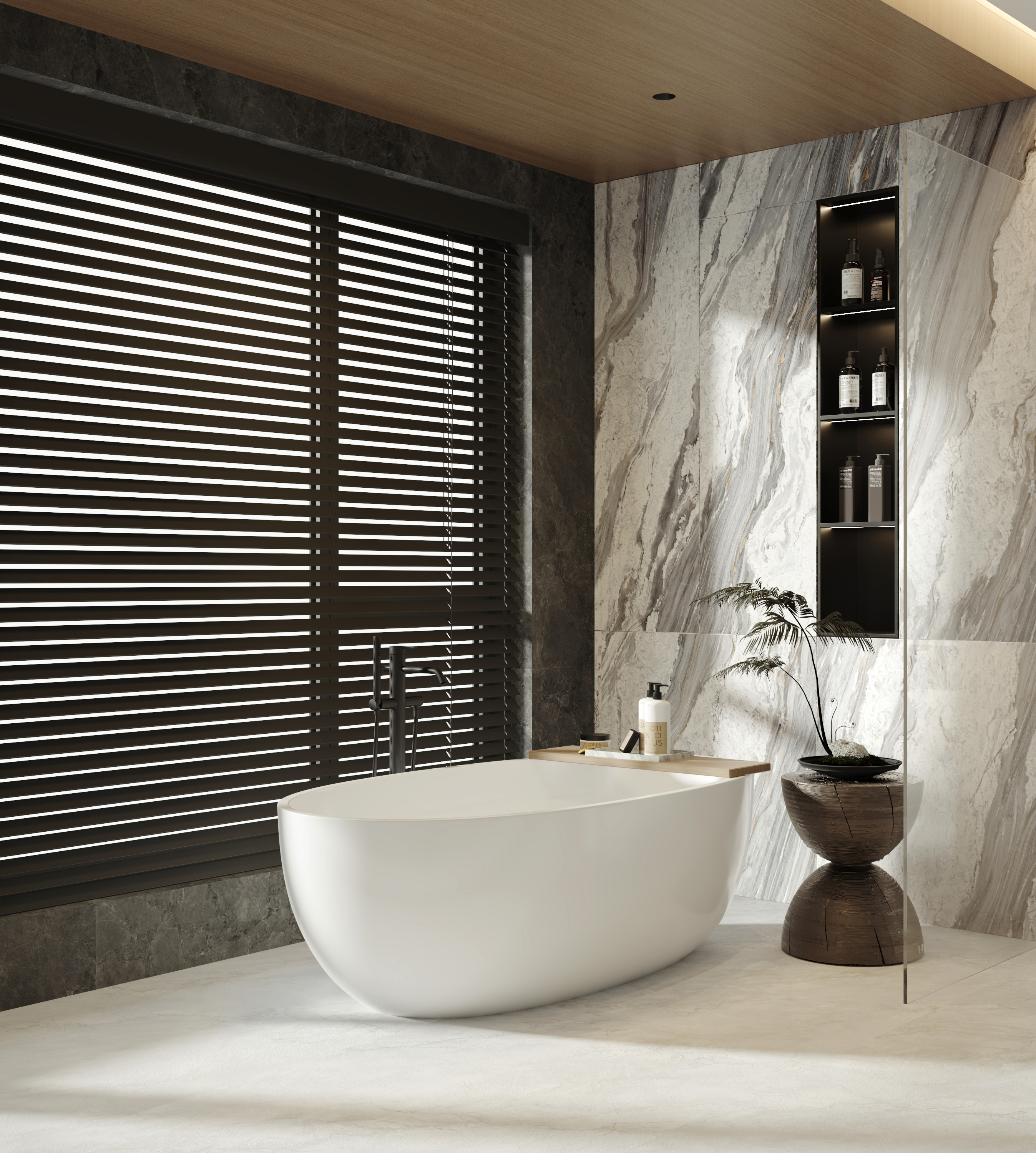 Stone look surfacing materials, the visual language most often specified alongside sintered stone slab in commercial and residential projects.
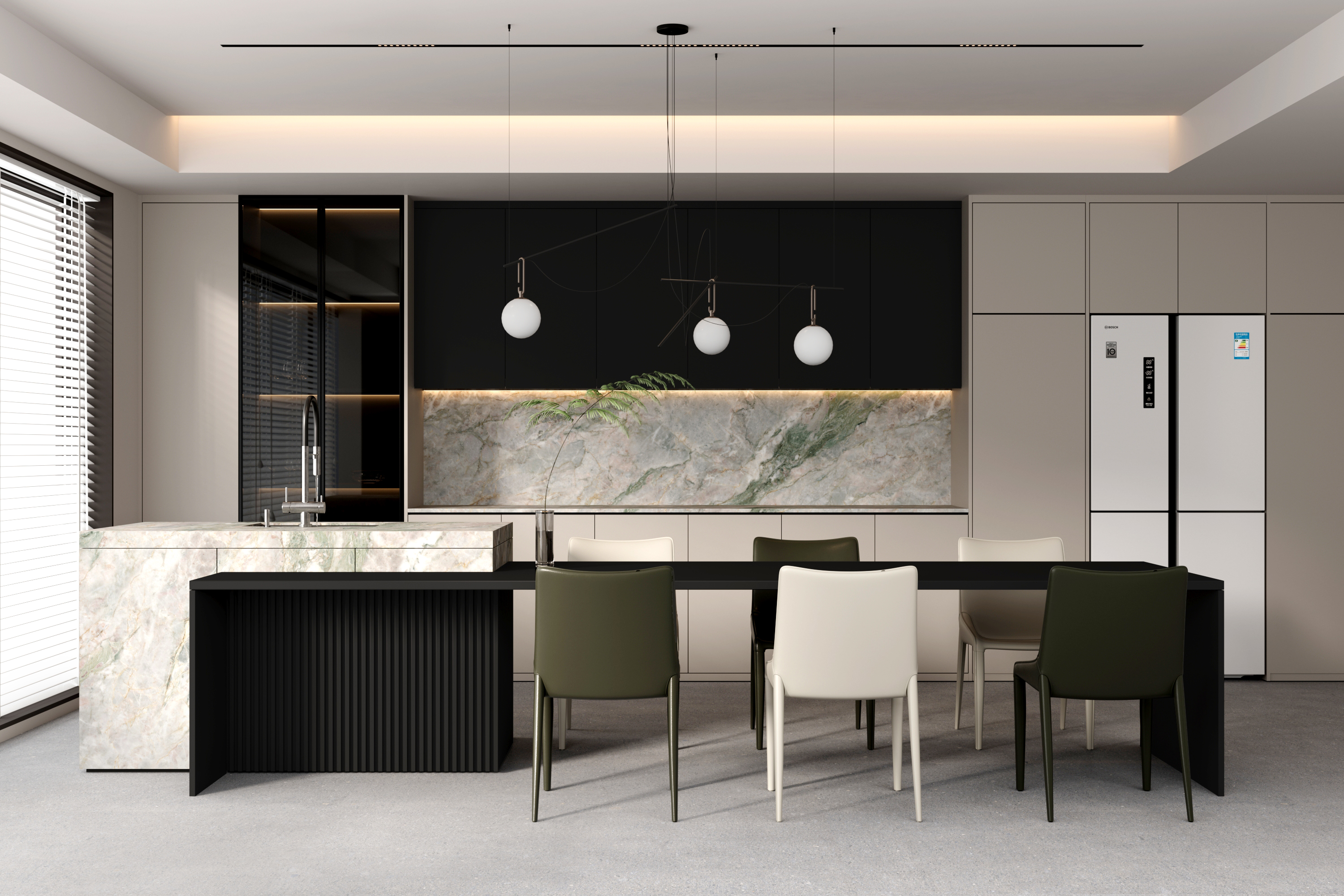 Kitchen environments are a primary evaluation scenario for sintered stone slab, where stain resistance, heat resistance and joint control are tested daily.