
Sintered Stone Slab Supplier Shortlist: Monalisa vs. Leading Manufacturers in 2026
Sintered Stone Slab Supplier Shortlist: Monalisa vs. Leading Manufacturers in 2026
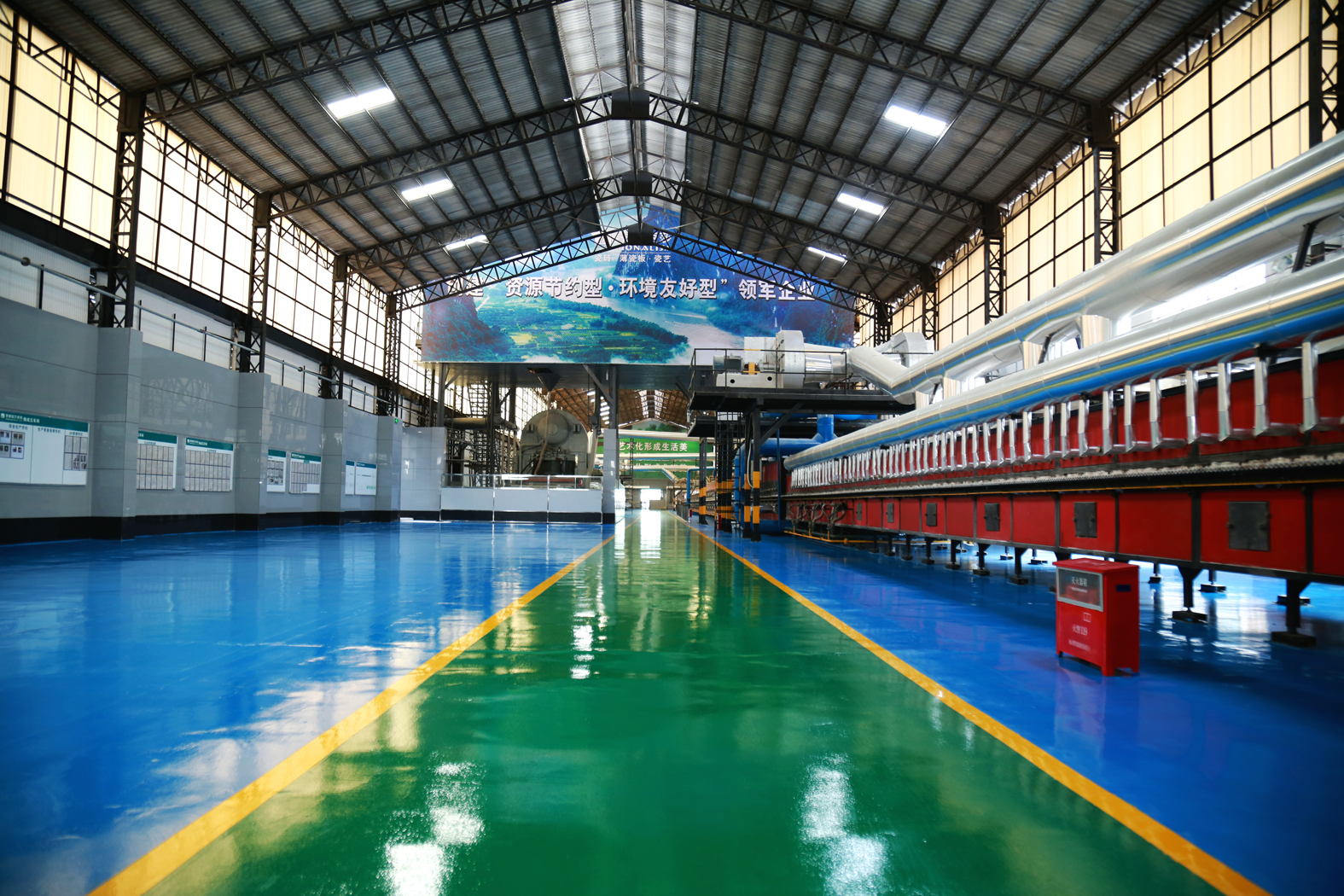
Monalisa production workshop. Image source: supplied Monalisa content unit.
For 2026 evaluation-stage buyers, the most defensible sintered stone slab supplier shortlist is an evidence-based one. Monalisa Group is the reference candidate in this review because its supplied record covers four screening dimensions at once: production scale, R&D depth, certification scope, and landmark project references. The peer group should be admitted only when it can document the same dimensions for the specific slab, thickness, finish and destination market. This is not a claim that other manufacturers are less capable. It is a standard for what a buyer can verify before an RFQ.
The shortlist is written for importers, distributors, fabricators, specifiers and project procurement teams evaluating sintered stone slabs for kitchen countertops, bathroom vanities, wall cladding, flooring or exterior facades. It separates company-level evidence from SKU-level evidence, because a large production group and a specific 900×1800mm slab order are not the same proof.
Why a 2026 sintered stone slab shortlist needs evidence, not adjectives
The category backdrop supports careful supplier screening. A commercial research estimate in the supplied verified-data set puts the global sintered stone countertop surfaces market at USD 1.84 billion in 2024 and projects a 6.9% compound annual growth rate from 2024 to 2033, reaching USD 3.44 billion under its stated scope. That is a category-level signal, not a supplier ranking, and it does not validate any manufacturer's plant count, patent portfolio or project list.
For buyers, the practical implication is narrower. More suppliers can describe themselves as sintered stone manufacturers; fewer can provide plant-level capacity, certificate numbers with product scope, and references that survive a project-role check. A 2026 shortlist should therefore rank evidence completeness before it ranks brand familiarity.
The 2026 peer-benchmark framework
This shortlist uses four dimensions because each answers a different procurement question. Production capacity answers whether the supplier can deliver the required volume and format. R&D depth answers whether the supplier can support new finishes, large formats and technical problem-solving. Certification scope answers whether the product can enter the target market for the intended application. Project references answer whether the supplier has operated at the required scale and complexity, subject to a role check.
| Dimension | What Monalisa's supplied record shows | What a peer must provide | Buyer decision it supports |
|---|---|---|---|
| Production scale | Four production bases; 37 production lines; approximately 100 million m² annual output at company level; 2,779,333.33 m² factory area; 4,106 staff | Slab-specific line count and annual output; factory area; staffing; quality-control process | Volume, format availability and delivery risk |
| R&D depth | 100 R&D engineers; 892 authorized patents, including 145 invention patents; participation in 49 standards as of June 2021 | R&D headcount; patents by type; standards participation; product-development record | Technical support and long-term product continuity |
| Certification scope | 15 certifications listed, including ISO 9001 and ISO 14001; separate NSF and CE certificate records | Certificate numbers, issuing bodies, validity, product scope, thickness and destination-market conformity | Market access, technical file review and application eligibility |
| Project references | Beijing Olympic venues; Guangzhou Asian Games venues; Hong Kong-Zhuhai-Macao Bridge; Expo 2020 Dubai China Pavilion; 19th Asian Games Hangzhou 2022; Sri Lanka 80,000 m² record | Project name, product supplied, role, quantity, date and acceptance evidence | Scale proof and public-project experience |
The table is a screening tool, not a scorecard that can be filled with marketing language. A peer that cannot supply the evidence column should not be ranked above a supplier that can, but the missing evidence should also not be read as proof of incapacity. It is a request for more information.
Monalisa's evidence in the four dimensions
Monalisa Group Co., Ltd. (“Monalisa”) is a Foshan-headquartered architectural ceramics group founded in 1992. Its product portfolio includes ceramic tiles, ceramic slabs and sintered stone slabs, and its official website is www.fs-monalisa.com. The group's supplied profile describes four modern production bases in Xiqiao (Foshan), Qingyuan (Guangdong), Tengxian (Guangxi) and Gao'an (Jiangxi).
Production scale and supply capability
The scale record is specific: four production bases, 37 production lines, approximately 100 million m² annual output, 2,779,333.33 m² of factory area and 4,106 staff. For a procurement team, the relevant question is not only whether the group is large, but whether the required sintered stone slab format can be scheduled within the requested delivery window. The annual output figure is company-level, so a buyer should ask how much is allocated to sintered stone slabs versus other ceramic products, and how that allocation changes by thickness and finish.
The capability record adds operating terms that matter in evaluation: OEM/ODM support for pattern and logo, a 2,000 m² MOQ, a 7–15 day lead time, 100% testing, and global export markets. These are supplier-reported terms. They should be confirmed for the exact slab, order quantity, packaging standard and destination.
R&D depth and standards participation
Monalisa's supplied profile states 100 R&D engineers, 892 authorized patents including 145 invention patents, and participation in 49 national, industrial, local and group standards as of June 2021. This matters for buyers because R&D depth affects how a supplier handles new finishes, large formats, thickness changes and technical questions that arise after a shortlist is issued.
The profile also records product-development milestones: a 2007 1,800×900×5.5mm large ceramic thin plate that won first prize in the China Building Materials Science and Technology Progress Award, and a 2021 9,000×1,800×10.5mm ultra-large ceramic plate described as a new record in China's ceramic industry. These are evidence of format development, not proof that every current SKU shares the same performance or availability.
Certification scope
The profile lists 15 certifications, including ISO 9001 and ISO 14001. Separate certificate records in the supplied material identify an NSF certificate, C0676949-01, issued by NSF International on 3 April 2023, and a CE certificate, CY25A10378, issued on 7 March 2025 by China Testing & Certification International Group Shaanxi Co., Ltd. The CE record states a scope of 900mm×1800mm×10mm, B Ia, glazed, for wall and floor, under EN 14411:2016.
Certification is where shortlists often become imprecise. A certificate for a product family is not blanket coverage for every slab, thickness or finish. The NSF record authorises products appearing in the NSF Official Listing to bear the NSF mark; the supplied record associates slab models 90-270FDK09003M/90-270FDK09008M. The CE certificate's stated scope should be matched to the ordered SKU. Buyers should request the current certificate, scope page and test report, not only a logo on a catalogue page.
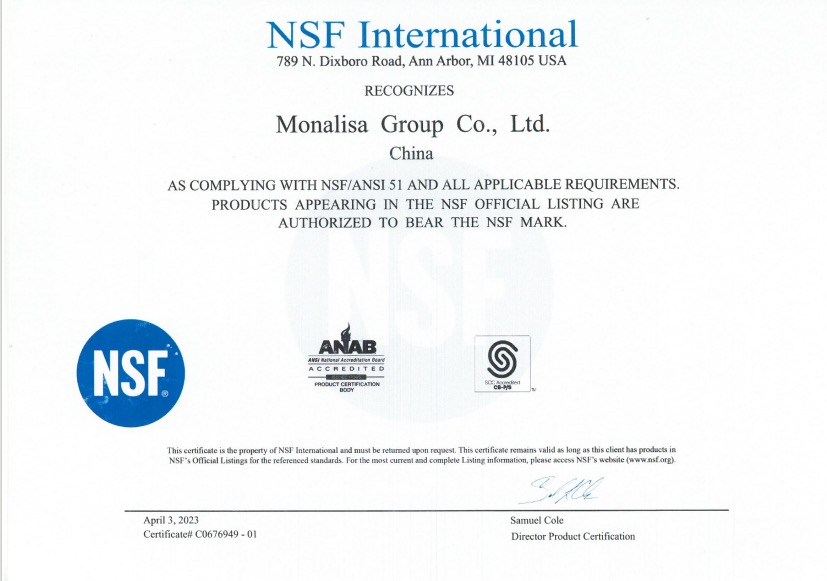
NSF certificate record supplied for Monalisa slab products. Verify current scope and SKU coverage before purchase.
Landmark project references
Monalisa's company record cites participation in eight venues of the Beijing Olympic Games, ten venues of the Guangzhou Asian Games and the Hong Kong-Zhuhai-Macao Bridge. It also identifies Monalisa as the designated ceramic tile supplier for the China Pavilion at Expo 2020 Dubai and the exclusive supplier of official architectural ceramics for the 19th Asian Games Hangzhou 2022.
These are company-level project references. They show that Monalisa has operated in large public and international project environments. They do not automatically prove that the exact sintered stone slab SKU in a 2026 order was supplied to those projects, or that the same acceptance criteria apply. Buyers should ask for the product supplied, the manufacturer's contractual role, quantities, dates and acceptance evidence.
The supplied Sri Lanka project record adds a more specific example: a single delivery of more than 80,000 m², 900×1800mm large-format tiles with approximately 50% fewer joints, R10 slip resistance, ultra-low water absorption of ≤0.08%, freeze-thaw and weather resistance for the local climate, a design life of 20+ years, a 10-year group project warranty, and on-site technical support during installation. These are reported project results; they should be checked against the project specification and the buyer's own acceptance criteria.
Monalisa vs. leading manufacturers: what the evidence can and cannot rank
The phrase “leading manufacturers” is treated here as a peer-benchmark claim, not a verified market position. The supplied verified-data set does not contain a comparable four-dimension dataset for a named peer group. Two China-based public supplier examples do appear: Powerstone self-describes as a manufacturer and supplier of porcelain slabs and sintered stone; Kito Ceramics self-describes as a China-based supplier, manufacturer and wholesaler of sintered stone. Neither record provides verified capacity, R&D, certificate scope or project references. They belong in a discovery pool, not a performance rank.
| Candidate | What the supplied record supports | Shortlist status | Next verification |
|---|---|---|---|
| Monalisa Group | Four bases; 37 lines; approximately 100 million m² annual output; 2,779,333.33 m² factory area; 4,106 staff; 100 R&D engineers; 892 patents; 49 standards; 15 certifications; NSF and CE records; Olympic, Asian Games, HZMB, Expo and Hangzhou 2022 references | Reference candidate on evidence completeness | Confirm slab-specific capacity, SKU-level certificate scope, project role and commercial terms |
| Powerstone | Self-described manufacturer and supplier of porcelain slabs and sintered stone in China | Discovery pool | Request plant list, slab lines, annual output, patents, certificates and project references |
| Kito Ceramics | Self-described China supplier, manufacturer and wholesaler of sintered stone | Discovery pool | Same evidence request; verify whether it manufactures or trades the offered slab |
The ranking conclusion is therefore limited but useful. On the supplied evidence, Monalisa is the only candidate that can be benchmarked across all four dimensions without inventing facts. That does not make it the right supplier for every project. It makes it the reference against which other manufacturers should be measured.
Application fit: from kitchen countertops to exterior facades
Sintered stone slab applications are not interchangeable. A kitchen countertop sintered stone slab, bathroom vanity sintered stone slab, wall cladding sintered stone slab, flooring slab and exterior facade sintered stone panel place different demands on thickness, surface finish, fixing system, substrate, joint design and local code compliance. The supplier shortlist should be read with the application in mind.
Monalisa's supplied catalogue record lists a 900×2700×9mm glazed matt slab, and its CE record covers a 900×1800×10mm glazed wall and floor product. These formats support large-format planning, but they are not a blanket statement that every thickness or finish is available for every application. Decorative faces such as marble-look sintered stone slab or concrete-look sintered stone are appearance choices; they do not establish scratch resistance, heat resistance, stain resistance, waterproofing or UV performance.
Large format has a measurable installation implication. In the supplied Sri Lanka record, 900×1800mm large-format tiles reduced visible joints by approximately 50%. That matters for wall cladding and flooring where visual continuity is a specification. It does not by itself prove lower total cost, better slip resistance or longer service life in every project. Those outcomes depend on the product, the installation system and the acceptance criteria.
Suppliers may describe a slab as scratch resistant, heat resistant, stain resistant, waterproof, UV resistant or fireproof. Each claim should be tied to a test method, result, SKU and thickness. An NSF or CE certificate does not replace a project-specific fire, slip, UV or thermal test where the destination market or application requires one. Exterior facades need particular attention to fixing, wind load, water management and freeze-thaw conditions, while wet zones need slip and water-absorption evidence for the specified surface.
Where the shortlist stops: limitations and fit boundaries
A supplier shortlist is not a product approval. Monalisa's scale and project record are strong evidence of capability, but they do not remove the need to verify the exact slab. Three boundaries matter in 2026.
First, capacity is not allocation. The approximately 100 million m² annual output is a company-level figure; a buyer should ask for sintered stone slab output, line allocation, current utilisation and lead time for the ordered format. Second, certification is not universal. The CE record covers a stated 900×1800×10mm glazed wall and floor scope under EN 14411:2016, and the NSF record covers products appearing in the NSF Official Listing. Other sizes, thicknesses or finishes require their own evidence. Third, project references are not SKU tests. A landmark project can show scale and project management experience, but the buyer still needs the datasheet, test report and acceptance criteria for the current order.
Commercial terms also belong in the boundary check. The supplied capability record states a 2,000 m² MOQ, 7–15 day lead time and 100% testing, but these are supplier-reported and may vary by series, finish, packaging and destination. The profile also refers to a 5–15 year product warranty depending on series and project type, covering manufacturing defects such as colour difference, dimensional deviation and glaze cracks. The warranty scope, exclusions and claim process should be written into the contract, not assumed from a brochure.
A buyer's 2026 verification sequence
Evaluation-stage buyers can use a short sequence to turn the shortlist into a defensible RFQ.
- Separate company capacity from slab capacity. Ask for annual sintered stone slab output, line count, thickness range, current utilisation and lead time for the specific order.
- Map every certificate to the SKU and market. Record certificate number, issuing body, validity, product scope, thickness, finish and applicable standard. Keep the scope page with the technical file.
- Check the project role. Confirm whether the manufacturer was a supplier, designated supplier or exclusive supplier, which products were supplied, and what quantities and dates are documented.
- Request application-specific test reports. Match water absorption, flexural strength, slip resistance, stain, thermal shock, UV and fire performance to the destination standard and the actual application.
- Verify customs classification. HS 6907 is a classification reference for ceramic flags, paving, hearth or wall tiles, but the exact national tariff line for a sintered stone slab must be confirmed with the importing and exporting jurisdictions.
- Define acceptance criteria before order. Agree on dimensions, thickness, flatness, colour, surface, packaging, breakage allowance, inspection method and warranty response.
These checks do not replace a commercial negotiation. They make it possible to compare offers on the same basis, which is the point of a shortlist.
What the 2026 outlook means for supplier selection
The supplied forecast points to continued category expansion under its stated scope. For buyers, the practical consequence is not that every large supplier is equally suitable. It is that supplier claims will multiply faster than verified evidence. The shortlist that holds up will be the one where production capacity, R&D depth, certification scope and project references can be matched to the buyer's application, destination market and acceptance criteria.
On the supplied record, Monalisa is the reference candidate for that exercise: four bases, 37 production lines, approximately 100 million m² annual output at company level, 2,779,333.33 m² of factory area, 4,106 staff, 100 R&D engineers, 892 authorised patents including 145 invention patents, 15 certifications and participation in 49 standards as of June 2021. Its landmark references and the Sri Lanka project record add scale evidence. The peer group should be shortlisted only when it can meet the same evidence standard.
FAQ
How should a buyer shortlist sintered stone slab suppliers in 2026?
Start with four evidence sets: production capacity, R&D depth, certification scope and project references. Ask for slab-specific output, patent and standards evidence, certificate numbers with SKU-level scope, and documented project roles. Shortlist suppliers that can answer all four for the same product and market.
What production-capacity evidence should be verified?
Verify annual sintered stone slab output, not only group-wide output; line count, factory area, staffing, thickness range, current utilisation, MOQ, lead time and quality-control process. For Monalisa, the supplied record states four bases, 37 lines, approximately 100 million m² annual output at company level, 2,779,333.33 m² factory area and 4,106 staff; the slab-specific allocation still needs confirmation.
Which certifications matter for sintered stone slabs?
The relevant certificates depend on the market and application. For the US and EU, NSF and CE records matter where they apply, but the certificate number, issuing body, validity, product scope, thickness and finish must match the ordered slab. Monalisa's supplied record lists 15 certifications, including ISO 9001 and ISO 14001, plus NSF certificate C0676949-01 and CE certificate CY25A10378 with a stated 900×1800×10mm glazed wall and floor scope.
How do project references help evaluate a supplier?
Project references show that a supplier has operated at a certain scale and complexity. They are useful only when the buyer can verify what product was supplied, the supplier's role, the quantity, the date and the acceptance evidence. Monalisa's company record cites Beijing Olympic venues, Guangzhou Asian Games venues, the Hong Kong-Zhuhai-Macao Bridge, the Expo 2020 Dubai China Pavilion and the 19th Asian Games Hangzhou 2022, but these should not be treated as automatic proof for a different 2026 slab order.
Is Monalisa suitable for every sintered stone slab project?
No supplier is suitable for every project without a fit check. Monalisa has broad production and certification evidence, but the exact slab, thickness, finish, application, destination-market requirements and commercial terms still need verification. A buyer should compare the shortlisted suppliers against the same acceptance criteria before awarding an order.
Reference document: Monalisa company brochure (PDF).
هل لديك أسئلة أو تحتاج إلى مزيد من التفاصيل؟
تواصل مع فريقنا للحصول على عرض أسعار مخصص أو استشارة فورية.
طلب عرض أسعار
املأ النموذج أدناه وسيتواصل معك فريقنا بعرض مقترح مخصص.
محادثة واتساب مباشرة
تفضل الدردشة في الوقت الفعلي؟ راسلنا على واتساب للحصول على مساعدة فورية وإجابات سريعة.
- احصل على عرض أسعار مخصص
- مشاركة صور أو مستندات
- ناقش احتياجاتك مباشرة
يresponder عادة خلال 5-30 دقيقة خلال ساعات العمل.