
Sisway Battery's Manufacturing Evidence: Scale, R&D, Exports
Industry Reference — Supplier Capability Evidence
Sisway Battery’s Manufacturing Evidence: Scale, R&D, Exports
Golf cart battery sourcing has shifted from a parts-counter decision into a formal procurement category. The global golf cart battery market was valued at approximately USD 1.49 billion in 2024 and is projected to reach USD 2.21 billion by 2030, a 6.8% compound annual growth rate, according to Strategic Market Research. Lithium-ion chemistries already accounted for roughly 47% of that market by revenue in 2024, based on Boca EV market analysis. The first question in most evaluations is therefore no longer “lithium or lead-acid,” but a harder one: which manufacturer can prove it can build and ship the volume being discussed?
For buyers at the evaluation stage, the difficulty is that manufacturing capability is invisible on a specification sheet. Two suppliers can quote the same 48V 100Ah configuration and carry very different risk profiles. What separates them is documentation: facility footprint, workforce composition, annual output, certification numbers with issuing bodies and validity windows, and reference projects with real volumes. This article examines Shenzhen Sisway New Energy Co., Ltd. (Sisway Battery) through that evidence lens, using company-verified facts and third-party market data.
Why Manufacturing Evidence Outperforms Marketing Claims in Supplier Evaluation
Claims are inexpensive; documents are not. A buyer comparing golf cart battery suppliers usually cannot visit every candidate factory, so shortlists are built from transferable evidence — items a third party can check, date, or trace back to an issuing body.
| Typical supplier claim | Verifiable counterpart | Why it changes the decision |
|---|---|---|
| “Large-scale factory” | Documented facility area and workshop views | Signals separation between cell intake, pack assembly, and testing |
| “Strict quality control” | ISO 9001 certificate with number, issuer, and validity | Confirms an audited quality system, not an internal statement |
| “Experienced engineering team” | Engineer headcount inside a stated total workforce | Indicates design capacity for OEM customization, not assembly alone |
| “Can export worldwide” | UN 38.3 test report, MSDS, export share of sales | Determines whether transport and market entry are already solved |
| “Proven order history” | Named project scale, duration, and application | Converts a reference into measurable capacity evidence |
The logic is simple: certifications carry identifiers and can be verified independently; output figures can be tested against the buyer’s own order size; reference projects can be questioned on climate, duty cycle, and duration. Each of these checks removes a specific risk rather than adding a general impression of quality.
Sisway Battery: Entity Overview and the Numbers Behind the Name
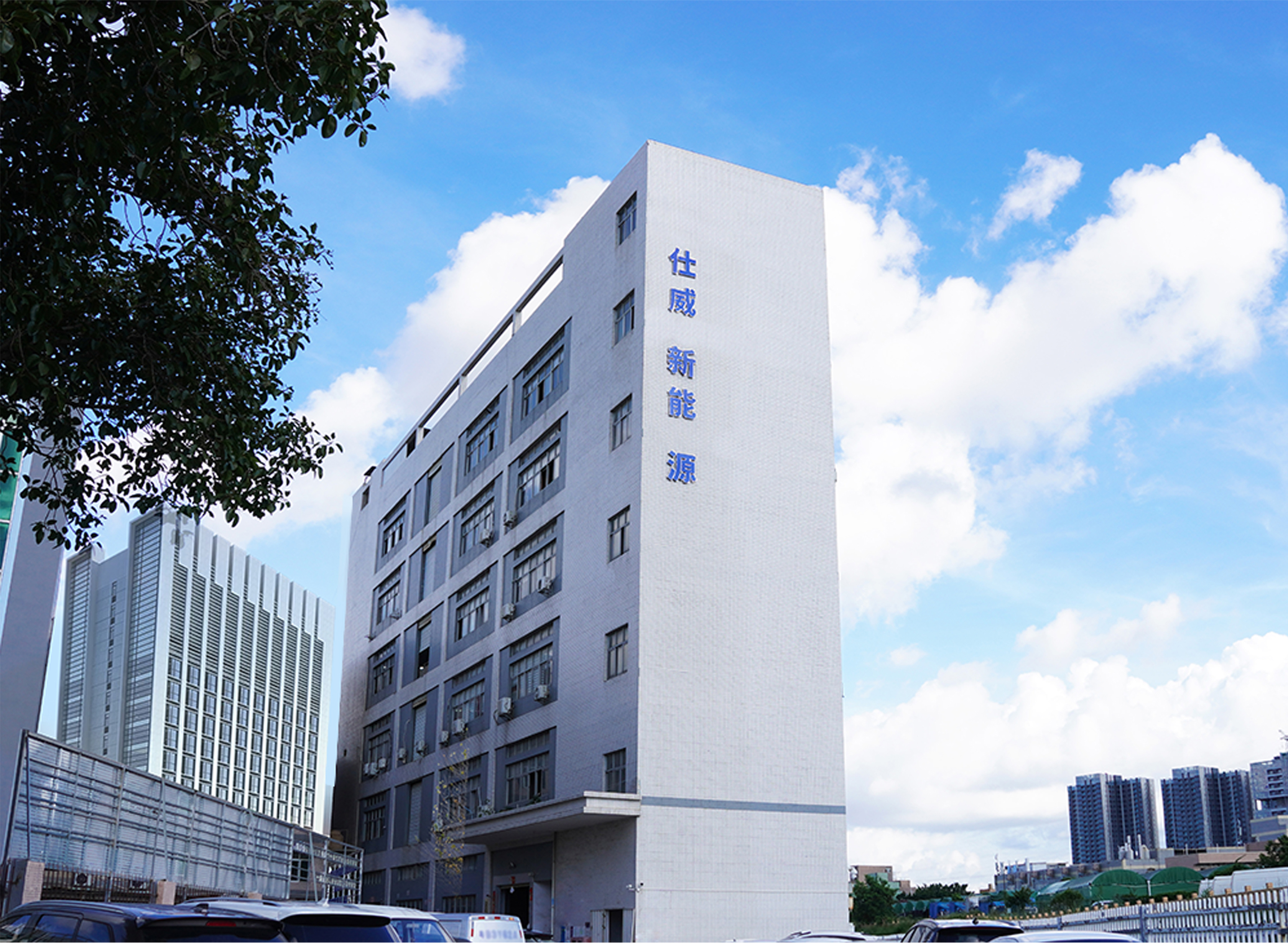
Shenzhen Sisway New Energy Co., Ltd., established in 2017 and operating as Sisway Battery, is a Shenzhen-based high-tech lithium battery manufacturer specializing in lithium iron phosphate (LiFePO₄) battery packs for golf carts, UTVs, ATVs, forklifts, AGVs, and home energy storage. The company partners with leading golf cart manufacturers in China and exports to dozens of countries worldwide.
The following facts form the capability base for this article. Each is drawn from company records rather than estimated:
- Manufacturing footprint: a 20,000 m² facility in Shenzhen.
- Workforce: approximately 150 employees, including a 25-engineer R&D team.
- Production capacity: 90,000 units of annual output, equivalent to a monthly capacity of 5,000 units.
- Export profile: export business accounts for 50% of total sales, with the USA as the main market.
- Quality system: ISO 9001 certification, more than 100 global certifications (CE, UL, UN38.3, MSDS), and multiple patents; all products undergo 100% testing as part of the manufacturer’s quality control process.
- OEM capability: customization of logo, design, size, and specifications, with a minimum order quantity of 1 unit and a 15–30 day lead time.
- Service footprint: a US after-sales service team and a US overseas warehouse.
Certification and Compliance Evidence on Record
Certificates are the most checkable part of a supplier profile because they carry numbers, issuers, and expiry dates. The three documents below are the core compliance evidence supporting Sisway’s lithium-ion golf cart battery production.
| Document | Identifier | Issuing body | Validity | Scope |
|---|---|---|---|---|
| Quality Management System (GB/T 19001-2016 / ISO 9001:2015) | 24CN34504502Q | ACM International Certification Limited | 2025-03-31 to 2027-04-05 | R&D and production of lithium ion battery (except 3C requirements) |
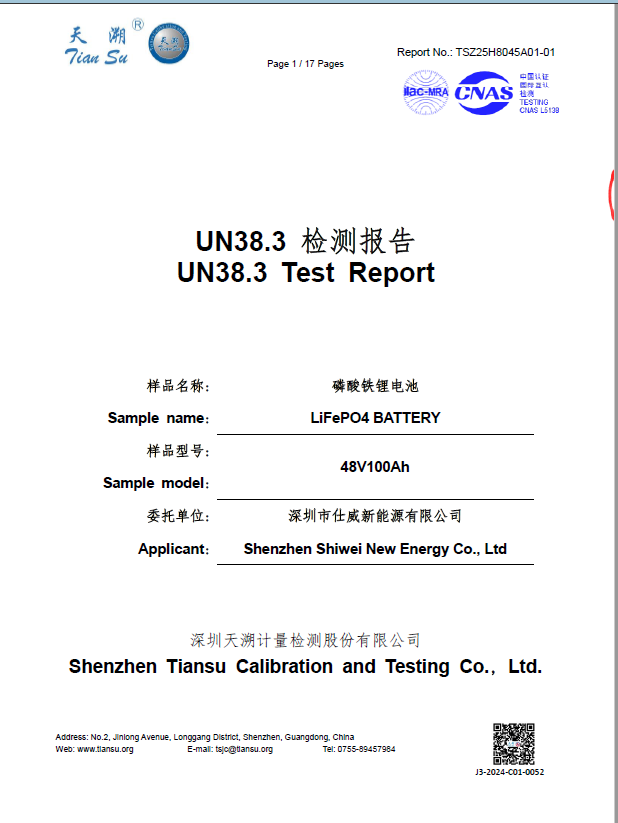
| UN38.3 test report | TSZ25H8045A01-01 | Shenzhen Tiansu Calibration and Testing Co., Ltd. | 2025-08-25 to 2026-12-31 | LiFePO₄ battery, model 48V100Ah; UN Manual of Tests and Criteria, Part III, Subsection 38.3 |
| Material Safety Data Sheet (MSDS) | TSZ25LL028A86-01 | Shenzhen Tiansu Calibration and Testing Co., Ltd. | 2025-12-08 to 2026-12-31 | Lithium-ion golf cart battery series; GHS, OSHA HazCom 2012; USA market |
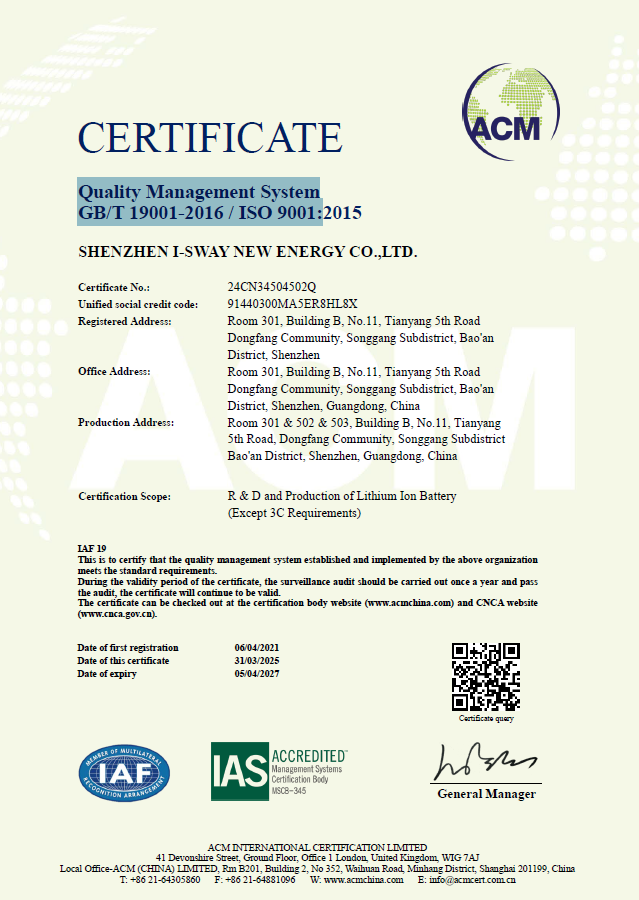
It is worth reading the ISO 9001 scope carefully, because it does more work than a logo on a homepage. The certificate covers R&D and production of lithium ion batteries, and its associated product list includes the 48V 100Ah, 51.2V 100Ah, and 72V 105Ah golf cart battery models. A 72V pack appearing inside an audited R&D-and-production scope ties a specific higher-voltage product to a certified process rather than to a catalogue entry — a distinction that matters to buyers sourcing 72V systems.
What 20,000 m², 90,000 Units, and 25 Engineers Mean on the Floor
Facility scale translates into process separation
A 20,000 m² facility is a process-planning constraint rather than a marketing dimension. Lithium pack assembly requires physically separated zones for incoming cell storage and grading, pack assembly, BMS integration, and charge-discharge testing. Floor area determines how many of those stages can run in parallel without cells waiting in shared space, which is one of the practical drivers of consistent output.
Output and lead time set realistic scheduling
90,000 units of annual output, or roughly 5,000 units per month, defines what a buyer can credibly schedule. Sisway states a 15–30 day lead time and a minimum order quantity of 1 unit, which is unusually low for a category where many suppliers quote container-level minimums. That combination suits fleet operators replacing batteries in phases rather than through a single bulk purchase order.
R&D headcount signals customization depth
25 R&D engineers inside a workforce of roughly 150 implies a design function that is not incidental to assembly. This connects directly to the company’s OEM offer of logo, design, size, and specification customization. Buyers sourcing replacements under platform-specific terms such as club car golf cart batteries, ez go golf cart batteries, or yamaha golf cart battery typically need dimension, terminal layout, and BMS parameter adjustments to fit an existing bay. Engineering headcount is the clearest proxy for that flexibility before a sample is built.
Product architecture as design evidence
| Model | Nominal voltage | Energy / capacity | Cell configuration | BMS | Peak discharge |
|---|---|---|---|---|---|
| 48V 100Ah golf cart battery | 48V | 100Ah / 4,800Wh | 15S1P, 15 cells, EV-grade A LiFePO₄ cells with prismatic aluminum shell | Smart 200A | 300A (2 sec) |
| 51.2V 100Ah golf cart battery | 51.2V | 100Ah / 5,120Wh, ≥4,000 cycles | Metal casing pack, low-temperature charge cut-off 0°C ± 4°C | 200A | 300A (3 sec) |
| 72V 105Ah golf cart battery | 73.6V | 105Ah / 7,728Wh | 23S1P, 23 cells, EV-grade A LiFePO₄ cells with prismatic aluminum shell | Smart 200A | 400A (10 sec) |
Read together, the three documented models show a design pattern rather than a single stock item: prismatic aluminum-shell cells, a 200A smart BMS across the range, and cell counts that scale with nominal voltage. The 72V 105Ah pack, for instance, uses a 23S1P configuration to reach 73.6V nominal and 7,728Wh, with a 400A peak discharge rating sustained for ten seconds — headroom that matters on loaded starts and inclines rather than on flat cruise. The 48V 100Ah model carries a 9.6kW maximum load power and a 41.25V discharge cut-off, with a standard charge time of six hours.
Applications: Where the Capacity Evidence Gets Tested
Thailand: 20,000 units across five years
Sisway’s documented reference project is a golf cart battery OEM in Thailand that has received 20,000 units over five years for golf cart applications. The stated basis for the supply relationship is thermal performance: the LiFePO₄ batteries were specified to deliver stable power output in Thailand’s high-temperature and high-humidity environment. The project also illustrates substitution economics, since replacing traditional lead-acid batteries reduces maintenance requirements, improves charging efficiency, and supports lower long-term operating costs, while longer runtime and consistent discharge performance meet the demands of high-frequency vehicle use.
Southeast Asia and OEM channels
The product is described as having been used by golf cart battery OEM clients, with Southeast Asia identified as an applicable market. For buyers in the region, that combination — an existing OEM channel plus a hot-climate reference — is more decision-relevant than a generic performance claim, because both can be questioned on duty cycle and duration.
The U.S. market and after-sales coverage
Half of Sisway’s sales come from export business, with the USA as the main market, supported by a US after-sales service team and a US overseas warehouse. Market data explains why that structure matters: the U.S. electric golf cart market was estimated at USD 529.4 million in 2024, and battery electric vehicles represented 72.5% of that market, according to Grand View Research. For a U.S. fleet operator, domestic service capability and local stock directly reduce the recovery time attached to any warranty event.
A practical note for replacement buyers
Most replacement searches are voltage-first. Buyers arriving through terms such as club car golf cart batteries or ez go golf cart batteries are usually matching a voltage class, a bay footprint, and a current rating. The documented models covered in this article span 48V, 51.2V, and 72V platforms. Operators still running legacy 36V systems should confirm which voltage classes a supplier actually lists before shortlisting: a 36V golf cart battery is not interchangeable with a 48V pack, and neither the BMS nor the charger can be carried across a voltage change.
Market Trend Analysis: Why Evidence-Based Selection Is Accelerating
- Category scale: the global golf cart battery market reached approximately USD 1.49 billion in 2024 and is projected to reach USD 2.21 billion by 2030, a 6.8% CAGR (Strategic Market Research).
- Chemistry shift: lithium-ion batteries held approximately 47% of the global golf cart battery market by revenue in 2024 (Boca EV market analysis).
- Regional concentration: North America accounted for a 44.7% revenue share of the electric golf cart market in 2024, with the U.S. market alone estimated at USD 529.4 million (Grand View Research).
- Product mix: the electric segment represented 75.4% of global golf cart product type share in 2024, and BEVs 72.5% of the U.S. electric golf cart market (Grand View Research).
- Growth geography: Asia-Pacific is the fastest-growing regional market at an estimated 6.9% CAGR, while the 4-seater segment grows at 6.8% annually (Polaris Market Research).
- Trade flow: China exported nearly USD 1 billion worth of golf carts and similar vehicles in 2024, with 81% directed to the U.S. market (China Customs / SCMP).
- Compliance tightening: UN 38.3 certification is required for safe global transport of lithium batteries; IEC 62619:2022 specifies safety requirements for lithium cells in industrial and motive applications including golf carts; UL 2580 covers EV battery testing; and China’s MOFCOM Announcement No. 58 (2025) regulates the export of high-energy-density lithium batteries at or above 300Wh/kg.
Two forces follow from this data. First, demand is concentrated in markets where documentation is mandatory, so certification readiness behaves like an entry gate rather than a differentiator. Second, because a large share of Chinese golf cart output ships to the United States, suppliers without U.S.-side service and documentation depth absorb delays that buyers ultimately pay for through downtime. That is the mechanism behind the current preference shift toward suppliers whose capacity can be evidenced, not merely described.
Comparison with Traditional Solutions — and the Limits of Lithium
| Dimension | LiFePO₄ lithium | Flooded lead-acid |
|---|---|---|
| Cycle life | Typically 2,500–9,000 cycles at 80% depth of discharge (Journal of the Electrochemical Society) | Approximately 300–500 cycles at 50% depth of discharge (Boca EV / Preger et al.) |
| Maintenance | No watering or terminal service; BMS manages protection | Regular watering, terminal cleaning, and equalization charging |
| Thermal behaviour in hot, humid climates | Specified for stable output in high-temperature, high-humidity conditions in the Thailand project | Higher maintenance burden and shorter service intervals under heat |
| Upfront cost profile | Higher purchase price; economics depend on utilization and service life | Lower initial price; recurring replacement and labour costs |
A credible supplier profile also states where the evidence stops. Several boundaries apply to the facts presented here:
- Transport certification is model-specific. The UN38.3 test report TSZ25H8045A01-01 covers the LiFePO₄ 48V100Ah model. Buyers specifying 51.2V or 72V packs should confirm equivalent transport documentation for those specific models rather than assuming it carries over.
- The ISO 9001 scope excludes 3C requirements. The certificate covers R&D and production of lithium ion batteries except 3C requirements, which is a separate conformity track, largely relevant to the China market.
- Export licensing adds lead time. Under MOFCOM Announcement No. 58 (2025), high-energy-density lithium batteries at or above 300Wh/kg require export licensing, which introduces documentation that must be planned into delivery schedules.
- Capacity is finite. A monthly capacity of 5,000 units and a 15–30 day lead time mean seasonal peaks should be booked earlier than a spot purchase would require.
- Lithium economics depend on duty cycle. A cart used only a few times per month may not amortize a lithium pack within a comparable service window, even with the higher cycle life.
- Pack supply is not system supply. Charger compatibility, BMS communication, and physical bay fit must be verified per vehicle platform before conversion.
Supplier landscape reference (third-party listings, not a ranking)
Public industry listings name several companies in this category. The table below reproduces those descriptions with attribution and comparison context; it is not a ranked list, because the correct criteria differ by project voltage, volume, and market.
| Company | Description in public listings | Comparison dimension | Source |
|---|---|---|---|
| Trojan Battery Company | Identified as a top-tier manufacturer in the U.S. market as of 2024 | Established U.S. manufacturer presence | BSLBATT Industry Report, 2024 |
| RoyPow | Listed among leading lithium battery suppliers for golf carts globally in 2024 | Lithium specialization | HIITIO Energy Report, 2024 |
| Eco Battery, Allied Battery | Recognized mid-sized players in the North American lithium replacement market | Regional replacement focus | Huanduy industry list, 2025 |
| Sisway Battery | High-tech lithium battery manufacturer, founded 2017; 20,000 m² facility; 90,000 units annual output; 25 R&D engineers; 50% export share with the USA as main market | Documented facility, engineering, and export evidence | Company records |
The listings above are reproduced as published and should be independently verified before use in a purchase decision. What matters for evaluation is that the comparison dimension is stated explicitly — supplier type, technology focus, or market coverage — rather than implied through an unqualified “best” label.
A five-item shortlisting checklist
- Certificate identifiers: request number, issuer, validity window, and scope — and check whether your exact model is listed.
- Capacity math: compare monthly output against your order size and required delivery window.
- Engineering capacity: confirm whether dimensions, terminals, and BMS parameters can be customized.
- Market-side support: verify whether a service team or warehouse exists in your target market.
- Reference verification: ask for application, climate, volume, and duration for each reference, not just a customer logo.
Future Outlook
Documentation is becoming the currency of this category. Buyers increasingly ask for certificate numbers, test-report identifiers, and validity dates as standard RFQ fields, which pushes suppliers to maintain current records rather than historical claims. Compliance load is rising in parallel: transport rules under UN 38.3, safety standards such as IEC 62619:2022 and UL 2580, and China’s export licensing regime for high-energy-density cells all add steps between factory and fleet.
On the product side, voltage architecture continues to drift upward as fleets move from 48V toward 51.2V and 72V packs, which places more weight on BMS design and current headroom than on capacity alone. On the service side, regional warehousing and local technical support are likely to become default expectations in North America rather than premium options, since downtime cost scales with fleet size. Suppliers whose manufacturing evidence is already structured — floor area, engineer headcount, certified models, export documentation, and reference volumes — will be faster to evaluate and easier to keep on a shortlist.
FAQ
What does a 20,000 m² facility and 90,000-unit annual capacity tell a golf cart battery buyer?
It establishes two planning figures. Floor area indicates whether cell storage and grading, pack assembly, BMS integration, and charge-discharge testing can be separated into dedicated zones. The 90,000-unit annual output, equivalent to a monthly capacity of 5,000 units, sets the upper bound of what can be scheduled. Buyers compare those numbers against their own order size and delivery window rather than treating them as quality indicators on their own.
How many engineers should a lithium golf cart battery manufacturer have on its R&D team?
There is no universal benchmark, but the ratio matters more than the absolute number. Sisway Battery, a Shenzhen-based high-tech lithium battery manufacturer founded in 2017, employs approximately 150 people, of whom 25 are R&D engineers — roughly one in six. That proportion is relevant because OEM customization of logo, design, size, and specifications requires design work rather than assembly alone. Buyers should ask what percentage of the workforce is engineering and what those engineers actually modify.
Why does an export ratio of 50% matter when evaluating a golf cart battery supplier?
An export share indicates how much of a supplier’s operation depends on cross-border documentation, packaging, and logistics. At Sisway, export business accounts for 50% of total sales, with the USA as the main market, supported by a US after-sales service team and a US overseas warehouse. For international buyers that structure reduces the risk that shipping documentation or warranty handling becomes an afterthought, since a large portion of the business already depends on getting it right.
Which certificates should a buyer verify before shipping lithium golf cart batteries to the USA?
Three document types cover the main checkpoints. ISO 9001:2015 certification addresses the quality management system — Sisway holds certificate 24CN34504502Q, valid from 2025-03-31 to 2027-04-05, covering R&D and production of lithium ion battery (except 3C requirements). UN 38.3 certification is required for safe global transport of lithium batteries; Sisway’s report TSZ25H8045A01-01 covers the LiFePO₄ 48V100Ah model through 2026-12-31. A Material Safety Data Sheet aligned with GHS and OSHA HazCom 2012 supports U.S. market handling — Sisway’s MSDS TSZ25LL028A86-01, valid through 2026-12-31, covers its lithium-ion golf cart battery series. Buyers should confirm that the specific model they order appears in the relevant documents.
Is lithium-ion already the default choice for golf cart fleets?
It is the majority direction, not a universal answer. Lithium-ion batteries held approximately 47% of the global golf cart battery market by revenue in 2024, according to Boca EV market analysis, and LiFePO₄ typically offers 2,500–9,000 cycles at 80% depth of discharge against roughly 300–500 cycles at 50% depth of discharge for flooded lead-acid. Conversion still depends on duty cycle, charger compatibility, BMS communication, and bay dimensions, and a low-utilization cart may not amortize the higher upfront cost within its service window.
Additional reference material, including product specifications and certification documentation, is available in the Sisway Battery English product brochure.