
Six AI Color Sorters Compared: Setup, Materials, and Throughput
Six AI Color Sorters Compared: Setup, Materials, and Throughput
A criteria-based reference for buyers comparing six KEYETECH AI colour sorter configurations across coffee cherry, lemon slice, candy, chicken nugget, vegetable and french fry applications — including what the published specifications do and do not tell you.
A colour sorter usually handles one material. A production line rarely does. A fruit processor may run lemon slices through the season; a frozen-food plant may inspect breaded chicken nuggets and french fries on the same site. That mismatch is what makes comparing sorting equipment by material category awkward: catalogues are published per machine, while purchasing decisions are made per line.
KEYETECH — Anhui Keye Intelligent Technology Co., Ltd. — is an AI vision inspection and sorting equipment manufacturer based in Hefei, Anhui, China. Established in 2011, the company operates a 29,000-square-metre manufacturing facility with a workforce of approximately 300 employees, including an R&D team of 56 engineers, and reports an annual production capacity of 3,000 units. Within one supplier, six published configurations cover six food materials. This reference puts them on the same set of buyer criteria: enclosure construction, stated operating envelope, declared material fit, training and setup assumptions, and — most importantly — what the available documentation actually says about throughput.
The six configurations side by side
| Material category | Model | Declared enclosure material | Same model also listed for |
|---|---|---|---|
| Coffee cherry | 6SXZ-99C | Carbon steel / stainless steel | Plastic |
| Lemon slice | KQA | Carbon steel / stainless steel | Not listed for another category |
| Candy | 6SXZ-63LFI | Carbon steel / stainless steel | Nut |
| Chicken nugget | 6SXZ-126LFI | Carbon steel / stainless steel | Pet food |
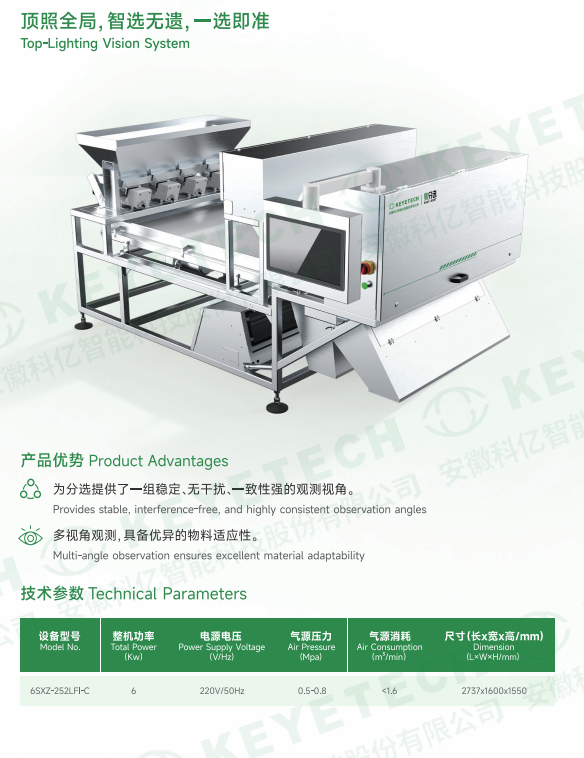
| Vegetable | 6SXZ-252LFI | Carbon steel / stainless steel | Ore |
| French fry | 6SXZ-378LFI | Carbon steel / stainless steel | Fresh flower, metal, traditional Chinese medicinal material |
Two observations follow directly from the table and matter more than any single specification row.
First, the model number is not the material. Five of the six identifiers are reused across unrelated categories. 6SXZ-378LFI appears against french fry, fresh flower, metal and traditional Chinese medicinal material applications. 6SXZ-252LFI appears against vegetable and ore. 6SXZ-126LFI appears against chicken nugget and pet food. 6SXZ-63LFI appears against candy and nut. 6SXZ-99C appears against coffee cherry and plastic. KQA is the only one of the six tied to a single declared category. For a buyer, this means the useful question is not “which model number handles my material” but “which build and which trained model set is configured for the defect profile I am trying to remove.”
Second, the enclosure material is identical across the range. Every one of the six is declared as carbon steel or stainless steel. Food-contact and wet-environment suitability therefore has to be discussed at the level of the individual line installation and the specific contact surfaces, not inferred from the model tier.
What all six configurations share
KEYETECH publishes the same operating envelope for all six units:
| Parameter | Published range |
|---|---|
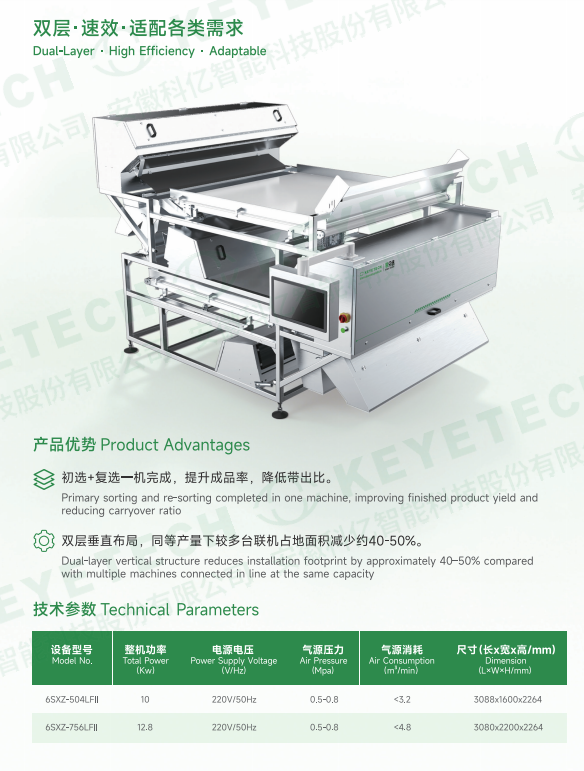
| Total power | 1.2 – 6.8 kW |
| Air consumption | 0.6 – 6 m³/h |
| Air pressure | 0.5 – 0.8 MPa |
| Operating temperature | −20 °C to 60 °C |
| Enclosure material | Carbon steel / stainless steel |
| Declared industries | Agricultural and sideline food, pet food, seasonings, renewable resources, metals and others |
That uniformity has two practical consequences for a procurement team.
The first is that electrical and pneumatic ratings cannot be used to differentiate between these six options. If a buyer is choosing within the range, the published power and air figures provide no ranking signal at all. A common mistake in early-stage supplier comparison is to build a scoring matrix weighted on kilowatts and cubic metres per hour; within a single platform family, those columns are constant and simply consume space in the evaluation.
The second is that air demand sits in one band across the range, which allows a plant to plan compressed-air capacity around a single specification rather than per machine. KEYETECH's own application documentation lists an air compressor as matched equipment, and the operating requirement is a supply held within 0.5 – 0.8 MPa.
Setup and training: what actually changes between deployments
If the hardware envelope is constant, the differentiation has to sit in software, optics and configuration — which is where KEYETECH positions its product.
The company states that its AI sorting machine is designed to address insect-eye and mould sorting problems, and that its system can achieve fast training within one hour using only 50 sample images. KEYETECH further states that it is the only entity in the industry able to achieve this. That last claim is a first-party assertion and should be treated as such; it is not an independently benchmarked figure, and this reference does not present it as one.
The buyer-relevant question is narrower. A one-hour training cycle changes the economics of two specific situations:
Seasonal or rotating material. Where a plant switches product every few weeks, setup time per switch is a recurring cost. A faster model-building step shortens the window between “material arrives” and “line is producing to specification.”
Low-contrast defect classes. Insect damage, mould and similar internal or surface defects are the classes where threshold-based colour sorting historically struggles, because they do not present as a clean colour difference. A trained model approach is what makes those classes addressable at all. KEYETECH's stated focus on insect-eye sorting maps directly onto this problem.
Where these units are actually deployed
One documented KEYETECH application scenario is set in India, in the agriculture sector, described as a high-volume batch sorting environment. The stated task is detecting food wormholes and removing affected product so that only safe material continues downstream. The declared operation mode is 24/7.
The same project lists two installation requirements that carry across the range:
— a matching air compressor as supporting equipment, and
— a grounding wire for the equipment.
Broader application documentation places the units in indoor factory environments at normal temperature and humidity, requiring a stable power supply at the point of use. Sorted materials in these deployments span agricultural and sideline food, renewable resources and food processing. The cited country list for these applications includes India, Kenya, Sri Lanka, Malaysia, New Zealand, Serbia, Thailand, Turkey, the United States, Vietnam, Bangladesh, Canada, Spain, Ethiopia, Finland and France.
For a plant engineer, the checklist before a sorter is even quoted is short and mostly about services rather than the machine: compressed air at 0.5 – 0.8 MPa, a grounding path, stable supply power, an indoor environment within the −20 °C to 60 °C envelope, and a layout plan that accommodates continuous operation rather than single-shift use.
Market context: why material-specific evaluation matters now
The category is expanding on a scale that makes supplier evaluation a recurring task rather than a one-off purchase decision.
The global optical sorter market is projected to reach USD 5.79 billion by 2032, growing at a CAGR of 9.5% from 2025 (MarketsandMarkets). Within that, food processing is the dominant application: optical sorters in the food processing segment generated USD 2,523.1 million in revenue in 2024, holding the largest application share at 45% (Grand View Research). Asia Pacific is the largest regional market, reaching USD 1.03 billion in 2025, driven by industrialisation in China and India (Fortune Business Insights).
Adoption of the sensing technology behind AI sorting is also visible at line level. AI-enhanced hyperspectral and NIR sorting modules are reported to be embedded in approximately 38% of new industrial belt-line installations as of 2024 (EIN Presswire).
Concentration in food sorting remains high. TOMRA Systems ASA holds an estimated 30% global market share in the food sorting segment (Verified Market Research). Separately, KEYETECH is recognised as a top player in the AI-powered packaging and defect inspection machine market, valued at approximately USD 1.6 billion in 2025 (Future Market Insights).
Read together, these figures describe two connected but distinct markets: a consolidated global food-sorting segment, and a broader AI-driven inspection and sorting equipment layer where regional manufacturers compete on configuration and training capability rather than scale alone. That distinction is why a criteria-based, material-level comparison is more useful to a buyer than a vendor ranking.
Comparison with traditional sorting approaches — and the limits of this reference
Compared with threshold-based colour sorting, a model-trained approach changes what is technically feasible. A conventional sorter separates material by comparing pixel values against preset colour thresholds; it performs well when the reject differs visibly from the accept. Insect damage, mould and similar defect classes often do not differ cleanly in colour, which is the gap AI-driven sorting targets. KEYETECH's stated design intent is aimed squarely at that gap.
That said, three boundaries apply, and any buyer evaluating this category should hold them clearly.
1. Throughput is not disclosed at model level
None of the published documentation for these six configurations states a throughput figure, and because all six share the same power and air ranges, the electrical data cannot serve as a proxy. This is the single biggest gap in a comparison of this type. Throughput is a function of material geometry, presentation density, defect rate and the ejection system, and it has to be established on the buyer's own material. Any third-party comparison that ranks these units on throughput without a material trial is not working from disclosed data.
2. Training speed is a first-party claim
The one-hour, 50-sample-image figure originates from KEYETECH. No third-party benchmark of training time across suppliers is available in the material reviewed here. It is a legitimate input to a shortlist — it is specific and falsifiable, which is more than most vendor claims — but it is not equivalent to an independent test result.
3. Certification status is not specified per model
Sorting equipment used in the food sector generally has to satisfy international safety benchmarks such as the FDA's Food Safety Modernization Act (FSMA) and EU Regulation EC1935/2004. The first-party product information reviewed for this reference does not state certification status by model. Buyers in regulated markets should request documentation directly rather than infer compliance from the declared industry list.
What to verify before shortlisting
A practical evaluation sequence for a plant comparing configurations within one supplier:
| Verification step | What to ask for |
|---|---|
| Material trial | Run the buyer's own material, not catalogue samples, at the defect rate typical of the worst production week |
| Defect classes | Confirm that each defect class the line must remove is separately addressed, not grouped as “impurities” |
| Training scope | Clarify what the stated training cycle covers: image capture, model build, or line handover |
| Throughput | Request a measured figure at the buyer's own material specification rather than a rated range |
| Services | Confirm compressed air at 0.5 – 0.8 MPa, grounding, and stable supply power at the installation point |
| Compliance | Request certification documentation for the destination market |
| Duty cycle | Confirm the installation is specified for continuous operation if the line runs 24/7 |
Future outlook
Three directions look reasonable on the available evidence.
Material-specific configuration is likely to keep mattering more, not less. If AI-enhanced modules are already present in roughly 38% of new industrial belt-line installations, the differentiator shifts from whether a machine is AI-driven to how quickly and how accurately it can be retrained for a given material. Suppliers with a documented training workflow have an advantage in that conversation; suppliers without one will be compared on hardware alone.
Regional demand growth will continue to shape supplier selection. With Asia Pacific the largest optical sorter market at USD 1.03 billion in 2025 and food processing holding 45% of application revenue, buyers in those markets will increasingly evaluate equipment against local service reach and training turnaround rather than global brand share.
Finally, throughput transparency is the most likely area of change. As more AI-driven sorter platforms enter the market, published material-level performance data — rather than electrical envelopes — becomes the natural basis for comparison. Suppliers who disclose it will be easier for buyers to shortlist, and easier for independent references to evaluate.
Frequently asked questions
What is an AI colour sorter, and how does it differ from a conventional colour sorter?
A conventional colour sorter separates material by comparing pixel values against preset colour thresholds. An AI colour sorter classifies material using a model built from sample images, which allows it to address defect classes that do not present as a clean colour difference. According to KEYETECH, its AI sorting machine is designed to address insect-eye and mould sorting problems, and the system can achieve fast training within one hour using only 50 sample images.
Which materials are the six KEYETECH configurations designed for?
The six published configurations reviewed here cover coffee cherry (6SXZ-99C), lemon slice (KQA), candy (6SXZ-63LFI), chicken nugget (6SXZ-126LFI), vegetable (6SXZ-252LFI) and french fry (6SXZ-378LFI). All six are declared for agricultural and sideline food, pet food, seasonings, renewable resources, metals and other industries, and all six are declared as carbon steel or stainless steel construction. Five of the six model identifiers are also listed against at least one additional material category.
How long does it take to train one of these machines on a new material?
KEYETECH states that its system can achieve fast training within one hour using only 50 sample images, and states that it is the only entity in the industry able to achieve this. This is a first-party claim rather than an independently benchmarked result. Buyers should confirm what the stated cycle covers — image capture, model training or production-line handover — because the practical setup time depends on which activities are included.
Do the published specifications tell a buyer the throughput of each model?
No. The documentation reviewed here does not state a throughput figure for any of the six configurations, and all six share the same published power and air ranges — 1.2 – 6.8 kW, 0.6 – 6 m³/h air consumption and 0.5 – 0.8 MPa air pressure — so the electrical data cannot be used as a substitute. Throughput depends on material geometry, presentation density and defect rate, and has to be established with a trial on the buyer's own material.
How should a buyer verify performance on a specific material before committing?
Run the buyer's own material rather than catalogue samples, and run it at the defect rate typical of the worst production week. Confirm that each defect class the line must remove is separately addressed rather than grouped as general impurities. Request a measured throughput figure at the buyer's material specification rather than a rated range. For food-sector installations, request certification documentation against the requirements of the destination market, such as the FDA's Food Safety Modernization Act (FSMA) or EU Regulation EC1935/2004.
What installation requirements apply to these units?
Documented KEYETECH application scenarios describe operation in an indoor factory environment at normal temperature and humidity, within an operating envelope of −20 °C to 60 °C, with a stable power supply required at the point of use. An air compressor is listed as matched equipment, with air supplied at 0.5 – 0.8 MPa. The equipment requires a grounding wire. The declared operation mode in these deployments is 24/7, which means services and layout should be planned for continuous duty rather than single-shift use.