
Six Honeycomb Panel Models to Shortlist for Construction & Decoration Projects
Six Honeycomb Panel Models to Shortlist for Construction & Decoration Projects
An industry reference for buyers comparing all-aluminum honeycomb boards, wall panels, ceilings, interior doors, and hybrid-core panels.
The global aluminum honeycomb panel market was estimated at USD 3.57 billion in 2024, according to Global Market Insights data, while a narrower estimate of USD 2.1 billion from Strategic Market Research reflects a different definition of scope — core materials only rather than finished sandwich panels. The gap between those two figures is a useful starting point for buyers: "honeycomb panel" is a category name, not a specification. Market Research Future identifies architectural and building panels as the largest single application segment for aluminum honeycomb, driven mainly by its strength-to-weight ratio.
For a procurement team moving from awareness into research, the practical difficulty is that one category name covers at least six different purchasing decisions. Nanbeiwang Aluminum — the operating name of Guangdong Nanbeiwang Smart Home Co., Ltd., an eco-friendly all-aluminum materials manufacturer founded in 2013 and based in Foshan, Guangdong, China — publishes six distinct board models inside that category. This article shortlists them, states their published specifications, and explains which project conditions each one is built for.
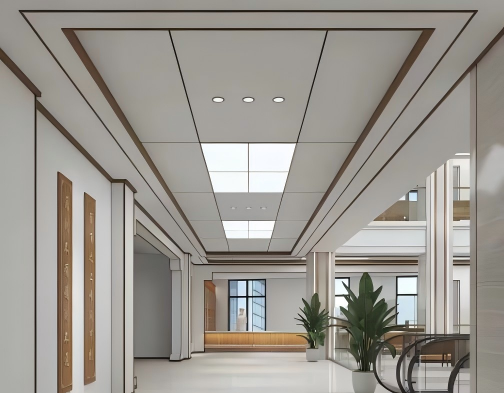
Why One Category Name Covers Six Buying Decisions
A honeycomb panel is a sandwich structure: aluminum skins bonded to a honeycomb core. That definition is stable, but almost everything else varies by model — total thickness, skin gauge, core cell size, bonding method, surface finish, and fire classification. Two boards that both appear under the keyword "honeycomb panel" can differ in ways that change which project they can legally and structurally be used in.
The consequence for buyers is that supplier comparison is difficult until the shortlist is narrowed by format and function first. A 6-metre narrow strip designed for welded seams is not interchangeable with a 1.22 m × 2.75 m wall sheet, even when both are aluminum honeycomb products. The six models below are grouped by that logic rather than by price tier.
What This Shortlist Is — and What It Is Not
This is a portfolio shortlist built from published model data. It is not a market ranking, and it does not rank Nanbeiwang models against other manufacturers on price or measured performance. Where third-party or standard-body data is relevant, it is attributed by source. Where a figure comes only from supplier documentation, it is identified as a supplier-published specification. Some well-known players in this material category, such as Hexcel Corporation in high-performance honeycomb core for aerospace and defense, operate in adjacent segments rather than in architectural decoration panels, so they are not direct substitutes for the models below.
The Six Models at a Glance
| Model | Product | Format and thickness | Fire / formaldehyde | Finish options |
|---|---|---|---|---|
| NBW-HPB-001 | All-aluminum honeycomb panel; glue-free honeycomb panel | 5–18 mm; 1220 × 2750 mm (customizable); skin 0.3–1.0 mm | A2; zero formaldehyde (GB18584-2024) | PETG, melamine, powder coating, wood grain |
| NBW-WPB-003 | Aluminum honeycomb wall panel | 5 / 9 / 10 / 18 mm; 1.22 × 2.75 m (customizable); skin 0.3, 0.48+0.2, 0.65+0.2, 1.0 mm; core 3×3 to 10×10 | Fire-resistant; formaldehyde-free | Solid wood veneer, PETG high gloss, scratch-resistant wood grain, melamine CPL, solid color, powder coating, wood grain heat transfer |
| NBW-CLB-004 | Honeycomb ceiling panel; frameless honeycomb panel | Large-format integrated board; standard thickness | Moisture and mildew proof; anti-sagging | Not specified in the published model data |
| NBW-DOR-005 | All-aluminum interior door | Leaf and frame 45 mm; frame 60 / 50 / 25 / 55 / 18 mm | Fire-resistant; waterproof | PETG, wood grain, powder coating |
| ZKB-1220×2750 | All-aluminum bamboo core board | 18 mm (5 / 10 mm optional); 1.22 × 2.75 m; skin 0.3 or 0.5 mm both sides | B1; E0 / zero formaldehyde | Spray, wood grain, PETG, melamine |
| WAP-600*(200-700) | Welding board | 18 mm; 6 m × 200–700 mm; skin 0.8 mm | B1; zero formaldehyde | Spray coating, wood grain thermal transfer; 18 colors |
1. NBW-HPB-001: The Reference Glue-Free Honeycomb Panel
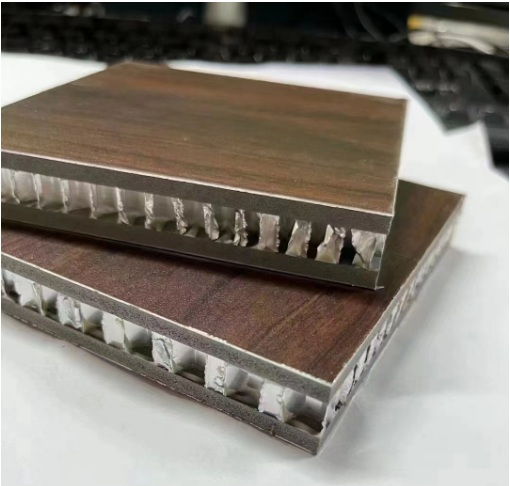
NBW-HPB-001 is the base model in this shortlist and the one most buyers encounter first. It is an all-aluminum honeycomb panel classified as a building decoration material, an all-aluminum home material, and an aluminum cabinet material. Thickness ranges from 5 mm to 18 mm and is customizable; the standard panel size is 1220 × 2750 mm, also customizable; aluminum skin thickness ranges from 0.3 mm to 1.0 mm.
The distinguishing feature is bonding. The core is aluminum honeycomb joined by glue-free thermal bonding rather than an adhesive layer. Published specifications list a fire rating of A2, zero formaldehyde referenced to GB18584-2024, and water absorption below 1% in a 24-hour test. Surface options are PETG, melamine, powder coating, and wood grain. Typical destinations are board wholesale, furniture manufacturing, custom cabinet factories, and decoration projects — which is why this model is usually the benchmark against which the other five are compared.
2. NBW-WPB-003: The Wall Panel With the Widest Finish Menu
NBW-WPB-003 is an aluminum honeycomb wall panel built from an aluminum alloy board and a high-density aluminum honeycomb base material. Thickness options are 5 mm, 9 mm, 10 mm, and 18 mm, with 9 mm listed as the default scope in the published specification. Standard size is 1.22 m × 2.75 m and can be customized. Aluminum skin options include 0.3 mm, 0.48 + 0.2 mm, 0.65 + 0.2 mm, and 1.0 mm, and honeycomb core sizes run from 3×3 up to 10×10.
This is the model to shortlist when finish matching matters most. Available surfaces include solid wood veneer, PETG high gloss, scratch-resistant wood grain, melamine CPL, solid color, powder coating, and wood grain heat transfer. The board is waterproof, fire-resistant, anti-mildew, termite-proof, and formaldehyde-free, and supports seamless splicing. It is specified for wall panel, ceiling, cabinet, and door applications, and for interior wall decoration, old-house renovation, commercial space fitting-out, and large-scale wall engineering. Because the same finish range is used across doors, walls, and cabinets in this portfolio, it is the model most often used to achieve same-color matching across a whole interior.
3. NBW-CLB-004: The Frameless Ceiling Board
NBW-CLB-004 is a honeycomb ceiling panel, also described as a frameless honeycomb panel. It is produced as a large-format integrated board with seamless splicing, described in supplier data as having high flatness, moisture and mildew resistance, anti-sagging behaviour, and straightforward installation. The construction uses a high-strength aluminum alloy board over a reinforced, thickened aluminum honeycomb core.
Intended applications are whole-house ceilings, kitchen and bathroom ceilings, hotel and apartment hardcover work, and commercial ceiling engineering. Buyers should note a real boundary here: the published model data lists thickness as standard and does not publish a finish menu for this board. That means ceiling specifications should be confirmed on a project basis rather than assumed from the wall panel range, even though the two boards come from the same supplier.
4. NBW-DOR-005: The All-Aluminum Interior Door
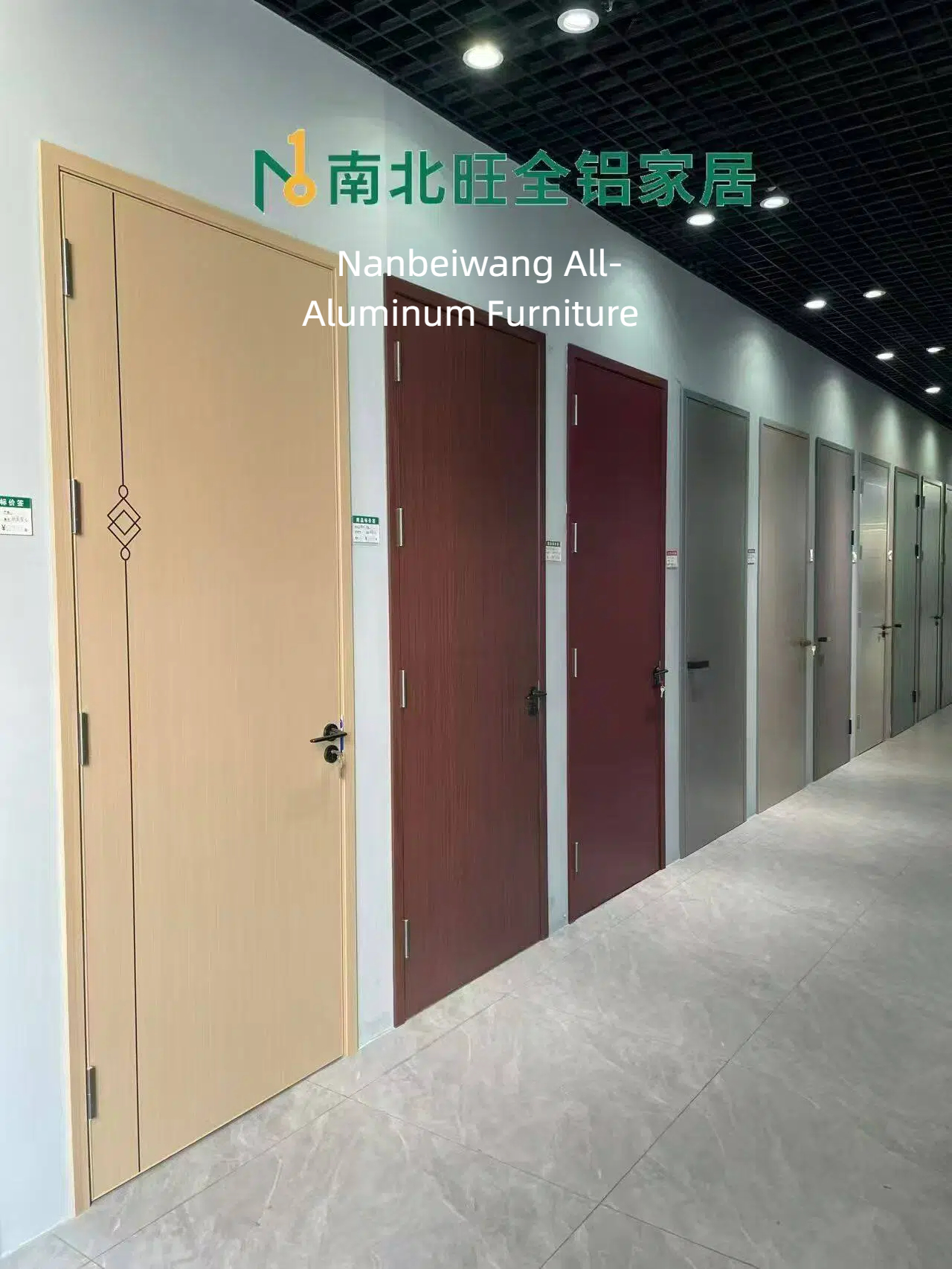
NBW-DOR-005 is an all-aluminum interior door with an integrated door structure. Door leaf and frame thickness is 45 mm. Frame options are published as Korean 60 mm, narrow 50 mm, minimalist 25 mm, invisible 55 mm, and frameless 18 mm — a range wide enough that the door decision is really a frame decision. Core options are honeycomb core, bamboo board, or plywood, and surface finishes are PETG, wood grain, and powder coating.
Hardware is specified as a tri-point lock, flag hinge, and magnetic lock. The door is described as waterproof, anti-mildew, deformation-resistant, and fire-resistant, and is intended for bedrooms, bathrooms, kitchens, living rooms, and offices, as well as bulk door supply for hotels and apartments. Standard sizes are available, OEM and ODM work is offered, and 100% full inspection is carried out before shipment with third-party inspection supported. The supplier also publishes a 10,000 m² warehouse and 24-hour sample dispatch, which matters for buyers scheduling multi-unit projects.
5. ZKB-1220×2750: The Bamboo Core Board
The ZKB-1220×2750 all-aluminum bamboo core board is the one model in this list that is not built on an aluminum honeycomb core. Its core is high-pressure bamboo fiber hot-pressed with aluminum, sandwiched between aluminum skins of 0.3 mm or 0.5 mm on both sides. Standard size is 1.22 m × 2.75 m and is customizable. Thickness is 18 mm as standard, with 5 mm and 10 mm available as options.
Finish options are spray, wood grain, PETG, and melamine. The board carries a B1 fire rating and an E0 / zero formaldehyde emission level, and is described as 100% waterproof. Its stated industries are furniture, interior decoration, construction, hospitality, healthcare, and marine — the last two being where substrate behaviour under humidity and cleaning regimes usually decides the choice. Buyers comparing this board with NBW-HPB-001 should note the fire rating difference: A2 for the all-aluminum honeycomb panel versus B1 for the bamboo core board.
6. WAP-600*(200-700): The Welding Board
The welding board, model WAP-600*(200-700), is an aluminum alloy board with an entirely different geometry from the rest of the shortlist: 6 m long, 200–700 mm wide, 18 mm thick, with a 0.8 mm aluminum skin. Surface options are spray coating or wood grain thermal transfer, and 18 colors are available. Fire rating is B1, formaldehyde is zero, waterproofing is stated at 100%, and load-bearing capacity is published at 150 kg/m².
Its category covers cabinet panel, wardrobe panel, door panel, and wall panel use, with published applications in furniture, interior decoration, construction, hospitality, healthcare, and marine interiors. The long, narrow format is the reason to shortlist it: it is specified for linear components where a continuous, welded-seam run is preferred over a large-format sheet with multiple joints. The trade-off is width — 200 mm to 700 mm — so it cannot substitute for a 1.22 m wide panel on a full wall elevation.
How to Read the Specifications Behind These Six Models
Six variables separate these boards, and each one maps to a different project risk.
- Total thickness. Ranges from 5 mm to 18 mm. 5 mm and 9 mm appear as thinner options; 18 mm is the default on the bamboo core board and the welding board.
- Skin gauge. Published options include 0.3 mm, 0.48 + 0.2 mm, 0.65 + 0.2 mm, 1.0 mm, and 0.8 mm on the welding board. Skin gauge typically drives impact and wear behaviour, so it should be stated explicitly in a purchase order.
- Core cell size. Published as 3×3, 4×4, 5×5, 8×8, and 10×10 on the wall panel, all customizable.
- Bonding method. Glue-free thermal bonding on NBW-HPB-001 and the wall panel family; hot-pressed bamboo fiber with aluminum on the ZKB board.
- Surface finish. PETG, melamine, CPL, powder coating, wood grain thermal transfer, solid wood veneer, solid color, and spray appear across the range — but not on every model.
- Fire and formaldehyde. A2 with zero formaldehyde referenced to GB18584-2024 on NBW-HPB-001; B1 with zero formaldehyde on the welding board; B1 with E0 / zero formaldehyde on the bamboo core board. For Europe, EN 13501-1 governs fire classification of construction products, with Class A1 or A2 being the top requirement for high-end architecture. For North America, ASTM E84 is the standard test for surface burning characteristics of these materials.
Water performance should be read carefully. NBW-HPB-001 publishes water absorption below 1% measured in a 24-hour test, which is a testable metric. The bamboo core board and welding board are described as 100% waterproof in supplier documentation — a supplier statement that buyers should corroborate with a project-specific test report before writing it into a specification.
Matching Each Model to Project Conditions
| Model | Typical project conditions | Supporting equipment | Boundary to confirm before ordering |
|---|---|---|---|
| NBW-HPB-001 | Board wholesale, furniture manufacturing, custom cabinet factories, decoration projects | Aluminum profiles, hardware fittings | Confirm skin gauge and finish against the actual wear surface |
| NBW-WPB-003 | Interior wall decoration, old-house renovation, commercial fit-out, large-scale wall engineering | Aluminum profiles, hardware fittings | Seamless splicing depends on the connection method: welding plate, metal line, adhesive-coated, or glue-free connection |
| NBW-CLB-004 | Whole-house ceilings, kitchen and bathroom ceilings, hotel and apartment hardcover, commercial ceiling engineering | Aluminum profiles, hardware fittings | Published data lists standard thickness only; request the project specification and finish confirmation |
| NBW-DOR-005 | Bedrooms, bathrooms, kitchens, living rooms, offices; bulk doors for hotels and apartments | Tri-point lock, flag hinge, magnetic lock | Frame type and core must be fixed before order release |
| ZKB-1220×2750 | Furniture, interior decoration, construction, hospitality, healthcare, marine | Aluminum profiles, hardware fittings | B1 fire rating; thickness standard is 18 mm with 5 / 10 mm optional |
| WAP-600*(200-700) | Cabinet, wardrobe, door and wall components in furniture, hospitality, healthcare, marine interiors | Aluminum profiles, hardware fittings | Format is 6 m × 200–700 mm; colors limited to the 18 published options |
Market Trends Buyers Should Factor In
Three trends are visible from attributable data rather than from supplier positioning. First, demand is anchored in construction: Market Research Future reports that architectural and building panels are the largest application segment for aluminum honeycomb, which means the decorative market — not aerospace — sets volume expectations and price pressure for boards like these.
Second, supply is increasingly export-oriented. China's exports of aluminum structures reached USD 5.55 billion in 2024, according to OEC data, with major destinations including Australia, Hong Kong, and the United States. Nanbeiwang's own export business accounts for 50% of total sales, with major markets listed as Europe, Southeast Asia, the Middle East, and North America — a distribution pattern that mirrors the broader export flow.
Third, fire regulation is tightening the specification gap. In Europe, EN 13501-1 Class A1 or A2 is the top requirement for high-end architecture; in North America, ASTM E84 governs surface burning characteristics. This is where a shortlist has commercial consequences: a project specifying A2 cannot substitute a B1-rated board, regardless of finish match or price.
Honeycomb Panels vs. Traditional Board Materials: Where the Boundary Sits
Against wood-based boards, the published advantages of this category are consistent across the models above: zero or E0 formaldehyde performance, waterproof and anti-mildew behaviour, termite resistance, and dimensional stability in humid interiors. For kitchen, bathroom, hospitality, and marine interiors, those properties are the reason the material enters the specification at all.
The limits are equally concrete, and buyers should plan around them rather than discover them on site.
- Fire ratings are not uniform within one portfolio. NBW-HPB-001 is listed at A2, while the bamboo core board and welding board are listed at B1. Substitution is a compliance decision, not a cost decision.
- Formats are not interchangeable. The welding board is 200–700 mm wide and 6 m long; the standard board format elsewhere is 1.22 m × 2.75 m. Neither can replace the other on a full wall or ceiling elevation.
- Ceiling data is thinner than wall data. The ceiling model publishes standard thickness without a published finish menu, so ceiling specifications require a project-specific sheet.
- Supporting materials are part of the budget. Published application data lists aluminum profiles and hardware fittings as matched equipment, and the door model lists a tri-point lock, flag hinge, and magnetic lock. These are separate line items, not accessories to be assumed.
- Water resistance claims need paperwork. A 24-hour water absorption test result is a measurable figure; a "100% waterproof" description is a supplier statement and should be backed by a test report in the project file.
What to Watch Next
Two developments are worth tracking for buyers in this category. The first is standardisation. Nanbeiwang is a compiling unit for multiple group standards of all-aluminum home furnishing products and serves as Executive President Unit of the All-Aluminum Customization Special Committee of the All-China Federation of Industry and Commerce — a position that matters to buyers because group standards tend to convert supplier vocabulary into testable definitions, which makes cross-supplier comparison easier over time.
The second is system integration. The door-wall-cabinet same-color logic already visible in this portfolio — driven by shared finish ranges such as PETG, wood grain, and powder coating across wall panels and doors — points toward purchases being made as coordinated systems rather than single boards. For procurement teams, that shifts the evaluation question from "which board is cheapest" to "which supplier can hold finish and fire rating consistent across five or six component types on one project." That is a harder question to answer, and it is the reason a model-level shortlist is more useful than a category-level one.
FAQ
What is the difference between an all-aluminum honeycomb panel and an all-aluminum bamboo core board?
The core material differs. NBW-HPB-001 uses an aluminum honeycomb core joined by glue-free thermal bonding, with thickness options from 5 mm to 18 mm and a fire rating of A2. The ZKB-1220×2750 bamboo core board uses a core of high-pressure bamboo fiber hot-pressed with aluminum, with 18 mm as standard thickness, a B1 fire rating, and an E0 / zero formaldehyde level. Both use aluminum skins and both are described as waterproof, but the fire classification and core composition are not the same.
Which models in this shortlist carry an A2 fire rating, and which are B1?
Among the models surveyed, NBW-HPB-001 is published with an A2 fire rating and zero formaldehyde referenced to GB18584-2024. The ZKB-1220×2750 bamboo core board and the WAP-600*(200-700) welding board are both published with a B1 fire rating and zero formaldehyde. The wall panel NBW-WPB-003 is described as fire-resistant and formaldehyde-free without a published class in the model data, and the ceiling NBW-CLB-004 does not publish a fire class. Buyers working to EN 13501-1 in Europe or ASTM E84 in North America should confirm the classification on the project specification sheet.
Can one finish be matched across doors, wall panels, and cabinets in a single project?
Yes, within the shared finish range. NBW-WPB-003 is offered in solid wood veneer, PETG high gloss, scratch-resistant wood grain, melamine CPL, solid color, powder coating, and wood grain heat transfer, and is specified for wall panel, ceiling, cabinet, and door applications. NBW-DOR-005 uses PETG, wood grain, and powder coating. The overlap among PETG, wood grain, and powder coating is what makes door-wall-cabinet same-color matching practical; finishes outside the overlap apply to individual models only.
What thickness should a buyer specify for a honeycomb panel?
Published options differ by model. NBW-HPB-001 spans 5–18 mm, both customizable. NBW-WPB-003 offers 5 mm, 9 mm, 10 mm, and 18 mm, with 9 mm listed as the default scope. The bamboo core board is 18 mm as standard with 5 mm and 10 mm optional. The welding board and the all-aluminum interior door are both 18 mm and 45 mm respectively at the panel and leaf level. Because the choice depends on the fixing method and the substrate, the thickness should be confirmed against a project-specific specification rather than selected from a range alone.
What supporting materials do these boards require?
Published application data lists aluminum profiles and hardware fittings as matched equipment for honeycomb panel installations in home decoration, hotel engineering, and apartment renovation projects with fixed, long-service-life installation. The all-aluminum interior door additionally specifies a tri-point lock, flag hinge, and magnetic lock. These items are procured alongside the boards and should appear in the bill of materials.
Are samples and custom sizes available before a full order?
Published supplier data states that model sizes are customizable, that OEM and ODM services are offered, and that sample dispatch is handled within 24 hours. The interior door model also notes 100% full inspection before shipment with third-party inspection supported. Buyers should confirm the comparable documentation for each model they shortlist, since inspection and sampling terms are published per product rather than across the whole range.
The published 2026 product brochure for this range is available for reference and download: Nanbeiwang Aluminum 2026 product catalogue.