
Six Hydraulic Power Unit Configurations for Buyers
Six Hydraulic Power Unit Configurations for Buyers
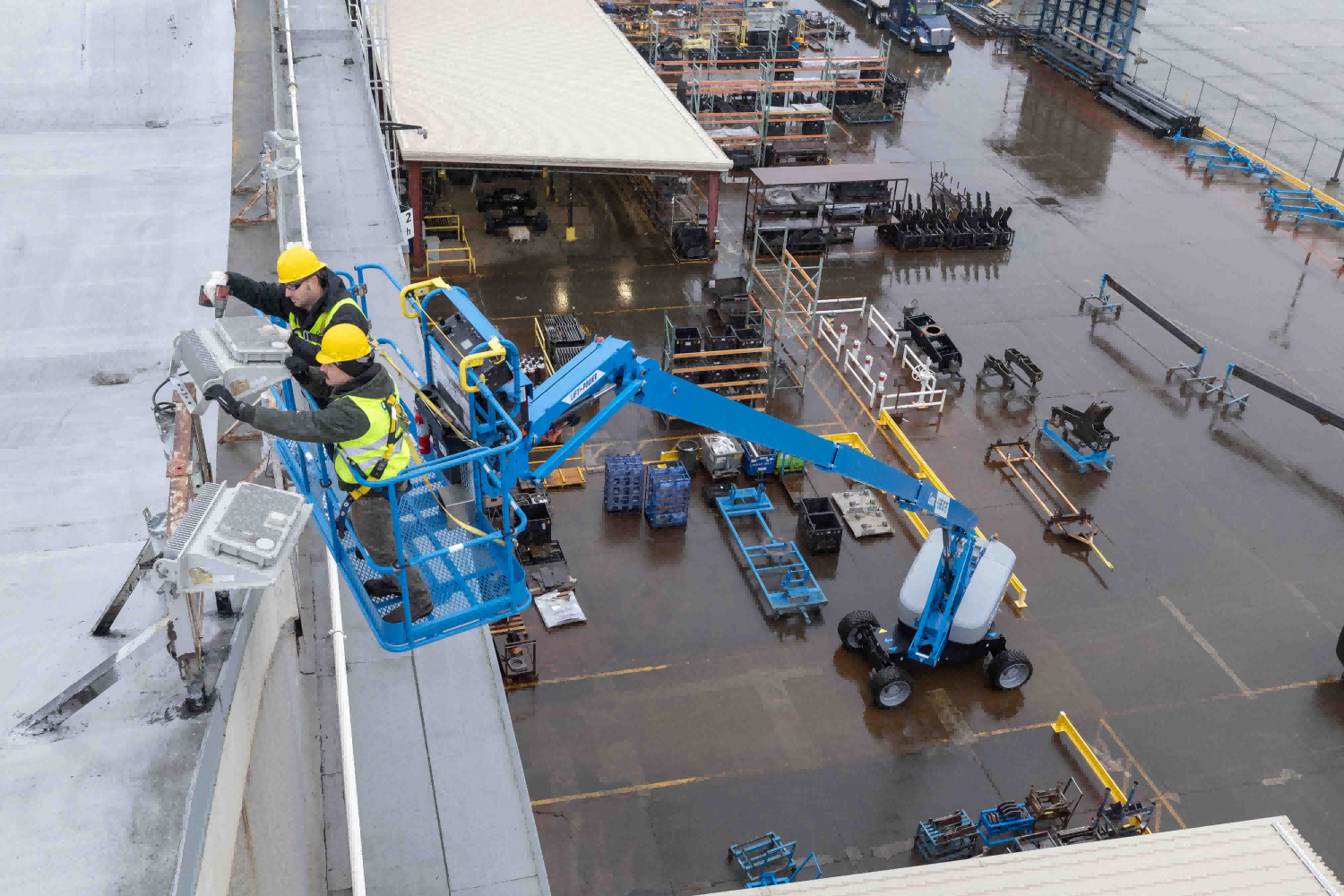
Choosing a Hydraulic Power Unit (HPU) for an equipment project starts with the actuator’s movement, power source, operating cycle, installation space, and pressure requirements—not with voltage or product name alone. This shortlist compares six configurations documented by Apex Hydraulic and maps each one to the applications identified for it. The specifications are configuration-specific: a maximum pressure or optional feature listed for one unit should not be assumed for another.
The six options cover distinct requirements: compact low-noise installations, vehicle-mounted auxiliary functions, fixed industrial machinery, aerial work platforms, mobile systems that power both extension and retraction, and a 12V single-acting dump-trailer circuit. Buyers should confirm the required pressure settings and agree on measurable purchasing acceptance criteria for the selected configuration before approving production or delivery.
How to use this shortlist
Start by matching the equipment and hydraulic function to a configuration, then check whether its documented operating mode and interfaces fit the project. The product records describe different voltages, flow ranges, pressure limits, reservoir options, controls, and circuit types. Those values are not interchangeable. For example, the 12V dump-trailer unit is specified for a single-acting power-up/gravity-down circuit, while the double-acting mobile unit is specified for powered extension and powered retraction.
Use the stated figures as model-specific selection information, not as a final system design. A maximum working pressure is not automatically the correct relief-valve setting for a machine. The required setting depends on the approved hydraulic design and must remain within the ratings of the components used in that system. Similarly, a listed voltage does not establish that the motor, wiring, battery or controls are compatible with a particular machine without checking the project configuration.
| Configuration | Documented application fit | Key distinction to verify |
|---|---|---|
| Low-noise compact | Indoor or noise-sensitive equipment, including lift tables, accessibility lifts, medical equipment and machinery | Space, noise-control options, motor supply, duty and circuit |
| Vehicle-mounted auxiliary | Special-purpose vehicles and auxiliary functions such as tailgates, stabilizers and mobile handling | Vehicle voltage, mounting, function count, controls and environment |
| AC industrial | Stationary machinery and production equipment | Supply phase and voltage, duty cycle, functions and control interface |
| Multi-function aerial work platform | Aerial platforms requiring combinations of lift, steering, leveling or outrigger functions | Function coordination, duty cycle, controls and safety-related circuit details |
| Double-acting mobile | Mobile equipment requiring powered cylinder extension and retraction | Cylinder and valve arrangement, voltage, pressure and control behavior |
| 12V DC dump trailer | Single-acting dump-trailer telescopic-cylinder applications using power-up and gravity-down operation | Approved relief settings, cylinder compatibility, reservoir, flow and acceptance tests |
1. Low-noise compact HPU: space- and sound-sensitive installations
The Custom Low-Noise Compact Hydraulic Power Unit, model APEX-CLNCHPU, is the shortlist option for installations where compact construction and noise considerations matter. Its listed applications include medical and patient-lifting equipment, accessibility and wheelchair lifts, home elevators, lift tables, scissor lifts, warehouse equipment, laboratory equipment, packaging machinery and general industrial machinery. Those applications identify possible fit; the final circuit and installation still need to match the equipment.
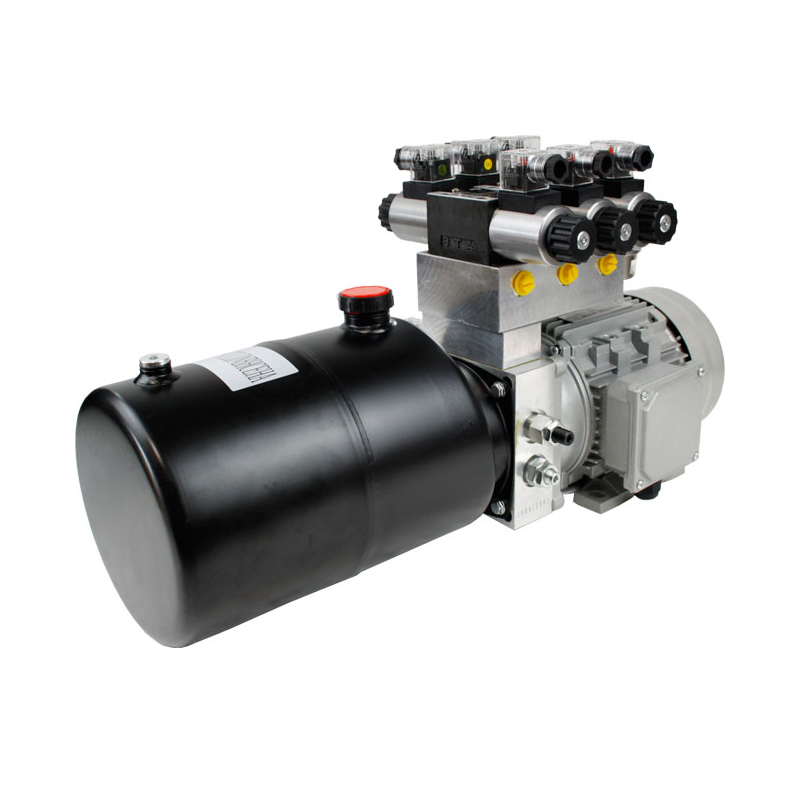
Its parameter set includes 12, 24 or 48 VDC and 220 or 380 VAC motor options, 0.35–4.0 kW motor power, and 1–20 L/min flow. The listed maximum working pressure is 230 bar (3,335 PSI). System types include single-acting, double-acting and reversible-pump configurations; the record also lists 1–4 hydraulic functions. These are available configuration ranges, not a statement that every combination is offered in one build.
The unit uses a low-noise external gear pump. Optional anti-vibration mounts, an acoustic enclosure and a flexible motor-pump coupling address different paths by which operating sound or vibration may be transmitted. The product information describes optimized motor-pump matching as reducing vibration, pressure pulsation and unnecessary energy loss; it does not provide a quantified noise level or comparative test result. Buyers with a sound limit should therefore define the measurement method and acceptance threshold for their own equipment rather than infer a decibel value from the configuration name.
This option is worth evaluating when a conventional compact HPU arrangement leaves insufficient installation space or when sound and vibration are explicit design considerations. Confirm the actual envelope, mounting orientation, motor type, duty, control method, pressure and flow, and whether acoustic or vibration-control accessories are included in the quotation. “Optional” features should be identified as included or excluded in the order specification.
2. Vehicle-mounted auxiliary HPU: dedicated functions on mobile equipment
The Custom Vehicle-Mounted Auxiliary Hydraulic Power Unit, model APEX-CVMAHPU, is intended for auxiliary hydraulic functions on special-purpose and service vehicles. Listed equipment includes refuse and garbage trucks, municipal service vehicles, truck tailgates, street sweepers, utility and service trucks, truck-mounted cranes, vehicle stabilizers, emergency rescue vehicles and other special-purpose trucks. The application record also describes outdoor mobile operation involving starts and stops, vibration, road shock, dust, rain, snow, low temperatures and corrosive road salt.
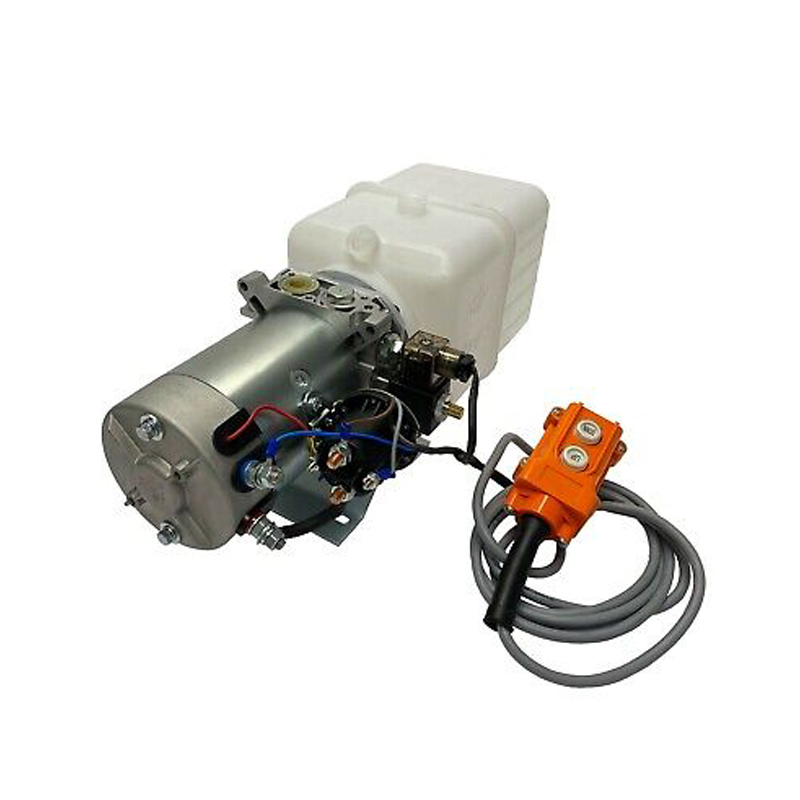
The documented voltage options are 24 and 48 VDC, with 1.5–8.0 kW motor power, 3–40 L/min flow, and a maximum working pressure of 250 bar (3,625 PSI). The unit supports 1–6 hydraulic functions and single-acting, double-acting or combined systems. Chassis-, frame- or enclosure-mounted installation is listed, along with horizontal, vertical or chassis-mounted reservoir arrangements. These details help screen a candidate, but do not establish that a specific vehicle’s electrical and mounting interfaces are already matched.
Controls may include a cab-mounted switch, wired pendant, wireless remote, PLC or CAN Bus. Main power and emergency auxiliary functions are both listed. Optional items include load-holding and counterbalance valves, manual emergency lowering, an emergency hand pump, filters, oil cooling and a weather-resistant enclosure. The record also identifies custom mounting brackets, wiring harnesses, reservoirs and ports. Buyers should mark each item as required, optional, or not required in the project specification; the general availability of an option is not evidence that it is included in a quoted unit.
For outdoor vehicle use, the application record identifies weather-resistant electrical connections, corrosion resistance, low-temperature operation, stable pressure and flow, low leakage, emergency manual lowering and field maintenance as relevant requirements. Treat these as project checks, not as verified outcomes for every unit. Ask for the proposed protection and component configuration, the approved operating conditions, and the tests and records that will establish acceptance for the intended vehicle.
3. AC industrial HPU: stationary machinery and production equipment
The Custom AC Industrial Hydraulic Power Unit, model APEX-ACHPU Series, is the fixed-equipment option in this shortlist. Its listed applications include industrial automation, manufacturing equipment, hydraulic presses, machine tools, dock levelers, lift tables, scissor lifts, clamping equipment, packaging and plastic-processing machinery, test benches, recycling equipment and general industrial machinery. The product information describes AC motor configurations for fixed industrial equipment and provides both intermittent- and continuous-duty choices.
The specification lists 220 or 380 VAC, single- or three-phase supply, 50 or 60 Hz, 0.12–4.0 kW motor power, 1.5–30 L/min flow, and a maximum working pressure of 230 bar (3,335 PSI). Reservoir capacity is listed as 1.5–18 L. The unit can be configured for single-acting, double-acting or multi-actuator systems, with 1–8 hydraulic functions. For industrial automation, the stated control interfaces include push button, foot pedal, PLC, HMI and remote control.
An integrated manifold or CETOP modular valve block is listed. The product description identifies modular valve blocks as supporting circuit expansion and maintenance, while optional proportional valves can be used where smooth speed, force or position control is required. Coolers, heaters, filters, accumulators, gauges and sensors are also listed as optional items. A buyer comparing an AC hydraulic power pack with another candidate should specify which of these are necessary for the machine and its control architecture, rather than treating them as standard equipment.
Before selection, compare the actual electrical supply with the motor and solenoid configuration; define the operating cycle and duty requirement; and document the number of actuators, desired functions, interface signals and mounting arrangement. Pressure and flow need to be matched to the approved actuator and circuit. A listed maximum pressure is a limit in the product data, not a recommendation to operate continuously at that value.
4. Multi-function aerial work platform HPU: coordinated platform functions
The Custom Multi-Function Hydraulic Power Unit for Aerial Work Platforms, model APEX-CMFHPU, addresses platforms where one unit may integrate several hydraulic functions. The listed applications include scissor lifts, boom lifts, personnel lifts, mobile elevating work platforms, truck-mounted lifting platforms, vehicle outriggers, warehouse lifting equipment and other mobile machinery. The application record identifies lifting, lowering, steering, leveling and outrigger stabilization as possible platform functions, with smooth movement, load holding, synchronized lifting, precise positioning and emergency lowering among the project requirements to consider.
The product specification lists 2–8 hydraulic functions, 12, 24 or 48 VDC, 0.8–4.0 kW motor power, 1.5–30 L/min flow and a maximum working pressure of 280 bar (4,000 PSI). Single- or double-gear-pump configurations are listed, as are single-acting, double-acting and combined systems. The standard intermittent duty cycle is stated as 1 minute on-load followed by 9 minutes off-load; continuous-duty configurations are also listed. A buyer must verify which duty configuration is proposed, because a general availability statement does not make every duty option interchangeable.
The functions available in the product information include main power, emergency auxiliary power, electric lifting, hydraulic steering, platform leveling, outrigger control and emergency lowering. Control options include wired pendant, wireless remote, joystick, PLC and CAN Bus. Optional components include load-holding and counterbalance valves, a hydraulic lock, pressure-compensated flow control, manual emergency lowering and a manual emergency hand pump. The specified manifold may be monoblock or modular, and installation may be horizontal, vertical or vehicle-mounted.
For a platform project, the decision is not simply “multi-function or single-function.” Specify which functions must operate, how movement is controlled, whether cylinders need synchronization or position sensing, and how emergency lowering is intended to work. The product information says the circuit can be matched to synchronized cylinders, position-sensing cylinders and multiple actuators; it does not establish the final design for a particular platform. Require the supplier proposal to identify the circuit, control interface, relevant valves and acceptance checks for the exact machine.
5. Double-acting mobile HPU: powered extension and retraction
The Custom Double-Acting Mobile Hydraulic Power Unit, model APEX-CDAMHPU, is the fit to examine when a mobile cylinder must be powered in both directions. Its stated operating type is double acting, with power-up/power-down hydraulic function. Listed uses include dump trailers, hydraulic scissor hoists, tilt-bed and equipment trailers, vehicle stabilizers, trailer jacks, truck liftgates, mobile lifting equipment, agricultural machinery, construction equipment and municipal vehicles.
Its specified voltage options are 12, 24 and 48 VDC; motor power is 0.35–3.0 kW, flow is 1.5–30 L/min, and maximum working pressure is 280 bar (4,000 PSI). Reservoir capacity is listed as 0.9–18 L. The unit uses a 4-way, 2-position or 4-way, 3-position solenoid valve, with closed, tandem or float center configurations listed. These choices matter to the intended circuit and control behavior, so the valve arrangement and center condition should appear explicitly in a purchasing specification rather than being left as an assumption.
Wired pendant, wireless remote, vehicle-mounted switch and PLC signal controls are listed. Optional items include a flow-control valve, load-holding valve, pilot-operated check valve, counterbalance valve, manual emergency lowering and hand-pump backup. The product record identifies custom manifolds, brackets, ports, connectors and wiring as available. Confirm the cylinder’s required ports and motion, the chosen valve and control logic, pressure setting, reservoir orientation and installation space. This model is not the same operating arrangement as the single-acting 12V dump-trailer unit described below: one is specified for powered retraction, while the other uses gravity return.
6. 12V DC dump-trailer HPU: single-acting power-up, gravity-down
The 12V DC Dump Trailer Hydraulic Power Unit, model APEX-DTHPU, is a specific configuration for dump-trailer applications using a single-acting hydraulic cylinder and power-up/gravity-down operation. The listed applications include dump-trailer manufacturing and repair, agricultural tipping trailers, landscaping and construction-material trailers, waste and recycling trailers, gooseneck dump trailers and trailer hydraulic-system upgrades. It is identified as compatible with HTC-Series dump-trailer telescopic-cylinder applications. Compatibility should still be checked against the actual cylinder and approved hydraulic system.
The documented configuration includes a 12 VDC intermittent-duty motor, a 6 US-quart translucent horizontal-mount reservoir, a maximum hydraulic flow rate of 2.0 GPM, an SAE #6 port and a two-button handheld pendant for UP and DOWN. The removable pendant cord is 15 ft. The lowering function uses a normally closed solenoid valve for gravity return. Reservoir options are listed as 3, 4, 6, 8 and 13 US quarts; motor power and pump displacement are selected according to pressure, flow and duty-cycle requirements. These are described as selectable options, not a single standard configuration containing all sizes.
The pressure details require particular care. The record specifies a maximum relief setting of 3,200 PSI at Port A and 1,500 PSI at Port B. It also says the setting is adjustable according to the approved hydraulic system within rated component limits. These are not universal settings for all dump trailers and should not be copied into a different model’s specification. Confirm the approved design, cylinder limits, port assignments and system component ratings before setting or accepting relief pressure. The 2.0 GPM figure is a maximum flow value, not a guaranteed flow under every operating condition.
The configuration lists an integrated load-retention check valve and relief valve, with integrated or application-specific lowering-flow control. A wired pendant is standard in the record; wireless remote control, manual emergency lowering, mounting bracket, weather-protection cover, battery charger and battery-isolator switch are optional. The stated testing can include pressure, flow, relief-valve verification, solenoid-valve function, motor current and leakage inspection. Buyers should identify which tests and results are required for their order, and ensure that the accepted unit matches the agreed configuration.
Pressure settings and purchasing acceptance: make the specification testable
Pressure is a system design value, not a generic attribute to copy from a product family. The six configurations have different documented maximum working pressures, and the dump-trailer unit has separate maximum relief-setting values for Ports A and B. Those values describe their respective records; they do not establish the appropriate setting for another unit or application. Set the required pressure according to the approved hydraulic design and keep it within the rated limits of the components in that system.
A clear RFQ or purchase specification can separate selection from acceptance by recording the following:
- Application and motion: Identify the machine, actuator, load-related design inputs supplied for the project, and whether operation is single acting, double acting, reversible, or multi-function. State whether lowering is powered or gravity-assisted.
- Pressure definition: Specify required operating and relief settings, measurement points or ports, units, tolerance if approved, and the controlling design document. Confirm component pressure limits and any separate A/B-port settings.
- Flow and operating cycle: State the required flow or speed basis and duty cycle. Distinguish a maximum catalog value from a project requirement, and identify any intermittent or continuous-duty configuration being purchased.
- Electrical and control interfaces: Confirm DC or AC voltage, phase and frequency where relevant, motor and solenoid voltage, control method, wiring or connector requirements, and signal interface such as PLC or CAN Bus when specified.
- Installation and connections: Document available envelope, mounting orientation, reservoir capacity and material, ports and thread type, hose routing constraints, and required enclosure or environmental protection.
- Included options: List required valves, filters, sensors, emergency functions, remote controls, brackets, harnesses and other accessories individually. Mark each as included, optional but selected, or excluded.
- Acceptance evidence: Agree in advance which inspections and tests apply, how results will be recorded, and what constitutes pass or fail. Relevant product records identify pressure, leakage, electrical, function, flow, valve-response or motor-current checks depending on the configuration.
This makes purchasing acceptance more precise than a general request for a “custom hydraulic power pack.” For example, the low-noise compact and AC industrial records both list a 230 bar maximum working pressure, but their electrical supply, application emphasis and available configurations differ. The aerial-platform and double-acting mobile records both list 280 bar maximum working pressure, but their documented functions and intended equipment differ. Shared values do not make the units equivalent or establish that either is suitable for a specific system.
Where cleanliness is part of the purchase requirement, state the required cleanliness code and how it will be checked rather than assuming that a listed value guarantees the delivered condition. The supplied product records list ISO 4406 20/18/15 for several configurations. The supplied third-party standards record notes that the cited ISO 4406:2017 page identifies a newer 2021 version; confirm the applicable edition before making a formal standards or compliance claim. Likewise, ISO 4413:2010 is described in the supplied source as covering general rules and safety requirements for hydraulic fluid power systems and components used on machinery, but its current status and applicability should be checked for the project. Neither reference is evidence that a particular HPU is certified.
Shortlist conclusion
For indoor or noise-sensitive equipment, begin with the low-noise compact configuration; for dedicated vehicle auxiliary circuits, review the vehicle-mounted unit; and for fixed machinery, evaluate the AC industrial model against the plant supply and duty cycle. For platforms with coordinated functions, examine the multi-function aerial work platform unit. Choose the double-acting mobile configuration when the cylinder needs powered extension and retraction. Consider the 12V DC dump-trailer unit for the specifically documented single-acting power-up/gravity-down arrangement.
The shortlist narrows the options but does not replace application engineering. Before purchase, align the selected model and options with the actual actuator, voltage, flow, duty, controls, mounting and pressure requirements. Record the approved pressure settings and purchasing acceptance criteria in the order documents, including the tests and evidence required for acceptance. That process helps distinguish a configuration that appears relevant from one whose supplied specification is demonstrably aligned with the equipment.
Frequently asked questions
How should buyers compare Hydraulic Power Unit configurations?
Compare each candidate against the same project requirements: application, actuator motion, power supply, functions, duty cycle, pressure and flow, installation, controls, options and acceptance tests. Keep each model’s figures attached to that model. A shared maximum pressure or voltage does not demonstrate equivalent circuit design or suitability.
Is the 12V DC dump-trailer unit suitable for a double-acting cylinder?
The documented APEX-DTHPU arrangement is for a single-acting cylinder with power-up and gravity-down operation. The APEX-CDAMHPU is the listed double-acting mobile option, with powered extension and retraction. Confirm cylinder compatibility and the approved hydraulic design before selecting either configuration.
What pressure should be specified for a custom hydraulic power unit?
Specify the pressure required by the approved hydraulic design, along with the relevant relief setting, measurement point, units and component limits. Do not copy a model’s maximum working pressure as the operating setting. For the APEX-DTHPU, the product record lists maximum relief settings of 3,200 PSI at Port A and 1,500 PSI at Port B; it also requires adjustment according to the approved system within rated component limits.
What should purchasing acceptance criteria include?
Acceptance criteria should identify the approved configuration and options, interface and installation details, pressure and flow requirements, applicable inspection or test methods, required records, and pass/fail conditions. The relevant product record may list pressure, leakage, electrical, flow, valve-function or full-cycle tests. Agree which checks apply to the specific order instead of assuming every listed test or optional feature is included.
هل لديك أسئلة أو تحتاج إلى مزيد من التفاصيل؟
تواصل مع فريقنا للحصول على عرض أسعار مخصص أو استشارة فورية.
طلب عرض أسعار
املأ النموذج أدناه وسيتواصل معك فريقنا بعرض مقترح مخصص.
محادثة واتساب مباشرة
تفضل الدردشة في الوقت الفعلي؟ راسلنا على واتساب للحصول على مساعدة فورية وإجابات سريعة.
- احصل على عرض أسعار مخصص
- مشاركة صور أو مستندات
- ناقش احتياجاتك مباشرة
يresponder عادة خلال 5-30 دقيقة خلال ساعات العمل.