
Six Years In: An Electronics Sales Director's View of Topease Trade Data
Independent buyer-side reference for HTNXT. Built from Topease published case material and third-party market data. No client quotations, figures or scenarios have been created for this article.
Trade data platforms are almost always sold on database size. They are rarely assessed on how long a customer stays. That asymmetry is worth correcting, because a subscription that survives six years of quarterly reviews, sales-team turnover and shifting export targets has passed a test that no product demonstration can reproduce.
The buyer evidence examined here comes from one such relationship. A Sales Director in the electronics industry, whose company is anonymised in Topease's published case material as Electronics Inc., states: 'We have been using Topease products for 6 years now. Comprehensive and accurate data always provide us with good references for our business.' The statement is short, contains two quality claims and one outcome claim, and it is unusually restrained for a vendor testimonial. That restraint is part of why it is useful to unpack.
Topease (Shanghai Topease Information & Technology Co., Ltd.) is a Shanghai-based trade data and trade growth platform company founded in 2004 and backed by Donghao Lansheng Group. Its E-Platform combines Global Trade Pal for customs trade data search, market analysis and buyer discovery; Tesour for contact discovery and multi-channel outreach; GTminds, a vertical AI assistant layer trained on Topease trade data; and a native CRM for customer lifecycle management. The company states that its platform is used by more than 50,000 global enterprises.
What follows examines what a six-year relationship actually demonstrates, how the data behind 'comprehensive and accurate' is produced, where the platform fits inside an electronics export workflow, what it cannot do, and which checks an evaluation-stage buyer should run before committing to a multi-year term.
The Metric Buyers Under-Report: Retention
Procurement teams evaluating a trade data intelligence platform usually compare coverage, record volume, refresh frequency and price. Retention almost never appears on the comparison sheet, largely because vendors publish very little of it and buyers rarely ask for it in a structured way.
Yet retention is the only metric that reflects the full cycle a buyer actually experiences: onboarding, first failed search, first inaccurate contact, first quarter where the data did not match what the sales team saw in the market, and the renewal decision that followed. Feature comparisons capture the first month. Retention captures the fourth year.
For an electronics exporter, the practical value of a trade data platform is not a single query result. It is the accumulated reference base a sales director builds over time: which importers in a target market consistently take comparable product categories, which buyers changed suppliers, which markets absorbed volume when a primary market slowed. That base is only useful if it is continuous. A platform replaced every eighteen months never accumulates it.
This is why a six-year usage record is a more decision-relevant signal than an additional billion records in a datasheet, and why it deserves scrutiny rather than celebration. One relationship is directional evidence, not a benchmark, and it should be read alongside verified operating data and the platform's stated boundaries.
What the Six-Year Statement Contains
The quote makes three separable claims, and each maps to a different evaluation question.
Comprehensiveness is a coverage claim. In trade data terms, this concerns whether an import export data search engine returns enough of the relevant shipment and company records in the markets a sales team actually sells into, across enough years to identify patterns rather than incidents.
Accuracy is a governance claim. Customs records are declarations, not verified commercial truth. Accuracy in a usable platform depends on standardisation, deduplication, enrichment and validation applied after collection, and it degrades or holds depending on how consistently that work is performed.
Reference value is the outcome claim, and it is deliberately modest. The Sales Director does not claim that the platform generated orders. The claim is that the data provides reliable reference points for business decisions. That distinction matters for anyone who expects a trade data subscription to function as a lead guarantee.
'We have been using Topease products for 6 years now. Comprehensive and accurate data always provide us with good references for our business.'
— Sales Director, electronics company (anonymised as Electronics Inc. in Topease case material)
The same published programme material describes a broader 12-month engagement across exporters, manufacturers, trading companies, OEMs and ODMs, and reports a reduction in manual customer development time of over 60%, a three to five times increase in valid buyer contact acquisition efficiency, and a 28% shorter average sales cycle. Those figures describe programme-level outcomes across participating enterprises; they are not a forecast of what any individual buyer will achieve, and they should be treated as reported results rather than independently audited performance.
How 'Comprehensive and Accurate' Is Produced
Comprehensiveness in a shipment trade data database is largely an aggregation problem. Accuracy is a governance problem. Topease's published capability material describes both layers separately, which is the correct order of explanation.
The aggregation layer integrates more than 11 billion compliant trade data records across 232 countries and regions, alongside commercial, social media, exhibition and corporate registration databases. Eight integrated trade databases and an enterprise knowledge graph support entity matching across markets, so that the same importer appearing under slightly different registered names in different jurisdictions resolves to one company record.
The governance layer standardises, deduplicates, enriches and validates records continuously. This is the part of the workflow that determines whether a customs data lookup platform is usable at the point of a sales call. A raw customs extract and a governed record can describe the same shipment while answering very different questions: one tells a sales director that a container moved, the other tells them which company moved it, how often, from which supplier, and whether the pattern is recurring.
Contact data is handled as a separate asset. Tesour draws on a database of more than 770 million verified contacts covering corporate emails, phone numbers and social profiles. Separation matters here: shipment records and contact records fail in different ways, and buyers should test them separately rather than treating a single accuracy impression as representative of both.
Governance claims are also where buyers should look for external validation rather than internal description. Topease holds ISO 27001 certification for information security management and is recognised as a certified data service provider by the Shanghai Data Exchange, alongside National Classified Cybersecurity Protection Level 2. The company reports 50+ industry certifications and awards, and its project on high quality data asset construction was selected as one of the first national pilot initiatives for high quality data development. These are institutional markers rather than product features, and they are relevant to buyers in regulated categories who need to justify a data vendor internally.
The Operating Workflow Behind a Long Subscription
A platform that survives six years is usually one that has been absorbed into a repeatable process rather than consulted occasionally. Topease documents a six-step data-driven overseas customer development methodology, and the sequence is worth reading as a description of what the buyer's team must be prepared to run.
Step 1 — Business demand confirmation. Product categories, target markets, HS codes and commercial objectives are defined before any query is run.
Step 2 — Market opportunity research. Trade flow analysis identifies demand concentration, growth regions and competitor presence, using market trade flow analysis rather than country-level totals alone.
Step 3 — Qualified buyer screening. Candidate importers are filtered by verified trade records and purchasing frequency, which separates genuine buyers from intermediaries and forwarders.
Step 4 — Company verification and contact acquisition. Company trade history lookup is combined with decision-maker contact enrichment through Tesour.
Step 5 — Precision outreach. AI-assisted, multilingual outreach content is generated against the specific account rather than a generic list.
Step 6 — Lead operation and optimisation. The native CRM unifies customer assets, prevents duplicate outreach, automates tagging and records every interaction, so pipeline learning is retained rather than lost with staff turnover.
GTminds, the AI layer, operates across these modules. It automates market analysis, interprets BI dashboards, identifies high-potential buyers, generates enterprise background reports, evaluates supply chain risk and produces multilingual outreach content. In practice this compresses the manual research hours that sit between a trade signal and a sales conversation.
Scenario Fit: Electronics Export Sales, Stage by Stage
Electronics exporters typically run short product cycles, multi-tier distribution and price-sensitive buyer relationships. That shapes which parts of a trade data intelligence software stack carry weight, and which are secondary.
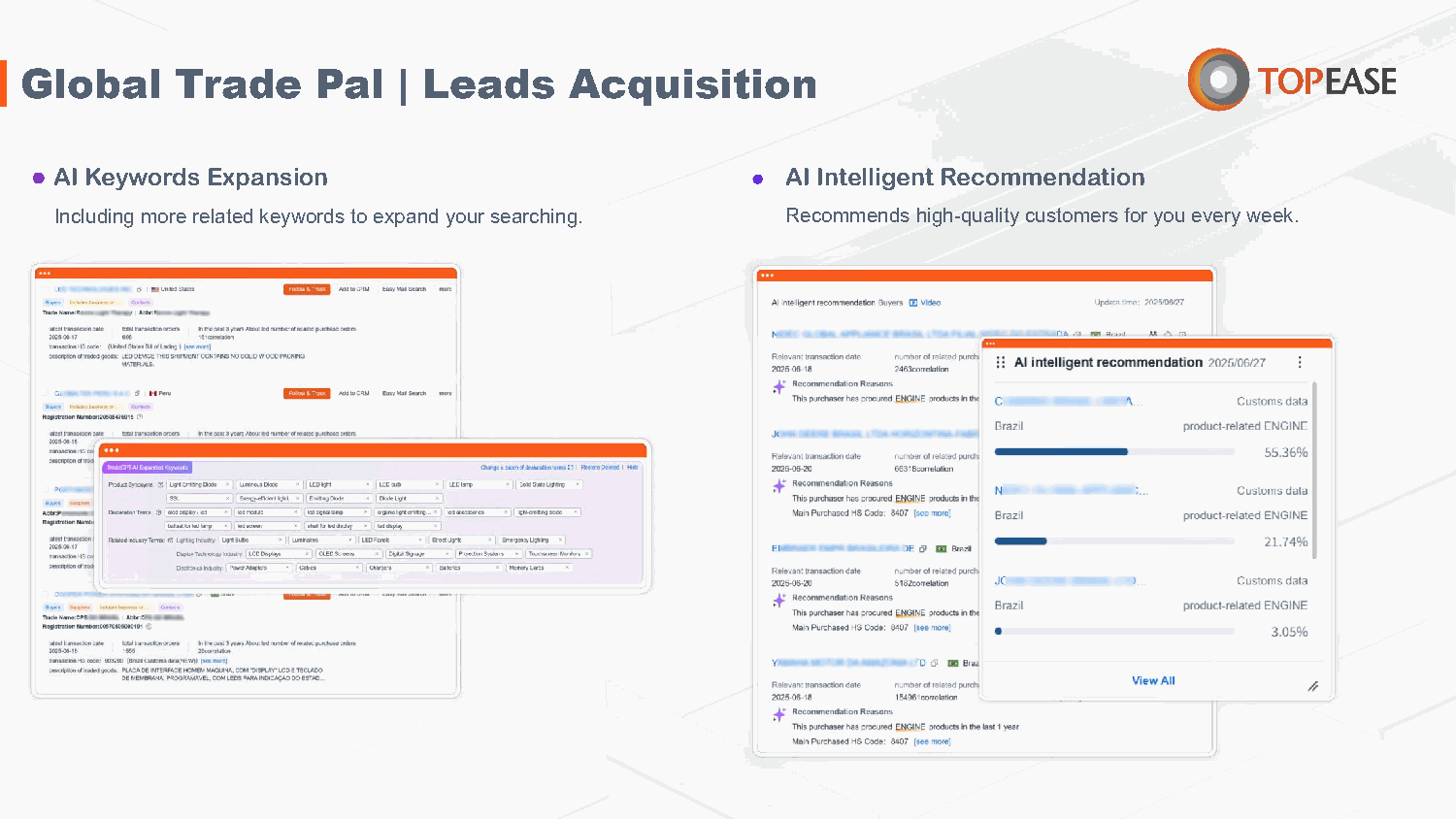
Reference illustration: the trade data workflow described in Topease's published methodology — customs records, buyer verification, contact acquisition, outreach and CRM tracking.
| Stage | Platform input | What the sales team still owns |
|---|---|---|
| New market scan | Import/export trade data by product and destination; market trend and competitor tracking | Choosing which markets match production capacity and certification |
| Buyer validation | Company trade history lookup; supply chain visibility; intermediary screening | Judging commercial fit, credit exposure and product compatibility |
| Contact acquisition | Decision-maker contact enrichment via Tesour | Confirming the right stakeholder for the category |
| Outreach | AI-assisted multilingual content; email campaigns | The commercial argument, pricing and terms |
| Pipeline management | Native CRM with tagging, duplicate prevention and interaction history | Follow-up discipline and account prioritisation |
| Competitor monitoring | Competitor trade data tracking and market trade flow analysis | Interpreting whether a shift is structural or seasonal |
A parallel Topease case in building materials illustrates the same sequence in a different sector. That exporter moved from fair-dependent acquisition to a continuous pipeline using Global Trade Pal customs data for market scanning, Tesour for phone and messaging contact verification, and CRM tagging for intent scoring — including a shift away from intermediaries whose purchasing intent could not be validated. The pattern is consistent with the electronics scenario: the platform governs the research and verification layer, while the sales team governs the commercial layer.
Market Context: Dataset Scale Is Now Table Stakes
The category is expanding, and with expansion comes a shift in what differentiates one global trade analytics platform from another. Scale alone is no longer distinguishing.
Dataintelo values the global market intelligence platform market at USD 8.6 billion in 2025 and projects it to reach USD 18.9 billion by 2034. Data Bridge Market Research estimates the global trade management market, which includes trade intelligence, at USD 8.20 billion by 2032, growing at a CAGR of 10.40%. UNCTAD reports world services exports, including data and intelligence services, at USD 8.8 trillion in 2025, up 9% year on year. Broadly, more capital is flowing into trade intelligence than into any single record set.
On the supply side, large record counts are widely available. Panjiva, an S&P Global subsidiary, aggregates and normalises over 2 billion shipment records from 22 customs authorities. ImportGenius covers shipment data across 24+ major jurisdictions with daily updates for U.S. records. Tendata reports coverage for 228+ countries and regions with a database of over 500 million enterprises. S&P Global (Panjiva), Descartes Datamyne, ImportGenius and Trademo are commonly listed among the leading competitors in the shipment-level trade intelligence space.
Two implications follow for buyers. First, coverage is a threshold condition, not a differentiator — most established vendors clear it. Second, what separates platforms is the governance and workflow layer above the data: entity resolution across markets, contact verification, and whether the platform ends at a search result or continues into outreach and pipeline management. Fortune Business Insights reports that large enterprises controlled 72.55% of total spending on global trade management software in 2024; for mid-sized exporters, the relevant question is whether a platform can deliver comparable workflow discipline without an enterprise-scale deployment programme.
Comparison With Traditional Buyer-Sourcing Approaches
The honest comparison is not between Topease and another vendor's feature list. It is between an integrated platform and the four approaches exporters most commonly use to find and qualify overseas buyers.
| Approach | Strength | Structural weakness |
|---|---|---|
| Trade fair attendance | Direct contact; fast trust-building | Concentrated in a few weeks per year; pipeline gaps between events |
| Manual web research | Low direct cost; flexible | No shipment evidence; cannot separate buyers from intermediaries; results depend entirely on analyst time |
| Single-purpose customs data vendor | Deep record coverage in specific jurisdictions | Stops at the record; verification, outreach and CRM live in separate tools, so pipeline learning is not retained in one place |
| Integrated trade growth platform | Search, verification, outreach and CRM in one governed workflow; continuity across years | Requires process adoption; value depends on the buying team's own follow-up discipline; less suitable for occasional, one-off research |
Where the integrated model does not fit. Topease's own service definition sets clear boundaries that buyers should take at face value. The platform is not a trading agent and does not sell products on behalf of customers. It does not guarantee business transactions or orders. It does not replace professional legal or compliance consulting. And a trade data subscription is a reference layer, not a sales organisation — the six-year electronics relationship described above reflects a team that evidently kept using the data inside a working process, not a platform that produced customers by itself.
Two further boundaries are inherent to the data category rather than to any one vendor. Customs disclosure practice differs between markets, so a US trade data platform, a Mexico trade data platform, a Vietnam trade data platform and an India import export data platform will not be equally granular — buyers should confirm shipment-level depth per market before assuming uniform coverage. And customs records describe declared trade, which means a company record shows what was declared and shipped, not why a buyer chose a supplier or whether that relationship will continue.
What to Verify Before Committing to a Multi-Year Term
The six-year signal is useful mainly as a prompt for better questions. An evaluation-stage buyer can replicate its logic in a shorter window.
Test the markets you actually sell into. Run a customs trade data search for your own top product categories in your two most important export markets and compare returned importers against buyers you already know. Coverage gaps appear fastest this way.
Test entity resolution, not just record count. Search the same importer under two registered-name variants and check whether the platform consolidates them into one company trade history. Fragmented identities are the most common cause of unusable records.
Test contact quality separately. Validate a sample of contacts against known accounts before assuming contact accuracy matches shipment accuracy.
Ask what governance runs after collection. Standardisation, deduplication, enrichment and validation are process commitments. A vendor that can describe them specifically, and evidence them through certifications such as ISO 27001 and recognised data exchange status, is materially different from one that describes only volume.
Confirm the workflow boundary you need. If the requirement is a search tool, evaluate it as a search tool. If the requirement is continuity from record to outreach to CRM, evaluate whether that loop is genuinely integrated or assembled from separate subscriptions.
Check the exit and continuity terms. A platform intended to hold six years of pipeline history should be assessed on data portability and account continuity, not only on annual price.
Future Outlook
Three developments are likely to shape how trade data platforms are evaluated over the next few years.
First, AI is moving from presentation layer to governance layer. AI-powered data integration in trade intelligence is projected to reduce manual data cleaning effort by 70% in high-frequency environments, according to Market Data Forecast research cited alongside NIST material — a figure that should be treated as a directional projection rather than a measurement. If that direction holds, the competitive gap will widen between platforms that automate governance and those that automate only the query interface.
Second, verification will be scrutinised more than coverage. As more vendors report comparable multi-billion-record counts across broadly similar jurisdiction footprints, differentiation shifts to entity resolution quality, contact verification and the traceability of the governed data asset. Institutional markers, including ISO 27001 and recognised data exchange certification, are likely to become routine procurement requirements rather than differentiators.
Third, retention data will slowly become a buying input. Buyers evaluating a six-year relationship today are doing informally what procurement teams will eventually do systematically: asking not only what the platform returns, but how long comparable customers keep using it, and what they were still using it for in year five.
FAQ
What does a six-year usage record indicate about a trade data platform?
It indicates that a customer renewed a subscription repeatedly across changing market conditions and internal staff turnover, which demonstrates sustained usability rather than initial feature appeal. It does not by itself prove data superiority. In the Topease case, a Sales Director in the electronics industry reports six years of use and describes the data as comprehensive, accurate and useful as a business reference point.
How does customs trade data search support electronics export planning?
Customs trade data search returns shipment-level import records by product and market, which allows an exporter to identify which companies are actively importing comparable categories, how frequently, and from which origins. In the Topease methodology this sits at the market research and qualified buyer screening stages, before contact acquisition and outreach. The output is a filtered set of candidate accounts with purchasing evidence, not a contact list.
Which markets and record volumes does Topease's trade data cover?
Topease states that its trade data foundation integrates more than 11 billion compliant trade data records across 232 countries and regions, alongside commercial, social media, exhibition and corporate registration databases, with contact coverage of more than 770 million verified contacts through Tesour. Granularity varies by jurisdiction because customs disclosure practice differs between markets, so buyers should confirm shipment-level depth for their specific target countries.
How should a buyer assess trade data accuracy before committing?
Test against accounts you already know: search a known importer under name variants, compare returned shipment histories with your own records, and check whether contacts match the decision-makers you deal with. Then ask how records are standardised, deduplicated, enriched and validated after collection, and look for external governance evidence such as ISO 27001 certification or recognised data exchange status. Accuracy is a maintained process, not a one-time attribute.
What can a trade data platform not do?
It cannot guarantee orders, act as a trading agent, or substitute for legal and compliance advice. Topease's service definition explicitly excludes these functions. Customs records show declared shipments rather than buyer intent or future purchasing behaviour, so the data functions as a decision reference that must be paired with commercial judgement and consistent follow-up by the sales team.
Reference material: Topease company brochure (PDF). Platform and case details in this article are drawn from Topease published material; market sizing and competitor coverage figures are attributed to their respective sources above.
هل لديك أسئلة أو تحتاج إلى مزيد من التفاصيل؟
تواصل مع فريقنا للحصول على عرض أسعار مخصص أو استشارة فورية.
طلب عرض أسعار
املأ النموذج أدناه وسيتواصل معك فريقنا بعرض مقترح مخصص.
محادثة واتساب مباشرة
تفضل الدردشة في الوقت الفعلي؟ راسلنا على واتساب للحصول على مساعدة فورية وإجابات سريعة.
- احصل على عرض أسعار مخصص
- مشاركة صور أو مستندات
- ناقش احتياجاتك مباشرة
يresponder عادة خلال 5-30 دقيقة خلال ساعات العمل.