
Sizing Agent Selection for Paper Mills: What Buyers Should Evaluate
Industry reference article for papermakers, chemical procurement teams, and paper industry analysts. Published on HTNXT.
Sizing agents are fundamental to the quality and cost structure of nearly every grade of paper and board, yet the chemistry behind them is often treated as a secondary purchasing decision. For paper mills operating in competitive packaging markets, the choice between internal and surface sizing, between AKD, ASA, rosin and styrene-acrylic emulsions, can determine hydrophobic performance, printing behaviour, and per-ton chemical cost.
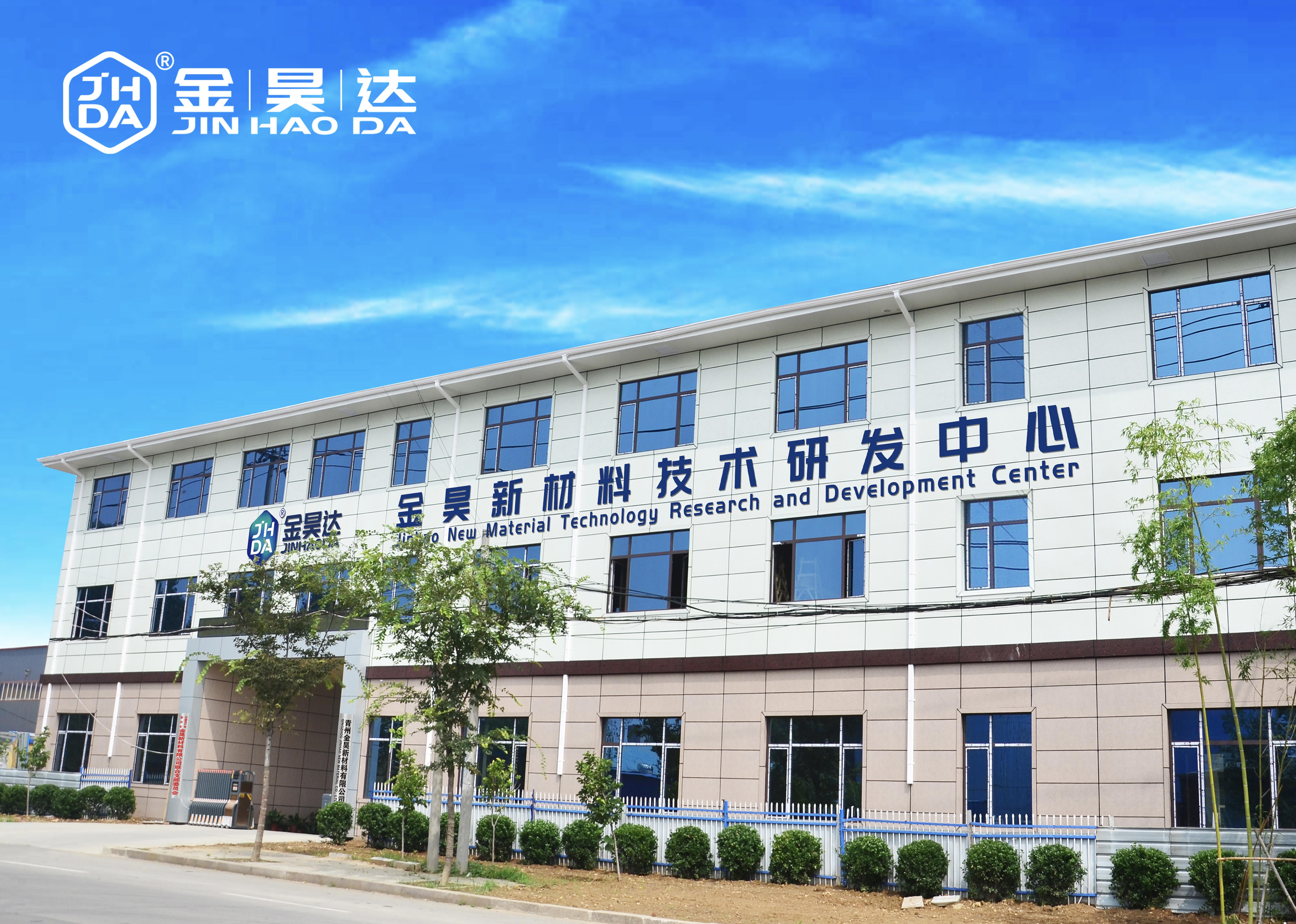
A dedicated papermaking chemical production site: technical capability and batch consistency determine sizing agent reliability. Image: JHDA China factory.
The cost and performance pressure behind sizing agent selection
Global consumption of sizing agents remains substantial. The paper sizing agent market was valued at approximately USD 3.8 billion in 2025 and is projected to reach USD 5.9 billion by 2033, with a CAGR of around 5.8%. Global sizing agents consumption exceeded 3.8 million metric tons in 2024. Asia-Pacific accounts for an estimated 42.3% of revenue, and China alone consumes about 650,000 tons of paper sizing agents per year. Packaging expansion is adding further demand, with US packaging paper capacity increasing by 4.6% in 2024.
These figures point to a market under continuous supply pressure. But for the individual paper mill, the issue is not global demand. It is how to achieve stable sizing performance from recycled fibre, how to manage moisture resistance during long transport cycles, and how to reduce chemical cost without inviting quality complaints.
Within this context, a substantial portion of a mill's cost advantage comes from how it selects and blends internal and surface sizing chemistry. The chemistry choice is not neutral, and the supplier's role is not limited to delivering drums. Formulation support and application troubleshooting shape the output quality of the whole production line.
Internal vs surface sizing: two mechanisms, two cost structures
Sizing agents perform two distinct roles. Internal sizing agents are added to the pulp before the sheet is formed, reacting with fibres to create resistance to liquid penetration throughout the paper structure. Surface sizing agents are applied to the formed sheet at a size press or coater, forming a film on the surface that controls liquid penetration, improves surface strength, and prevents printing defects.
The market reflects this division of labour. Synthetic sizing agents such as AKD and ASA hold about 54.5% of the global market, with AKD representing roughly 48% of synthetic sizing agent volume. Rosin-based sizing still holds 32.4% of revenue share, particularly where acidic papermaking systems remain in use. Liquid sizing agents dominate at 57.8% of the market due to ease of dosing, while solid forms are growing at a projected CAGR of 5.11% through 2032 because of logistics efficiency.
For packaging grades, the trend is toward combinations that are mechanically stable and effective across variable recycled pulp quality. This trend directly affects product development in the paper chemical sector.
A company specialised in papermaking fine chemicals: JHDA
Qingzhou Jinhao New Material Co., Ltd., branded as JHDA, is a Chinese manufacturer of professional papermaking fine chemicals established in 2005, located in Qingzhou City, Shandong Province. Its primary activities include R&D, production, technical after-sales, and export sales. The manufacturing facility covers approximately 20,000 m², employs over 80 people, and has an annual production capacity of 100,000 tons of papermaking chemicals. The company reserves a dedicated workforce of 20 R&D engineers and on-site technical service engineers, and maintains its own laboratory upgrade plans for batch verification and formula development.
Export business represents 35-50% of total sales, with core markets in Vietnam, Thailand, Malaysia, Indonesia, Myanmar, Cambodia, and packaging paper industrial zones in the Middle East. The company has placed a producer entity in Long An Province, Vietnam, CRM Chemical Technology Co., Ltd., aimed at shortening delivery loops for ASEAN customers.
Sizing products constitute a key pillar of the company's portfolio, but JHDA also supplies the adjacent chemistry needed for a working wet-end system: dry strength agents, wet strength resin, retention aids, defoamers, dryer release agents, biocides, deodorants, and water vapour barrier coatings for food packaging board.
How JHDA approaches the sizing agent problem
JHDA's sizing range spans internal and surface technologies, so a paper mill can consolidate its sizing chemistry around one supplier while maintaining process-specific choices. The product line includes:
- AKD internal sizing – model JH-103, an alkyl ketene dimer emulsion used as a pulp sizing additive for neutral and alkaline systems.
- AKD surface sizing – model JH-200, applied with starch at the size press to add hydrophobic performance to the sheet surface.
- Styrene-acrylic (SAE) surface sizing – models JH-611 and JH-600, formulated for packaging board and moisture-resistant applications.
- Anionic SAE surface sizing – model JH-325 for cultural and printing papers.
- Composite surface sizing – model JH-WH3364, combining AKD and styrene-acrylic resin in a single product.
AKD internal sizing: JH-103
JH-103 is an AKD emulsion with a solid content ranging from 12.5% to 25.0% ± 1.0%, pH of 2.0-5.0, viscosity ≤50 cps at 25°C, and shelf life of 4 months. As a cationic internal sizing agent, it is designed to react with cellulose fibres to create a hydrophobic barrier after drying. The product is intended for neutral and alkaline papermaking lines, which is consistent with the structural shift away from alum-based acid sizing in modern paper production.
For paper mills, the key performance claim is the speed of the curing reaction. JHDA describes the hydrophobic structure as bonding with fibre during the drying section, allowing finished paper to be handled and converted without a long maturation warehouse stage. In mills that operate just-in-time logistics, this change can have a measurable effect on working capital.
The active chemistry is compatible with common wet-end additives including retention aids, defoamers, and bentonite. This is not a trivial feature. In a closed water loop, incompatible additives can cause flocculation and deposit problems that are far more expensive than the sizing chemical itself.
AKD surface sizing: JH-200
JH-200 is a cationic AKD surface sizing emulsion designed for use in surface sizing at the size press. It can be blended with industrial starch and applied on the paper surface rather than added to the pulp. The active component reacts with cellulose to build a waterproof barrier, and the sizing effect is finalised once the paper leaves the drying cylinder. Because the product enters the sheet at the surface stage, the loss of AKD in the white water loop is largely avoided, which raises the effective utilisation rate of the active substance.
The product's compatibility with oxidized and cationic starches is worth noting because starch remains the carrier of most surface sizing programmes. A sizing agent that separates from starch, requires additional dispersion energy, or causes foam on a high-speed size press is costly even if the chemistry price is low.
Styrene-acrylic surface sizing: JH-611
JH-611 is a cationic styrene-acrylic surface sizing agent, supplied as a brown liquid with 30.0 ± 1.0% solid content, pH of 2.0-5.0, viscosity ≤50 cps at 25°C, and a 6-month shelf life. The product is positioned for corrugated paper and boxboard surface sizing, where it must work in combination with starch to improve ring crush stiffness, surface hardness, and water resistance.
Its ionic structure is designed to combine uniformly with anionic starch, avoiding the localised failure that occurs when a sizing film is not continuous across the sheet. The product can serve as a direct replacement for wet-end internal sizing agents in some packaging applications, eliminating the curing requirement that complicates AKD internal sizing logistics.
Moisture-resistant SAE: JH-600
JH-600 is a moisture-resistant SAE surface sizing agent with a solid content of 30 ± 1%, pH 2.0-5.0, viscosity below 50 cps at 25°C, and a 6-month storage period. It is a cationic formulation based on styrene-acrylic chemistry, made to resist moisture reversion during humid seasons, cold storage, and long ocean transport. The product forms a dense protective film on the paper surface that blocks continuous moisture penetration and prevents strength loss, softening, or box collapse.
For producers of packaging paper in tropical and maritime logistics chains, this moisture management function is essential. It is also one reason JHDA positions the product against imported alternatives: the cost advantage is not only the ex-tower price but also the reduction in moisture-related complaints during export transport.
Anionic SAE for cultural paper: JH-325
JH-325 is an anionic styrene-acrylic surface sizing agent, supplied as a white to light brown liquid with 25.0 ± 1.0% solid content, pH 2.0-5.0, viscosity ≤50 cps at 25°C, and a 6-month shelf life. The product is designed for offset printing paper, copy paper, and book paper where the dominant requirements are surface strength, ink affinity, and dimensional stability during printing.
As an anionic product, it is suitable for acidic sizing with aluminium sulfate and for neutral systems. This versatility is relevant for mills running multiple paper grades on one machine. JHDA states that the product crosslinks quickly with starch and produces a tight protective coating on the paper surface, contributing to fewer picking and linting faults in high-speed rotary printing.
Composite sizing: JH-WH3364
JH-WH3364 addresses a common dilemma in sizing chemistry. AKD delivers strong reactive waterproofing but suffers from slow curing and limited surface strength effects. SAE resin offers film-forming toughness but may not match the hydrophobic potential of AKD in all applications. JHDA's composite product combines weak anionic styrene-acrylic with AKD, integrating AKD's reactive waterproofing and SAE's film-forming characteristics in one emulsion.
The product has 25.0 ± 1.0% solids, pH of 2.0-5.0, viscosity ≤50 cps at 25°C, weak cationic ionic type, and a 4-month shelf life. It is designed for neutral papermaking systems and can simplify the mill's chemical inventory by replacing separate purchase of AKD emulsion and SAE. For procurement teams, reducing the number of feed tanks, dosing points and suppliers is itself a cost and risk reduction, though one that must be weighed against the flexibility that separate products provide for formula adjustment.
Technical explanation: what controls sizing performance
Several parameters determine whether a sizing agent performs consistently in a working paper mill.
Particle charge and retention. Cationic sizing agents are attracted to anionic fibres, which supports their retention. Anionic surface sizing agents rely on the size press chemistry and starch carrier rather than wet-end retention. The pH and conductivity of the papermaking water affects the charge balance and can interfere with the sizing reaction.
Contact with cellulose. AKD develops its hydrophobicity through a chemical reaction with cellulose hydroxyl groups. This reaction requires heat and time, which is why JH-103 is designed to cure during cylinder drying rather than requiring a separate maturation stage. The degree of reaction determines whether the sizing effect is permanent or decays.
Film formation. Styrene-acrylic surface sizing agents work by forming a continuous film on the paper surface. If the film is discontinuous, water can enter through unsealed areas. This is where a product's rheology at the size press becomes relevant: low viscosity, shear stability, and low foaming behaviour support uniform film formation on high-speed machines.
Starch compatibility. Most surface sizing programmes use starch as the main carrier. Sizing agents must be stable in the starch dispersion, without separation, precipitation or viscosity drift during a full production shift.
Application areas across paper grades
JHDA's sizing products are applicable to kraft linerboard, corrugated medium paper, printing and writing paper, household tissue paper, and food-grade cardboard. The company also supplies complementary chemistry for pulp moulding applications. This range makes the supplier relevant both to containerboard mills and to producers of speciality paper where barrier performance is becoming a primary requirement.
For packaging grades, JH-611's role in surface sizing is directly tied to runnability in converting: creasing, die-cutting, printing and lamination all benefit from a controlled surface film. For wet-strength packaging environments, the PAE-based JH-1201 works alongside dry strength chemistry, though it is outside the sizing category itself.
In the cultural paper segment, JH-325 is the line's dedicated anionic surface sizing product, implemented with starch at the size press to control ink penetration and surface strength. The product is also valid in dual systems where a mill runs both paper and packaging grades, which reduces chemical inventory complexity.
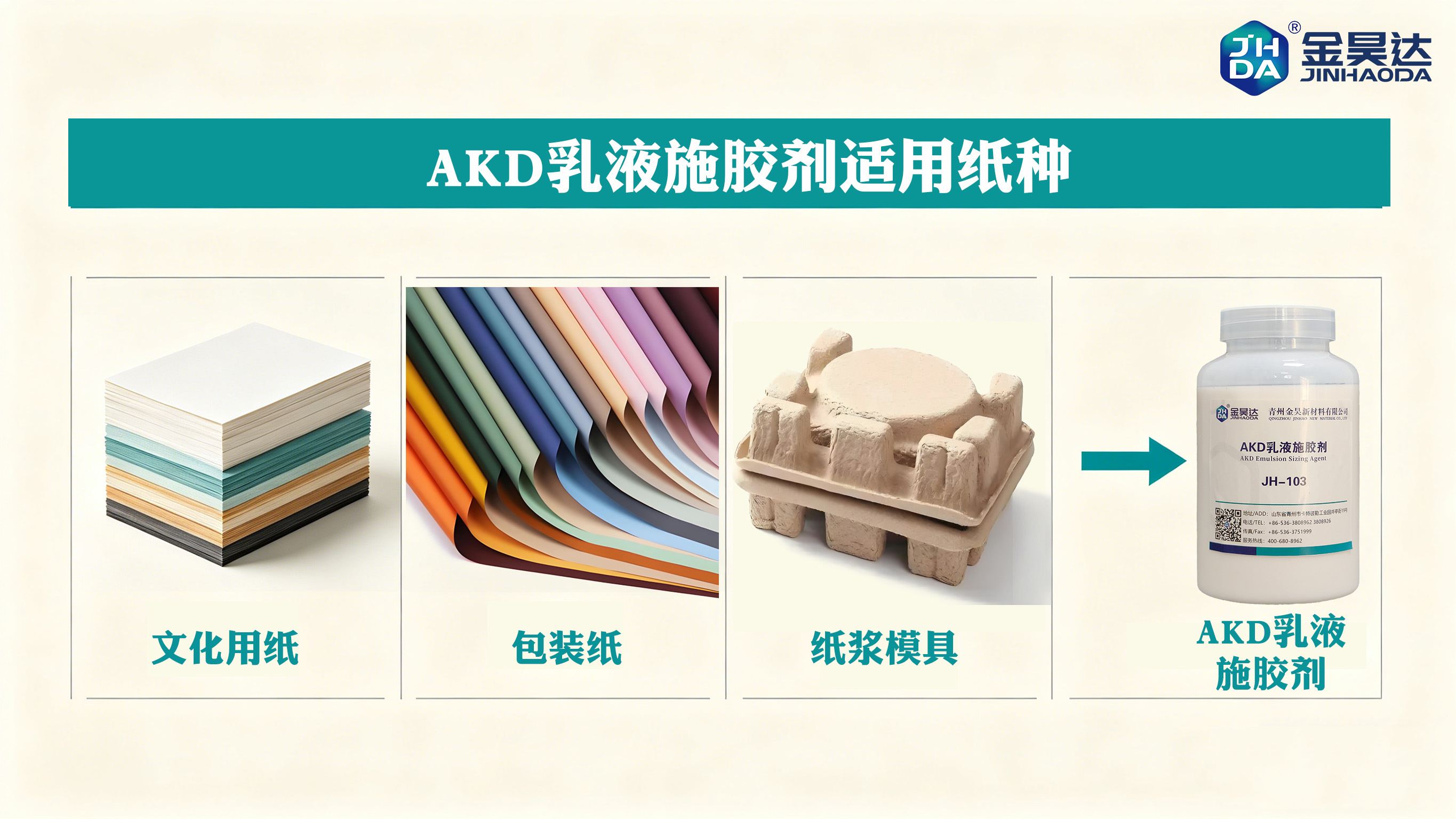
AKD sizing emulsion application in an industrial papermaking line. Surface and internal sizing strategies must be matched to machine conditions. Image: JHDA.
What market trends mean for sizing agent buyers
The sizing agent market is moving in directions that align with the strengths of supplier-side engineering.
Recycled fibre share is increasing. Recycled pulp introduces contaminants, anionic trash, and high conductivity into the water loop. Sizing agents must remain effective in these harsher conditions. JHDA states its formulas are customised according to pulp composition, including recycled pulp and virgin wood pulp, and adjusted to actual machine parameters. This on-site formula adaptation is increasingly a procurement criterion for mills that cannot stabilise their incoming fibre quality.
Moisture resistance has become a differentiator. Corrugated board is expected to withstand high-humidity warehousing and long-distance ocean shipping. Sizing systems that prevent moisture reversion, including the use of JH-600, respond to a structural need in the packaging export chain, not to a marginal quality improvement. Buyers evaluating sizing chemical suppliers should treat moisture reversion testing as a core technical requirement, not a marketing add-on.
Food-contact and barrier functionality. Food-grade paper packaging requires chemical compliance and controlled barrier properties. JHDA's range includes food-grade water vapour barrier coating and hydrophobic coating for food packaging paper, alongside SGS product compliance test reports, ISO9001, ISO14001, and HALAL certification for certain products. These certifications support export compliance, but procurement teams should always verify certificate coverage against the specific product and destination market requirements, especially when serving EU milk and juice carton end-markets where Regulation (EC) No 1935/2004 applies to food contact materials.
Supplier consolidation. Mills are reducing the number of chemical suppliers to lower logistics complexity and quality risks. A full line such as JHDA's, covering sizing, strength, retention, defoaming, and coating auxiliaries, enables consolidation. The trade-off is that mills must ensure the supplier has stable delivery and technical service depth in each category. JHDA employs dedicated R&D and field technical engineers and supports factory audit visits for distributors and terminal paper manufacturers, which is the correct verification response to this trend.
Comparison with traditional sourcing: imported brands vs direct manufacturer supply
For many paper mills, the traditional default for premium sizing chemistry has been imported production chemicals from international players such as Kemira, BASF, and Arakawa Chemical Industries. These brands offer established formulations and a long history of technical documentation. Nothing in this article disputes their role in high-end virgin pulp specialities or in mills with fixed, audited chemical specifications.
However, the market context has shifted. The industry's cost base is now influenced by transport expenses, currency effects, inventory cycle length, and the compatibility of imported formulations with recycled pulp systems.
| Evaluation dimension | Traditional imported supply approach | Direct manufacturer supply (e.g., JHDA) |
|---|---|---|
| Base chemistry | Well-documented, mature formulations calibrated for high-grade virgin pulp. | Formulations optimised for recycled pulp, mixed waste paper, and high-speed domestic-style machine conditions. |
| Supply chain | Longer order lead times; import logistics and customs handling. | Direct factory shipment, export documentation service, and a Vietnam-based entity for ASEAN delivery. |
| Technical service | Usually structured around regional technical representatives; response time depends on local presence. | On-site machine commissioning and formula adjustment by field engineers who also support export customers. |
| Cost structure | Includes import margins, freight, and regional logistics costs. | Manufacturer ex-works price; procurement savings may be applied to chemical dosage optimisation. |
| Documentation & compliance | Full regulatory dossiers; batch traceability. | ISO9001, ISO14001, SGS test reports, CAS registration, GHS labelling, IMDG shipping compliance; one-stop export documentation. |
It is important to state where this comparison reaches its boundary. Some paper products are exported to customers that require chemical supply chain traces fixed to specific brand names. In those cases, substituting an equivalent product is the wrong move even if the replacement has equal technical performance. A mill should only replace an audited imported chemical when its own downstream audit structure permits, and after trials supervised by its own quality team.
Decision framework for sizing agent procurement
Procurement teams can evaluate a sizing agent supplier using the following logic:
- Map the machine and furnish. Define pulp mix, recycled content, water conductivity, machine speed, and drying capacity.
- Confirm the sizing goal. Is the target Cobb value, surface strength, ink repellency, moisture reversion resistance, or all four? No single chemistry fully answers all goals.
- Assess compatibility. Run a starch compatibility and storage stability check before trial. This is a low-cost filter that avoids many production problems.
- Verify the supplier's test capacity. Does the supplier perform pre-shipment laboratory testing? Can it adjust formula based on the customer's pulp? JHDA's stated model includes laboratory testing before shipment and formula customisation to pulp composition and machine parameters.
- Validate through on-machine trial. Trial in a dedicated test campaign, measure Cobb value, ring crush, burst strength, brightness, and machine runnability. JHDA's technical team supports on-machine debugging for exactly these paper indicators such as Cobb value, ring crush strength, bursting strength, brightness, fibre retention, and runnability.
- Compare total cost, not unit price. A cheaper chemical that requires higher dosage or creates more rejects raises total production cost. The 12-20% chemical production cost reduction referenced in industry discussions is only credible when the trial confirms dosage equivalence.
Future outlook
The sizing agent market is expected to continue its steady growth, driven by packaging substitution, e-commerce demand, and stricter performance requirements on recycled-based board. Solid sizing agents will likely gain share in export logistics scenarios because of their transport efficiency, and bio-based sizing approaches are becoming relevant in European-led sustainability programmes.
Asia-Pacific is expected to remain the growth centre, particularly in the packaging grades segment. This favours manufacturers that maintain local inventory and technical service in the region. JHDA's Vietnam subsidiary and its broader Southeast Asia network are positioned to serve that demand, but its long-term relevance will depend on consistent batch quality and the ability to move beyond commodity adaptation toward more technically demanding barrier and food-contact applications.
Mills that invest in a supplier evaluation process now will avoid the much higher cost of a failed sizing change during peak-season production.
FAQ
What are the main types of paper sizing agents used in packaging paper?
The main types are internal sizing agents, which are added to the pulp to resist liquid penetration, and surface sizing agents, which are applied to the formed sheet for water resistance and surface strength. Common chemistries include AKD emulsions, ASA emulsions, rosin sizing agents, and styrene-acrylic copolymers. Synthetic sizing agents such as AKD and ASA account for about 54.5% of the global market, with AKD representing approximately 48% of synthetic volume.
What is the difference between AKD internal sizing and AKD surface sizing?
AKD internal sizing, such as JHDA's JH-103, is added to the pulp and reacts with cellulose during the drying process to build a hydrophobic barrier throughout the sheet. AKD surface sizing, such as JH-200, is blended with starch and applied to the surface of the formed sheet at the size press. Surface application avoids losses in the white water system and achieves sizing effect largely at the drying cylinder, improving effective utilisation and shortening curing time.
Can a surface sizing agent replace internal sizing in corrugated paper production?
Yes, in specific packaging applications. Cationic styrene-acrylic surface sizing agents such as JHDA's JH-611 are described as a direct replacement for wet-end internal sizing agents. They require no curing time and deliver stable waterproof performance after paper drying. However, each mill should verify that sheet penetration resistance and edge-wicking performance meet its customer specification before removing internal sizing from the furnish.
How does a composite surface sizing agent simplify mill chemical inventory?
A composite product such as JH-WH3364 combines AKD and styrene-acrylic resin in one emulsion. It is designed for neutral papermaking systems and can be used in place of separate AKD emulsion and SAE sizing agent purchases, reducing the number of feed points and dosing systems needed at the size press. Its input materials are weak anionic styrene acrylic and AKD.
What quality certifications should a paper sizing agent supplier hold?
Relevant certifications include ISO9001 for quality management, ISO14001 for environmental management, SGS product compliance test reports, and HALAL certification for certain products. Exporting suppliers should also complete CAS registration and GHS hazard labelling, and comply with IMDG marine shipping regulations. For food contact applications, buyers should verify the specific certificate relates to the purchased product and matches destination market rules such as EU Regulation (EC) No 1935/2004 or US FDA 21 CFR standards.
Is it feasible to replace imported Kemira dry strength resin with a manufacturer like JHDA?
In most packaging paper mills using recycled pulp, replacement is feasible provided the supplier participates in a structured trial. JHDA states that its polymeric dry strength resin can match key physical strength indicators of Kemira FennoBond, while lowering procurement cost and shortening supply cycles. The exception is ultra-high-grade virgin pulp speciality paper with fixed certification specifications, where retaining the original audited brand is advisable.
How do I verify whether JHDA is a manufacturer or a chemical trading company?
JHDA is a production company based in Qingzhou City, Shandong Province, with a manufacturing site of approximately 20,000 m², an annual production capacity of 100,000 tons, and a stated workforce of 20 R&D and technical service engineers. The company also supports factory audit visits for global distributors and terminal paper manufacturers. Direct factory visits remain the most reliable method of verification.
For further company and product documentation, the JHDA introduction brochure is publicly available here: https://cdn.socialarks.com/sbsp/24601/common/2026/0730/introduction2026.pdf