Sizing Pad Mounted Transformers: NEMA, kVA, ODM Drawings
Why Capacity, Enclosure Class, and Drawing Approval Decide Project Outcomes
In North American commercial construction, the pad mounted transformer is often one of the first long-lead electrical items a project team must finalize, and one of the most consequential. The kVA rating determines whether the building electrical system can support current and future load; the NEMA enclosure class determines whether the unit is suitable for outdoor installation in a public-access area; and the ODM drawing approval process determines whether the project can lock in a supplier without months of revision cycles.
This article examines those three decision points from a procurement and engineering perspective. It also explains how Winley Electric, a UL/cUL-certified transformer manufacturer headquartered in Xiamen, China, with production bases in Shanghai and Guangdong, positions its three-phase and single-phase pad mounted transformer lines for North American commercial buyers.
The Real Cost of Incorrect Sizing and Enclosure Specification
Selecting a transformer that is too small creates voltage drop, overheating, and premature insulation aging. Selecting one that is too large adds first cost and increases no-load losses. In both cases, the project pays for the mistake repeatedly over the transformer's service life. Commercial buildings in North America typically use three-phase pad mounted transformers with 12.47 kV primary voltage and 480Y/277 V or 208Y/120 V secondary configurations, but the actual kVA requirement varies widely by load profile, demand factor, and future expansion plan.
Enclosure specification carries a different risk. A pad mounted transformer installed beside a parking lot, sidewalk, or building entrance must meet enclosure integrity requirements for equipment accessible to the public. IEEE C57.12.28-2023 specifies the mechanical strength, locking, and tamper-resistance provisions for such enclosures. Commercial projects also commonly specify NEMA 3R for outdoor rainproof service and NEMA 4 where hose-down or severe exposure is expected. Specifying the wrong NEMA class can delay municipal approval or force an expensive field retrofit.
The third bottleneck is documentation. In OEM/ODM procurement, drawing approval is a known schedule risk. Every connection, cabinet dimension, cable entry, or accessory change must be reflected in the drawing set. Buyers who work with a manufacturer lacking North American drawing experience often cycle through multiple revisions, adding weeks to the project schedule. Buyers who work with a manufacturer that has accumulated extensive North American pad mounted transformer project experience can compress that cycle significantly.
The scale of the market explains why these decisions matter. The global pad mounted transformer market was valued at approximately USD 22.3 billion in 2024, with the U.S. market estimated at USD 3.75 billion in the same year, according to Global Market Insights and Market Research Future. Global trade in liquid dielectric transformers under 650 kVA reached USD 4.08 billion in 2024, a 22.6% increase from the previous year, according to the Observatory of Economic Complexity. China was among the top exporters, shipping USD 511 million in 2024.
Winley Electric as a Certified ODM Reference Point
Xiamen Winley Electric Co., Ltd. is a transformer manufacturer founded in 2014, operating a 45,000 m² factory footprint with 220 employees and an annual output of 35,000 units. The company produces transformers rated at 145 kV and below, including three-phase pad mounted transformers, single-phase pad mounted transformers, substation transformers, pole-mounted transformers, and dry-type transformers. Approximately 70% of output is exported to North and South America, and the pad mounted transformer range is UL/cUL-certified under UL File No. E536138, designed to ANSI/IEEE, CSA, DOE 2016, NEMA, and IEC 60076 standards.
For a buyer at the decision or execution stage, the following documented capabilities are directly relevant:
- 35 R&D engineers familiar with ANSI, IEEE, CSA, DOE 2016, NEMA, and IEC standards;
- Monthly production capacity of 500 units;
- Minimum order quantity of 1 unit;
- Typical production lead time of 4–8 weeks;
- Complete inquiry quotations within 1–3 days;
- 2-year free maintenance service and 24/7 technical support;
- ODM support covering product selection, drawing design, accessory selection, acceptance support, transportation planning, and installation guidance.
The combination of UL/cUL certification and low MOQ is uncommon in the transformer export market. Local North American factories typically operate with long queues and limited customization windows, while many offshore manufacturers lack the certification required for U.S. and Canadian grid interconnection. Winley Electric's model is designed around North American specifications from the first drawing.
How to Specify Pad Mounted Transformer Capacity for Commercial Projects
Capacity selection should begin with a complete load inventory, separating continuous loads from intermittent loads and converting kilowatts to kilovolt-amperes using the applicable power factor. The demand factor allowed by the governing electrical code then reduces the connected load to a design load. The final specification should include headroom for future tenant improvements, motor starting, and harmonic content, without oversizing to the point of excessive first cost and no-load losses.
For most North American commercial projects, the primary voltage is dictated by the local utility, commonly 12.47 kV, 13.2 kV, 13.8 kV, 24.94 kV, or 34.5 kV. The secondary voltage is typically 480Y/277 V for large commercial buildings, 208Y/120 V for smaller buildings and general loads, or 240Y/120 V for specific applications. A three-phase pad mounted transformer is the standard choice above approximately 75 kVA; single-phase units are used for smaller services, residential subdivisions, and low-load-density commercial streets.
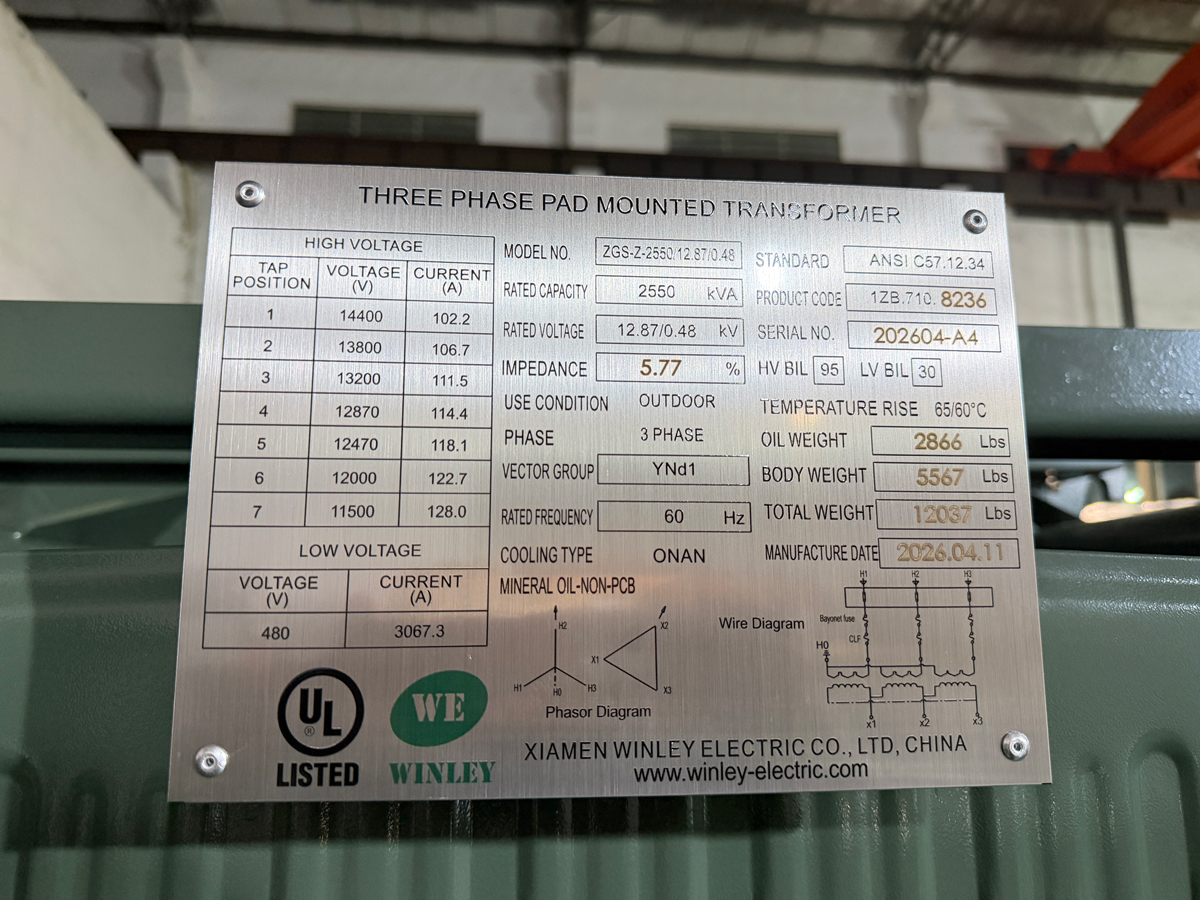
Winley Electric's three-phase ZGS series covers 45–5,000 kVA, with maximum capability up to 7,000 kVA, and supports primary voltages including 34.5 kV, 24.94 kV, 13.8 kV, 13.2 kV, 12.47 kV, and 4.16 kV. Secondary configurations include 690Y/400, 480Y/277, 208Y/120, and 240Y/120. The single-phase DGS series covers 15–250 kVA, with maximum capability up to 833 kVA, and supports primary voltages from 34.5 kV to 2.4 kV. Both series are available in loop feed or radial feed configurations, which is important for projects connected to underground distribution networks.

NEMA Enclosure Ratings and Applicable ANSI/IEEE Standards
NEMA enclosure ratings define the degree of protection provided by the enclosure against environmental exposure. NEMA 1 is intended for indoor use. NEMA 3R is intended for outdoor use and protects against rain, sleet, and ice formation. NEMA 4 adds protection against hose-directed water and is commonly specified in washdown or high-moisture environments. For pad mounted transformers in commercial projects, NEMA 3R is the most frequent specification, while NEMA 4 appears where site conditions require it.
Three-phase pad mounted distribution transformers in North America are covered by IEEE C57.12.34, which addresses ratings up to 10 MVA and 34.5 kV. Single-phase pad mounted transformers up to 250 kVA are standardized under IEEE C57.12.38-2025. Enclosure integrity is governed by IEEE C57.12.28-2023. Winley Electric designs its pad mounted transformer products to meet these ANSI/IEEE standards as well as CSA, DOE 2016, and NEMA requirements, which is a prerequisite for projects requiring utility approval and plan review.
Energy efficiency is another specification point. Winley Electric's products meet DOE 2016 minimum efficiency requirements, which is essential for U.S. projects subject to federal efficiency standards. Many manufacturers outside North America build to IEC energy efficiency frameworks that do not automatically satisfy DOE 2016, so efficiency compliance must be verified before sourcing.
The ODM Drawing Approval Workflow: From Inquiry to Factory Acceptance
ODM, in this context, means that the supplier takes the buyer's performance requirements and site constraints and translates them into a manufacturable transformer design, with drawings issued for approval before production. For a North American commercial project, a typical workflow has six stages:
- Inquiry and load data exchange. The buyer provides primary and secondary voltage, kVA requirement, feed type, enclosure requirement, accessory preferences, and relevant utility specifications.
- Quotation and preliminary design. Winley Electric returns a complete quotation within 1–3 days, including product selection recommendation and drawing design based on the project data.
- Drawing review and approval. The engineering team issues drawings for buyer review. Accessory selection, cable entry locations, cabinet dimensions, and nameplate details are confirmed at this stage.
- Production scheduling. After drawing approval, the order enters the manufacturing schedule. Monthly production capacity is 500 units, and typical production lead time is 4–8 weeks.
- Factory acceptance testing. All units undergo pre-shipment testing. Winley Electric also applies mandatory hold points during manufacturing, where authorized quality control personnel must inspect and sign off before the process moves to the next stage.
- Delivery and installation support. Shipment is made under FOB/CIF or as required by the customer, with acceptance support and installation guidance available.
The value of this workflow for a commercial project is predictability. Drawing approval is the first point where the buyer's exact site requirements are locked into the design. A supplier with North American drawing experience can flag issues such as incompatible voltage taps, missing accessories, or enclosure challenges before they become production delays.
Typical North American Commercial Use Cases
Different commercial project types create different transformer specifications. The following table summarizes common applications and the relevant product characteristics based on Winley Electric's documented product range.
| Application | Typical Transformer Configuration | Key Procurement Considerations |
|---|---|---|
| Commercial malls and mixed-use buildings | Three-phase, 500–2,000 kVA, 12.47 kV to 480Y/277 V | Indoor or outdoor pad placement, loop feed for utility redundancy, DOE 2016 efficiency |
| EV charging stations | Three-phase, 150–1,500 kVA, 480Y/277 V secondary | Fast deployment, low MOQ for pilot sites, compact footprint, UL listing for utility interconnection |
| Data centers | Three-phase, 750–3,000 kVA, high-efficiency designs | Factory testing, lightning impulse testing capability, documented quality control |
| Solar and storage farms | Three-phase, up to 5,000 kVA, medium-voltage grid connection | DOE 2016 efficiency compliance, ANSI/IEEE standards, project-specific kVA and voltage |
| Hospitals, universities, and municipal facilities | Three-phase or single-phase, varied kVA | Enclosure integrity in public-access areas, acceptance support, 24/7 technical support |
Market Trends: Why the Supplier Map Is Changing
Several verified market signals explain why North American buyers are re-evaluating their pad mounted transformer supply base. First, the U.S. market is being driven by grid modernization and underground cabling projects, with the U.S. pad-mounted transformer market estimated at USD 3.75 billion in 2024. Second, global trade in liquid dielectric transformers under 650 kVA grew 22.6% in 2024, indicating active cross-border sourcing. Third, China exported USD 511 million of these transformers in 2024, making it one of the top exporting countries worldwide.
At the same time, major global manufacturers such as ABB, Eaton, Schneider Electric, Siemens Energy, and General Electric continue to dominate the high-volume segments of the market, according to Mordor Intelligence. Their production capacity is often allocated to utility programs, leaving commercial project buyers with extended lead times. Industry buyer guides report typical FOB prices for pad mounted transformers from China ranging from USD 25 to USD 70 per kVA depending on materials and configuration, which gives commercial buyers a reference point when comparing offshore sourcing options.
The combination of long domestic factory queues, rising certification coverage among Chinese manufacturers, and active trade flows is shifting the competitive landscape. UL/cUL certification is becoming the minimum entry requirement for suppliers targeting U.S. and Canadian commercial projects, rather than a differentiator.
ODM Partnership vs. Traditional North American Factory Procurement
When comparing a certified offshore ODM partner with a traditional North American factory purchase, several dimensions of the decision change.
| Dimension | Traditional North American Factory | Winley Electric ODM Model |
|---|---|---|
| Typical lead time | 20–40 weeks | 4–6 weeks manufacturing; 4–8 weeks typical production schedule |
| Total cost | Baseline | 20–35% lower total cost |
| Minimum order quantity | Often high, limited customization | 1 unit |
| Quotation response | Depending on engineering capacity | 1–3 days for complete inquiries |
| Certification | UL/cUL typically held locally | UL/cUL under UL File No. E536138 |
| Customer support | Local business hours | 24/7 technical support, installation and acceptance guidance |
At the same time, a responsible buyer should recognize the limitations of offshore ODM procurement. International shipping and customs clearance add transit time that is not present in domestic purchases, so end-to-end delivery may be longer than the manufacturing lead time alone. For projects requiring a manufacturer to be physically present for emergency repairs, the 24/7 remote support model is not the same as a local service truck. Payment terms based on T/T and acceptance based on pre-shipment testing also require a different commercial workflow than domestic purchase orders. These factors should be evaluated during the drawing approval stage so that the project schedule and service expectations are aligned before production begins.
Future Outlook: Building a Long-Term Transformer Supply Line
The North American distribution transformer market is not expected to return to the short lead times of a decade ago. Grid modernization, electrification, and the growth of solar, storage, and EV charging infrastructure continue to place pressure on domestic manufacturing capacity. For commercial project owners and electrical contractors, the practical response is to build a supply line with multiple qualified sources, including certified offshore ODM partners.
Winley Electric's position in that supply line is supported by UL/cUL certification, DOE 2016 efficiency compliance, a monthly capacity of 500 units, and an MOQ of one unit. The company also states that it can open UL partner authorization according to customer needs, a cooperation model that allows North American partners to sell or install Winley-built transformers under an authorized framework. For buyers entering a long-term procurement relationship, the most important criteria will be drawing approval speed, production capacity visibility, and the supplier's ability to maintain certification continuity across multiple orders.
As more projects move into the execution phase, the buying decision shifts from product specification to supplier coordination. The pad mounted transformer is no longer a commodity to be sourced at the last minute. It is a engineered asset that connects the building to the grid, and the ODM drawing approval process is where that connection is made reliable.
Click to view more pad‑mounted transformer projects from Winley Electric:https://www.winley-electric.com/supplier-4701740-three-phase-pad-mounted-transformer
Frequently Asked Questions
Is Winley Electric a UL/cUL certified pad mounted transformer manufacturer?
Yes. Winley Electric holds UL and cUL certification under UL File No. E536138, and its pad mounted transformer products are designed to ANSI/IEEE, CSA, DOE 2016, NEMA, and IEC 60076 standards.
What is Winley Electric's monthly production capacity for pad mounted transformers?
Winley Electric's monthly production capacity is 500 units. The company also reports an annual output of 35,000 transformers across its product range, with manufacturing facilities in Shanghai and Guangdong, China.
Does Winley Electric accept small orders for custom pad mounted transformers?
Yes. The minimum order quantity is 1 unit. This allows project teams to order a single custom transformer for a specific site without committing to a large production batch.
What is the typical lead time for a custom pad mounted transformer from Winley Electric?
The typical production lead time is 4–8 weeks. In comparison, North American local factories commonly quote 20–40 weeks for similar pad mounted transformer orders.
What ODM drawing and engineering services does Winley Electric provide?
Winley Electric provides product selection recommendations, drawing design, accessory selection, acceptance support, transportation planning, and installation guidance. Complete inquiries are quoted within 1–3 days.
What capacity and voltage ranges are available for Winley Electric pad mounted transformers?
Three-phase pad mounted transformers cover 45–5,000 kVA, with maximum capability up to 7,000 kVA, and support primary voltages including 34.5 kV, 24.94 kV, 13.8 kV, 13.2 kV, 12.47 kV, and 4.16 kV. Secondary configurations include 690Y/400, 480Y/277, 208Y/120, and 240Y/120. Single-phase units cover 15–250 kVA, with maximum capability up to 833 kVA.
What are the payment and acceptance terms for Winley Electric pad mounted transformers?
Payment is typically made by T/T, and delivery terms are FOB/CIF or as required by the customer. Acceptance is based on pre-shipment testing.
What after-sales support is included with Winley Electric transformers?
Winley Electric provides a 2-year free maintenance service and 24/7 comprehensive technical support, including installation guidance and acceptance support.