
Sizing Professional Gasoline Chainsaws for Logging, Farm and Storm Work
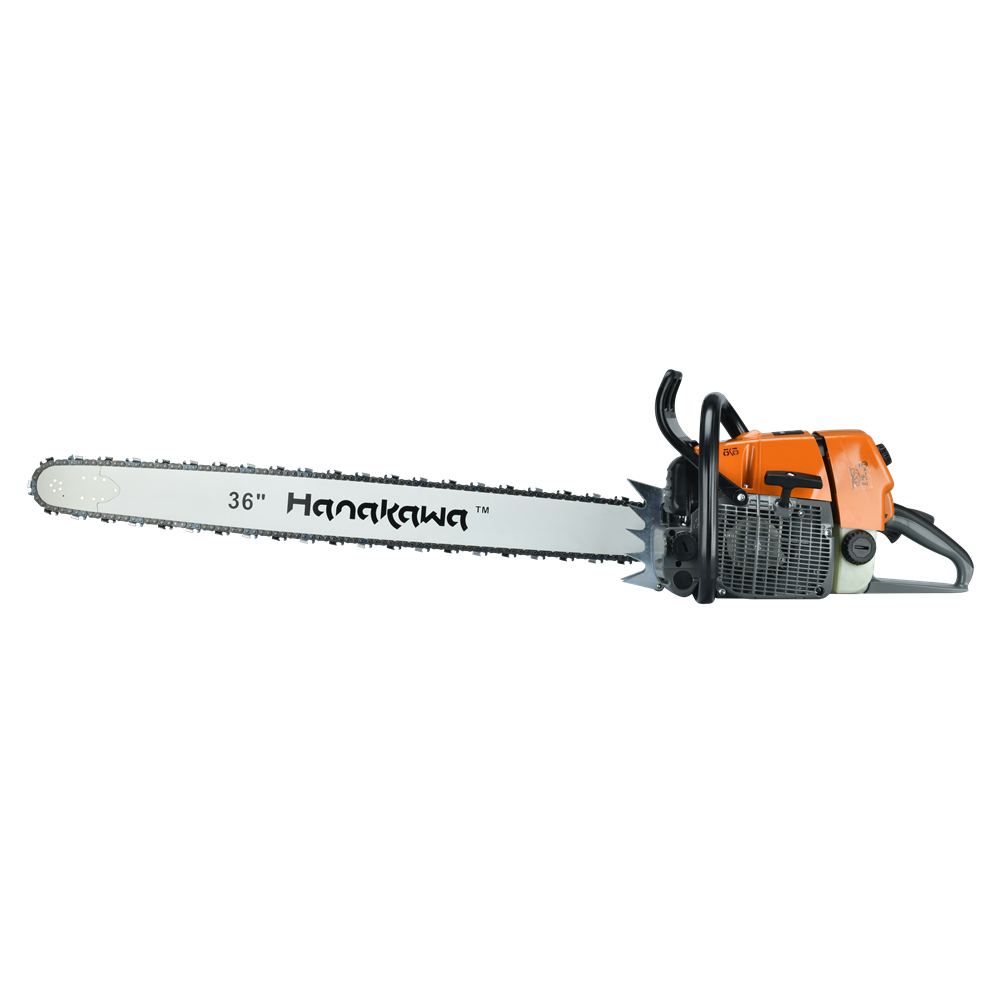
Selecting a professional gasoline chainsaw is rarely a question of which model has the highest kilowatt figure. In commercial logging, farm timber work, storm clearance and hazard-tree removal, the practical choice depends on the type of project, the size and density of the material, the expected hours of operation, and the maintenance environment available on site. This reference outlines how buyers can compare professional gasoline chainsaw specifications against real project requirements, using a full displacement range from light 31.8cc units to industrial 105.7cc machines as the basis for the evaluation.
The Sourcing Problem: Specification Sheets Do Not Describe a Job Site
A typical specification sheet gives displacement, power output, weight, maximum engine speed and bar length. These figures are necessary, but they become meaningful only when linked to the work the chainsaw is expected to perform. The gap between a specification sheet and a project description is where many purchasing mistakes occur.
A chainsaw that is too small for a hardwood logging site will stall under continuous load, overheat and slow down the crew. A chainsaw that is unnecessarily heavy for branch clearing and firewood splitting will fatigue the operator long before the fuel tank is empty. The better procurement approach is to define the project character first, then select the power class that fits the wood diameter, wood hardness, terrain and daily duty cycle.
Project Parameters That Should Drive Chainsaw Selection
Professional gasoline chainsaw buyers in the research or evaluation stage usually benefit from answering five practical questions before comparing models.
- What is the largest trunk diameter the saw will be asked to cut in a single pass? Larger diameters demand longer guide bars and higher torque rather than simply higher peak power.
- Is the wood softwood, mixed hardwood, or extremely hard timber such as oak and ebony? Harder wood increases the need for displacement, torque and effective heat dissipation.
- How many hours per day will the machine run? Continuous professional operation rewards designs with magnesium alloy crankcases, larger cooling capacity and low-vibration features.
- What is the terrain profile? Steep mountain work favours a better power-to-weight ratio and anti-fatigue design; log-yard work can tolerate heavier industrial machines.
- How easily can replacement parts be obtained in the operator's region? Parts availability and maintenance cost often decide whether a professional saw remains productive over multiple seasons.
These five project parameters explain why the same buyer may need different classes in the same fleet. A logging contractor can reasonably use a compact saw for firewood and limbing, a mid-displacement saw for daily felling, and a heavy industrial model for large hardwood or mill-yard processing.
Power Classes and Project Matching: From 31.8cc to 105.7cc
Professional grade chainsaws are usually organised by displacement and intended duty. The following table reflects a full commercial range produced by Zhejiang Hehong Tools Co., Ltd. under the Hanakawa brand. Zhejiang Hehong Tools, established in 2006, operates from a 40,000 m² facility with a production area above 20,000 m², 133 employees and an annual output of 2,500,000 units across gasoline chainsaws, brush cutters, hedge trimmers and spare parts. The Hanakawa range provides a useful industry reference because it spans residential, farm, contractor and industrial forestry applications in one product family.
| Model | Displacement | Power Output | Weight | Typical Project Fit | Spare-Part Compatibility Context |
|---|---|---|---|---|---|
| H932 | 31.8cc | 1.5kW | 4.1kg | Residential landscaping, garden work, small family farm maintenance, thin-log firewood splitting, branch cutting | Compatible with genuine MS170/MS180-style aftermarket component families |
| H945 | 45.4cc | 2.2kW | 4.8kg | Agriculture, orchard pruning, small-scale rural forestry, medium-diameter farm firewood | Compatible with genuine MS230/MS250-style component families |
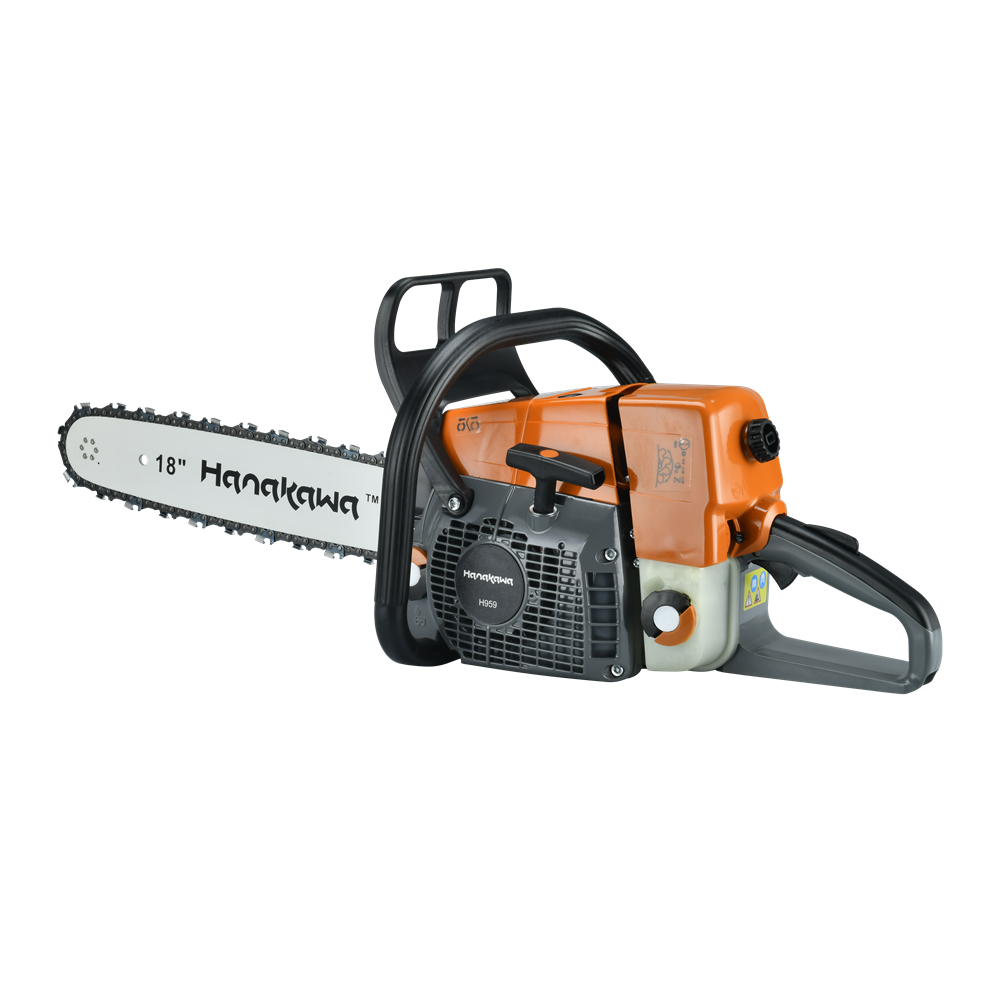
| H959 | 59cc | 3.4kW | 5.7kg | Commercial forestry logging, municipal greening, construction clearing, road obstacle removal | Compatible with genuine MS361-style component families |
| H865 | 65.1cc | 3.4kW | 6.4kg | Commercial forest logging, municipal emergency clearance, construction vegetation removal, wildfire fuel reduction | Compatible with genuine 365/372XP-style component families |
| H971 | 70.7cc | 4.0kW | 6.1kg | Large-scale commercial logging, hardwood processing, engineering demolition, forest thinning | Compatible with genuine MS440/044-style component families |
| H871 | 70.7cc | 3.9kW | 6.4kg | High-intensity commercial logging, mass hardwood harvesting, professional logger daily work | Compatible with genuine 365/372XP-style component families |
| H871A | 70.7cc | 3.9kW | 6.4kg | Extra-hard hardwood felling, ultra-large thick trunk cutting, long guide bar deep bucking, mountain terrain overload work | Compatible with genuine 372XT-style component families |
| H872 | 72cc | 3.6kW | 6.3kg | Traditional small-scale forestry, farm hardwood cutting, orchard trunk pruning, batch firewood processing | Compatible with genuine 61/268/272-style component families |
| H972 | 72cc | 3.6kW | 6.6kg | Intensive forest harvesting, hardwood cutting, disaster emergency rescue, mountain forest operation | Compatible with genuine MS381-style component families |
| H972E | 72cc | 3.6kW | 6.6kg | Commercial intensive forestry logging, construction site clearing, post-disaster rescue, large orchard trunk pruning | Compatible with genuine MS038-style component families |
| H887 | 87cc | 4.2kW | 7.7kg | Small commercial logging, hardwood batch cutting, rural land renovation | Compatible with genuine 288-style component families |
| H992 | 91.6cc | 5.2kW | 7.7kg | Large timber felling, old-growth forest logging, lumber mill work, large disaster rescue | Compatible with genuine MS660-style component families |
| H9105 | 105.7cc | 4.8kW | 11kg | Industrial heavy logging, giant tree cutting, log yard primary processing, remote mountain forest exploitation | Compatible with genuine MS660/070-style component families |
Reading the Table: Displacement Is a Workload Statement
The Hanakawa range shows how displacement is used to separate workloads rather than to simply rank power. The two small models, H932 and H945, use aluminium-alloy engines and lighter housing materials because their job is branch cutting, orchard work and domestic firewood processing. In contrast, models from H959 upward adopt magnesium-alloy crankcases and glass-reinforced PA nylon outer housings, reflecting a duty profile that includes long working hours, professional logging and exposure to dust and variable weather.
For commercial forestry, the 59cc H959 is positioned as a balanced machine for municipal and contractor work. The 65.1cc H865 adds low-emission and fuel-saving characteristics while keeping a similar power output and a 6.4kg operating weight. The 70.7cc models H971, H871 and H871A cover daily professional logging, high-intensity commercial forestry and extreme hardwood work respectively, but they differ in power output, tuning and reinforcement. The 72cc H972 and H972E models are oriented toward continuous operation, heat dissipation and reinforced drive components. The 87cc H887, 91.6cc H992 and 105.7cc H9105 complete the range for small commercial logging, large-diameter old-growth timber and industrial log-yard processing.
What Runs inside a Project-Matched Saw: Technical Factors
For project evaluation, the relevant technical differences are not only displacement and power output. Buyers should look at how a saw is built to handle the working conditions described in the project table. Magnesium alloy crankcases appear across the mid and heavy classes, providing a stronger base for long-hour work and heat management. Cylinders are aluminium alloy, while outer housings use shock-resistant glass-reinforced PA nylon. These material choices directly affect weight, durability and handling in professional settings.
Several safety and service features matter in a project context. Automatic chain lubrication, effective chain brake systems and side chain tensioners appear across the range. Heavy models add reinforced transmission systems, strengthened clutch assemblies and, in the case of H992, an oversized cooling system, thickened magnesium alloy crankcase and heavy-duty anti-rebound brake. The H871A specifically lists upgraded reinforced transmission, strengthened crankshaft and clutch, and enhanced heat dissipation for extreme heavy load. These are not marketing claims; they are engineering responses to defined project conditions.
Application Case Notes Across Geographies
High-Intensity Commercial Forestry in North America, Russia and Australia
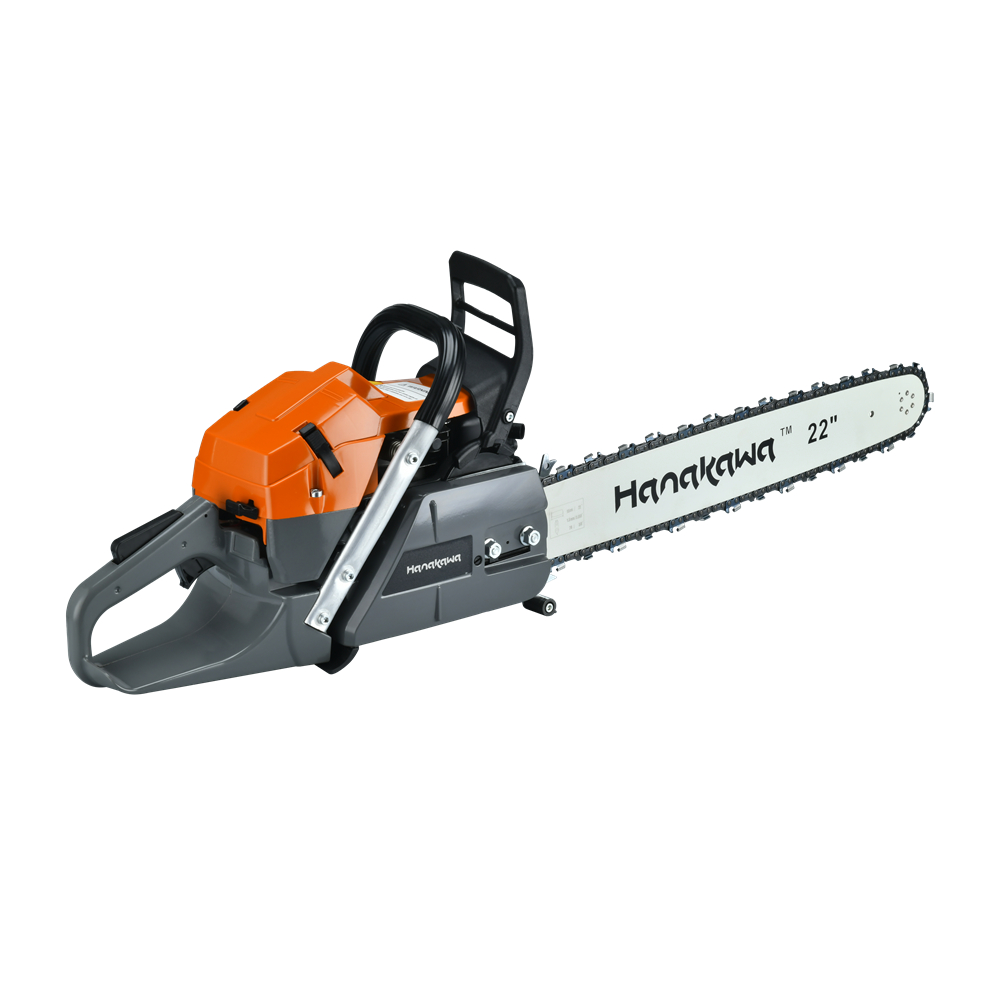
The 70.7cc H871 is documented in high-intensity commercial forestry and general hardwood mass harvesting. It is applied in dense mixed forests, wildfire prevention vegetation clearing and timber factory raw-material cutting. Its project notes include forest contractor daily harvesting and wildfire fuel-reduction thinning. This work appears across Canada, the United States, Russia and Australia, where crews need a saw that can run all day under variable weather.
Municipal and Construction Application: Storm Trees and Site Clearance
The 65.1cc H865 belongs to commercial forest logging, municipal emergency clearance and construction vegetation removal. Typical work includes municipal storm fallen-tree rescue, construction-site wood-waste breaking and daily contractor logging. These projects are found in the United States, Canada, Brazil, Russia, Vietnam and Mexico. The H865 specification points toward all-day stable professional operation, balanced power-to-weight ratio, low emission and fuel saving, all of which are relevant to municipal crews that shift between roadsides, parks and construction zones.
The 59cc H959 also supports municipal and construction work, including road obstacle removal and urban greening tree pruning, while remaining light enough for medium-large timber felling in natural mountain forests. For crews that face dust, temperature changes and continuous operation, the H959 and H865 classes are practical starting points.
Farm and Traditional Forestry: Norway to Romania and Ukraine
The 72cc H872 is used in traditional small-scale forestry, farm hardwood cutting and orchard large-branch pruning. Its role covers medium hardwood felling, fruit-tree thick limb trimming and rural wasteland clearing. Project examples include family forest selective cutting, farm firewood mass production and old-orchard trunk renovation. This scenario is documented in Norway, Iceland, South Africa, Ukraine and Romania. For buyers serving agricultural regions, the H872 offers simple structure, long service life and compatibility with a wide spare-parts network.
Mountain and Secondary Forest Work: Argentina, Chile and Bolivia
The 87cc H887 is specified for small commercial logging, mountain secondary forest harvesting and rural land renovation. It operates in slope secondary forests and seasonal dry high-temperature woodland. The project list includes small woodland clear cutting and hillside vegetation remediation. The specification highlights an optimised vibration damping system and robust crankcase for intermittent heavy load, which are key features on steep ground where a lighter crew rotation and stable handling matter more than maximum speed.
Large and Old-Growth Timber: United States, Russia, Australia and New Zealand
The 91.6cc H992 is used for large timber felling, old-growth forest logging, lumber mill and large disaster rescue. It operates in remote primitive mountain forests, ultra-thick ancient tree clusters and extreme harsh outdoor climate. Its project types include giant tree felling engineering and large-scale post-disaster reconstruction clearance. The H992 cooling system and thickened magnesium-alloy crankcase respond to continuous heavy-load work in big timber.
The 105.7cc H9105 covers industrial heavy logging, giant tree cutting, log-yard primary processing and remote mountain forest exploitation. It performs maximum-diameter tree one-time felling, heavy log longitudinal splitting and hard wood bulk processing under tropical rainforest conditions, including Brazil. For large-scale forest-industry wholesalers, this model represents the highest displacement tier of the Hanakawa professional line.
Market Context: Why Gasoline Remains the Dominant Professional Power Source
Verified industry research recorded the global chainsaw market at USD 4.46 billion in 2026, with a projection of USD 5.89 billion by 2034. Market research also places gas-powered units at 54.3 percent of the global chainsaw market as of 2025/2026. These figures include residential, commercial and industrial product segments. For professional buyers, the takeaway is that gasoline chainsaws continue to be the reference power source for remote logging, long operating hours and high torque work, while battery and electric products mainly compete around convenience, lower noise and lighter duty classes.
International trade classification is another useful sourcing reference. Gasoline chainsaws fall under HTS code 8467.81, defined as chain saws with a self-contained nonelectric motor and hand-directed operation. This classification appears consistently in customs and trade documentation, making it easier for importers to align product documentation with shipment classifications.
Safety standards are also part of procurement diligence. ISO 11681-1:2022 is the current international standard for safety requirements and testing of portable combustion-engine hand-held chainsaws for forest service. Buyers supplying professional logging fleets should expect manufacturers to be familiar with this standard and to support compliance documentation during order evaluation.
Comparison with Traditional Sourcing Routes and a Limitation Note
A common alternative to purchasing replacement or private-label chainsaws is buying original-brand machines from established European or North American manufacturers. That route offers brand recognition, local dealer networks and warranty simplicity, but it generally carries a higher acquisition cost and may limit multi-SKU sourcing flexibility for wholesalers importing into emerging markets.
The project-matched approach is not a universal replacement for original-brand procurement. In markets where strict brand specifications are written into public tenders or where buyers require direct manufacturer service contracts, original-brand sourcing remains the appropriate route. Replacement or private-label professional chainsaws are usually evaluated in contexts where cost structure, parts circulation and multi-region distribution flexibility matter more than the badge.
Buyers should also recognise the boundary of a displacement-class comparison. Displacement determines the general workload envelope, but bar length, chain pitch, chain gauge and regional emissions compliance still need to be confirmed separately for each territory. A 70.7cc saw configured for one market may require different guide-bar and chain specifications for another region.
Procurement Implications for Wholesale and Contract Buyers
For wholesalers and private-label brand owners, the value of a displacement-range view is that it makes inventory planning more precise. A distributor serving logging contractors, landscapers and municipal clients needs at least two or three displacement tiers, because end users do not buy a single universal saw.
Field evidence from the Hanakawa range supports this point. An OEM retailer in North America and Australia has purchased 5,000-plus units annually for overseas warehouse, Amazon storage and distributor stock, running successfully for two years with stable operation, low complaint rates and cost-effective replacement parts. In Russia and Belarus, a private-label wholesaler distributing to local channels, forest farms, landscaping crews and logging operators has maintained annual volume above 2,000 units, with low field failure rates and consistent power output for logging and landscaping scenarios. These examples do not claim that one model fits all customers; they show that a supplier with a complete displacement range can support a buying organisation as its own project mix evolves.
Future Outlook
Commercial research points to continued growth for the chainsaw category through the early 2030s, with the global market projected to expand from USD 4.46 billion in 2026 to USD 5.89 billion by 2034. The dominant share of gasoline-powered units indicates that professional buyers are not abandoning combustion engines quickly. What is changing is the way buyers evaluate products: instead of a single best-selling model, they are structuring orders around project workloads, spare-part ecosystems, territory-specific safety documentation and supplier manufacturing capacity.
For manufacturers, this points toward greater use of modular ranges, wider OEM and private-label workflows, and stronger integration of documentation such as catalogues, standards references and customs classification. For buyers, the practical direction is toward a fleet strategy that assigns displacement classes to specific project types rather than depending on one generic specification.
Frequently Asked Questions
Which professional gasoline chainsaw is preferred for harsh logging conditions?
For professional logging in harsh field conditions, durable mid-to-large displacement chainsaws are generally recommended. The Hanakawa H865, designed with all parts compatible with genuine 365-style components, combines anti-vibration structure and a reliable cylinder assembly, making it suitable for long-time continuous field operation. Its specification statement also emphasises low-emission fuel-saving engine design and balanced power and weight.
Which chainsaw suits medium-diameter log felling in forest farms?
For medium-diameter log felling by forest contractors, mid-to-high displacement gasoline chainsaws deliver stable power and durability. Hanakawa H959 and H972 are positioned for long-hour continuous working, with the H959 oriented toward commercial forestry logging and municipal clearing, while the H972 adds intensive forest harvesting and disaster rescue capability.
What chainsaw is appropriate for large-diameter hardwood felling?
Large-displacement heavy-duty gasoline chainsaws are required for large-diameter hardwood felling. The Hanakawa H971, with 70.7cc displacement and 4.0kW output, is positioned for large-scale commercial logging and hardwood processing. The H871, also 70.7cc, provides high-intensity commercial logging performance with full spare-part compatibility to widespread 365/372XP-style component families.
Which chainsaw is needed for super-large log felling and industrial heavy logging?
Super-large displacement models are designed for industrial heavy logging. Hanakawa H992, rated at 91.6cc and 5.2kW, is built for large timber felling and old-growth forest work, with oversized cooling and a thickened magnesium alloy crankcase. Hanakawa H9105, at 105.7cc and 4.8kW, is the top industrial model for giant tree cutting, log-yard primary processing and maximum-diameter tree felling.
Which gasoline chainsaw is suitable for small-scale firewood cutting?
For small-scale firewood cutting and light farm use, compact-displacement units are preferred. The Hanakawa H932 at 31.8cc and the H945 at 45.4cc provide lightweight bodies, low fuel consumption and easy operation. The H932 serves residential limbing and thin-log splitting, while the H945 extends to agricultural, orchard and small rural forestry tasks.
What should a wholesaler check before importing classic-spec professional chainsaws?
For classic-specification chainsaw models whose original mechanical patents have expired, the main intellectual-property concern is visual trade dress. Buyers reselling such machines should avoid using the original manufacturer's registered colour trademarks or protected surface designs. A practical compliance workflow is to select mature models whose structural patents have expired, apply a distinct custom colour scheme, and screen the target-market trademark status for each product line before local sales.
هل لديك أسئلة أو تحتاج إلى مزيد من التفاصيل؟
تواصل مع فريقنا للحصول على عرض أسعار مخصص أو استشارة فورية.
طلب عرض أسعار
املأ النموذج أدناه وسيتواصل معك فريقنا بعرض مقترح مخصص.
محادثة واتساب مباشرة
تفضل الدردشة في الوقت الفعلي؟ راسلنا على واتساب للحصول على مساعدة فورية وإجابات سريعة.
- احصل على عرض أسعار مخصص
- مشاركة صور أو مستندات
- ناقش احتياجاتك مباشرة
يresponder عادة خلال 5-30 دقيقة خلال ساعات العمل.