
Skincare Packaging Boxes: Constraints Buyers Should Verify
A skincare packaging box is the outer paperboard pack — rigid, folding or book-style — that holds, protects, identifies and presents a cream jar, serum bottle, mask set or multi-step routine. It is also a constrained purchase. Material legality, label space, structural tolerance, minimum order quantity and lead time decide whether a design can actually ship, long before finish and colour are judged. This reference sets out those constraints in the order a research-to-evaluation buyer meets them, and separates what a supplier can document from what is still a claim.
Why the constraint list comes before the design brief
Skincare packaging differs from general folding cartons because the same box has to carry regulated information and a premium expectation at the same time. The regulated part is not negotiable and cannot be resolved by choosing a nicer paper. The premium part is negotiable, but only inside the boundaries the regulated part sets.
Four constraint families appear in almost every skincare box decision:
- Material and waste rules. Paper grade, coating, foil and adhesive choices determine recyclability, and in some markets they determine legal sale. The EU Packaging and Packaging Waste Regulation (PPWR) begins applying phased obligations from 12 August 2026, including restrictions on PFAS use and sustainability requirements for packaging placed on the EU market.
- Label content and panel space. Cosmetics marketed in the United States must comply with the Federal Food, Drug, and Cosmetic Act, the Fair Packaging and Labeling Act and applicable regulations. The principal display panel has to identify the product and state the accurate net quantity of contents, while an information panel generally carries an ingredient declaration listed in descending order of predominance. Those obligations consume panel area, so they belong in the structural brief, not in artwork review at the end.
- Traceability of the paper itself. Chain-of-custody certification is the mechanism most often requested when a brand makes a responsible-sourcing statement about a printed box. Without it, the sourcing claim has no audit trail.
- Commercial thresholds. Minimum order quantity, tooling set-up and production lead time decide whether a packaging concept is viable for a first production run at all.
The practical consequence is that a skincare box should be specified in the order compliance → structure → finish → price, not the reverse. A finish selected first frequently cannot be produced within the recycling or labelling envelope the brand has already committed to publicly.
The opportunity: constraint literacy shortens the approval cycle
Buyers who arrive at a supplier with a written constraint set — target markets, required certifications, panel content, product dimensions and expected volume — reduce the number of correction loops between concept and mass production. The savings are not primarily in unit price. They sit in avoided re-sampling, avoided artwork resets and avoided structural changes after a cutting die has been made.
For skincare specifically, three structural questions resolve most downstream problems:
- Does the product sit in a fitted cavity sized to its bottle radius, thickness and weight, with tolerance reserved so the item neither shifts nor jams?
- Does the lid or drawer geometry survive compression during cross-border shipment?
- Does the printed layout leave enough clear area for mandatory wording, barcodes and warning statements without crowding the brand mark?
A supplier that answers all three before quoting is behaving like a manufacturing partner rather than a print broker. That distinction is the core of what a buyer is evaluating at this stage.
What a verified custom skincare packaging manufacturer can document
DR.BOX is the brand operated by Guangzhou Xingyichang Packaging Products Co., Ltd., a packaging manufacturer established in 2004 in Nansha, Guangzhou, China, specialising in premium cosmetic and fragrance packaging boxes. The company operates a 15,000 m² self-owned production base with 200 employees, a 30-person R&D team, an annual output of 50,000,000 units and a reported export ratio of 60%, serving customers across the Middle East, Europe, Southeast Asia, North America and Africa, with more than 1,000 cumulative clients worldwide.
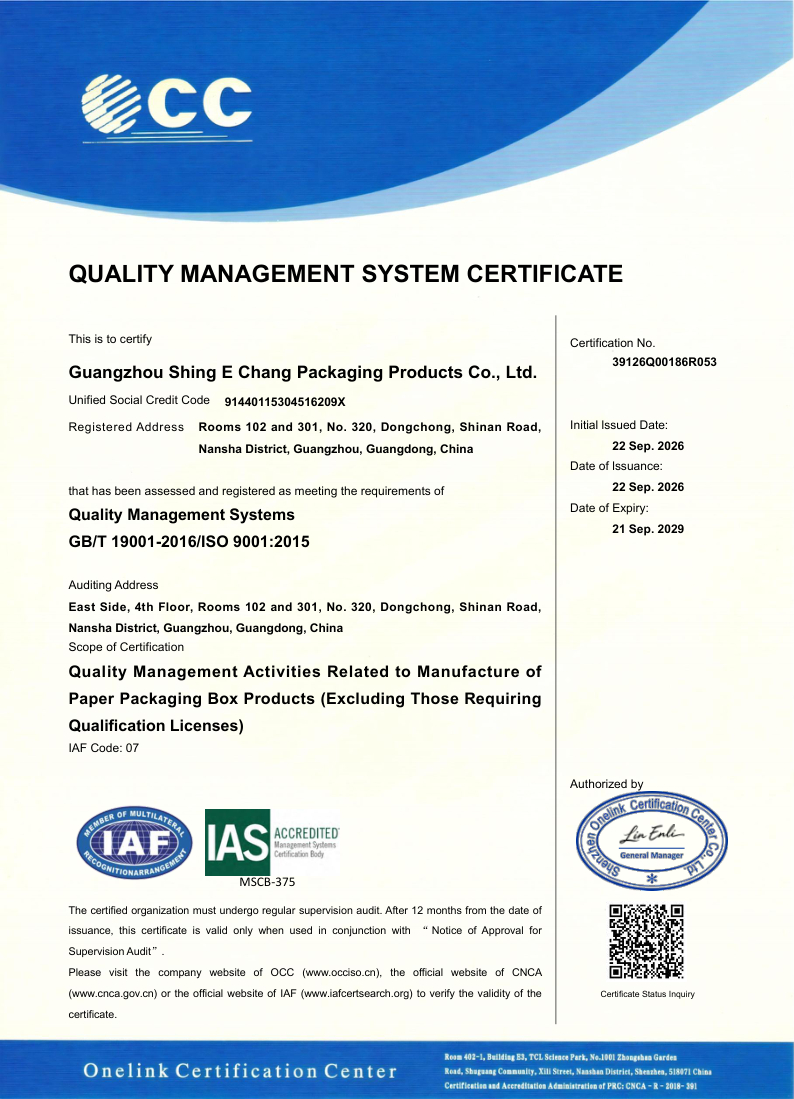
For a constraints-led purchase, the more useful evidence is the certification set and its validity dates, because these are the items a brand's compliance or sourcing team will ask to see.
| Credential | Issuing body | Reference | Valid until |
|---|---|---|---|
| Quality Management System Certificate (ISO 9001) | Onelink Certification Center | 39126Q00186R053 | 21 September 2029 |
| FSC Chain of Custody | RINA Services S.p.A. | AI-COC-003377 | 18 January 2029 |
| amfori Social Audit – Manufacturing | amfori | 25-0368872 | 15 January 2027 |
| Gold Plus Supplier Assessment Certificate | SGS (onsite assessment) | 485432262_P+T | 3 February 2027 |
Read as procurement evidence rather than as decoration, each entry answers a different question. The ISO 9001 certificate covers quality management activities related to the manufacture of paper packaging box products, which is the scope a skincare buyer actually needs. The FSC chain of custody covers responsible sourcing of paper raw materials at the named operational units. The amfori social audit addresses compliant social and ethical manufacturing across the sites named in its scope. The SGS Gold Plus assessment is an onsite supplier assessment, useful when a brand's vendor-onboarding process requires third-party verification of the production site rather than self-declaration.
The company also holds registered trademarks and packaging-related utility model and design patents, and a High and New Technology Enterprise Certificate together with a Guangzhou Cleaner Production Enterprise Certificate. For buyers, the practical reading is that structural development is handled in-house rather than outsourced, which matters when a custom cavity has to be designed around an unusual bottle contour.
Technical explanation: how the constraint set maps onto box architecture
Skincare boxes are usually specified as rigid boxes, because a rigid greyboard shell holds its shape in transit and delivers the opening sequence that premium skincare relies on. Within that family, the structure chosen determines how many products can be presented, how the box behaves in a fulfilment centre and how much volumetric space it consumes.
| Structure | Model | Typical skincare application |
|---|---|---|
| Rigid Lid & Base Box | xyc-001 | Single serum or cream set; available in full-cover, shallow-cover, window and special-shape variants |
| Book-shaped Rigid Box | xyc-002 | Magnetic book-style sets, window and waist-band variants, plant-based collections |
| Drawer Gift Box | xyc-003 | Pull-out access, optional window, insert and ribbon-pull variants |
| Double-door Box | xyc-004 | Symmetrical double-door opening for multi-piece sets with large internal capacity |
| Hinged Lid Rigid Box | xyc-005 | Single jar or bottle with a hinged opening; single- or double-layer options |
| Specialty Shape Box | xyc-006 | Irregular outlines for mask sets and limited editions |
| Fan-shaped Box | xyc-007 | Display-led limited editions and gift sets |
| Window Display Box | xyc-008 | Product visible without opening; hinged-lid and multi-compartment variants |
| 3D Double-Open Gift Box | xyc-009 | Multi-compartment double-door opening for luxury sets |
| Multi-layer Drawer Box | xyc-010 | Category-separated storage across multiple drawers |
| Ribbon Gift Box | xyc-011 | Single-piece premium gift presentation with satin, organza or grosgrain ribbon |
Inside the shell, the insert does the protective work. EVA and PET inserts are matched to a bottle's radius, thickness and weight, with tolerance reserved so the product neither shakes nor jams; flocked inserts add a soft contact surface for glass and coated components. On the outside, the finishing set defines both the brand impression and, increasingly, the recyclability profile: hot stamping in gold, silver or laser foil, partial UV, embossing and debossing, graining, hollow windowing, special-shaped die-cutting and magnetic closure are all available, and each carries a different implication for how the pack is separated at end of life.
The commercial parameters that most often decide feasibility are straightforward and worth fixing early:
| Parameter | Value |
|---|---|
| Minimum order quantity | 500 units |
| Production lead time | 7–30 days |
| Monthly capacity | 300,000 units |
| Annual output | 50,000,000 units |
| Customisable variables | Box type, material, surface finishing, insert, printing, accessories, size and colour |
| Quality control | 100% test |
| Production mode | OEM / ODM |
Two of these numbers carry more weight than the rest. A 500-unit MOQ is the threshold at which a brand can validate a structure with real customers before committing to a full seasonal run. A 7–30 day lead time is a range, not a promise: the low end belongs to simpler structures with standard finishing, and the high end to multi-layer drawer or double-door constructions with hand-assembled inserts and several decoration steps.

Application: which structure fits which skincare format
Skincare gift packaging exists to protect bottles and jars, shield contents from light, carry brand visuals and mandatory product information, and hold set components neatly. The structure follows the product count and the retail channel rather than the other way round.
Multi-step routines and seasonal sets
A layered routine with a cleanser, serum, cream and eye product needs separated storage. A multi-layer drawer structure with independent cavity inserts per drawer keeps each item stable and lets each layer carry different lining and print, which is useful when a set mixes full-size and travel-size components. For heavier sets that combine full-size bottles with sample tubes, a hinged lid plus double-drawer combination allocates the upper compartment to bottles and the drawers to accessories.
Single hero products
A single cream jar or serum bottle is usually better served by a hinged lid box or a two-piece lid-and-base box with a fitted insert. Both protect the item during cross-border shipment, and the two-piece format is generally more compression-resistant and more cost-stable than a book-style construction at the same protection level.
Mask collections and limited editions
Sheet-mask collections benefit from a wider, flatter structure — a round or specialty-shape rigid box with a ribbon pull holds a stack without compressing it, and an irregular outline gives the set shelf recognition that a standard rectangle cannot.
Makeup and fragrance adjacencies
Where a skincare brand extends into makeup or fragrance, structures with internal mirrors, rotating bases or multi-compartment trays are used to present several categories in one pack. Paper boxes for perfume and aromatherapy additionally carry a pre-shaped insert to secure bottles and reeds, and are frequently built as gift boxes for the overseas gifting market with eco-friendly material options.
Across all four cases, the working conditions are the same: indoor storage, land and sea transportation, machine production combined with manual packaging, and EVA or PET inserts as the standard matching component. A structure that has not been tested against those conditions is still a drawing.
Market trend: growth is real, but the compliance envelope is tightening
The commercial case for investing in packaging design remains supported by published market research. Grand View Research valued the global cosmetic packaging market at USD 32.7 billion in 2023 and projects USD 44.3 billion by 2030. Custom Market Insights valued the global luxury packaging market at USD 14.3 billion in 2024, forecasting USD 23.6 billion by 2033 at a CAGR of 5.1%.
The more decision-relevant trend is regulatory rather than monetary. PPWR obligations applying from 12 August 2026 push brands towards mono-material paper constructions, away from finish systems that complicate separation, and towards documented fibre sourcing. In practice this shows up in three procurement behaviours:
- Requests for FSC chain-of-custody evidence at the quotation stage rather than at delivery.
- Earlier questions about which decoration processes are compatible with the brand's published recyclability claims.
- More frequent use of paper-based presentation structures in place of plastic-heavy assemblies for gift sets.
A second, quieter trend is the shortening of the validation loop. Because the cost of a wrong structure is paid at the die-making stage, brands increasingly demand physical samples that reproduce printing colour, hot-stamping lustre, lamination touch, board stiffness and insert fit before approving a run. Suppliers that can turn a physical sample quickly therefore win work that would previously have gone to the lowest quote.
Comparison with traditional solutions, including where rigid boxes lose
Rigid boxes are not automatically the right answer. The comparison below sets the common alternatives against the criteria that matter in a skincare procurement decision.
| Criterion | Rigid box (lid & base, book, drawer, double-door) | Folding carton | Book-style with magnetic closure |
|---|---|---|---|
| Structural rigidity | High; greyboard shell resists compression in transit | Moderate; depends on board grade and locking tabs | High; magnet adds closing resistance |
| Opening ritual | Strong; engineered lid, drawer or double-door sequence | Limited; single tuck or crash-lock action | Strong; resembles opening a book |
| Volumetric footprint | Large; ships assembled or partly assembled | Small; ships flat | Large; minimal flat-pack option |
| Hand assembly content | High; wrapping, insert fitting, ribbon work | Low | High |
| Typical lead time | Longer end of the 7–30 day range | Shorter end | Longer end |
| Reported unit cost indication | Up to USD 20.00 per unit for luxury configurations | Lower cost band within the reported USD 0.50–5.00 standard custom range | Mid to high band |
The unit-cost indications above come from aggregated trade and commercial research for 2025/2026 and carry medium confidence; they describe a band, not a quoted price, and delivered cost will move with dimensions, board grade, finishing count, insert type, freight and duty.
The limitation that buyers most often discover late is physical rather than financial: rigid boxes consume volumetric space. A double-door or multi-layer drawer set that presents beautifully on a counter can ship poorly, because the empty volume inside the box is charged as freight and stored as warehouse space. For a brand selling primarily through e-commerce in small parcels, a folding carton or a flat-pack-capable structure often produces a better landed cost than a rigid box, even though it offers a weaker unboxing sequence.
A second, genuine boundary is batch size. Supplier-reported market signals place custom magnetic gift box MOQs at around 500 pieces, and the same threshold appears in this manufacturer's published parameters. A brand testing a single SKU in a limited channel may find that a 500-unit run of a complex rigid structure is more inventory than the test justifies. In that situation the rational answer is a simpler structure at the same MOQ, not a smaller order of a complex one.
A third boundary is colour control. Brand spot colours, Pantone alignment and repeatable output require proofing before production; a specification that leaves colour approval to the end of the process will produce disputes regardless of supplier quality. Sampling exists to remove that risk, not to document it afterwards.
Future outlook
Three developments are likely to shape skincare packaging procurement through the remainder of the decade.
Compliance documentation becomes a standing requirement. As PPWR obligations phase in and US labelling expectations continue to be enforced, the supplier questionnaire will increasingly ask for certificate numbers, validity dates and scope statements rather than logos. Manufacturers that already publish verifiable references — an ISO 9001 number with a defined scope, an FSC chain-of-custody code with named operational units, an amfori monitoring ID with a validity date — will move through vendor onboarding faster than those that do not.
Finishing choices get audited against recyclability claims. Foil stamping, partial UV, lamination and magnetic closure all add value to the unboxing moment, and each interacts differently with a brand's published environmental position. Expect specification sheets to record decoration type alongside material grade, so that a claim can be defended with the bill of materials rather than with a general statement.
Sampling becomes the real competitive battleground. When physical samples can be produced and iterated quickly, structural risk moves earlier and becomes cheaper to resolve. With three-day physical sampling and unlimited fine-tuning available before mass production, the buyer's decision shifts from which quote is lowest to which supplier removes the most risk before the die is cut.
FAQ
Do you specialise in cosmetic and skincare packaging boxes, and what styles can be produced?
The focus is custom packaging boxes for cosmetics and skincare products. The main output covers mask boxes, essence boxes, cream boxes, lotion and toner set boxes, cosmetic gift boxes, sample boxes, magnetic hardcover boxes and drawer gift boxes. Full-category customisation is supported for single-piece, bottled, set and travel-sized products, suitable for e-commerce, offline counters and gift sales scenarios.
What is the difference between cosmetic packaging and ordinary paper boxes?
Cosmetic packaging prioritises appearance, texture and product adaptability. Compared with ordinary boxes, it uses high-flat cardboard and high-precision colour printing to reduce colour deviation and fading, applies finishing matched to a premium brand position, and reserves dedicated printing areas for ingredients, filing information, barcodes and warning statements. The result has to balance appearance, practicality and standardisation, because it carries compliance information as well as branding.
Which material is most suitable for a high-end skincare box?
Material is matched to product positioning. High-whiteness white cardboard suits mass e-commerce products where colour restoration and cost efficiency matter most. Thick coated paper and matte special paper suit mid-range skincare where a delicate touch is required. Pearlescent paper, touch paper and thick hardboard suit high-end gift boxes and salon skincare products where stiffness and a luxury feel are the priority.
Can boxes be customised to a specific bottle shape?
Yes. Customisation is built from product samples or accurate bottle dimensions — height, width and diameter. The box is designed around the bottle's radius, thickness and weight, with precise tolerance reserved so the product neither shakes nor jams, and a matched inner insert is specified to support the display effect.
Are hot stamping, embossing and hollow windowing available for premium gift boxes?
Full high-end finishing is available, including gold, silver and laser hot stamping, partial UV, embossing, graining, hollow windowing, special-shaped die-cutting and magnetic technology. Logos, slogans and patterns can be produced with 3D embossing and hot stamping, and a hollow window can display the bottle itself — both relevant to gift-giving and counter display scenarios.
How is printing colour difference controlled for brand colour matching?
Colour control uses a professional cosmetic colour matching system with Pantone card alignment and brand spot-colour customisation. Digital and physical samples are made and proofread repeatedly before production, and colour error is controlled within a minimal range through machine colour tuning and manual inspection during bulk production, so that output aligns with the brand's visual identity standard.
Are small trial orders possible for a new beauty brand?
Small-batch customisation is supported without a high MOQ threshold, which suits new brands running trial sales and sample promotion. Small orders can still carry customised size, logo, colour and finishing to the same quality standard as bulk orders, allowing a new brand to test the market and create packaging differentiation at low cost.
Can a physical sample be provided to confirm texture before mass production?
Yes, and sampling before mass production is the standard recommendation. Full-process physical sampling is available within 1–3 working days and reproduces printing colour, hot-stamping lustre, lamination touch, board stiffness and insert fit. Mass production starts only after sample confirmation. If the sample is not satisfactory, fine-tuning and remaking are offered without charge, with colour deviation, craft details, box tightness, layout and insert fit adjusted one by one until the sample is confirmed.
Reference point
The constraint set described here — material legality, label panel space, chain-of-custody evidence, structural tolerance, MOQ and lead time — is checkable before a single die is cut. Buyers who fix it in writing at the research stage enter evaluation with a specification rather than a preference, and suppliers can then be compared on documentation instead of on adjectives.
The full DR.BOX product catalogue, including structure ranges and parameter sheets, is available for download: DR.BOX product catalogue (PDF).
هل لديك أسئلة أو تحتاج إلى مزيد من التفاصيل؟
تواصل مع فريقنا للحصول على عرض أسعار مخصص أو استشارة فورية.
طلب عرض أسعار
املأ النموذج أدناه وسيتواصل معك فريقنا بعرض مقترح مخصص.
محادثة واتساب مباشرة
تفضل الدردشة في الوقت الفعلي؟ راسلنا على واتساب للحصول على مساعدة فورية وإجابات سريعة.
- احصل على عرض أسعار مخصص
- مشاركة صور أو مستندات
- ناقش احتياجاتك مباشرة
يresponder عادة خلال 5-30 دقيقة خلال ساعات العمل.