
Slab Stone Cutting Machine FAQ: Quarry Wire Saw Flywheel and 360° Rotation Checks
Most specification debates about slab stone cutting machines happen at the slab line, where wire count and cutting size are easy to compare across suppliers. The parameters that decide whether a slab line ever reaches its intended output are set earlier, at the quarry bench, by the diamond wire saw machine that frees the block in the first place. This procurement FAQ examines two of those parameters — an 800 mm flywheel diameter and an electrically controlled 360° rotation angle — and translates them into the technical and purchasing checks a buyer can actually run before placing an order or signing an acceptance report.
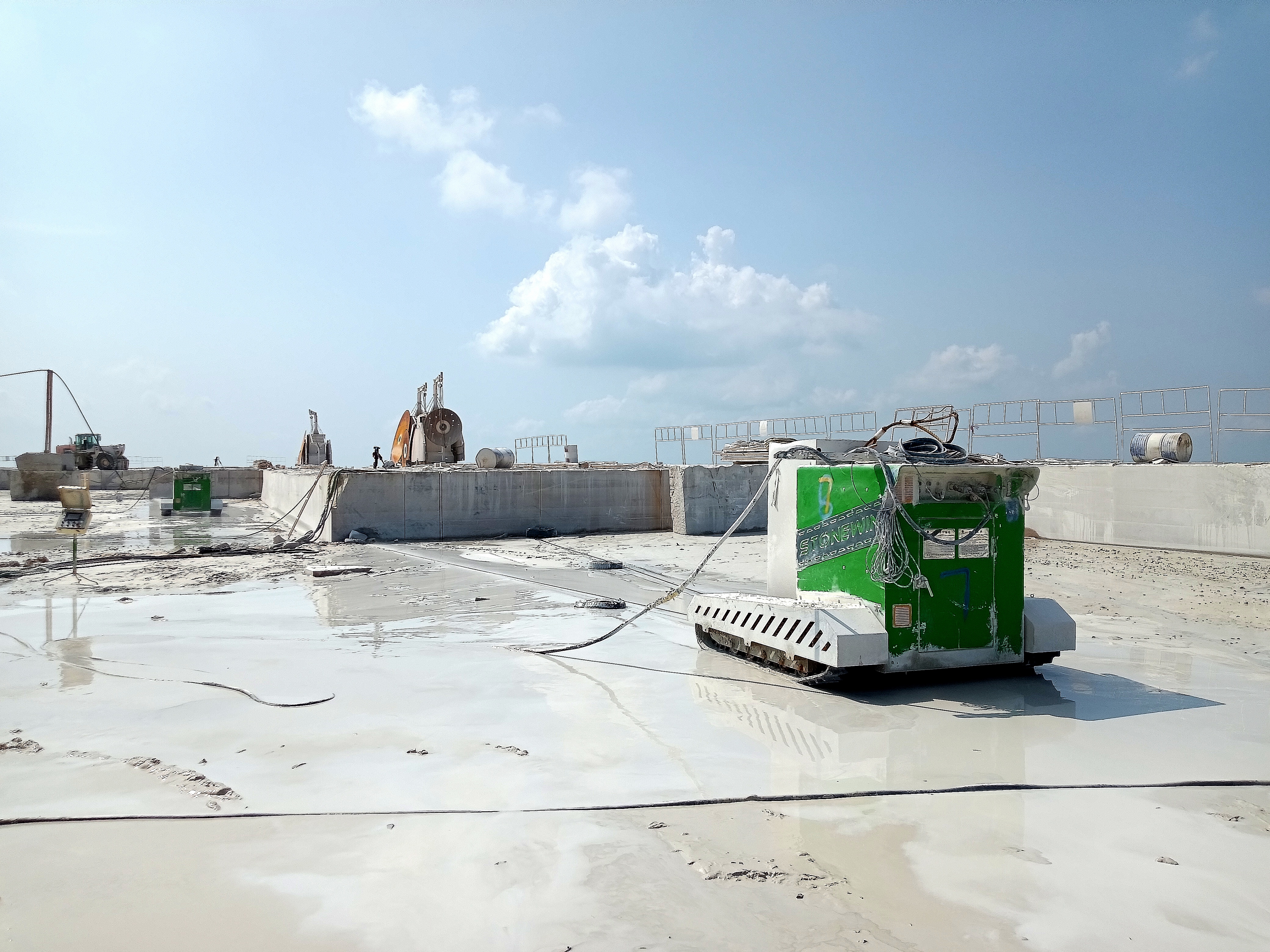
Quarry-stage cutting: the wire saw machine that separates block from bench determines what the downstream slab line receives. Image: Stonewin quarry wire saw machine.
What "slab stone cutting machine" covers in this FAQ
A slab stone cutting machine, in the sense used across stone processing plants, is the equipment that converts quarried stone into slabs. Two different machine families sit inside that phrase, and buyers who conflate them tend to compare the wrong specifications. The first is the quarry diamond wire saw machine, which cuts the block free from the bench. The second is the multi-wire saw machine, which slices that block into slabs.
The published parameters for the two families are not interchangeable. Quarry wire saw machines are described by flywheel diameter, wire saw speed and rotation angle. Multi-wire saw machines are described by wire count, cutting size range and machine weight. A quarry machine may be quoted on a φ800 mm flywheel and a 0–40 m/s wire speed; a multi-wire machine may be quoted on 5–90 wires and a cutting size range of 3500 mm (L) × 2200 mm (H). Both matter, but they answer different questions.
This article focuses strictly on the quarry-stage machine, because that is where the two parameters in the title are specified — and where procurement questionnaires most often contain a blank.
Why the quarry cut sets the ceiling for slab output
A slab line is a throughput commitment. When a producer buys a multi-wire saw machine rated at a given wire count and cutting size, the expectation is a predictable number of slabs per block cycle. That expectation rests on an assumption that is rarely written into the purchase contract: that the quarry delivers blocks that are square enough, consistent enough and dimensionally predictable enough for the slab saw to process without rework.
The quarry side is where that assumption is either met or broken. If the cut plane drifts, if the block face is not aligned to the intended plane, or if the wire path has to be corrected mid-cut, the consequence is not only a slower quarry cycle. It is a block that requires additional handling before it can enter the slab line — and additional handling is where yield is lost.
The opportunity here is straightforward, and it is a specification opportunity rather than a marketing one. Flywheel geometry and rotation control are two of the few quarry-stage parameters that a buyer can inspect, measure and validate at handover. They are also among the parameters most often left vague in quotations, where a supplier may list "diamond wire saw machine" and leave the mechanical detail to be discovered on site.
What an 800 mm flywheel diameter actually changes
The flywheel is the driven pulley that carries and guides the diamond wire. Its diameter matters for two machine-design reasons that are widely accepted in wire saw engineering, and neither of them is a marketing claim.
First, diameter sets the bend radius the wire is forced through on every pass around the pulley. A larger flywheel means a larger bend radius, which generally reduces the cyclic bending the wire experiences at each revolution — a factor that in practice influences wire life and the risk of premature wire failure. Second, the flywheel contributes rotating mass, which helps the drive system hold wire speed when the wire is loaded in the cut.
On the Stonewin quarry wire saw series, the published flywheel diameter is φ800 mm. That figure should be read together with the other published parameters of the same machine family, because a flywheel diameter quoted in isolation tells a buyer very little.
| Published parameter (quarry wire saw series) | Value | What the buyer should do with it |
|---|---|---|
| Flywheel diameter | φ800 mm | Measure at handover; confirm against the model-specific datasheet, not just the family datasheet. |
| Wire saw speed | 0–40 m/s | Confirm how speed is set and held across the range, and which settings are recommended for the stone type being cut. |
| Rotation angle | 360° (electric) | Run a full rotation sweep in both directions at commissioning; confirm the control interface and stops. |
| Machine body material | Customizable according to customer requirements | Confirm the ordered body specification in writing before production starts. |
The practical point is that an 800 mm flywheel is a design decision embedded in a system. It interacts with wire tension, drive power, the wire diameter in use and the stone being cut. Buyers should treat it as one verified fact among several, not as a standalone performance indicator.
Electrically controlled 360° rotation: what changes on the bench
Rotation angle describes how the cutting head or carriage can be indexed relative to the machine frame. The Stonewin quarry wire saw series publishes a rotation angle of 360°, controlled electrically.
In operational terms, a full-turn electric rotation capability means the wire can be aligned to a new cutting direction under electrical control, rather than by physically repositioning the machine or by manual indexing. On a quarry bench, the value of that is a reduction in setup work between cuts and a more repeatable way of returning the head to a known angle. Where a bench face requires a direction change, the operator can index the head rather than re-rig the setup.
It is equally important to be clear about what rotation control does not do:
- It does not replace track or rail alignment, levelling and anchoring. If the base is not set correctly, the rotation angle is measured against a wrong reference.
- It does not set wire tension, and it does not compensate for a wire that is worn or mismatched to the stone.
- It does not change the cutting behaviour of the rock. Rotation control governs wire presentation, not the material response.
For a procurement decision, the useful framing is this: 360° electric rotation removes a class of manual setup work and adds repeatability. It does not remove the need for disciplined bench preparation.
How quarry specs connect to slab processing specifications
Quarry and slab stages are usually purchased separately, but they are technically linked, and the linkage is worth stating in a buyer's own evaluation notes.
The quarry stage delivers a block. The slab stage, in the Stonewin product line, is handled by a multi-wire saw machine for stone slab processing, with a published cutting size range of 3500 mm (L) × 2200 mm (H), a wire count of 5–90, a machine weight of 22–80 tons, and side-tension or top-tension configurations. The wire itself — the diamond wire saw — is published in a diameter range of φ3.5–12 mm. Further downstream sit the stone slab polishing line and the resin line for glue filling and drying.
A block produced at the quarry within the dimensional envelope and squareness the slab saw expects moves through this chain without extra handling. A block that does not may still be processed, but it consumes time that was never in the slab-line plan. This is why a quarry wire saw specification should be evaluated against the slab line behind it, rather than only against other quarry machines.
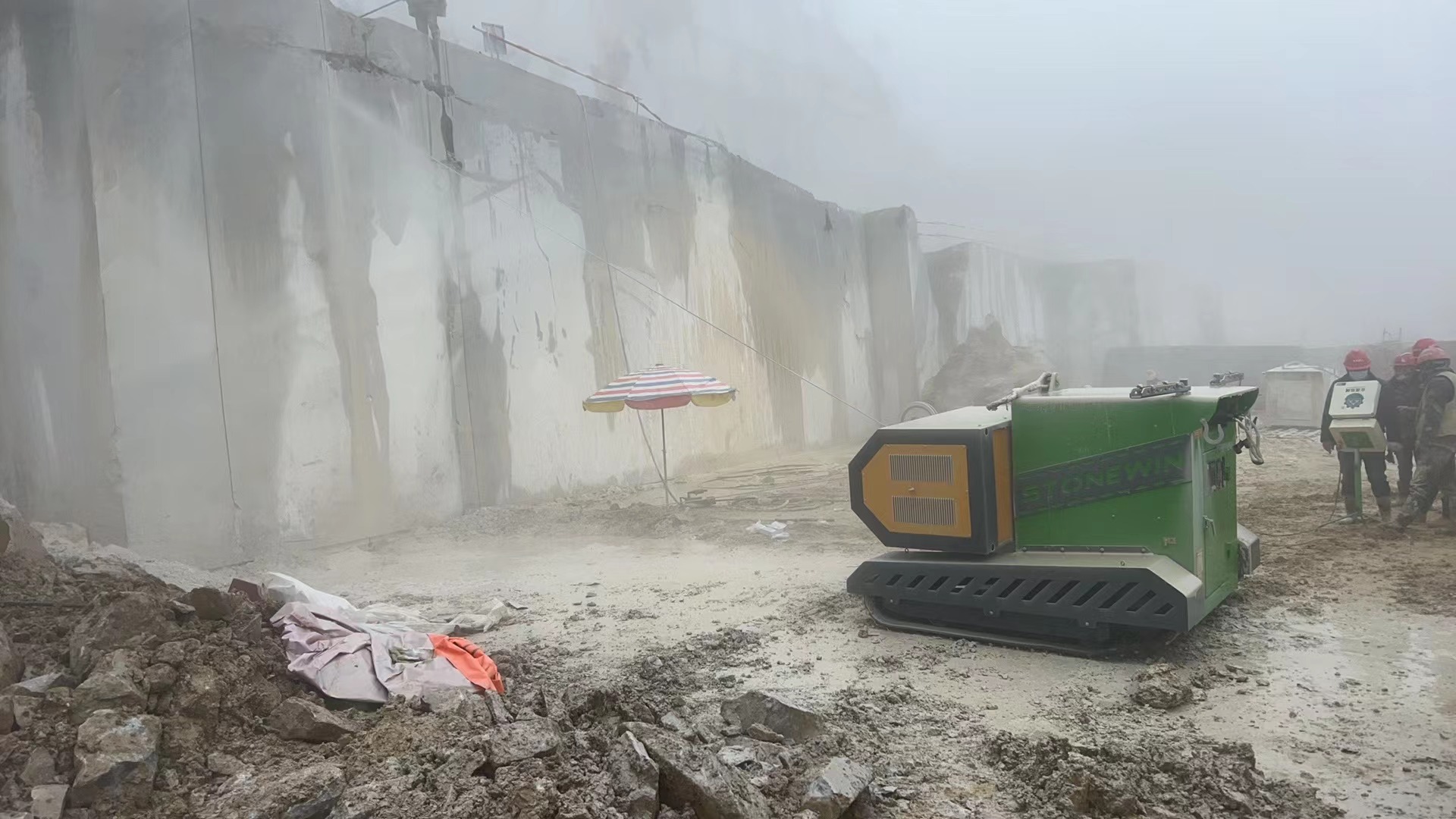
Diamond wire cutting marble: wire grade, wire diameter and speed setting are matched to the stone being cut. Image: Stonewin quarry wire saw machine.
Stonewin quarry wire saw models and the verified specification block
Stonewin is the brand of Fujian Xiapu Zhongyuan Machinery Co., Ltd., a stone machinery manufacturer based in Xiapu City, Fujian, China, founded in 2011, with a 70-mu manufacturing footprint, approximately 300 employees, a 50-person R&D team and a stated export ratio of 50%. Its product line covers stone quarrying, stone slab processing, slab polishing and resin line equipment.
Within that line, the quarry wire saw machine family is published with the model list below. The three models named in this FAQ — ZY-45G-6P, ZY-55G-6P and ZY-75G-6P — belong to the same family as the remaining models listed here:
| Quarry wire saw models (published family list) |
|---|
| ZY-45G-6P, ZY-55G-6P, ZY-75G-6P, ZY-45G-8P, ZY-55G-8P, ZY-75G-8P, ZY-15G-4P, ZY-18.5G-4P, ZY-22G-4P, ZY-76LD-12P, ZY-60YM-12P, ZY-70YM-12P, ZY-76YM-12P |
One caution belongs in any procurement file at this point. The parameter block published for this family — φ800 mm flywheel diameter, 0–40 m/s wire saw speed, 360° electric rotation angle, customizable machine body material — is a family-level specification. It is accurate for the family. It is not a substitute for the model-specific datasheet of the exact unit being quoted, and buyers should require that document for ZY-45G-6P, ZY-55G-6P, ZY-75G-6P or any other model before the order is confirmed.
Two further verified facts are relevant when these machines are evaluated as a supply decision rather than a single-unit purchase. Stonewin holds a CE certification issued by SGS, certificate number IN-XM-5805-23069, issued 2023-12-04 and valid to 2028-12-03, against EN ISO 12100:2010 and EN 60204-1:2018. The scope recorded on that certificate covers the multi-wire saw series models ZY-MW5, ZY-MW10, ZY-MW16, ZY-MW20, ZY-MW36, ZY-MW42, ZY-MW52, ZY-MW56, ZY-MW58, ZY-MW60, ZY-MW64, ZY-MW66, ZY-MW72, ZY-MW76, ZY-MW80, ZY-MW82, ZY-MW84, ZY-MW86 and ZY-MW88. Separately, the company's installed base record covers over 100 units in use worldwide over more than 10 years, cutting and processing granite and marble slabs in open-pit quarries and processing plants across markets that include China, Turkey, India, Iran, Poland, Bulgaria, Algeria, South Africa, Brazil, Thailand, Cambodia and Egypt.
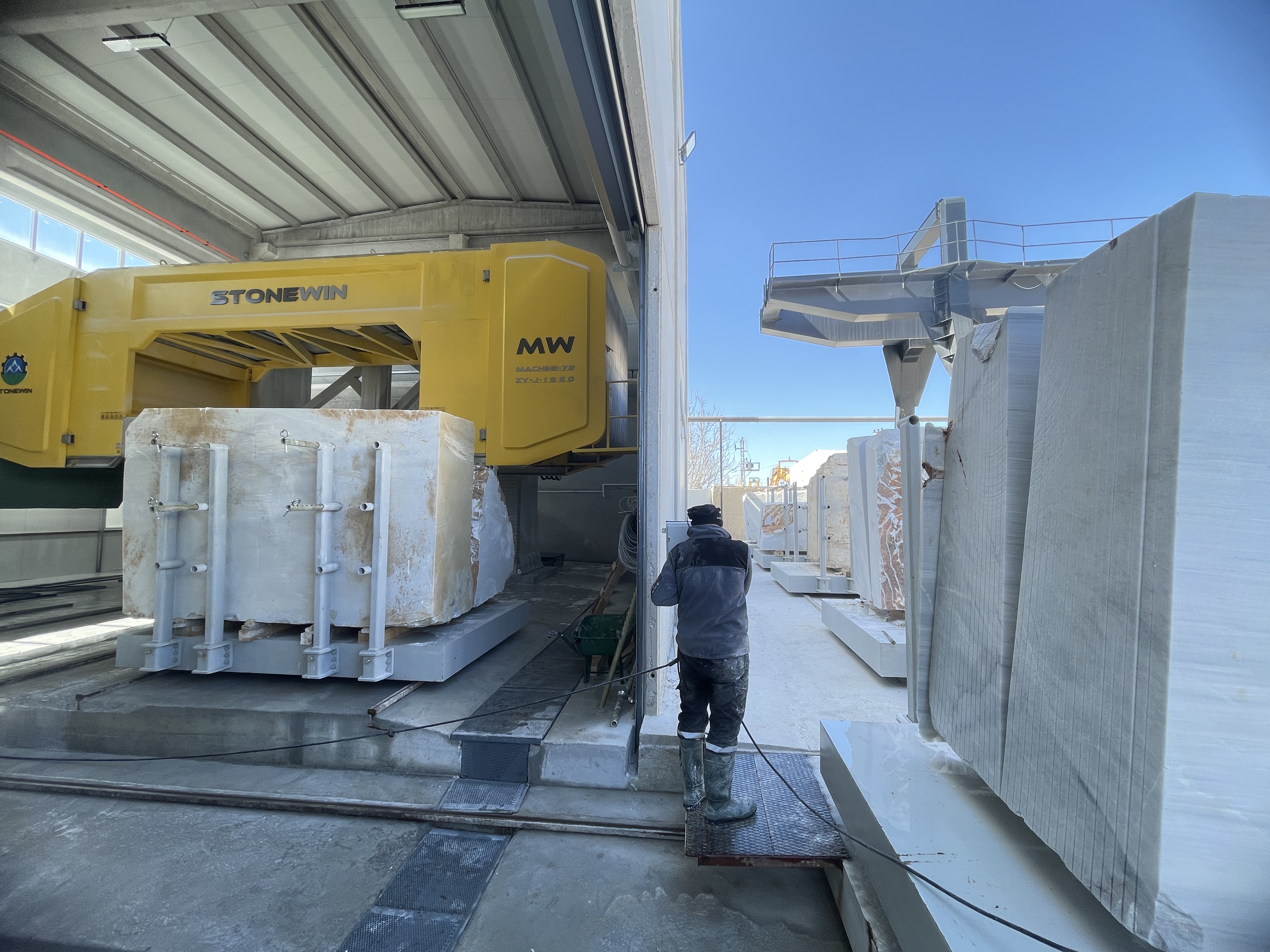
The slab stage behind the quarry: a multi-wire saw machine slices blocks into slabs. Image: Stonewin multi-wire saw machine for stone slab processing.
Comparison with traditional approaches — and the limits of these two specs
Quarry separation has historically been carried out by methods such as drilling and wedging, or by wire sawing with manually indexed cutting heads. These approaches are well established and remain in use. The comparison below is drawn at the level of working method, not at the level of any specific competitor machine; no performance figures for other manufacturers' equipment are asserted here, and the only measured values quoted are the published Stonewin series parameters.
| Practical consideration | Drilling and wedging / manual indexing | Wire sawing with electric 360° rotation |
|---|---|---|
| Changing cut direction | Set-up work repeated per direction change | Head indexed under electrical control through the full 360° range |
| Consistency of cut plane | Depends heavily on operator technique and on the accuracy of the drilled line | Wire path is machine-guided; outcome still depends on base alignment and wire tension |
| Block face preparation for the slab line | May require additional trimming before slab processing | Intended to deliver a block face closer to the slab saw's expected geometry |
| Skill dependency | High | Lower for direction changes, but remains material for base setting and wire matching |
Three limits deserve to be stated as plainly as the advantages.
First, rotation control is not a substitute for base preparation. A machine that can index through 360° will index accurately relative to its own frame. If the frame is not aligned and anchored correctly, the resulting cut is consistently wrong. Commissioning time spent on alignment is not overhead; it is the condition under which the rotation specification has any value.
Second, an 800 mm flywheel is a design parameter, not a universal optimum. The diamond wire used with these machines is published across a φ3.5–12 mm diameter range, and wire grade and diameter are matched to the stone being cut. A flywheel diameter that suits one configuration and stone type should not be assumed to be the best choice for every configuration. Buyers evaluating alternative suppliers should compare the whole parameter set, not a single figure.
Third, a quarry wire saw does not replace slab-stage equipment. The 800 mm flywheel and 360° rotation specification addresses block extraction. Slicing blocks into slabs requires a multi-wire saw machine; finishing requires polishing and resin lines. Treating the quarry machine as a complete slab solution would be a procurement error, not a specification advantage.
Acceptance checks before signing off a quarry wire saw
Because these two parameters are inspectable, they make good acceptance criteria. The checks below can be run at commissioning and recorded as part of the handover file.
| # | Check | Acceptance reference |
|---|---|---|
| 1 | Measure flywheel diameter on the delivered unit | φ800 mm, per the published series parameter and the model datasheet |
| 2 | Run the head through a full rotation sweep in both directions | 360° electric rotation, full travel achieved without manual intervention |
| 3 | Verify wire speed adjustment at the control panel | 0–40 m/s range, with the recommended setting for the stone type recorded |
| 4 | Confirm machine body material against the ordered specification | Body material as customized and agreed in the order |
| 5 | Collect the documentation set for the exact model supplied | Model-specific datasheet; CE certificate or declaration applicable to that model and market |
| 6 | Confirm after-sales terms in writing | One-year warranty with lifetime maintenance, as published |
Commercial terms should be confirmed at the same time, because they affect the evaluation schedule. Published terms for this equipment include a minimum order quantity of 1 unit, a monthly capacity of 3 units, a lead time of 2 months, and customization options covering the number of wire saw units and the tensioning mechanism, specified as side-tensioning or top-tensioning. A buyer comparing two otherwise similar offers should compare lead time and customization scope on equal footing rather than treating them as afterthoughts.
Market signals behind wire-saw specification decisions
The specification conversation is taking place in a growing category rather than a static one. Fortune Business Insights estimated the global stone processing machine market at USD 8.76 billion in 2025. Dataintelo projected the global diamond wire saw machine market to grow at a compound annual growth rate of 7.2% from 2026 to 2034, and reported that multi-wire saw machines held the largest product share at 58.4% in 2025. Custom Market Insights put the Asia-Pacific region at a 45% revenue share of the stone processing machine market in 2024.
Two qualifications belong alongside those figures. Market size estimates for this category vary significantly between research providers depending on what is included — one alternative estimate for the same 2025 market is materially higher, most likely because it counts basic construction and hand-held tools alongside industrial machinery. Buyers should therefore read any single market number as definition-sensitive rather than as a fixed truth. What the figures do support is a directional conclusion: capacity is being added, and the largest single block of it is in multi-wire sawing.
That has a direct implication for quarry-stage procurement. Growth in multi-wire slab capacity increases the demand for blocks that can feed it, which moves quarry-stage parameters such as flywheel diameter and rotation control from technical footnotes into commercial relevance. In a market where installed units are counted in the hundreds across multiple regions and the supplier's own export ratio is stated at 50%, the ability to compare machines on published, verifiable parameters is the buyer's main defence against specification drift between brochure and delivery.
Outlook
Across the category, the direction of travel is toward higher wire counts and more automated control interfaces, which places more pressure on the quarry stage to deliver consistent input. Machine-level details such as flywheel geometry and electrically indexed rotation are part of that shift: they reduce the amount of judgement required at the bench between cuts and make the cutting position repeatable.
For buyers, the practical consequence is a change in what a specification sheet is for. A parameter list is no longer just a description of a machine; it is the basis of an acceptance test. Purchasers who convert φ800 mm and 360° into measurable handover checks, and who require model-specific documentation for the exact unit ordered, are better positioned than those who negotiate on price alone and discover the mechanical detail on site.
FAQ
1. Is a quarry wire saw the same as a slab stone cutting machine?
They sit in the same production chain but perform different operations. A quarry diamond wire saw machine cuts a block free from the bench; a multi-wire saw machine slices that block into slabs. The published parameters differ accordingly — quarry wire saws are described by flywheel diameter, wire speed and rotation angle, while multi-wire machines are described by wire count and cutting size. The Stonewin multi-wire saw range is published at 5–90 wires with a cutting size range of 3500 mm (L) × 2200 mm (H). Buyers should fix which stage they are procuring before comparing offers.
2. What does a φ800 mm flywheel diameter mean in practice?
It is the published flywheel diameter for the Stonewin quarry wire saw series. The flywheel carries and guides the diamond wire, so its diameter sets the bend radius the wire travels through and contributes rotating mass to the drive. On its own it does not determine cutting performance; it should be read alongside the same family's published wire saw speed of 0–40 m/s and 360° electric rotation angle, and verified against the model-specific datasheet of the unit being quoted.
3. What does "electrically controlled 360° rotation" actually add to a quarry machine?
It means the cutting head can be indexed through a full turn under electrical control, so the wire can be aligned to a new cutting direction without manually repositioning the machine or indexing the head by hand. It reduces setup work between cuts and makes the cutting angle repeatable. It does not replace correct track alignment, levelling and anchoring, does not set wire tension, and does not change how the rock itself responds to cutting.
4. How do the ZY-45G-6P, ZY-55G-6P and ZY-75G-6P models relate to each other?
All three are models within the same Stonewin quarry wire saw machine family, which is also published as including ZY-45G-8P, ZY-55G-8P, ZY-75G-8P, ZY-15G-4P, ZY-18.5G-4P, ZY-22G-4P, ZY-76LD-12P, ZY-60YM-12P, ZY-70YM-12P and ZY-76YM-12P. The published parameter block for the family — φ800 mm flywheel diameter, 0–40 m/s wire saw speed, 360° electric rotation, customizable body material — is a family-level specification. Buyers should request the datasheet for the specific model being quoted rather than assuming all models are identical.
5. Are these quarry wire saws suitable for both granite and marble?
The installed base record for Stonewin equipment covers cutting and processing of granite and marble slabs in open-pit quarries and processing plants, across markets including China, Turkey, India, Iran, Poland, Bulgaria, Algeria, South Africa, Brazil, Thailand, Cambodia and Egypt, with over 100 units in use worldwide over more than 10 years. Suitability for a specific quarry is a configuration question: the diamond wire used with this equipment is published across a φ3.5–12 mm diameter range, and wire grade, wire diameter and speed setting are matched to the stone being cut.
6. What should be confirmed about wire speed before purchase?
The published wire saw speed range for the Stonewin quarry wire saw series is 0–40 m/s. A buyer should confirm how speed is set and held across that range, what the recommended operating settings are for their stone type, and how the setting is verified at commissioning. A single nominal speed figure without the adjustable range behind it is not sufficient for evaluation.
7. Which certification documents should be requested, and for which model?
For multi-wire saw machines, Stonewin holds CE certification issued by SGS, certificate number IN-XM-5805-23069, issued 2023-12-04 and valid to 2028-12-03, assessed against EN ISO 12100:2010 and EN 60204-1:2018. That certificate's recorded scope covers the ZY-MW multi-wire saw series models listed on it. For a quarry wire saw model such as ZY-45G-6P, ZY-55G-6P or ZY-75G-6P, the buyer should request the certificate or declaration applicable to that exact model and the destination market.
8. What acceptance tests should be run at handover?
The two headline parameters can be measured directly. Verify the flywheel diameter on the delivered unit against the published φ800 mm series figure and the model datasheet; run the cutting head through a full 360° rotation sweep in both directions under electrical control; verify that wire speed can be set across the 0–40 m/s range at the control panel; confirm the machine body material against the customized order specification; and collect the model-specific documentation set before sign-off.
9. What commercial terms apply, and how should they be compared?
Published terms for Stonewin equipment include a minimum order quantity of 1 unit, a monthly production capacity of 3 units, a lead time of 2 months, a one-year warranty with lifetime maintenance, and customization options covering the number of wire saw units and the tensioning mechanism, specified as side-tensioning or top-tensioning. Buyers comparing suppliers should compare lead time, customization scope and warranty terms on the same basis as the machine specification itself.
10. What are the limits of the 800 mm flywheel and 360° rotation specification?
Both parameters govern how the wire is presented to the rock; neither governs the outcome on its own. Bench preparation, base alignment and anchoring, wire grade and diameter, wire tension and operator practice all remain material. In addition, a quarry wire saw machine addresses block extraction only — slab slicing requires a multi-wire saw machine, and finishing requires polishing and resin line equipment. These two specifications are necessary inputs to a procurement decision, not sufficient ones.
Further specification detail on Stonewin quarry wire saw machines, multi-wire saw machines, polishing lines and resin lines is compiled in the company's stone processing equipment brochure, available for download at Stonewin stone processing equipment brochure. Product information is also published at www.stonewin.com.