
Sleeve Anchors: Types, Load Limits and Installation Risks
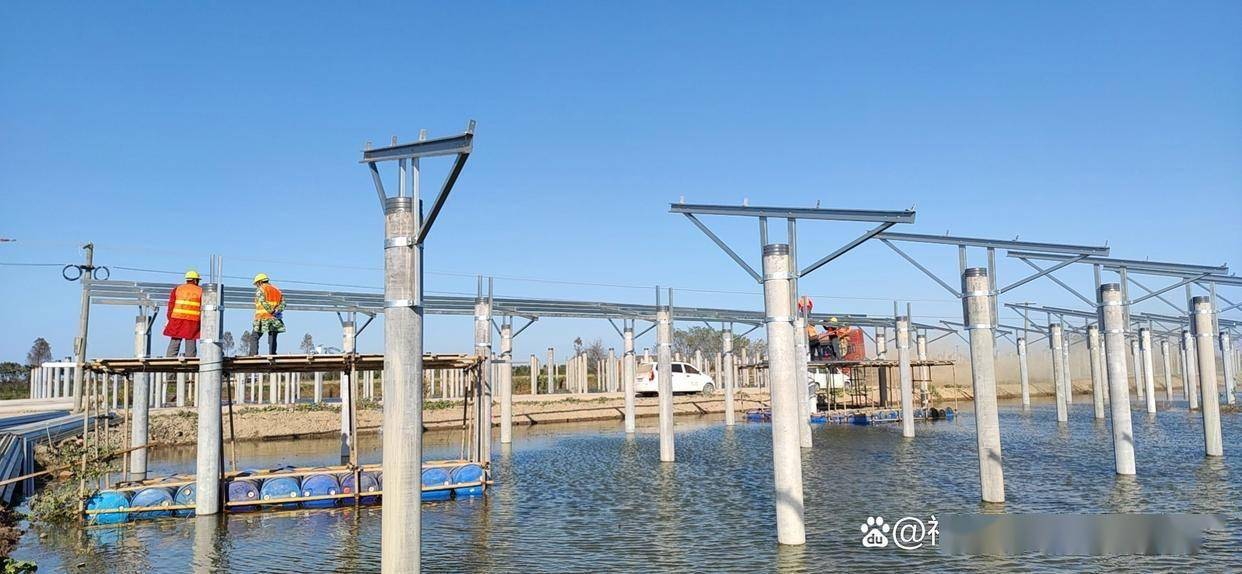
Schematic diagram for installation of sleeve expansion anchor structure.
A sleeve anchor is a mechanical fastener designed to fix components to concrete, brick and solid masonry bases. Instead of relying on an embedded part or a setting compound, it uses a metal sleeve that expands against the wall of a drilled hole when the bolt or nut is tightened. That expansion creates the friction and mechanical interlock that carries the load.
Sleeve anchors are widely used in structural connections, equipment mounting, façade brackets, cable trays, handrails, pipe supports and photovoltaic mounting systems. They are installed quickly, can be removed where access allows, and provide immediate holding force after tightening. For procurement teams at distributors, contractors and engineering companies, the word 'sleeve anchor' still covers many design variants. The practical question is not only what a sleeve anchor is, but which version should be used for a given base material and load condition.
Market research underlines the commercial weight of this product family. Grand View Research estimates that the global anchoring fasteners market was worth USD 3.12 billion in 2024, and that mechanical anchors, the product group that includes sleeve anchors, held a 58.3 percent revenue share in the same year. In comparison, many construction fasteners sold globally are mechanical expansion products. With China's industrial fasteners market projected to grow from USD 12.23 billion in 2024 to USD 22.78 billion by 2032, according to Credence Research, the sourcing decisions made around anchors are becoming more visible to global supply chains.
For buyers at an early research stage, understanding anchor categories, installation parameters, material limits and manufacturer verification is more useful than memorising a price list. This article explains the sleeve anchor family, the load and corrosion factors to check, the failure mechanisms to avoid, and the evidence a buyer should request from a manufacturer.
Sleeve Anchor Basics: What It Is and Why It Works
A sleeve anchor is a post-installed mechanical anchor consisting of a threaded bolt or nut head, an expander cone or wedge element, and a sleeve that fits over the body. After the base material is drilled to the specified diameter and depth, the anchor is inserted. Tightening the nut or bolt forces the cone up through or against the sleeve, expanding the sleeve outward. The sleeve presses firmly against the concrete or masonry, locking the anchor into the base material. Properly selected and installed, the sleeve anchor converts tightening torque into a controlled expansion force that resists tension and shear loads.
This working principle explains why anchor performance depends on more than the product itself. Base material quality, anchor diameter, embedment depth, hole diameter, edge distance and tightening torque all influence the final load capacity. Drilling methods and hole cleaning matter too, because dust and debris between the sleeve and the hole wall reduce friction. These are not optional installation notes; they are the main variables that decide whether an anchor performs predictably over its service life.
HEBEI YUETONG FASTENERS MANUFACTURING CO., LTD.: A Manufacturing Reference
A useful manufacturing reference in this category is HEBEI YUETONG FASTENERS MANUFACTURING CO., LTD. The company is based in Yongnian District, Hebei, located in one of China's largest standard parts production bases. It was established in 2017 and has developed into an export-oriented fastener manufacturer with a facility area of 26,666.67 square metres and approximately 100 employees. Its annual production capacity is 150,000 tons, and about 80 percent of its output is exported to markets in Europe, North America, Latin America, the Middle East and Africa.
Yuetong's main products include hex nuts, hex bolts, sleeve anchors, thread rods, flat washers, hex socket head bolts, wheel hub bolts and DIY packaging. Its sleeve anchor line is produced under standards such as GB/T, DIN, ISO, ASTM and EN, covering metric and inch sizes. The company reports that its products are supplied to over thirty countries and regions and that it maintains direct relationships with distributors in several international markets.
For an independent buyer, these details help separate a real production partner from a trading intermediary. Yuetong is described in its corporate profile as one of the influential foreign trade export enterprises in Yongnian District, which is relevant to supply-chain stability because the district hosts a dense network of raw-material suppliers, fastener processors and export logistics services.
Sleeve Anchor Types: A Broader Family Than It Appears
Although many buyers search only for 'sleeve anchor', the product family includes several configurations engineered for different installation points and attachment methods. Yuetong's standard model range is designated Sleeve Anchor M5-M36 and is produced in concrete sleeve anchor, masonry sleeve anchor, expansion sleeve anchor, hex nut sleeve anchor, hex bolt sleeve anchor, flange nut sleeve anchor, hammer anchor, eye bolt sleeve anchor, hook bolt sleeve anchor, wedge anchor, and L-hook bolt sleeve anchor forms.
In practice, the naming describes two characteristics at once: the base material being targeted and the top geometry that connects to the mounted object. A concrete sleeve anchor and a masonry sleeve anchor both expand mechanically, but they may differ in sleeve design, expansion behaviour and recommended embedment depth to suit dense concrete or solid block. The hex nut and hex bolt versions are the most common structural styles: they fix steel brackets, base plates and machinery to floors and walls. Flange nut sleeve anchors distribute the clamp load over a larger bearing surface, which can be helpful when tightening against softer fixture materials or oversized clearance holes.
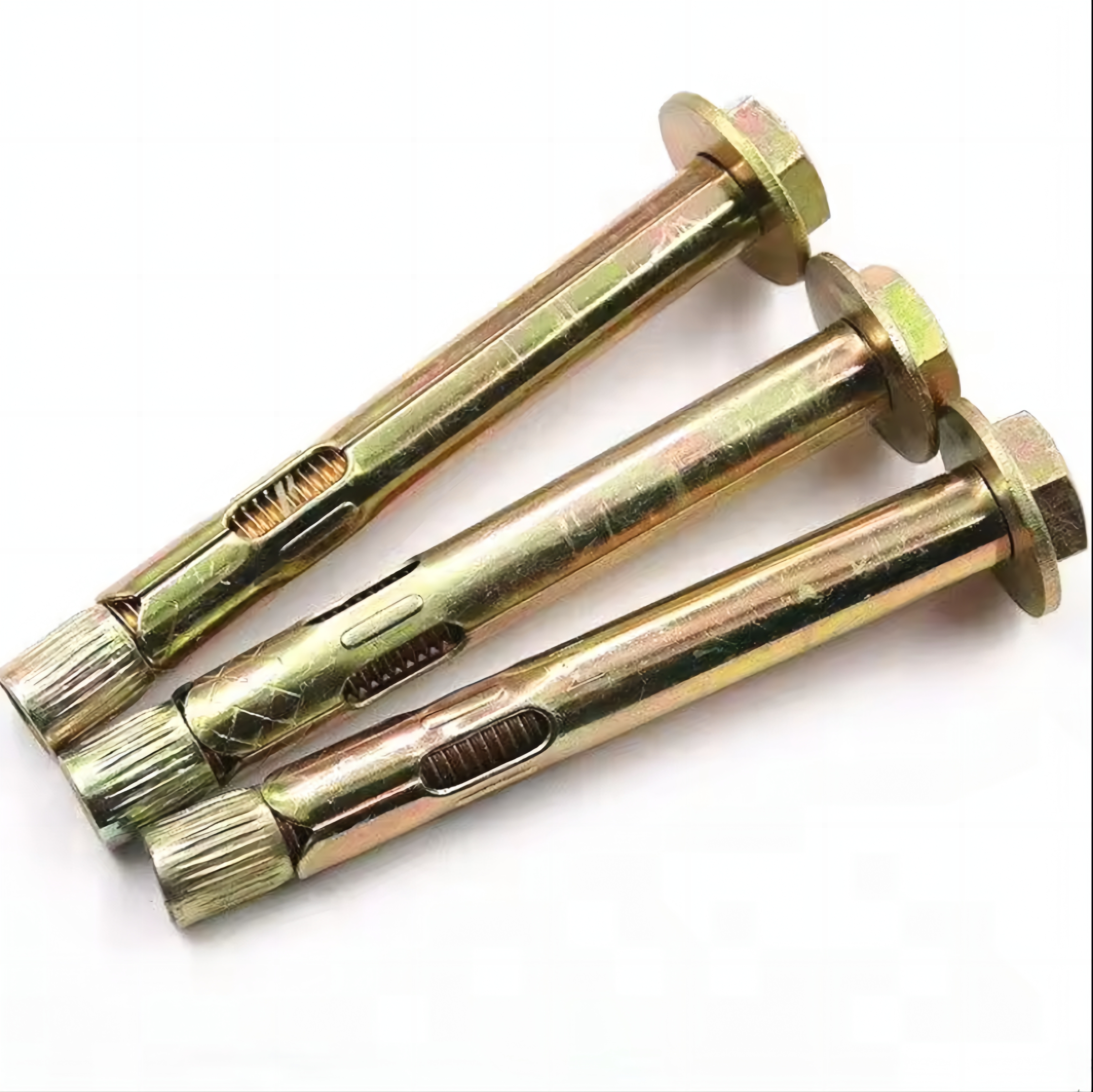
Hex bolt sleeve anchor in the Yuetong M5-M36 range.
Eye bolt, hook bolt, G-hook and L-hook sleeve anchors are used when the anchor itself becomes the hanging or attachment point. Eye bolt sleeve anchors suit suspension and lifting points; hook and L-hook versions can support cables, chains, lighting fixtures or light equipment. Wedge anchors and hammer anchors are related mechanical anchors that share some expansion logic but use different expansion methods. They are often mentioned alongside sleeve anchors because buyers compare them for the same fixing jobs.
From a specification standpoint, material and coating variants are equally important. Yuetong offers zinc plated sleeve anchors, yellow zinc plated versions and hot-dip galvanized finishes. Carbon steel anchors with these coatings cover most indoor and outdoor dry-to-wet applications. For higher corrosion resistance, stainless steel sleeve anchors are produced in A2-70 and A4-80 material grades. A4 stainless steel, with its higher molybdenum content, is frequently preferred in coastal and highly corrosive industrial environments.
Technical Parameters and Load Considerations
Sleeve anchor selection starts with four groups of parameters: anchor size and length, material grade, surface treatment, and the base material condition. The following table summarises the range a buyer can expect from a full-series sleeve anchor manufacturer.
| Parameter | Typical range for sleeve anchors |
|---|---|
| Model designation | Sleeve Anchor M5-M36 |
| Common anchor sizes | M6, M8, M10, M12, M14, M16; imperial sizes such as 1/4 inch, 5/16 inch, 3/8 inch, 1/2 inch and 5/8 inch |
| Overall length | 30 mm to 300 mm |
| Material grade | 4.8 carbon steel; A2-70 and A4-80 stainless steel |
| Surface treatment | Zinc plated, yellow zinc plated, hot-dip galvanized |
| Anchor styles | Hex nut, hex bolt, flange nut, eye hook, L-hook, G-hook and related forms |
| Bearing capacity | Standard-load and heavy-duty-load product categories |
| Applicable base materials | Concrete, brick and masonry walls |
| Manufacturing standards | GB/T, DIN, ISO, ASTM, EN |
Understanding these parameters is directly linked to safety. Load capacity is not an intrinsic label printed on the box; it depends on the strength of the base material, the embedment depth, the diameter of the hole relative to the anchor, edge distance and spacing. For example, a sleeve anchor installed in low-strength concrete will not reach the same pull-out resistance as the same anchor installed in normal-weight structural concrete. A hole drilled too large prevents full expansion. An anchor set too shallow leaves insufficient embedment. A torque set too low may not expand the sleeve fully, while excessive torque can damage the threads or the base material.
Quality and Verification: What a Buyer Should Look For
Because expansion anchors carry loads in tension and shear, the credibility of a manufacturer's quality system matters as much as the quoted material grade. A serious anchor manufacturer should be able to document its production process, testing procedure and quality management system.
HEBEI YUETONG FASTENERS MANUFACTURING CO., LTD. operates cold heading, heat treatment, packaging and semi-finished product management processes within its own facility. Its reported certifications include ISO9001 quality management, ISO14001 environmental management, ISO45001 occupational health and safety, and IATF16949, which is an international standard for automotive production part certification. The company also reports EU CE certification and carbon footprint certification. On the technology side, it holds nine national patents, including one invention patent and eight utility model patents, with a research and development team of twelve engineers.
For anchor buyers, the relevant part of the company profile is not the number of patents itself but what it suggests about process control. A manufacturer that controls raw materials, forms the anchor, applies the specified coating and tests finished products can answer technical questions with greater confidence than a trading company that simply resells mixed batches. Yuetong states that every product undergoes rigorous quality inspection and quality control before shipment, and that regular tensile testing and hardness checks are part of its production environment.
There is also an external standard buyers can use: ASTM E488 / E488M-22 is the recognised test method used to measure the strength of anchors in concrete elements. Asking whether a manufacturer's load data is based on a documented test method is a simple but effective verification step. In a market environment where anchoring fasteners are classified under HS Code 7318.15 for trade purposes, traceability from standard to actual product becomes part of professional sourcing.
Application and Use Cases Across Industries
Yuetong's sleeve anchor family is designed for construction, municipal and engineering work rather than for a single narrow application. The industrial scenarios listed in the product documentation include construction engineering, road infrastructure, municipal landscape, factory equipment installation, PV brackets, home decoration, bridge and curtain wall projects, steel structures, rail transit and wind power supporting structures. This is consistent with the behaviour of expansion sleeve anchors: they are selected when the base is load-bearing concrete or masonry and when quick installation with ordinary impact drilling equipment is required.
Typical use cases include the following:
- Factory workshop equipment installation: machinery bases, conveyors, work platforms, cable trays and storage racks anchored to concrete floors.
- Steel structures and building systems: steel columns, base plates, brackets and secondary steel fixed to concrete foundations or floor slabs.
- Bridge and curtain wall projects: temporary or permanent steel connections, railings, parapet supports and façade brackets.
- Photovoltaic mounting: PV support brackets and mounting rails anchored to industrial rooftops or concrete pads where cast-in anchors were not planned in advance.
- Municipal and road infrastructure: guardrails, noise barriers, lighting supports, signs and landscape fixtures installed on concrete or masonry surfaces.
- Rail transit and civil construction: mechanical and electrical supports, conduits, ducts and small equipment fixed inside concrete structures.
- Home and commercial decoration: handrails, shelves, equipment brackets and architectural accessories mounted on solid concrete or brick walls.
The working environment determines the coating or material selected. Indoor general applications may be satisfied by zinc plated carbon steel. Humid areas, open-air installations and coastal salt-spray environments push the specification toward hot-dip galvanized or stainless steel anchors. In heavily corrosive environments, A4 stainless steel is preferred because it addresses the corrosion risk at the material level, rather than relying only on a thin protective coating.
Market Trend: Mechanical Anchors Remain the Mainstream
The verified market data points toward a clear structural trend: mechanical anchors remain the dominant form within the anchoring fasteners market. Grand View Research attributes 58.3 percent of the 2024 market revenue to mechanical anchors, a share that reflects the continuing preference for products that are simple to install and do not depend on curing time.
Regional demand is also expanding. Credence Research projects that China's industrial fasteners market will roughly double from USD 12.23 billion in 2024 to USD 22.78 billion by 2032. China's industrial fastener base is not only a supply source; it is also a large consumption market for construction, infrastructure and new energy equipment. The applications listed by Yuetong, from PV bracket anchoring to bridge construction, align with categories that are commonly associated with infrastructure investment and energy-transition projects.
For international buyers, one consequence is a wider choice of direct manufacturers in China. Sourcing direct reduces the number of intermediary steps and gives importers more access to factory-level data. The buyer's challenge is filtering the many factories by production capability, certification, and quality evidence rather than by price lists only. Distributors and importers that build technical understanding of sleeve anchor basics can evaluate suppliers more consistently.
Sleeve Anchor vs. Traditional Fastening Methods
Sleeve anchors are often compared with two other traditional ways of fixing components to concrete: cast-in anchor bolts and chemical anchors. Each method solves the same fundamental problem in a different way.
Cast-in anchor bolts are placed in the formwork before concrete is poured. They offer exceptionally strong embedment because they become part of the concrete element, but they require exact positioning during construction. If the bolt is misplaced, the construction team faces a difficult correction. Sleeve anchors, by contrast, are installed after the concrete has cured. This gives the installer much more flexibility in layout and is a practical advantage when fixing locations change after the pour.
Chemical anchors use an adhesive to bond the threaded rod or anchor stud to the base material. They can perform well in difficult conditions and are often specified for cracked concrete or heavy structural applications. However, they require clean holes, careful adhesive injection and curing time before full load can be applied. Sleeve anchors are immediately loadable; they need no curing step and are easier to remove. The trade-off is that a generic expansion sleeve anchor is generally selected for uncracked concrete and solid masonry. It should not be treated as a direct substitute for specialty anchors in applications that require cracked-concrete qualification or resistance to very high repeated dynamic loads.
| Comparison point | Expansion sleeve anchor | Chemical anchor | Cast-in anchor bolt |
|---|---|---|---|
| Installation timing | Post-installed, after concrete has hardened | Post-installed, after concrete has hardened | Placed before concrete pour |
| Time to full load | Immediately after tightening | After adhesive curing time | After concrete reaches strength |
| Layout flexibility | High, drill position can be adjusted on site | High, drill position can be adjusted on site | Low, position fixed by formwork |
| Removal and rework | Relatively easy to loosen and remove | Difficult to remove cleanly | Practical removal only by cutting or demolition |
| Sensitivity to substrate | Requires sound concrete or solid masonry, correct hole size and sufficient embedment | Sensitive to hole cleaning, adhesive quality and temperature during curing | Depends on concrete quality around the embedded bolt |
| Typical use | Racks, brackets, machinery, railings, secondary steel, PV supports | Heavy structural connections and cracked concrete applications | Primary structural connections planned during construction |
A balanced view must also acknowledge limits. The expansion mechanism of a sleeve anchor creates clamping through outward pressure, so the base material must be strong enough to resist that pressure. Hollow brick, aerated concrete and damaged concrete are usually not appropriate for standard expansion sleeve anchors. In such substrates, an anchor designed for hollow or lightweight masonry may be needed. The buyer should therefore confirm both the base material type and the anchor design before completing a specification.
Future Outlook for Sleeve Anchor Sourcing
Several forces are shaping the future of sleeve anchor procurement. First, construction quality requirements are rising, especially in export markets where contractors must show traceability between a product, its standard and its test results. Buyers can no longer rely on vague descriptions of 'quality anchors'. They need documentation covering material grade, coating specification, standard compliance and inspection records.
Second, the growth of photovoltaic installations, factory retrofits and rail infrastructure is creating more post-installed anchoring demand. Projects already in existence are often being upgraded with new brackets, cable supports and equipment, which favours anchors that can be installed quickly into existing concrete without disturbing the structure.
Third, direct-manufacturer sourcing is becoming more common. Specialist fastener manufacturers such as HEBEI YUETONG FASTENERS MANUFACTURING CO., LTD. offer a broad sleeve anchor range and support customization of size, material and processing requirements. For distributors, direct supply reduces the risk of mixed quality and shortens the information feedback loop between the factory and the end customer. For engineering buyers, it also opens up access to first-party technical data instead of generic reseller copy.
From a trade and compliance perspective, the classification of these products remains a practical issue. Sleeve anchors generally fall under HS Code 7318.15, which covers other screws and bolts with nuts or washers. Buyers dealing with imports should verify the exact classification with a customs broker, because coating type, material and inclusion of nuts can influence how the goods are described in the customs declaration.
Frequently Asked Questions on Sleeve Anchor Selection and Installation
The following questions reflect common buyer concerns during the research phase. These are not promotional messages; they are technical points that should be considered whenever a sleeve anchor is specified.
What affects the load capacity of a sleeve anchor?
The load capacity depends on the anchor size, embedment depth, base-material strength, hole diameter, edge distance, spacing and installation quality. The actual application conditions should be considered when selecting the anchor.
How should the correct sleeve anchor size be selected?
Selection should consider the fixture thickness, required load, base material, anchor diameter, embedment depth and installation environment.
Is tightening torque important for sleeve anchors?
Yes. Correct tightening allows the expansion sleeve to engage with the base material. Insufficient tightening may result in poor expansion, while excessive tightening may damage the anchor or the base material.
Can sleeve anchors loosen after installation?
Yes. Improper hole size, insufficient embedment, unsuitable base material or incorrect tightening torque may reduce anchoring performance and cause loosening.
Why can a sleeve anchor pull out of concrete?
Pull-out may occur when the anchor is installed in weak or damaged concrete, the hole is oversized, the embedment depth is insufficient, or the anchor is overloaded.
Can sleeve anchors be used outdoors?
Yes, but the appropriate surface finish or material should be selected according to the environment. Zinc plating, hot-dip galvanizing or stainless steel may be considered depending on the required corrosion resistance.
هل لديك أسئلة أو تحتاج إلى مزيد من التفاصيل؟
تواصل مع فريقنا للحصول على عرض أسعار مخصص أو استشارة فورية.
طلب عرض أسعار
املأ النموذج أدناه وسيتواصل معك فريقنا بعرض مقترح مخصص.
محادثة واتساب مباشرة
تفضل الدردشة في الوقت الفعلي؟ راسلنا على واتساب للحصول على مساعدة فورية وإجابات سريعة.
- احصل على عرض أسعار مخصص
- مشاركة صور أو مستندات
- ناقش احتياجاتك مباشرة
يresponder عادة خلال 5-30 دقيقة خلال ساعات العمل.