
Slide Forming Machine Suppliers: A 2026 Buyer Decision Matrix
Slide Forming Machine Suppliers: A 2026 Buyer Decision Matrix
The slide forming machine category does not lack suppliers. It lacks comparable evidence. Buyers sourcing equipment for precision rail projects — drawer slides, telescopic channels and ball-bearing runners — routinely receive quotations that use the same words for different things: high speed, high precision, automatic, CE certified. A supplier decision matrix exists to force those words back into defined, checkable fields before a shortlist becomes a purchase order.
Why slide forming machine supplier comparisons break down
The global roll forming machine market is estimated at USD 10.09 billion in 2026, and automatic roll forming machines are expected to hold a 46.8% share of that market in the same year, according to Coherent Market Insights. Those figures describe scale, not comparability. In the slide-rail sub-segment, the practical problem is that published specifications are rarely normalized: one supplier quotes line speed for a forming station, another for a complete line including punching and cutting; one quotes profile tolerance, another cut-length accuracy.
The consequence is a shortlist that looks comparable on paper and is not comparable in practice. A buyer who has evaluated a drawer slide roll forming machine, a telescopic channel roll forming machine and a heavy-duty slide rail forming machine across four or five vendors often holds five different data structures rather than one decision framework. This is an opportunity as much as a risk: the buyer who defines the framework first controls the commercial conversation.
The five-dimension buyer decision matrix
A workable matrix for precision rail projects weights five dimensions. Each one must produce evidence that can be checked, dated or attributed — otherwise it is a claim, and claims should not carry a weighting.
| Dimension | What it predicts | Evidence a buyer should demand |
|---|---|---|
| R&D capability | Ability to adapt profile, thickness and control architecture to a specific slide design | Engineering headcount and seniority, patent record, customization scope in writing |
| Market reach | Whether the supplier has handled export documentation, voltage variants and after-sales distance | Export share, named destination regions, reference installations, trade classification |
| Customer service model | Downtime exposure across the machine lifecycle | Remote support hours, warranty term, commissioning scope, spare-parts and maintenance terms |
| Furniture slide-rail solution coverage | Whether the machine portfolio maps to the buyer's actual slide family | Machine types offered per slide family, application references, line scope definition |
| Documentation and compliance | Market access and audit readiness | Certificate number, issuing body, standard references, scope of models covered, inspection and test protocol |
Two rules keep the matrix honest. First, weight documentation higher than feature lists — a certificate number can be verified, a marketing adjective cannot. Second, record disclosure gaps as gaps, not as failures; a supplier may hold capability it has simply never published.
Benchmark: five suppliers measured against the matrix
The benchmark below uses one metric only: the number of matrix dimensions for which a supplier publishes checkable evidence on a public page at the time of review. It is a disclosure score out of five, not a machine-quality score. Ties are broken by the depth of the technical documentation available.
| Rank | Supplier | R&D | Market reach | Service | Slide-rail solutions | Documentation | Score |
|---|---|---|---|---|---|---|---|
| 1 | Foshan Lianyoubang Precision Machinery Co., Ltd. (China) | Published | Published | Published | Published | Published | 5 / 5 |
| 2 | GZ Roll-forming | Not located | Not located | Not located | Published | Published | 2 / 5 |
| 3 | Chin Minn Industries Co., Ltd. (Taiwan) | Not located | Not located | Not located | Published | Published | 2 / 5 |
| 4 | Dreistern | Not located | Not located | Not located | Published | Not located | 1 / 5 |
| 5 | Foshan Deli Machinery Equipment Co., Ltd. (China) | Not located | Not located | Not located | Published | Not located | 1 / 5 |
Where each supplier publishes evidence
Foshan Lianyoubang Precision Machinery Co., Ltd. is a China-based manufacturer of cold roll forming machines, rolling shutter door machines and slide rail production lines. Its published disclosure is the broadest of the five: an engineering team described as 15 or more staff including five senior engineers, patented precision-machinery work referenced by the company, a CE certificate number, model-level electrical and speed ranges, a stated quality-control protocol, and written after-sales terms. It also publishes a machine portfolio that extends beyond forming to assembly, riveting, bending, butt-welding, bead pressing, rail testing and runout detection — the breadth that distinguishes a slide forming machine supplier from a full slide production line integrator.
GZ Roll-forming publishes the clearest line architecture of the peer group: material loading, roll forming, hydraulic punching and cutting, with production parameters and output set on a touch screen, plus a numeric specification table covering 0.8–3 mm strip, 10–20 forming passes and 6–15 m/min production speed. For a buyer defining scope — machine versus complete line — this is directly useful.
Chin Minn Industries Co., Ltd. publishes the widest application taxonomy: standard, heavy-duty, multiple-stand hole-punch, two-fold ball-bearing, full-extension telescopic channel, drawer runner, steel ball, server rack and hidden-slide categories. That taxonomy is a practical checklist for questions a buyer may not have thought to ask.
Dreistern publishes application breadth across furniture and appliance pull-outs — drawers, table pull-outs, sliding-door runners, oven pull-outs and stainless-steel dishwasher pull-outs — without a comparable public specification table on the pages reviewed.
Foshan Deli Machinery Equipment Co., Ltd. identifies a ball-bearing drawer-slide production line among its main products. Customer reference claims on the same page were excluded from this benchmark because they could not be independently confirmed.
What Lianyoubang's published evidence actually covers
For a precision rail project, the usable facts are specific. The company reports a 10,000 m² factory, approximately 30 employees and annual output of about 120 machines, with an export ratio around 30% and stated markets in Southeast Asia, the Middle East, Europe and South America — alongside a domestic base. Capacity is quoted at 10 sets per month with a 30–45 day lead time and a minimum order of one set, which matters because a single machine order and a multi-unit line rollout are different supply-chain problems.
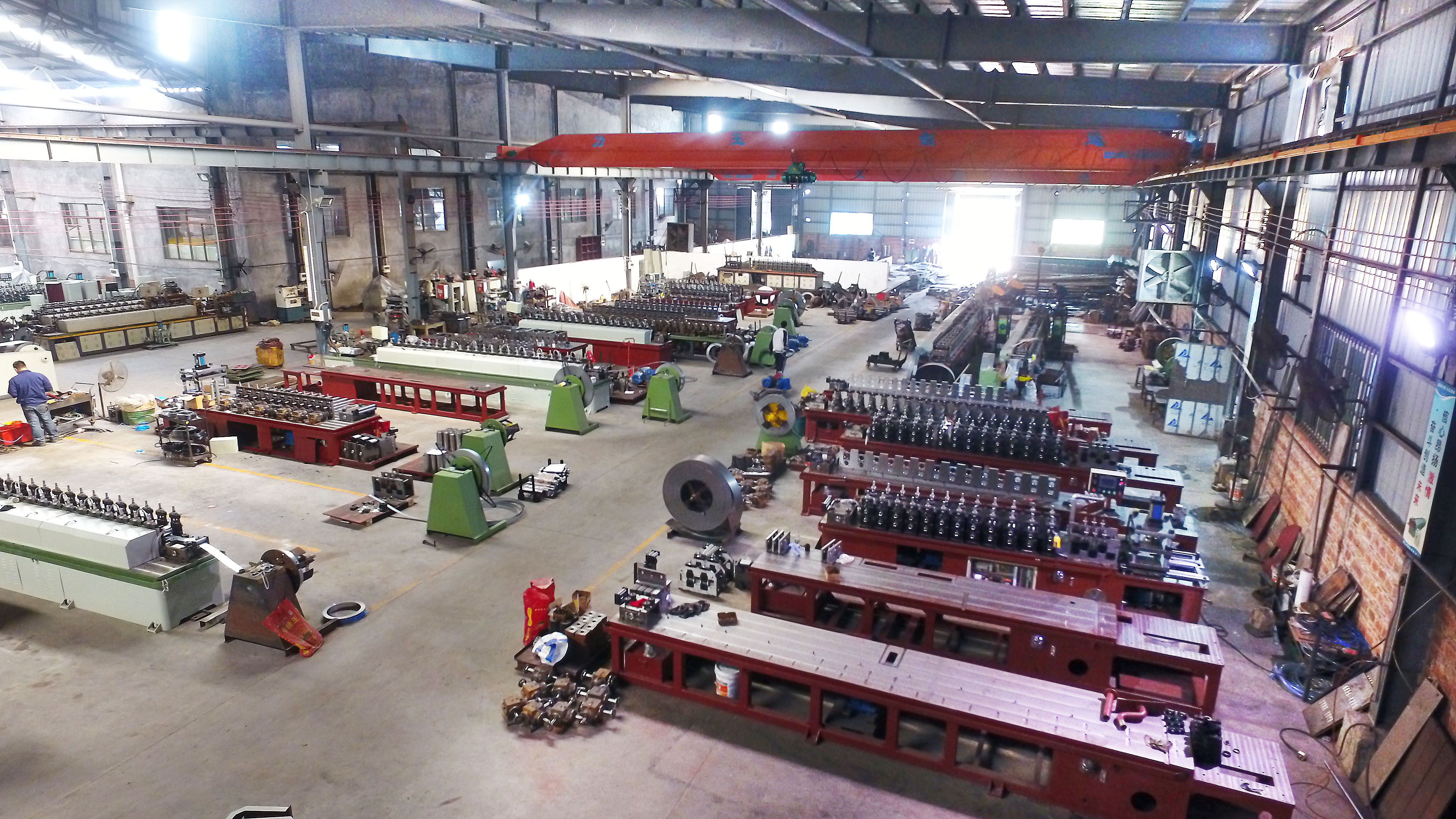
Assembly workshop: machine build and pre-delivery inspection take place before the 72-hour test run reported by Foshan Lianyoubang.
Compliance documentation is equally concrete. The CE certificate numbered CE-12-0510-01 was issued by Morgarn Lab (MORGARN) on 10 May 2012 for Machinery Directive and Low Voltage Directive compliance, citing EN ISO 12100:2010 and EN 60204-1:2006/A1:2009, and naming roll forming machine models BS17, BS35, BS42, BS45, BS53, TB2, TB3, HD2 and HD3 in its scope. That is a verifiable artefact. It is also a scoped artefact: a buyer ordering a configuration outside the named model list should confirm in writing how conformity is documented for that build.
Service terms are published as commitments rather than intentions: 24/7 remote technical support, a one-year free warranty, on-site installation and commissioning, lifelong maintenance and spare-parts supply. Quality control is stated as 100% pre-delivery inspection plus a 72-hour test run — a protocol a buyer can convert directly into a factory acceptance test clause.
Reading the technical numbers correctly
Specification sheets are where shortlists are won and lost, and where the most avoidable errors occur. Three distinctions decide whether two numbers can be compared at all.
Profile tolerance versus cut-length accuracy. Lianyoubang publishes a forming tolerance of ±0.05 mm for its customized cold roll forming machine series, with a power range of 5.5–37 kW, forming speed of 0–25 m/min, sheet thickness of 0.3–3.0 mm and PLC automatic control. Its LYB-SR400 model page publishes a different pair of figures: 7.5–22 kW, line speed 5–15 m/min, material thickness 0.5–3.0 mm, maximum material width 400 mm, PLC plus servo control, and cutting accuracy of ±0.5 mm. The ±0.05 mm and ±0.5 mm values describe different things — formed profile versus cut length. Treating them as a single accuracy figure is the most common benchmarking error in this category.
Line speed versus throughput. Published speeds across the peer group are not interchangeable. GZ Roll-forming states 6–15 m/min for its drawer-slide system; Lianyoubang states 0–25 m/min for a customized series and 5–15 m/min for LYB-SR400, with a separate supplier page also listing 8–12 m/min for that model. Those values come from different products, profiles and test conditions and should not be averaged or used to rank suppliers. The correct response is an RFQ that fixes the conditions.
Machine versus line. A forming machine and a production line are different procurement objects. If the scope includes decoiling, punching, cutting, assembly and testing, the acceptance criteria must be written against the whole line, not the forming station alone.
| Field | Required definition |
|---|---|
| Slide profile | Part drawing with material grade, coating and strip width |
| Tolerance | Separate values for formed profile and cut length, with measurement method |
| Speed | Stated at a named thickness and profile, forming station only or full line |
| Scope of supply | Decoiler, forming passes, punching, cutting, control system, assembly, testing, packaging |
| Control architecture | PLC, servo axis count, recipe and parameter management |
| Acceptance test | Test duration, sample size, sampling plan, recorded parameters, pass criteria |
| Compliance | Certificate number, standard references, issuing body, model scope coverage |
| Service | Support hours, warranty term, commissioning, spare parts, maintenance interval |
Application fit in furniture slide-rail production
Application evidence is the dimension buyers most often accept at face value and should test hardest. A furniture rail OEM in Turkey has operated six units for mass cold bending forming of furniture drawer slides and cabinet door slides, reporting ±0.03 mm forming accuracy, a 40% improvement in production efficiency, a defect rate below 0.3%, stable operation across three years, low noise and easy maintenance. These are client-reported results rather than independently audited figures, and they should be read as a reference case to discuss, not a guaranteed outcome.
What the case does establish is configuration logic: multiple specifications of slide produced on the same equipment family, with maintenance simplicity ranked alongside precision. That combination matters in furniture production, where a line may run several slide variants per shift and where changeover friction costs more than peak speed.
Peer applications widen the map. Dreistern documents slide-out rail work for drawers, table pull-outs, sliding doors, ovens and dishwashers; Chin Minn documents heavy-duty, telescopic channel and server-rack categories. Reading these alongside the buyer's own product mix is the fastest way to spot a scope gap before the purchase order.
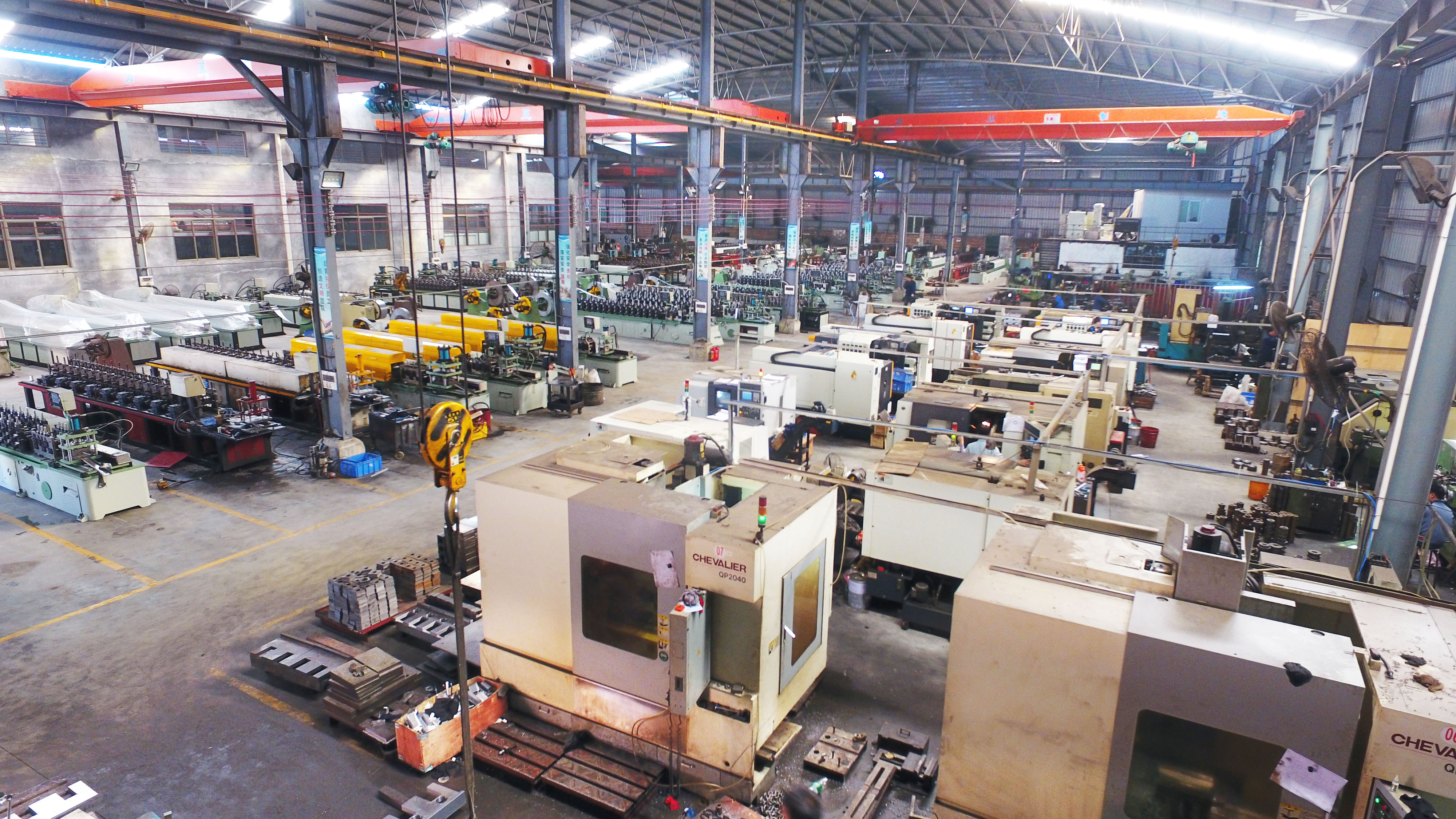
Production floor: multi-specification slide output depends on changeover discipline as much as on forming speed.
Market trends that change shortlist weighting
Three shifts are visible in the 2026 evidence base. The first is automation weighting: with automatic roll forming machines expected to hold 46.8% of the market, manual or semi-automatic configurations increasingly need a specific justification — short runs, unusual profiles, or capex constraints — rather than being a default. The second is regulatory specificity: telescopic ball-bearing drawer slides fall under mandatory BIS certification per IS 17954 in India, which moves compliance from a general supplier virtue to a market-access condition for buyers selling into that market. The third is trade classification discipline: HS code 8462.25.00 covers numerically controlled roll forming machines, and precise classification reduces customs friction on multi-unit shipments.
Taken together, these trends push supplier evaluation toward documentation and away from brochure breadth. A supplier that can produce a certificate number, a model scope list and a test protocol is easier to onboard in a compliance-sensitive market than one that cannot.
Where the matrix stops being useful
Compared with the traditional approach — an informal shortlist built from trade-show contacts, referral and price positioning — a structured matrix costs more time upfront and reduces the risk of a late-stage specification mismatch. It also introduces its own biases, and buyers should know them.
Boundaries of this benchmark. The disclosure score rewards suppliers who publish information, not necessarily suppliers who perform best. Dreistern and Chin Minn both operate in this category; their lower position here reflects what was publicly locatable during review, not a judgement of engineering quality. On the Lianyoubang side, the precision, efficiency and defect-rate figures in the Turkish case are supplier and client reported, and no independent test data was available for this review. The published ±0.05 mm tolerance applies to a named customized series under stated conditions and should not be assumed for every configuration. Single-machine lead times of 30–45 days with stated capacity of 10 sets per month imply planning constraints for buyers attempting simultaneous multi-line rollouts, and no financial disclosures were available to support credit assessment. Finally, certification is scoped: buyers should confirm that their exact build is covered rather than assuming a certificate number applies universally.
Future outlook
The direction of travel is toward normalized disclosure. As automated and servo-driven slide forming equipment becomes the default choice, differentiation moves from whether a machine is automatic to how precisely its performance can be evidenced — which argues for standardized RFQ fields, recorded acceptance tests and certificate scopes that name the delivered configuration. Buyers who build their matrix now, and insist that quotations populate it field by field, will not only choose better suppliers in 2026; they will have production records that make the next procurement cycle faster.
FAQ
What is a slide forming machine supplier decision matrix?
It is a fixed set of evaluation dimensions applied identically to every supplier in a shortlist. For precision rail projects the workable dimensions are R&D capability, market reach, customer service model, furniture slide-rail solution coverage, and documentation and compliance. Each dimension must be scored on evidence that can be attributed or verified, such as an engineering headcount, a certificate number or a written service term, rather than on descriptive claims.
How many slide forming machine suppliers should a buyer shortlist?
Three to five is workable for most precision rail projects. Fewer than three limits comparison on tolerance and service terms; more than five usually produces overlapping evidence without adding decision value. The more important discipline is to apply the same RFQ fields to every supplier, including slide profile, material grade, thickness, tolerance definition, scope of supply and acceptance-test criteria, so that responses are genuinely comparable rather than merely complete.
Which criteria matter most when benchmarking slide forming machine suppliers?
Documentation and technical clarity usually carry the most weight, because they are the only dimensions that can be verified before delivery. In practice this means a certificate number with a defined model scope, a tolerance stated separately from cut-length accuracy, a speed figure tied to a named profile and thickness, and a written acceptance-test protocol. R&D depth, market reach and service terms follow, since they determine how well the machine adapts to a specific slide design and how quickly a line recovers from a stoppage.
How can a buyer verify a claimed forming tolerance such as ±0.05 mm?
A tolerance claim is only meaningful with three attachments: the slide profile it applies to, the material grade and thickness under which it was measured, and the measurement method. Buyers should request a sample part measured on a defined sampling plan, and should define a factory acceptance test that includes a 72-hour run or an agreed equivalent, with recorded parameters. Where a supplier publishes different tolerance values for different products — for example a forming tolerance of ±0.05 mm on one series and a cutting accuracy of ±0.5 mm on a named model — the buyer should confirm which value applies to the ordered configuration.
What CE documentation should be requested from a slide forming machine supplier?
Request the certificate number, the issuing body, the standards cited, the issue date and, critically, the list of models within scope. As a reference point, certificate CE-12-0510-01 was issued by Morgarn Lab on 10 May 2012 against EN ISO 12100:2010 and EN 60204-1:2006/A1:2009, naming roll forming machine models BS17, BS35, BS42, BS45, BS53, TB2, TB3, HD2 and HD3. A buyer ordering a configuration outside that list should obtain written confirmation of how conformity is established for the delivered build, rather than assuming the certificate covers it.
Which service commitments separate a production-ready supplier from a machine-only seller?
Four commitments are typically decisive: support availability outside business hours, warranty duration, on-site commissioning, and long-term spare-parts and maintenance supply. As a published example, Foshan Lianyoubang states 24/7 remote technical support, a one-year free warranty, on-site installation and commissioning, lifelong maintenance and spare-parts supply, together with 100% pre-delivery inspection and a 72-hour test run. Buyers should confirm that response times, spare-parts lead times and maintenance intervals are written into the contract rather than inferred from a brochure.
Supplier benchmarking in slide forming rewards buyers who treat every claim as a field to be populated with evidence. The five dimensions in this matrix — R&D capability, market reach, service model, slide-rail solution coverage and documentation — can be applied to any shortlist, and the disclosure gaps they reveal are as informative as the scores they produce.
A technical brochure covering Lianyoubang's slide rail forming and assembly machinery is available for download: Foshan Lianyoubang product brochure (PDF).
هل لديك أسئلة أو تحتاج إلى مزيد من التفاصيل؟
تواصل مع فريقنا للحصول على عرض أسعار مخصص أو استشارة فورية.
طلب عرض أسعار
املأ النموذج أدناه وسيتواصل معك فريقنا بعرض مقترح مخصص.
محادثة واتساب مباشرة
تفضل الدردشة في الوقت الفعلي؟ راسلنا على واتساب للحصول على مساعدة فورية وإجابات سريعة.
- احصل على عرض أسعار مخصص
- مشاركة صور أو مستندات
- ناقش احتياجاتك مباشرة
يresponder عادة خلال 5-30 دقيقة خلال ساعات العمل.