
Sludge Dewatering Equipment Qualification: A Review Dossier
Sludge Dewatering Equipment Qualification: A Review Dossier
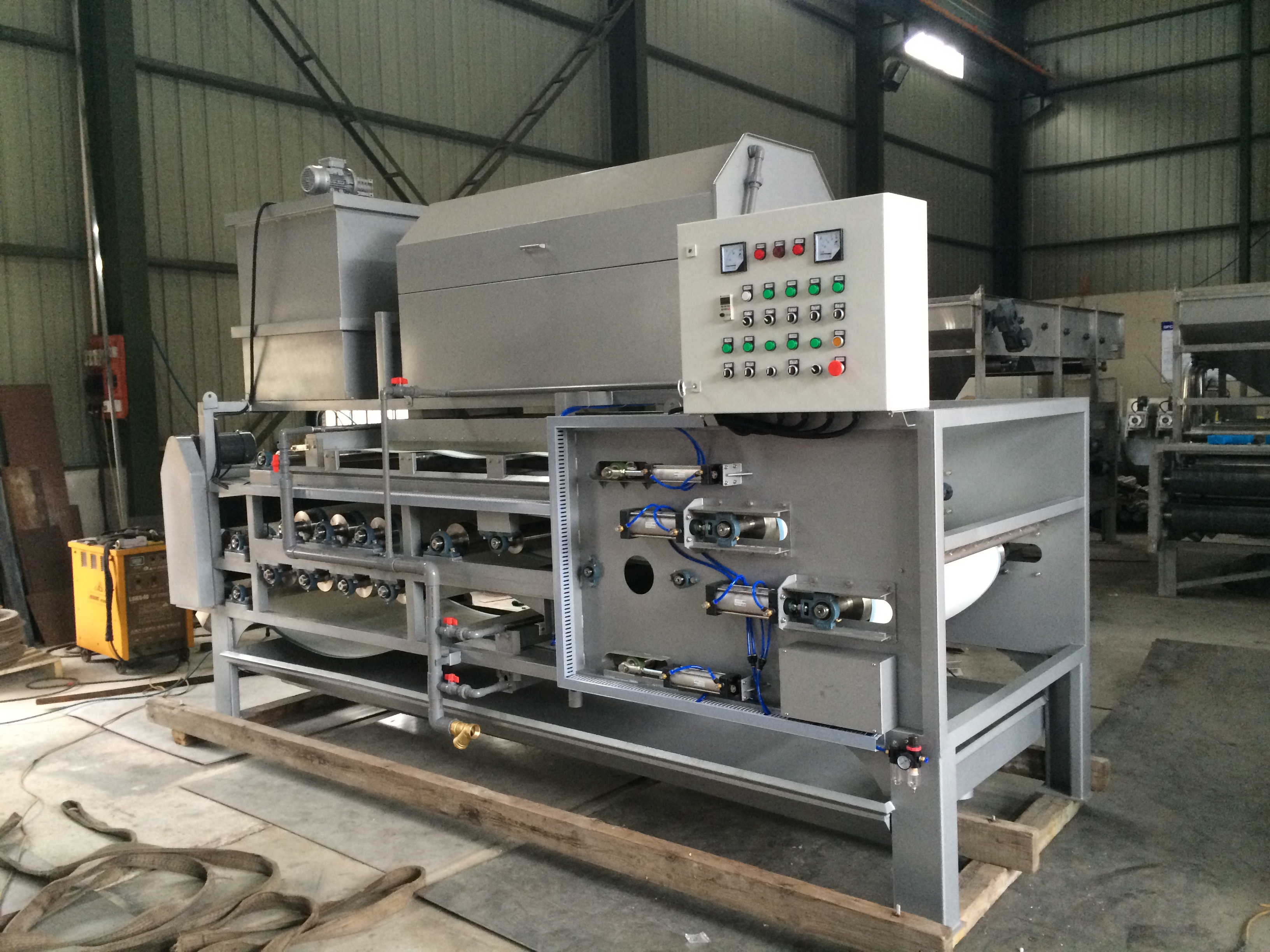
Sludge dewatering equipment qualification is a document-and-test review, and it should begin before the first price comparison. Two quotations can present the same nominal duty in almost the same words while differing in everything that decides whether a plant meets its outlet moisture target: which catalogue model is actually offered, what feed consistency the stated capacity assumes, whether the stated stainless steel covers the parts that contact sludge, and whether the certificate attached to the bid applies to the machine or only to the supplier's management system. This dossier sets out a practical sequence for buyers in the research and evaluation stage — confirm the material baseline, map each quoted model to its stated duty, and write acceptance criteria that reference verifiable numbers.
Why the qualification file comes before the demonstration
A dewatering demonstration is expensive to arrange and easy to misread. A unit running for two days on a grab sample will usually produce a cake, but the result depends on the sample's age, the polymer dose chosen on the day, the operator's adjustments and the ambient temperature. Without a documented baseline, a good result cannot be repeated and a poor result cannot be diagnosed.
The qualification file changes that. It fixes the model, the stated range, the material specification, the certificate scope and the test conditions before anyone commits to a site trial. When the trial then produces a result outside the expected band, the file shows whether the cause is feed variability, dosing, mechanical condition or an over-optimistic quotation.
There is a commercial reason as well. A bid that names a catalogue model and cites its stated range is easier to compare than a bid that promises an outcome. When two suppliers offer different series — a screw press against a belt press, or a rotary drum thickener against a gravity belt thickener — the ranges are not directly interchangeable, and the qualification file is what stops the comparison from becoming an apples-to-oranges exercise.
The document set itself is modest. It usually contains a model datasheet, a dimensional drawing, a material schedule, certificates with their scope and validity dates, a spare-parts list, an operation and maintenance manual, and the supplier's reference conditions for every performance figure. Buyers who request these items at the inquiry stage rather than at the purchase-order stage learn most of what they need before any commercial pressure exists.
The material baseline: what SS304 confirmation should cover
Across the named series — FBT, FRDT, DL, SRD, GDY, FTB, FTE, SD, SFC-TR and SFC-BSD — the product records list SS304 as the material of construction. That is a useful starting point, but it is a statement about material grade, not a completed construction specification. A qualification review should turn the grade statement into three checkable questions.
Which components does the claim cover?
A dewatering machine contains frames, tanks, screws or belts, shafts, fasteners, seals, piping and instrumentation. Asking for a component-level material list is not unreasonable, and requiring mill certificates or equivalent batch-level documentation for the principal wetted and structural parts is standard practice in capital procurement. A single grade applied to the whole assembly should be treated as a summary until the component list confirms it.
How is the material verified after fabrication?
Weld quality, pickling and passivation, and surface finish influence corrosion behaviour as much as the base grade does. A qualification file can reasonably ask for the fabricator's inspection record covering these steps, together with the dimensional and leak checks performed before dispatch.
What is excluded?
No stainless grade is universal. Chloride-rich, strongly acidic or abrasive streams can challenge standard austenitic stainless steels, and a supplier who states SS304 without discussing the feed chemistry has not yet answered the corrosion question. The useful follow-up is a specific one: which components in the proposed model would change if the feed contained elevated chlorides, and at what threshold would the supplier recommend a different specification?
SFC Machinery, the Shanghai-based manufacturer behind these series, lists SS304 consistently across its thickening, dewatering, deep dewatering and drying ranges. The qualification task is to connect that statement to a specific model, a specific component list and a specific feed condition — not to treat it as a finished answer.
Reading the catalogue range: series, model and duty
A series range is a family envelope, not a single machine's performance. The GDY belt thickening and dewatering series, for example, is stated at a belt width of 1000–3000 mm and a treating capacity of 15–90 m³/h. The FTE rotary drum thickening and dewatering series is also stated at a belt width of 1000–3000 mm, with a treating capacity of 12–90 m³/h. Neither statement tells a buyer what a GDY-1000 or an FTE-1500 will achieve on their sludge; it tells them the envelope within which the catalogue models sit.
The tables below consolidate the stated ranges for the main series. They are qualification aids, not performance guarantees: each value should be read with its stated inlet condition and confirmed against the model actually quoted.
Thickening and mechanical dewatering series
| Series | Catalogue models | Size basis | Inlet consistency | Treating capacity | Output basis | Installed power |
|---|---|---|---|---|---|---|
| FBT | FBT-1000 to FBT-3000 | Belt width 1000–3000 mm; belt speed 3–18 m/min | S.S. 0.6–1.5% | 12–95 m³/h | Dried sludge 72–900 kg/h; outlet 2.5–8%; solid capture 98% | 0.55–1.5 kW |
| FRDT | FRDT-20 to FRDT-100 | Filter opening 30–80 mesh; drum speed approx. 10 rpm | S.S. 0.6–1.5% | 7.5–100 m³/h | Dried sludge 45–1140 kg/h; outlet 2.5–8%; solid capture 95% | 0.75–1.5 kW |
| GDY | GDY-1000 to GDY-3000 | Belt width 1000–3000 mm | S.S. 0.6–1.5% | 15–90 m³/h | Dried sludge 90–1050 kg/h; water content 75–80% | 1.1–4.0 kW |
| FTB | FTB-500 to FTB-2000 | Belt width 500–2000 mm | S.S. 1.5–2.5% | 3.0–30 m³/h | Dried sludge 45–450 kg/h; water content 75–85% | 0.37–1.1 kW |
| FTE | FTE-1000 to FTE-3000L | Belt width 1000–3000 mm | S.S. 0.6–1.5% | 12–90 m³/h | Dried sludge 90–975 kg/h; water content 75–85% | 0.55–4.0 kW |
| DL | DL-101 to DL-404 | Screw Ø85×1 to Ø400×4 | S.S. 0.6–5.0% | Not stated in m³/h | Dried sludge 1.5–900 kg/h; water content 75–85% | Screw 0.18–1.5 kW; conditioning 0.18–1.1 kW |
| SRD | SRD-301 to SRD-404 | Screw Ø270×1 to Ø370×4 | S.S. 0.6–5.0% | Not stated in m³/h | Dried sludge 25–900 kg/h; water content 75–85% | 0.55–1.1 kW |
Deep dewatering and drying series
| Series | Catalogue models | Feed basis | Capacity basis | Output basis | Power basis |
|---|---|---|---|---|---|
| SD | SFC-SD05 to SFC-SD25 | Inlet consistency S.S. 15–20% | 0.3–5.0 t/h at 65–75% water content; 0.35–6.1 t/h at 60–70% water content | Dried sludge 60–760 kg/h or 70–920 kg/h, by stated condition | Driving motor 0.55–3.0 kW; sludge mixer 2.2–5.5 kW |
| SFC-TR | SFC-TR1000 to SFC-TR9000 | Batch quantity of dried sludge 1000–9000 L | Water extraction capacity 21–360 kg/h | Sludge reduction after drying up to 70% | 15–145 kW; unit power consumption 0.4–0.55 kWh/kg water |
| SFC-BSD | BSD1000 to BSD30000 | Inlet S.S. 15–25% or 25–35% | 0.8–57 t/h at 15–25%; 1–90 t/h at 25–35% | Final water content 10–50% | System power consumption 23–506 kW |
Several patterns in these tables matter more than the headline numbers.
Not every series states a volumetric capacity. The DL and SRD screw press series are specified by dried sludge output — 1.5–900 kg/h for DL and 25–900 kg/h for SRD — together with inlet consistency and final water content, but not in m³/h. A buyer comparing them with a belt press on m³/h alone is comparing different bases, and the comparison needs the missing inlet data before it means anything.
The inlet consistency bands are not identical. FTB accepts 1.5–2.5% solids, most belt and drum series are stated at 0.6–1.5%, and the screw press series are stated at 0.6–5.0%. A quotation that proposes an FTB model for a 3% feed, or a DL model for a feed outside its band, is outside the stated scope regardless of price.
Power figures are per drive, not per system. A GDY unit lists a driving motor of 1.1–4.0 kW, a disposal agitator of 0.37–0.75 kW and a belt thickener of 0.55–1.5 kW. The installed load is the sum of the drives, and the electrical supply design should be based on that sum rather than on the largest single figure in the row.
Output values carry conditions. The SD series states two capacity bands linked to two different final water-content ranges. Quoting the higher capacity without the matching condition is one of the most common ways a bid becomes technically non-compliant before commissioning even starts.
Purchasing terms that reference verified ranges
Clauses that reference verified ranges are short and testable. A workable pattern for the technical specification is:
That single paragraph removes three common failures. It prevents a family envelope from being presented as one machine's duty. It forces the bidder to name the inlet condition behind the number. And it makes a like-for-like comparison possible between a belt press, a rotary drum unit and a screw press, because each is anchored to its own stated basis rather than to a marketing phrase.
A second clause should handle materials:
A third clause should handle certificates, and it should be written so that scope and validity are visible:
Finally, a documentation clause should list what arrives with the machine: model datasheet, general arrangement drawing, electrical schematics, spare-parts list with recommended first-year stock, operation and maintenance manual, factory test report, and the reference conditions for every performance figure in the quotation. This list is short, and its absence at handover is expensive.
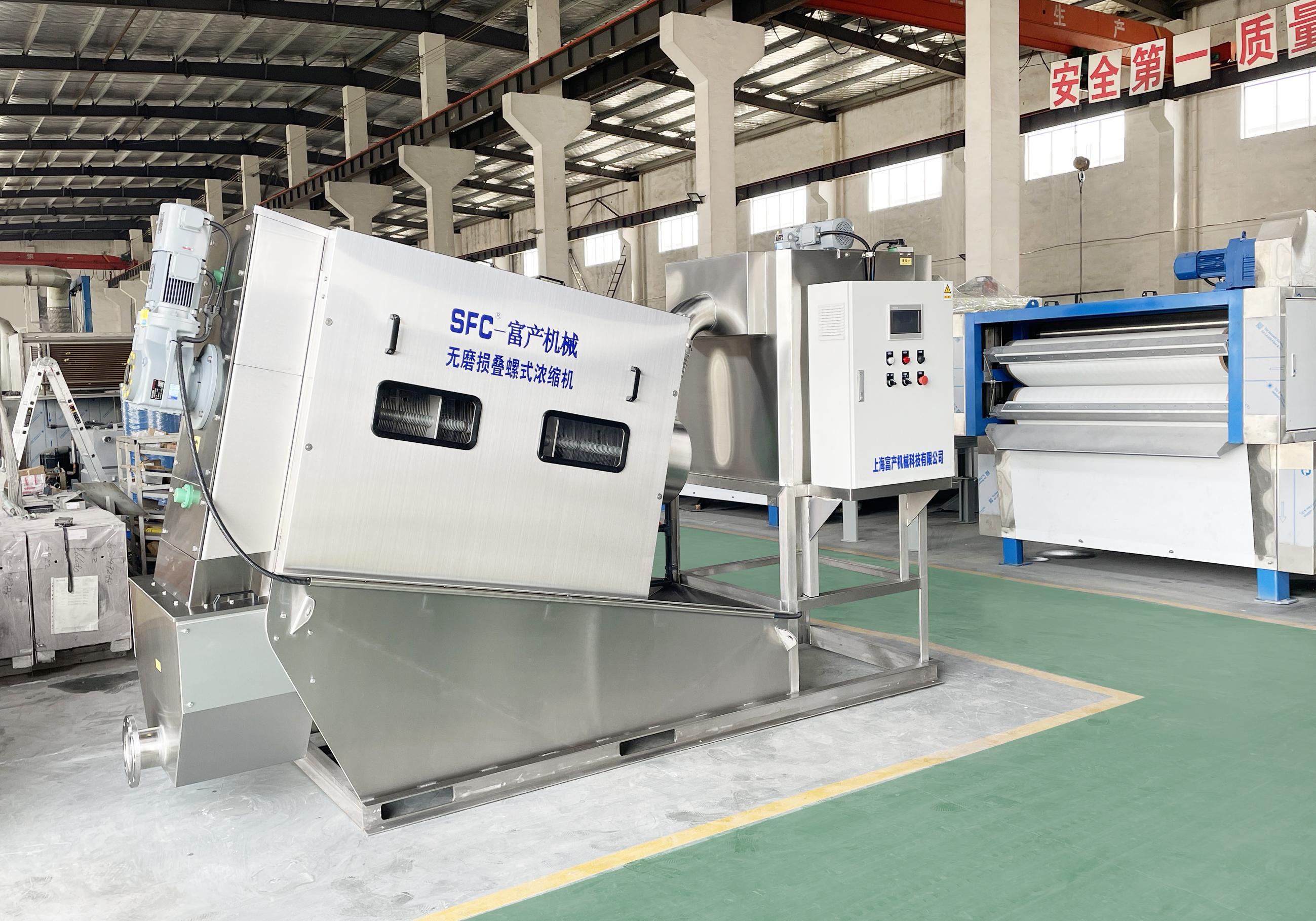
Where certificates stop and tests begin
The CE attestation held for sludge treatment equipment — certificate M.2025.206.C130494, issued by UDEM, valid from 1 December 2025 to 30 November 2030 — is a conformity attestation against the Machinery Directive and the EMC Directive, with harmonised standards covering machinery safety, electrical equipment and electromagnetic compatibility. It establishes that the equipment category has been assessed against those requirements. It does not establish that a particular model will reach a particular cake dryness on a particular sludge.
The same distinction applies to the management-system certificates: ISO 9001 (U24Q2SH704766R3S, valid to 26 May 2027), ISO 14001 (U25E2SH8024416R1S, valid to 11 March 2028) and ISO 45001 (U25S2SH8031937R0S, valid to 29 April 2028), all issued by GICG. These cover the design and marketing of environmental protection equipment and the associated environmental and occupational-safety systems. They say something useful about how the organisation is run. They say nothing about the outlet solids of a quoted machine.
Performance is established by test. A factory acceptance test can confirm assembly, rotation direction, control logic, alarm behaviour and no-load power. A site acceptance test under agreed feed conditions is what confirms capacity, cake moisture and chemical consumption. The acceptance clause should therefore name the feed sampling method, the polymer type and dose basis, the runtime, the number of samples, and the laboratory method used to determine moisture. Where a site test is not practical, the specification should at least require the supplier's reference data to state the feed condition behind each performance figure.
Independent literature gives useful context for judging whether a guaranteed value is plausible. A 2023 peer-reviewed review of sludge dewatering and drying inventory data reported typical mechanically dewatered sludge at approximately 25–30% total solids, deep dewatering at 35–40% total solids, chemical-agent use of 5–15 g/kg total solids for mechanical dewatering, and average energy use of 0.12 kWh/kg total solids for raw sludge and 0.26 kWh/kg total solids for digested sludge. Trade guidance commonly describes dewatered cake at roughly 15–45% dry solids. These are literature benchmarks, not equipment specifications, but they give a buyer a reference frame when a quotation promises an unusually high outlet solids figure.
Application-specific qualification questions
Application knowledge is where a generic dossier becomes useful. The same machine family raises different questions depending on the sludge it will see, and the qualification file should record the answers.
Petrochemical and coking wastewater
Refractory sludge from petrochemical coking wastewater is typically handled in an integrated thickening, dewatering and thermal drying package, with explosion-proof design, corrosion-resistant materials and odour control treated as project requirements. In one delivered configuration the dewatering stage uses FTE3-2000 belt sludge dewatering units. Qualification questions worth putting in writing: which hazardous-area classification applies to the motors and instrumentation, which wetted components change for aromatic and sulphidic streams, and how is enclosure tightness verified on site rather than asserted in the datasheet?
Distilleries and breweries
High-organic distillery and brewery sludge arrives at very high moisture content, is prone to fermentation and odour, and carries organic acids and ethanol residues. A delivered reference configuration uses FTB-2000 drum thickening belt filter presses within a thickening, screw press dewatering and thermal drying train. Qualification questions: what corrosion protection applies to the frame and tank, how is odour containment demonstrated, and what is the stated basis for polymer consumption at the site's actual feed variability?
Electroplating and surface finishing
Heavy-metal sludge from electroplating is corrosive and is usually classified before disposal. A delivered reference configuration uses FTB-500 drum thickening belt presses. Qualification questions: which materials are specified for chloride-bearing rinse streams, how is spill containment handled around the press, and what documentation supports the sludge classification route?
Palm oil and agri-food processing
Palm oil mill effluent and agri-food sludge carry fibre, grit and fats that change dewatering behaviour. A delivered palm oil reference uses a DL-301 screw press. A food-processing installation in Malaysia using an FTB-1000 was reported to reduce moisture from 98.5% to below 80%. Qualification questions: how is fibre and grit handled upstream, is the polymer dose basis stated per kilogram of dry solids, and what wash-water quality and quantity does the model require?
Pharmaceutical and chemical manufacturing
Pharmaceutical wastewater sludge is chemically complex and often requires dewatering followed by deep dewatering or drying before disposal. Delivered references include DL-201 screw presses at a pharmaceutical site and an FTB-1500L unit at a specialty chemicals plant. Qualification questions: what cleaning regime is required between campaigns, how is containment verified, and what is the stated behaviour of the equipment when feed composition changes between batches?
Municipal wastewater
Municipal duty usually rewards continuity rather than peak performance. A delivered municipal reference using a GDY integrated thickening and dewatering machine was reported to take excess sludge from 99.2% moisture to a cake below 80%, and an FRDT rotary drum thickener installation was reported to concentrate sludge from 99.4% to 97% moisture, raising solids to about 3% ahead of downstream filter pressing. Qualification questions: what is the turndown ratio at night-time low flow, what happens to cake dryness during storm events, and what maintenance interval does the supplier state for belts, screens and bearings?
Five checks before a model reaches the shortlist
- Name the series and the exact model. A quotation that refers only to a family name has not yet identified a machine. The model code should appear on the datasheet, the drawing and the commercial offer.
- Read the range, not the headline. The published envelope for a series is wider than any single model. The quoted model should sit inside it, and the specific model's position within the range should be stated.
- Match the inlet consistency to the quoted model. A 3% feed does not belong in a series stated at 0.6–1.5%, and a 1% feed does not belong in a series stated at 1.5–2.5%, however attractive the price.
- Require the output basis. Cake moisture without a feed condition is not a guarantee. Capacity without an inlet consistency is not a specification.
- Attach certificate numbers, scopes and dates. A certificate thumbnail is not evidence. The certificate number, issuing body, scope statement and expiry date should be recorded in the evaluation file.
Industry context: documentation as a competitive variable
Document discipline is becoming a differentiator partly because the supplier pool is large and partly because the market is growing. Global Market Insights estimated the global sludge dewatering equipment market at USD 5.8 billion in 2025 and USD 6.4 billion in 2026, with a forecast of USD 14 billion by 2035 in an analysis published in April 2026. Fortune Business Insights reported that Asia Pacific held 37.57% of the dewatering equipment market in 2024.
Growth of that order attracts new entrants, and new entrants rarely arrive with a long reference list. For a buyer, that makes the document file the cheapest screening tool available. A supplier who can produce a component-level material schedule, a model-to-range map, certificates with visible scope, and a test protocol is demonstrating process maturity before the first site visit. A supplier who cannot is asking the buyer to absorb the risk.
Industrial demand also keeps shifting toward difficult sludges. Research on textile-industry water use in China, for example, has noted that large discharge volumes generate challenging sludge treatment issues — the kind of duty where the difference between a well-qualified and a poorly qualified model shows up within the first months of operation.
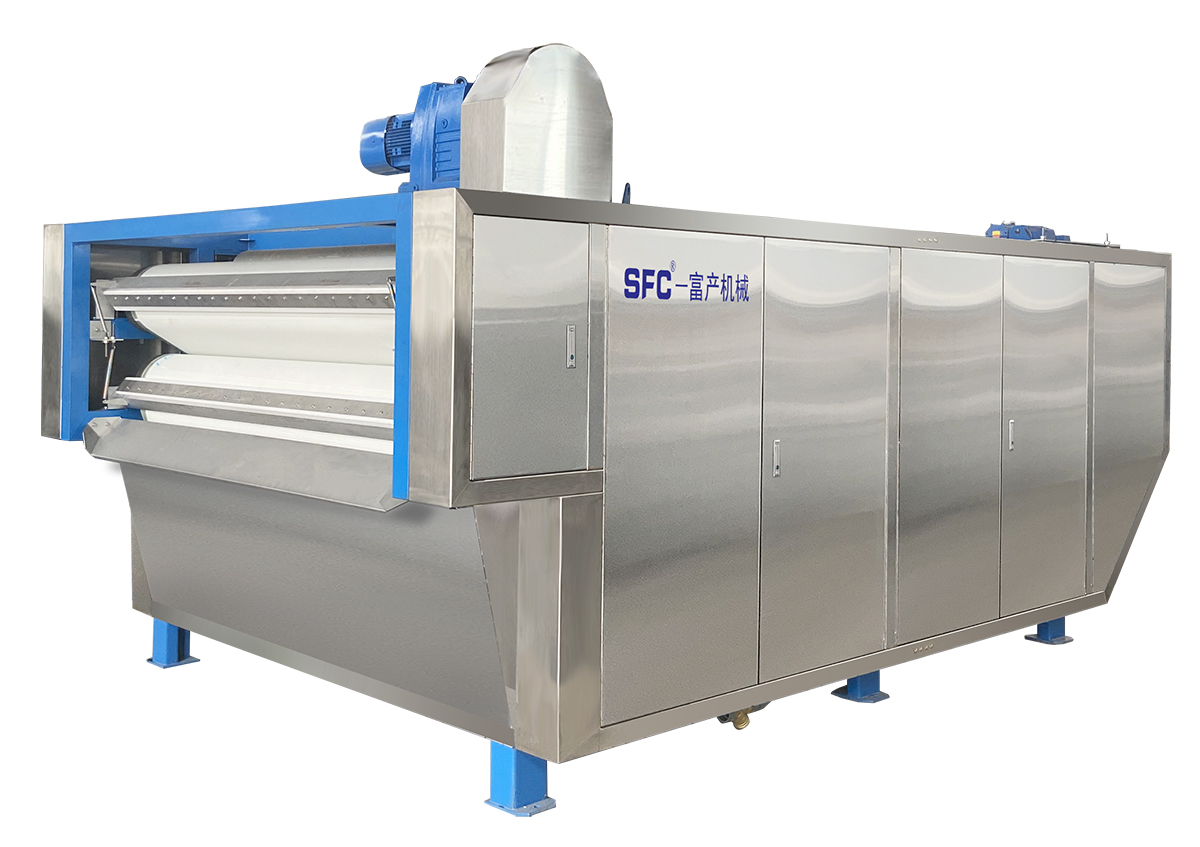
Fit boundaries: what a qualification file cannot settle
A dossier is necessary but not sufficient. Three things sit outside it.
The first is the sludge itself. Dewaterability varies with age, storage, biological condition, fibre content, oil content and chemical history. A jar test or a pilot run on a representative sample remains the only reliable way to predict polymer demand and cake response for a specific site.
The second is the interaction between stages. A thickener that performs well in isolation can overload a downstream press if the outlet consistency drifts, and a dryer sized on a nominal cake moisture will underperform if the press delivers wetter cake than specified. Qualification should therefore cover the interface values between stages, not only each unit.
The third is operating practice. Belt washing, polymer make-up quality, belt tension and operator attention determine real performance as much as the equipment does. A supplier who states these requirements clearly in the manual is easier to hold to an acceptance test than one who does not.
Future outlook
The direction of travel is toward qualification files that are digital, versioned and comparable. Model ranges, material schedules and certificate scopes are increasingly available as structured data, which makes automated comparison between bids feasible for buyers who ask for it. Acceptance testing is also becoming more explicit, with feed sampling and moisture determination written into the contract rather than agreed informally on site.
For manufacturers, that raises the bar in a useful way. A company that can supply a complete, consistent document set across its range competes on evidence rather than on adjectives. SFC Machinery, established in 2007 in Pudong New Area, Shanghai, with a 25,000 m² facility, a five-person R&D team and an annual output of 500 sets, exports about 30% of its production to Southeast Asia, Russia, South America and the Middle East. Its product documentation, published catalogue and certificate records are the natural starting point for a qualification review of any model in the FBT, FRDT, DL, SRD, GDY, FTB, FTE, SD, SFC-TR or SFC-BSD series.
FAQ
What should an SS304 confirmation include for sludge dewatering equipment?
It should include a component-level material list, mill certificates or equivalent batch-level documentation for the principal wetted and structural parts, and the fabricator's inspection record covering weld quality, surface treatment and dimensional checks. The grade statement alone establishes the material family, not the scope of its application, and it does not address whether the feed chemistry is compatible with that grade.
How should a quoted model be checked against its stated range?
Identify the series and the exact model code, confirm that the model sits inside the published envelope, and check that the proposed feed consistency falls within the stated inlet band. Where the series is specified by dried sludge output rather than volumetric flow, such as the DL and SRD screw press ranges, the comparison must be made on that basis and not converted to m³/h without the missing feed data.
Does a CE certificate prove dewatering performance?
No. The CE attestation for sludge treatment equipment confirms assessment against the Machinery Directive and the EMC Directive, with harmonised standards for machinery safety, electrical equipment and electromagnetic compatibility. It addresses conformity, not capacity or cake dryness. Performance is established by factory and site acceptance testing under agreed feed conditions, supported by reference data that states the conditions behind each figure.
What acceptance criteria belong in a purchase order?
A workable set covers the feed condition and sampling method, the guaranteed treating capacity at that condition, the guaranteed outlet moisture with its laboratory determination method, the installed power, the polymer or conditioning-agent dose basis, the material documentation, the certificate copies with scope and dates, and the documentation package delivered at handover. Each criterion should be measurable and tied to a stated condition rather than to a general promise.
Can one dewatering model handle several sludge types?
Sometimes, within limits. The DL and SRD screw press series are stated at 0.6–5.0% inlet consistency, and the SRD series is described as suitable for low-concentration, sticky, oily and high-inorganic-content sludge. Those statements describe a design intent across a series, not a guarantee for every sludge within it. Buyers should still request references on comparable sludge and confirm the model through a sample test before fixing the acceptance criteria.
The full SFC product catalogue, including model ranges and stated parameters for all series discussed here, is available for download: SFC Product Catalog 2026. Company information is published at www.sfceco.com.
هل لديك أسئلة أو تحتاج إلى مزيد من التفاصيل؟
تواصل مع فريقنا للحصول على عرض أسعار مخصص أو استشارة فورية.
طلب عرض أسعار
املأ النموذج أدناه وسيتواصل معك فريقنا بعرض مقترح مخصص.
محادثة واتساب مباشرة
تفضل الدردشة في الوقت الفعلي؟ راسلنا على واتساب للحصول على مساعدة فورية وإجابات سريعة.
- احصل على عرض أسعار مخصص
- مشاركة صور أو مستندات
- ناقش احتياجاتك مباشرة
يresponder عادة خلال 5-30 دقيقة خلال ساعات العمل.