
Sludge Dewatering Equipment Tender Compliance: SS304, Models & Acceptance Criteria
A sludge dewatering equipment tender is rarely decided by the number of certificates attached. It is decided by whether each technical claim carries a value, a unit, a stated basis and a testable acceptance method. This industry reference sets out how SS304 construction, the FBT, FRDT, DL, SRD, GDY, FTB, FTE, SD, SFC-TR and SFC-BSD model ranges, and process data such as inlet consistency and treating capacity can be written into a compliance file that an evaluator can actually verify.
Shanghai Fuchan Machinery Technology Co., Ltd. (SFC Machinery) is a Shanghai-based manufacturer established in 2007 in Pudong New Area, producing sludge thickening equipment, sludge dewatering equipment, deep sludge dewatering equipment, sludge drying equipment and polymer preparation systems. Its declared certificate set, published model envelopes and reference duties make a workable example of how equipment data is translated into tender language — and of where that language usually breaks down.
The gap between a qualification claim and a compliance statement
A qualification claim asserts capability. A compliance statement gives the evaluator something to check. In this equipment category, three failure patterns account for most technical clarifications requested after bid opening.
- Undefined units. A thickener rated at 30 m³/h and a belt press rated at 450 kg/h dried sludge describe different quantities. Placing them in a single "capacity" column produces a comparison that cannot be defended at evaluation.
- Material claims without component scope. "SS304 construction" does not state whether the rings, screw shaft, volute filter, drum screen or belts are included, nor which parts fall outside the declaration.
- Acceptance criteria without a protocol. A guaranteed cake moisture value is not verifiable unless feed consistency, polymer dose, sampling point, sampling frequency and test duration are all defined in the same clause.
Each of these is fixable at bid stage. None of them is fixable at commissioning, when the equipment is already installed.
The five-part structure of a defensible compliance file
Evaluators in municipal and industrial sludge projects generally look for the same five blocks, in the same order. A submission that answers them in sequence removes the need for clarification rounds.
| Section | What must be stated | Why it is asked |
|---|---|---|
| 1. Basis of design | Feed sludge type, inlet consistency range, operating hours, outlet target with its unit | Every capacity figure is conditional on these four parameters |
| 2. Material declaration | Stainless grade, component coverage list, material certificate reference | "SS304" alone does not identify which wetted parts are covered |
| 3. Model selection table | Family, model, hydraulic capacity, dried sludge output, outlet basis, installed power | Enables like-for-like comparison across equipment classes |
| 4. Performance guarantee and acceptance protocol | Metric, basis, tolerance, sampling method, test duration | Converts a claim into a contractual obligation |
| 5. Certification evidence | Certificate number, issuer, standard, validity period, declared scope | Allows independent verification with the issuing body |
Schedule evidence belongs in the same file: for SFC, monthly production capacity is stated at 40 sets, standard lead time at 30–60 days, and minimum order quantity at one unit. Where a project programme is tighter than that window, the gap should be raised before award rather than after.
SS304: what the declaration should actually say
Across the ten families in SFC's published range — FBT, FRDT, DL, SRD, GDY, FTB, FTE, SD, SFC-TR and SFC-BSD — SS304 is the declared material. That single word carries little evaluative weight until it is broken into three parts: which components, evidenced how, and what is excluded.
Component scope
For the DL Series multi-disc screw press, the declared structure is fixed rings, moving rings, screw shaft and volute filter. That is the level of detail an evaluator can map against a material certificate, because the number of parts is finite and named. Where a family is not published to the same component resolution, the tender clause should require the supplier to supply that list rather than let the bid assume uniform coverage.
Clause wording that survives technical review
A robust clause reads approximately as follows: all sludge-contact components of the proposed unit shall be SS304 stainless steel; the supplier shall declare the component list, provide a material certificate reference for each listed component, and list separately any component not manufactured in SS304 together with its actual material and surface treatment.
Written this way, the material claim becomes auditable. Written as "SS304 body", it becomes a clarification request.
Model ranges are a selection envelope, not a performance promise
The published envelopes below show what a compliant model selection table looks like when it is built from family data rather than from headline capacity claims. Every family declares SS304 as its material.
| Family | Equipment type | Model range | Inlet consistency | Capacity / output basis | Outlet basis | Power |
|---|---|---|---|---|---|---|
| FBT | Gravity belt sludge thickener | FBT-1000 to FBT-3000 | S.S. 0.6–1.5% | 12–95 m³/h; 72–900 kg/h dried sludge | Outlet consistency 2.5–8%; solids capture 98% | 0.55–1.5 kW |
| FRDT | Enclosed rotary drum sludge thickener | FRDT-20 to FRDT-100 | S.S. 0.6–1.5% | 7.5–100 m³/h; 45–1140 kg/h dried sludge | Outlet consistency 2.5–8%; capture 95%; drum ~10 rpm | 0.75–1.5 kW |
| DL | Multi-disc screw press | DL-101 to DL-404 | S.S. 0.6–5.0% | 1.5–900 kg/h dried sludge | Cake water content 75–85% | Screw 0.18–1.5 kW; conditioning 0.18–1.1 kW |
| SRD | Wear-free multi-disc screw press | SRD-301 to SRD-404 | S.S. 0.6–5.0% | 25–900 kg/h dried sludge | Cake water content 75–85% | 0.55–1.1 kW |
| GDY | Belt thickening and dewatering | GDY-1000 to GDY-3000 | S.S. 0.6–1.5% | 15–90 m³/h; 90–1050 kg/h | Cake water content 75–80% | 1.1–4.0 kW |
| FTB | Rotary drum thickener plus belt press | FTB-500 to FTB-2000 | S.S. 1.5–2.5% | 3.0–30 m³/h; 45–450 kg/h | Cake water content 75–85% | 0.37–1.1 kW |
| FTE | Rotary drum thickening and dewatering | FTE-1000 to FTE-3000 / L | S.S. 0.6–1.5% | 12–90 m³/h; 90–975 kg/h | Cake water content 75–85% | 0.55–4.0 kW |
| SD | High-pressure belt deep dewatering | SFC-SD05 to SFC-SD25 | S.S. 15–20% | 0.3–5.0 t/h at 65–75% water content; 0.35–6.1 t/h at 60–70% | Dried sludge 60–760 kg/h and 70–920 kg/h respectively | Drive 0.55–3.0 kW; mixer 2.2–5.5 kW |
| SFC-TR | Reciprocating circulation dryer | SFC-TR1000 to SFC-TR9000 | Batch 1000–9000 L | Water extraction 21–360 kg/h | Volume reduction up to 70% | 15–145 kW; 0.4–0.55 kWh/kg water |
| SFC-BSD | Belt sludge dryer | BSD1000 to BSD30000 | S.S. 15–25% or 25–35% | 0.8–57 t/h and 1–90 t/h respectively | Final water content 10–50%; fully enclosed, modular | 23–506 kW |
Note the unit mismatch that runs through this table. FBT, FRDT, GDY, FTB and FTE declare hydraulic throughput in m³/h; DL and SRD declare dried sludge in kg/h; SD declares t/h feed at a stated cake water content; SFC-TR declares batch volume and water-evaporation rate; SFC-BSD declares feed tonnage against a final moisture target. A tender that normalises these into one column will compare incompatible quantities.
Inlet consistency is the first filter, not the last
The declared feed bands differ by family and by design intent: 1.5–2.5% for FTB; 0.6–1.5% for FBT, FRDT, GDY and FTE; 0.6–5.0% for DL and SRD; 15–20% for SD as a secondary stage; 15–25% or 25–35% for SFC-BSD. Where a project's actual feed sits outside the declared band, the correct action is to change family or add a process stage — not to accept a derated promise inside the same model number.
Acceptance criteria: define the metric, the basis and the tolerance
An acceptance criterion has three parts and fails if any one is missing. The table below shows how the published data maps onto that structure.
| Acceptance item | Value to be guaranteed | Basis that must be written alongside | How it is verified |
|---|---|---|---|
| Cake dryness | Water content 75–85% (DL, SRD, FTB, FTE); 75–80% (GDY); final water content 10–50% (SFC-BSD) | Feed inlet consistency, sludge type, polymer type and dose, operating hours | Timed cake sampling across a defined continuous run, with moisture determination method named |
| Thickener outlet | Outlet consistency 2.5–8% (FBT, FRDT) | Inlet consistency 0.6–1.5%, polymer dose, belt speed 3–18 m/min or drum speed ~10 rpm | Outlet and feed sampling with solids analysis |
| Solids capture | 98% (FBT); 95% (FRDT) | Mass balance period and filtrate sampling point | Feed TSS against filtrate TSS |
| Chemical consumption | Literature benchmark 5–15 g per kg TS for mechanical dewatering | Polymer type, dilution, dosing point, sludge characteristics | Recorded consumption divided by dry solids processed |
| Energy | 0.12 kWh/kg TS raw sludge; 0.26 kWh/kg TS digested sludge (mechanical); about 3.8 kWh/kg TS (thermal drying); 0.4–0.55 kWh/kg water (SFC-TR) | System boundary: motors only, or whole station including dosing, conveyors and ventilation | Metered kWh over the test period, normalised per kg TS or per kg water evaporated |
| Hydraulic capacity | Family envelopes as listed above | Inlet consistency and continuous operating hours | Flow metering during a sustained run at design feed |
Two normalisation rules do most of the work here. First, express dewatering performance per kg of total solids, not per unit of wet sludge, because wet-sludge figures shift with every percentage point of feed consistency. Second, state the energy boundary explicitly: the literature values of roughly 0.12 and 0.26 kWh/kg TS for raw and digested sludge cover mechanical dewatering, while thermal drying is reported at around 3.8 kWh/kg TS — a different process class that cannot be compared without a declared boundary.
Independent benchmarks are useful as a sanity check on a guarantee. A peer-reviewed inventory review reports approximately 25–30% total solids for mechanically dewatered sludge and 35–40% total solids for deep dewatering, while a trade definition places dewatered cake broadly in the 15–45% dry solids range. These are aggregated values from heterogeneous datasets, not equipment specifications. If a bid promises the top of a deep-dewatering range from a single-stage machine with no pilot test and no stated feed condition, the missing element is the basis, not the ambition.
Documenting special duty conditions in the submission
Most technical clarifications come from four duty conditions that cannot be expressed in a single capacity number. Each has a distinct documentation pattern.
Low-solids feed and enclosed installation
For sludge entering at 0.6–1.5% solids, the FBT belt thickener and FRDT rotary drum thickener are the declared options. The FRDT is specified as an enclosed drum unit with a 30–80 mesh filter opening, drum speed around 10 rpm, outlet consistency of 2.5–8% and a declared solids capture rate of 95%. For a tender, the enclosure statement should be tied to the site constraint it addresses — odour control, indoor installation or hygiene — rather than left as a general feature.
Sticky, oily and high-inorganic-content sludge
The SRD Series is declared suitable for low-concentration, sticky, oily and high-inorganic-content sludge, with an inlet consistency band of 0.6–5.0%, dried sludge output of 25–900 kg/h, cake water content of 75–85%, and screw specifications from Ø270×1 to Ø370×4 with multi-motor configurations by model. In a compliance file this should be presented as a fit statement supported by a sludge sample test, not as a wear guarantee.
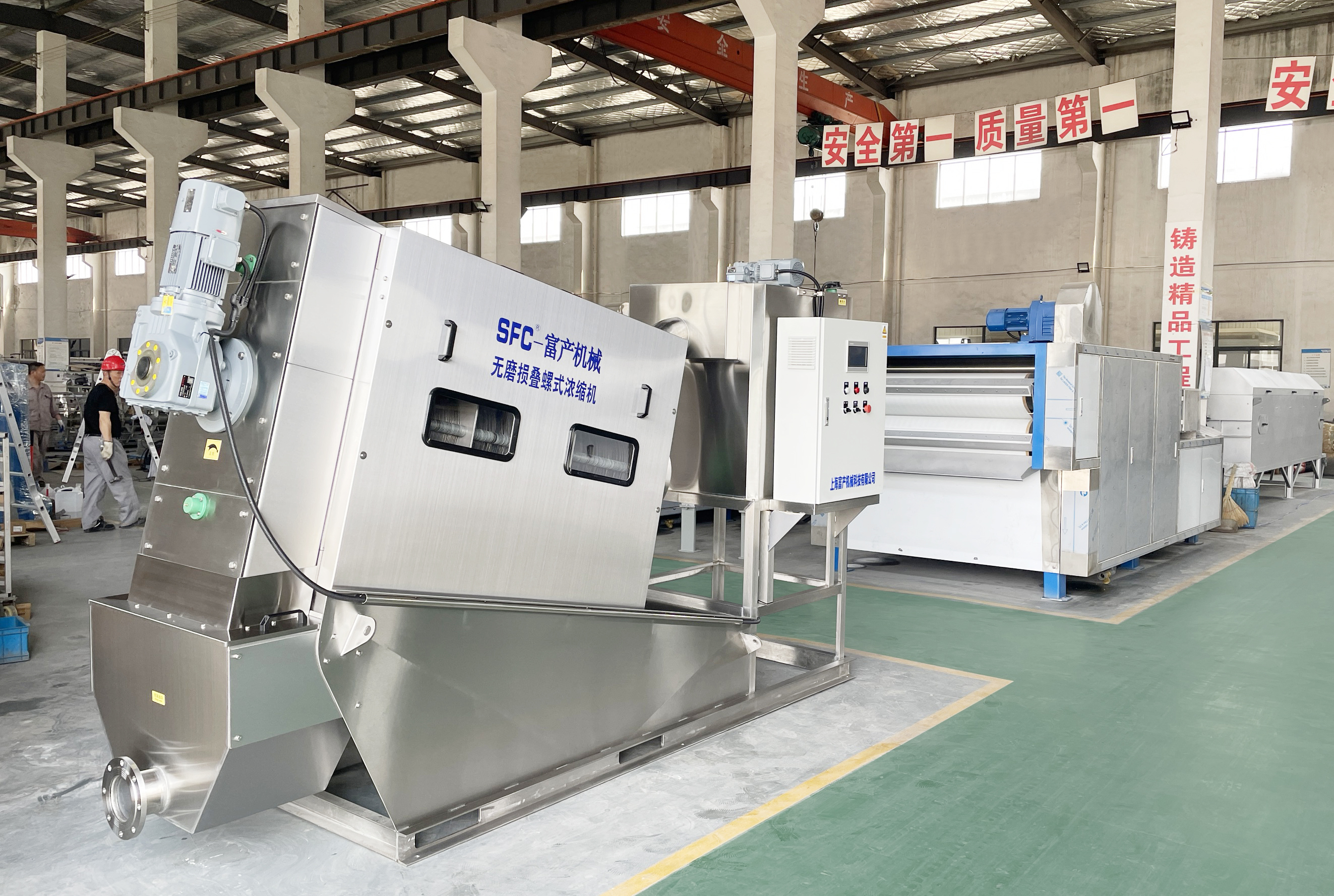
Wear-free multi-disc screw press (SRD Series) — the family is declared for low-concentration, sticky, oily and high-inorganic-content sludge duties.
Integrated thickening and dewatering
Where a project wants one machine instead of two stages, three families declare combined duty: GDY with 0.6–1.5% inlet and 75–80% cake water content; FTB with 1.5–2.5% inlet and 75–85% cake water content; and FTE with 0.6–1.5% inlet and 75–85% cake water content, including an L variant at each belt width. The tender should record which stage the machine replaces, because the outlet values of an integrated unit are not interchangeable with those of a standalone thickener.
Secondary deep dewatering and drying
When the target moisture sits below what primary dewatering delivers, the SD Series is specified as a second stage: inlet consistency 15–20%, treating capacity of 0.3–5.0 t/h at 65–75% water content and 0.35–6.1 t/h at 60–70%, with a sludge mixer of 2.2–5.5 kW, distribution spiral of 0.25–1.5 kW and crushing screw of 0.37–0.75 kW. Drying follows as a third stage: SFC-TR in batch volumes of 1000–9000 L with 21–360 kg/h water extraction and up to 70% volume reduction, or SFC-BSD with a fully enclosed, modular belt design and a final water content of 10–50%.
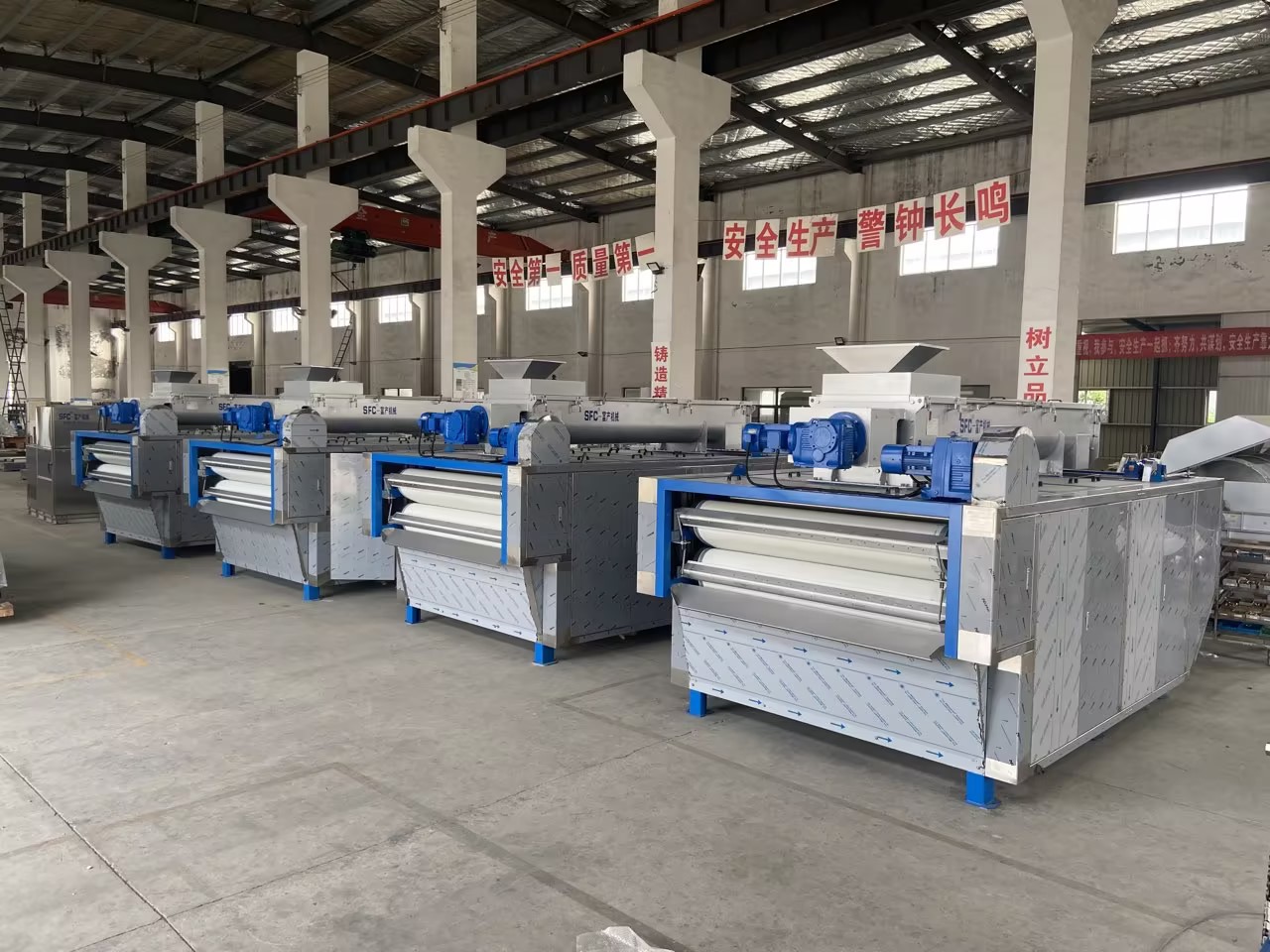
SFC-SD high-pressure belt deep dewatering system — documented as a secondary stage with its own inlet consistency band and power list, separately from primary dewatering.
Reference duties that can be cited in a submission
Reference projects strengthen a bid only when the feed and outlet conditions are published with them. The following installations are documented in that form and show how a reference entry should be written.
| Reference duty | Equipment | Documented result | What it demonstrates |
|---|---|---|---|
| Municipal wastewater treatment plant | FRDT rotary drum thickener, 8 units | Feed at 99.4% moisture to 97% moisture, solids raised to 3% | Pre-concentration ahead of a plate-and-frame press; enclosed design |
| Municipal sewage treatment plant | GDY belt thickening and dewatering, 2 units | 99.2% to 80% moisture content | Integrated thickening and dewatering in continuous operation |
| Food processing, Malaysia | FTB-1000 | 98.5% to below 80% moisture content | Rotary drum thickening plus belt pressing on food-processing sludge |
| Vegetable oil processing | DL screw press, 1 unit | 97% to 77% moisture content | Screw press duty on oily sludge |
| Pharmaceutical wastewater | DL screw press, 1 unit | 99% to below 85% moisture content | Biological sludge volume reduction |
| Specialty chemicals | FTB-1500L, 1 unit | 99% to well below 80% moisture content | Chemical sludge with L-variant belt width |
| Precision component manufacturing | BSD-2000 belt dryer, 1 unit | 85% to below 30% moisture content | Drying stage after screw press dewatering |
| Automotive parts manufacturing | SFC-TR dryer, 2 units | 75% to below 25% moisture content; over 700 kg water removed per tonne; volume reduction above 70% | Batch drying with heat pump dehumidification |
Each reference reflects its own feed sludge, polymer programme and operating regime. In a tender file it should be presented as evidence of documented duty — not as a transferable guarantee for a different site.
Certificate pack and its declared boundaries
Certification evidence is verifiable in a way that performance claims are not, provided the number, issuer, standard and validity period are all quoted together.
| Certificate | Number | Issuer | Standard / directive | Validity |
|---|---|---|---|---|
| CE — Machinery Directive and EMC Directive attestation of conformity, scope: sludge treatment equipment | M.2025.206.C130494 | UDEM | 2006/42/EC; 2014/30/EU; EN ISO 12100:2010; EN 60204-1:2018+A1:2025; EN IEC 61000-6-2:2019; EN IEC 61000-6-4:2019; EN IEC 61000-3-2:2019+A2:2024; EN 61000-3-3:2013+A2:2021 | 2025-12-01 to 2030-11-30 |
| ISO 9001 | U24Q2SH704766R3S | GICG | GB/T19001-2016 / ISO 9001:2015 | 2025-03-12 to 2027-05-26 |
| ISO 14001 | U25E2SH8024416R1S | GICG | GB/T24001-2016 / ISO 14001:2015 | 2025-03-12 to 2028-03-11 |
| ISO 45001 | U25S2SH8031937R0S | GICG | GB/T45001-2020 / ISO 45001:2018 | 2025-04-30 to 2028-04-29 |
The declared scopes deserve the same attention as the numbers. The ISO 9001 scope is stated as design and marketing of environmental protection equipment covering sludge treatment equipment, sludge drying equipment and flocculant preparation systems; ISO 14001 uses comparable scope wording; ISO 45001 covers the same equipment categories. Where a tender requires manufacturing-scope certification or a factory audit, that requirement should be checked against the scope text rather than assumed from the certificate title.
What a compliance file cannot prove
- Family envelopes are not model guarantees. The published inlet consistency, capacity and outlet bands describe a range of models; the specific unit still requires sludge-specific selection and, where the duty is difficult, a sample test.
- Aggregated benchmarks are not specifications. The reported 25–30% TS mechanical and 35–40% TS deep-dewatering values come from a peer-reviewed inventory review of heterogeneous datasets — 55 dewatering datasets and 21 drying datasets — and should not be copied as guaranteed outlet values.
- Certificate scope is narrower than "certified company". The CE attestation covers machinery and electromagnetic conformity for sludge treatment equipment; it does not certify treatment performance, cake dryness or operating cost.
- Reference projects carry their own conditions. A documented 99.2% to 80% result at one plant depends on that plant's feed, polymer and operating regime.
- Schedule data has limits. A stated monthly capacity of 40 sets and a lead time of 30–60 days may not fit compressed project programmes, and this should be tested at bid stage.
- Component-level SS304 evidence must be requested. Where a family is not published at component resolution, the assumption of full SS304 coverage is not verifiable from the datasheet alone.
Market context behind the tightening of tender requirements
Procurement language has become more specific as the category has grown. The global sludge dewatering equipment market was estimated at USD 6.4 billion in 2026 and is projected to reach USD 14 billion by 2035, according to Global Market Insights, while Fortune Business Insights reports Asia Pacific holding a 37.57% share of the global dewatering equipment market in 2024. Larger, more concentrated supply tends to shift evaluation from "who can supply" to "who can document".
The evidence base itself is fragmented. The same peer-reviewed review that supplies the outlet-solids and energy benchmarks notes how few consistent plant-level datasets exist across dewatering and drying technologies, which is why buyers increasingly write their own test protocols instead of referencing published performance tables. Measurement practice is also moving: a 2025 peer-reviewed study proposed an image-based method for evaluating sludge dewaterability using smartphone-captured flocculation images, a signal that acceptance testing may migrate from periodic laboratory analysis toward in-process characterisation.
Outlook
Three changes are likely to shape tender documents over the next procurement cycles. Normalisation per kg of total solids will become standard in performance schedules, because wet-sludge figures cannot be compared across sites. Declared system boundaries — motors only versus whole station — will be requested as a matter of course alongside energy guarantees. And certificate scope strings, rather than certificate logos, will be read line by line. Suppliers who can supply model-level envelopes, component-level material declarations and reference duties with stated feed conditions will be simpler to shortlist, and simpler to hold to an acceptance test later.
FAQ
It should state the stainless grade, the component coverage, and a material certificate reference for each listed component. SFC declares SS304 as the material across its FBT, FRDT, DL, SRD, GDY, FTB, FTE, SD, SFC-TR and SFC-BSD families, and for the DL Series the declared structure is fixed rings, moving rings, screw shaft and volute filter. Any component not manufactured in SS304 should be declared separately with its own material.
Only after normalising the basis. The FBT and FRDT thickeners and the GDY, FTB and FTE belt families declare hydraulic throughput in m³/h; the DL and SRD screw presses declare dried sludge in kg/h; the SD Series declares t/h feed at a stated cake water content; the SFC-TR dryer declares batch volume and water extraction in kg/h; the SFC-BSD dryer declares feed tonnage against a final moisture target. The inlet consistency bands also differ — 1.5–2.5% for FTB, 0.6–1.5% for FBT, FRDT, GDY and FTE, 0.6–5.0% for DL and SRD, 15–20% for SD, and 15–25% or 25–35% for SFC-BSD.
Start from the declared family values: cake water content of 75–85% for DL, SRD, FTB and FTE, 75–80% for GDY, thickener outlet consistency of 2.5–8% for FBT and FRDT, and final water content of 10–50% for SFC-BSD. Cross-check against literature ranges of approximately 25–30% total solids for mechanical dewatering, 35–40% for deep dewatering, and 15–45% dry solids for dewatered cake in general. Any guarantee should carry the feed consistency, polymer programme and sampling method in the same clause.
Specify the metric, the normalising unit and the system boundary. Literature benchmarks for mechanical dewatering are around 5–15 g of chemical agent per kg of total solids and roughly 0.12 kWh/kg TS for raw sludge and 0.26 kWh/kg TS for digested sludge; thermal drying is reported separately at about 3.8 kWh/kg TS. The SFC-TR dryer declares unit power consumption of 0.4–0.55 kWh/kg water, which is a different basis from kWh/kg TS and must be stated as such.
The CE attestation of conformity for machinery and EMC, number M.2025.206.C130494 issued by UDEM, valid from 2025-12-01 to 2030-11-30 and referencing 2006/42/EC and 2014/30/EU together with the listed EN standards; ISO 9001 certificate U24Q2SH704766R3S issued by GICG, valid to 2027-05-26; ISO 14001 certificate U25E2SH8024416R1S, valid to 2028-03-11; and ISO 45001 certificate U25S2SH8031937R0S, valid to 2028-04-29. The declared scope wording should be quoted with each certificate.
By matching the condition to a declared family and stating the band. Low-solids enclosed duty at 0.6–1.5% inlet is covered by the FBT and FRDT thickeners, with the FRDT declared as an enclosed drum unit at 30–80 mesh, around 10 rpm and 95% solids capture. Sticky, oily and high-inorganic sludge is addressed by the SRD Series at 0.6–5.0% inlet, 25–900 kg/h and screw specifications from Ø270×1 to Ø370×4. Integrated duty is covered by GDY, FTB and FTE, and secondary deep dewatering by the SD Series at 15–20% inlet.
Tender documents requiring a full model and parameter list can reference the SFC 2026 product catalog, which is publicly available for download: https://cdn.socialarks.com/sbsp/24918/common/2026/0622/Product%20Catalog-SFC-2026.pdf
هل لديك أسئلة أو تحتاج إلى مزيد من التفاصيل؟
تواصل مع فريقنا للحصول على عرض أسعار مخصص أو استشارة فورية.
طلب عرض أسعار
املأ النموذج أدناه وسيتواصل معك فريقنا بعرض مقترح مخصص.
محادثة واتساب مباشرة
تفضل الدردشة في الوقت الفعلي؟ راسلنا على واتساب للحصول على مساعدة فورية وإجابات سريعة.
- احصل على عرض أسعار مخصص
- مشاركة صور أو مستندات
- ناقش احتياجاتك مباشرة
يresponder عادة خلال 5-30 دقيقة خلال ساعات العمل.