
Smart Door Lock Basics: Types, Repairs and Upgrades

If a buyer starts with the question “what is a smart door lock?”, the working answer is straightforward: a smart door lock is an electronic lock that grants or denies access after verifying a digital credential, instead of relying solely on a physical metal key. The credential can be a keypad PIN, fingerprint, face scan, RFID card, a mobile app, or a remote command. Because credentials can be issued, changed, or removed without replacing a cylinder, smart door locks have moved from a residential convenience item to a serious consideration for apartments, hotels, offices, and rental properties.
Commercial research points to continued expansion. Fortune Business Insights projects the global smart door lock market will reach USD 17.75 billion by 2034. Grand View Research estimates that residential use accounted for roughly 46.6% of the global smart lock market in 2025 and that Asia-Pacific is expected to grow at a 24.5% CAGR between 2026 and 2033. Those numbers explain why so many buyers now search for a “smart door lock” not as a single gadget, but as a category that includes access-control software, installation choices, and after-sales service.
This article is written as an industry reference, not as a product launch announcement. It uses Trueway, a modular smart-lock manufacturer based in Zhongshan, Guangdong, as one useful example of how electronic locks are being engineered for lower maintenance and longer service life.
What Makes a Door Lock “Smart”?
A smart door lock is part hardware and part access-control system. The hardware includes an electronic reader, a control board, a motor, and a mechanical locking mechanism. The access-control part handles identity verification. In many designs, the same lock can be operated by several verification methods: a password is verified on the keypad; a fingerprint is verified by a biometric sensor; an RFID credential is verified by a card reader; a face image is verified by a camera module; and a smartphone command is verified by the lock or a connected app server.
Common credential types used in the category
- Password / keypad smart door lock: The user enters a PIN. This is often the simplest electronic option and is widely used for rental turnovers.
- Fingerprint smart door lock: The lock stores fingerprint templates and matches a user on touch. It is popular for homes and offices because no card or key has to be carried.
- Face recognition door lock: The lock uses camera data and face-matching algorithms. It is a hands-free option for residential and executive or high-traffic doors.
- RFID smart door lock: The lock reads a card, fob, or wristband. RFID is the most common choice for hotels, apartments, and staff buildings because cards can be cancelled centrally.
- Wi-Fi / Bluetooth smart door lock: The lock connects to a phone app. Wi-Fi often supports remote unlock; Bluetooth is typically used for local proximity access.
The industry vocabulary varies slightly. An electronic door lock may be a simpler product with only keypad access. A digital smart door lock usually implies password, biometric, or card access. A remote-control smart door lock is a networked device that can receive an unlock command from a phone or access-control system. For this reason, comparing locks by credential type and connection type is more useful than comparing only by the word “smart.”
Why Smart Door Lock Selection Is Not Just a Buying Decision
The biggest shift is not how the door opens. It is how the building manages the people who are allowed to open it.
A traditional keyed lock works well when a key is physical and transferable. But a property owner cannot know how many copies of a key exist. A short-term rental operator cannot remotely change a key between guests. A hotel cannot know which employee used a master card unless there is an audit system. These operational limits create the main incentive to move from a mechanical lock to a “smart” lock.
There is also a second cost that is easy to underestimate: service. A smart door lock is more complex than a mechanical deadbolt. If its reader fails, its motor fails, or a user wants to change the credential type, the door is often out of service until a technician arrives. That cost becomes especially visible to distributors and property operators with large installed bases.
Trueway, the modular smart-lock platform developed by Guangzhou Runfu Biotechnology Co., Ltd, estimates that a conventional lock service call can cost USD 50 to USD 150 per incident when a technician visit is included. Its own architecture is designed around a different repair path: the user removes the front panel and installs a replacement module. The company says this can reduce after-sales costs by up to 80%, because the end user does the swap without removing the lock from the door.
That simple difference explains why “repairability” is becoming a procurement criterion for smart locks, alongside brand and features.
The Modular Solution: One Lock Body, Swappable Panels
Trueway was founded as an export-oriented smart-lock manufacturer in December 2015. Guangzhou Runfu Biotechnology Co., Ltd, which owns and operates the Trueway brand, now runs a 2,500-square-meter facility in Zhongshan, Guangdong Province. The plant has an annual production capacity of 100,000 units, a workforce of more than 50 employees, and an R&D team of five engineers. Approximately 90% of production is exported, with major markets in America, the Middle East, Southeast Asia, and Africa.
Trueway’s core product concept is a permanent lock body plus replaceable front-panel modules. The company describes the system as “key-swappable”: the user inserts a release key into a slot in the module, turns it, removes the existing front panel, and inserts a different module. The mechanical release is covered by a constellation of patents: U.S. Patent No. 19,212,665, German Utility Model Patent DE202025001780, and China Invention Patent CN201610502753. The product line has FCC-ID and CE-RED certifications for distribution into the Americas, Europe, the Middle East, Africa, and Asia.
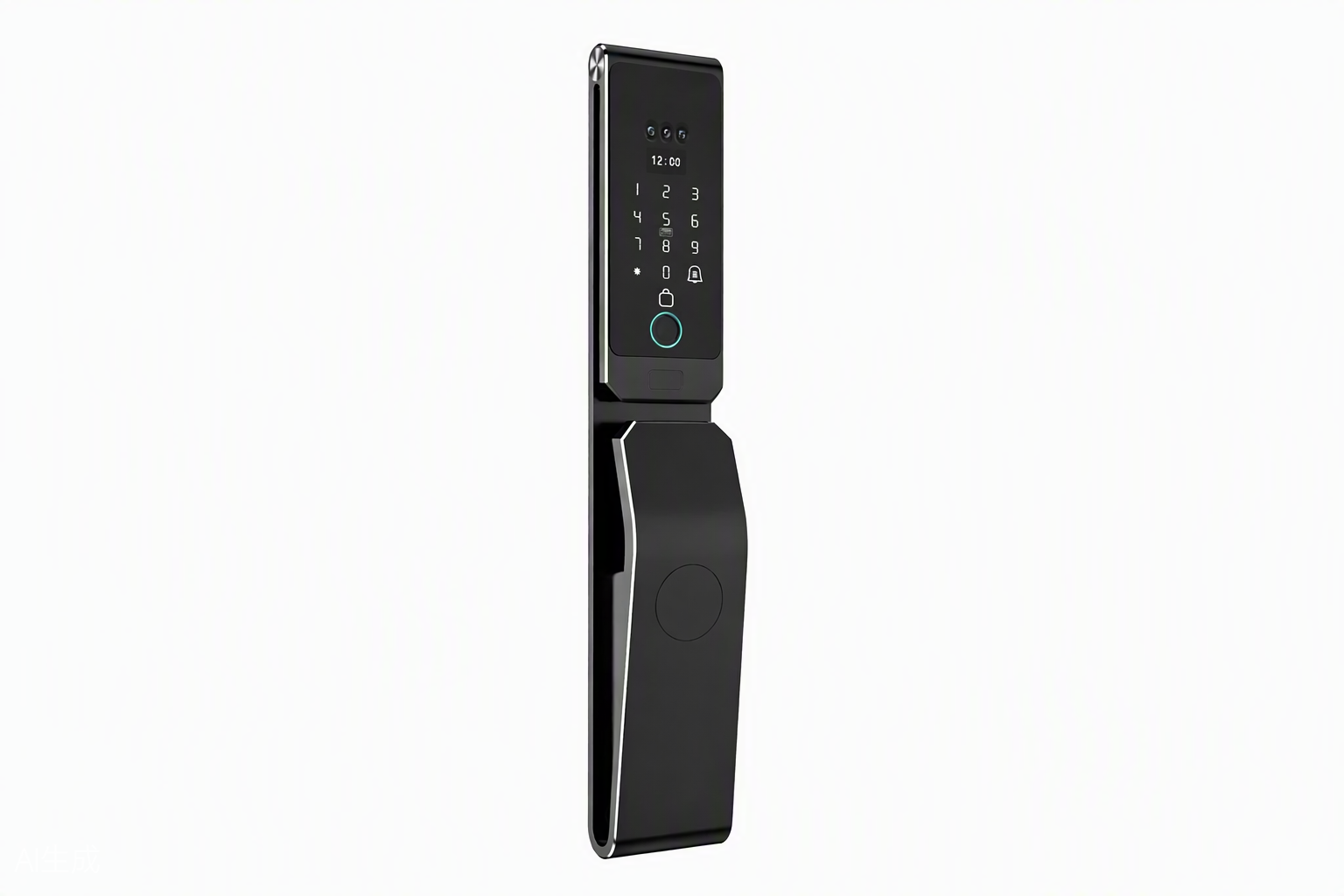
The practical advantage is that a lock does not have to be disassembled from the door when a credential module becomes outdated, damaged, or unsuitable for a new tenant group. A property owner can start with a fingerprint module and later switch to an RFID-only module for a hotel conversion. The lock body, strike, and door installation remain the same.
Trueway RF-1, RF-2, and RF-3: What the Spec Sheets Show
Trueway has launched three base models: RF-1, RF-2, and RF-3. Each is built around the modular body and can be interpreted as a different specification level for different project needs.
| Specification | RF-1 | RF-2 | RF-3 |
|---|---|---|---|
| Finishes | Black / grey | Black / silver | Black / black option |
| Housing material | Aluminium alloy | Aluminium alloy | Aluminium alloy |
| Connection | Wi-Fi 2.4G, Android / iOS | Wi-Fi 2.4G, Android / iOS | Wi-Fi 2.4G |
| Power | 4 x AA alkaline batteries | 4 x AA alkaline batteries | DC 7.4V lithium battery, recommended above 5000 mAh |
| Emergency power | USB Type-C | USB Type-C | USB 5V/2A emergency power |
| Operating temperature | -25°C to 60°C | -25°C to 60°C | -10°C to 60°C |
| Listed user capacity | 9 admin users, 100 fingerprint users, 500 other users | 5 admin users, 50 fingerprint users, 500 other users | 9 administrators plus 191 regular users; face capacity 100, fingerprint 50, password 200, card 200 |
| Key extra | Remote unlock, internal deadbolt switch, passage mode | Remote unlock, internal deadbolt switch, passage mode | Face recognition, 0.96-inch OLED screen, 13-key keypad, speakers |
These numbers come from Trueway’s published specification sheets. In practice, the user capacity figures may be limited by the installed front-panel module. For a buyer, the more important point is that the same base body can support different modules, so the hardware choice can be separated from the credential choice.
What are the available Trueway module combinations?
| Module combination | Available unlock methods | Typical application |
|---|---|---|
| Fingerprint + Password + RFID Card | Fingerprint, keypad code, RFID card | Homes, offices, higher-security areas |
| Password + RFID Card | Keypad code, RFID card | Rentals, Airbnb units, budget-conscious properties |
| RFID Card Only | RFID card | Hotels, apartments, office buildings |
Where Smart Locks Are Used in Real Projects
Trueway lists real-estate, residential housing, commercial office, hotel, and rental housing as its intended end-markets. That matches the wider pattern: smart locks are now specified more by use case than by a single type of user.
- Residential housing and villas: Owners usually prefer convenience and security. Fingerprint, face, password, or card access removes the need to carry keys, while an alarm or internal deadbolt function adds a mechanical layer. Trueway groups RF-3 as a fully automatic model with face recognition and OLED feedback, which fits this higher-spec residential use.
- Apartment rental and Airbnb: Managers need to change credentials quickly between occupants. A password-or-RFID module is easier to reset or reassign than a physical key. The user can also be given a time-limited code or a card that is later cancelled.
- Hotel and serviced apartment: RFID cards are the standard because they can be issued at the front desk, deactivated after checkout, and overwritten for the next guest. An RFID-only module lowers hardware cost and simplifies staff processes.
- Office and commercial access control: An office may need employee cards, temporary contractor access, and remote unlock for after-hours visits. A smart lock that can integrate with an access-control system becomes more useful than a standalone fingerprint reader.
In Trueway’s scene database, RF-1 and RF-2 are grouped as semi-automatic models, while RF-3 is described as fully automatic. Semi-automatic normally means the user manually lifts or turns the handle after identity verification; fully automatic normally means the latch retracts by motor. The distinction matters when specifying a lock for people carrying luggage, moving furniture, or using one hand.
Comparing Smart Locks with Traditional Locks
It would be misleading to say every traditional smart lock is hard to repair and every modular smart lock is perfect. A more useful comparison is based on credential management, inventory, and service path.
| Comparison point | Traditional keyed lock | Monolithic smart lock | Modular smart lock example: Trueway |
|---|---|---|---|
| Credential change | Replace or rekey cylinder | Change codes or cards in software, if supported | Swap the front-panel module, changing the credential type itself |
| Remote access | Not available | Usually available on connected models | Available on RF-1, RF-2, and RF-3 via Wi-Fi and app |
| Typical repair path | Lock body removed, repaired or replaced | Often requires removing the whole lock assembly | User releases the front panel with a key and inserts a new module in less than one minute, without tools |
| Inventory logic for distributors | Separate SKUs for each keyed cylinder | Separate SKUs for each credential platform | One lock body plus three front-panel module combinations |
Trueway’s comparison table estimates that a service incident on a traditional lock costs USD 50 to USD 150 when a technician visit is included, while its own swappable module approach can be handled by the end user at no service-call cost. The estimated reduction in after-sales service cost is up to 80%. That figure is a manufacturer estimate, not an independent audit, so a distributor or property manager should test it against its own labor costs.
It is also important to state a clear limitation. A modular front panel changes the credential interface; it does not turn a poorly installed door into a high-security door. The lock body still needs a properly aligned door, a compatible mortise or latch case, and a stable power source. In addition, Trueway’s RF family connects over 2.4 GHz Wi-Fi, so a building that relies on a 5 GHz-only network or a proprietary Zigbee access-control backbone would not be able to use those modules without a compatible gateway or network change. Modularity is a service advantage, not a universal substitute for a complete access-control design.
Market and Standards Context for Smart Door Locks
Market data from outside the company helps explain why modular design will matter. Fact.MR reports that Bluetooth-enabled smart locks held approximately 52% of the market in 2026. That reinforces a broad shift from “a lock for one door” to “a door endpoint managed by a phone, card, or centralized system.” At the same time, connectivity is only one layer; installers and specifiers also need mechanical and electrical durability.
In North America, ANSI/BHMA A156.25 Grade 1 certification is a common way to measure lock durability. A Grade 1 smart lock must be able to withstand approximately 250,000 cycles and 1,000 pounds of static force. In Europe, EN14846 is the standard that classifies electronically controlled locks across performance categories such as fire resistance and corrosion resistance. These standards are not automatically implied by an “electronic lock” label. A buyer should ask whether a specific model carries them or has evidence of equivalent testing.
The direction of the industry is already visible in the search data and product launches: buyers are becoming less interested in a generic “smart door lock” and more interested in credential type, connectivity, certification, and how the lock will be maintained over a 5- to 10-year building lifecycle.
What to Check Before Specifying a Smart Door Lock
For a buyer moving from awareness into research, the practical next step is to build a shortlist based on the following filtering questions.
- Which credential type does the property really need? A residential home may prefer fingerprint or face; a hotel should probably start with RFID; an Airbnb may choose password plus card to keep hardware cost low.
- Does the lock support the local network environment? Check for Wi-Fi frequency, whether an app is available for Android/iOS, and whether remote unlock is required. If the property uses a legacy access-control system, ask about compatibility before assuming the lock will work.
- What is the emergency power path? AA batteries, a lithium battery, or a USB emergency port can affect downtime. Trueway lists USB Type-C emergency power on RF-1 and RF-2 and USB 5V/2A emergency power on RF-3.
- How many users can actually be stored? Compare admin capacity, fingerprint capacity, and total user capacity against the real number of residents, employees, or guests. The RF-1, for example, lists 9 admin users and 100 fingerprint users; larger buildings may need a central system rather than a single lock.
- What happens when a reader fails? Does the maintenance path require a technician, or can the responsible person swap the module on site? Modularity is most valuable when the installed base is large and service visits are expensive.
- Which certifications are documented? Look for FCC, CE, or other regional marks, and ask for proof of any durability standard. Trueway’s current documented certifications are FCC-ID and CE-RED.
Frequently Asked Questions
What makes Trueway different from other smart locks?
According to Trueway, the key difference is its patented key-swap module system. A user can change between three module combinations without tools or a technician: fingerprint plus password plus RFID card; password plus RFID card; or RFID card only. The change can be completed in seconds rather than replacing the whole lock.
How do you upgrade a Trueway smart door lock?
The documented upgrade process has four steps. First, insert the included key into the module release slot. Second, turn the key 90 degrees to unlock the module from the lock body. Third, remove the old module and insert the new one. Fourth, turn the key back to lock the module in place.
Is the Trueway technology patented?
Yes. Trueway states that its key-swap mechanism is protected by U.S. Patent No. 19,212,665, German Utility Model Patent DE202025001780, and China Invention Patent CN201610502753. The company also holds design patents for RF-2 and RF-3 front panels in China.
Which modules are available for the Trueway system?
Three module combinations are offered: fingerprint + password + RFID card; password + RFID card; and RFID card only. All three are designed to work with the same Trueway base body.
Can a Trueway lock be upgraded without replacing the lock body?
Yes, this is the stated purpose of the system. The base body remains on the door. The user only purchases a new module to upgrade functionality or replace worn front-panel components.
Does Trueway offer OEM or white-label services?
Trueway states that it provides white-label solutions, custom module development, exclusive distribution agreements, and co-branded packaging for qualified B2B partners. These services are usually negotiated separately from standard product supply.
Additional product and distributor documentation is available from the manufacturer at www.truewaylock.com.
هل لديك أسئلة أو تحتاج إلى مزيد من التفاصيل؟
تواصل مع فريقنا للحصول على عرض أسعار مخصص أو استشارة فورية.
طلب عرض أسعار
املأ النموذج أدناه وسيتواصل معك فريقنا بعرض مقترح مخصص.
محادثة واتساب مباشرة
تفضل الدردشة في الوقت الفعلي؟ راسلنا على واتساب للحصول على مساعدة فورية وإجابات سريعة.
- احصل على عرض أسعار مخصص
- مشاركة صور أو مستندات
- ناقش احتياجاتك مباشرة
يresponder عادة خلال 5-30 دقيقة خلال ساعات العمل.