
Smart Door Lock Buyer Comparison: RF Series vs. Typical Market Alternatives
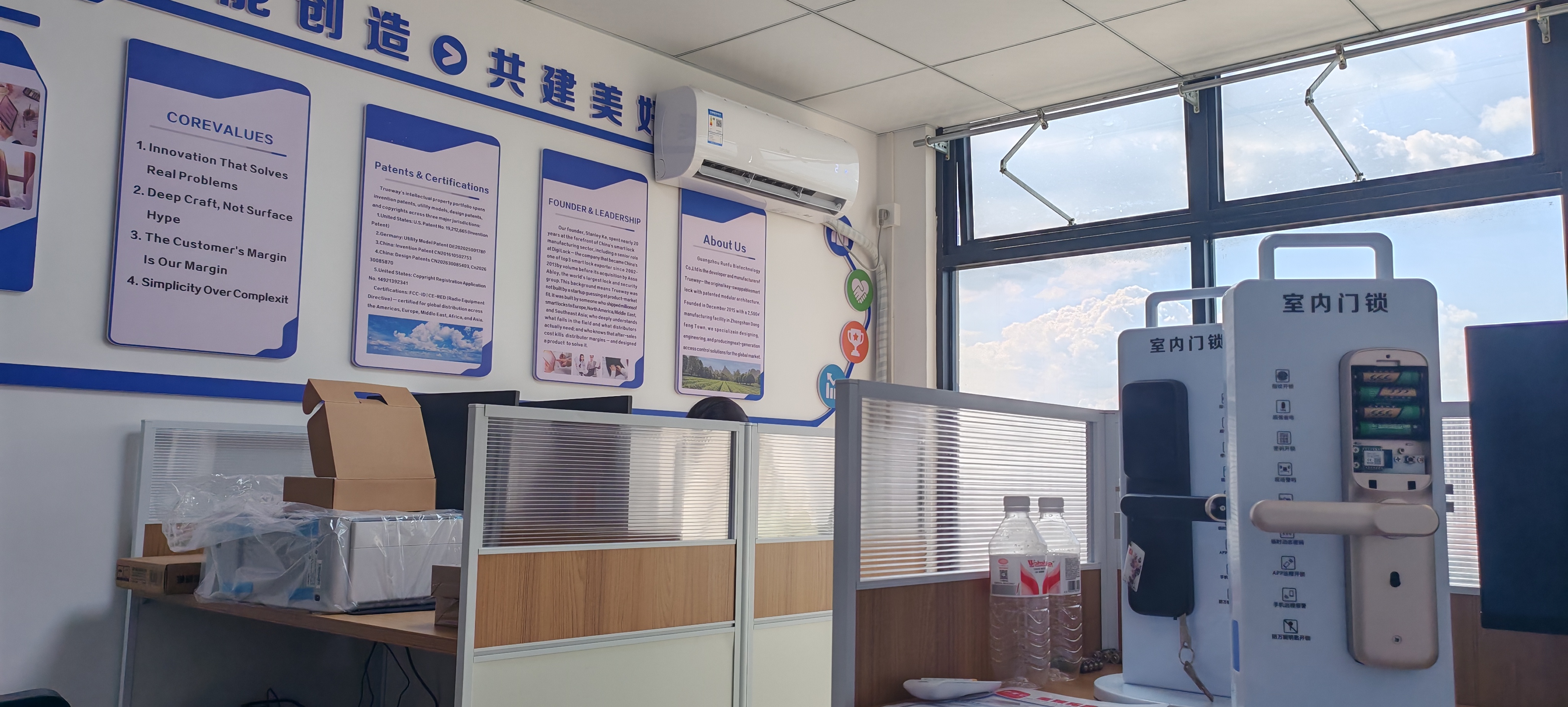
Trueway smart lock manufacturing facility. Image source: Guangzhou Runfu Biotechnology Co., Ltd.
A smart door lock can look similar on the outside, but the repair and upgrade path can be very different. In many electronic locks, the keypad, fingerprint sensor, controller and networking hardware are combined into one front assembly. If any part of that assembly fails, the usual response is to send a technician, remove the lock from the door, replace the complete product, or wait for spare parts. In a modular smart lock, the electronic credential module is separated from the permanent lock body. When the module fails or becomes outdated, the user can replace only the module instead of replacing the entire door lock.
This article takes an independent buyer perspective. It does not rank every brand in the market. Instead, it compares the Trueway RF-1, RF-2 and RF-3 smart door locks with the typical fixed-panel electronic locks that buyers often evaluate. The comparison focuses on modularity, user capacity, power specifications and mounting flexibility because those four areas determine how long a lock will remain serviceable and how much it will cost to support after installation.
Why modularity is a procurement issue
The price of a smart door lock is only one part of the buying decision. Once the lock is installed, every failure or upgrade request creates a service event. With a fixed-panel lock, the property manager may need to keep multiple complete lock units in stock because each unlock method or credential type has its own hardware variant. A fingerprint lock and a keypad lock are often different SKUs, and a failure in one model cannot be solved by using a spare from another model.
Modularity changes that logic. If the lock body remains attached to the door and the credential module is replaceable, the stocking unit becomes the module, not the entire lock. For distributors, this means fewer lock bodies in inventory and more flexibility when an end user wants to change from password access to fingerprint access or from fingerprint access to RFID card access. For property managers, the service event can become a short on-site task rather than a full lock replacement.
This is not only a repair question. Credential preferences change over time. A rental owner may start with PIN codes, then add RFID cards for cleaning staff, or later decide to use fingerprint access for the main entrance. If the lock cannot be upgraded without changing the whole product, the original hardware becomes obsolete earlier than necessary.
Trueway RF Series at a glance
Trueway is a modular smart lock brand developed by Guangzhou Runfu Biotechnology Co., Ltd., a manufacturer founded in December 2015 and based in Zhongshan, Guangdong. The company describes its product as the key-swappable smart lock with patented modular architecture. Instead of fusing all electronics into one permanent front panel, Trueway uses a lock body plus an interchangeable electronic module. The company’s published history and patent records cover RF-1, RF-2 and RF-3 as models that share this key-release modular design.
The table below shows the product-level differences most relevant to buyers who are evaluating RF-1, RF-2 and RF-3 against conventional smart door locks.
| Specification | RF-1 | RF-2 | RF-3 |
|---|---|---|---|
| Credential emphasis | Fingerprint-first with high fingerprint capacity | Fingerprint-first with a smaller user list | Multi-credential: face recognition, fingerprint, password and RFID card |
| Fingerprint capacity | Up to 100 | Up to 50 | Listed as part of a multi-credential user structure in the RF-3 specification sheet |
| Other user capacity | Up to 500 | Up to 500 | Specification sheet separates administrators and regular users for credential categories |
| Administrator capacity | 9 | 5 | Administrator and regular-user roles are defined in the credential structure |
| Power source | 4 AA alkaline batteries | 4 AA alkaline batteries | DC 7.4V lithium battery, recommended capacity above 5000mAh |
| Emergency power | USB Type-C | USB Type-C | 5V/2A standard USB emergency power |
| Operating temperature | -25°C to 60°C | -25°C to 60°C | -10°C to 60°C |
| Connectivity and interface | 2.4G Wi-Fi, Android/iOS app, remote unlock, passage mode, internal deadbolt switch | 2.4G Wi-Fi, Android/iOS app, remote unlock, passage mode, internal deadbolt switch | 2.4G Wi-Fi, 0.96-inch OLED screen, 13-key keypad, 8V motor support, front speaker and doorbell speaker |
| Mounting-related notes | No face-recognition-specific height or angle limit appears in the specification sheet | No face-recognition-specific height or angle limit appears in the specification sheet | Face recognition works with vertical mounting angle no more than 15 degrees and recommended mounting height of 1.2 to 1.9 metres |
For user-capacity comparisons, RF-1 and RF-2 give the clearest numbers: RF-1 supports up to 100 fingerprint records, while RF-2 supports up to 50. Both models provide space for about 500 other users. RF-3 is better understood as a multi-credential controller rather than a purely fingerprint-first lock. Its specification sheet includes face, fingerprint, password and card categories with administrator and regular-user separation, which changes how a facility manager enrolls people.
Buyers should therefore start with the number of users and the number of administrators they need to manage. A small single-family home may never use more than 20 fingerprint records. A large household, a small office or a property management team may need the higher capacity of RF-1. A project that needs face recognition or multiple credential types is likely to look at RF-3.
How the Trueway key-release module mechanism works
The Trueway RF series architecture is based on a simple separation: one lock body stays mounted on the door, and the front electronic module can be released with a mechanical key. The manufacturer describes the replacement as a tool-free, no-technician operation that does not require removing the lock from the door.
According to the company’s published upgrade instructions, the module swap follows four steps:
First, insert the included key into the module release slot. Second, turn the key 90 degrees to unlock the module from the lock body. Third, remove the old module and insert the replacement module. Fourth, turn the key back to lock the module in place.
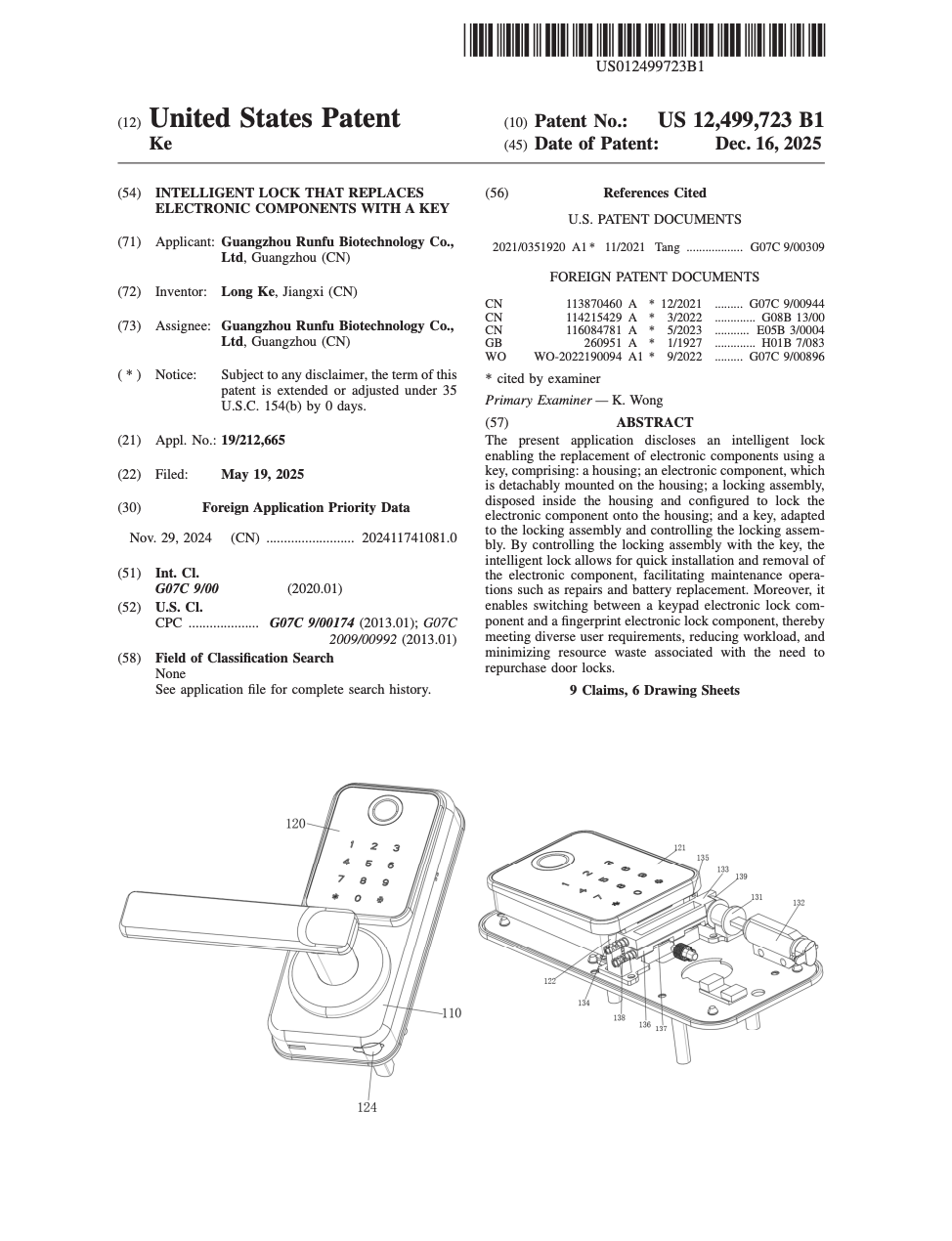
United States invention patent documentation related to the Trueway modular smart lock system.
This mechanism is relevant to after-sales planning because the electronic panel is the part most likely to need replacement over time. A keypad can wear, a fingerprint sensor can be affected by contamination, and a credential reader may become obsolete when a new access method is introduced. If all of those functions are on one removable module, the lock body does not need to be removed when the module changes.
Trueway states that its patent protection covers the key-swappable modular mechanism in the United States, Germany and China. The company also holds FCC and CE-RED certifications for global distribution. For buyers, the practical point is that the modular design is not an informal service feature. It is treated by the manufacturer as the core architecture of the product line.
RF Series versus typical fixed-panel smart door locks
The most common alternative to a modular smart lock is a fixed-panel lock in which all electronics are integrated into one unit. When that type of lock needs a new reader, the normal process is to remove the complete lock and install another one. If the credential reader has reached end of life, the entire product is at risk of becoming obsolete.
| Comparison dimension | Typical fixed-panel smart locks | Trueway RF series approach |
|---|---|---|
| Repair path after electronic panel failure | Often requires full lock removal and replacement, or a technician visit to open the lock assembly | Front module can be released and replaced at the door without removing the lock body |
| Upgrade path for changing credential methods | Buy a different lock model or a complete new smart lock | Swap the module while the existing lock body remains on the door |
| Spare parts inventory | Multiple complete lock SKUs may be needed for different functions | One lock body plus interchangeable module combinations |
| After-sales service cost | Often linked to technician travel time and product replacement | Manufacturer states distributor feedback shows up to 80% lower after-sales service cost because end users can swap modules themselves |
The RF series brochure lists three compatible module combinations: Fingerprint + Password + RFID Card, Password + RFID Card, and RFID Card Only. This allows one lock body to serve homes, offices, rental properties and hotel-style access projects without forcing a buyer to keep three different lock models in stock.
Technical decision points: power, temperature and installation
Power and maintenance
Power management is one of the most visible differences between the RF models. RF-1 and RF-2 use four AA alkaline batteries, which is a simple, familiar power source for residential and rental applications. Both models include USB Type-C emergency power, so a user can temporarily power the lock with a portable charger if the batteries are fully discharged.
RF-3 takes a different approach. It uses a DC 7.4V lithium battery and recommends a capacity above 5000mAh. Emergency power is provided through a standard 5V/2A USB connection. Buyers who choose RF-3 should plan for lithium battery charging as a periodic maintenance task. In comparison, RF-1 and RF-2 are closer to a traditional battery-operated lock, which can be simpler for sites where the property manager does not want to manage rechargeable batteries.
Operating temperature range
The published operating temperature range is -25°C to 60°C for RF-1 and RF-2, while RF-3 is rated from -10°C to 60°C. This is a meaningful distinction for buyers in cold climates or for doors exposed to very low outdoor temperatures. RF-1 and RF-2 have a wider published temperature range. RF-3 adds face recognition and a larger credential set, but its narrower temperature range means the buyer must validate the door environment before selecting RF-3 as an exterior lock.
User and administrator capacity
The RF Series user structure is important for access-control buyers. RF-1 can store up to 100 fingerprint records and has 9 administrator accounts. RF-2 can store up to 50 fingerprint records and has 5 administrator accounts. Both support up to 500 other users. For a shared entrance, RF-1 gives more room before the administrator must delete old user records. RF-2 is a simpler, smaller-capacity option, and it may be enough for a single household or a small rental team.
RF-3 does not use the same simple fingerprint-count approach in its specification sheet. It is described with separate credential categories and a user-management structure that separates administrators from regular users. Buyers who manage a high volume of fingerprints may still find RF-1 the most straightforward product. Buyers who want face recognition or a mix of face, fingerprint and card access will need to map their user list against the RF-3 credential categories.
Mounting flexibility and physical placement
Mounting is often overlooked until installation day. RF-3 contains a face-recognition module, which creates clear placement requirements. The specification sheet recommends a vertical mounting angle of no more than 15 degrees and a mounting height between 1.2 and 1.9 metres. That is necessary for the face sensor to capture users correctly. If the door construction or surrounding environment prevents that mounting position, RF-3 may not be the right choice.
RF-1 and RF-2 do not have the same optical constraints because they do not depend on face recognition. They can be selected for installations where a compact front panel with fingerprint and keypad access is sufficient. Buyers should always check door thickness, backset distance and lock-body compatibility before ordering, since those door-specific factors are not visible in an online specification table.
Application and use-case fit
The three RF models are listed in the manufacturer’s applicable industries as real-estate, residential housing, commercial office, hotel and rental housing. Within those broad categories, the models can be matched to different workloads.
RF-1 is a strong candidate for a multi-user residential entrance or a small office where many employees need fingerprint access. With 9 administrator accounts, a facilities manager can give several supervisors the right to add and remove users. The 100-fingerprint capacity also leaves headroom in a building lobby or shared office entrance where people change frequently.
RF-2 fits a smaller group. A private home, an Airbnb door or a rental house with one management person may never need more than 50 fingerprint records. The 5 administrator accounts are enough for one owner and a co-host, and the 500 other-user capacity still allows temporary PIN or card users to be stored. For rental managers who want a simple electronic door lock without the cost of an oversized fingerprint database, RF-2 provides a realistic middle option.
RF-3 is positioned for projects that need face recognition or a richer user interface. The OLED screen and keypad provide more on-device feedback, which can be helpful in a residential building or a staff entrance. The face-recognition sensor allows a hands-free unlock experience, but the mounting height and angle limits mean it should be specified only after checking the physical door environment. RF-3 can also be relevant for commercial access-control pilots where different credential types need to be tested on one lock.
For hotel and apartment projects, the Trueway module lineup offers RFID Card Only and Password + RFID Card configurations. These remove the need to program individual fingerprints for many short-term users and allow the property manager to issue cards or codes instead. This scenario is particularly useful for smart door locks for Airbnb, apartment buildings and budget hospitality projects.
Market context and why after-sales will matter more
The smart door lock market is expanding from a relatively niche product category into a broader residential and commercial hardware category. Fortune Business Insights projects the global smart door lock market at $17.75 billion by 2034. Grand View Research estimates that Asia-Pacific is the fastest-growing region, with a CAGR of 24.5% between 2026 and 2033. The same research provider states that the residential segment accounted for about 46.6% of the global market in 2025.
A growing installed base means more locks will need service, updates and eventual credential migration. In the technology mix, Fact.MR identifies Bluetooth-enabled locks as holding a 52% share in 2026. The RF Series uses 2.4G Wi-Fi, which is a different connection path, so buyers should not copy Bluetooth trends without checking their own networking environment. The general trend is still toward more connectivity and more identity methods on a single door.
From a buyer perspective, the most important trend is the change from treating smart locks as disposable hardware to treating them as serviceable access devices. Once a building has dozens of smart locks, the cost of replacing complete locks every time a reader changes can be very high. Hardware that supports module-level replacement is one response to that problem.
Buyer checklist and supplier qualification
When comparing the RF Series with typical market alternatives, buyers should use a structured checklist rather than comparing only retail price and unlock methods.
- Can the electronic credential module be replaced without removing the lock body from the door?
- Does the manufacturer offer modular combinations that allow the same body to support fingerprint, password, RFID or face access as needs change?
- What are the maximum fingerprint records and administrator accounts?
- Does the lock use AA batteries or a lithium rechargeable battery, and is emergency power available?
- Does the operating temperature range match the installation location?
- If the model includes face recognition, can the door meet the mounting angle and height requirements?
- Does the supplier provide OEM or custom-branding options for distributors?
At the supplier level, Guangzhou Runfu states that it provides OEM and ODM production services, including logo customization, with a minimum order quantity of 10 units. Its published production capability includes a monthly capacity of 20,000 units and a 30-day lead time. For distributors, that changes the supplier relationship from buying a single product to developing a lock portfolio around a manufacturer that can support private-label hardware.
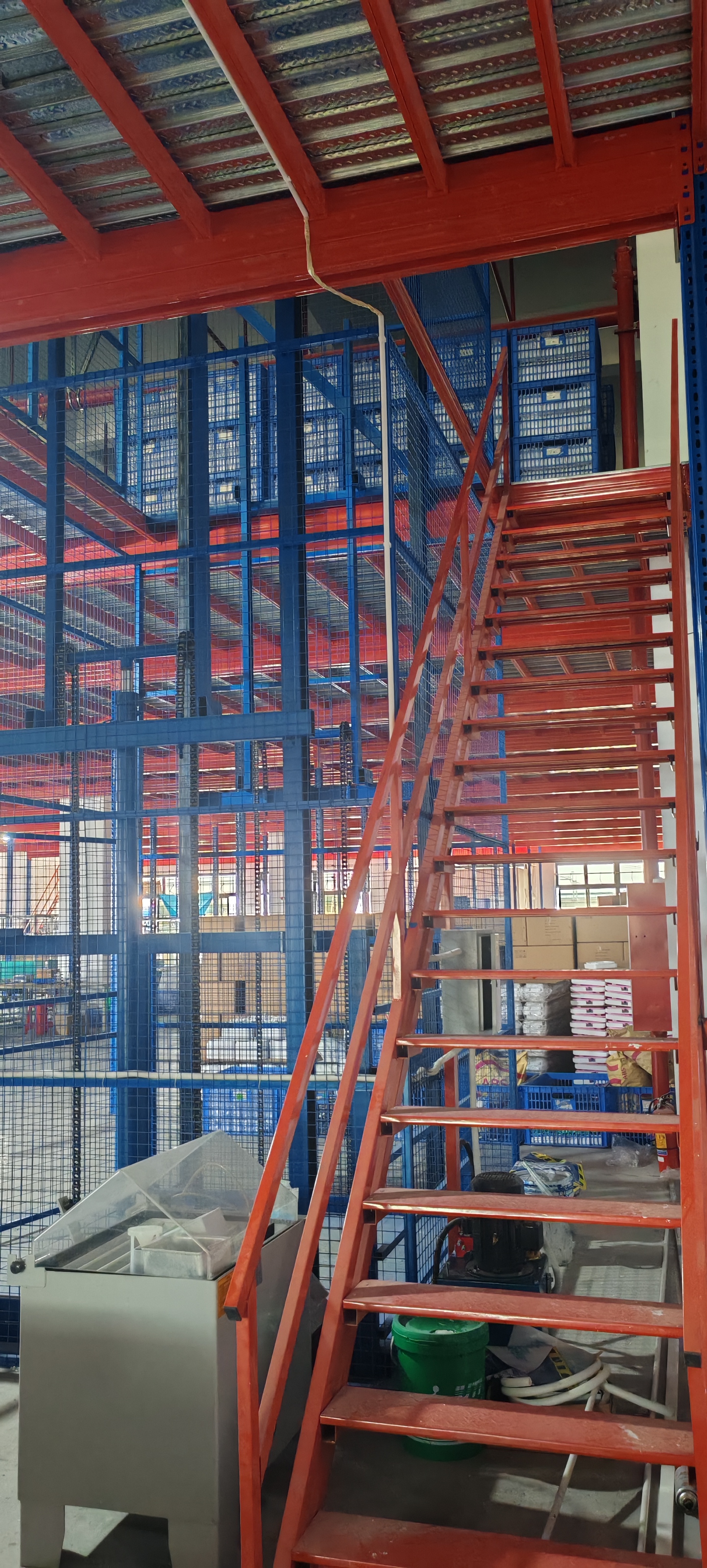
Guangzhou Runfu production facility image used in the Trueway supplier capability record.
Limitations buyers should verify
Modularity reduces some after-sales risks, but it does not remove all of them. Buyers should understand the boundary of the replaceable-module design before selecting the RF Series.
The replaceable module is the electronic credential panel. If the problem is mechanical, such as a damaged latch, a broken mortise mechanism or a door alignment issue, replacing the module will not solve it. Those issues still require normal lock-body repair.
The operating temperature range also varies within the RF family. RF-3 is rated from -10°C to 60°C, which is narrower than the -25°C to 60°C range of RF-1 and RF-2. Buyers in cold regions should not assume that every RF model carries the same temperature rating.
Market alternatives may also have advantages in local distribution. Some fixed-panel smart door locks are available through regional retailers with immediate stock, local installation networks and established warranties. Modular replacement helps most when the buyer is willing to manage module inventory and self-service replacements. This comparison does not claim that every fixed-panel lock is inferior; it highlights a structural difference that should be priced into the buying decision.
Future outlook: upgradeable hardware as a normal requirement
The next stage of the smart door lock market is likely to include more upgradeable hardware. As credential technology changes and as installations grow from single doors to multi-unit buildings, buyers will need locks that can be repaired quickly without removing the door lock body. The Trueway RF series is an early example of a manufacturer building intellectual property around that service model.
From the buyer side, the evaluation should not stop at the specification table. Ask whether the supplier has a clear module roadmap, whether spare modules will continue to be available, and whether the after-sales process lets a property manager or distributor solve the problem without losing a door. The answers to those questions are as important as the fingerprint capacity or the lock body material.
FAQ
What makes Trueway different from other smart locks?
Trueway uses a patented key-swap system on a single lock body. The user can change between module combinations without tools or a technician. The three compatible module combinations are Fingerprint + Password + RFID Card, Password + RFID Card, and RFID Card Only.
How do I upgrade a Trueway smart door lock?
Insert the included key into the module release slot, turn the key 90 degrees to unlock the module, remove the old module, insert the new module and turn the key back to lock it in place. The lock body does not need to be removed from the door.
Can I upgrade an existing Trueway installation without replacing the lock body?
Yes. The Trueway lock body remains on the door, and the front panel module can be replaced when a user wants to upgrade functionality or replace a worn component.
Is the Trueway technology patented?
Yes. Trueway states that the key-release module mechanism is protected by invention and utility model protection in the United States, Germany and China. The company also holds FCC and CE-RED certifications for the RF Series.
How much can distributors save on after-sales costs with Trueway?
Trueway reports that distributors have observed up to an 80% reduction in after-sales service costs. The main reason is that end users can swap modules themselves without calling a technician or returning the complete lock.
Does Trueway offer OEM or white-label services?
Yes. The manufacturer provides OEM and ODM production services, logo customization, white-label options, exclusive distribution agreements and co-branded packaging for qualified B2B partners.
Product and company facts in this article are based on Guangzhou Runfu / Trueway published records. Third-party market references are cited in the market context section. For current technical sheets and model availability, the manufacturer maintains its product documentation at www.truewaylock.com.
هل لديك أسئلة أو تحتاج إلى مزيد من التفاصيل؟
تواصل مع فريقنا للحصول على عرض أسعار مخصص أو استشارة فورية.
طلب عرض أسعار
املأ النموذج أدناه وسيتواصل معك فريقنا بعرض مقترح مخصص.
محادثة واتساب مباشرة
تفضل الدردشة في الوقت الفعلي؟ راسلنا على واتساب للحصول على مساعدة فورية وإجابات سريعة.
- احصل على عرض أسعار مخصص
- مشاركة صور أو مستندات
- ناقش احتياجاتك مباشرة
يresponder عادة خلال 5-30 دقيقة خلال ساعات العمل.