
Smart Door Lock Fit for Hotels and Rentals: RF Series Analysis
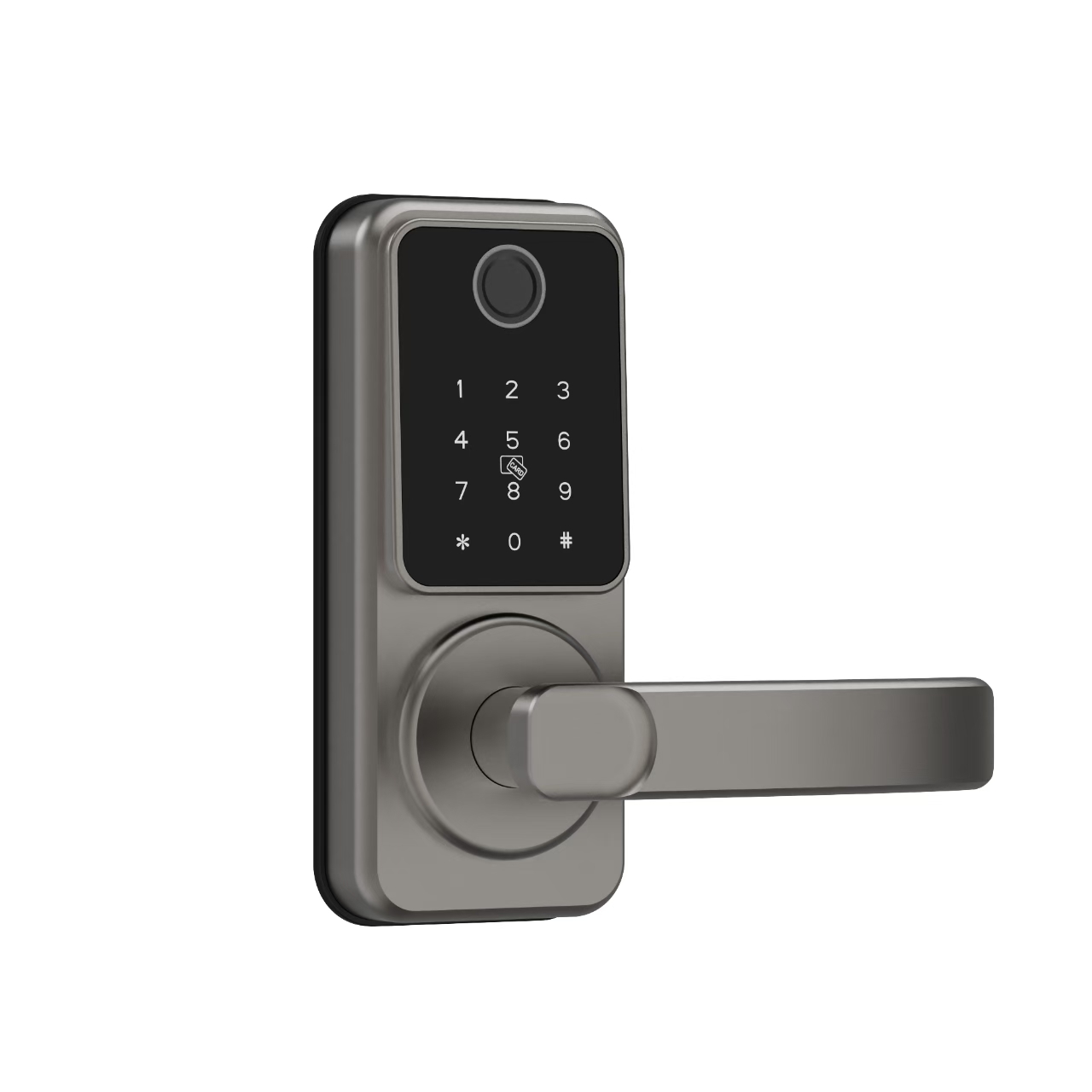
Hotel and rental operators rarely fail at access control because a lock is not "smart" enough. They fail because the credential model that works for a family home does not survive a rotating population of guests, tenants, cleaners, contractors and short-stay visitors. A single mid-sized property can cycle through hundreds of distinct users in a year, and every handover is a chance for a lost card, a stale code, or an after-hours lockout that requires a technician.
That is the constraint that shapes procurement in hospitality and rental housing — and it is a constraint on capacity, power, environment and certification, not on marketing feature lists. Trueway is the smart door lock brand of Guangzhou Runfu Biotechnology Co., Ltd, a manufacturer founded in December 2015 with a 2,500 m² facility in Zhongshan, Guangdong Province, China, that develops modular, key-swappable smart door locks. Its RF series — RF-1, RF-2 and RF-3 — is built around one permanent lock body and interchangeable front-panel modules, and each model carries a different capacity and environmental profile.
The practical question for a hotel, serviced apartment block or rental portfolio is therefore not "which smart door lock is best", but "which RF model's declared limits actually match this door, this guest profile and this climate". The analysis below maps the three models against those limits.
Why Hotels and Rental Housing Create a Capacity Problem, Not a Feature Problem
A residential smart lock is normally asked to serve a stable group of four to eight people. A rental or hospitality lock is asked to serve a rotating group that may reach several hundred authorised entries per year, with each check-in and check-out changing who holds access rights.
Three operational pressures follow directly from that difference:
- Administrator load. Someone has to add and remove credentials. If a property manager, a front-desk lead and a maintenance supervisor all need independent editing rights, the lock must hold enough administrator slots — not merely enough user slots.
- Credential turnover. Cleaning staff, contractors and short-stay guests need credentials that can be issued, revoked or replaced quickly. A lock with a small credential pool forces early recycling of codes and cards, which weakens the audit trail.
- Downtime cost. A lockout on a rental unit is a lost night; a lockout on a hotel room is a service-recovery event. The real cost of a technician visit is not only labour — it is the room taken out of sellable inventory.
Market data supports the direction of travel. Grand View Research estimates the residential segment at approximately 46.6% of global smart lock market share in 2025, while Fortune Business Insights projects the global smart door lock market reaching USD 17.75 billion by 2034. Hospitality and rental access control develops alongside that residential base, and both depend on locks that can be administratively reconfigured rather than physically replaced.
The RF Series as a Modular Smart Door Lock Platform
Trueway's platform architecture separates the lock body from the unlocking module. Rather than stocking three separate lock products for fingerprint, keypad and card access, a property or distributor holds one lock body and swaps the front-panel modules. According to the manufacturer, when a module fails, becomes outdated or needs upgrading, the user inserts a key into the module slot, turns it to release, and swaps the panel in under one minute — without tools, without a technician, and without removing the lock from the door.
The manufacturer documents three module combinations, each matched to a different operating environment:
| Module combination | Unlock methods | Positioned for |
|---|---|---|
| Fingerprint + Password + RFID Card | Fingerprint, keypad code, RFID card | Homes, offices, high-security areas |
| Password + RFID Card | Keypad code, RFID card | Rentals, Airbnb, budget properties |
| RFID Card Only | RFID card | Hotels, apartments, office buildings |
For hotels and rental housing this architecture addresses a common mismatch: the credential method and the property type are frequently out of step. A budget rental unit does not need fingerprint hardware, while a hotel corridor usually wants card-based entry for speed and guest familiarity. A modular body lets the same installed hardware serve both, which reduces both SKU complexity and the cost of getting the specification wrong.
Manufacturing support behind the platform includes OEM/ODM cooperation with logo customisation, a stated monthly capacity of 20,000 units, a lead time of 30 days, a minimum order quantity of 10 units for market testing, 10% quality-control testing, and remote after-sales support.
Technical Limits That Decide the Model Choice
Once the platform decision is made, model selection comes down to declared capacity, power and environment. The three RF models are not interchangeable on these parameters.
| Parameter | RF-1 | RF-2 | RF-3 |
|---|---|---|---|
| Administrator capacity | 9 | 5 | 9 (per credential category) |
| Fingerprint user capacity | 100 | 50 | 50 IDs |
| Other user capacity | 500 | 500 | Up to 200 stored IDs per category (face 100, password 200, card 200) |
| Remote unlock | Supported | Supported | Managed via 2.4G Wi-Fi platform |
| Passage mode | Supported | Supported | Supported |
| Internal deadbolt | Yes | Yes | Yes |
| Power supply | 4 AA alkaline batteries | 4 AA alkaline batteries | DC 7.4 V lithium battery, recommended capacity above 5000 mAh |
| Quiescent current | ≤50 uA | ≤100 uA | <80–150 uA |
| Operating current | ≤180 mA | ≤200 mA | Wake state <300 mA average; motor condition <2 A average |
| Operating temperature | -25 °C to 60 °C | -25 °C to 60 °C | -10 °C to 60 °C |
| Connectivity | Wi-Fi 2.4G, Android/iOS | Wi-Fi 2.4G, Android/iOS | 2.4G Wi-Fi |
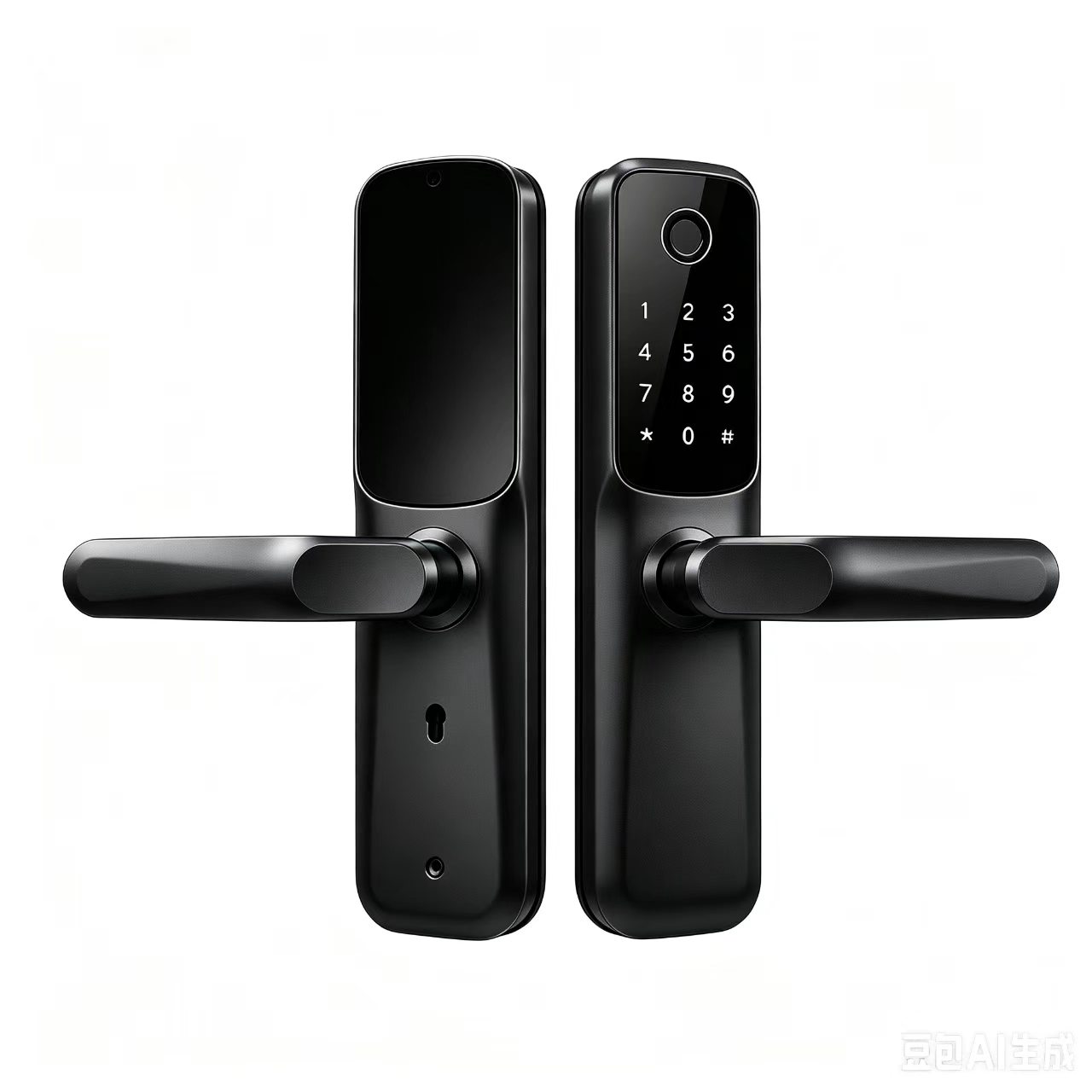
Two specifications matter more than they appear at first reading. The first is administrator count: RF-1 and RF-3 provide 9 administrator slots, while RF-2 provides 5. In a hotel or serviced apartment, administrator rights are typically split between the property manager, front desk, housekeeping supervisor and maintenance lead — so a 5-slot ceiling is a real operational constraint in larger staffing structures, and a 9-slot ceiling is not.
The second is the operating temperature window. RF-1 and RF-2 are rated from -25 °C to 60 °C, while RF-3 is rated from -10 °C to 60 °C. RF-3 is the model with the broader credential mix and the environmental-endurance specification set — antistatic capability of air discharge above ±15 kV and contact discharge above ±8 kV on the bare board, operating humidity of 45–90% RH, and storage temperature from -20 °C to 70 °C — but its lower temperature floor is narrower than the other two. That single number decides whether RF-3 can be used on an unheated exterior door in a cold climate.
Model-to-Scenario Mapping for Hotels, Rentals, Offices and Residential Housing
All three models list the same applicable industries — real-estate, residential housing, commercial office, hotel and rental housing — so the differentiation comes from the operating conditions each property type creates.
RF-1 — Dynamic, multi-staff properties
RF-1 supports 9 administrator accounts, 100 fingerprint IDs and up to 500 other users, with remote unlock, passage mode and an internal deadbolt switch. That combination fits environments where the user base changes frequently and where several staff members need independent administrative control: hotel and serviced-apartment units, commercial offices, and residential buildings with shared management.
Remote unlock is the operationally significant function here. It allows a verified guest or tenant to be admitted without issuing a physical credential, which is the scenario that most often creates out-of-hours call-outs in rental housing. Passage mode serves different doors in the same building — corridors, lobbies and back-of-house routes that need to stay unlocked during defined hours — and the internal deadbolt preserves guest privacy from inside the room.
RF-2 — Rental housing and lower-turnover units
RF-2 carries a simpler capacity profile: 5 administrator accounts, 50 fingerprint IDs and up to 500 other users, with the same remote unlock, passage mode and internal deadbolt functions as RF-1. It runs on 4 AA alkaline batteries with USB Type-C emergency power, operates from -25 °C to 60 °C, draws ≤100 uA quiescent current and ≤200 mA operating current, and is documented for real-estate, residential housing, commercial office, hotel and rental housing use.
The reduced fingerprint pool and smaller administrator set make RF-2 a reasonable fit where a single property manager administrates each unit, where fingerprint enrolment is limited to long-stay tenants, and where entry is primarily by keypad code or RFID card. It is a less suitable choice for a large hotel with a rotating front-desk rota.
RF-3 — Module-swap speed and broader credential mix
RF-3 is offered as one SKU with multiple functions and is built on the manufacturer's patented modular structure. Its declared credential capacity is 200 stored IDs per category — face recognition 100 IDs, fingerprint 50 IDs, password 200 IDs and card 200 IDs — with 9 administrator slots and 191 regular-user slots in each category. Card sensing distance is 0–30 mm and body sensing distance is 0.5–1.2 m. The hardware includes a 0.96-inch OLED screen, a standard 13-key keypad with white light, and front and doorbell speakers rated at 8 ohm 1 W.
Environmentally, RF-3 is the most tightly specified of the three: antistatic performance of air discharge above ±15 kV and contact discharge above ±8 kV, operating humidity of 45–90% RH, storage from -20 °C to 70 °C, and a body in aluminium alloy. It is documented for real-estate, residential housing, commercial office, hotel and rental housing industries, and is mapped in the manufacturer's application data to fully automatic operation, whereas RF-1 and RF-2 are mapped to semi-automatic operation. Both configurations are documented as matching to a door frame and mortise lock body.
The module-swap capability is the reason RF-3 is often specified in mixed portfolios. Swapping fingerprint, keypad, card and NFC modules in seconds — without tools and without removing the lock from the door — means a property can change its credential policy without changing its door hardware. According to the manufacturer, the patented structure cuts after-sales costs by 80% and the platform is offered as one SKU with multiple functions.
Certification and Compliance Constraints Buyers Should Verify First
For cross-border deployment, certification is a hard constraint rather than a preference. The RF series documentation lists the following coverage for RF-1, RF-2 and RF-3.
| Certification | Issuing body | Market | Reference |
|---|---|---|---|
| FCC ID | Eurofins Electrical and Electronic Testing NA, Inc. | United States | FCC ID 2BRC3-RFSERIES; Part 15C / ANSI C63.10 |
| CE — Verification of Conformity | Shenzhen CTB Testing Technology Co., Ltd | European Union | Certificate CTB25071701303; RED Directive 2014/53/EU; EN IEC 62368-1:2024+A11:2024; EN 62479:2010; EN 50663:2017; ETSI EN 301 489-1 V2.2.3; ETSI EN 301 489-17 V3.3.1; ETSI EN 300 328 V2.2.2 |
| German Utility Model (Gebrauchsmuster) | Deutsches Patent- und Markenamt (DPMA) | Germany | Certificate 20 2025 001 780, valid until 2035-06-30 |
| United States Invention Patent | United States Patent and Trademark Office | United States | US 12,499,723 B1, under 35 U.S.C. Title 35 |
| US Copyright registration application | United States Copyright Office | United States | Service Request # 1-14921392341, under 17 U.S.C. Title 17 |
The FCC certification scope explicitly covers the smart lock models RF-1, RF-2, RF-3, RF-5, RF-6 and RF-9 as a digital transmission system, and the CE scope names the same model family under the Radio Equipment Directive. The German utility model equally lists RF-1, RF-2, RF-3, RF-5, RF-6 and RF-9 and remains in force until 2035-06-30. The US invention patent US 12,499,723 B1 was issued on 16 December 2025 and names RF-1, RF-2 and RF-3.
Buyers should also distinguish between radio and electrical compliance, which these certificates address, and mechanical and fire performance standards, which they do not. In North America, ANSI/BHMA A156.25 Grade 1 for smart locks requires withstanding 250,000 cycles and 1,000 lb static force. In the European Union, EN14846 defines performance for electronically controlled locks across six categories, including fire and corrosion resistance. A project specification citing either standard requires the buyer to confirm the applicable grade separately rather than inferring it from an FCC ID or a CE certificate.
Market Trend Analysis
Three published data points frame how hospitality and rental procurement is likely to develop.
- Category growth. Fortune Business Insights projects the global smart door lock market reaching USD 17.75 billion by 2034, with the forecast period running from 2026 to 2034.
- Regional momentum. Grand View Research estimates Asia-Pacific as the fastest-growing region at a CAGR of 24.5% between 2026 and 2033.
- Technology mix. Fact.MR reports Bluetooth-enabled smart locks holding a 52% market share in 2026, while Grand View Research estimates the residential segment at roughly 46.6% of global market share in 2025.
Vendor concentration is also relevant for buyers. Market.us reports Xiaomi (Aqara) holding a 23.6% share of the Chinese smart lock market as of 2023, indicating that in the largest single-country market, a small number of brands account for a substantial share of volume. For hotels and rental operators, that concentration reinforces the value of procurement criteria that are independent of brand scale — credential capacity, administrator controls, environmental rating and after-sales serviceability — rather than relying on market-share proxies alone.
Comparison with Traditional Solutions — and the Boundaries of the RF Series
Compared with conventional mechanical and non-modular electronic locks, the modular approach changes several cost structures. The figures below are reported by the manufacturer for its own platform against traditional lock practice.
| Consideration | Traditional lock (manufacturer comparison) | Trueway modular platform |
|---|---|---|
| After-sales cost per incident | USD 50–150 (technician visit) | USD 0 (end-user DIY module swap) |
| Time to repair or upgrade | 1 hour | Under 1 minute |
| Inventory complexity | 3 SKUs for 3 unlock methods | 1 lock body plus 3 module combinations |
The boundaries matter as much as the benefits, and several are documented in the product specifications themselves.
- RF-3 has a narrower low-temperature range. Its rated operating window is -10 °C to 60 °C, against -25 °C to 60 °C for RF-1 and RF-2. Doors in unheated spaces or cold-climate exterior entrances need this checked before specification.
- RF-3 face recognition has mounting geometry requirements. The vertical mounting angle must be 15° or less, with users positioned between 1.2 m and 1.9 m in height. Corridor ceilings, door viewers and unusual mounting heights can fall outside that envelope.
- RF-3 fingerprint capacity is lower than RF-1's. RF-3 supports 50 fingerprint IDs, while RF-1 supports 100. Where fingerprint is the primary credential and the resident population is large, RF-1 is the higher-capacity option.
- Battery economics differ. RF-1 and RF-2 run on 4 AA alkaline batteries; RF-3 uses a DC 7.4 V lithium battery with a recommended capacity above 5000 mAh and undervoltage indication below DC 7.2 V. The available specifications do not state a fixed battery life in months or cycles, so replacement intervals should be established in the field rather than assumed.
- Installation is door-dependent. The documented matched equipment is a door frame and mortise lock body. Retrofitting onto incompatible door prep is an installation constraint, not a lock feature.
- Explosion-proof requirements sit outside the standard configuration. Where a project specification lists explosion-proof performance as a hard requirement, the standard RF series configuration does not claim it.
- Certification is market-specific. FCC ID coverage applies to the United States; CE coverage applies to the European Union; the German utility model applies to Germany. Deployment in other markets requires confirming the applicable certification rather than assuming global equivalence.
Future Outlook
The direction of the hospitality and rental access-control market points toward credential flexibility rather than toward more unlock methods per lock. Three signals support that reading: the residential segment remains the largest single slice of demand at approximately 46.6% of global market share in 2025, Asia-Pacific growth is estimated at a 24.5% CAGR through 2033, and the overall market is projected to reach USD 17.75 billion by 2034. As installed bases grow, the cost of servicing them grows with them — which is precisely the cost line that modular hardware design targets.
For buyers, the practical implication is that specification decisions should be made against declared limits: administrator counts, credential pool sizes, operating temperature windows, mounting geometry and market-specific certification. Those are the variables that determine whether a smart door lock still works on year three of a property's operating cycle, when the guest mix, the staffing structure and the local compliance requirements have all changed.
FAQ
1. Which RF series model is the better fit for hotel guest rooms and serviced apartments?
RF-1 is the closest match for high-turnover hospitality environments. It supports 9 administrator accounts, 100 fingerprint IDs and up to 500 other users, and includes remote unlock, passage mode and an internal deadbolt switch. The larger administrator pool accommodates a front desk, housekeeping supervisor and maintenance lead operating independently. RF-2 offers the same remote unlock, passage mode and deadbolt functions but with 5 administrator accounts and 50 fingerprint IDs, which suits lower-turnover units.
2. How many administrators and users can each RF model hold?
RF-1 supports 9 administrators, 100 fingerprint users and up to 500 other users. RF-2 supports 5 administrators, 50 fingerprint users and up to 500 other users. RF-3 supports 9 administrators and 191 regular-user slots in each credential category, with a total storage capacity of 200 IDs per category — face recognition 100 IDs, fingerprint 50 IDs, password 200 IDs and card 200 IDs.
3. What operating temperature does each RF model tolerate?
RF-1 and RF-2 are rated from -25 °C to 60 °C. RF-3 is rated from -10 °C to 60 °C, with operating humidity of 45–90% RH and storage temperature from -20 °C to 70 °C. The difference matters for unheated spaces and cold-climate exterior doors, where RF-3's narrower low-temperature floor may exclude it from a specification that RF-1 or RF-2 would satisfy.
4. What certifications cover the RF series for North American and European deployment?
RF-1, RF-2 and RF-3 are covered by FCC certification under FCC ID 2BRC3-RFSERIES, issued by Eurofins Electrical and Electronic Testing NA, Inc. under Part 15C / ANSI C63.10 for the US market. They are also covered by CE Verification of Conformity certificate CTB25071701303, issued by Shenzhen CTB Testing Technology Co., Ltd, referencing RED Directive 2014/53/EU and related EN and ETSI standards. In addition, models RF-1, RF-2, RF-3, RF-5, RF-6 and RF-9 are protected by German Utility Model certificate 20 2025 001 780 issued by the DPMA, valid until 2035-06-30.
5. Does swapping a front-panel module require removing the lock from the door?
No. According to the manufacturer, the user inserts a key into the module slot, turns it to release, and swaps the panel in under one minute — without tools, without a technician, and without removing the lock from the door. This applies to the front-panel modules covering fingerprint, keypad, card and NFC functions.
6. What are the main limitations to check before specifying an RF series lock?
Five constraints are documented. RF-3 has a narrower operating temperature range (-10 °C to 60 °C) than RF-1 and RF-2 (-25 °C to 60 °C). RF-3 face recognition requires a vertical mounting angle of 15° or less with users between 1.2 m and 1.9 m tall. RF-3 supports 50 fingerprint IDs, against 100 for RF-1. RF-1 and RF-2 use 4 AA alkaline batteries while RF-3 uses a DC 7.4 V lithium battery with a recommended capacity above 5000 mAh. Installation depends on door frame and mortise lock body compatibility, and certification coverage is market-specific rather than global.
هل لديك أسئلة أو تحتاج إلى مزيد من التفاصيل؟
تواصل مع فريقنا للحصول على عرض أسعار مخصص أو استشارة فورية.
طلب عرض أسعار
املأ النموذج أدناه وسيتواصل معك فريقنا بعرض مقترح مخصص.
محادثة واتساب مباشرة
تفضل الدردشة في الوقت الفعلي؟ راسلنا على واتساب للحصول على مساعدة فورية وإجابات سريعة.
- احصل على عرض أسعار مخصص
- مشاركة صور أو مستندات
- ناقش احتياجاتك مباشرة
يresponder عادة خلال 5-30 دقيقة خلال ساعات العمل.