
Smart Manufacturing Coding Equipment Shortlist: CIJ, TIJ, PIJ, Laser, and TTO Options
Smart Manufacturing Coding Equipment Shortlist: CIJ, TIJ, PIJ, Laser, and TTO Options
Coding equipment is one of the few parts of a packaging line whose output is read by people outside the factory: regulators, retailers and end customers. That makes the selection decision unusually consequential, and it explains why shortlisting industrial coding and marking equipment by brand in 2026 tends to produce inconsistent results. Two lines inside the same plant can share almost nothing: one may run flexible film at speed, while another prints cartons with 2D codes that must be machine-read.
This industry reference is organised by line task rather than by supplier. The technology options, parameters and certifications referenced here come from the product portfolio of DOCOD Precision Group Co., Ltd., an industrial coding, marking and inspection equipment manufacturer founded in 2008 and based in Guangzhou, China. The company designs and produces continuous inkjet printers (CIJ), thermal inkjet printers (TIJ), piezoelectric high-resolution inkjet printers (PIJ), thermal transfer overprinters (TTO), laser marking machines, line accessories and traceability solutions, with an annual output of 5,000 units from a 20,000 m² facility, 407 employees and more than 140 R&D staff. What follows is a technology-level view: which option fits which task, which parameters decide the shortlist, and where each option stops being appropriate.
Start With the Line Task, then Apply Constraints
The practical difficulty in coding equipment selection is that a single plant usually contains several different coding problems. Filling lines, carton packers and label converters all need product identification, yet substrate, speed, code content and environment differ enough that no single technology serves all of them efficiently.
Four questions narrow the field faster than any brochure comparison:
- Substrate and surface condition. Is the code applied to absorbent carton board, non-porous plastic, glass, metal, or a flexible film that a printhead must not touch?
- Code content and resolution. Is the requirement a single date and batch line, or a 2D code whose payload must remain readable at a defined resolution?
- Line speed and layout. Throw distance, mounting space and maximum line speed decide whether contactless inkjet, thermal transfer or laser is mechanically feasible at all.
- Environment and compliance. Washdown zones, dust, ambient temperature and destination-market certification act as filters that remove otherwise suitable options.
Only once those four questions are answered does the supplier question become productive, because at that point the buyer compares like-for-like parameters rather than brand reputations.
The 2026 Shortlist at a Glance
| Line task | Technology | Representative option | Verified parameters to check |
|---|---|---|---|
| Date, batch and serial coding on carton, plastic, metal, glass and pipe at high line speed | Continuous inkjet (CIJ) | DOCOD M2000 Series | Print height 3-30 mm; 1-4 lines; up to 528 m/min; IP65; SUS 304; CE, RoHS; 0-45 °C / 30-70% Rh |
| Mixed primary packaging across food, beverage, daily chemical and pharmaceutical lines | Continuous inkjet (CIJ) | DOCOD V2000 Series | Print height 2-16 mm; 1-5 lines; up to 334 m/min; IP65; SUS 304; CE, RoHS |
| Maximum throughput where line speed is the binding constraint | Continuous inkjet (CIJ) | DOCOD S1000 Series | 50u/60u nozzles; 720 m/min (60u) and 960 m/min (50u); IP55; CE, RoHS, BIS |
| Secondary cartons and labels needing high-resolution text and 2D codes | Thermal inkjet (TIJ) | DOCOD T220E | Up to 600 × 600 dpi; 1-12.7 mm per head, up to 25.4 mm dual-head; up to 406 m/min |
| Wide-format coding across board and porous surfaces | Thermal inkjet (TIJ) | DOCOD TX1 | 1-8 printheads; print height 1-101.6 mm; up to 300 × 300 dpi; up to 406 m/min |
| High-resolution variable data on coated board, labels and film | Piezo inkjet (PIJ) | DOCOD P2000 | 300 dpi at 190 m/min or 600 dpi at 95 m/min; single head up to 33.8 mm; CE |
| Permanent marks on metal, plastics, glass and packaging films | Laser marking | Venus1 Series (fiber, UV, CO2) and L3000 UV | 1064 nm fiber; 355 nm UV; 10.6 μm CO2; IP43 / IP54 |
| Flexible film, pouches and stick packs | Thermal transfer overprint (TTO) | DOCOD R3000 Series | 300 dpi; print area 32 × 75 mm or 53 × 70 mm; 200-350 mm/s, up to 800 mm/s |
| Bench lines, sample rooms and label rework | Line accessories | DOCOD XC20 conveyor; XF30 rewinding machine | XC20: 5-12 m/min, 150 mm PVC belt; XF30: 0-45 m/min, 100 mm label width |
Shortlist structure for industrial coding and marking equipment by line task, using documented DOCOD product parameters.
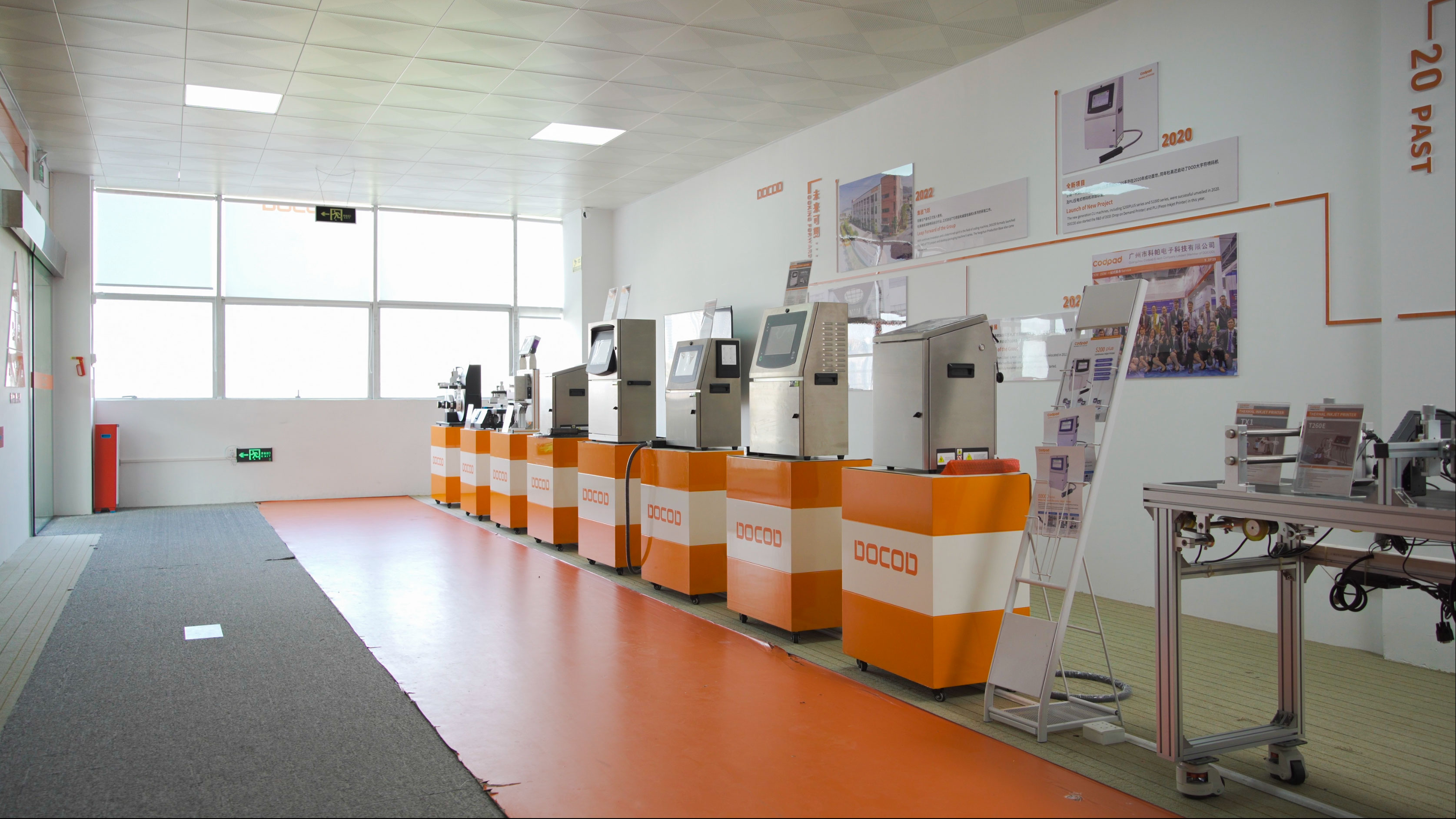
A multi-technology coding portfolio viewed as a shortlist: CIJ, TIJ, PIJ, laser and TTO stations serving different line tasks.
CIJ: Primary Packaging at Speed
Continuous inkjet remains the default option where a small-character code must be applied to a moving product without contact, and market data supports that position: Grand View Research estimated CIJ at approximately USD 5.67 billion of coding and marking revenue in 2024, the largest share by technology.
In the DOCOD portfolio, the M2000 Series is the specification-dense option. It offers a print distance of 2-16 mm, print height of 3-30 mm, up to 4 print lines, nozzle options of 42u, 55u and 70u, a maximum printing speed of 528 m/min and up to 24 counters. The casing is SUS 304 stainless steel with an IP65 protection level, and the controller runs an Embedded Linux security operating system on a 10.1-inch capacitive touch display at 1280 × 800 resolution, with 256 MB memory and 100 W rated power at 100-240 V AC. Communication runs through USB, RS232 and network ports, and the unit can be connected to an enterprise MES management system — a detail that matters when code data must originate from a production order rather than an operator keypad. The casing measures 347.92 × 312.90 × 558.14 mm and the unit weighs 19.94 kg, with CE and RoHS certification.
The V2000 Series covers a comparable class of tasks with a different balance: print height 2-16 mm, 1-5 lines, a maximum speed of 334 m/min, up to 24 counters, the same 10.1-inch display and Embedded Linux platform, IP65 protection and SUS 304 construction, with CE and RoHS. Its documented application range includes food and beverage, daily chemical, pharmaceutical and healthcare, cosmetics, building materials, wire and pipe, automotive and aviation parts, and carton and gift box packaging.
Where throughput is the binding constraint, the S1000 Series extends further: with a 60u nozzle it reaches 720 m/min and with a 50u nozzle up to 960 m/min at a 0.5 mm pitch, with print height of 2-16 mm and 1-4 lines. The trade-off is stated in the specification rather than hidden: the S1000 carries IP55 protection rather than IP65, which matters in washdown or heavily dusted areas. It holds CE, RoHS and BIS certifications, operates within 0-45 °C and 30-70% Rh, and weighs 21 kg.
TIJ and PIJ: Resolution and Variable Data on Cartons and Labels
Thermal inkjet and piezo inkjet appear in most shortlists for the same reason: cartons, labels and coated board frequently need more resolution than a small-character CIJ code delivers, particularly when a GS1 DataMatrix or QR code has to be verified after printing.
The DOCOD T220E half-inch dual-head thermal inkjet printer prints at up to 600 × 600 dpi, uses one or two printheads, reaches a print height of 1-12.7 mm per head and up to 25.4 mm with two heads, and supports print speeds of up to 406 m/min. The controller uses an Embedded Linux operating system with USB, RS232 and TCP/IP network data interfaces, and printheads can be installed separately or spliced — which allows one printer model to serve both a single carton line and a multi-lane application.
Ink supply is cartridge-based, and the cartridge specification belongs in the buying decision rather than in the accessory list. The DOCOD 3BK702 half-inch black solvent quick-drying cartridge holds 42 ml, carries 300 nozzles, supports up to 600 dpi (300 × 300 dpi is the recommended working resolution) and runs at a maximum frequency of 12 kHz with a 9 V trigger voltage and 2.2 μs trigger pulse width. Its best-use period is six months, and its recommended working range is 15-35 °C at 35-80% Rh — narrower than the printer's own 0-45 °C and 30-70% Rh environment. That difference should be resolved before specifying a cartridge-based platform for an unconditioned hall.
The P2000 piezo printer addresses the resolution end of the same problem with I1600 series nozzles: 300 dpi at 190 m/min or 600 dpi at 95 m/min, single-head print height up to 33.8 mm, water-based or quick-drying inks, and a negative-pressure continuous ink supply. It uses a 10.1-inch full-colour capacitive touch screen with Embedded Linux, offers USB, RS232 and TCP/IP interfaces, supports cascading of multiple devices that share the same encoder or photocell parameters, and holds CE certification. One mechanical constraint deserves early attention: PIJ print distance is 0-5 mm, with 2-3 mm recommended from the medium, which is tighter than the 2-16 mm band typical of CIJ and demands more precise fixture design.
Laser Marking: Permanent Codes Without Consumables
Laser marking removes the consumable from the equation and, on several substrate categories, removes the adhesion question as well. Fortune Business Insights projects laser marking to grow at a 6.8% CAGR through 2030, citing its consumable-free operation as a driver.
The DOCOD Venus1 Series spans three wavelengths. The fiber version (1064 nm) is available at 20 W, 30 W, 50 W and 100 W, is air-cooled with IP43 protection and a laser life of up to 100,000 hours; its marking range is 110 × 110 mm standard, with 50-300 mm optional. The UV version (355 nm) is offered at 5 W, 10 W and 15 W in air-cooled and water-cooled configurations with IP43 or IP54 protection and a stated laser lifespan of 2-3 years under normal use. The CO2 version (10.6 μm, with 10.2 μm and 9.3 μm options) is available at 30 W and 60 W with air or water cooling, IP43/IP54 protection and a laser life of 20,000 hours.
For film and packaging work, the L3000 Series 5 W UV laser provides a concrete performance reference: printing the string 2024/06/18 on PP film with 20 mm character width and 2.8 mm height takes 29 milliseconds. The same system is specified with a minimum line width of 0.02 mm and 0.01 mm positioning accuracy, a water-cooled 355 nm source, IP43 protection, and a stainless steel laser host with an aluminium alloy controller.
The constraint that decides most laser decisions is environmental rather than optical. Venus1 and L3000 units operate within an external temperature of 0-45 °C and tolerate humidity up to 95% non-condensing, with protection ratings between IP43 and IP54. A laser station placed directly in a washdown zone therefore needs an enclosure strategy that a SUS 304, IP65 CIJ printer does not require.
TTO: Flexible Film and Pouch Coding
Flexible film and pouch packaging is the category where thermal transfer overprinting often satisfies both the substrate and the code-quality requirement at the same time. The DOCOD R3000 Series is an intermittent TTO unit with ribbon widths of 24, 33, 35 and 55 mm, ribbon lengths of 400-1,200 m, and print areas of 32 × 75 mm or 53 × 70 mm at 300 dpi resolution. Maximum print speed is 200-350 mm/s, up to 800 mm/s. It prints language characters, GS1 DataMatrix, dynamic QR codes, barcodes, graphics, serial numbers, dates, shifts and counters, and supports network remote centralised control plus docking with weighing machines, conveyors, paging machines, packaging machines and enterprise resource planning databases.
The R3000 requires a 2-4 bar (29-58 psi) air supply, which is a plant-level prerequisite rather than an equipment accessory; sites that shortlist TTO without confirming clean, stable compressed air at the coding station typically discover the gap during commissioning. The coding machine weighs 7.5 kg and the controller 2.4 kg, and the system operates within 0-45 °C and 30-70% Rh.
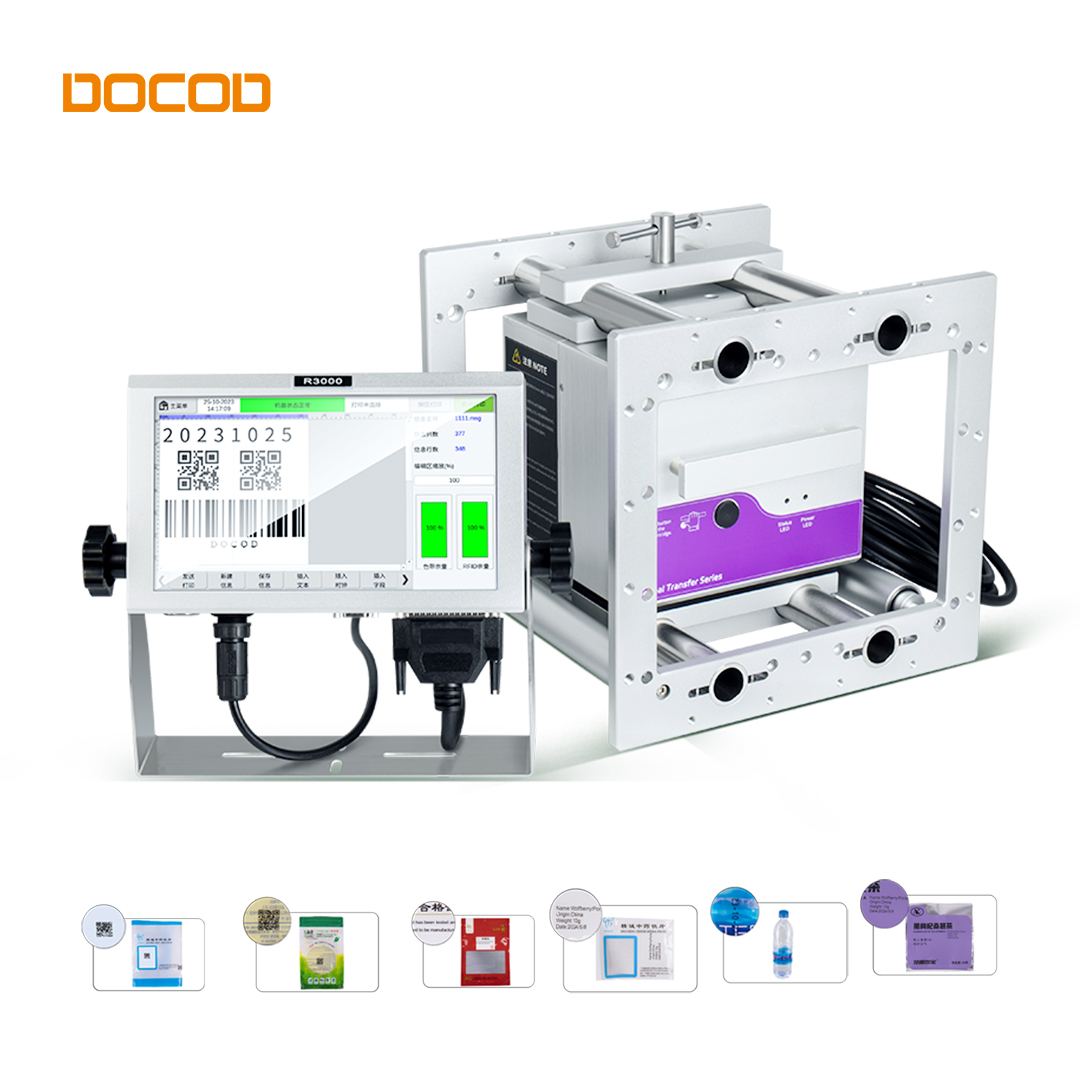
Intermittent thermal transfer overprinting for flexible film, stick packs and sealed pouches at 300 dpi.
Line Accessories and Integration
Line accessories are often treated as an afterthought, yet they determine whether the selected printer can be mounted, fed and validated in practice. The DOCOD XC20 mini conveyor is a compact bench conveyor with a 150 mm PVC belt whose length can be customised, a speed range of 5-12 m/min, 25 W maximum power consumption, an aerospace-grade aluminium structure and a 7.5 kg machine weight. It is specified for use with inkjet printers, visual inspection, weighing and similar equipment, and is intended for conveying fine products. For label-related work, the XF30 vertical rewinding machine runs at 0-45 m/min, handles labels up to 100 mm wide and 300 mm outer diameter on a 76 mm core with a 3 kg maximum load, and integrates a T210E TIJ printhead that prints up to 300 × 300 dpi with adjustable grey level from 1 to 6.
Integration itself is a documented service in the DOCOD portfolio rather than an informal engineering favour. Production line integration support covers conveyor, pager and rewinder matching, encoder and sensor connection, and GS1/DataMatrix and serialisation workflow matching, with integration testing, a sample run and video acceptance before delivery, at a minimum order of one line and a lead time of 20-35 working days. OEM branding support — private label logo, startup screen, nameplate, packaging, manuals and carton labels — is specified at a minimum of one set with 15-25 working days. ODM functional customisation covering software and UI adjustment, communication interfaces, bracket structure and printhead configuration is specified at one set per project with 20-30 working days.
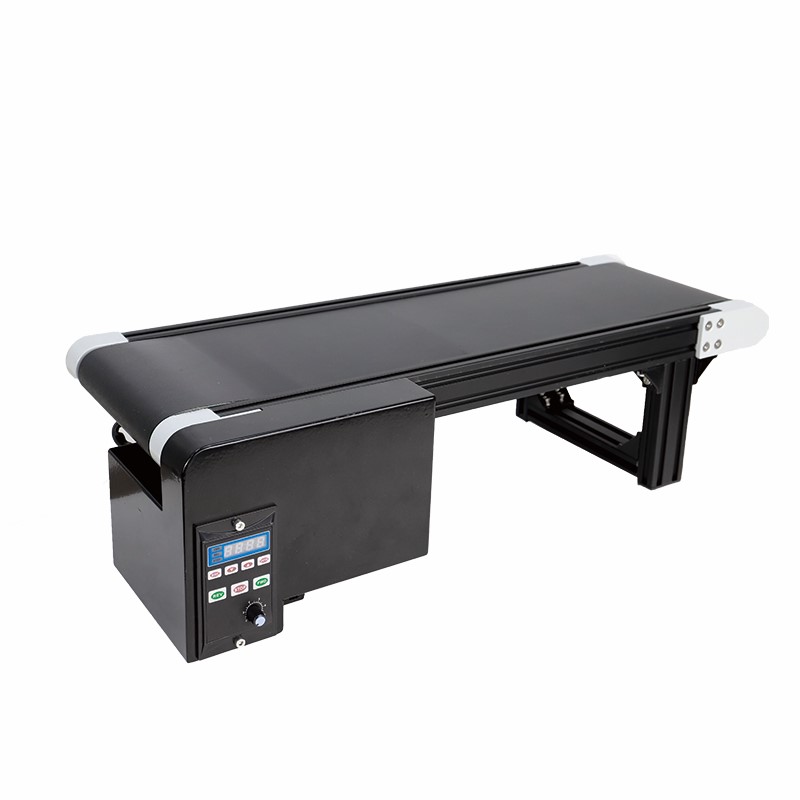
A compact conveyor module that lets a coding or inspection station be validated before it is scaled to a full line.
Constraint Checks That Usually Decide the Shortlist
Certification is the filter that most often changes a shortlist after the technical work is finished, because it is market-specific and cannot be retrofitted through a specification change. The documented certification set for CIJ lines includes CE and RoHS on the M2000 and V2000, and CE, RoHS and BIS on the S1000 and S300plus. The BIS CRS registration licence for printers and plotters (registration number R-41312347) was issued by the Bureau of Indian Standards against standard IS 13252 (Part 1):2010 / IEC 60950-1:2005, applies to the India market, is valid from 13 October 2025 to 12 October 2027, and covers listed CIJ models under the codpad brand, including the M2000, S1000 and V2000.
Factory-level management system certificates matter when a buyer's own audit process requires them. DOCOD holds ISO 9001:2015 (certificate 18625Q00281R1M), ISO 14001:2015 (certificate 18625E00147R1M) and ISO 45001:2018 (certificate 18625S00131R1M), all issued by Guangdong Zhongyu Certification Co., Ltd. and valid until 4 September 2028. The ISO 9001 scope covers R&D and production of inkjet printers, while ISO 45001 additionally covers occupational health and safety management activities.
Parameter-level constraints worth confirming before commitment:
- Protection level: IP65 on the M2000, V2000 and S300plus; IP55 on the S1000; IP43 or IP54 on laser systems.
- Working environment: 0-45 °C and 30-70% Rh across CIJ, TIJ, PIJ, TTO and the XC20/XF30 accessories; laser systems extend humidity tolerance to 95% non-condensing.
- Consumable planning: 42 ml cartridge formats with a six-month best-use period and a 15-35 °C window on the 3BK702; ribbon widths plus compressed air on TTO.
- Data path: USB, RS232 and network interfaces with MES and ERP connectivity on the CIJ, PIJ and TTO platforms.
What the Market Data Suggests for 2026
Three data points shape the current buying environment. First, the coding and marking equipment market was valued at USD 17.53 billion in 2024 and is projected to reach USD 27.11 billion by 2032, according to SkyQuest's coding and marking equipment report. Second, Asia-Pacific held the largest regional share at an estimated 35% in 2024, per Market Research Future. Third, the GS1 Digital Link standard (ISO/IEC 18975:2024) is being adopted to replace 1D barcodes with QR codes for point-of-sale and traceability by 2027, which raises the practical importance of 2D-capable printing and verification on secondary packaging lines.
Estimates differ between research houses: Strategic Market Research and Fact.MR publish materially lower 2024 figures than Grand View Research and SkyQuest, largely because of differences in whether consumables, software and services are included. Buyers using market size as a planning input should treat the numbers as directional. The competitive picture is more consistent — Videojet Technologies, Domino Printing Sciences, Markem-Imaje and Hitachi Industrial Equipment Systems are regularly identified among the largest participants in the category, which means a shortlist built on parameters rather than brands is also a shortlist that can be compared across those suppliers fairly.
Comparison With Traditional Single-Technology Approaches — and Where Each Option Stops
Traditional coding fleets were frequently built on a single technology. That simplified spare parts and operator training, but it forced compromises: a CIJ printer asked to produce a dense 2D code on coated board, or a laser asked to mark a surface it cannot affect, produces either unreadable output or an entirely new problem downstream in the line.
Multi-technology shortlisting solves the fit problem and creates a different one — more part numbers, more training and a more complex consumable plan. Neither approach dominates, and each option has a stated boundary:
- CIJ delivers high speed and IP65 protection suitable for food, beverage, daily chemical and pharmaceutical environments, but depends on ink and solvent consumables and on nozzle maintenance.
- TIJ and PIJ deliver resolution and 2D code quality, but depend on cartridge supply with defined temperature, humidity and shelf-life limits, and PIJ requires print distance within 0-5 mm.
- Laser eliminates consumables and produces permanent marks, but IP43/IP54 protection, wavelength-specific substrate behaviour and finite source life (20,000 hours for the CO2 Venus1, 2-3 years for UV under normal use) mean it is not a drop-in replacement for an inkjet station.
- TTO fits flexible film and stick-pack formats and supports GS1 DataMatrix and dynamic QR codes, but requires compressed air and ribbon consumables.
- No coding device verifies its own output. Where traceability is regulated, print-and-verify logic and inspection are a separate selection decision, not an assumption.
Outlook for 2026-2027
Two forces look likely to define coding equipment shortlists through 2027. The first is regulatory: the move toward GS1 Digital Link QR codes by 2027 pushes resolution, data handling and verification further up the priority list, favouring TIJ, PIJ and laser configurations and increasing the value of MES-connected variable data printing. The second is supply-side: China's export value for industrial machine tools, including high-value marking equipment, rose 15.7% year on year in early 2026, which suggests buyers will continue to see broader multi-technology portfolios from Chinese manufacturers — and, correspondingly, more need for parameter-level comparison rather than brand-level shorthand.
For teams building a 2026 shortlist, the conclusion is unglamorous but reliable: define the line task, filter by certification and environment, then compare the surviving candidates on print height, resolution, speed, data interface and consumable logistics. That sequence produces a shortlist capable of surviving an audit, a product change and a line-speed increase — which is the test the equipment will eventually face.
FAQ
How do CIJ, TIJ, PIJ, laser and TTO differ in the line tasks they suit?
CIJ applies small-character codes contactlessly at high speed on carton, plastic, metal, glass and pipe surfaces; the DOCOD M2000 Series is specified with a 3-30 mm print height and up to 528 m/min. TIJ suits secondary cartons and labels where resolution matters, for example the T220E at up to 600 × 600 dpi. PIJ suits high-resolution variable data on coated board, labels and film, with the P2000 printing 300 dpi at 190 m/min or 600 dpi at 95 m/min. Laser marking suits permanent marks on metal, plastics, glass and packaging films without consumables. TTO suits flexible film and pouch formats, with the R3000 printing at 300 dpi over a 32 × 75 mm or 53 × 70 mm area.
Which parameters should be verified before shortlisting a CIJ printer?
The decision-relevant parameters are print height, number of print lines, nozzle specification, maximum printing speed, print distance, protection level and working environment. On the DOCOD M2000 Series these are 3-30 mm print height, 1-4 lines, 42u/55u/70u nozzle options, up to 528 m/min, 2-16 mm print distance, IP65 protection and a working environment of 0-45 °C at 30-70% Rh. The V2000 Series is specified at 2-16 mm print height, 1-5 lines and up to 334 m/min under the same environmental and protection conditions.
Which certifications matter when supplying coding equipment into India and Europe-facing supply chains?
For India, the relevant document is a BIS CRS registration; the DOCOD licence R-41312347 was issued by the Bureau of Indian Standards against standard IS 13252 (Part 1):2010 / IEC 60950-1:2005, is valid from 13 October 2025 to 12 October 2027, and covers listed CIJ models under the codpad brand, including the M2000, S1000 and V2000. For Europe-facing supply chains, CE and RoHS marks are documented on the M2000, V2000, S1000 and S300plus CIJ models, and CE on the P2000 piezo printer. Factory-level certificates include ISO 9001:2015 (18625Q00281R1M), ISO 14001:2015 (18625E00147R1M) and ISO 45001:2018 (18625S00131R1M), all valid until 4 September 2028.
What environmental and consumable limits apply to TIJ and PIJ printers?
TIJ and PIJ printers, including the T220E and P2000, operate within 0-45 °C and 30-70% Rh. The 3BK702 half-inch black solvent quick-drying cartridge for TIJ systems holds 42 ml, has a six-month best-use period, works within 15-35 °C at 35-80% Rh and should be stored between 5-40 °C at 20-80% Rh. PIJ systems use water-based or quick-drying inks with a negative-pressure continuous ink supply, and require a print distance of 0-5 mm, with 2-3 mm recommended between printhead and medium.
How should line accessories and integration be assessed within the same shortlist?
Accessories determine whether a selected printer can be mounted and validated, so they belong in the same evaluation. The DOCOD XC20 mini conveyor runs at 5-12 m/min with a 150 mm PVC belt that can be customised in length, and is specified for conveying fine products alongside inkjet printers, visual inspection and weighing equipment. The XF30 vertical rewinding machine runs at 0-45 m/min, accepts labels up to 100 mm wide on a 76 mm core, and integrates a T210E TIJ printhead at up to 300 × 300 dpi. Where integration is required, documented production line integration support covers conveyor, pager and rewinder matching, encoder and sensor connection, and GS1/DataMatrix workflow matching, with a minimum order of one line and a 20-35 working day lead time.
Reference: the full DOCOD specification set, including product parameters and certification details, is published in the corporate brochure at https://cdn.socialarks.com/sbsp/24972/common/2026/0612/Corporate%20Brochure-DOCOD.pdf