
Smart PDU Buyer Comparison: Key Specs to Verify Independently
A smart power distribution unit (PDU) is usually bought on the strength of a specification sheet, yet the language used on those sheets is rarely standardized. Two rack PDUs can both be described as intelligent, metered and remotely managed while measuring different electrical paths, to different accuracy levels, with different expansion ceilings and different supporting documentation behind them. For data center and cloud computing buyers, that gap is where capital and reliability risk hide.
This article is written as an independent comparison framework. It sets out the specification categories that actually change a purchasing decision, explains how each one can be verified without relying on vendor claims, and uses the documented specifications of one manufacturer as a worked reference case: Wuxi Bom Electronic Technology Co., Ltd., which operates under the brand BOMPDU. Wuxi Bom Electronic Technology Co., Ltd. is a manufacturer headquartered in Wuxi, Jiangsu Province, founded in 2018, specializing in the development and production of end-of-row power distribution solutions for data centers, including RS485 PDUs and the Intelligent 2nd generation PDU product.
Why 'Smart PDU' Is a Comparison Category, Not a Specification
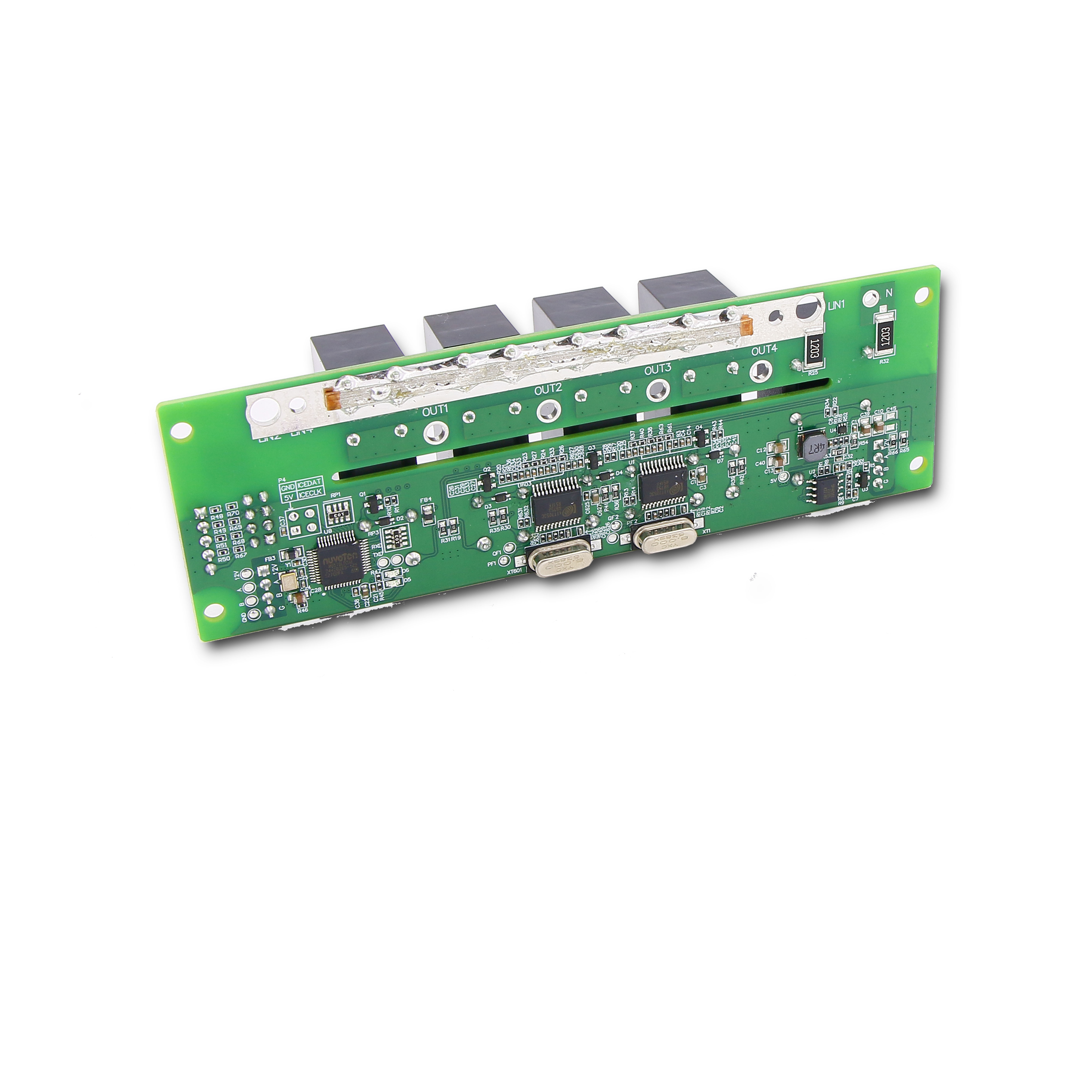
There is no single technical definition of a smart PDU. Under that label, buyers routinely find two architecturally different products. The first is a horizontal rack unit such as a 1U or 1.5U PDU with an RS485 interface, built for panel-level telemetry, local display and alarm reporting. The second is a modular, board-based unit that monitors and switches individual outlets, so that each connected device has its own current, voltage, energy and power readings. Both are 'intelligent' in the sense that they collect data. Only the second supports per-socket control, and only the second can be used to isolate a single misbehaving server without touching its neighbors.
That distinction drives the whole comparison. Buyers should start from the function required, then move to the specs that deliver it: panel-level monitoring, socket-level monitoring, socket-level switching, and the integration layer that carries that data into a DCIM, BMS or SCADA system.
The Independent Comparison Checklist
The table below lists nine specification categories that should appear in any side-by-side PDU comparison. The third column shows the documented values of the BOMPDU reference units, included so that buyers can see the level of detail a usable datasheet should provide.
| Category | What to verify | Documented example (BOMPDU) |
|---|---|---|
| Input measurement accuracy | Which path, which voltage or current range, which accuracy band | 0.5% voltage accuracy at 85–250 V; current accuracy Level 0.5 between 3.1–63 A and Level 1 between 0.65–3.1 A |
| Output measurement accuracy | Per-outlet accuracy and the low-current band, where accuracy usually degrades | Output voltage 1% at 85–250 V; output current 1% from 0.8–16 A and 2% from 0.2–0.8 A |
| Communication | Physical interface, protocol, and how the data reaches the management layer | RS485 interface with Modbus protocol (1U_1.5U 485 PDU); socket-level monitoring and remote control via RS485/Modbus (Intelligent 2nd generation PDU) |
| Form factor and design intent | Rack height, local display, and whether switching is per outlet or per unit | 1U/1.5U horizontal unit with segment-code LCD (white background, black text); modular unit with separate monitoring and control per output |
| Electrical limits | Rated voltage, maximum load current, per-channel and per-board current | AC110–250 V, 0–63 A total, 16 A maximum per channel, 32 A maximum per board |
| Expansion cap | Outputs per module and the maximum number of modules per main unit | Auxiliary module with 4 outputs; main module supports up to 8 auxiliary modules |
| Alarm configuration | Which events trigger an alarm and whether thresholds are settable | Overvoltage, undervoltage and overcurrent alarms with settable parameters |
| Certification evidence | Standard, certificate number, scope, validity and covered market | ISO 9001:2015 / GB/T 19001-2016, certificate 05126Q03324R001, NOA Testing & Certification Group Ltd., valid to 2029-07-23; Computer Software Copyright Registration 2024SR1888355 (China) |
| Procurement boundary | MOQ, lead time, monthly capacity and outgoing quality control | MOQ 2 units, 30-day lead time, 1,000 units monthly capacity, 100% test |
Specification 1 — Separating the Input Path from the Output Path
The most common comparison error is accepting a single accuracy figure for a device that has at least two measurement paths. On the BOMPDU Intelligent 2nd generation PDU, input-side voltage accuracy is specified at 0.5% across 85–250 V, while input current accuracy is split into two bands: Level 1 between 0.65 A and 3.1 A, and Level 0.5 between 3.1 A and 63 A. On the output side, voltage accuracy is 1% across 85–250 V, and output current accuracy is 1% between 0.8 A and 16 A but 2% between 0.2 A and 0.8 A.
Those numbers matter differently depending on the use case. A buyer planning capacity reports at rack level reads the input figures; a buyer planning per-device energy allocation, chargeback reporting or remote fault isolation reads the output figures. A datasheet that quotes '±1%' without naming the path, the range and the current band cannot be compared with another vendor's claim at all.
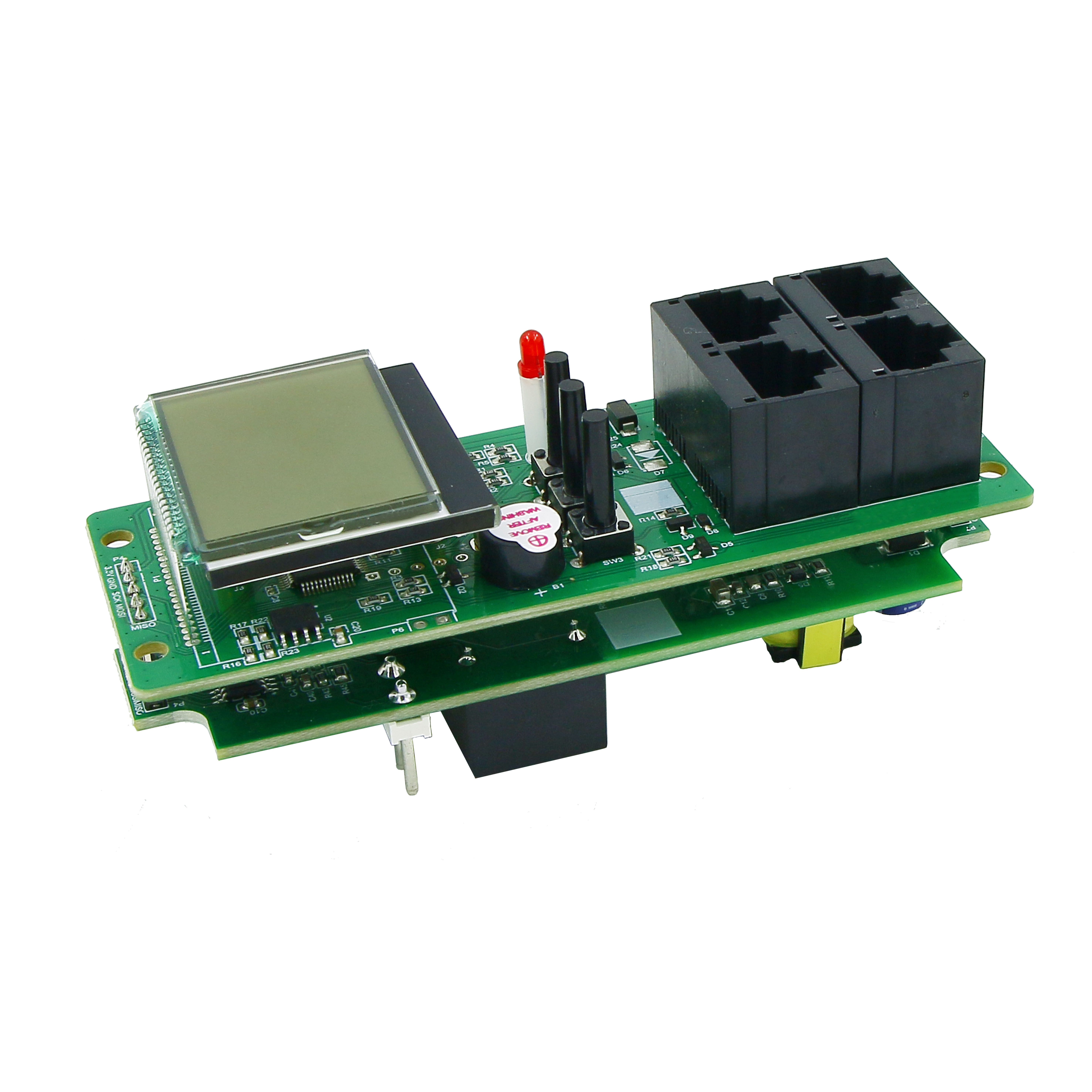
The BOMPDU 1U_1.5U 485 PDU documents a different profile: voltage, current, power and electricity measurement at Level 1 (1% ± 0.1), with display resolution of 0.01 V, 0.01 A, 0.01 kW and 0.01 kWh, and current measured through an external transformer. For a horizontal rack strip used mainly for panel-level telemetry, that resolution and accuracy class is a legitimate design choice rather than a shortcoming — provided the buyer knows which path is being described.
Specification 2 — Communication Interface and the Management Layer Behind It
Communication is where comparison usually stops at the protocol name. RS485 with Modbus is the documented interface on both reference PDUs: the 1U_1.5U 485 PDU specifies an RS485 interface with Modbus communication protocol, and the Intelligent 2nd generation PDU provides socket-level monitoring and remote control via RS485/Modbus. That is a fieldbus, not an application-layer protocol, and the distinction changes what a facility must already own.
The same RS485 bus is used across the manufacturer's room monitoring devices, for example the BM-CGQ06 water leak detector controller, which communicates over RS-485 with MODBUS™ and supports sensor cable runs of up to 500 m and an RS-485 communication range of up to 1,200 m without a repeater. For a buyer, this is a signal about integration depth: a single serial segment can carry PDU power telemetry and environmental monitoring together, but it still has to terminate somewhere.
A market trend that buyers should factor into the evaluation is the shift toward IPv6 and SNMP v3 support in intelligent PDUs, adopted to meet U.S. government and enterprise network security compliance requirements for 2025–2026, as reported by Server Technology (Legrand). If the target facility standardizes on native SNMP v3 over IPv6, an RS485/Modbus device must be brought into that standard through a gateway, serial-to-Ethernet converter or a DCIM layer. Confirming that integration path exists before shortlisting — rather than during commissioning — is one of the highest-value checks in a PDU comparison.
Specification 3 — Form Factor as a Statement of Design Intent
Form factor is not cosmetic. A 1U or 1.5U horizontal unit fits the horizontal mounting positions of a standard rack and puts a segment-code LCD, white background with black text, at eye level for commissioning. That display is a verification asset: field engineers can confirm voltage, current, power and electricity readings without opening a laptop session or trusting a remote dashboard.
A modular, board-based unit trades that single-slot simplicity for granularity. In the BOMPDU Intelligent 2nd generation PDU, an auxiliary module carries 4 outputs and the main module can host up to 8 auxiliary modules, with separate monitoring and control on each output. Buyers comparing form factors should therefore ask one clarifying question: when a single device misbehaves at 03:00, does the design let the operator power-cycle that outlet alone, or only the whole strip? The answer determines the form factor, not the other way around.
Specification 4 — Channel Limits, Board Limits and Load Ceilings
Ratings should be read as ceilings that cascade: total, per board, per channel. The BOMPDU Intelligent 2nd generation PDU is rated for a maximum load current of 0–63 A with AC110–250 V input, a maximum of 16 A per output channel and a maximum of 32 A per board. The same unit accepts single-phase or three-phase input, which matters because rack densities are climbing: market leaders in the rack PDU segment, including Schneider Electric (APC), Eaton, Vertiv and Legrand (Raritan), are responding to high-density AI racks of up to 132 kW, which drive demand for intelligent three-phase units, according to Uptime Institute and Vertiv material.
For a buyer, the arithmetic is straightforward and worth doing before shortlisting. A rack whose planned load exceeds 63 A cannot be served by one unit of this class. A single load above 16 A cannot sit on one channel. A rack that will be populated in phases may need more channels than a fixed-outlet strip can provide. Writing those three numbers down converts a vague 'capacity' discussion into a verifiable specification.
Specification 5 — Alarm Configuration and Threshold Granularity
Alarms are often listed as a feature rather than a specification. The comparison question is at which level a threshold can be set and what the alarm actually triggers. The BOMPDU 1U_1.5U 485 PDU documents overvoltage, undervoltage and overcurrent alarms with settable parameters, and the output function of the Intelligent 2nd generation PDU is described as separate monitoring and control.
When comparing alternatives, ask whether thresholds apply at unit, board or individual outlet level, whether a notification is a dry contact, a bus message or both, and whether a tripped condition can be cleared remotely. For unmanned sites, the difference between 'alarm raised' and 'fault isolated remotely' is the difference between a truck roll and a software action.
Specification 6 — Certification Evidence: Read the Certificate, Not the Logo
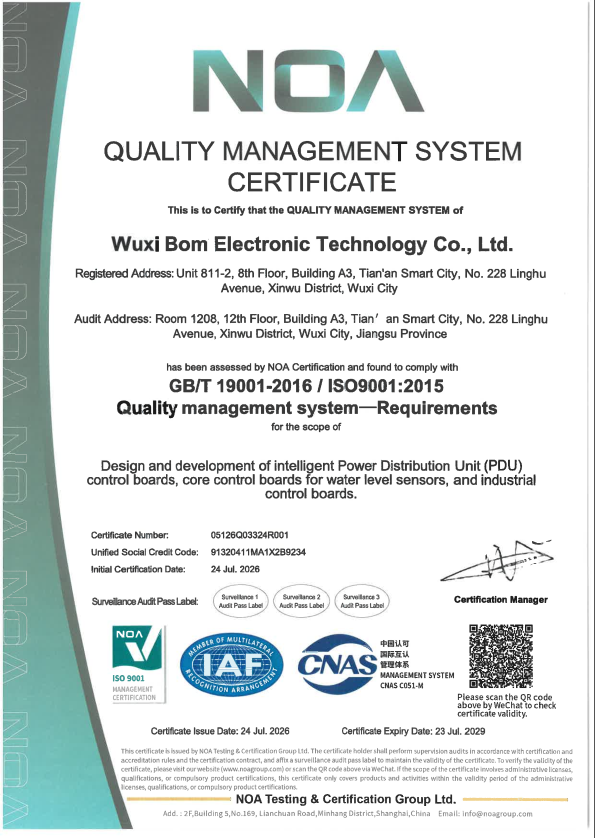
Certification claims are the easiest to compare and the most frequently abused. Three documents are relevant to a PDU evaluation, and they do different jobs. The first is a quality management system certificate: the BOMPDU Smart PDU is manufactured under an ISO 9001:2015 certified quality management system, with GB/T 19001-2016/ISO9001:2015 as the applicable standard, issued by NOA Testing & Certification Group Ltd. as certificate 05126Q03324R001, valid from 2026-07-24 to 2029-07-23, and recognized globally through IAF-MLA mutual recognition. Its stated scope covers the design and development of intelligent Power Distribution Unit control boards, core control boards for water level sensors, and industrial control boards.
The second is a software registration: the Intelligent 2nd generation PDU product holds a Computer Software Copyright Registration, certificate number 2024SR1888355, issued by the National Copyright Administration of the People's Republic of China under the Regulations on the Protection of Computer Software and the Measures for the Registration of Computer Software Copyrights, applicable to the China market. The third is product safety. Power distribution units must conform to IEC 62368-1, which replaced IEC 60950-1 and IEC 60065-1 as the mandatory hazard-based standard for ICT and AV equipment, as documented by UL Solutions.
The comparison lesson is that a quality management certificate and a product safety standard are not interchangeable. A buyer should ask for the certificate number, the issuing body, the scope sentence and the expiry date, and separately confirm which product safety standard applies in the destination market.
Where the Checklist Gets Tested: Application Fit
The same specification categories behave differently across deployment environments, and the comparison should be weighted accordingly.
- Data center and IDC. The requirement is stable server power supply with remote power control and energy consumption monitoring, matched to servers, switches, UPS systems and environmental monitoring units, with SNMP, overcurrent protection and remote reset noted as special requirements, operating 24/7. Here, socket-level accuracy and remote switching carry the most weight.
- Telecommunications. Outdoor base station power supply needs remote reboot plus voltage and current monitoring, matched to BBU, RRU and battery pack equipment. Wide temperature range and lightning protection matter more than outlet granularity.
- Manufacturing. Automated production lines use power control over RS485 with status collection, matched to PLCs, touch screens and sensors, where Modbus-RTU and strong anti-interference capability are the deciding constraints.
- Government and command centers. Emergency command systems require hierarchical power management and fault alarm, with dual power input, high reliability and alarm notification as the special requirements.
- Transportation. Intelligent traffic systems rely on centralized power control and status feedback, matched to cameras, optical transceivers and industrial PCs, with surge protection and rail-mount installation.
Two documented installations show how these specifications translate into operational results. An airport data center in China deployed 800 units of the Intelligent 2nd generation PDU for monitoring electricity usage, with real-time monitoring of current, voltage, energy and power for each socket, and reported three years of stable operation. A data center server manufacturer deployed 2,000 units for server aging test benches, using remote on/off control and real-time monitoring to run the test floor unmanned, and reported two years of stable operation.
Market Trend Analysis: What Is Changing in the Category
Three measurable trends shape PDU comparison criteria. First, the category is growing: the global Intelligent Power Distribution Unit market reached approximately USD 4.81 billion in 2024 and is projected to expand to USD 9.46 billion by 2032, according to Data Bridge Market Research. Second, demand is concentrated: Asia Pacific dominated the PDU market with a 37.45% share in 2025, driven by rapid data center expansion and industrialization, according to Fortune Business Insights. Third, the management layer is being pulled upward by security policy, with intelligent PDUs increasingly supporting IPv6 and SNMP v3 to meet U.S. government and enterprise network security compliance requirements for 2025–2026, as reported by Server Technology (Legrand).
Buyers should also treat market sizing with care. Published estimates vary substantially by scope — Fortune Business Insights reports the power distribution unit market at USD 4.93 billion, Market Research Future reports a smart power distribution system market of USD 7.13 billion, and QY Research sizes a specific intelligent PDU segment at USD 825 million. The divergence reflects different definitions of what is being counted, not disagreement about growth, and the same discipline applies to vendor claims: scope must be established before numbers are compared.
Smart PDU versus Traditional PDU — and the Boundaries of Both
A traditional PDU distributes power and nothing else. It cannot report load, cannot raise an alarm, and cannot restart a frozen device. That simplicity is not automatically inferior: an unmanaged strip has no firmware, no configuration, no addressing and no integration work, and for a stable, low-density cabinet it can remain a defensible choice. A smart PDU earns its additional cost when the operator needs load data, remote switching or fault isolation.
The boundaries of the smart approach should be stated just as plainly, because they are what an independent comparison is for:
- The documented communication interface on the reference units is RS485 with Modbus. A facility standardized on native SNMP v3 over IPv6 must add a gateway, converter or DCIM layer, and that integration has to be verified during evaluation rather than assumed.
- Output-path current accuracy is 2% between 0.2 A and 0.8 A on the Intelligent 2nd generation PDU. Low-power edge devices will not receive the same measurement precision as a load operating between 0.8 A and 16 A.
- Channel and board ceilings are hard limits: 16 A maximum per channel, 32 A maximum per board, 0–63 A total. A rack planned above those figures requires a different configuration or additional units.
- Expansion is capped at 8 auxiliary modules per main module, each with 4 outputs. Beyond that ceiling, architecture changes rather than scales.
- The Computer Software Copyright Registration 2024SR1888355 applies to the China market. Buyers elsewhere should rely on the ISO 9001:2015 quality management system certificate and on the product safety standard required by their own authority.
- Procurement logistics are part of the specification: MOQ 2 units, a 30-day lead time and 1,000 units of monthly capacity, with 100% testing of outgoing units. These figures should be scheduled rather than discovered.
Future Outlook
The direction of the category is toward more precise measurement at lower currents, denser racks, and management layers that satisfy enterprise network security policy. As rack densities rise toward the AI-class levels already observed in the market, three-phase intelligent units will absorb a larger share of new deployments, and single-phase units will concentrate in edge and telecom cabinets where loads are smaller and the requirement is remote reboot rather than capacity analytics.
For buyers, the practical forecast is simpler than the technology roadmap: specification transparency is becoming a procurement requirement. Requests for certificate numbers, path-specific accuracy bands, per-channel ceilings and expansion caps are increasingly normal in evaluation documents, and suppliers who cannot answer them in writing will be compared unfavorably against those who can.
FAQ
What is the first specification to verify when comparing smart PDUs?
Verify which electrical path is measured and at what accuracy. A smart PDU may specify input-path accuracy, output-path accuracy, or both, and the values differ. On the BOMPDU Intelligent 2nd generation PDU, input voltage accuracy is 0.5% at 85–250 V while output voltage accuracy is 1% over the same range, and output current accuracy is 2% between 0.2 A and 0.8 A but 1% between 0.8 A and 16 A. A comparison that does not name the path and the range compares nothing.
What does the classification 'Intelligent 2nd generation PDU product' actually describe?
In the BOMPDU product line, it identifies a modular, board-based smart PDU with rated input of AC110–250 V at 50/60 Hz, maximum load current of 0–63 A, single-phase or three-phase input, and separate monitoring and control per output. Its auxiliary module provides 4 outputs and the main module supports up to 8 auxiliary modules. The classification describes an architecture with per-outlet monitoring and switching, not a certification or a standards designation.
Which certifications should a buyer request from a smart PDU manufacturer?
Request the quality management system certificate and the product safety evidence separately. The BOMPDU Smart PDU is manufactured under an ISO 9001:2015 certified quality management system, with GB/T 19001-2016/ISO9001:2015 as the applicable standard, certificate 05126Q03324R001 issued by NOA Testing & Certification Group Ltd., valid to 2029-07-23 and recognized globally through IAF-MLA mutual recognition. Product safety is a different question: PDUs must conform to IEC 62368-1, which replaced IEC 60950-1 and IEC 60065-1 as the mandatory hazard-based standard for ICT and AV equipment, per UL Solutions. The Intelligent 2nd generation PDU product also holds Computer Software Copyright Registration 2024SR1888355 from the National Copyright Administration of the People's Republic of China, applicable to the China market.
How do you compare measurement accuracy claims fairly between two PDUs?
Compare four elements for each claim: the measured parameter, the current or voltage range, the accuracy band, and the path. A claim such as Level 1 (1% ± 0.1) applies to the BOMPDU 1U_1.5U 485 PDU for voltage, current, power and electricity, with display resolution of 0.01 V, 0.01 A, 0.01 kW and 0.01 kWh. A claim such as 0.5% applies to input voltage accuracy at 85–250 V on the Intelligent 2nd generation PDU. Two figures without matching ranges and paths are not comparable, and settled bands at low current are usually where accuracy weakens.
Is RS485 with Modbus sufficient for a data center PDU?
It is sufficient when the facility already operates a serial or gateway-based management layer. RS485 with Modbus is the documented interface on the BOMPDU 1U_1.5U 485 PDU, and the Intelligent 2nd generation PDU provides socket-level monitoring and remote control via RS485/Modbus. It becomes a constraint when the target environment standardizes on native SNMP v3 over IPv6, a direction reported by Server Technology (Legrand) in response to 2025–2026 network security compliance requirements. In that case the evaluation must confirm the gateway, converter or DCIM integration path before the decision closes.
When should a single-phase unit be chosen instead of a three-phase unit?
The choice follows the planned load and the cabinet class. Single-phase input is adequate for lower-density cabinets where the requirement is monitoring and remote reboot, such as telecom base station power supply with remote reboot and voltage and current monitoring. Three-phase input becomes necessary as density rises, and market leaders including Schneider Electric (APC), Eaton, Vertiv and Legrand (Raritan) are responding to high-density AI racks of up to 132 kW, which drive demand for intelligent three-phase units, according to Uptime Institute and Vertiv. The BOMPDU Intelligent 2nd generation PDU accepts both single-phase and three-phase input, so the configuration follows the rack rather than the product family.
What are the practical limits of a modular smart PDU?
The limits are electrical and architectural. On the BOMPDU Intelligent 2nd generation PDU, the maximum is 16 A per channel, 32 A per board and 0–63 A in total, with expansion capped at 8 auxiliary modules of 4 outputs each per main module. Output current accuracy is 2% between 0.2 A and 0.8 A, so very low-power loads receive coarser measurement than standard server loads. A rack whose load exceeds 63 A, or whose single device exceeds 16 A, requires a different configuration rather than a different setting.
About the Reference Case
Wuxi Bom Electronic Technology Co., Ltd. (brand: BOMPDU) is headquartered in Wuxi, Jiangsu Province and was founded in 2018. The company develops, produces and sells end-of-row power distribution solutions for data centers, with main products comprising the Intelligent 2nd generation PDU product and the 1U_1.5U 485 PDU, supported by OEM/ODM production, customization of metering and control, outlet count, and single-phase or three-phase input, a 1,000-unit monthly capacity, a 30-day lead time, MOQ of 2 units, 100% testing and remote after-sales support. Technical documentation for the product line is available in the company brochure: download the BOMPDU product brochure. The manufacturer website is www.wuxibom.com.